Leviticus 21:9

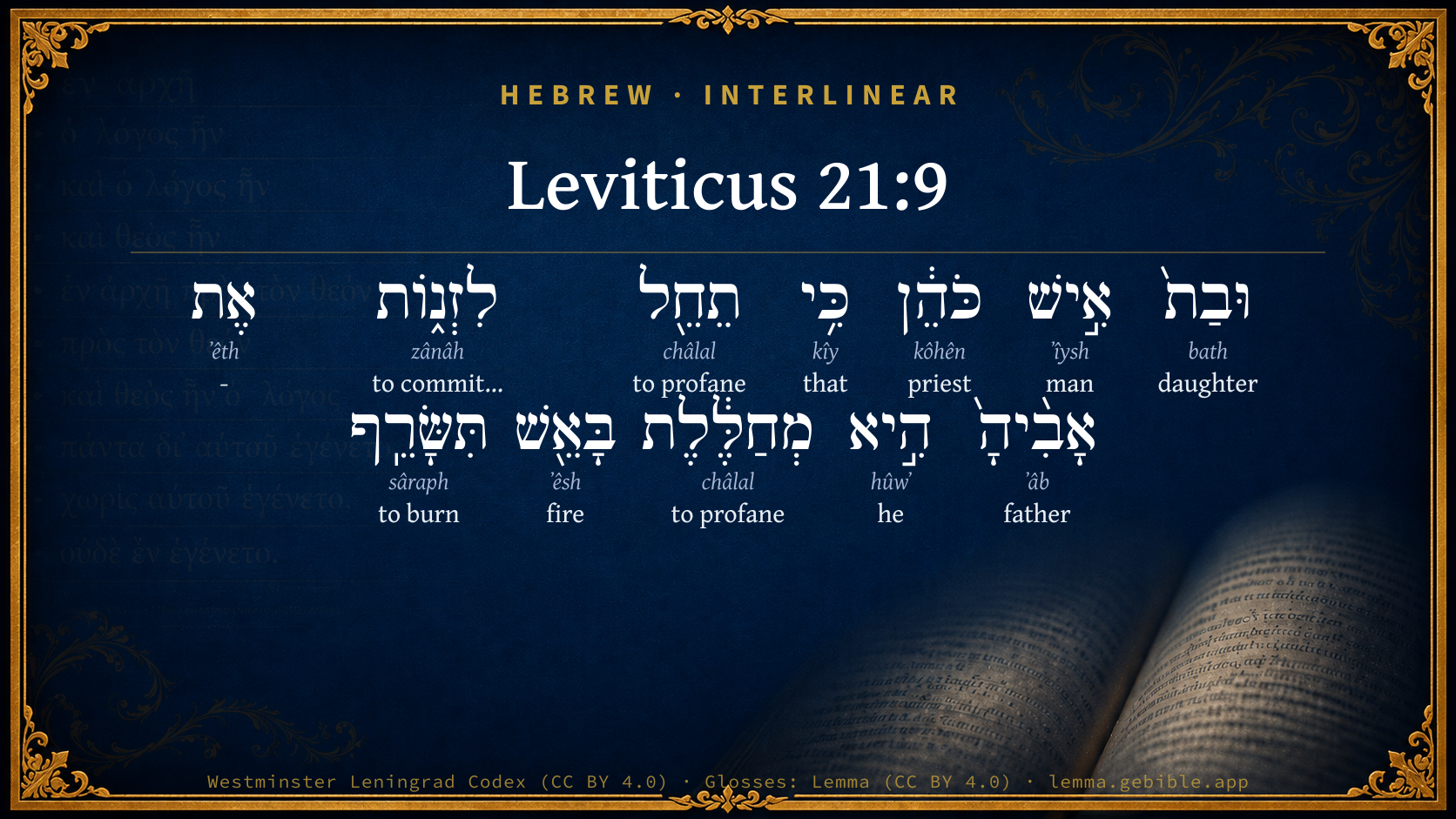
Hebrew (Westminster Leningrad Codex) Leviticus 21:9 appears in the Hebrew Old Testament. The text above is from the Westminster Leningrad Codex. Each word links to its Strong’s number, a concise gloss, and parsing drawn from the Open Scriptures Hebrew Bible morphology. Click any word for its full Brown-Driver-Briggs (BDB) entry.
Download image
Cite this verse

Leviticus 21:9 (World English Bible). Public Domain. Lemma interlinear Bible study tool, https://lemma.gebible.app/v/leviticus/21/9.

Show BibTeX & RIS
BibTeX
RIS
English Translation
"'The daughter of any priest, if she profanes herself by playing the prostitute, she profanes her father: she shall be burned with fire.
World English Bible · Public Domain
Download a study sheet

One document with this verse’s original text, its word-by-word gloss line, the meaning frame, cross-references with their text, attributed commentary, and full source and license credits — printable, and it pastes into notes with its structure intact.

This verse Autodidact and up

Study sheet (.html) Plain text (.txt)

A passage Seminary Student

Up to 50 verses in one chapter. A passage sheet keeps up to 6 commentary sources and 12 cross-references per verse, in the order this page ranks them, and says so on the sheet whenever that leaves anything out. Ask for a single verse and you get the Autodidact verse sheet above.

Everything on this page stays free to read, with no account — the sheet is a download of what is already on screen, not access to it.

Want to remove ads? Support Godless Engineer
Compare translations 3

The same verse in 3 English versions, stacked beneath the original-language interlinear above. Click any original word for its lexicon entry.

Each is an independent rendering of the whole verse — the interlinear is not word-aligned to these translations.

Highlighted words mark where these versions differ — a whole-verse word diff, not a word-by-word alignment.

  • World English Bible Public Domain
    "'The daughter of any priest, if she profanes herself by playing the prostitute, she profanes her father: she shall be burned with fire.
  • King James Version Public Domain
    And the daughter of any priest, if she profane herself by playing the whore, she profaneth her father: she shall be burnt with fire.
  • unfoldingWord Literal Text CC BY-SA 4.0
    And a daughter of a man, a priest, when she is profaned by prostituting—she is profaning her father. She must be burned with fire.

unfoldingWord Literal Text — © unfoldingWord, licensed CC BY-SA 4.0. Word-aligned USFM3 via Door43 (git.door43.org/unfoldingWord/en_ult).

Versions to compare (up to 4)

3 of 4 selected

Show all 18 translations

Every available English version of this verse, each an independent rendering of the whole verse.

  • World English Bible Public Domain
    "'The daughter of any priest, if she profanes herself by playing the prostitute, she profanes her father: she shall be burned with fire.
  • Berean Standard Bible Public Domain
    If a priest’s daughter defiles herself by prostituting herself, she profanes her father; she must be burned in the fire.
  • Majority Standard Bible Public Domain
    If a priest’s daughter defiles herself by prostituting herself, she profanes her father; she must be burned in the fire.
  • King James Version Public Domain
    And the daughter of any priest, if she profane herself by playing the whore, she profaneth her father: she shall be burnt with fire.
  • American Standard Version (1901) Public Domain
    And the daughter of any priest, if she profane herself by playing the harlot, she profaneth her father: she shall be burnt with fire.
  • Revised Version (1885) Public Domain
    And the daughter of any priest, if she profane herself by playing the harlot, she profaneth her father: she shall be burnt with fire.
  • Geneva Bible (1599) Public Domain
    If a Priestes daughter fall to play the whore, she polluteth her father: therefore shall she be burnt with fire.
  • Douay-Rheims (1899) Public Domain
    If the daughter of a priest be taken in whoredom, and dishonour the name of her father, she shall be burnt with fire.
  • Young's Literal Translation Public Domain
    `And a daughter of any priest when she polluteth herself by going a-whoring -- her father she is polluting; with fire she is burnt.
  • Literal Standard Version CC BY-SA 4.0
    And when a daughter of any priest defiles herself by going whoring—she is defiling her father; she is burned with fire.
  • Unlocked Literal Bible CC BY-SA 4.0
    Any daughter of any priest who defiles herself by becoming a prostitute disgraces her father. She must be burned.
  • unfoldingWord Literal Text CC BY-SA 4.0
    And a daughter of a man, a priest, when she is profaned by prostituting—she is profaning her father. She must be burned with fire.
  • Darby Bible Public Domain
    And the daughter of any priest, if she profane herself by playing the whore, she profaneth her father: she shall be burned with fire.
  • World Messianic Bible Public Domain
    “‘The daughter of any priest, if she profanes herself by playing the prostitute, she profanes her father. She shall be burned with fire.
  • Webster's Bible Public Domain
    And the daughter of any priest, if she shall profane herself by lewdness, she profaneth her father: she shall be burnt with fire.
  • Free Bible Version CC BY-SA 4.0
    A priest's daughter who makes herself unclean through prostitution makes her father unclean. She must be executed by burning.
  • Bible in Basic English Public Domain
    And if the daughter of a priest makes herself common and by her loose behaviour puts shame on her father, let her be burned with fire.
  • JPS Tanakh (1917) Public Domain
    And the daughter of any priest, if she profane herself by playing the harlot, she profaneth her father: she shall be burnt with fire.

Literal Standard Version (2020), Covenant Press — licensed CC BY-SA 4.0. Text via the HelloAO Bible API (eBible.org). Unlocked Literal Bible (unfoldingWord) — licensed CC BY-SA 4.0. Text via the HelloAO Bible API (eBible.org). unfoldingWord Literal Text — © unfoldingWord, licensed CC BY-SA 4.0. Word-aligned USFM3 via Door43 (git.door43.org/unfoldingWord/en_ult). Free Bible Version, Dr. Jonathan Gallagher — licensed CC BY-SA 4.0. Text via the HelloAO Bible API (eBible.org).

Word by word

More ways to search: Search by grammar → Find every occurrence → Compare this word →

Practice this passage: Drill this verse → Learn its vocabulary →

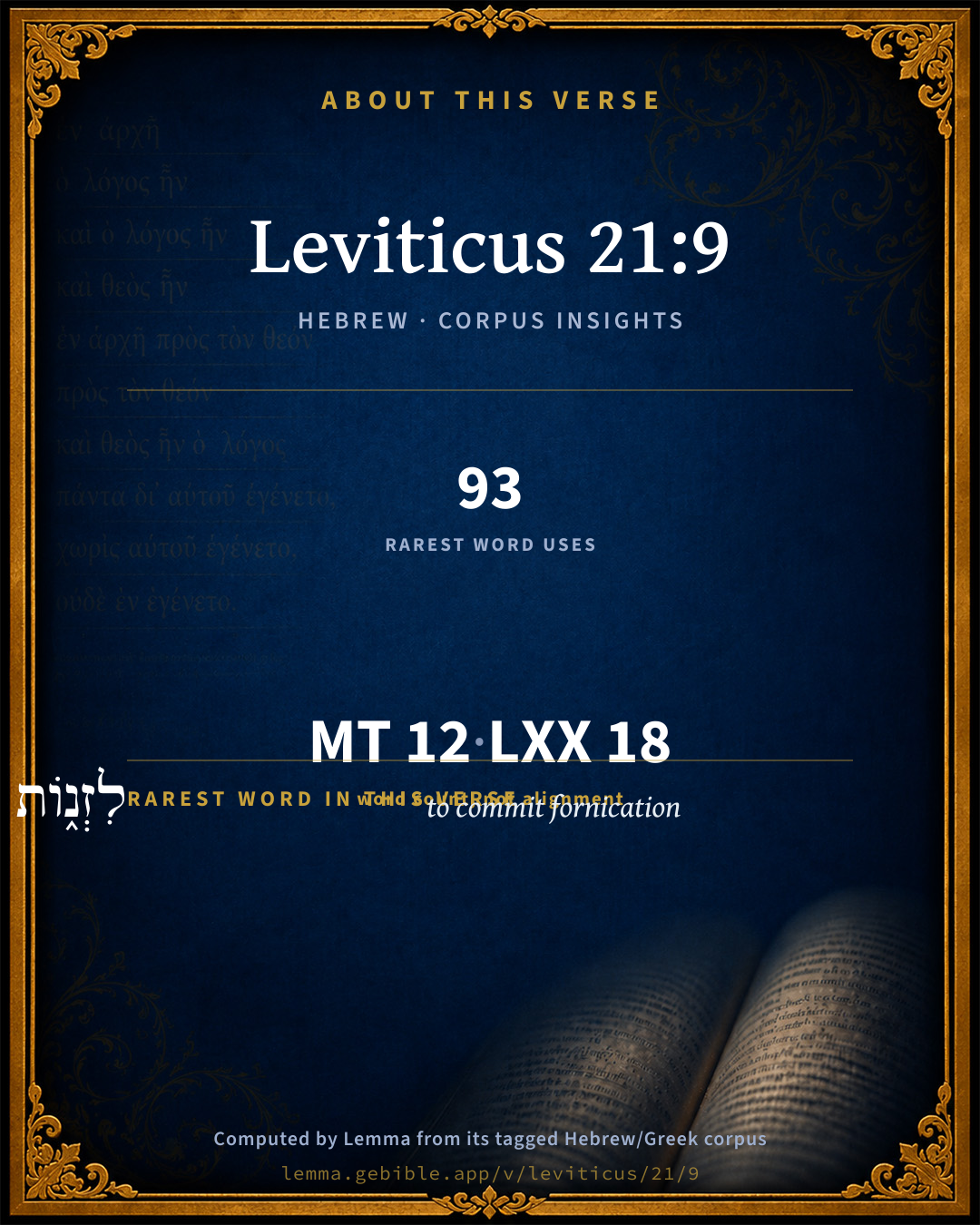
לִזְנ֑וֹת
zânâh
H2181
“to commit fornication”
Preposition + Verb, Qal, Infinitive Construct
Part of Speech
Preposition + Verb
Stem
Qal
Form
Infinitive Construct
Full BDB Definition

Origin: a primitive root [highly-fed and therefore wanton]

TWOT: 563

to commit fornication, be a harlot, play the harlot - (Qal) - to be a harlot, act as a harlot, commit fornication - to commit adultery - to be a cult prostitute - to be unfaithful (to God) (figuratively) - (Pual) to play the harlot - (Hiphil) - to cause to commit adultery - to force into prostitution - to commit fornication
  1. וּבַת֙ bath H1323 “and · daughter of” Conjunction + Noun, Common, Feminine, Singular, Construct
  2. אִ֣ישׁ ʼîysh H376 “man of” Noun, Common, Masculine, Singular, Construct
  3. כֹּהֵ֔ן kôhên H3548 “priest” Noun, Common, Masculine, Singular, Absolute
  4. כִּ֥י kîy H3588 “that” Conjunction
  5. תֵחֵ֖ל châlal H2490 “to profane” Verb, Niphal, Imperfect, 3rd Person, Feminine, Singular
  6. אֶת ʼêth H853 “-” Particle, Direct Object
  7. אָבִ֨יהָ֙ ʼâb H1 “father · her” Noun, Common, Masculine, Singular, Construct + Suffix, Personal, 3rd Person, Feminine, Singular
  8. הִ֣יא hûwʼ H1931 “he” Pronoun, Personal, 3rd Person, Feminine, Singular
  9. מְחַלֶּ֔לֶת châlal H2490 “profaning” Verb, Piel, Participle Active, Feminine, Singular, Absolute
  10. בָּאֵ֖שׁ ʼêsh H784 “in/at the · fire” Preposition, Determined + Noun, Common, Both, Singular, Absolute
  11. תִּשָּׂרֵֽף sâraph H8313 “to burn” Verb, Niphal, Imperfect, 3rd Person, Feminine, Singular

About this verse

These counts appear in no published source. They are computed here, from the morphology-tagged text and Lemma’s own curated glosses. What Lemma adds →

12
words
11
distinct lemmas
Pentateuch
section

Grammatical profile

  • 4 verbs
  • 5 nouns
  • 1 pronoun
  • 1 conjunction
  • 1 particle

Verb forms

  • תֵחֵ֖ל Niphal · Imperfect
  • לִזְנ֑וֹת Qal · Infinitive Construct
  • מְחַלֶּ֔לֶת Piel · Participle Active
  • תִּשָּׂרֵֽף Niphal · Imperfect

Repetition

A word recurs within this verse — often emphatic in Hebrew:

  • תֵחֵ֖ל to profane H2490 ×2

Hebrew & Septuagint length

In English translation the verse runs 23 words from the Hebrew and 27 from the Septuagint (LXX English) — closely comparable.

A rough comparison of the two English renderings, which tokenize alike — not a word-level alignment.

Word counts can differ between the Hebrew and the Greek without any difference in meaning — e.g. the Hebrew direct-object marker אֵת has no separate Greek word, and Greek often adds the article ὁ.

In the original languages it is 12 Hebrew tokens and 18 Greek tokens — but the two are counted differently (Hebrew bundles its prefixes and suffixes into one token; the Greek is in lemma form), so that isn’t a like-for-like length.

Cross-references

14

Topical passages linked to Leviticus 21:9 in the Treasury of Scripture Knowledge — connected by theme and wording, ordered by reader-vote popularity; previews shown in the World English Bible.

  • Genesis 38:24 It happened about three months later, that it was told Judah, saying, "Tamar, your daughter-in-law, has played the prostitute; and moreover, behold, she is with child by prostitution." Judah said, "Bring her forth, and let her be burnt."
  • Leviticus 19:29 Don't profane your daughter, to make her a prostitute; lest the land fall to prostitution, and the land become full of wickedness.
  • Leviticus 20:14 "'If a man takes a wife and her mother, it is wickedness: they shall be burned with fire, both he and they; that there may be no wickedness among you.
  • Joshua 7:15 It shall be, that he who is taken with the devoted thing shall be burnt with fire, he and all that he has; because he has transgressed the covenant of Yahweh, and because he has done folly in Israel.
  • Joshua 7:25 Joshua said, Why have you troubled us? Yahweh shall trouble you this day. All Israel stoned him with stones; and they burned them with fire, and stoned them with stones.
  • 1 Samuel 2:17 The sin of the young men was very great before Yahweh; for the men despised the offering of Yahweh.
  • 1 Samuel 2:34 This shall be the sign to you, that shall come on your two sons, on Hophni and Phinehas: in one day they shall die both of them.
  • 1 Samuel 3:13–14 For I have told him that I will judge his house forever, for the iniquity which he knew, because his sons did bring a curse on themselves, and he didn't restrain them.
  • Isaiah 33:14 The sinners in Zion are afraid; trembling has seized the godless ones: Who among us can dwell with the devouring fire? who among us can dwell with everlasting burning?
  • Ezekiel 9:6 kill utterly the old man, the young man and the virgin, and little children and women; but don't come near any man on whom is the mark: and begin at my sanctuary. Then they began at the old men that were before the house.
  • Malachi 2:3 Behold, I will rebuke your seed, and will spread dung on your faces, even the dung of your feasts; and you will be taken away with it.
  • Matthew 11:20–24 Then he began to denounce the cities in which most of his mighty works had been done, because they didn't repent.
  • 1 Timothy 3:4–5 one who rules his own house well, having children in subjection with all reverence;
  • Titus 1:6 if anyone is blameless, the husband of one wife, having children who believe, who are not accused of loose or unruly behavior.

Cross-references courtesy of OpenBible.info (CC BY 4.0).

Hebrew and Greek witnesses Masoretic Hebrew ↔ Greek Septuagint

The same verse in the two great witnesses to the Old Testament, shown verse-for-verse.

These are two independent witnesses, not word-aligned to each other, and the Septuagint is shown in lemma (dictionary) form.

Hebrew Leviticus 21:9 Masoretic · Westminster Leningrad Codex

וּבַת֙ אִ֣ישׁ כֹּהֵ֔ן כִּ֥י תֵחֵ֖ל לִזְנ֑וֹת אֶת אָבִ֨יהָ֙ הִ֣יא מְחַלֶּ֔לֶת בָּאֵ֖שׁ תִּשָּׂרֵֽף

"'The daughter of any priest, if she profanes herself by playing the prostitute, she profanes her father: she shall be burned with fire.

World English Bible · Public Domain

Greek LXX Leviticus 21:9 Septuagint · lemma form

καί θυγάτηρ ἄνθρωπος ἱερεύς ἐάν βεβηλόω ὁ ἐκπορνεύω ὁ ὄνομα ὁ πατήρ αὐτός αὐτός βεβηλόω ἐπί πῦρ κατακαίω

And if the daughter of a priest should be profaned to go a whoring, she profanes the name of her father: she shall be burnt with fire.

LXX2012 (modern English Septuagint) · Public Domain

Hebrew: Westminster Leningrad Codex (CC BY 4.0). Greek: Septuagint (public domain); English from LXX2012 (modern English Septuagint) (Public Domain). How the Septuagint differs from the Hebrew →

Targum (Aramaic paraphrase)

2

The Targum is the ancient Jewish Aramaic paraphrase of the Hebrew Scriptures — an interpretive translation, not the Hebrew text itself. Onkelos (literal) and Pseudo-Jonathan (expansive) render the Torah, and Jonathan the Prophets. Coverage is partial: where no permissively-licensed English translation exists for a verse, only the Aramaic is shown. This is verse-level text, not a word-by-word alignment to the Hebrew.

  1. Targum Onkelos Torah (Genesis–Deuteronomy)
    וּבַת גְבַר כָּהֵן אֲרֵי תִתְחַל לְמִטְעֵי מִקְדֻשַׁת אֲבוּהָ הִיא מִתַּחֲלָא בְּנוּרָא תִּתּוֹקָד

    (no public-domain English translation for this verse)

    Targum Onkelos — Aramaic: “Onkelos Genesis” (public domain); “Onkelos Exodus” (public domain); “Onkelos Leviticus” (public domain); “Onkelos Numbers” (public domain); “Onkelos Deuteronomy” (public domain). English: “Sefaria Community Translation” (CC0 1.0 (public-domain dedication)); “J.W. Etheridge. The Targums of Onkelos and Jonathan Ben Uzziel on the Pentateuch. London: Longmans, Green, 1862” (public domain). Text via Sefaria.

  2. Targum Pseudo-Jonathan Torah (Genesis–Deuteronomy)
    וּבְרַת גְבַר כָּהִין מְאַרְסָא אֲרוּם תָּפִיס גַרְמָהּ לְמִטְעֵי בִּזְנֵי עַד דְהִיא עִם בֵּית אָבוּהָא וְזַנְיַת בְּנוּרָא תִּתּוֹקָד

    And if the betrothed daughter of a man of the priesthood profane herself, by going astray in fornication; if, while she is yet in her father's house, she is guilty of fornication, she shall be burned with fire.

    Targum Pseudo-Jonathan — Aramaic: “Targum Jonathan on Genesis” (public domain); “Targum Jonathan on Exodus” (public domain); “Targum Jonathan on Leviticus” (public domain); “Targum Jonathan on Numbers” (public domain); “Targum Jonathan on Deuteronomy” (public domain). English: “The Targum of Jonathan ben Uzziel, trans. J. W. Etheridge, London, 1862” (public domain). Text via Sefaria.

Commentary

Notes on Leviticus 21:9 from classic Christian and Jewish commentators (each source and its license shown beneath its notes). The classic Christian expositions comment on the surrounding passage and are grouped to its opening verse, so a note may address several verses; the Jewish commentaries on the Tanakh (Rashi and others) are per-verse, so they appear only where the commentator wrote on this verse.

Lemma curates 59 commentaries, every one of them public domain or Creative Commons licensed, each selected and text-cleaned for this edition rather than reprinted as found. About our sources →

Trapp's Complete Commentary

John Trapp

Lev 21:9 And the daughter of any priest, if she profane herself by playing the whore, she profaneth her father: she shall be burnt with fire.

Ver. 9. She shall be burnt with fire.] A peculiar plague, to show the hatefulness of the sin.

John Trapp, A Commentary or Exposition upon All the Books of the Old and New Testament (1647–1656) — public domain. Text from a community e-Sword module.

Joseph Benson's Commentary

Lev 21:9. And the daughter — And by analogy his son also, and his wife, because the reason of the law here added concerns all. And nothing is more common than to name one kind for the rest of the same nature, as also is done Leviticus 18. She profaneth her father — Exposeth his person and office, and consequently religion, to contempt.

Joseph Benson's Commentary on the Old and New Testaments (1811–1818) — public domain. Text from a community e-Sword module.

Adam Clarke's Commentary

Verse 9. She shall be burnt with fire.] Probably not burnt alive, but strangled first, and then burnt afterward. Though it is barely possible that some kind of branding may be intended.

Adam Clarke's Commentary on the Bible (1810–1826) — public domain. Text from a community e-Sword/MySword module.

Ellicott's Commentary for English Readers

(9) And the daughter of any priest.—This statute, according to the administrators of the Law during the second Temple, applies only to betrothed and married daughters. Hence the ancient Chaldee version renders it, “and if the betrothed daughter”

She shall be burnt with fire.—Whilst the married daughter of a layman who had gone astray was punished with death by strangling (see Lev_20:10; Deu_22:23-24), the daughter of a priest who had disgraced herself was to be punished with the severer death by burning. Though the doom of the guilty partner in the crime is not mentioned here, his sentence was death by strangulation.

A Bible Commentary for English Readers, edited by Charles John Ellicott (1878–1897) — public domain. Text from a community e-Sword module.

The Cambridge Bible for Schools and Colleges

gen. ed. J. J. S. Perowne

9. For the form of punishment, cp. Lev_20:14.

The Cambridge Bible for Schools and Colleges (gen. ed. J. J. S. Perowne; Cambridge University Press, 1878–1918) — public domain. Text from a community e-Sword module.

John Gill's Exposition

And the daughter of any priest,.... The Targum of Jonathan restrains it to one that is betrothed; but others, as Jarchi and Aben Ezra, whether betrothed or married; and all confess, as the former says, that the Scripture does not speak of one that is single or entirely free: but there is no exception in the text; and besides, the daughter of any man that was betrothed to a man, and guilty of the crime here spoken of, was to die, Deu 22:23; and therefore such a law respecting the priest's daughter would be needless; unless it can be thought that it was made merely for the sake of the different kind of death she was to be put to, and that burning was a more terrible one than stoning:

if she profane herself by playing the whore; which brings scandal and disgrace on any person, and much more on anyone that had the honour of being related to a person in such a sacred office, and the advantage of a more strictly religious education, and had eaten of the holy things in her father's house; all which were aggravations of her crime, and made it the more scandalous and reproachful to her: some render it, "when she begins to play the whore" (b); as soon as ever it is discovered in her, and she is taken in it; even for the first that she commits, she is not to be spared, but put to death:

she profaneth her father: which is another aggravation of her sin; she brings him under disgrace, disparages his office, and exposes him to censure, reproach, and ridicule, as not having taken care of her education, and taught her better, and kept her under restraints; men will upbraid him with it, saying, this is a priest's daughter that has committed this lewdness; nor will say of him, as Jarchi observes, cursed be he that begat her, and cursed be he that brought her up:

she shall be burnt with fire; not with hot melted lead poured down her mouth, but with faggots set about her; See Gill on Lev 20:14; no punishment is here fixed for the person that lay with her, but, according to the Jewish canons (c), she was to be strangled.

(b) "cum coepit fornicari", Pagninus, Montanus; so Tigurine version. (c) Misn. Sanhedrin, c. 10. sect. 1. Maimon. Issure Biah, c. 1. sect. 6.

John Gill's Exposition of the Whole Bible (1746–1763) — public domain (CC PDM 1.0). Text via the HelloAO Bible API.

Albert Barnes' Notes on the Bible

burnt with fire - See the Lev 20:14 note.

Albert Barnes' Notes on the Bible (1834–1885) — public domain. Text from a community e-Sword/MySword module.

Haydock's Catholic Bible Commentary

Fire. Provided she be betrothed, and still in her father’s house; so that the infamy fall upon him. (Jonathan) --- For if she be with her husband, she must undergo the usual punishment of stoning. Other young women received no corporal punishment for simple fornication: the man was bound to marry them, if the father consented; and, at any rate, he was forced to give them a dowry, Exodus xxii. 16. (Calmet) --- But if the woman pretended falsely that they were virgins, they were stoned, Deuteronomy xxii. 20.

George Leo Haydock (1774–1849), Haydock's Catholic Family Bible and Commentary, 1859 edition — public domain. Excludes Psalms (Douay-Rheims chapter numbering differs from Protestant) and Deuterocanonical books (Catholic canon only).

Matthew Poole's English Annotations

And by analogy his son also, and his wife, because the reason of the law here added concerns all. And nothing is more common than to name one kind for the rest of the same nature, as also is done Le 18.

She profaneth her father, i.e. exposeth his person and office, and consequently religion, one of whose prime ministers he is, to contempt.

She shall be burnt with fire; which was the severest of all the kinds of punishments among the Jews. Whereby God would show, both the greatness of their sins who stand in nearer relation to God than others, and how far God is from allowing sin in those who are nearest to him.

Matthew Poole's English Annotations on the Holy Bible (1683–1685) — public domain. Text from a community e-Sword/MySword module.

Whedon's Commentary on the Bible

Daniel D. Whedon

9. Daughter of any priest — Not only must the priest’s lips keep knowledge, but he must also exemplify in his family the holy religion of which he is the appointed guardian and teacher. The special safeguard of this law may have arisen from the fact that the priest’s home was less guarded than were those of other people, owing to his absence when ministering. Perhaps without this law Gentile ritualistic fornication might have been introduced.

She shall be burnt — After being stoned her body shall be burned, in order to impress upon the people the heinousness of sin in the high places of Israel. See Lev_20:14, note. The fires of the divine wrath blaze with the hottest flame around the holy altars.

Daniel D. Whedon (gen. ed.), Commentary on the Old and New Testaments (1874–1909) — public domain. Text from a community e-Sword module.

John Wesley's Explanatory Notes

And the daughter - And by analogy his son also, and his wife, because the reason of the law here added, concerns all. And nothing is more common than to name one kind for the rest of the same nature, as also is done chap. xviii, 6. She profaneth her father - Exposeth his person and office, and consequently religion, to contempt.

John Wesley, Explanatory Notes Upon the Whole Bible (1754–1765) — public domain. Text via the GEBible commentary corpus.

Rashi

Rabbi Shlomo Yitzchaki (Rashi)

כי תחל לזנות means, if she profanes herself through unchastity, i. e. that a marriage-tie of some kind applied to her and she nevertheless prostituted herself either after betrothal (which constituted a kind of marriage-tie, since she would require a bill of divorce to enable her to marry someone else) or after marriage (having left her father's house for her husband’s). Our Rabbis are of different opinions regarding this (whether Scripture speaks here of an ארוסה or a נשואה), but all agree that Scripture is not speaking of a פנויה (a woman who is neither betrothed nor married) (cf. Sanhedrin 51b).

את אביה היא מחללת SHE PROFANETH HER FATHER — i. e. she profanes and makes light of his honor by her conduct (מחללת does not mean she causes him to become a חלל, one unfit for priestly service), in that people say about him, "Cursed be he who has engendered this woman; — cursed be he who has reared this woman” (Sanhedrin 52a).

Rashi on the Tanakh — English translations: “The Judaica Press complete Tanach with Rashi, translated by A. J. Rosenberg” (CC BY 4.0); “Pentateuch with Rashi's commentary by M. Rosenbaum and A.M. Silbermann, 1929-1934” (public domain); “The Metsudah Tanach series, Lakewood, N.J” (CC BY 4.0); and “The Book of Joshua, Metsudah Publications, 1997” (CC BY 4.0). Text via Sefaria.

Lesson kit

Teaching starters — assembled from the data on this page, not authored interpretation. Every prompt links to the verse data it draws on. Edit before teaching.

Leviticus, in the Pentateuch, opens this verse with 12 words (11 distinct Hebrew lemmas). Its most distinctive word is zânâh (“to commit fornication”). A historical commentator’s framing appears above. Read the whole chapter for the surrounding context.

Discussion questions

  1. How does “to commit fornication” (zânâh) shape what this verse is saying?
  2. Genesis 38:24 shares this passage’s theme. How do the two illuminate each other?
  3. “to profane” occurs 2× in this one verse. What is the effect of the repetition?
  4. These translations render this verse differently. What is at stake in choosing one wording over another?
  5. The verb «תֵחֵ֖ל» is Niphal Imperfect. How does its form color the action?
  6. Reading how Trapp's Complete Commentary and Joseph Benson's Commentary read this verse, where do the two commentators agree and where do they part?

Things to notice

Reading settings

Reading text

Shown beneath each verse's original-language words.

Old Testament
Old Testament edition

Read the OT as the Masoretic Hebrew (MT) or the Greek Septuagint (LXX).

English shown for the Greek Septuagint (in the Hebrew ↔ Greek comparison).

Comparing translations? Open the Compare panel on any verse page to stack up to four side by side.