
Judges 15:6

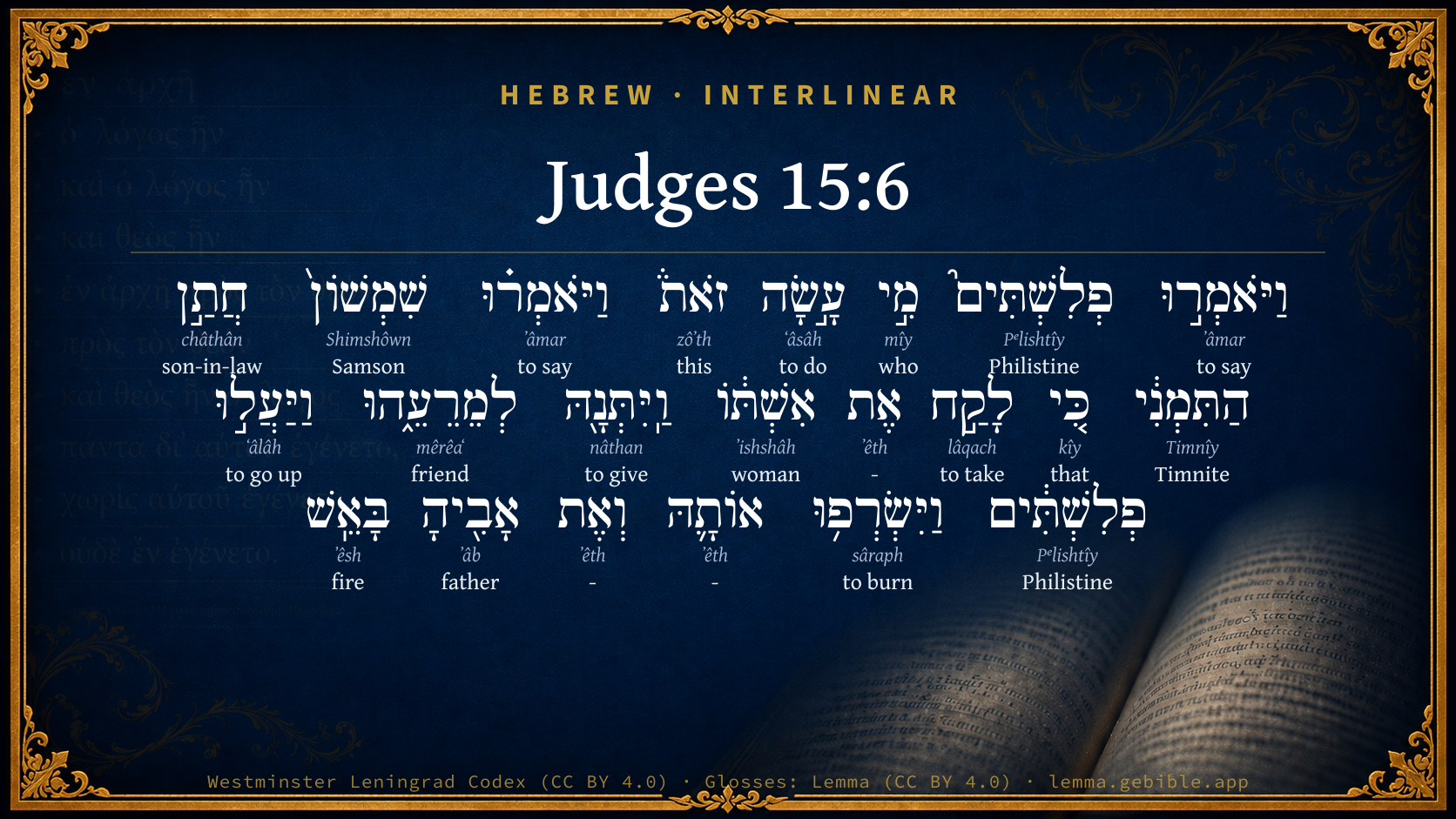
Hebrew (Westminster Leningrad Codex) Judges 15:6 appears in the Hebrew Old Testament. The text above is from the Westminster Leningrad Codex. Each word links to its Strong’s number, a concise gloss, and parsing drawn from the Open Scriptures Hebrew Bible morphology. Click any word for its full Brown-Driver-Briggs (BDB) entry.
Download image
Cite this verse

Judges 15:6 (World English Bible). Public Domain. Lemma interlinear Bible study tool, https://lemma.gebible.app/v/judges/15/6.

Show BibTeX & RIS
BibTeX
RIS
English Translation
Then the Philistines said, Who has done this? They said, Samson, the son-in-law of the Timnite, because he has taken his wife, and given her to his companion. The Philistines came up, and burnt her and her father with fire.
World English Bible · Public Domain
Highlights
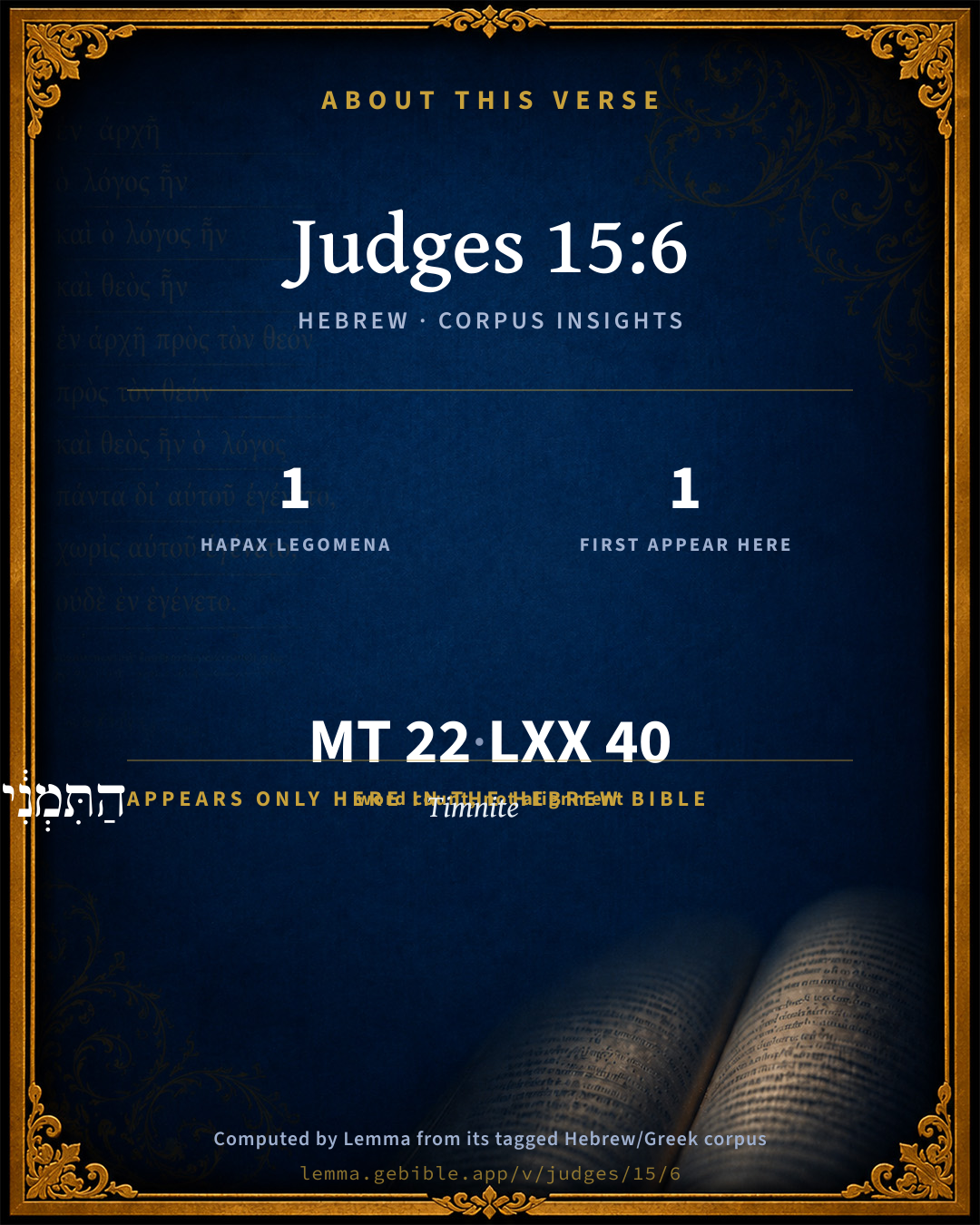
  • 1 hapax legomenon — only here in the Hebrew Bible
  • 1 first appearance in the Hebrew Bible
Full analysis ↓
Download a study sheet

One document with this verse’s original text, its word-by-word gloss line, the meaning frame, cross-references with their text, attributed commentary, and full source and license credits — printable, and it pastes into notes with its structure intact.

This verse Autodidact and up

Study sheet (.html) Plain text (.txt)

A passage Seminary Student

Up to 50 verses in one chapter. A passage sheet keeps up to 6 commentary sources and 12 cross-references per verse, in the order this page ranks them, and says so on the sheet whenever that leaves anything out. Ask for a single verse and you get the Autodidact verse sheet above.

Everything on this page stays free to read, with no account — the sheet is a download of what is already on screen, not access to it.

Want to remove ads? Support Godless Engineer
Compare translations 3

The same verse in 3 English versions, stacked beneath the original-language interlinear above. Click any original word for its lexicon entry.

Each is an independent rendering of the whole verse — the interlinear is not word-aligned to these translations.

Highlighted words mark where these versions differ — a whole-verse word diff, not a word-by-word alignment.

  • World English Bible Public Domain
    Then the Philistines said, Who has done this? They said, Samson, the son-in-law of the Timnite, because he has taken his wife, and given her to his companion. The Philistines came up, and burnt her and her father with fire.
  • King James Version Public Domain
    Then the Philistines said, Who hath done this? And they answered, Samson, the son in law of the Timnite, because he had taken his wife, and given her to his companion. And the Philistines came up, and burnt her and her father with fire.
  • unfoldingWord Literal Text CC BY-SA 4.0
    And the Philistines said, “Who has done this?” And they said, “Samson, the son-in-law of the Timnite, because he took his wife and gave her to his companion.” And the Philistines went up and burned her and her father with fire.

unfoldingWord Literal Text — © unfoldingWord, licensed CC BY-SA 4.0. Word-aligned USFM3 via Door43 (git.door43.org/unfoldingWord/en_ult).

Versions to compare (up to 4)

3 of 4 selected

Show all 18 translations

Every available English version of this verse, each an independent rendering of the whole verse.

  • World English Bible Public Domain
    Then the Philistines said, Who has done this? They said, Samson, the son-in-law of the Timnite, because he has taken his wife, and given her to his companion. The Philistines came up, and burnt her and her father with fire.
  • Berean Standard Bible Public Domain
    “Who did this?” the Philistines demanded. “It was Samson, the son-in-law of the Timnite,” they were told. “For his wife was given to his companion.” So the Philistines went up and burned her and her father to death.
  • Majority Standard Bible Public Domain
    “Who did this?” the Philistines demanded. “It was Samson, the son-in-law of the Timnite,” they were told. “For his wife was given to his companion.” So the Philistines went up and burned her and her father to death.
  • King James Version Public Domain
    Then the Philistines said, Who hath done this? And they answered, Samson, the son in law of the Timnite, because he had taken his wife, and given her to his companion. And the Philistines came up, and burnt her and her father with fire.
  • American Standard Version (1901) Public Domain
    Then the Philistines said, Who hath done this? And they said, Samson, the son-in-law of the Timnite, because he hath taken his wife, and given her to his companion. And the Philistines came up, and burnt her and her father with fire.
  • Revised Version (1885) Public Domain
    Then the Philistines said, Who hath done this? And they said, Samson, the son in law of the Timnite, because he hath taken his wife, and given her to his companion. And the Philistines came up, and burnt her and her father with fire.
  • Geneva Bible (1599) Public Domain
    Then the Philistims sayde, Who hath done this? And they answered, Samson the sonne in law of the Timnite, because hee had taken his wife, and giuen her to his companion. Then the Philistims came vp and burnt her and her father with fire.
  • Douay-Rheims (1899) Public Domain
    Then the Philistines said: Who hath done this thing? And it was answered: Samson the son in law of the Thamnathite, because he took away his wife, and gave her to another, hath done these things. And the Philistines went up and burnt both the woman and her father.
  • Young's Literal Translation Public Domain
    And the Philistines say, `Who hath done this?' And they say, `Samson, son-in-law of the Timnite, because he hath taken away his wife, and giveth her to his companion;' and the Philistines go up, and burn her and her father with fire.
  • Literal Standard Version CC BY-SA 4.0
    And the Philistines say, “Who has done this?” And they say, “Samson, son-in-law of the Timnite, because he has taken away his wife, and gives her to his companion”; and the Philistines go up, and burn her and her father with fire.
  • Unlocked Literal Bible CC BY-SA 4.0
    The Philistines asked, “Who did this?” They were told, “Samson, the Timnite's son-in-law, did this because the Timnite took Samson's wife and gave her to his friend.” Then the Philistines went and burned up her and her father.
  • unfoldingWord Literal Text CC BY-SA 4.0
    And the Philistines said, “Who has done this?” And they said, “Samson, the son-in-law of the Timnite, because he took his wife and gave her to his companion.” And the Philistines went up and burned her and her father with fire.
  • Darby Bible Public Domain
    Then the Philistines said, "Who has done this?" And they said, "Samson, the son-in-law of the Timnite, because he has taken his wife and given her to his companion." And the Philistines came up, and burned her and her father with fire.
  • World Messianic Bible Public Domain
    Then the Philistines said, “Who has done this?” They said, “Samson, the son-in-law of the Timnite, because he has taken his wife and given her to his companion.” The Philistines came up, and burned her and her father with fire.
  • Webster's Bible Public Domain
    Then the Philistines said, Who hath done this? And they answered, Samson, the son-in-law of the Timnite, because he had taken his wife, and given her to his companion. And the Philistines came up, and burnt her and her father with fire.
  • Free Bible Version CC BY-SA 4.0
    “Who did this?” the Philistines asked. “It was Samson, the son-in-law of the man from Timnah,” they were told. “That man gave Samson's wife to Samson's best man.” So the Philistines went and burned her and her father to death.
  • Bible in Basic English Public Domain
    Then the Philistines said, Who has done this? And they said, Samson, the son-in-law of the Timnite, because he took his wife and gave her to his friend. So the Philistines came up and had her and her father's house burned.
  • JPS Tanakh (1917) Public Domain
    Then the Philistines said: 'Who hath done this?' And they said: 'Samson, the son-in-law of the Timnite, because he hath taken his wife, and given her to his companion.' And the Philistines came up, and burnt her and her father with fire.

Literal Standard Version (2020), Covenant Press — licensed CC BY-SA 4.0. Text via the HelloAO Bible API (eBible.org). Unlocked Literal Bible (unfoldingWord) — licensed CC BY-SA 4.0. Text via the HelloAO Bible API (eBible.org). unfoldingWord Literal Text — © unfoldingWord, licensed CC BY-SA 4.0. Word-aligned USFM3 via Door43 (git.door43.org/unfoldingWord/en_ult). Free Bible Version, Dr. Jonathan Gallagher — licensed CC BY-SA 4.0. Text via the HelloAO Bible API (eBible.org).

Word by word

More ways to search: Search by grammar → Find every occurrence → Compare this word →

Practice this passage: Drill this verse → Learn its vocabulary →

הַתִּמְנִ֔י
Timnîy
H8554
“the · Timnite”
Particle, Definite Article + Noun, Proper
Part of Speech
Particle + Noun
Type
Proper
Full BDB Definition

Origin: patrial from H8553

TWOT: None

Timnite = "thou wilt number: a portion" - an inhabitant of Timnath or Timnah or Thimnathah
  1. וַיֹּאמְר֣וּ ʼâmar H559 “and · to say” Conjunction + Verb, Qal, Sequential Imperfect, 3rd Person, Masculine, Plural
  2. פְלִשְׁתִּים֮ Pᵉlishtîy H6430 “Philistines” Noun, Gentilic, Masculine, Plural, Absolute
  3. מִ֣י mîy H4310 “who” Particle, Interrogative
  4. עָ֣שָׂה ʻâsâh H6213 “to do” Verb, Qal, Perfect, 3rd Person, Masculine, Singular
  5. זֹאת֒ zôʼth H2063 “this” Pronoun, Demonstrative, Feminine, Singular
  6. וַיֹּאמְר֗וּ ʼâmar H559 “and · to say” Conjunction + Verb, Qal, Sequential Imperfect, 3rd Person, Masculine, Plural
  7. שִׁמְשׁוֹן֙ Shimshôwn H8123 “Samson” Noun, Proper
  8. חֲתַ֣ן châthân H2860 “son-in-law of” Noun, Common, Masculine, Singular, Construct
  9. כִּ֚י kîy H3588 “that” Conjunction
  10. לָקַ֣ח lâqach H3947 “to take” Verb, Qal, Perfect, 3rd Person, Masculine, Singular
  11. אֶת ʼêth H853 “-” Particle, Direct Object
  12. אִשְׁתּ֔וֹ ʼishshâh H802 “woman · his” Noun, Common, Feminine, Singular, Construct + Suffix, Personal, 3rd Person, Masculine, Singular
  13. וַֽיִּתְּנָ֖הּ nâthan H5414 “and · to give · her” Conjunction + Verb, Qal, Sequential Imperfect, 3rd Person, Masculine, Singular + Suffix, Personal, 3rd Person, Feminine, Singular
  14. לְמֵרֵעֵ֑הוּ mêrêaʻ H4828 “to/for · friend · his” Preposition + Noun, Common, Masculine, Singular, Construct + Suffix, Personal, 3rd Person, Masculine, Singular
  15. וַיַּעֲל֣וּ ʻâlâh H5927 “and · to go up” Conjunction + Verb, Qal, Sequential Imperfect, 3rd Person, Masculine, Plural
  16. פְלִשְׁתִּ֔ים Pᵉlishtîy H6430 “Philistines” Noun, Gentilic, Masculine, Plural, Absolute
  17. וַיִּשְׂרְפ֥וּ sâraph H8313 “and · to burn” Conjunction + Verb, Qal, Sequential Imperfect, 3rd Person, Masculine, Plural
  18. אוֹתָ֛הּ ʼêth H853 “- · her” Particle, Direct Object + Suffix, Personal, 3rd Person, Feminine, Singular
  19. וְאֶת ʼêth H853 “and · -” Conjunction + Particle, Direct Object
  20. אָבִ֖יהָ ʼâb H1 “father · her” Noun, Common, Masculine, Singular, Construct + Suffix, Personal, 3rd Person, Feminine, Singular
  21. בָּאֵֽשׁ ʼêsh H784 “in/at the · fire” Preposition, Determined + Noun, Common, Both, Singular, Absolute

About this verse

These counts appear in no published source. They are computed here, from the morphology-tagged text and Lemma’s own curated glosses. What Lemma adds →

22
words
18
distinct lemmas
Historical
section

Notable vocabulary

1 hapax legomenon — a word that appears only here in the entire Hebrew Bible:

  • הַתִּמְנִ֔י Timnite H8554

First appearance in Scripture

This word makes its first canonical appearance in the Hebrew Bible here:

  • הַתִּמְנִ֔י Timnite H8554

Shared distinctive vocabulary

לְמֵרֵעֵ֑הוּ friend H4828 occurs in 7 verses of the Hebrew Bible. Also found in:

Grammatical profile

  • 7 verbs
  • 9 nouns
  • 1 pronoun
  • 1 conjunction
  • 4 particles

Verb forms

  • וַיֹּאמְר֣וּ Qal · Sequential Imperfect
  • עָ֣שָׂה Qal · Perfect
  • וַיֹּאמְר֗וּ Qal · Sequential Imperfect
  • לָקַ֣ח Qal · Perfect
  • וַֽיִּתְּנָ֖הּ Qal · Sequential Imperfect
  • וַיַּעֲל֣וּ Qal · Sequential Imperfect
  • וַיִּשְׂרְפ֥וּ Qal · Sequential Imperfect

Repetition

Words recur within this verse — often emphatic in Hebrew:

  • וַיֹּאמְר֣וּ to say H559 ×2
  • פְלִשְׁתִּים֮ Philistine H6430 ×2

Hebrew & Septuagint length

In English translation the verse runs 40 words from the Hebrew and 46 from the Septuagint (LXX English) — closely comparable.

A rough comparison of the two English renderings, which tokenize alike — not a word-level alignment.

Word counts can differ between the Hebrew and the Greek without any difference in meaning — e.g. the Hebrew direct-object marker אֵת has no separate Greek word, and Greek often adds the article ὁ.

In the original languages it is 22 Hebrew tokens and 40 Greek tokens — but the two are counted differently (Hebrew bundles its prefixes and suffixes into one token; the Greek is in lemma form), so that isn’t a like-for-like length.

Cross-references

4

Topical passages linked to Judges 15:6 in the Treasury of Scripture Knowledge — connected by theme and wording, ordered by reader-vote popularity; previews shown in the World English Bible.

  • Judges 14:15 It happened on the seventh day, that they said to Samson's wife, Entice your husband, that he may declare to us the riddle, lest we burn you and your father's house with fire: have you called us to impoverish us? is it not [so]?
  • Proverbs 22:8 He who sows wickedness reaps trouble, And the rod of his fury will be destroyed.
  • 1 Thessalonians 4:6 that no one should take advantage of and wrong a brother or sister in this matter; because the Lord is an avenger in all these things, as also we forewarned you and testified.
  • Judges 12:1 The men of Ephraim were gathered together, and passed northward; and they said to Jephthah, Why did you pass over to fight against the children of Ammon, and didn't call us to go with you? we will burn your house on you with fire.

Cross-references courtesy of OpenBible.info (CC BY 4.0).

Hebrew and Greek witnesses Masoretic Hebrew ↔ Greek Septuagint

The same verse in the two great witnesses to the Old Testament, shown verse-for-verse.

These are two independent witnesses, not word-aligned to each other, and the Septuagint is shown in lemma (dictionary) form.

Hebrew Judges 15:6 Masoretic · Westminster Leningrad Codex

וַיֹּאמְר֣וּ פְלִשְׁתִּים֮ מִ֣י עָ֣שָׂה זֹאת֒ וַיֹּאמְר֗וּ שִׁמְשׁוֹן֙ חֲתַ֣ן הַתִּמְנִ֔י כִּ֚י לָקַ֣ח אֶת אִשְׁתּ֔וֹ וַֽיִּתְּנָ֖הּ לְמֵרֵעֵ֑הוּ וַיַּעֲל֣וּ פְלִשְׁתִּ֔ים וַיִּשְׂרְפ֥וּ אוֹתָ֛הּ וְאֶת אָבִ֖יהָ בָּאֵֽשׁ

Then the Philistines said, Who has done this? They said, Samson, the son-in-law of the Timnite, because he has taken his wife, and given her to his companion. The Philistines came up, and burnt her and her father with fire.

World English Bible · Public Domain

Greek LXX Judges 15:6 Septuagint · lemma form

καί εἶπον ὁ ἀλλόφυλος τίς ποιέω οὗτος καί εἶπον σαμψων ὁ νυμφίος ὁ θαμνι ὅτι λαμβάνω ὁ γυνή αὐτός καί δίδωμι αὐτός ὁ ἐκ ὁ φίλος αὐτός καί ἀναβαίνω ὁ ἀλλόφυλος καί ἐνπίμπρημι αὐτός καί ὁ πατήρ αὐτός ἐν πῦρ

And the Philistines said, Who has done these things? and they said, Sampson the son-in-law of the Thamnite, because he has taken his wife, and given her to one of his friends; and the Philistines went up, and burnt her and her father's house with fire.

LXX2012 (modern English Septuagint) · Public Domain

On this verse, The Cambridge Bible for Schools and Colleges discusses the Septuagint’s reading. Read the note in Commentary ↓

Hebrew: Westminster Leningrad Codex (CC BY 4.0). Greek: Septuagint (public domain); English from LXX2012 (modern English Septuagint) (Public Domain). How the Septuagint differs from the Hebrew →

Targum (Aramaic paraphrase)

1

The Targum is the ancient Jewish Aramaic paraphrase of the Hebrew Scriptures — an interpretive translation, not the Hebrew text itself. Onkelos (literal) and Pseudo-Jonathan (expansive) render the Torah, and Jonathan the Prophets. Coverage is partial: where no permissively-licensed English translation exists for a verse, only the Aramaic is shown. This is verse-level text, not a word-by-word alignment to the Hebrew.

  1. Targum Jonathan Prophets (Joshua–Malachi)
    וַאֲמַרוּ פְלִשְׁתָּאֵי מַן עֲבַד דָא וַאֲמַרוּ שִׁמְשׁוֹן חֲתָנֵיהּ דְתִמְנִי אֲרֵי נְסִיב יַת אִתְּתֵיהּ וְיַהֲבָהּ לְחַבְרֵיהּ וּסְלִיקוּ פְלִשְׁתָּאֵי וְאוֹקִידוּ יָתָהּ וְיַת אֲבוּהָא בְּנוּרָא:

    (no public-domain English translation for this verse)

    Targum Jonathan — Aramaic: “Mikraot Gedolot” (public domain). English: “Sefaria Community Translation” (CC0 1.0 (public-domain dedication)); “London "Chaldee Paraphrase," 1871” (public domain). Text via Sefaria.

Commentary

Notes on Judges 15:6 from classic Christian and Jewish commentators (each source and its license shown beneath its notes). The classic Christian expositions comment on the surrounding passage and are grouped to its opening verse, so a note may address several verses; the Jewish commentaries on the Tanakh (Rashi and others) are per-verse, so they appear only where the commentator wrote on this verse.

Lemma curates 59 commentaries, every one of them public domain or Creative Commons licensed, each selected and text-cleaned for this edition rather than reprinted as found. About our sources →

Trapp's Complete Commentary

John Trapp

Jdg 15:6 Then the Philistines said, Who hath done this? And they answered, Samson, the son in law of the Timnite, because he had taken his wife, and given her to his companion. And the Philistines came up, and burnt her and her father with fire.

Ver. 6. Burnt her and her father with fire.] Thus the fear of the wicked cometh upon them, {Pro 10:24} and justly, when they prefer iniquity before affliction, as Samson’s wife had done. See Jdg 14:15. Josephus saith that together with her they burned all her kindred. She should have been of his mind who said, Potius in ardentem rogue insiluero quam ullum peccatum in Deum commisero. I will leap into a bonfire, rather than sin against God.

John Trapp, A Commentary or Exposition upon All the Books of the Old and New Testament (1647–1656) — public domain. Text from a community e-Sword module.

Joseph Benson's Commentary

Jdg 15:6. The Philistines came up and burned her — For the mischief which she had occasioned them; thus she brought upon herself that mischief which she studied to avoid. The Philistines had threatened to burn her and her father’s house with fire. To avoid this, she betrayed her husband. And now the very thing she feared comes upon her! And her father — Whom they looked upon as one chief cause of the mischief done, by his giving his daughter, Samson’s wife, to another man. Punishing or revenging by fire seems to have been a usual practice in those days: see Jdg 14:15.

Joseph Benson's Commentary on the Old and New Testaments (1811–1818) — public domain. Text from a community e-Sword module.

Whedon's Commentary on the Bible

Daniel D. Whedon

SAMSON’S REVENGE OF HIS WIFE’S DEATH, Jdg_15:6-8.

6. Burnt her and her father with fire — This was the first outburst of popular indignation and fury. Not finding at hand the perpetrators of the deed, they wreak vengeance on those who had been the occasion of it. And so that weak and deceitful woman, who had sought to save herself and her father by teasing Samson’s secret from him and telling it to his rival, meets at length the very doom she thought to turn away.

Daniel D. Whedon (gen. ed.), Commentary on the Old and New Testaments (1874–1909) — public domain. Text from a community e-Sword module.

Geneva Bible (1599)

Geneva Bible translators

So the wicked punish not vice for love of justice, but for fear of danger, which else might come to them.

Or, the citizen of Timnath.

Geneva Bible (1599) marginal notes — public domain. Text via Bolls.life.

Jamieson, Fausset & Brown

Robert Jamieson, A. R. Fausset & David Brown

Who hath done this--The author of this outrage, and the cause that provoked such an extraordinary retaliation, soon became known; and the sufferers, enraged by the destruction of their crops, rushing with tumultuous fury to the house of Samson's wife, "burnt her and her father with fire." This was a remarkable retribution. To avoid this menace, she had betrayed her husband; and by that unprincipled conduct, eventually exposed herself to the horrid doom which, at the sacrifice of conjugal fidelity, she had sought to escape [Jdg 14:15].

Jamieson, Fausset & Brown — Commentary Critical and Explanatory on the Whole Bible (1871) — public domain (CC PDM 1.0). Text via the HelloAO Bible API.

Adam Clarke's Commentary

Verse 6. Burnt her and her father] This was probably done to appease Samson: as they saw he had been unjustly treated both by his wife and her father; therefore they destroyed them both, that they might cause his wrath to cease from them. And this indeed seems intimated in the following verse: And Samson said - Though ye have done this, yet will I be avenged of you; that is, I am not yet satisfied: ye have done me great wrongs, I must have proportionate redress; then I shall rest satisfied.

Adam Clarke's Commentary on the Bible (1810–1826) — public domain. Text from a community e-Sword/MySword module.

Ellicott's Commentary for English Readers

(6) They answered.—The phrase is impersonal; but Samson had quite openly threatened vengeance in speaking to the Timnites, and is not likely to have done his work unaided or to have been very reticent about it; nor would the poor oppressed Israelites be inclined to keep his secret when they were confronted with the fury of the Philistines.

Burnt her and her father with fire.—Was this meant as a way of revenging themselves on Samson, or of avenging him for the wrongs which he had received from the Timnite? The latter seems to be most unlikely. Looking with despair and fury at the blackened fields which but a few days before had been thick with golden corn, it is inconceivable that the Philistines would be in a mood to perform an act of justice for the sake of the deadly enemy who had inflicted this loss upon them. Their motive is clear enough. They wished to insult and injure Samson, and, at the same time, vent their fierce spleen on the man whose family and whose conduct had led to all these troubles. That they thought about “burning as the punishment of adultery among the Jews” (Gen_38:24, &c.) is still more improbable. To burn a person, and his house and his family, seems to have been the ordinary revenge of these barbarous days. (See Jdg_12:1; Jdg_14:15.)

A Bible Commentary for English Readers, edited by Charles John Ellicott (1878–1897) — public domain. Text from a community e-Sword module.

The Cambridge Bible for Schools and Colleges

gen. ed. J. J. S. Perowne

6. her father] Read with many Hebr. mss., LXX. cod. A, Peshitto etc. her father’s house, i.e. family, as in the threat Jdg_14:15.

The Cambridge Bible for Schools and Colleges (gen. ed. J. J. S. Perowne; Cambridge University Press, 1878–1918) — public domain. Text from a community e-Sword module.

John Gill's Exposition

Then the Philistines said, who hath done this?.... They asked and inquired one of another, who they thought could be the author of such mischief:

and they answered, Samson, the son in law of the Timnite; this they said either by conjecture, which might be the case of some; and others more confidently asserted it, having heard what he said, Jdg 15:3 and they assign a very good reason for it:

because he had already taken away his wife, and given her to his companion, which had provoked him to do such an action as this; and perhaps the very same persons that were very well pleased before that Samson was so served, yet now were full of wrath and indignation at the Timnite, having suffered so much in their property on his account:

and the Philistines came up, and burnt her and her father with fire; Josephus (d) says, her and her relations; they set fire to her father's house, where she was, and burnt them both in it, whereby that evil came upon her she thought to avoid by getting the secret of the riddle out of Samson, and telling it to his companion, Jdg 14:15 and suffered the proper punishment for her adultery; the people that did this were those that lived in the towns adjacent, from whence they came up to Timnath, whose fields, vineyards, and oliveyards, had been destroyed by the foxes with their firebrands.

(d) Antiqu. l. 5. c. 8. sect. 7.

John Gill's Exposition of the Whole Bible (1746–1763) — public domain (CC PDM 1.0). Text via the HelloAO Bible API.

Albert Barnes' Notes on the Bible

burnt her and her father - Out of revenge on Samson’s nearest relations; or, as others think, as an act of justice in favor of Samson, and in hope of pacifying his anger. Burning was the punishment for adultery and kindred crimes among the Jews Gen 38:24; Lev 20:14; Lev 21:9. Samson’s wife brought upon herself the very punishment which she sought to escape by betraying her husband Jdg 14:15.

Albert Barnes' Notes on the Bible (1834–1885) — public domain. Text from a community e-Sword/MySword module.

Haydock's Catholic Bible Commentary

Father. Thus they met with the fate which the woman had endeavoured to avoid, by an infidelity to her husband. (Salien) --- The princes of the Philistines acknowledged the wrong which had been done to Samson, and thus testify their abhorrence of adultery. (Calmet) --- Some Hebrew manuscripts confirm the Septuagint, Arabic, and Syriac versions; and instead of "her father with her," read, "and her father’s house," (Kennicott) or all his family.

George Leo Haydock (1774–1849), Haydock's Catholic Family Bible and Commentary, 1859 edition — public domain. Excludes Psalms (Douay-Rheims chapter numbering differs from Protestant) and Deuterocanonical books (Catholic canon only).

Matthew Poole's English Annotations

Partly for her adultery, which divers heathens punished with death; and partly for that mischief which she had occasioned to them; thus she brought upon herself that mischief which she studied to avoid, Jdg 14:15, as wicked persons oft do, Pro 10:24.

Matthew Poole's English Annotations on the Holy Bible (1683–1685) — public domain. Text from a community e-Sword/MySword module.

The Pulpit Commentary

And the Philistines... burnt her and her father with fire. Jud_1:14:15. It appears from Gen_38:24 Lev_20:14 Lev_21:9 Jos_7:15, Jos_7:25, that burning with fire was a judicial punishment among the Hebrews. Possibly the Philistines, in their fear of Samson, and perhaps also from a rude sense of justice, inflicted this punishment upon the Thimnathite and her father as the real authors of the destruction of their corn-fields, by giving Samson so unheard of provocation. Note the fact of the identical fate overtaking Samson"s wife which she had sought to escape by base treachery. (cf. Joh_11:48 with what actually happened)

Vers. 6-8. Those who have occasioned evil punished for those who caused it.

Of this policy amongst individuals and nations the world is full.

I WICKED MEN ARE OFTEN WISER THAN THEIR ACTIONS WOULD INDICATE. It was well to inquire, "Who hath done this?" but when the agent was discovered, they were too afraid of him to punish him, so they wreaked their vengeance upon those who could not defend themselves. Greater care is shown by men in removing occasions of evil than in curing the source of it.

II HUMAN INJUSTICE MAY UNCONSCIOUSLY EFFECT THE ENDS OF DIVINE JUSTICE. The father-in-law and wife of Samson deserved punishment, but hardly from those through dread of whom they had done Samson wrong.

III BY ACTING AS THEY DID THE PHILISTINES ONLY BROUGHT UPON THEMSELVES GREATER DISASTERS.

IV ONE WRONG LEADS TO ANOTHER. M.

The Pulpit Commentary (1880–1919), ed. H.D.M. Spence-Jones & Joseph S. Exell — public domain. Text from a community e-Sword module.

John Wesley's Explanatory Notes

Burnt her - For the mischief which she had occasioned them; thus she brought upon herself that mischief which she studied to avoid. The Philistines had threatened to burn her and her father's house with fire. To avoid this she betrayed her husband. And now the very thing she feared comes upon her!

John Wesley, Explanatory Notes Upon the Whole Bible (1754–1765) — public domain. Text via the GEBible commentary corpus.

Keil & Delitzsch

C. F. Keil & F. Delitzsch

The Philistines found out at once, that Samson had done them this injury because his father-in-law, the Timnite, had taken away his wife and given her to his companion. They therefore avenged themselves by burning her and her father-probably by burning his house down to the ground, with its occupants within it-an act of barbarity and cruelty which fully justified Samson's war upon them.

Keil & Delitzsch — Biblical Commentary on the Old Testament (1861–1891) — public domain (CC PDM 1.0). Text via the HelloAO Bible API. (Old Testament only.)

Rashi

Rabbi Shlomo Yitzchaki (Rashi)

The son-in-law of the Timnite. The son-in-law of the Pelishtite from Timnah.

Rashi on the Tanakh — English translations: “The Judaica Press complete Tanach with Rashi, translated by A. J. Rosenberg” (CC BY 4.0); “Pentateuch with Rashi's commentary by M. Rosenbaum and A.M. Silbermann, 1929-1934” (public domain); “The Metsudah Tanach series, Lakewood, N.J” (CC BY 4.0); and “The Book of Joshua, Metsudah Publications, 1997” (CC BY 4.0). Text via Sefaria.

Lesson kit

Teaching starters — assembled from the data on this page, not authored interpretation. Every prompt links to the verse data it draws on. Edit before teaching.

Judges, in the Historical, opens this verse with 22 words (18 distinct Hebrew lemmas). Its most distinctive word is Timnîy (“Timnite”). A historical commentator’s framing appears above. Read the whole chapter for the surrounding context.

Discussion questions

  1. What does “Timnite” (Timnîy) contribute to the verse as a whole?
  2. This verse holds 1 word here found nowhere else in the Hebrew Bible. What might the rare word draw attention to?
  3. The word “Timnite” first appears here in Scripture. What is being introduced at this debut?
  4. Genesis 26:26 shares the word «friend» with this verse. How do the two illuminate each other?
  5. “to say” occurs 2× in this one verse. What is the effect of the repetition?
  6. The translations on this page render this verse differently — a whole-verse word diff, not a word-by-word alignment. What might account for the different wordings?
  7. The verb «וַיֹּאמְר֣וּ» is Qal Sequential Imperfect. How does its form color the action?
  8. Reading how Trapp's Complete Commentary and Joseph Benson's Commentary read this verse, where do the two commentators agree and where do they part?

Things to notice

  • 1 word in this verse appears nowhere else in the Hebrew Bible.
  • 1 word makes its first canonical appearance in Scripture here.
  • This verse counts 22 Hebrew ↔ 40 Greek words.
  • These translations choose different wording for 14 words in this verse.
  • “to say” occurs 2× in this single verse.

Reading settings

Reading text

Shown beneath each verse's original-language words.

Old Testament
Old Testament edition

Read the OT as the Masoretic Hebrew (MT) or the Greek Septuagint (LXX).

English shown for the Greek Septuagint (in the Hebrew ↔ Greek comparison).

Comparing translations? Open the Compare panel on any verse page to stack up to four side by side.