
Numbers 18:9

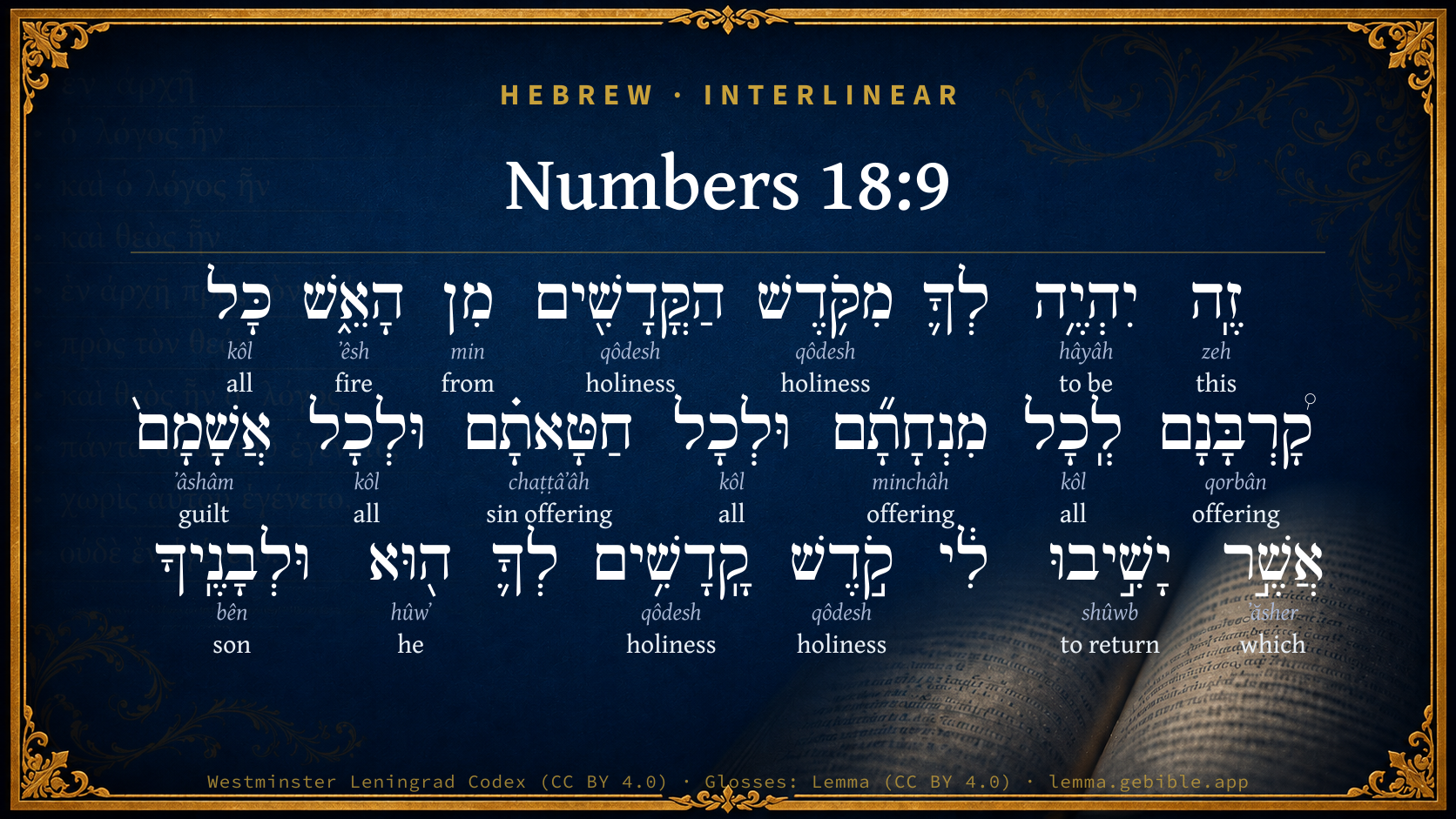
Hebrew (Westminster Leningrad Codex) Numbers 18:9 appears in the Hebrew Old Testament. The text above is from the Westminster Leningrad Codex. Each word links to its Strong’s number, a concise gloss, and parsing drawn from the Open Scriptures Hebrew Bible morphology. Click any word for its full Brown-Driver-Briggs (BDB) entry.
Download image
Cite this verse

Numbers 18:9 (World English Bible). Public Domain. Lemma interlinear Bible study tool, https://lemma.gebible.app/v/numbers/18/9.

Show BibTeX & RIS
BibTeX
RIS
English Translation
This shall be your of the most holy things, [reserved] from the fire: every offering of theirs, even every meal-offering of theirs, and every sin-offering of theirs, and every trespass-offering of theirs, which they shall render to me, shall be most holy for you and for your sons.
World English Bible · Public Domain
Download a study sheet

One document with this verse’s original text, its word-by-word gloss line, the meaning frame, cross-references with their text, attributed commentary, and full source and license credits — printable, and it pastes into notes with its structure intact.

This verse Autodidact and up

Study sheet (.html) Plain text (.txt)

A passage Seminary Student

Up to 50 verses in one chapter. A passage sheet keeps up to 6 commentary sources and 12 cross-references per verse, in the order this page ranks them, and says so on the sheet whenever that leaves anything out. Ask for a single verse and you get the Autodidact verse sheet above.

Everything on this page stays free to read, with no account — the sheet is a download of what is already on screen, not access to it.

Want to remove ads? Support Godless Engineer
Compare translations 3

The same verse in 3 English versions, stacked beneath the original-language interlinear above. Click any original word for its lexicon entry.

Each is an independent rendering of the whole verse — the interlinear is not word-aligned to these translations.

Highlighted words mark where these versions differ — a whole-verse word diff, not a word-by-word alignment.

  • World English Bible Public Domain
    This shall be your of the most holy things, [reserved] from the fire: every offering of theirs, even every meal-offering of theirs, and every sin-offering of theirs, and every trespass-offering of theirs, which they shall render to me, shall be most holy for you and for your sons.
  • King James Version Public Domain
    This shall be thine of the most holy things, reserved from the fire: every oblation of theirs, every meat offering of theirs, and every sin offering of theirs, and every trespass offering of theirs which they shall render unto me, shall be most holy for thee and for thy sons.
  • unfoldingWord Literal Text CC BY-SA 4.0
    This shall be for you from the holy thing of the holy things, from the fire: every offering of theirs, for every grain offering of theirs and for every sin offering of theirs and for every guilt offering of theirs which they return to me. It a holy thing of holy things for you and for your sons.

unfoldingWord Literal Text — © unfoldingWord, licensed CC BY-SA 4.0. Word-aligned USFM3 via Door43 (git.door43.org/unfoldingWord/en_ult).

Versions to compare (up to 4)

3 of 4 selected

Show all 18 translations

Every available English version of this verse, each an independent rendering of the whole verse.

  • World English Bible Public Domain
    This shall be your of the most holy things, [reserved] from the fire: every offering of theirs, even every meal-offering of theirs, and every sin-offering of theirs, and every trespass-offering of theirs, which they shall render to me, shall be most holy for you and for your sons.
  • Berean Standard Bible Public Domain
    A portion of the most holy offerings reserved from the fire will be yours. From all the offerings they render to Me as most holy offerings, whether grain offerings or sin offerings or guilt offerings, that part belongs to you and your sons.
  • Majority Standard Bible Public Domain
    A portion of the most holy offerings reserved from the fire will be yours. From all the offerings they render to Me as most holy offerings, whether grain offerings or sin offerings or guilt offerings, that part belongs to you and your sons.
  • King James Version Public Domain
    This shall be thine of the most holy things, reserved from the fire: every oblation of theirs, every meat offering of theirs, and every sin offering of theirs, and every trespass offering of theirs which they shall render unto me, shall be most holy for thee and for thy sons.
  • American Standard Version (1901) Public Domain
    This shall be thine of the most holy things, `reserved' from the fire: every oblation of theirs, even every meal-offering of theirs, and every sin-offering of theirs, and every trespass-offering of theirs, which they shall render unto me, shall be most holy for thee and for thy sons.
  • Revised Version (1885) Public Domain
    This shall be thine of the most holy things, reserved from the fire: every oblation of theirs, even every meal offering of theirs, and every sin offering of theirs, and every guilt offering of theirs, which they shall render unto me, shall be most holy for thee and for thy sons.
  • Geneva Bible (1599) Public Domain
    This shalbe thine of the most holy things, reserued from the fire: all their offering of all their meate offring, and of all their sinne offring, and of all their trespasse offring, which they bring vnto me, that shalbe most holy vnto thee, and to thy sonnes.
  • Douay-Rheims (1899) Public Domain
    These therefore shalt thou take of the things that are sanctified, and are offered to the Lord. Every offering, and sacrifice, and whatsoever is rendered to me for sin and for trespass, and becometh holy of holies, shall be for thee and thy sons.
  • Young's Literal Translation Public Domain
    This is thine of the most holy things, from the fire: all their offering, to all their present, and to all their sin-offering, and to all their guilt-offering, which they give back to Me, is most holy to thee, and to thy sons;
  • Literal Standard Version CC BY-SA 4.0
    This is yours from the most holy things, from the fire: all their offering, of all their present, and of all their sin-offering, and of all their guilt-offering, which they give back to Me, is most holy to you and to your sons;
  • Unlocked Literal Bible CC BY-SA 4.0
    This will belong to you from the most holy things that is kept from the fire. From every offering of theirs—every grain offering, every sin offering, and every guilt offering—they are set apart to you and to your sons.
  • unfoldingWord Literal Text CC BY-SA 4.0
    This shall be for you from the holy thing of the holy things, from the fire: every offering of theirs, for every grain offering of theirs and for every sin offering of theirs and for every guilt offering of theirs which they return to me. It a holy thing of holy things for you and for your sons.
  • Darby Bible Public Domain
    This shall be thine of the most holy things, [reserved] from the fire: every offering of theirs, of all their oblations, and of all their sin-offerings, and of all their trespass-offerings, which they render unto me, it is most holy for thee and for thy sons.
  • World Messianic Bible Public Domain
    This shall be yours of the most holy things from the fire: every offering of theirs, even every meal offering of theirs, and every sin offering of theirs, and every trespass offering of theirs, which they shall give to me, shall be most holy for you and for your sons.
  • Webster's Bible Public Domain
    This shall be thine of the most holy things reserved from the fire: every oblation of theirs, every meat-offering of theirs, and every sin-offering of theirs, and every trespass-offering of theirs, which they shall render to me, shall be most holy for thee and for thy sons.
  • Free Bible Version CC BY-SA 4.0
    Part of the most holy offerings taken from the burnt offerings are yours. Part of all the offerings they give me as most holy offerings, whether it's grain offerings or sin offerings or guilt offerings, that part belongs to you and your sons.
  • Bible in Basic English Public Domain
    This is to be yours of the most holy things, out of the fire offerings; every offering of theirs, every meal offering and sin-offering, and every offering which they make on account of error, is to be most holy for you and your sons.
  • JPS Tanakh (1917) Public Domain
    This shall be thine of the most holy things, reserved from the fire: every offering of theirs, even every meal-offering of theirs, and every sin-offering of theirs, and every guilt-offering of theirs, which they may render unto Me, shall be most holy for thee and for thy sons.

Literal Standard Version (2020), Covenant Press — licensed CC BY-SA 4.0. Text via the HelloAO Bible API (eBible.org). Unlocked Literal Bible (unfoldingWord) — licensed CC BY-SA 4.0. Text via the HelloAO Bible API (eBible.org). unfoldingWord Literal Text — © unfoldingWord, licensed CC BY-SA 4.0. Word-aligned USFM3 via Door43 (git.door43.org/unfoldingWord/en_ult). Free Bible Version, Dr. Jonathan Gallagher — licensed CC BY-SA 4.0. Text via the HelloAO Bible API (eBible.org).

Word by word

More ways to search: Search by grammar → Find every occurrence → Compare this word →

Practice this passage: Drill this verse → Learn its vocabulary →

אֲשָׁמָם֙
ʼâshâm
H817
“guilt · their”
Noun, Common, Masculine, Singular, Construct + Suffix, Personal, 3rd Person, Masculine, Plural
Part of Speech
Noun
Type
Common
Gender
Masculine
Number
Singular
State
Construct
Full BDB Definition

Origin: from H816

TWOT: 180b

guilt, offense, guiltiness - offense, trespass, fault - guilt, guiltiness - compensation (for offense) - trespass offering, guilt offering
  1. זֶֽה zeh H2088 “this” Pronoun, Demonstrative, Masculine, Singular
  2. יִהְיֶ֥ה hâyâh H1961 “to be” Verb, Qal, Imperfect, 3rd Person, Masculine, Singular
  3. מִקֹּ֥דֶשׁ qôdesh H6944 “from · holiness of” Preposition + Noun, Common, Masculine, Singular, Construct
  4. הַקֳּדָשִׁ֖ים qôdesh H6944 “the · holy things” Particle, Definite Article + Noun, Common, Masculine, Plural, Absolute
  5. מִן min H4480 “from” Preposition
  6. הָאֵ֑שׁ ʼêsh H784 “the · fire” Particle, Definite Article + Noun, Common, Both, Singular, Absolute
  7. כָּל kôl H3605 “all of” Noun, Common, Masculine, Singular, Construct
  8. קָ֠רְבָּנָם qorbân H7133 “offering · their” Noun, Common, Masculine, Singular, Construct + Suffix, Personal, 3rd Person, Masculine, Plural
  9. לְֽכָל kôl H3605 “to/for · all of” Preposition + Noun, Common, Masculine, Singular, Construct
  10. מִנְחָתָ֞ם minchâh H4503 “offering · their” Noun, Common, Feminine, Singular, Construct + Suffix, Personal, 3rd Person, Masculine, Plural
  11. וּלְכָל kôl H3605 “and · to/for · all of” Conjunction + Preposition + Noun, Common, Masculine, Singular, Construct
  12. חַטָּאתָ֗ם chaṭṭâʼâh H2403 “sin offering · their” Noun, Common, Feminine, Singular, Construct + Suffix, Personal, 3rd Person, Masculine, Plural
  13. וּלְכָל kôl H3605 “and · to/for · all of” Conjunction + Preposition + Noun, Common, Masculine, Singular, Construct
  14. אֲשֶׁ֣ר ʼăsher H834 “which” Particle, Relative
  15. יָשִׁ֣יבוּ shûwb H7725 “to return” Verb, Hiphil, Imperfect, 3rd Person, Masculine, Plural
  16. קֹ֣דֶשׁ qôdesh H6944 “holiness of” Noun, Common, Masculine, Singular, Construct
  17. קָֽדָשִׁ֥ים qôdesh H6944 “holy things” Noun, Common, Masculine, Plural, Absolute
  18. ה֖וּא hûwʼ H1931 “he” Pronoun, Personal, 3rd Person, Masculine, Singular
  19. וּלְבָנֶֽיךָ bên H1121 “and · to/for · sons · your” Conjunction + Preposition + Noun, Common, Masculine, Plural, Construct + Suffix, Personal, 2nd Person, Masculine, Singular

About this verse

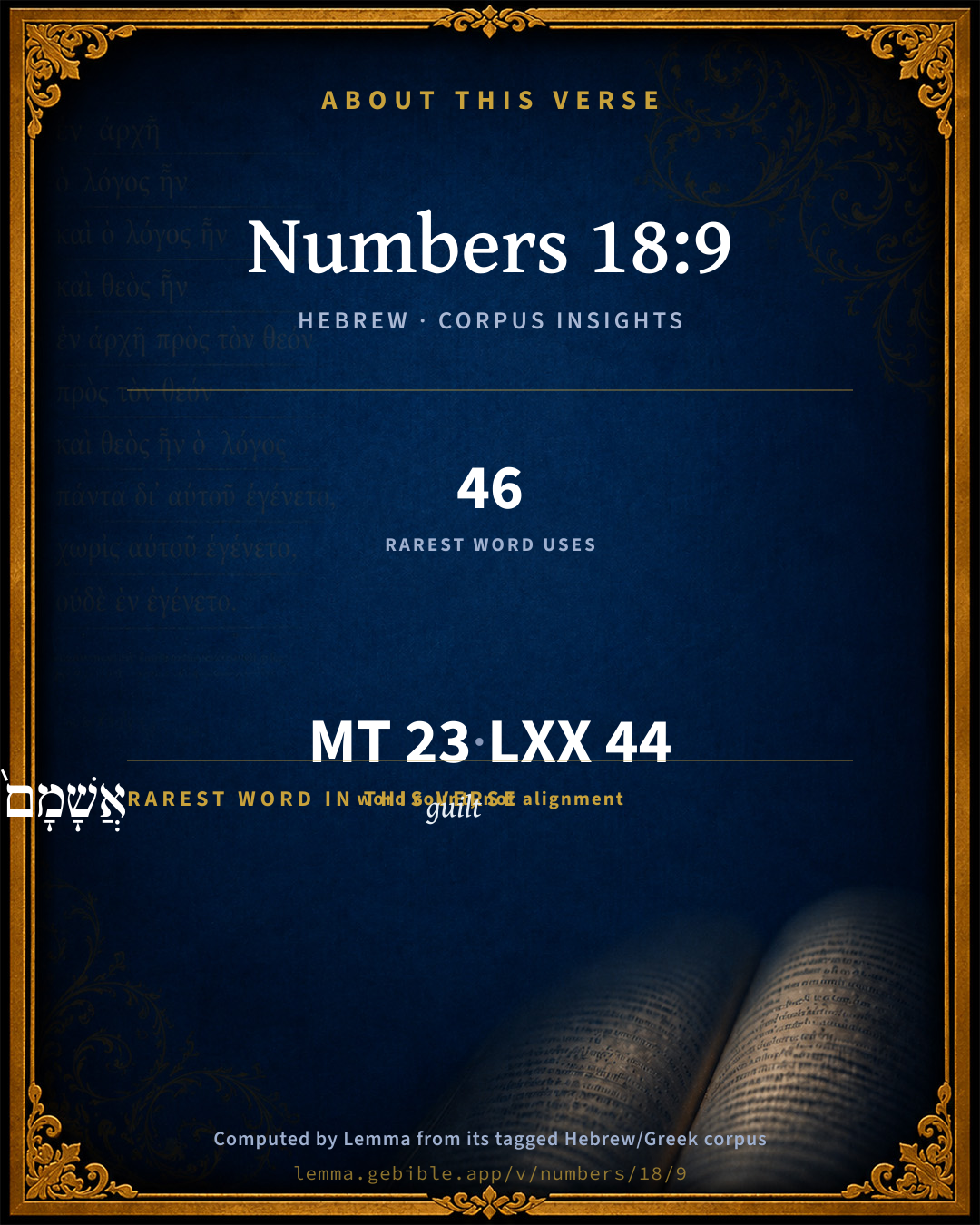
These counts appear in no published source. They are computed here, from the morphology-tagged text and Lemma’s own curated glosses. What Lemma adds →

23
words
14
distinct lemmas
Pentateuch
section

Shared distinctive vocabulary

אֲשָׁמָם֙ guilt H817 occurs in 41 verses of the Hebrew Bible. Also found in:

Grammatical profile

  • 2 verbs
  • 14 nouns
  • 2 pronouns
  • 4 prepositions
  • 1 particle

Verb forms

  • יִהְיֶ֥ה Qal · Imperfect
  • יָשִׁ֣יבוּ Hiphil · Imperfect

Repetition

Words recur within this verse — often emphatic in Hebrew:

  • מִקֹּ֥דֶשׁ holiness H6944 ×4
  • כָּל all H3605 ×4

Hebrew & Septuagint length

In English translation the verse runs 48 words from the Hebrew and 58 from the Septuagint (LXX English) — closely comparable.

A rough comparison of the two English renderings, which tokenize alike — not a word-level alignment.

Word counts can differ between the Hebrew and the Greek without any difference in meaning — e.g. the Hebrew direct-object marker אֵת has no separate Greek word, and Greek often adds the article ὁ.

In the original languages it is 23 Hebrew tokens and 44 Greek tokens — but the two are counted differently (Hebrew bundles its prefixes and suffixes into one token; the Greek is in lemma form), so that isn’t a like-for-like length.

Cross-references

11

Topical passages linked to Numbers 18:9 in the Treasury of Scripture Knowledge — connected by theme and wording, ordered by reader-vote popularity; previews shown in the World English Bible.

  • Leviticus 7:7 "'As is the sin offering, so is the trespass offering; there is one law for them. The priest who makes atonement with them shall have it.
  • Leviticus 14:13 He shall kill the male lamb in the place where they kill the sin offering and the burnt offering, in the place of the sanctuary; for as the sin offering is the priest's, so is the trespass offering. It is most holy.
  • Leviticus 6:25–26 "Speak to Aaron and to his sons, saying, 'This is the law of the sin offering: in the place where the burnt offering is killed, the sin offering shall be killed before Yahweh. It is most holy.
  • Leviticus 4:22 "'When a ruler sins, and unwittingly does any one of all the things which Yahweh his God has commanded not to be done, and is guilty;
  • Leviticus 4:27 "'If anyone of the common people sins unwittingly, in doing any of the things which Yahweh has commanded not to be done, and is guilty;
  • Leviticus 5:1 "'If anyone sins, in that he hears the voice of adjuration, he being a witness, whether he has seen or known, if he doesn't report it, then he shall bear his iniquity.
  • Leviticus 2:1–3 "'When anyone offers an offering of a meal offering to Yahweh, his offering shall be of fine flour; and he shall pour oil on it, and put frankincense on it.
  • Leviticus 5:6 and he shall bring his trespass offering to Yahweh for his sin which he has sinned, a female from the flock, a lamb or a goat, for a sin offering; and the priest shall make atonement for him concerning his sin.
  • Leviticus 7:1 "'This is the law of the trespass offering. It is most holy.
  • Leviticus 10:12–13 Moses spoke to Aaron, and to Eleazar and to Ithamar, his sons who were left, "Take the meal offering that remains of the offerings of Yahweh made by fire, and eat it without yeast beside the altar; for it is most holy;
  • Leviticus 10:17 "Why haven't you eaten the sin offering in the place of the sanctuary, seeing it is most holy, and he has given it you to bear the iniquity of the congregation, to make atonement for them before Yahweh?

Cross-references courtesy of OpenBible.info (CC BY 4.0).

Hebrew and Greek witnesses Masoretic Hebrew ↔ Greek Septuagint

The same verse in the two great witnesses to the Old Testament, shown verse-for-verse.

These are two independent witnesses, not word-aligned to each other, and the Septuagint is shown in lemma (dictionary) form.

Hebrew Numbers 18:9 Masoretic · Westminster Leningrad Codex

זֶֽה יִהְיֶ֥ה לְךָ֛ מִקֹּ֥דֶשׁ הַקֳּדָשִׁ֖ים מִן הָאֵ֑שׁ כָּל קָ֠רְבָּנָם לְֽכָל מִנְחָתָ֞ם וּלְכָל חַטָּאתָ֗ם וּלְכָל אֲשָׁמָם֙ אֲשֶׁ֣ר יָשִׁ֣יבוּ לִ֔י קֹ֣דֶשׁ קָֽדָשִׁ֥ים לְךָ֛ ה֖וּא וּלְבָנֶֽיךָ

This shall be your of the most holy things, [reserved] from the fire: every offering of theirs, even every meal-offering of theirs, and every sin-offering of theirs, and every trespass-offering of theirs, which they shall render to me, shall be most holy for you and for your sons.

World English Bible · Public Domain

Greek LXX Numbers 18:9 Septuagint · lemma form

καί οὗτος εἰμί σύ ἀπό ὁ ἁγιάζω ἅγιος ὁ κάρπωμα ἀπό πᾶς ὁ δῶρον αὐτός καί ἀπό πᾶς ὁ θυσίασμα αὐτός καί ἀπό πᾶς πλημμέλεια αὐτός καί ἀπό πᾶς ὁ ἁμαρτία ὅσος ἀποδίδωμι ἐγώ ἀπό πᾶς ὁ ἅγιος σύ εἰμί καί ὁ υἱός σύ

And let this be to you from all the holy things that are consecrated to me, even the burnt offerings, from all their gifts, and from all their sacrifices, and from every trespass-offering of theirs, and from all their sin-offerings, whatever things they give to me of all their holy things, they shall be yours and your sons'.

LXX2012 (modern English Septuagint) · Public Domain

Hebrew: Westminster Leningrad Codex (CC BY 4.0). Greek: Septuagint (public domain); English from LXX2012 (modern English Septuagint) (Public Domain). How the Septuagint differs from the Hebrew →

Targum (Aramaic paraphrase)

2

The Targum is the ancient Jewish Aramaic paraphrase of the Hebrew Scriptures — an interpretive translation, not the Hebrew text itself. Onkelos (literal) and Pseudo-Jonathan (expansive) render the Torah, and Jonathan the Prophets. Coverage is partial: where no permissively-licensed English translation exists for a verse, only the Aramaic is shown. This is verse-level text, not a word-by-word alignment to the Hebrew.

  1. Targum Onkelos Torah (Genesis–Deuteronomy)
    דֵין יְהֵי לָךְ מִקוֹדֶשׁ קוּדְשַׁיָא מוֹתַר מִן אֶשָׁתָא כָּל קוּרְבַּנְהוֹן לְכָל מִנְחַתְהוֹן וּלְכָל חַטְוַתְהוֹן וּלְכָל אֲשַׁמְהוֹן דִי יְתִיבוּן קֳדָמַי קוֹדֶשׁ קוּדְשִׁין דִילָךְ הִיא וְלִבְנָךְ

    (no public-domain English translation for this verse)

    Targum Onkelos — Aramaic: “Onkelos Genesis” (public domain); “Onkelos Exodus” (public domain); “Onkelos Leviticus” (public domain); “Onkelos Numbers” (public domain); “Onkelos Deuteronomy” (public domain). English: “Sefaria Community Translation” (CC0 1.0 (public-domain dedication)); “J.W. Etheridge. The Targums of Onkelos and Jonathan Ben Uzziel on the Pentateuch. London: Longmans, Green, 1862” (public domain). Text via Sefaria.

  2. Targum Pseudo-Jonathan Torah (Genesis–Deuteronomy)
    דֵין יְהֵי לָךְ מִקוֹדֶשׁ קוּדְשַׁיָא מַה דְמִשְׁתַּיֵיר מֵעָלָתָא דְעָנָא מִן אֵישָׁתָא כָּל קוּרְבַּנְהוֹן לְכָל מִנְחַתְהוֹן וּלְכָל חַטְוַותְהוֹן וּלְכָל אֲשַׁמְהוֹן דִיְתִיבִין קֳדָמַי קוֹדֶשׁ קוּדְשִׁין דִילָךְ הוּא וְדִבְנָךְ

    They shall be to thee most sacred; whatsoever remaineth of the sheep offered by fire, all their oblations, of all their minchas, of all their sin offerings, and of all their trespass offerings which they present before Me, they are most sacred for thee and for thy sons.

    Targum Pseudo-Jonathan — Aramaic: “Targum Jonathan on Genesis” (public domain); “Targum Jonathan on Exodus” (public domain); “Targum Jonathan on Leviticus” (public domain); “Targum Jonathan on Numbers” (public domain); “Targum Jonathan on Deuteronomy” (public domain). English: “The Targum of Jonathan ben Uzziel, trans. J. W. Etheridge, London, 1862” (public domain). Text via Sefaria.

Commentary

Notes on Numbers 18:9 from classic Christian and Jewish commentators (each source and its license shown beneath its notes). The classic Christian expositions comment on the surrounding passage and are grouped to its opening verse, so a note may address several verses; the Jewish commentaries on the Tanakh (Rashi and others) are per-verse, so they appear only where the commentator wrote on this verse.

Lemma curates 59 commentaries, every one of them public domain or Creative Commons licensed, each selected and text-cleaned for this edition rather than reprinted as found. About our sources →

Trapp's Complete Commentary

John Trapp

Num 18:9 This shall be thine of the most holy things, [reserved] from the fire: every oblation of theirs, every meat offering of theirs, and every sin offering of theirs, and every trespass offering of theirs, which they shall render unto me, [shall be] most holy for thee and for thy sons.

Ver. 9. Which they shall render unto me.] As a recompense for some trespass against me. {Num 5:8 Lev 6:6}

John Trapp, A Commentary or Exposition upon All the Books of the Old and New Testament (1647–1656) — public domain. Text from a community e-Sword module.

Tyndale Open Study Notes

Tyndale Open Resources

18:9-11 The most holy offerings were consumed only by Aaron and his sons, the priests set apart to serve in God’s presence (Exod 28:1; 29:44-46). • This portion was a holy offering presented to God, and the priests had to respect it as such (Num 18:10). Other categories of offerings provided food for the priests and their families (18:11-12), but only if they were ceremonially clean.

Tyndale Open Study Notes — © Tyndale Open Resources, licensed CC BY-SA 4.0. Text via the HelloAO Bible API.

Geneva Bible (1599)

Geneva Bible translators

That which was not burned should be the Priest’s.

Geneva Bible (1599) marginal notes — public domain. Text via Bolls.life.

Ellicott's Commentary for English Readers

(9) From the fire.—i.e., from the fire which was kindled upon the altar of burnt offering.

Every oblation of their’s, every meat offering of their’s . . . —Or, every oblation of their’s for all their meat offerings, and for all their sin offerings, and for all their trespass offerings (or, guilt offerings).

A Bible Commentary for English Readers, edited by Charles John Ellicott (1878–1897) — public domain. Text from a community e-Sword module.

The Cambridge Bible for Schools and Colleges

gen. ed. J. J. S. Perowne

9. The portions ‘[reserved] from the fire’ on the altar were a ‘handful’ or a small undefined quantity of the meal-offerings (Lev_2:2; Lev_2:9; Lev_2:16; Lev_5:12; Lev_6:15), and in the case of animal offerings certain portions of the fat (described in Lev_3:3-5; Lev_7:3-5). The blood, which represented the sacred life of the animal, was never eaten, but was poured out.

The Cambridge Bible for Schools and Colleges (gen. ed. J. J. S. Perowne; Cambridge University Press, 1878–1918) — public domain. Text from a community e-Sword module.

John Gill's Exposition

This shall be thine of the most holy things,.... For, as observed, there were some lighter and lesser holy things or sacrifices, and others superlatively so: and those are begun with, such as were

reserved from the fire; those parts of sacrifices which were not burnt with fire on the altar of burnt offerings:

every oblation of theirs; which is a general word, including various offerings, the particulars follow:

every meat offering of theirs: or bread offering, for they were made of fine flour and oil, and burnt on the altar, the remainder of which was eaten by Aaron and his sons, Lev 6:14,

every sin offering of theirs; which was offered to make atonement for sin, which also belonged to the priests and their sons, excepting such whose blood was carried into the most holy place, Lev 6:25,

and every trespass offering of theirs, which they shall render unto me; which was offered for a trespass committed; what remained of this also, when burnt on the altar, was eaten by the priest and his sons, Lev 7:5; and this sacrifice was a ram, when a trespass was committed, either in the holy things of the Lord, or in wrongs done to men, Lev 5:15; Jarchi interprets it of an offering for a trespass committed by rapine or violence to a stranger: these, all of them, it is added:

shall be most holy for thee and for thy sons; for their use, and for theirs only.

John Gill's Exposition of the Whole Bible (1746–1763) — public domain (CC PDM 1.0). Text via the HelloAO Bible API.

Haydock's Catholic Bible Commentary

And are. Hebrew, "This shall be thine, of the most holy things, from the fire." Some parts of the victims for sin and of the libations were to be consumed, while the rest was given to the priests. These libations were not properly styled holy of holies, (which were to be eaten only in the holy place, by those who were in actual service) no more than the peace-offerings were, of which even women might partake, ver. 11, 12., and Leviticus x. 14.

George Leo Haydock (1774–1849), Haydock's Catholic Family Bible and Commentary, 1859 edition — public domain. Excludes Psalms (Douay-Rheims chapter numbering differs from Protestant) and Deuterocanonical books (Catholic canon only).

Matthew Poole's English Annotations

The most holy things; such as were to be eaten only by the priests, and that in the sanctuary. How these differ from the holy things, see on Lev 6:17.

Reserved from the fire, i.e. such sacrifices or such parts of sacrifices as were not burnt in the fire.

Every oblation; which may be understood either,

1. Of the wave-loaves, Lev 23:17, and the shew-bread, which were most holy things, Lev 23:20; 24:9, and which did belong to the priest; nor was there any other such oblation besides what is here particularly expressed; for the peace-offerings were not most holy, and the burnt-offerings were not the priest’s. Or,

2. Of oblations in general; and so the following particulars are mentioned by way of explication and restriction of that general word, to show what oblations are here meant, and to exclude peace-offerings and burnt-offerings.

Which they shalt render unto me, by way of compensation for a trespass committed against me, in which case a ram was to be offered, Lev 6:2,6, which was a most holy thing, and may be particularly designed here.

Shall be most holy; thou shalt esteem it a most holy thing, and shalt use it accordingly, in manner following. Or, these are most holy, and therefore shall be

for thee, and for thy sons, to wit, exclusively, none else may eat them.

Matthew Poole's English Annotations on the Holy Bible (1683–1685) — public domain. Text from a community e-Sword/MySword module.

Whedon's Commentary on the Bible

Daniel D. Whedon

9. Meat offering — See Leviticus 2, notes.

Sin offering — See Lev_4:3, note.

Trespass offering — R.V., “guilt offering.” See Leviticus v, Introductory Note, and Lev_5:6, note. The burnt offering is omitted from the priestly revenues because none of it was reserved from the fire of the altar except the skin, which was a perquisite of the priest. Lev_7:8, notes.

Most holy — See Lev_2:3; Lev_6:25, notes.

Daniel D. Whedon (gen. ed.), Commentary on the Old and New Testaments (1874–1909) — public domain. Text from a community e-Sword module.

The Pulpit Commentary

Reserved from fire, i.e., from the sacrificial altar. Every oblation of theirs. As specified in the following clauses. The burnt offering is not mentioned because it was wholly consumed, and only the skin fell to the priest. The sin offerings for the priest or for the congregation were also wholly consumed, (Lev_4:12, Lev_4:21) but the sin offerings of private individuals, although in no case partaken of by the offerers, were available for the priests, (Lev_6:26) and this was the ordinary case.

The Pulpit Commentary (1880–1919), ed. H.D.M. Spence-Jones & Joseph S. Exell — public domain. Text from a community e-Sword module.

John Wesley's Explanatory Notes

Most holy - Such as were to be eaten only by the priests, and that in the sanctuary. Reserved - That is, such sacrifices or parts of sacrifices as were not burnt in the fire. Render unto me - By way of compensation for a trespass committed against me, in which case a ram was to be offered, which was a most holy thing, and may be particularly designed here.

John Wesley, Explanatory Notes Upon the Whole Bible (1754–1765) — public domain. Text via the GEBible commentary corpus.

Rashi

Rabbi Shlomo Yitzchaki (Rashi)

מן האש FROM THE FIRE — i.e., after the burning of the portions given over the fire. (The words are taken to mean: from the time when the fire has operated).

כל קרבנם EVERY OFFERING OF THEIRS — for instance the sacrifices of communal feast offerings.

מנחתם חטאתם ואשמם EVERY MEAL OFFERING OF THEIRS, AND EVERY SIN OFFERING OF THEIRS, AND EVERY GUILT OFFERING OF THEIRS — all these offerings should be understood in their usual meanings.

אשר ישיבו לי WHICH THEY SHALL RENDER (more lit., which they shall return) UNTO ME — This refers to property wrongfully taken from a proselyte (which, when he has no legal heir, reverts to the priests; cf. Rashi on v. 8) (Sifrei Bamidbar 117:2; Zevachim 44b).

Rashi on the Tanakh — English translations: “The Judaica Press complete Tanach with Rashi, translated by A. J. Rosenberg” (CC BY 4.0); “Pentateuch with Rashi's commentary by M. Rosenbaum and A.M. Silbermann, 1929-1934” (public domain); “The Metsudah Tanach series, Lakewood, N.J” (CC BY 4.0); and “The Book of Joshua, Metsudah Publications, 1997” (CC BY 4.0). Text via Sefaria.

Lesson kit

Teaching starters — assembled from the data on this page, not authored interpretation. Every prompt links to the verse data it draws on. Edit before teaching.

Numbers, in the Pentateuch, opens this verse with 23 words (14 distinct Hebrew lemmas). Its most distinctive word is ʼâshâm (“guilt”). A historical commentator’s framing appears above. Read the whole chapter for the surrounding context.

Discussion questions

  1. What does “guilt” (ʼâshâm) contribute to the verse as a whole?
  2. Genesis 26:10 shares the word «guilt» with this verse. How do the two illuminate each other?
  3. “holiness” occurs 4× in this one verse. What is the effect of the repetition?
  4. These translations render this verse differently. What is at stake in choosing one wording over another?
  5. The verb «יִהְיֶ֥ה» is Qal Imperfect. How does its form color the action?
  6. Reading how Trapp's Complete Commentary and Tyndale Open Study Notes read this verse, where do the two commentators agree and where do they part?

Things to notice

Reading settings

Reading text

Shown beneath each verse's original-language words.

Old Testament
Old Testament edition

Read the OT as the Masoretic Hebrew (MT) or the Greek Septuagint (LXX).

English shown for the Greek Septuagint (in the Hebrew ↔ Greek comparison).

Comparing translations? Open the Compare panel on any verse page to stack up to four side by side.