
Numbers 6:18

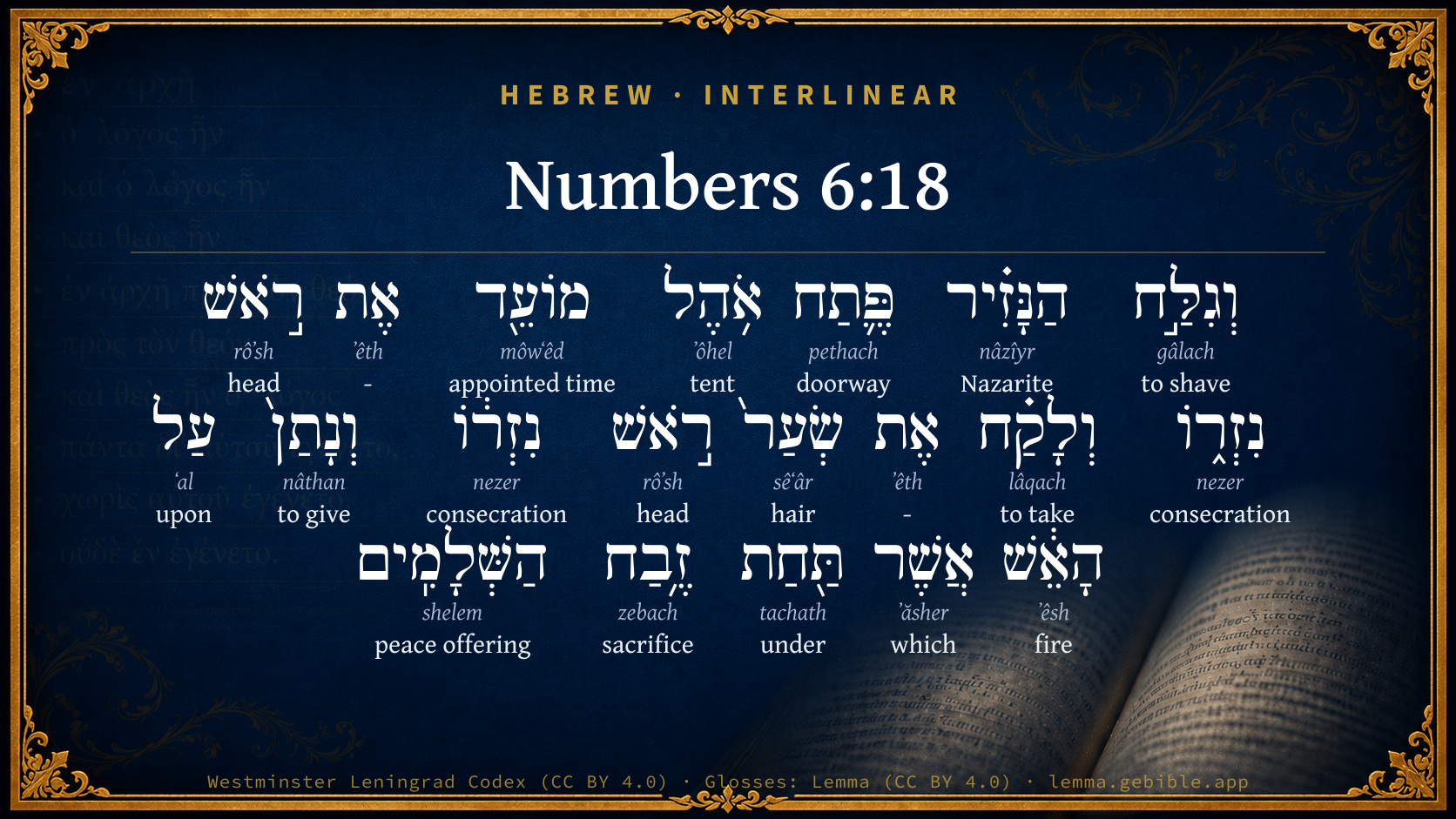
Hebrew (Westminster Leningrad Codex) Numbers 6:18 appears in the Hebrew Old Testament. The text above is from the Westminster Leningrad Codex. Each word links to its Strong’s number, a concise gloss, and parsing drawn from the Open Scriptures Hebrew Bible morphology. Click any word for its full Brown-Driver-Briggs (BDB) entry.
Download image
Cite this verse

Numbers 6:18 (World English Bible). Public Domain. Lemma interlinear Bible study tool, https://lemma.gebible.app/v/numbers/6/18.

Show BibTeX & RIS
BibTeX
RIS
English Translation
The Nazirite shall shave the head of his separation at the door of the Tent of Meeting, and shall take the hair of the head of his separation, and put it on the fire which is under the sacrifice of peace offerings.
World English Bible · Public Domain
Download a study sheet

One document with this verse’s original text, its word-by-word gloss line, the meaning frame, cross-references with their text, attributed commentary, and full source and license credits — printable, and it pastes into notes with its structure intact.

This verse Autodidact and up

Study sheet (.html) Plain text (.txt)

A passage Seminary Student

Up to 50 verses in one chapter. A passage sheet keeps up to 6 commentary sources and 12 cross-references per verse, in the order this page ranks them, and says so on the sheet whenever that leaves anything out. Ask for a single verse and you get the Autodidact verse sheet above.

Everything on this page stays free to read, with no account — the sheet is a download of what is already on screen, not access to it.

Want to remove ads? Support Godless Engineer
Compare translations 3

The same verse in 3 English versions, stacked beneath the original-language interlinear above. Click any original word for its lexicon entry.

Each is an independent rendering of the whole verse — the interlinear is not word-aligned to these translations.

Highlighted words mark where these versions differ — a whole-verse word diff, not a word-by-word alignment.

  • World English Bible Public Domain
    The Nazirite shall shave the head of his separation at the door of the Tent of Meeting, and shall take the hair of the head of his separation, and put it on the fire which is under the sacrifice of peace offerings.
  • King James Version Public Domain
    And the Nazarite shall shave the head of his separation at the door of the tabernacle of the congregation, and shall take the hair of the head of his separation, and put it in the fire which is under the sacrifice of the peace offerings.
  • unfoldingWord Literal Text CC BY-SA 4.0
    And the Nazirite shall shave the head of his separation the opening of the tent of meeting, and he shall take the hair of the head of his separation, and he shall put on the fire that under the sacrifice of peace offering.

unfoldingWord Literal Text — © unfoldingWord, licensed CC BY-SA 4.0. Word-aligned USFM3 via Door43 (git.door43.org/unfoldingWord/en_ult).

Versions to compare (up to 4)

3 of 4 selected

Show all 18 translations

Every available English version of this verse, each an independent rendering of the whole verse.

  • World English Bible Public Domain
    The Nazirite shall shave the head of his separation at the door of the Tent of Meeting, and shall take the hair of the head of his separation, and put it on the fire which is under the sacrifice of peace offerings.
  • Berean Standard Bible Public Domain
    Then at the entrance to the Tent of Meeting, the Nazirite is to shave his consecrated head, take the hair, and put it on the fire under the peace offering.
  • Majority Standard Bible Public Domain
    Then at the entrance to the Tent of Meeting, the Nazirite is to shave his consecrated head, take the hair, and put it on the fire under the peace offering.
  • King James Version Public Domain
    And the Nazarite shall shave the head of his separation at the door of the tabernacle of the congregation, and shall take the hair of the head of his separation, and put it in the fire which is under the sacrifice of the peace offerings.
  • American Standard Version (1901) Public Domain
    And the Nazirite shall shave the head of his separation at the door of the tent of meeting, and shall take the hair of the head of his separation, and put it on the fire which is under the sacrifice of peace-offerings.
  • Revised Version (1885) Public Domain
    And the Nazirite shall shave the head of his separation at the door of the tent of meeting, and shall take the hair of the head of his separation, and put it on the fire which is under the sacrifice of peace offerings.
  • Geneva Bible (1599) Public Domain
    And the Nazarite shall shaue the head of his consecration at the doore of the Tabernacle of the Congregation, and shall take the heare of the head of his consecration, and put it in the fire, which is vnder the peace offring.
  • Douay-Rheims (1899) Public Domain
    Then shall the hair of the consecration of the Nazarite, be shaved off before the door of the tabernacle of the covenant: and he shall take his hair, and lay it upon the fire, which is under the sacrifice of the peace offerings.
  • Young's Literal Translation Public Domain
    `And the Nazarite hath shaved (at the opening of the tent of meeting) the head of his separation, and hath taken the hair of the head of his separation, and hath put `it' on the fire which `is' under the sacrifice of the peace-offerings.
  • Literal Standard Version CC BY-SA 4.0
    And the Nazarite has shaved (at the opening of the Tent of Meeting) the head of his separation, and has taken the hair of the head of his separation, and has put [it] on the fire which [is] under the sacrifice of the peace-offerings.
  • Unlocked Literal Bible CC BY-SA 4.0
    The Nazirite must shave his head indicating his separation to God at the entrance to the tent of meeting. He must take the hair from his head and put it on the fire that is under the sacrifice of fellowship offerings.
  • unfoldingWord Literal Text CC BY-SA 4.0
    And the Nazirite shall shave the head of his separation the opening of the tent of meeting, and he shall take the hair of the head of his separation, and he shall put on the fire that under the sacrifice of peace offering.
  • Darby Bible Public Domain
    And the Nazarite shall shave the head of his consecration at the entrance to the tent of meeting, and shall take the hair of the head of his consecration, and put it on the fire which is under the sacrifice of the peace-offering.
  • World Messianic Bible Public Domain
    The Nazirite shall shave the head of his separation at the door of the Tent of Meeting, take the hair of the head of his separation, and put it on the fire which is under the sacrifice of peace offerings.
  • Webster's Bible Public Domain
    And the Nazarite shall shave the head of his separation at the door of the tabernacle of the congregation, and shall take the hair of the head of his separation, and put it in the fire which is under the sacrifice of the peace-offerings.
  • Free Bible Version CC BY-SA 4.0
    Then the Nazirites are to shave their heads at the entrance to the Tent of Meeting. They shall take the hair from their heads that were dedicated, and place it on the fire under the peace offering.
  • Bible in Basic English Public Domain
    Then let his long hair, the sign of his oath, be cut off at the door of the Tent of meeting, and let him put it on the fire on which the peace-offerings are burning.
  • JPS Tanakh (1917) Public Domain
    And the Nazirite shall shave his consecrated head at the door of the tent of meeting, and shall take the hair of his consecrated head, and put it on the fire which is under the sacrifice of peace-offerings.

Literal Standard Version (2020), Covenant Press — licensed CC BY-SA 4.0. Text via the HelloAO Bible API (eBible.org). Unlocked Literal Bible (unfoldingWord) — licensed CC BY-SA 4.0. Text via the HelloAO Bible API (eBible.org). unfoldingWord Literal Text — © unfoldingWord, licensed CC BY-SA 4.0. Word-aligned USFM3 via Door43 (git.door43.org/unfoldingWord/en_ult). Free Bible Version, Dr. Jonathan Gallagher — licensed CC BY-SA 4.0. Text via the HelloAO Bible API (eBible.org).

Word by word

More ways to search: Search by grammar → Find every occurrence → Compare this word →

Practice this passage: Drill this verse → Learn its vocabulary →

הַנָּזִ֗יר
nâzîyr
H5139
“the · Nazarite”
Particle, Definite Article + Noun, Common, Masculine, Singular, Absolute
Part of Speech
Particle + Noun
Type
Common
Gender
Masculine
Number
Singular
State
Absolute
Full BDB Definition

Origin: from H5144

TWOT: 1340b

consecrated or devoted one, Nazarite - consecrated one - devotee, Nazarite - untrimmed (vine)
  1. וְגִלַּ֣ח gâlach H1548 “and · to shave” Conjunction + Verb, Piel, Sequential Perfect, 3rd Person, Masculine, Singular
  2. פֶּ֛תַח pethach H6607 “doorway of” Noun, Common, Masculine, Singular, Construct
  3. אֹ֥הֶל ʼôhel H168 “tent of” Noun, Common, Masculine, Singular, Construct
  4. מוֹעֵ֖ד môwʻêd H4150 “appointed time” Noun, Common, Masculine, Singular, Absolute
  5. אֶת ʼêth H853 “-” Particle, Direct Object
  6. רֹ֣אשׁ rôʼsh H7218 “head of” Noun, Common, Masculine, Singular, Construct
  7. נִזְר֑וֹ nezer H5145 “consecration · his” Noun, Common, Masculine, Singular, Construct + Suffix, Personal, 3rd Person, Masculine, Singular
  8. וְלָקַ֗ח lâqach H3947 “and · to take” Conjunction + Verb, Qal, Sequential Perfect, 3rd Person, Masculine, Singular
  9. אֶת ʼêth H853 “-” Particle, Direct Object
  10. שְׂעַר֙ sêʻâr H8181 “hair of” Noun, Common, Masculine, Singular, Construct
  11. רֹ֣אשׁ rôʼsh H7218 “head of” Noun, Common, Masculine, Singular, Construct
  12. נִזְר֔וֹ nezer H5145 “consecration · his” Noun, Common, Masculine, Singular, Construct + Suffix, Personal, 3rd Person, Masculine, Singular
  13. וְנָתַן֙ nâthan H5414 “and · to give” Conjunction + Verb, Qal, Sequential Perfect, 3rd Person, Masculine, Singular
  14. עַל ʻal H5921 “upon” Preposition
  15. הָאֵ֔שׁ ʼêsh H784 “the · fire” Particle, Definite Article + Noun, Common, Both, Singular, Absolute
  16. אֲשֶׁר ʼăsher H834 “which” Particle, Relative
  17. תַּ֖חַת tachath H8478 “under” Preposition
  18. זֶ֥בַח zebach H2077 “sacrifice of” Noun, Common, Masculine, Singular, Construct
  19. הַשְּׁלָמִֽים shelem H8002 “the · peace offerings” Particle, Definite Article + Noun, Common, Masculine, Plural, Absolute

About this verse

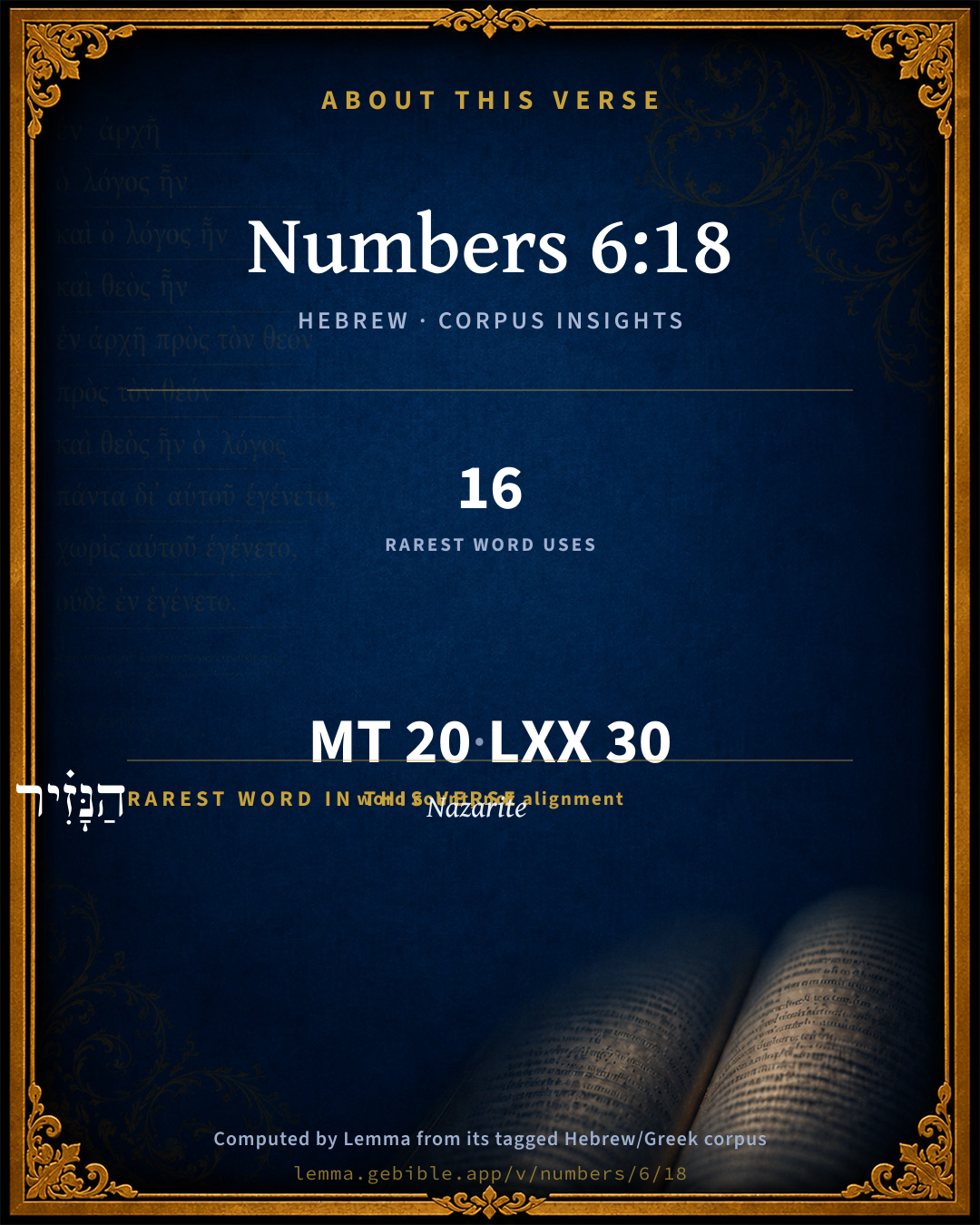
These counts appear in no published source. They are computed here, from the morphology-tagged text and Lemma’s own curated glosses. What Lemma adds →

20
words
17
distinct lemmas
Pentateuch
section

Notable vocabulary

The rarest word here is הַנָּזִ֗יר Nazarite H5139 — appearing just 16 times in the whole Hebrew Bible.

Shared distinctive vocabulary

הַנָּזִ֗יר Nazarite H5139 occurs in 16 verses of the Hebrew Bible. Also found in:

Grammatical profile

  • 3 verbs
  • 12 nouns
  • 2 prepositions
  • 3 particles

Verb forms

  • וְגִלַּ֣ח Piel · Sequential Perfect
  • וְלָקַ֗ח Qal · Sequential Perfect
  • וְנָתַן֙ Qal · Sequential Perfect

Repetition

Words recur within this verse — often emphatic in Hebrew:

  • רֹ֣אשׁ head H7218 ×2
  • נִזְר֑וֹ consecration H5145 ×2

Hebrew & Septuagint length

In English translation the verse runs 42 words from the Hebrew and 35 from the Septuagint (LXX English) — closely comparable.

A rough comparison of the two English renderings, which tokenize alike — not a word-level alignment.

Word counts can differ between the Hebrew and the Greek without any difference in meaning — e.g. the Hebrew direct-object marker אֵת has no separate Greek word, and Greek often adds the article ὁ.

In the original languages it is 20 Hebrew tokens and 30 Greek tokens — but the two are counted differently (Hebrew bundles its prefixes and suffixes into one token; the Greek is in lemma form), so that isn’t a like-for-like length.

Cross-references

7

Topical passages linked to Numbers 6:18 in the Treasury of Scripture Knowledge — connected by theme and wording, ordered by reader-vote popularity; previews shown in the World English Bible.

  • Acts 21:24 Take them, and purify yourself with them, and pay their expenses for them, that they may shave their heads. Then all will know that there is no truth in the things that they have been informed about you, but that you yourself also walk keeping the law.
  • Numbers 6:9 "If any man dies very suddenly beside him, and he defiles the head of his separation; then he shall shave his head in the day of his cleansing. On the seventh day he shall shave it.
  • Acts 18:18 Paul, having stayed after this many more days, took his leave of the brothers, and sailed from there for Syria, together with Priscilla and Aquila. He shaved his head in Cenchreae, for he had a vow.
  • Numbers 6:5 "All the days of his vow of separation there shall no razor come on his head, until the days are fulfilled, in which he separates himself to Yahweh. He shall be holy. He shall let the locks of the hair of his head grow long.
  • Luke 17:10 Even so you also, when you have done all the things that are commanded you, say, 'We are unworthy servants. We have done our duty.'"
  • Acts 21:26 Then Paul took the men, and the next day, purified himself and went with them into the temple, declaring the fulfillment of the days of purification, until the offering was offered for every one of them.
  • Ephesians 1:6 to the praise of the glory of his grace, by which he freely bestowed favor on us in the Beloved,

Cross-references courtesy of OpenBible.info (CC BY 4.0).

Hebrew and Greek witnesses Masoretic Hebrew ↔ Greek Septuagint

The same verse in the two great witnesses to the Old Testament, shown verse-for-verse.

These are two independent witnesses, not word-aligned to each other, and the Septuagint is shown in lemma (dictionary) form.

Hebrew Numbers 6:18 Masoretic · Westminster Leningrad Codex

וְגִלַּ֣ח הַנָּזִ֗יר פֶּ֛תַח אֹ֥הֶל מוֹעֵ֖ד אֶת רֹ֣אשׁ נִזְר֑וֹ וְלָקַ֗ח אֶת שְׂעַר֙ רֹ֣אשׁ נִזְר֔וֹ וְנָתַן֙ עַל הָאֵ֔שׁ אֲשֶׁר תַּ֖חַת זֶ֥בַח הַשְּׁלָמִֽים

The Nazirite shall shave the head of his separation at the door of the Tent of Meeting, and shall take the hair of the head of his separation, and put it on the fire which is under the sacrifice of peace offerings.

World English Bible · Public Domain

Greek LXX Numbers 6:18 Septuagint · lemma form

καί ξυράω ὁ εὔχομαι παρά ὁ θύρα ὁ σκηνή ὁ μαρτύριον ὁ κεφαλή ὁ εὐχή αὐτός καί ἐπιτίθημι ὁ θρίξ ἐπί ὁ πῦρ ὅς εἰμί ὑπό ὁ θυσία ὁ σωτήριον

And he that has vowed shall shave the head of his consecration by the doors of the tabernacle of witness, and shall put the hairs on the fire which is under the sacrifice of peace-offering.

LXX2012 (modern English Septuagint) · Public Domain

On this verse, Haydock's Catholic Bible Commentary discusses the Septuagint’s reading. Read the note in Commentary ↓

Hebrew: Westminster Leningrad Codex (CC BY 4.0). Greek: Septuagint (public domain); English from LXX2012 (modern English Septuagint) (Public Domain). How the Septuagint differs from the Hebrew →

Targum (Aramaic paraphrase)

2

The Targum is the ancient Jewish Aramaic paraphrase of the Hebrew Scriptures — an interpretive translation, not the Hebrew text itself. Onkelos (literal) and Pseudo-Jonathan (expansive) render the Torah, and Jonathan the Prophets. Coverage is partial: where no permissively-licensed English translation exists for a verse, only the Aramaic is shown. This is verse-level text, not a word-by-word alignment to the Hebrew.

  1. Targum Onkelos Torah (Genesis–Deuteronomy)
    וִיגַלַח נְזִירָא בִּתְרַע מַשְׁכַּן זִמְנָא יָת רֵישׁ נִזְרֵהּ וְיִסַב יָת שְׂעַר רֵישׁ נִזְרֵהּ וְיִתֵּן עַל אֶשָׁתָא דִי תְחוֹת דוּדָא דְנִכְסַת קוּדְשַׁיָא

    (no public-domain English translation for this verse)

    Targum Onkelos — Aramaic: “Onkelos Genesis” (public domain); “Onkelos Exodus” (public domain); “Onkelos Leviticus” (public domain); “Onkelos Numbers” (public domain); “Onkelos Deuteronomy” (public domain). English: “Sefaria Community Translation” (CC0 1.0 (public-domain dedication)); “J.W. Etheridge. The Targums of Onkelos and Jonathan Ben Uzziel on the Pentateuch. London: Longmans, Green, 1862” (public domain). Text via Sefaria.

  2. Targum Pseudo-Jonathan Torah (Genesis–Deuteronomy)
    וִיגַלַח נְזִירָא יַת רֵישׁ נִזְרֵיהּ לְבָרָא בָּתַר דִנְכִיסוּ יַת נִכְסַת קוּדְשַׁיָא בִּתְרַע מַשְׁכַּן זִמְנָא וְיִסַב יַת שְעַר רֵישׁ נִזְרֵיהּ וְיִתֵּן עַל אֵשָׁתָא דִתְחוֹת דוּדָא דְנִכְסַת קוּדְשַׁיָא

    And the Nazir shall shave his consecrated head, without, after the offering of the holy oblations at the door of the tabernacle of ordinance, and take the hair of his consecrated head, and lay it on the fire that is under the cauldron of the peace offering.

    Targum Pseudo-Jonathan — Aramaic: “Targum Jonathan on Genesis” (public domain); “Targum Jonathan on Exodus” (public domain); “Targum Jonathan on Leviticus” (public domain); “Targum Jonathan on Numbers” (public domain); “Targum Jonathan on Deuteronomy” (public domain). English: “The Targum of Jonathan ben Uzziel, trans. J. W. Etheridge, London, 1862” (public domain). Text via Sefaria.

Commentary

Notes on Numbers 6:18 from classic Christian and Jewish commentators (each source and its license shown beneath its notes). The classic Christian expositions comment on the surrounding passage and are grouped to its opening verse, so a note may address several verses; the Jewish commentaries on the Tanakh (Rashi and others) are per-verse, so they appear only where the commentator wrote on this verse.

Lemma curates 59 commentaries, every one of them public domain or Creative Commons licensed, each selected and text-cleaned for this edition rather than reprinted as found. About our sources →

Trapp's Complete Commentary

John Trapp

Num 6:18 And the Nazarite shall shave the head of his separation [at] the door of the tabernacle of the congregation, and shall take the hair of the head of his separation, and put [it] in the fire which [is] under the sacrifice of the peace offerings.

Ver. 18. And put it in the fire.] To teach us, that the Lord so loveth his children, that he esteemeth the least hair of their head as a precious gift.

John Trapp, A Commentary or Exposition upon All the Books of the Old and New Testament (1647–1656) — public domain. Text from a community e-Sword module.

Joseph Benson's Commentary

Num 6:18. At the door of the tabernacle — Publicly, that it might be known that his vow was ended; and therefore he was at liberty as to those things from which he had restrained himself for a season, otherwise some might have taken offence at his use of his liberty. The fire — Upon which the flesh of the peace-offerings was boiled.

Joseph Benson's Commentary on the Old and New Testaments (1811–1818) — public domain. Text from a community e-Sword module.

Geneva Bible (1599)

Geneva Bible translators

In token that his vow is ended.

For the hair which was consecrated to the Lord, might not be cast into any profane place.

Geneva Bible (1599) marginal notes — public domain. Text via Bolls.life.

Adam Clarke's Commentary

Verse 18. Shall take the hair - and put it in the fire] The hair was permitted to grow for this purpose; and as the Nazarite was a kind of sacrifice, offered to God through the whole term of his nazarate or separation, and no human flesh or blood could be offered on the altar of the Lord, he offered his hair at the conclusion of his separation, as a sacrifice - that hair which was the token of his complete subjection to the Lord, and which was now considered as the Lord's property.

The Hindoos, after a vow, do not cut their hair during the term of their vow; but at the expiration of it they shave it off at the place where the vow was made.

That the hair of the head was superstitiously used among different nations, we have already had occasion to remark; (See Clarke on Le 19:27;) and that the Gentiles might have learned this from the Jews is possible, though some learned men think that this consecration of the hair to a deity was in use among the heathens before the time of Moses, and in nations who had no intercourse or connection with the Jews.

Adam Clarke's Commentary on the Bible (1810–1826) — public domain. Text from a community e-Sword/MySword module.

Ellicott's Commentary for English Readers

(18) And the Nazarita shall shave . . . —The consignment of his hair to the sacrificial fire formed a solemn and suitable termination of the days of his separation to the Lord during the continuance of his Nazirite vow.

A Bible Commentary for English Readers, edited by Charles John Ellicott (1878–1897) — public domain. Text from a community e-Sword module.

The Cambridge Bible for Schools and Colleges

gen. ed. J. J. S. Perowne

18. The burning of the hair is of the nature of an offering, and also prevents its desecration. The custom is not confined to the Hebrews, but finds many parallels in antiquity and in primitive races to-day. The hair is considered to be the special seat of the life and strength of the man, and thus represents the man himself when it is offered to the deity.

The Cambridge Bible for Schools and Colleges (gen. ed. J. J. S. Perowne; Cambridge University Press, 1878–1918) — public domain. Text from a community e-Sword module.

John Gill's Exposition

And the priest shall take the sodden shoulder of the ram,.... The left shoulder, for the right shoulder, which is the heave shoulder of every peace offering, belonged to the priest by another law; and by this law of the Nazarite, he had also the other shoulder, and so had both, which was peculiar to this case; the vow of the Nazarite being a very sacred thing and he being enabled to perform it, a greater expression of gratitude for it was expected and required of him: this shoulder was taken out of the pot in which it was boiled:

and one unleavened cake out of the basket, and one unleavened wafer; one of the ten cakes, and one of the ten wafers, both are mentioned; and which appear by this to be together in the basket of unleavened bread, from whence they were now to be taken, the rest having been offered with the other sacrifices:

and shall put them upon the hands of the Nazarite; the boiled shoulder, and the cake and wafer upon it:

after the hair of his separation is shaven; and cast into the fire; for the waving of these seems to be the last and finishing part of this whole affair.

John Gill's Exposition of the Whole Bible (1746–1763) — public domain (CC PDM 1.0). Text via the HelloAO Bible API.

Haydock's Catholic Bible Commentary

Fire, on the altar, where the ram has been sacrificed. (Abulensis.) Lyranus thinks it was burnt on the fire, with which the meat was boiled. (Menochius) (Chaldean) (Tirinus) --- The Septuagint, Philo, &c., understand it in the former sense; and Theodoret says the consecrated hair was placed upon the victim on the fire. (Calmet)

George Leo Haydock (1774–1849), Haydock's Catholic Family Bible and Commentary, 1859 edition — public domain. Excludes Psalms (Douay-Rheims chapter numbering differs from Protestant) and Deuterocanonical books (Catholic canon only).

Matthew Poole's English Annotations

Of his separation; or, of his Nazariteship, i.e. in which the chief of his Nazariteship or separation to God consisted.

At the door of the tabernacle; publicly, that it might be known that his vow was ended; and therefore he was at liberty as to those things from which he had restrained himself for a season, otherwise some might have been scandalized at his use of his liberty. See Act 21:26.

In the fire; either,

1. The fire of the altar. But why then is this restrained to the peaceofferings, seeing it was common to the burnt-offerings and to the sinofferings? Or rather,

2. To the fire of the kitchen, upon which the flesh of the peace-offerings was boiled.

Matthew Poole's English Annotations on the Holy Bible (1683–1685) — public domain. Text from a community e-Sword/MySword module.

Whedon's Commentary on the Bible

Daniel D. Whedon

18. Put it in the fire — Traces of the hair sacrifice are found among the Greeks in the case of Achilles, at the funeral of Patroclus, who cut off his golden locks and threw them into the flood as a sacrifice to the river-god. Nero cut off his first beard, and, putting it into a box studded with jewels, consecrated it to Jupiter Capitolinus. Virgil says that the topmost lock was dedicated to the infernal gods. These practices may have been derived from the Jewish Nazarites.

Daniel D. Whedon (gen. ed.), Commentary on the Old and New Testaments (1874–1909) — public domain. Text from a community e-Sword module.

The Pulpit Commentary

Shall take the hair of the head of his separation, and shall put it in the fire which is under the sacrifice of the peace offerings. It is not said, nor intended, that the hair was offered to God as a sacrifice. If so, it would have been burnt with the burnt offering which represented the self-dedication of the worshipper. It had been holy to the Lord, growing uncut all the days of the vow. The vow was now at an end; the last solemn act of sacrifice, the peace offering, which completed all, and typified that fearless and thankful communion with God which is the end of all religion, was now going on; it was fitting that the hair which must now be shorn, but could not be disposed of in any ordinary way, should be burnt upon the altar of God. In the fire, i.e., on the brazen altar. In later days it seems to have been done in a room assigned to the Nazirites in the court of the women: another deviation from the ordinal law.

The Pulpit Commentary (1880–1919), ed. H.D.M. Spence-Jones & Joseph S. Exell — public domain. Text from a community e-Sword module.

John Wesley's Explanatory Notes

At the door - Publickly, that it might be known that his vow was ended, and therefore he was at liberty as to those things from which he had restrained himself for a season, otherwise some might have been scandalized at his use of his liberty. The fire - Upon which the flesh of the peace-offerings was boiled.

John Wesley, Explanatory Notes Upon the Whole Bible (1754–1765) — public domain. Text via the GEBible commentary corpus.

unfoldingWord translationNotes

Door43 World Missions Community

indicating his separation

Here "separation" means "dedication." Also, this abstract noun may be written as a verb. AT: "indicating his dedication" or "indicating how he has separated himself" (See: Idiom and Abstract Nouns)

translationWords

God

tent of meeting

fire

unfoldingWord translationNotes — © Distant Shores Media and the Door43 World Missions Community, licensed CC BY-SA 4.0. Source: git.door43.org/Door43/en_tn.

Rashi

Rabbi Shlomo Yitzchaki (Rashi)

וגלח הנזיר פתח אהל מועד AND THE NAZARITE SHALL CLIP [THE HAIR OF THE HEAD OF HIS NAZARITEHOOD] AT THE ENTRANCE OF THE APPOINTED TENT — One might think that he must cut his hair in the forecourt (for it states at the entrance of the appointed tent)! Surely, this would be treating the forecourt in a contemptuous manner! But the meaning is: the Nazarite shall cut his hair after the feast-offerings had been slaughtered of which Scripture writes, (Leviticus 3:2) “and he shall slaughter it פתח אהל מועד” (cf. Sifrei Bamidbar 35; Nazir 45a).

אשר תחת זבח השלמים [AND HE SHALL TAKE THE HAIR … AND PUT IT IN THE FIRE] WHICH IS UNDER THE SACRIFICE OF THE FEAST-OFFERINGS — i.e., under the pot in which he boils it (the שלמים); because the feast offerings of the Nazarite were boiled in the forecourt since the priest had to take “the shoulder” after it had been boiled (cf. vv. 19 and 20) and to wave it before the Lord (cf. Nazir 45b).

Rashi on the Tanakh — English translations: “The Judaica Press complete Tanach with Rashi, translated by A. J. Rosenberg” (CC BY 4.0); “Pentateuch with Rashi's commentary by M. Rosenbaum and A.M. Silbermann, 1929-1934” (public domain); “The Metsudah Tanach series, Lakewood, N.J” (CC BY 4.0); and “The Book of Joshua, Metsudah Publications, 1997” (CC BY 4.0). Text via Sefaria.

Lesson kit

Teaching starters — assembled from the data on this page, not authored interpretation. Every prompt links to the verse data it draws on. Edit before teaching.

Numbers, in the Pentateuch, opens this verse with 20 words (17 distinct Hebrew lemmas). Its most distinctive word is nâzîyr (“Nazarite”). A historical commentator’s framing appears above. Read the whole chapter for the surrounding context.

Discussion questions

  1. The word nâzîyr carries the sense “Nazarite.” How does it shape the verse?
  2. How does Genesis 49:26, which shares the word «Nazarite», read alongside this verse?
  3. What does the repetition of “head” (2× in this one verse) do in this verse?
  4. The translations on this page render this verse differently — a whole-verse word diff, not a word-by-word alignment. What might account for the different wordings?
  5. «וְגִלַּ֣ח» is a Piel Sequential Perfect verb. How does that grammatical form shape the action described?
  6. Compare how Trapp's Complete Commentary and Joseph Benson's Commentary read this verse. Where do they agree or differ?

Things to notice

Reading settings

Reading text

Shown beneath each verse's original-language words.

Old Testament
Old Testament edition

Read the OT as the Masoretic Hebrew (MT) or the Greek Septuagint (LXX).

English shown for the Greek Septuagint (in the Hebrew ↔ Greek comparison).

Comparing translations? Open the Compare panel on any verse page to stack up to four side by side.