

2 Chronicles 7:3

Hebrew (Westminster Leningrad Codex) 2 Chronicles 7:3 appears in the Hebrew Old Testament. The text above is from the Westminster Leningrad Codex. Each word links to its Strong’s number, a concise gloss, and parsing drawn from the Open Scriptures Hebrew Bible morphology. Click any word for its full Brown-Driver-Briggs (BDB) entry.
Download image
Cite this verse

2 Chronicles 7:3 (World English Bible). Public Domain. Lemma interlinear Bible study tool, https://lemma.gebible.app/v/2-chronicles/7/3.

Show BibTeX & RIS
BibTeX
RIS
English Translation
All the children of Israel looked on, when the fire came down, and the glory of Yahweh was on the house; and they bowed themselves with their faces to the ground on the pavement, and worshiped, and gave thanks to Yahweh, [saying], For he is good; for his loving kindness endures for ever.
World English Bible · Public Domain
Highlights
  • 1 first appearance in the Hebrew Bible
Full analysis ↓
Download a study sheet

One document with this verse’s original text, its word-by-word gloss line, the meaning frame, cross-references with their text, attributed commentary, and full source and license credits — printable, and it pastes into notes with its structure intact.

This verse Autodidact and up

Study sheet (.html) Plain text (.txt)

A passage Seminary Student

Up to 50 verses in one chapter. A passage sheet keeps up to 6 commentary sources and 12 cross-references per verse, in the order this page ranks them, and says so on the sheet whenever that leaves anything out. Ask for a single verse and you get the Autodidact verse sheet above.

Everything on this page stays free to read, with no account — the sheet is a download of what is already on screen, not access to it.

Want to remove ads? Support Godless Engineer
Compare translations 3

The same verse in 3 English versions, stacked beneath the original-language interlinear above. Click any original word for its lexicon entry.

Each is an independent rendering of the whole verse — the interlinear is not word-aligned to these translations.

Highlighted words mark where these versions differ — a whole-verse word diff, not a word-by-word alignment.

  • World English Bible Public Domain
    All the children of Israel looked on, when the fire came down, and the glory of Yahweh was on the house; and they bowed themselves with their faces to the ground on the pavement, and worshiped, and gave thanks to Yahweh, [saying], For he is good; for his loving kindness endures for ever.
  • King James Version Public Domain
    And when all the children of Israel saw how the fire came down, and the glory of the LORD upon the house, they bowed themselves with their faces to the ground upon the pavement, and worshipped, and praised the LORD, saying, For he is good; for his mercy endureth for ever.
  • unfoldingWord Literal Text CC BY-SA 4.0
    And all the sons of Israel were seeing the fire come down and the glory of Yahweh on the house, and they bowed down their faces to the ground on the stone pavement, and they worshiped and gave thanks to Yahweh, “Truly he is good; truly his covenant faithfulness is forever.”

unfoldingWord Literal Text — © unfoldingWord, licensed CC BY-SA 4.0. Word-aligned USFM3 via Door43 (git.door43.org/unfoldingWord/en_ult).

Versions to compare (up to 4)

3 of 4 selected

Show all 18 translations

Every available English version of this verse, each an independent rendering of the whole verse.

  • World English Bible Public Domain
    All the children of Israel looked on, when the fire came down, and the glory of Yahweh was on the house; and they bowed themselves with their faces to the ground on the pavement, and worshiped, and gave thanks to Yahweh, [saying], For he is good; for his loving kindness endures for ever.
  • Berean Standard Bible Public Domain
    When all the Israelites saw the fire coming down and the glory of the LORD above the temple, they bowed down on the pavement with their faces to the ground, and they worshiped and gave thanks to the LORD: “For He is good; His loving devotion endures forever.”
  • Majority Standard Bible Public Domain
    When all the Israelites saw the fire coming down and the glory of the LORD above the temple, they bowed down on the pavement with their faces to the ground, and they worshiped and gave thanks to the LORD: “For He is good; His loving devotion endures forever.”
  • King James Version Public Domain
    And when all the children of Israel saw how the fire came down, and the glory of the LORD upon the house, they bowed themselves with their faces to the ground upon the pavement, and worshipped, and praised the LORD, saying, For he is good; for his mercy endureth for ever.
  • American Standard Version (1901) Public Domain
    And all the children of Israel looked on, when the fire came down, and the glory of Jehovah was upon the house; and they bowed themselves with their faces to the ground upon the pavement, and worshipped, and gave thanks unto Jehovah, `saying', For he is good; for his lovingkindness `endureth' for ever.
  • Revised Version (1885) Public Domain
    And all the children of Israel looked on, when the fire came down, and the glory of the LORD was upon the house; and they bowed themselves with their faces to the ground upon the pavement, and worshipped, and gave thanks unto the LORD, saying, For he is good; for his mercy endureth for ever.
  • Geneva Bible (1599) Public Domain
    And when all the children of Israel saw the fire, and the glory of the Lord come downe vpon the house, they bowed themselues with their faces to the earth vpon the pauement, and worshipped and praysed the Lord, saying, For he is good, because his mercy lasteth for euer.
  • Douay-Rheims (1899) Public Domain
    Moreover all the children of Israel saw the fire coming down, and the glory of the Lord upon the house: and falling down with their faces to the ground, upon the stone pavement, they adored and praised the Lord: because he is good, because his mercy endureth for ever.
  • Young's Literal Translation Public Domain
    And all the sons of Israel are looking on the descending of the fire, and the honour of Jehovah on the house, and they bow -- faces to the earth -- on the pavement, and do obeisance, and give thanks to Jehovah, for good, for to the age `is' His kindness.
  • Literal Standard Version CC BY-SA 4.0
    And all the sons of Israel are looking on the descending of the fire, and the glory of YHWH on the house, and they bow—faces to the earth—on the pavement, and pay respect, and give thanks to YHWH, [saying], “For [He is] good, for His kindness [is] for all time!”
  • Unlocked Literal Bible CC BY-SA 4.0
    When all the people of Israel saw the fire come down and the glory of Yahweh over the house, they bowed down with their faces to the ground on the stone pavement and worshiped and gave thanks to Yahweh. They said, “For he is good, for his covenant loyalty endures forever.”
  • unfoldingWord Literal Text CC BY-SA 4.0
    And all the sons of Israel were seeing the fire come down and the glory of Yahweh on the house, and they bowed down their faces to the ground on the stone pavement, and they worshiped and gave thanks to Yahweh, “Truly he is good; truly his covenant faithfulness is forever.”
  • Darby Bible Public Domain
    And all the children of Israel saw how the fire came down, and the glory of Jehovah upon the house, and bowed themselves with their faces to the ground on the pavement, and worshipped and thanked Jehovah: For he is good, for his loving-kindness [endureth] for ever.
  • World Messianic Bible Public Domain
    All the children of Israel looked on, when the fire came down, and the LORD’s glory was on the house. They bowed themselves with their faces to the ground on the pavement, worshiped, and gave thanks to the LORD, saying, “For he is good, for his loving kindness endures forever!”
  • Webster's Bible Public Domain
    And when all the children of Israel saw how the fire came down, and the glory of the LORD upon the house, they bowed themselves with their faces to the ground upon the pavement, and worshiped, and praised the LORD, saying, For he is good; for his mercy endureth for ever.
  • Free Bible Version CC BY-SA 4.0
    When all the Israelites saw the fire coming down and the glory of the Lord in the Temple, they knelt down and bowed their faces to the ground. They worshiped and praised the Lord, saying, “He is good! His trustworthy love lasts forever!”
  • Bible in Basic English Public Domain
    And all the children of Israel were looking on when the fire came down, and the glory of the Lord was on the house; and they went down on their knees, with their faces to the earth, worshipping and praising the Lord, and saying, He is good; for his mercy is unchanging for ever.
  • JPS Tanakh (1917) Public Domain
    And all the children of Israel looked on, when the fire came down, and the glory of the LORD was upon the house; and they bowed themselves with their faces to the ground upon the pavement, and prostrated themselves, and gave thanks unto the LORD; 'for He is good, for His mercy endureth for ever.'

Literal Standard Version (2020), Covenant Press — licensed CC BY-SA 4.0. Text via the HelloAO Bible API (eBible.org). Unlocked Literal Bible (unfoldingWord) — licensed CC BY-SA 4.0. Text via the HelloAO Bible API (eBible.org). unfoldingWord Literal Text — © unfoldingWord, licensed CC BY-SA 4.0. Word-aligned USFM3 via Door43 (git.door43.org/unfoldingWord/en_ult). Free Bible Version, Dr. Jonathan Gallagher — licensed CC BY-SA 4.0. Text via the HelloAO Bible API (eBible.org).

Word by word

More ways to search: Search by grammar → Find every occurrence → Compare this word →

Practice this passage: Drill this verse → Learn its vocabulary →

הָרִֽצְפָה֙
ritspâh
H7531
“the · pavement”
Particle, Definite Article + Noun, Common, Feminine, Singular, Absolute
Part of Speech
Particle + Noun
Type
Common
Gender
Feminine
Number
Singular
State
Absolute
Full BDB Definition

Origin: from H7529

TWOT: 2210a , 2211a

pavement - glowing stone or coal, live coal
  1. וְכֹ֣ל kôl H3605 “and · all of” Conjunction + Noun, Common, Masculine, Singular, Construct
  2. בְּנֵ֣י bên H1121 “sons of” Noun, Common, Masculine, Plural, Construct
  3. יִשְׂרָאֵ֗ל Yisrâʼêl H3478 “Israel” Noun, Proper
  4. רֹאִים֙ râʼâh H7200 “seeing” Verb, Qal, Participle Active, Masculine, Plural, Absolute
  5. בְּרֶ֣דֶת yârad H3381 “in/at · to go down” Preposition + Verb, Qal, Infinitive Construct
  6. הָאֵ֔שׁ ʼêsh H784 “the · fire” Particle, Definite Article + Noun, Common, Both, Singular, Absolute
  7. וּכְב֥וֹד kâbôwd H3519 “and · glory of” Conjunction + Noun, Common, Both, Singular, Construct
  8. יְהוָ֖ה Yᵉhôvâh H3068 “LORD” Noun, Proper
  9. עַל ʻal H5921 “upon” Preposition
  10. הַבָּ֑יִת bayith H1004 “the · house” Particle, Definite Article + Noun, Common, Masculine, Singular, Absolute
  11. וַיִּכְרְעוּ֩ kâraʻ H3766 “and · to bow” Conjunction + Verb, Qal, Sequential Imperfect, 3rd Person, Masculine, Plural
  12. אַפַּ֨יִם ʼaph H639 “nostrils” Noun, Common, Masculine, Dual, Absolute
  13. אַ֤רְצָה ʼerets H776 “land · toward” Noun, Common, Both, Singular, Absolute + Suffix, Demonstrative
  14. עַל ʻal H5921 “upon” Preposition
  15. וַיִּֽשְׁתַּֽחֲו֔וּ shâchâh H7812 “and · to bow down” Conjunction + Verb, Hithpael, Sequential Imperfect, 3rd Person, Masculine, Plural
  16. וְהוֹד֤וֹת yâdâh H3034 “and · to throw” Conjunction + Verb, Hiphil, Infinitive Construct
  17. לַיהוָה֙ Yᵉhôvâh H3068 “to/for · LORD” Preposition + Noun, Proper
  18. כִּ֣י kîy H3588 “that” Conjunction
  19. ט֔וֹב ṭôwb H2896 “good” Adjective, Adjective, Masculine, Singular, Absolute
  20. כִּ֥י kîy H3588 “that” Conjunction
  21. לְעוֹלָ֖ם ʻôwlâm H5769 “to/for · forever” Preposition + Noun, Common, Masculine, Singular, Absolute
  22. חַסְדּֽוֹ chêçêd H2617 “kindness · his” Noun, Common, Masculine, Singular, Construct + Suffix, Personal, 3rd Person, Masculine, Singular

About this verse

These counts appear in no published source. They are computed here, from the morphology-tagged text and Lemma’s own curated glosses. What Lemma adds →

23
words
20
distinct lemmas
Historical
section

Notable vocabulary

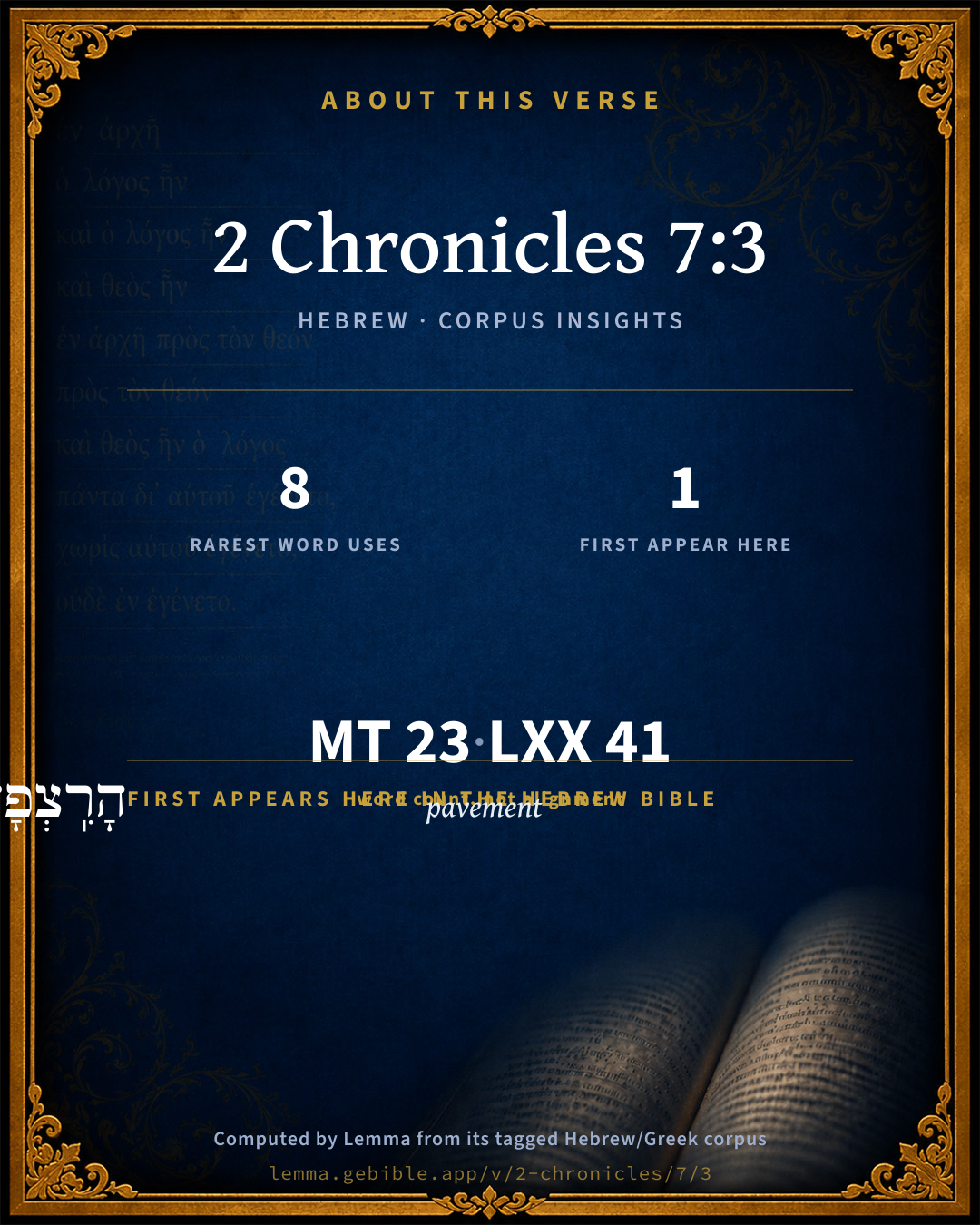
The rarest word here is הָרִֽצְפָה֙ pavement H7531 — appearing just 8 times in the whole Hebrew Bible.

First appearance in Scripture

This word makes its first canonical appearance in the Hebrew Bible here:

  • הָרִֽצְפָה֙ pavement H7531

Shared distinctive vocabulary

הָרִֽצְפָה֙ pavement H7531 occurs in 6 verses of the Hebrew Bible. Also found in:

Grammatical profile

  • 5 verbs
  • 13 nouns
  • 1 adjective
  • 2 prepositions
  • 2 conjunctions

Verb forms

  • רֹאִים֙ Qal · Participle Active
  • בְּרֶ֣דֶת Qal · Infinitive Construct
  • וַיִּכְרְעוּ֩ Qal · Sequential Imperfect
  • וַיִּֽשְׁתַּֽחֲו֔וּ Hithpael · Sequential Imperfect
  • וְהוֹד֤וֹת Hiphil · Infinitive Construct

Repetition

Words recur within this verse — often emphatic in Hebrew:

  • יְהוָ֖ה LORD H3068 ×2
  • עַל upon H5921 ×2
  • כִּ֣י that H3588 ×2

Hebrew & Septuagint length

In English translation the verse runs 53 words from the Hebrew and 51 from the Septuagint (LXX English) — closely comparable.

A rough comparison of the two English renderings, which tokenize alike — not a word-level alignment.

Word counts can differ between the Hebrew and the Greek without any difference in meaning — e.g. the Hebrew direct-object marker אֵת has no separate Greek word, and Greek often adds the article ὁ.

In the original languages it is 23 Hebrew tokens and 41 Greek tokens — but the two are counted differently (Hebrew bundles its prefixes and suffixes into one token; the Greek is in lemma form), so that isn’t a like-for-like length.

Cross-references

17

Topical passages linked to 2 Chronicles 7:3 in the Treasury of Scripture Knowledge — connected by theme and wording, ordered by reader-vote popularity; previews shown in the World English Bible.

  • 2 Chronicles 5:13 it happened, when the trumpeters and singers were as one, to make one sound to be heard in praising and thanking Yahweh; and when they lifted up their voice with the trumpets and cymbals and instruments of music, and praised Yahweh, [saying], For he is good; for his loving kindness endures forever; that then the house was filled with a cloud, even the house of Yahweh,
  • 2 Chronicles 20:21 When he had taken counsel with the people, he appointed those who should sing to Yahweh, and give praise in holy array, as they went out before the army, and say, Give thanks to Yahweh; for his loving kindness endures forever.
  • Luke 1:50 His mercy is for generations of generations on those who fear him.
  • Hebrews 7:24–25 But he, because he lives forever, has his priesthood unchangeable.
  • Ezra 3:11 They sang one to another in praising and giving thanks to Yahweh, [saying], For he is good, for his loving kindness endures forever toward Israel. All the people shouted with a great shout, when they praised Yahweh, because the foundation of the house of Yahweh was laid.
  • Isaiah 63:7 I will make mention of the loving kindnesses of Yahweh, [and] the praises of Yahweh, according to all that Yahweh has bestowed on us, and the great goodness toward the house of Israel, which he has bestowed on them according to his mercies, and according to the multitude of his loving kindnesses.
  • Exodus 4:31 The people believed, and when they heard that Yahweh had visited the children of Israel, and that he had seen their affliction, then they bowed their heads and worshiped.
  • Psalms 136:1–26 Give thanks to Yahweh, for he is good; For his loving kindness endures forever.
  • Leviticus 9:24 There came forth fire from before Yahweh, and consumed the burnt offering and the fat upon the altar: and when all the people saw it, they shouted, and fell on their faces.
  • Numbers 14:5 Then Moses and Aaron fell on their faces before all the assembly of the congregation of the children of Israel.
  • Numbers 16:22 They fell on their faces, and said, God, the God of the spirits of all flesh, shall one man sin, and will you be angry with all the congregation?
  • 1 Kings 18:39 When all the people saw it, they fell on their faces: and they said, Yahweh, he is God; Yahweh, he is God.
  • 1 Chronicles 16:41 and with them Heman and Jeduthun, and the rest who were chosen, who were mentioned by name, to give thanks to Yahweh, because his loving kindness endures forever;
  • 1 Chronicles 29:20 David said to all the assembly, Now bless Yahweh your God. All the assembly blessed Yahweh, the God of their fathers, and bowed down their heads, and worshiped Yahweh, and the king.
  • Psalms 95:6 Oh come, let's worship and bow down. Let's kneel before Yahweh, our Maker,
  • Psalms 103:17 But Yahweh's loving kindness is from everlasting to everlasting with those who fear him, His righteousness to children's children;
  • Jeremiah 33:11 the voice of joy and the voice of gladness, the voice of the bridegroom and the voice of the bride, the voice of those who say, Give thanks to Yahweh of Hosts, for Yahweh is good, for his loving kindness endures forever; [and of them] who bring [sacrifices of] thanksgiving into the house of Yahweh. For I will cause the captivity of the land to return as at the first, says Yahweh.

Cross-references courtesy of OpenBible.info (CC BY 4.0).

Hebrew and Greek witnesses Masoretic Hebrew ↔ Greek Septuagint

The same verse in the two great witnesses to the Old Testament, shown verse-for-verse.

These are two independent witnesses, not word-aligned to each other, and the Septuagint is shown in lemma (dictionary) form.

Hebrew 2 Chronicles 7:3 Masoretic · Westminster Leningrad Codex

וְכֹ֣ל בְּנֵ֣י יִשְׂרָאֵ֗ל רֹאִים֙ בְּרֶ֣דֶת הָאֵ֔שׁ וּכְב֥וֹד יְהוָ֖ה עַל הַבָּ֑יִת וַיִּכְרְעוּ֩ אַפַּ֨יִם אַ֤רְצָה עַל הָרִֽצְפָה֙ וַיִּֽשְׁתַּֽחֲו֔וּ וְהוֹד֤וֹת לַיהוָה֙ כִּ֣י ט֔וֹב כִּ֥י לְעוֹלָ֖ם חַסְדּֽוֹ

All the children of Israel looked on, when the fire came down, and the glory of Yahweh was on the house; and they bowed themselves with their faces to the ground on the pavement, and worshiped, and gave thanks to Yahweh, [saying], For he is good; for his loving kindness endures for ever.

World English Bible · Public Domain

Greek LXX 2 Chronicles 7:3 Septuagint · lemma form

καί πᾶς ὁ υἱός ἰσραήλ ὁράω καταβαίνω ὁ πῦρ καί ὁ δόξα κύριος ἐπί ὁ οἶκος καί πίπτω ἐπί πρόσωπον ἐπί ὁ γῆ ἐπί ὁ λιθόστρωτος καί προςκυνέω καί αἰνέω ὁ κύριος ὅτι ἀγαθός ὅτι εἰς ὁ αἰών ὁ ἔλεος αὐτός

And all the children of Israel saw the fire descending, and the glory of the Lord was upon the house: and they fell upon their face to the ground on the pavement, and worshipped, and praised the Lord; for it is good to do so, because his mercy endures for ever.

LXX2012 (modern English Septuagint) · Public Domain

On this verse, Ellicott's Commentary for English Readers discusses the Septuagint’s reading. Read the note in Commentary ↓

Hebrew: Westminster Leningrad Codex (CC BY 4.0). Greek: Septuagint (public domain); English from LXX2012 (modern English Septuagint) (Public Domain). How the Septuagint differs from the Hebrew →

Commentary

Notes on 2 Chronicles 7:3 from classic Christian and Jewish commentators (each source and its license shown beneath its notes). The classic Christian expositions comment on the surrounding passage and are grouped to its opening verse, so a note may address several verses; the Jewish commentaries on the Tanakh (Rashi and others) are per-verse, so they appear only where the commentator wrote on this verse.

Lemma curates 59 commentaries, every one of them public domain or Creative Commons licensed, each selected and text-cleaned for this edition rather than reprinted as found. About our sources →

Trapp's Complete Commentary

John Trapp

2Ch 7:3 And when all the children of Israel saw how the fire came down, and the glory of the LORD upon the house, they bowed themselves with their faces to the ground upon the pavement, and worshipped, and praised the LORD, [saying], For [he is] good; for his mercy [endureth] for ever.

Ver. 3. Saw how the fire came down.] Though the Lord do not now thus sensibly answer prayers by fire from heaven, or by shaking the house, as Act 4:31, yet by faith we are assured, and by experience confirmed, that they are graciously accepted.

John Trapp, A Commentary or Exposition upon All the Books of the Old and New Testament (1647–1656) — public domain. Text from a community e-Sword module.

Joseph Benson's Commentary

2Ch 7:3. The glory of the Lord upon the house — The cloud first came down upon the house, and then entered into the house, and was seen both within it by the priests, and without it by the people; who by this evident token of the divine presence, and the sudden and miraculous descent of the fire, were fully satisfied that it was God’s house, and that he would accept their sacrifices offered there, hear their prayers, and bestow his blessings upon them. They bowed themselves with their faces to the ground upon the pavement — Fell prostrate upon the ground, thus expressing their awful dread of the divine majesty, their cheerful submission to the divine authority, and the sense they had of their utter unworthiness to enter into his presence. And worshipped and praised the Lord — As they had great reason to do, having seen such manifest tokens of his presence among them. Saying, For he is good, &c. — Thus using the same words in which the priests had just before praised him: a song never out of season, and for which our hearts and tongues should never be out of tune.

Joseph Benson's Commentary on the Old and New Testaments (1811–1818) — public domain. Text from a community e-Sword module.

Jamieson, Fausset & Brown

Robert Jamieson, A. R. Fausset & David Brown

all the children of Israel . . . bowed themselves with their faces to the ground upon the pavement--This form of prostration (that of lying on one's knees with the forehead touching the earth), is the manner in which the Hebrews, and Orientals in general, express the most profound sentiments of reverence and humility. The courts of the temple were densely crowded on the occasion, and the immense multitude threw themselves on the ground. What led the Israelites suddenly to assume that prostrate attitude on the occasion referred to, was the spectacle of the symbolical cloud slowly and majestically descending upon the temple, and then entering it.

Jamieson, Fausset & Brown — Commentary Critical and Explanatory on the Whole Bible (1871) — public domain (CC PDM 1.0). Text via the HelloAO Bible API.

Ellicott's Commentary for English Readers

(3) Upon the pavement.—Riçpâh; rendered by the LXX. τὸ λιθόστρωτον, which is the word used in Joh_19:13; Vulg., “pavimentum stratum lapide.” (Comp. Eze_40:17-18; Est_1:6, a tesselated pavement.)

And praised.—Gave thanks to Jehovah. The infinitive is here used for the finite form of the verb, as elsewhere.

For he is good; for his mercy endureth for ever.—See 1Ch_16:34-41; 1Ch_23:30; 2Ch_5:13; 2Ch_20:21. The Syriac and Arabic paraphrase, “and they said one to another: Give thanks to the Lord,” &c. There is hardly anything in the section, except this last phrase, which can be said to be characteristic of the style of the chronicler.

A Bible Commentary for English Readers, edited by Charles John Ellicott (1878–1897) — public domain. Text from a community e-Sword module.

The Cambridge Bible for Schools and Colleges

gen. ed. J. J. S. Perowne

3. And when all the children of Israel saw how the fire came down] R.V. And all the children of Israel looked on, when the fire came down.

praised the Lord] R.V. gave thanks unto the LORD; cp. 2Ch_5:13.

The Cambridge Bible for Schools and Colleges (gen. ed. J. J. S. Perowne; Cambridge University Press, 1878–1918) — public domain. Text from a community e-Sword module.

John Gill's Exposition

And when all the children of Israel saw how the fire came down,.... From heaven upon the sacrifice, and consumed it, which was all visible to the eye; or it may be this was a distinct fire from the former, since it seems to have come down upon the house, and so may denote a bright, shining, glorious light; the same with what follows:

and the glory of the Lord upon the house; for not only the house was filled with the glory, but there was a bright stream of light and glory over it, very dazzling and surprising:

they bowed themselves with their faces to the ground upon the pavement; of the great court, where they were assembled:

and worshipped and praised the Lord: worshipped him by praising him:

saying, for he is good; in his nature, promises, and blessings; is good, and does good:

for his mercy endureth for ever; this was the close of their song of praise.

John Gill's Exposition of the Whole Bible (1746–1763) — public domain (CC PDM 1.0). Text via the HelloAO Bible API.

Haydock's Catholic Bible Commentary

Glory. The same word was before rendered majesty. (Haydock)

George Leo Haydock (1774–1849), Haydock's Catholic Family Bible and Commentary, 1859 edition — public domain. Excludes Psalms (Douay-Rheims chapter numbering differs from Protestant) and Deuterocanonical books (Catholic canon only).

Matthew Poole's English Annotations

The cloud first came down upon the house, and then entered into the house, and was seen both within it by the priests, and without it by the people.

Matthew Poole's English Annotations on the Holy Bible (1683–1685) — public domain. Text from a community e-Sword/MySword module.

The Pulpit Commentary

For he is good (so 2Ch_5:13; 1Ch_16:34)

The Pulpit Commentary (1880–1919), ed. H.D.M. Spence-Jones & Joseph S. Exell — public domain. Text from a community e-Sword module.

John Wesley's Explanatory Notes

With their faces - Thus expressing their awful dread of the Divine Majesty, their chearful submission to the Divine authority, and the sense they had of their utter unworthiness to enter into his presence. Upon - The cloud first came down upon the house, and then entered into the house, and was seen both within it by the priests, and without it by the people.

John Wesley, Explanatory Notes Upon the Whole Bible (1754–1765) — public domain. Text via the GEBible commentary corpus.

Lesson kit

Teaching starters — assembled from the data on this page, not authored interpretation. Every prompt links to the verse data it draws on. Edit before teaching.

2 Chronicles, in the Historical, opens this verse with 23 words (20 distinct Hebrew lemmas). Its most distinctive word is ritspâh (“pavement”). A historical commentator’s framing appears above. Read the whole chapter for the surrounding context.

Discussion questions

  1. What does “pavement” (ritspâh) contribute to the verse as a whole?
  2. The word “pavement” first appears here in Scripture. What is being introduced at this debut?
  3. Esther 1:6 shares the word «pavement» with this verse. How do the two illuminate each other?
  4. “LORD” occurs 2× in this one verse. What is the effect of the repetition?
  5. These translations render this verse differently. What is at stake in choosing one wording over another?
  6. The verb «רֹאִים֙» is Qal Participle Active. How does its form color the action?
  7. Reading how Trapp's Complete Commentary and Joseph Benson's Commentary read this verse, where do the two commentators agree and where do they part?

Things to notice

Reading settings

Reading text

Shown beneath each verse's original-language words.

Old Testament
Old Testament edition

Read the OT as the Masoretic Hebrew (MT) or the Greek Septuagint (LXX).

English shown for the Greek Septuagint (in the Hebrew ↔ Greek comparison).

Comparing translations? Open the Compare panel on any verse page to stack up to four side by side.