Exodus 24:17

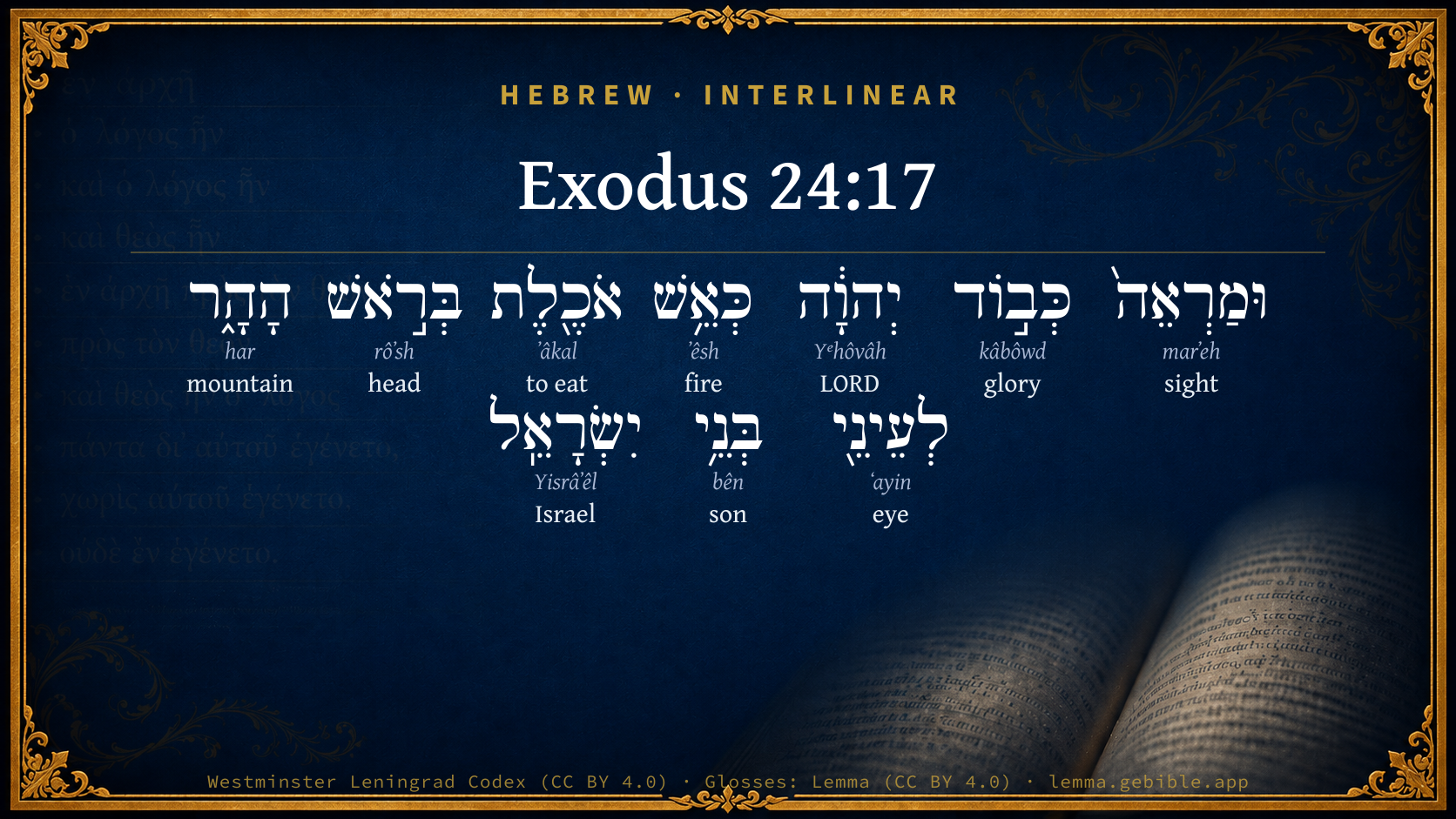
Hebrew (Westminster Leningrad Codex) Exodus 24:17 appears in the Hebrew Old Testament. The text above is from the Westminster Leningrad Codex. Each word links to its Strong’s number, a concise gloss, and parsing drawn from the Open Scriptures Hebrew Bible morphology. Click any word for its full Brown-Driver-Briggs (BDB) entry.
Download image
Cite this verse

Exodus 24:17 (World English Bible). Public Domain. Lemma interlinear Bible study tool, https://lemma.gebible.app/v/exodus/24/17.

Show BibTeX & RIS
BibTeX
RIS
English Translation
The appearance of the glory of Yahweh was like devouring fire on the top of the mountain in the eyes of the children of Israel.
World English Bible · Public Domain
Download a study sheet

One document with this verse’s original text, its word-by-word gloss line, the meaning frame, cross-references with their text, attributed commentary, and full source and license credits — printable, and it pastes into notes with its structure intact.

This verse Autodidact and up

Study sheet (.html) Plain text (.txt)

A passage Seminary Student

Up to 50 verses in one chapter. A passage sheet keeps up to 6 commentary sources and 12 cross-references per verse, in the order this page ranks them, and says so on the sheet whenever that leaves anything out. Ask for a single verse and you get the Autodidact verse sheet above.

Everything on this page stays free to read, with no account — the sheet is a download of what is already on screen, not access to it.

Want to remove ads? Support Godless Engineer
Compare translations 3

The same verse in 3 English versions, stacked beneath the original-language interlinear above. Click any original word for its lexicon entry.

Each is an independent rendering of the whole verse — the interlinear is not word-aligned to these translations.

Highlighted words mark where these versions differ — a whole-verse word diff, not a word-by-word alignment.

  • World English Bible Public Domain
    The appearance of the glory of Yahweh was like devouring fire on the top of the mountain in the eyes of the children of Israel.
  • King James Version Public Domain
    And the sight of the glory of the LORD was like devouring fire on the top of the mount in the eyes of the children of Israel.
  • unfoldingWord Literal Text CC BY-SA 4.0
    And the appearance of the glory of Yahweh was like a devouring fire on the top of the mountain in the eyes of the sons of Israel.

unfoldingWord Literal Text — © unfoldingWord, licensed CC BY-SA 4.0. Word-aligned USFM3 via Door43 (git.door43.org/unfoldingWord/en_ult).

Versions to compare (up to 4)

3 of 4 selected

Show all 18 translations

Every available English version of this verse, each an independent rendering of the whole verse.

  • World English Bible Public Domain
    The appearance of the glory of Yahweh was like devouring fire on the top of the mountain in the eyes of the children of Israel.
  • Berean Standard Bible Public Domain
    And the sight of the glory of the LORD was like a consuming fire on the mountaintop in the eyes of the Israelites.
  • Majority Standard Bible Public Domain
    And the sight of the glory of the LORD was like a consuming fire on the mountaintop in the eyes of the Israelites.
  • King James Version Public Domain
    And the sight of the glory of the LORD was like devouring fire on the top of the mount in the eyes of the children of Israel.
  • American Standard Version (1901) Public Domain
    And the appearance of the glory of Jehovah was like devouring fire on the top of the mount in the eyes of the children of Israel.
  • Revised Version (1885) Public Domain
    And the appearance of the glory of the LORD was like devouring fire on the top of the mount in the eyes of the children of Israel.
  • Geneva Bible (1599) Public Domain
    And the sight of the glorie of the Lord was like consuming fire on the top of the moutaine, in the eyes of the children of Israel.
  • Douay-Rheims (1899) Public Domain
    And the sight of the glory of the Lord was like a burning fire upon the top of the mount, in the eyes of the children of Israel.
  • Young's Literal Translation Public Domain
    And the appearance of the honour of Jehovah `is' as a consuming fire on the top of the mount, before the eyes of the sons of Israel;
  • Literal Standard Version CC BY-SA 4.0
    And the appearance of the glory of YHWH [is] as a consuming fire on the top of the mountain, before the eyes of the sons of Israel;
  • Unlocked Literal Bible CC BY-SA 4.0
    The appearance of Yahweh's glory was like a devouring fire on the top of the mountain in the eyes of the Israelites.
  • unfoldingWord Literal Text CC BY-SA 4.0
    And the appearance of the glory of Yahweh was like a devouring fire on the top of the mountain in the eyes of the sons of Israel.
  • Darby Bible Public Domain
    And the appearance of the glory of Jehovah was like a consuming fire on the top of the mountain, before the eyes of the children of Israel.
  • World Messianic Bible Public Domain
    The appearance of the LORD’s glory was like devouring fire on the top of the mountain in the eyes of the children of Israel.
  • Webster's Bible Public Domain
    And the sight of the glory of the LORD was like devouring fire on the top of the mount, in the eyes of the children of Israel.
  • Free Bible Version CC BY-SA 4.0
    To the Israelites the Lord's glory looked like a burning fire on the top of the mountain.
  • Bible in Basic English Public Domain
    And the glory of the Lord was like a flame on the top of the mountain before the eyes of the children of Israel.
  • JPS Tanakh (1917) Public Domain
    And the appearance of the glory of the LORD was like devouring fire on the top of the mount in the eyes of the children of Israel.

Literal Standard Version (2020), Covenant Press — licensed CC BY-SA 4.0. Text via the HelloAO Bible API (eBible.org). Unlocked Literal Bible (unfoldingWord) — licensed CC BY-SA 4.0. Text via the HelloAO Bible API (eBible.org). unfoldingWord Literal Text — © unfoldingWord, licensed CC BY-SA 4.0. Word-aligned USFM3 via Door43 (git.door43.org/unfoldingWord/en_ult). Free Bible Version, Dr. Jonathan Gallagher — licensed CC BY-SA 4.0. Text via the HelloAO Bible API (eBible.org).

Word by word

More ways to search: Search by grammar → Find every occurrence → Compare this word →

Practice this passage: Drill this verse → Learn its vocabulary →

וּמַרְאֵה֙
marʼeh
H4758
“and · sight of”
Conjunction + Noun, Common, Masculine, Singular, Construct
Part of Speech
Conjunction + Noun
Type
Common
Gender
Masculine
Number
Singular
State
Construct
Full BDB Definition

Origin: from H7200

TWOT: 2095i

sight, appearance, vision - sight, phenomenon, spectacle, appearance, vision - what is seen - a vision (supernatural) - sight, vision (power of seeing)
  1. כְּב֣וֹד kâbôwd H3519 “glory of” Noun, Common, Both, Singular, Construct
  2. יְהוָ֔ה Yᵉhôvâh H3068 “LORD” Noun, Proper
  3. כְּאֵ֥שׁ ʼêsh H784 “like/as · fire” Preposition + Noun, Common, Both, Singular, Absolute
  4. אֹכֶ֖לֶת ʼâkal H398 “eating” Verb, Qal, Participle Active, Feminine, Singular, Absolute
  5. בְּרֹ֣אשׁ rôʼsh H7218 “in/at · head of” Preposition + Noun, Common, Masculine, Singular, Construct
  6. הָהָ֑ר har H2022 “the · mountain” Particle, Definite Article + Noun, Common, Masculine, Singular, Absolute
  7. לְעֵינֵ֖י ʻayin H5869 “to/for · eyes of” Preposition + Noun, Common, Both, Dual, Construct
  8. בְּנֵ֥י bên H1121 “sons of” Noun, Common, Masculine, Plural, Construct
  9. יִשְׂרָאֵֽל Yisrâʼêl H3478 “Israel” Noun, Proper

About this verse

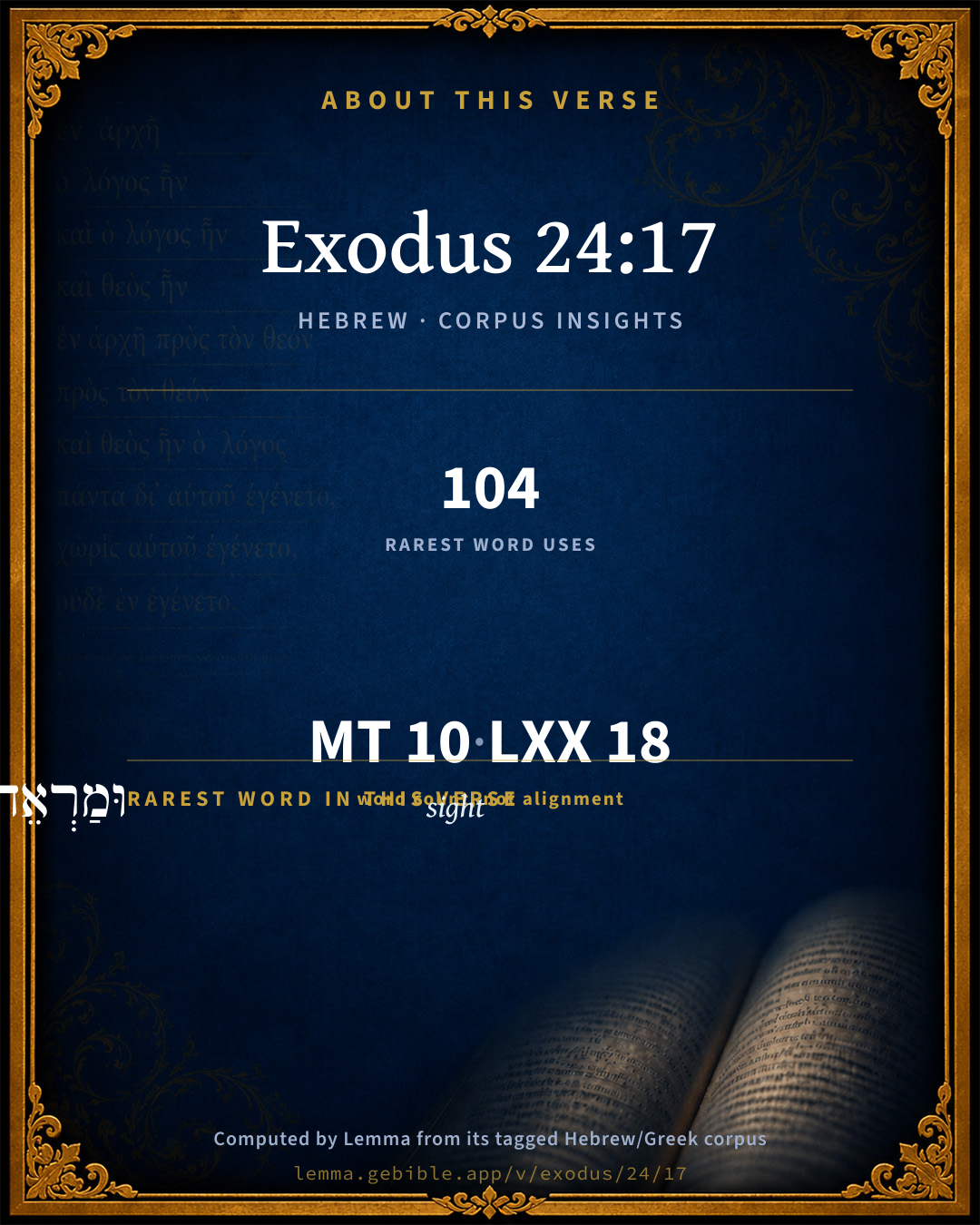
These counts appear in no published source. They are computed here, from the morphology-tagged text and Lemma’s own curated glosses. What Lemma adds →

10
words
10
distinct lemmas
Pentateuch
section

Grammatical profile

  • 1 verb
  • 9 nouns

Verb forms

  • אֹכֶ֖לֶת Qal · Participle Active

Hebrew & Septuagint length

In English translation the verse runs 25 words from the Hebrew and 24 from the Septuagint (LXX English) — closely comparable.

A rough comparison of the two English renderings, which tokenize alike — not a word-level alignment.

Word counts can differ between the Hebrew and the Greek without any difference in meaning — e.g. the Hebrew direct-object marker אֵת has no separate Greek word, and Greek often adds the article ὁ.

In the original languages it is 10 Hebrew tokens and 18 Greek tokens — but the two are counted differently (Hebrew bundles its prefixes and suffixes into one token; the Greek is in lemma form), so that isn’t a like-for-like length.

Cross-references

9

Topical passages linked to Exodus 24:17 in the Treasury of Scripture Knowledge — connected by theme and wording, ordered by reader-vote popularity; previews shown in the World English Bible.

  • Hebrews 12:29 for our God is a consuming fire.
  • Deuteronomy 4:24 For Yahweh your God is a devouring fire, a jealous God.
  • Exodus 3:2 The angel of Yahweh appeared to him in a flame of fire out of the midst of a bush. He looked, and behold, the bush burned with fire, and the bush was not consumed.
  • Deuteronomy 4:36 Out of heaven he made you to hear his voice, that he might instruct you: and on earth he made you to see his great fire; and you heard his words out of the midst of the fire.
  • Hebrews 12:18 For you have not come to a mountain that might be touched, and that burned with fire, and to blackness, darkness, tempest,
  • Exodus 19:18 Mount Sinai, the whole of it, smoked, because Yahweh descended on it in fire; and its smoke ascended like the smoke of a furnace, and the whole mountain quaked greatly.
  • Habakkuk 3:4–5 His splendor is like the sunrise. Rays shine from his hand, where his power is hidden.
  • Ezekiel 1:27 I saw as it were glowing metal, as the appearance of fire within it round about, from the appearance of his loins and upward; and from the appearance of his loins and downward I saw as it were the appearance of fire, and there was brightness round about him.
  • Nahum 1:6 Who can stand before his indignation? Who can endure the fierceness of his anger? His wrath is poured out like fire, and the rocks are broken apart by him.

Cross-references courtesy of OpenBible.info (CC BY 4.0).

Hebrew and Greek witnesses Masoretic Hebrew ↔ Greek Septuagint

The same verse in the two great witnesses to the Old Testament, shown verse-for-verse.

These are two independent witnesses, not word-aligned to each other, and the Septuagint is shown in lemma (dictionary) form.

Hebrew Exodus 24:17 Masoretic · Westminster Leningrad Codex

וּמַרְאֵה֙ כְּב֣וֹד יְהוָ֔ה כְּאֵ֥שׁ אֹכֶ֖לֶת בְּרֹ֣אשׁ הָהָ֑ר לְעֵינֵ֖י בְּנֵ֥י יִשְׂרָאֵֽל

The appearance of the glory of Yahweh was like devouring fire on the top of the mountain in the eyes of the children of Israel.

World English Bible · Public Domain

Greek LXX Exodus 24:17 Septuagint · lemma form

ὁ δέ εἶδος ὁ δόξα κύριος ὡσεί πῦρ φλέγω ἐπί ὁ κορυφή ὁ ὄρος ἐναντίον ὁ υἱός ἰσραήλ

And the appearance of the glory of the Lord was as burning fire on the top of the mountain, before the children of Israel.

LXX2012 (modern English Septuagint) · Public Domain

Hebrew: Westminster Leningrad Codex (CC BY 4.0). Greek: Septuagint (public domain); English from LXX2012 (modern English Septuagint) (Public Domain). How the Septuagint differs from the Hebrew →

Targum (Aramaic paraphrase)

2

The Targum is the ancient Jewish Aramaic paraphrase of the Hebrew Scriptures — an interpretive translation, not the Hebrew text itself. Onkelos (literal) and Pseudo-Jonathan (expansive) render the Torah, and Jonathan the Prophets. Coverage is partial: where no permissively-licensed English translation exists for a verse, only the Aramaic is shown. This is verse-level text, not a word-by-word alignment to the Hebrew.

  1. Targum Onkelos Torah (Genesis–Deuteronomy)
    וְחֵיזוּ יְקָרָא דַיְיָ כְּחֵיזוּ אֶשָׁא אָכְלָא בְּרֵישׁ טוּרָא לְעֵינֵי בְּנֵי יִשְׂרָאֵל:

    (no public-domain English translation for this verse)

    Targum Onkelos — Aramaic: “Onkelos Genesis” (public domain); “Onkelos Exodus” (public domain); “Onkelos Leviticus” (public domain); “Onkelos Numbers” (public domain); “Onkelos Deuteronomy” (public domain). English: “Sefaria Community Translation” (CC0 1.0 (public-domain dedication)); “J.W. Etheridge. The Targums of Onkelos and Jonathan Ben Uzziel on the Pentateuch. London: Longmans, Green, 1862” (public domain). Text via Sefaria.

  2. Targum Pseudo-Jonathan Torah (Genesis–Deuteronomy)
    וְחֵיזוּ זִיו יִקְרָא דַיְיָ הֵי כְאֵשָׁא בָעֲרָא וְזִיקוּקֵי אֵשָׁא אָכְלָא אֵשָׁא וַהֲווֹ חָמָן וּתְמֵהִין בְּנֵי יִשְרָאֵל

    And the appearance of the splendour of the glory of the Lord was as burning fire with flashes of devouring fire; and the sons of Israel beheld and were awe-struck.

    Targum Pseudo-Jonathan — Aramaic: “Targum Jonathan on Genesis” (public domain); “Targum Jonathan on Exodus” (public domain); “Targum Jonathan on Leviticus” (public domain); “Targum Jonathan on Numbers” (public domain); “Targum Jonathan on Deuteronomy” (public domain). English: “The Targum of Jonathan ben Uzziel, trans. J. W. Etheridge, London, 1862” (public domain). Text via Sefaria.

Commentary

Notes on Exodus 24:17 from classic Christian and Jewish commentators (each source and its license shown beneath its notes). The classic Christian expositions comment on the surrounding passage and are grouped to its opening verse, so a note may address several verses; the Jewish commentaries on the Tanakh (Rashi and others) are per-verse, so they appear only where the commentator wrote on this verse.

Lemma curates 59 commentaries, every one of them public domain or Creative Commons licensed, each selected and text-cleaned for this edition rather than reprinted as found. About our sources →

Trapp's Complete Commentary

John Trapp

Exo 24:17 And the sight of the glory of the LORD [was] like devouring fire on the top of the mount in the eyes of the children of Israel.

Ver. 17. Was like devouring fire.] So it is still; {Heb 12:29} which so terrifieth the sinners in Zion, that they run away with these words in their mouths, "Who among us shall dwell with the devouring fire? who among us shall dwell with everlasting burnings?" {Isa 33:14}

John Trapp, A Commentary or Exposition upon All the Books of the Old and New Testament (1647–1656) — public domain. Text from a community e-Sword module.

Tyndale Open Study Notes

Tyndale Open Resources

24:17 consuming fire: See 3:2 and study note.

Tyndale Open Study Notes — © Tyndale Open Resources, licensed CC BY-SA 4.0. Text via the HelloAO Bible API.

Geneva Bible (1599)

Geneva Bible translators

The Lord appeareth like devouring fire to carnal men: but to them that he draweth with his Spirit, he is like pleasant Sapphire.

Geneva Bible (1599) marginal notes — public domain. Text via Bolls.life.

Adam Clarke's Commentary

Verse 17. The glory of the Lord was like devouring fire] This appearance was well calculated to inspire the people with the deepest reverence and godly rear; and this is the use the apostle makes or it, Heb 12:28-29, where he evidently refers to this place, saying, Let us have grace whereby we may serve God acceptably with reverence and godly fear; for our God is a CONSUMING FIRE. Seeing the glory of the Lord upon the mount like a devouring fire, Moses having tarried long, the Israelites probably supposed that he had been devoured or consumed by it, and therefore the more easily fell into idolatry. But how could they do this, with this tremendous sight of God's glory before their eyes?

Adam Clarke's Commentary on the Bible (1810–1826) — public domain. Text from a community e-Sword/MySword module.

Ellicott's Commentary for English Readers

(17) The sight of the glory of the Lord.—To the Israelites in the plain below, the appearance on the top of the Ras Sufsafeh was “like devouring fire.” A light like that of a conflagration rested on the top of the Ras Sufsafeh all the time that Moses was away.

A Bible Commentary for English Readers, edited by Charles John Ellicott (1878–1897) — public domain. Text from a community e-Sword module.

John Gill's Exposition

And the sight of the glory of the Lord was like devouring fire on the top of the mount,.... For when God spoke out of the cloud, the glory of the Lord flashed out like devouring fire; it was not devouring fire, but it was like it; it was like a great blaze of fire, which consumes all that is in its ways; it was such a large body of light, and so clear and bright, that it looked like devouring flames of fire; and being upon the top of the mount was very visible, and seen at a great distance in the eyes of the children of Israel throughout, their camp.

Exodus 24:18

John Gill's Exposition of the Whole Bible (1746–1763) — public domain (CC PDM 1.0). Text via the HelloAO Bible API.

Matthew Poole's English Annotations

He saith

like it, for it was not

devouring fire, as appears by Moses’s long abode in it. Note here, whatsoever the elders of Israel saw before, the people saw no similitude of God, as Moses observes, Deu 4:15.

Matthew Poole's English Annotations on the Holy Bible (1683–1685) — public domain. Text from a community e-Sword/MySword module.

The Pulpit Commentary

Meanwhile, to those below in the plain, "the glory of the Lord" on the summit above them, was like devouring fire on the top of the mount. They had but to lift their eyes thither, and they saw his wonderful glory showing like a huge fire on the spot from which he had spoken to them. (Exo_20:18) This manifestation continued certainly for the first six days; whether it lasted longer or not is open to question.

The Pulpit Commentary (1880–1919), ed. H.D.M. Spence-Jones & Joseph S. Exell — public domain. Text from a community e-Sword module.

Lesson kit

Teaching starters — assembled from the data on this page, not authored interpretation. Every prompt links to the verse data it draws on. Edit before teaching.

Exodus, in the Pentateuch, opens this verse with 10 words (10 distinct Hebrew lemmas). Its most distinctive word is marʼeh (“sight”). A historical commentator’s framing appears above. Read the whole chapter for the surrounding context.

Discussion questions

  1. The word marʼeh carries the sense “sight.” How does it shape the verse?
  2. Hebrews 12:29 shares this passage’s theme. How do the two illuminate each other?
  3. These translations render this verse differently; the difference is in the English rendering, not the original. What questions does that raise?
  4. The verb «אֹכֶ֖לֶת» is Qal Participle Active. How does its form color the action?
  5. Reading how Trapp's Complete Commentary and Tyndale Open Study Notes read this verse, where do the two commentators agree and where do they part?

Things to notice

Reading settings

Reading text

Shown beneath each verse's original-language words.

Old Testament
Old Testament edition

Read the OT as the Masoretic Hebrew (MT) or the Greek Septuagint (LXX).

English shown for the Greek Septuagint (in the Hebrew ↔ Greek comparison).

Comparing translations? Open the Compare panel on any verse page to stack up to four side by side.