Deuteronomy 32:22

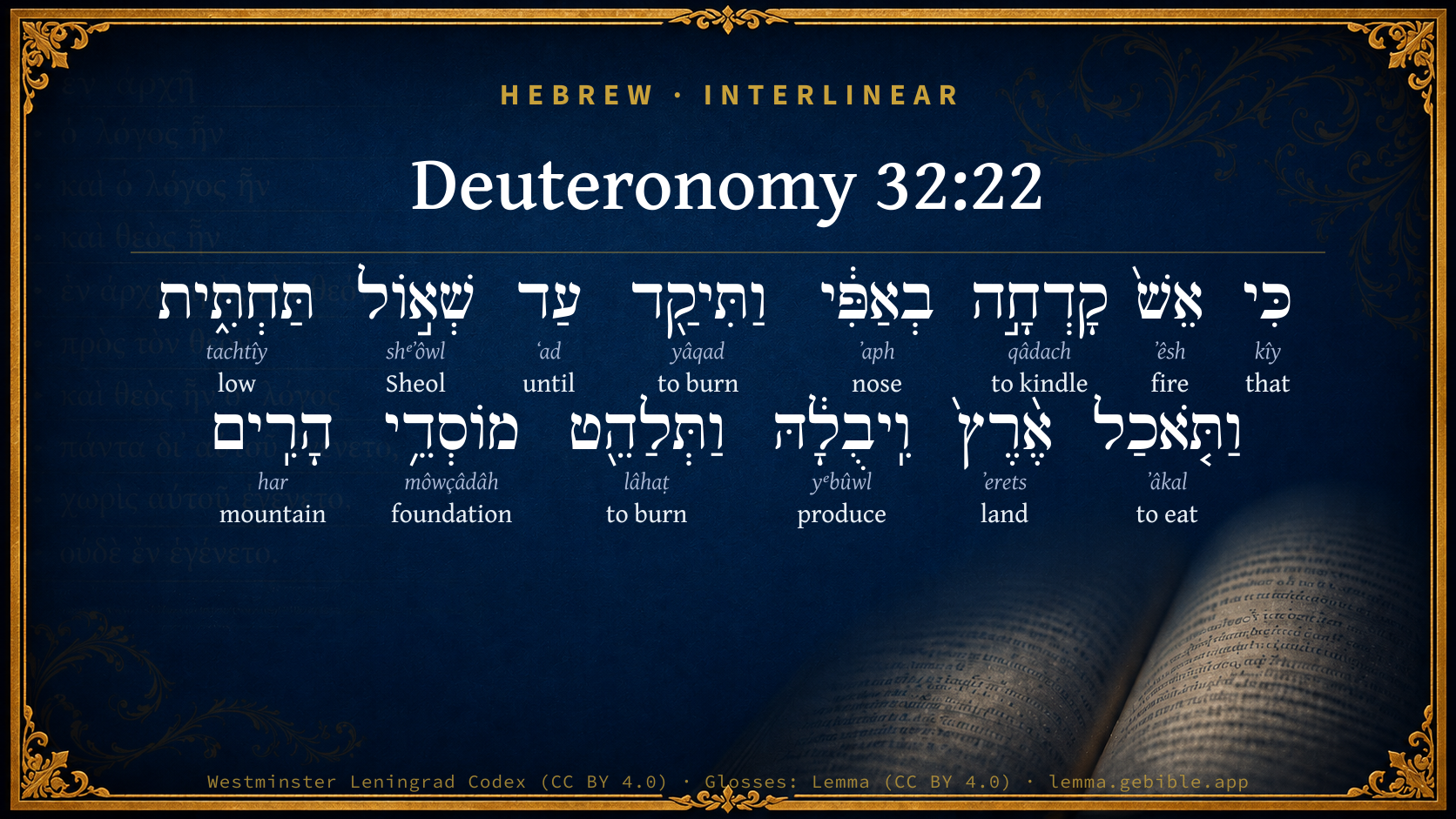
Hebrew (Westminster Leningrad Codex) Deuteronomy 32:22 appears in the Hebrew Old Testament. The text above is from the Westminster Leningrad Codex. Each word links to its Strong’s number, a concise gloss, and parsing drawn from the Open Scriptures Hebrew Bible morphology. Click any word for its full Brown-Driver-Briggs (BDB) entry.
Download image
Cite this verse

Deuteronomy 32:22 (World English Bible). Public Domain. Lemma interlinear Bible study tool, https://lemma.gebible.app/v/deuteronomy/32/22.

Show BibTeX & RIS
BibTeX
RIS
English Translation
For a fire is kindled in my anger, Burns to the lowest Sheol, Devours the earth with its increase, Sets on fire the foundations of the mountains.
World English Bible · Public Domain
Highlights
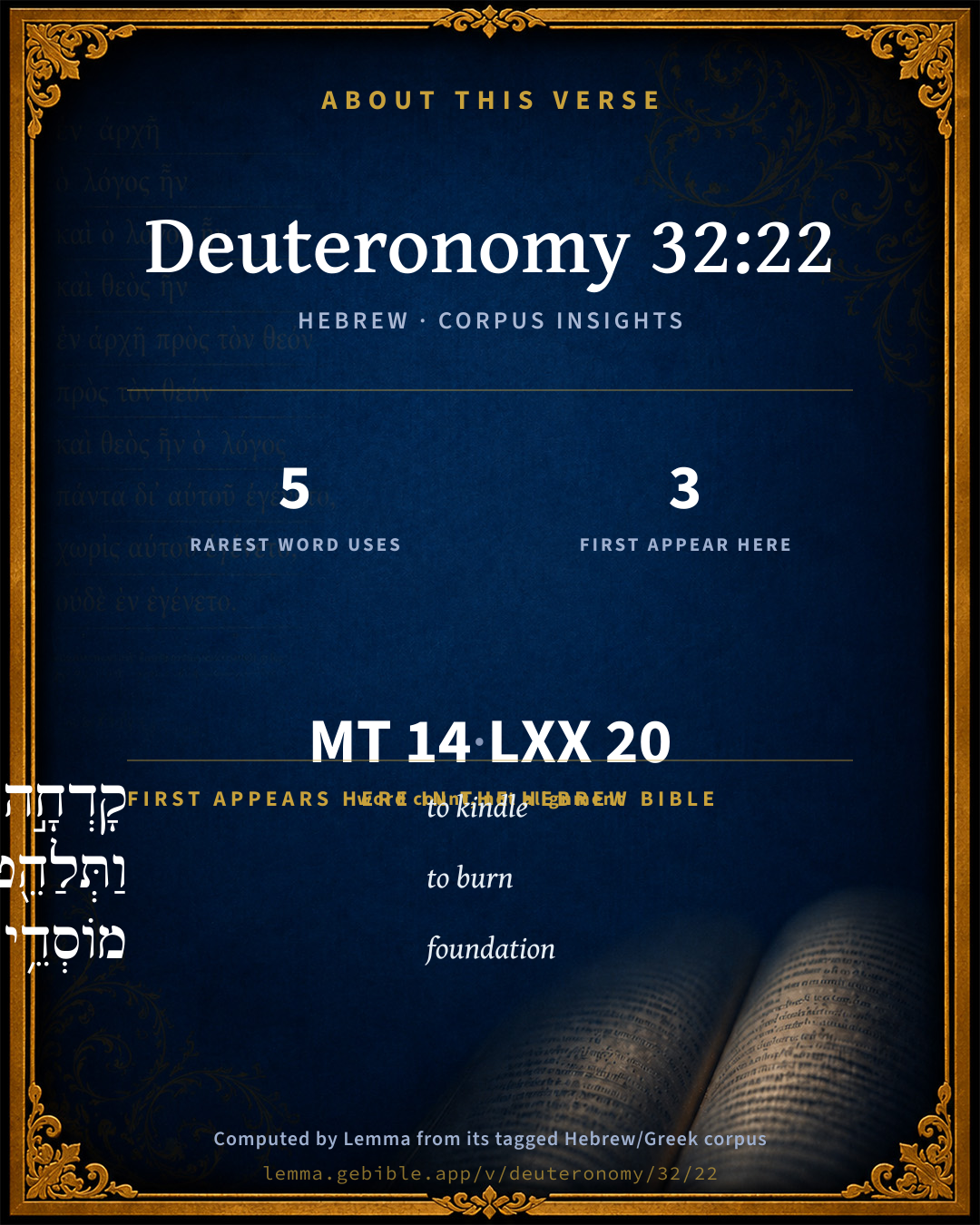
  • 3 first appearances in the Hebrew Bible
Full analysis ↓
Download a study sheet

One document with this verse’s original text, its word-by-word gloss line, the meaning frame, cross-references with their text, attributed commentary, and full source and license credits — printable, and it pastes into notes with its structure intact.

This verse Autodidact and up

Study sheet (.html) Plain text (.txt)

A passage Seminary Student

Up to 50 verses in one chapter. A passage sheet keeps up to 6 commentary sources and 12 cross-references per verse, in the order this page ranks them, and says so on the sheet whenever that leaves anything out. Ask for a single verse and you get the Autodidact verse sheet above.

Everything on this page stays free to read, with no account — the sheet is a download of what is already on screen, not access to it.

Want to remove ads? Support Godless Engineer
Compare translations 3

The same verse in 3 English versions, stacked beneath the original-language interlinear above. Click any original word for its lexicon entry.

Each is an independent rendering of the whole verse — the interlinear is not word-aligned to these translations.

Highlighted words mark where these versions differ — a whole-verse word diff, not a word-by-word alignment.

  • World English Bible Public Domain
    For a fire is kindled in my anger, Burns to the lowest Sheol, Devours the earth with its increase, Sets on fire the foundations of the mountains.
  • King James Version Public Domain
    For a fire is kindled in mine anger, and shall burn unto the lowest hell, and shall consume the earth with her increase, and set on fire the foundations of the mountains.
  • unfoldingWord Literal Text CC BY-SA 4.0
    for a fire flares in my nose, and burns to the lowest Sheol, and devours the earth and its yield, and scorches the foundations of the mountains. ts\*

unfoldingWord Literal Text — © unfoldingWord, licensed CC BY-SA 4.0. Word-aligned USFM3 via Door43 (git.door43.org/unfoldingWord/en_ult).

Versions to compare (up to 4)

3 of 4 selected

Show all 18 translations

Every available English version of this verse, each an independent rendering of the whole verse.

  • World English Bible Public Domain
    For a fire is kindled in my anger, Burns to the lowest Sheol, Devours the earth with its increase, Sets on fire the foundations of the mountains.
  • Berean Standard Bible Public Domain
    For a fire has been kindled by My anger, and it burns to the depths of Sheol; it consumes the earth and its produce, and scorches the foundations of the mountains.
  • Majority Standard Bible Public Domain
    For a fire has been kindled by My anger, and it burns to the depths of Sheol; it consumes the earth and its produce, and scorches the foundations of the mountains.
  • King James Version Public Domain
    For a fire is kindled in mine anger, and shall burn unto the lowest hell, and shall consume the earth with her increase, and set on fire the foundations of the mountains.
  • American Standard Version (1901) Public Domain
    For a fire is kindled in mine anger, And burneth unto the lowest Sheol, And devoureth the earth with its increase, And setteth on fire the foundations of the mountains.
  • Revised Version (1885) Public Domain
    For a fire is kindled in mine anger, And burneth unto the lowest pit, And devoureth the earth with her increase, And setteth on fire the foundations of the mountains.
  • Geneva Bible (1599) Public Domain
    For fire is kindled in my wrath, and shall burne vnto the bottome of hell, and shall consume the earth with her increase, and set on fire the foundations of the mountaines.
  • Douay-Rheims (1899) Public Domain
    A fire is kindled in my wrath, and shall burn even to the lowest hell: and shall devour the earth with her increase, and shall burn the foundations of the mountains.
  • Young's Literal Translation Public Domain
    For a fire hath been kindled in Mine anger, And it burneth unto Sheol -- the lowest, And consumeth earth and its increase, And setteth on fire foundations of mountains.
  • Literal Standard Version CC BY-SA 4.0
    For a fire has been kindled in My anger, || And it burns to the lowest [part] of Sheol, || And consumes earth and its increase, || And sets on fire [the] foundations of mountains.
  • Unlocked Literal Bible CC BY-SA 4.0
    For a fire is kindled by my anger and is burning to the lowest Sheol; it is devouring the earth and its harvest; it is setting on fire the foundations of the mountains.
  • unfoldingWord Literal Text CC BY-SA 4.0
    for a fire flares in my nose, and burns to the lowest Sheol, and devours the earth and its yield, and scorches the foundations of the mountains. ts\*
  • Darby Bible Public Domain
    For a fire is kindled in mine anger, And it shall burn into the lowest Sheol, And shall consume the earth and its produce, And set fire to the foundations of the mountains.
  • World Messianic Bible Public Domain
    For a fire is kindled in my anger, that burns to the lowest Sheol, devours the earth with its increase, and sets the foundations of the mountains on fire.
  • Webster's Bible Public Domain
    For a fire is kindled in my anger, and shall burn to the lowest hell, and shall consume the earth with her increase, and set on fire the foundations of the mountains.
  • Free Bible Version CC BY-SA 4.0
    My anger has been set on fire, burning down to the depths of the grave, destroying the earth and all it produces, even setting fire to the foundations of the mountains.
  • Bible in Basic English Public Domain
    For my wrath is a flaming fire, burning to the deep parts of the underworld, burning up the earth with her increase, and firing the deep roots of the mountains.
  • JPS Tanakh (1917) Public Domain
    For a fire is kindled in My nostril, and burneth unto the depths of the nether-world, and devoureth the earth with her produce, and setteth ablaze the foundations of the mountains.

Literal Standard Version (2020), Covenant Press — licensed CC BY-SA 4.0. Text via the HelloAO Bible API (eBible.org). Unlocked Literal Bible (unfoldingWord) — licensed CC BY-SA 4.0. Text via the HelloAO Bible API (eBible.org). unfoldingWord Literal Text — © unfoldingWord, licensed CC BY-SA 4.0. Word-aligned USFM3 via Door43 (git.door43.org/unfoldingWord/en_ult). Free Bible Version, Dr. Jonathan Gallagher — licensed CC BY-SA 4.0. Text via the HelloAO Bible API (eBible.org).

Word by word

More ways to search: Search by grammar → Find every occurrence → Compare this word →

Practice this passage: Drill this verse → Learn its vocabulary →

קָדְחָ֣ה
qâdach
H6919
“to kindle”
Verb, Qal, Perfect, 3rd Person, Feminine, Singular
Part of Speech
Verb
Stem
Qal
Form
Perfect
Person
3rd Person
Gender
Feminine
Number
Singular
Full BDB Definition

Origin: a primitive root to inflame

TWOT: 1987

to kindle, be kindled - (Qal) - to kindle - to be kindled
  1. כִּי kîy H3588 “that” Conjunction
  2. אֵשׁ֙ ʼêsh H784 “fire” Noun, Common, Both, Singular, Absolute
  3. בְאַפִּ֔י ʼaph H639 “in/at · nose · my” Preposition + Noun, Common, Masculine, Singular, Construct + Suffix, Personal, 1st Person, Common, Singular
  4. וַתִּיקַ֖ד yâqad H3344 “and · to burn” Conjunction + Verb, Qal, Sequential Imperfect, 3rd Person, Feminine, Singular
  5. עַד ʻad H5704 “until” Preposition
  6. שְׁא֣וֹל shᵉʼôwl H7585 “Sheol” Noun, Proper
  7. תַּחְתִּ֑ית tachtîy H8482 “low” Adjective, Adjective, Feminine, Singular, Absolute
  8. וַתֹּ֤אכַל ʼâkal H398 “and · to eat” Conjunction + Verb, Qal, Sequential Imperfect, 3rd Person, Feminine, Singular
  9. אֶ֨רֶץ֙ ʼerets H776 “land” Noun, Common, Both, Singular, Absolute
  10. וִֽיבֻלָ֔הּ yᵉbûwl H2981 “and · produce · her” Conjunction + Noun, Common, Masculine, Singular, Construct + Suffix, Personal, 3rd Person, Feminine, Singular
  11. וַתְּלַהֵ֖ט lâhaṭ H3857 “and · to burn” Conjunction + Verb, Piel, Sequential Imperfect, 3rd Person, Feminine, Singular
  12. מוֹסְדֵ֥י môwçâdâh H4146 “foundations of” Noun, Common, Both, Plural, Construct
  13. הָרִֽים har H2022 “mountains” Noun, Common, Masculine, Plural, Absolute

About this verse

These counts appear in no published source. They are computed here, from the morphology-tagged text and Lemma’s own curated glosses. What Lemma adds →

14
words
14
distinct lemmas
Pentateuch
section

Notable vocabulary

The rarest word here is קָדְחָ֣ה to kindle H6919 — appearing just 5 times in the whole Hebrew Bible.

First appearance in Scripture

These words make their first canonical appearance in the Hebrew Bible here:

  • קָדְחָ֣ה to kindle H6919
  • וַתְּלַהֵ֖ט to burn H3857
  • מוֹסְדֵ֥י foundation H4146

Shared distinctive vocabulary

קָדְחָ֣ה to kindle H6919 occurs in 5 verses of the Hebrew Bible. Also found in:

Grammatical profile

  • 4 verbs
  • 7 nouns
  • 1 adjective
  • 1 preposition
  • 1 conjunction

Verb forms

  • קָדְחָ֣ה Qal · Perfect
  • וַתִּיקַ֖ד Qal · Sequential Imperfect
  • וַתֹּ֤אכַל Qal · Sequential Imperfect
  • וַתְּלַהֵ֖ט Piel · Sequential Imperfect

Hebrew & Septuagint length

In English translation the verse runs 27 words from the Hebrew and 36 from the Septuagint (LXX English) — closely comparable.

A rough comparison of the two English renderings, which tokenize alike — not a word-level alignment.

Word counts can differ between the Hebrew and the Greek without any difference in meaning — e.g. the Hebrew direct-object marker אֵת has no separate Greek word, and Greek often adds the article ὁ.

In the original languages it is 14 Hebrew tokens and 20 Greek tokens — but the two are counted differently (Hebrew bundles its prefixes and suffixes into one token; the Greek is in lemma form), so that isn’t a like-for-like length.

Cross-references

32

Topical passages linked to Deuteronomy 32:22 in the Treasury of Scripture Knowledge — connected by theme and wording, ordered by reader-vote popularity; previews shown in the World English Bible.

  • Lamentations 4:11 Yahweh has accomplished his wrath, he has poured out his fierce anger; He has kindled a fire in Zion, which has devoured the foundations of it.
  • Jeremiah 15:14 I will make [them] to pass with your enemies into a land which you don't know; for a fire is kindled in my anger, which shall burn on you.
  • Numbers 16:35 Fire came forth from Yahweh, and devoured the two hundred fifty men who offered the incense.
  • Job 9:5–6 Who removes the mountains, and they don't know it, When he overturns them in his anger
  • Psalms 86:13 For your loving kindness is great toward me. You have delivered my soul from the lowest Sheol.
  • Isaiah 24:19–20 The earth is utterly broken, the earth is torn apart, the earth is shaken violently.
  • Jeremiah 17:4 You, even of yourself, shall discontinue from your heritage that I gave you; and I will cause you to serve your enemies in the land which you don't know: for you have kindled a fire in my anger which shall burn forever.
  • Micah 1:4 The mountains melt under him, And the valleys split apart, Like wax before the fire, Like waters that are poured down a steep place.
  • Zephaniah 3:8 "Therefore wait for me," says Yahweh, "until the day that I rise up to the prey, for my determination is to gather the nations, that I may assemble the kingdoms, to pour on them my indignation, even all my fierce anger, for all the earth will be devoured with the fire of my jealousy.
  • Deuteronomy 29:20 Yahweh will not pardon him, but then the anger of Yahweh and his jealousy will smoke against that man, and all the curse that is written in this book shall lie on him, and Yahweh will blot out his name from under the sky.
  • Psalms 21:9 You will make them as a fiery furnace in the time of your anger. Yahweh will swallow them up in his wrath. The fire shall devour them.
  • Psalms 46:2 Therefore we won't be afraid, though the earth changes, Though the mountains are shaken into the heart of the seas;
  • Psalms 83:14 As the fire that burns the forest, As the flame that sets the mountains on fire,
  • Psalms 97:3 A fire goes before him, And burns up his adversaries on every side.
  • Psalms 144:5 Part your heavens, Yahweh, and come down. Touch the mountains, and they will smoke.
  • Isaiah 24:6 Therefore has the curse devoured the earth, and those who dwell therein are found guilty: therefore the inhabitants of the earth are burned, and few men left.
  • Isaiah 30:33 For a Topheth is prepared of old; yes, for the king it is made ready; he has made it deep and large; the pile of it is fire and much wood; the breath of Yahweh, like a stream of sulfur, does kindle it.
  • Isaiah 54:10 For the mountains may depart, and the hills be removed; but my loving kindness shall not depart from you, neither shall my covenant of peace be removed, says Yahweh who has mercy on you.
  • Isaiah 66:15–16 For, behold, Yahweh will come with fire, and his chariots shall be like the whirlwind; to render his anger with fierceness, and his rebuke with flames of fire.
  • Jeremiah 4:4 Circumcise yourselves to Yahweh, and take away the foreskins of your heart, you men of Judah and inhabitants of Jerusalem; lest my wrath go forth like fire, and burn so that none can quench it, because of the evil of your doings.
  • Lamentations 2:3 He has cut off in fierce anger all the horn of Israel; He has drawn back his right hand from before the enemy: He has burned up Jacob like a flaming fire, which devours round about.
  • Ezekiel 36:5 therefore thus says the Lord Yahweh: Surely in the fire of my jealousy have I spoken against the residue of the nations, and against all Edom, that have appointed my land to themselves for a possession with the joy of all their heart, with despite of soul, to cast it out for a prey.
  • Nahum 1:5–6 The mountains quake before him, and the hills melt away. The earth trembles at his presence, yes, the world, and all who dwell in it.
  • Habakkuk 3:10 The mountains saw you, and were afraid. The tempest of waters passed by. The deep roared and lifted up its hands on high.
  • Malachi 4:1–2 "For, behold, the day comes, it burns as a furnace; and all the proud, and all who work wickedness, will be stubble; and the day that comes will burn them up," says Yahweh of Hosts, "that it shall leave them neither root nor branch.
  • Matthew 10:28 Don't be afraid of those who kill the body, but are not able to kill the soul. Rather, fear him who is able to destroy both soul and body in Gehenna.
  • 2 Thessalonians 1:8 giving vengeance to those who don't know God, and to those who don't obey the Gospel of our Lord Jesus,
  • Hebrews 12:29 for our God is a consuming fire.
  • Psalms 18:7–8 Then the earth shook and trembled. The foundations also of the mountains quaked and were shaken, Because he was angry.
  • Matthew 18:9 If your eye causes you to stumble, pluck it out, and cast it from you. It is better for you to enter into life with one eye, rather than having two eyes to be cast into the Gehenna of fire.
  • Matthew 23:33 You serpents, you offspring of vipers, how will you escape the judgment of Gehenna?
  • Mark 9:43–48 If your hand causes you to stumble, cut it off. It is better for you to enter into life maimed, rather than having your two hands to go into Gehenna, into the unquenchable fire,

Cross-references courtesy of OpenBible.info (CC BY 4.0).

Hebrew and Greek witnesses Masoretic Hebrew ↔ Greek Septuagint

The same verse in the two great witnesses to the Old Testament, shown verse-for-verse.

These are two independent witnesses, not word-aligned to each other, and the Septuagint is shown in lemma (dictionary) form.

Hebrew Deuteronomy 32:22 Masoretic · Westminster Leningrad Codex

כִּי אֵשׁ֙ קָדְחָ֣ה בְאַפִּ֔י וַתִּיקַ֖ד עַד שְׁא֣וֹל תַּחְתִּ֑ית וַתֹּ֤אכַל אֶ֨רֶץ֙ וִֽיבֻלָ֔הּ וַתְּלַהֵ֖ט מוֹסְדֵ֥י הָרִֽים

For a fire is kindled in my anger, Burns to the lowest Sheol, Devours the earth with its increase, Sets on fire the foundations of the mountains.

World English Bible · Public Domain

Greek LXX Deuteronomy 32:22 Septuagint · lemma form

ὅτι πῦρ ἐκκαίω ἐκ ὁ θυμός ἐγώ καίω ἕως αἵδης κάτω καταἐσθίω γῆ καί ὁ γένημα αὐτός φλέγω θεμέλιος ὄρος

For a fire has been kindled out of my wrath, it shall burn to hell below; it shall devour the land, and the fruits of it; it shall set on fire the foundations of the mountains.

LXX2012 (modern English Septuagint) · Public Domain

On this verse, The Pulpit Commentary discusses the Septuagint’s reading. Read the note in Commentary ↓

Hebrew: Westminster Leningrad Codex (CC BY 4.0). Greek: Septuagint (public domain); English from LXX2012 (modern English Septuagint) (Public Domain). How the Septuagint differs from the Hebrew →

Targum (Aramaic paraphrase)

2

The Targum is the ancient Jewish Aramaic paraphrase of the Hebrew Scriptures — an interpretive translation, not the Hebrew text itself. Onkelos (literal) and Pseudo-Jonathan (expansive) render the Torah, and Jonathan the Prophets. Coverage is partial: where no permissively-licensed English translation exists for a verse, only the Aramaic is shown. This is verse-level text, not a word-by-word alignment to the Hebrew.

  1. Targum Onkelos Torah (Genesis–Deuteronomy)
    אֲרֵי קִדוּם תַּקִיף כְּאֶשָׁא נְפַק מִקָדָמַי בִּרְגַז וְשֵׁצֵי עַד שְׁאוֹל אֲרָעִית וְאָסֵף אַרְעָא וַעֲלַלְתַּהּ וְשֵׁצְיַת עַד סְיָפֵי טוּרַיָא

    (no public-domain English translation for this verse)

    Targum Onkelos — Aramaic: “Onkelos Genesis” (public domain); “Onkelos Exodus” (public domain); “Onkelos Leviticus” (public domain); “Onkelos Numbers” (public domain); “Onkelos Deuteronomy” (public domain). English: “Sefaria Community Translation” (CC0 1.0 (public-domain dedication)); “J.W. Etheridge. The Targums of Onkelos and Jonathan Ben Uzziel on the Pentateuch. London: Longmans, Green, 1862” (public domain). Text via Sefaria.

  2. Targum Pseudo-Jonathan Torah (Genesis–Deuteronomy)
    אֲרוּם קִידוֹם תַּקִיף כְּאֵישָׁא נְפַק מִן קֳדָמַי וּבְעָרַת בִּתְקוֹף רוּגְזִי וְאַיְקִידַת עַד שְׁיוֹל אַרְעַיָא וּסְיָיפַת אַרְעָא וַעֲלַלְתָּהּ וְשַׁלְהוֹבַת יְסוֹדֵי טַוְורַיָא

    For an east wind strong as fire shall go out before Me, and blaze in the might of My anger, and burn to the lowest hell; it shall consume the land with its produce, and set the foundations of the mountains in flame.

    Targum Pseudo-Jonathan — Aramaic: “Targum Jonathan on Genesis” (public domain); “Targum Jonathan on Exodus” (public domain); “Targum Jonathan on Leviticus” (public domain); “Targum Jonathan on Numbers” (public domain); “Targum Jonathan on Deuteronomy” (public domain). English: “The Targum of Jonathan ben Uzziel, trans. J. W. Etheridge, London, 1862” (public domain). Text via Sefaria.

Commentary

Notes on Deuteronomy 32:22 from classic Christian and Jewish commentators (each source and its license shown beneath its notes). The classic Christian expositions comment on the surrounding passage and are grouped to its opening verse, so a note may address several verses; the Jewish commentaries on the Tanakh (Rashi and others) are per-verse, so they appear only where the commentator wrote on this verse.

Lemma curates 59 commentaries, every one of them public domain or Creative Commons licensed, each selected and text-cleaned for this edition rather than reprinted as found. About our sources →

Trapp's Complete Commentary

John Trapp

Deu 32:22 For a fire is kindled in mine anger, and shall burn unto the lowest hell, and shall consume the earth with her increase, and set on fire the foundations of the mountains.

Ver. 22. For a fire.] {See Trapp on "Deu 10:4"}

John Trapp, A Commentary or Exposition upon All the Books of the Old and New Testament (1647–1656) — public domain. Text from a community e-Sword module.

Joseph Benson's Commentary

Deu 32:22. For a fire is kindled in mine anger — In this verse are predicted the dreadful calamities which God would bring upon the land of Judea, in words which seem to import the total ruin of it. Devouring judgments are here compared to fire, as they are also Eze 30:8; Amo 2:5. And from hence to Deu 32:28, the destruction of their city and country by the Romans, and the dreadful calamities which they have suffered since in different ages, seem chiefly to be intended. And shall burn to the lowest hell — Or to the lowest parts of the earth, as the word שׁאול, sheol, here rendered hell, signifies: Num 16:30-33. Most destructive calamities are meant, judgments that should never cease till they had overturned the whole Jewish constitution. And set on fire the foundations of the mountains — That is, subvert their strongest fortresses, yea, Jerusalem itself, founded on the holy mountains, which was perfectly fulfilled in its destruction by Titus. And, according to Josephus, Titus himself, though a heathen, saw and acknowledged the hand of God in the affair. For, observing the vast height of the walls, the largeness of every stone, and the exact order wherein they were laid and compacted, he cried out, “God was with us in this war: it is he that drove the Jews from these munitions. For what could the hands of men or machines have availed against such towers?” Perhaps it may not be improper to mention here, as a further illustration of this prophecy, and its accomplishment, what is related, not only by the Christian writers of that age, Chrysostom, Sozomen, and Socrates, but also by Ammianus Marcellinus, a heathen historian, that when Julian the Apostate ordered the temple of Jerusalem to be rebuilt, with a view to give the lie to our Saviour’s prophecy concerning it, “terrible globes of fire burst out near the foundations, which overturned all, burned the workmen, and made the place so inaccessible, that they desisted from the attempt.” See Bishop Warburton’s book, entitled Julian.

Joseph Benson's Commentary on the Old and New Testaments (1811–1818) — public domain. Text from a community e-Sword module.

Tyndale Open Study Notes

Tyndale Open Resources

32:22 The realm of the dead was thought to be in the depths beneath the earth, and the entrance to that world was the grave. God is omnipresent, and his judgment reaches the most inaccessible places (see Ps 139:7-12).

Tyndale Open Study Notes — © Tyndale Open Resources, licensed CC BY-SA 4.0. Text via the HelloAO Bible API.

Adam Clarke's Commentary

Verse 22. The lowest hell] שאול תחתית sheol tachtith, the very deepest destruction; a total extermination, so that the earth - their land, and its increase, and all their property, should be seized; and the foundations of their mountains - their strongest fortresses, should be razed to the ground. All this was fulfilled in a most remarkable manner in the last destruction of Jerusalem by the Romans, so that of the fortifications of that city not one stone was left on another. See the notes on Mt 24:1-51.

Adam Clarke's Commentary on the Bible (1810–1826) — public domain. Text from a community e-Sword/MySword module.

Ellicott's Commentary for English Readers

(22) For a fire is kindled in mine anger.—Quoted by Jeremiah (Jer_15:14, and comp. Jer_17:4).

The foundations of the mountains.—Rashi says, “Jerusalem, which is founded on the mountains,” as it is said, “Jerusalem, the mountains are about her” (Psa_125:2).

A Bible Commentary for English Readers, edited by Charles John Ellicott (1878–1897) — public domain. Text from a community e-Sword module.

The Cambridge Bible for Schools and Colleges

gen. ed. J. J. S. Perowne

22. is kindled] but with the force of flaring up quickly, Jer_15:14; Jer_17:4, Isa_50:11; Isa_64:2 (1); it is not necessary to render ’aph, anger, by its original meaning nostril.

pit] Heb. She’ol, underworld, Psa_86:13.

increase] See Deu_11:17.

And setteth on fire] licks or flames about; only in late writings.

The Cambridge Bible for Schools and Colleges (gen. ed. J. J. S. Perowne; Cambridge University Press, 1878–1918) — public domain. Text from a community e-Sword module.

John Gill's Exposition

I will heap mischief upon them,.... One calamity upon another, which are after particularly mentioned:

I will spewed mine arrows upon them; God is here represented as an enemy to the Jews, as having bent his bow against them like an enemy, Lam 2:4; and as having a quiver, and that full of arrows, and as determined to draw out and spend everyone of them, in taking vengeance upon them; which arrows are his four sore judgments mentioned Eze 14:21; and expressed in Deu 32:24.

John Gill's Exposition of the Whole Bible (1746–1763) — public domain (CC PDM 1.0). Text via the HelloAO Bible API.

Haydock's Catholic Bible Commentary

A fire. He alludes to the destruction of Sodom, (Calmet) which may be considered as a figure of that which will overtake the whole world at the last day, and excruciate both the souls and the bodies of the reprobate in the flames of hell. (Haydock) --- Fire also denotes war, the horrors of which overwhelmed the Jews both at the first and the last sieges of Jerusalem. (Calmet)

George Leo Haydock (1774–1849), Haydock's Catholic Family Bible and Commentary, 1859 edition — public domain. Excludes Psalms (Douay-Rheims chapter numbering differs from Protestant) and Deuterocanonical books (Catholic canon only).

Matthew Poole's English Annotations

A fire is kindled, i.e. great and grievous judgments shall be inflicted, which oft come under the name of fire, &c. See Deu 4:24; Eze 30:8; Amo 2:2,5.

Unto the lowest hell, or, unto hell, or the graves beneath. The sense is, it shall not only burn up all the corn and fruits and buildings which appear above ground, but it shall reach to the inwards and depths of the earth, and burn up the very roots and hopes of future increase.

Matthew Poole's English Annotations on the Holy Bible (1683–1685) — public domain. Text from a community e-Sword/MySword module.

Whedon's Commentary on the Bible

Daniel D. Whedon

22. For a fire is kindled in mine anger — A fire blazes up in my face. Comp. Psa_18:8 : “There went up a smoke out of his nostrils, and fire out of his mouth devoured: coals were kindled by it.” The figure of the anger of Jehovah consuming to the lowest depths is terrible in grandeur, and calculated to impress upon the Hebrews the peril of apostasy.

Daniel D. Whedon (gen. ed.), Commentary on the Old and New Testaments (1874–1909) — public domain. Text from a community e-Sword module.

The Pulpit Commentary

cf. Jer_15:14 Jer_17:4; Lam_4:11. The lowest hell; the lowest sheol, the uttermost depth of the under-world. The Hebrew sheol (lwOav) answering to the Greek adhv, by which it is usually rendered by the LXX, is a general designation of the unseen state, the place of the dead. By some the word is derived from lav; to ask, because sheol is ever asking, is insatiable; (Pro_30:16) but more probably it is from a root signifying to excavate, to hollow, and, like the German holle, means primarily a hollow place or cavern. The Divine wrath kindles a consuming fire, that burns down to the lowest depths to the deepest part of sheol consumes the earth"s produce, and sets on fire the foundations of the mountains. This does not refer to any particular judgment that was to befall the national Israel, but is a general description of the effects of the Divine wrath when that is poured forth in judgments on men.

The Pulpit Commentary (1880–1919), ed. H.D.M. Spence-Jones & Joseph S. Exell — public domain. Text from a community e-Sword module.

John Wesley's Explanatory Notes

A fire is kindled - Great and grievous judgments shall be inflicted, which often come under the name of fire. Are they proud of their plenty? It shall burn up the increase of the earth. Are they confident of their strength? It shall destroy the very foundations of the mountains. It shall burn unto the lowest hell: it shall bring them to the very depth of misery in this world, which yet will he but a faint resemblance of their endless misery in the next.

John Wesley, Explanatory Notes Upon the Whole Bible (1754–1765) — public domain. Text via the GEBible commentary corpus.

unfoldingWord translationNotes

Door43 World Missions Community

General Information:

Moses speaks a poetic song to the people of Israel. He continues to quote Yahweh's words. (See: Parallelism)

For a fire is kindled by my anger ... foundations of the mountains

Yahweh compares his anger to a fire. This emphasizes his power to destroy what makes him angry. (See: Metaphor)

a fire is kindled by my anger and is burning ... it is devouring ... it is setting

This can be stated in active form. AT: "I start a fire because I am angry, and it burns ... it is devouring ... it is setting" or "when I am angry, I destroy my enemies like a fire, and I destroy everything on earth and in ... I devour ... I set" (See: Active or Passive)

to the lowest Sheol

"even to the world of the dead"

translationWords

fire

anger

Hades

devour

earth

harvest

found

unfoldingWord translationNotes — © Distant Shores Media and the Door43 World Missions Community, licensed CC BY-SA 4.0. Source: git.door43.org/Door43/en_tn.

Rashi

Rabbi Shlomo Yitzchaki (Rashi)

קדחה means, IT BURNS.

ותיקד AND IT SHALL BLAZE in your midst to the very foundations (Rashi merely supplies the words “in your midst” and paraphrases עד שאול תחתית).

ותאכל ארץ ויבלה AND IT SHALL CONSUME THE LAND WITH HER INCREASE — i.e., your land and its produce (Rashi means that ארץ does not mean “the ground”, “the soil”).

ותלהט AND IT SHALL SET ON FIRE [THE FOUNDATIONS OF THE MOUNTAINS] — i.e. Jerusalem that is founded on the mountains, as it is said, (Psalms 125:2) “Jerusalem, mountains are round about it” (Sifrei Devarim 320:12).

Rashi on the Tanakh — English translations: “The Judaica Press complete Tanach with Rashi, translated by A. J. Rosenberg” (CC BY 4.0); “Pentateuch with Rashi's commentary by M. Rosenbaum and A.M. Silbermann, 1929-1934” (public domain); “The Metsudah Tanach series, Lakewood, N.J” (CC BY 4.0); and “The Book of Joshua, Metsudah Publications, 1997” (CC BY 4.0). Text via Sefaria.

Lesson kit

Teaching starters — assembled from the data on this page, not authored interpretation. Every prompt links to the verse data it draws on. Edit before teaching.

Deuteronomy, in the Pentateuch, opens this verse with 14 words (14 distinct Hebrew lemmas). Its most distinctive word is qâdach (“to kindle”). A historical commentator’s framing appears above. Read the whole chapter for the surrounding context.

Discussion questions

  1. How does “to kindle” (qâdach) shape what this verse is saying?
  2. 3 words here appear for the first time in Scripture. What is being introduced at this debut?
  3. Isaiah 50:11 shares the word «to kindle» with this verse. How do the two illuminate each other?
  4. The translations on this page render this verse differently — a whole-verse word diff, not a word-by-word alignment. What might account for the different wordings?
  5. The verb «קָדְחָ֣ה» is Qal Perfect. How does its form color the action?
  6. Reading how Trapp's Complete Commentary and Joseph Benson's Commentary read this verse, where do the two commentators agree and where do they part?

Things to notice

Reading settings

Reading text

Shown beneath each verse's original-language words.

Old Testament
Old Testament edition

Read the OT as the Masoretic Hebrew (MT) or the Greek Septuagint (LXX).

English shown for the Greek Septuagint (in the Hebrew ↔ Greek comparison).

Comparing translations? Open the Compare panel on any verse page to stack up to four side by side.