
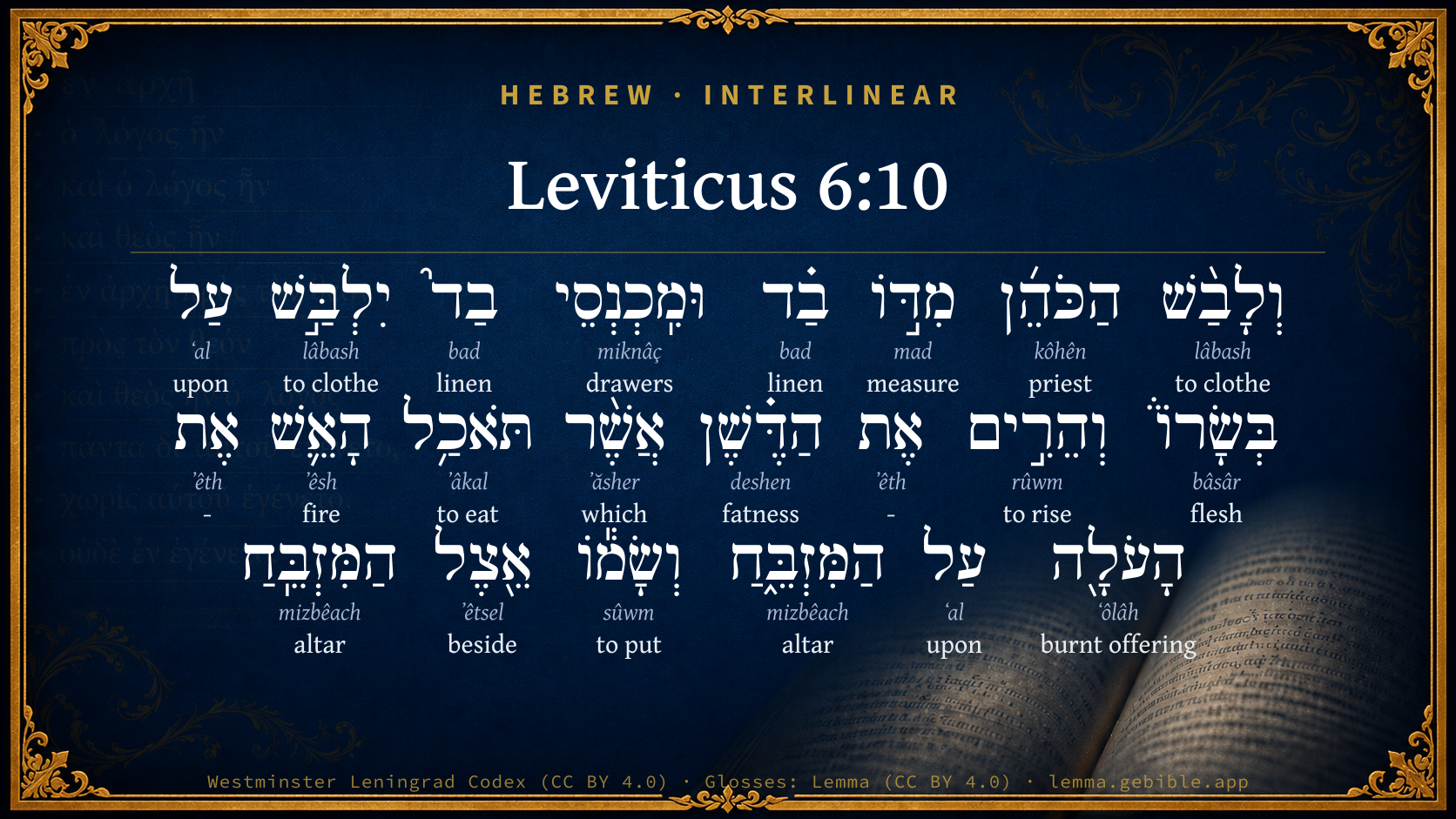
Leviticus 6:10

Hebrew (Westminster Leningrad Codex) Leviticus 6:10 appears in the Hebrew Old Testament. The text above is from the Westminster Leningrad Codex. Each word links to its Strong’s number, a concise gloss, and parsing drawn from the Open Scriptures Hebrew Bible morphology. Click any word for its full Brown-Driver-Briggs (BDB) entry.
Download image
Cite this verse

Leviticus 6:10 (World English Bible). Public Domain. Lemma interlinear Bible study tool, https://lemma.gebible.app/v/leviticus/6/10.

Show BibTeX & RIS
BibTeX
RIS
English Translation
The priest shall put on his linen garment, and he shall put on his linen breeches upon his body; and he shall remove the ashes from where the fire has consumed the burnt offering on the altar, and he shall put them beside the altar.
World English Bible · Public Domain
Highlights
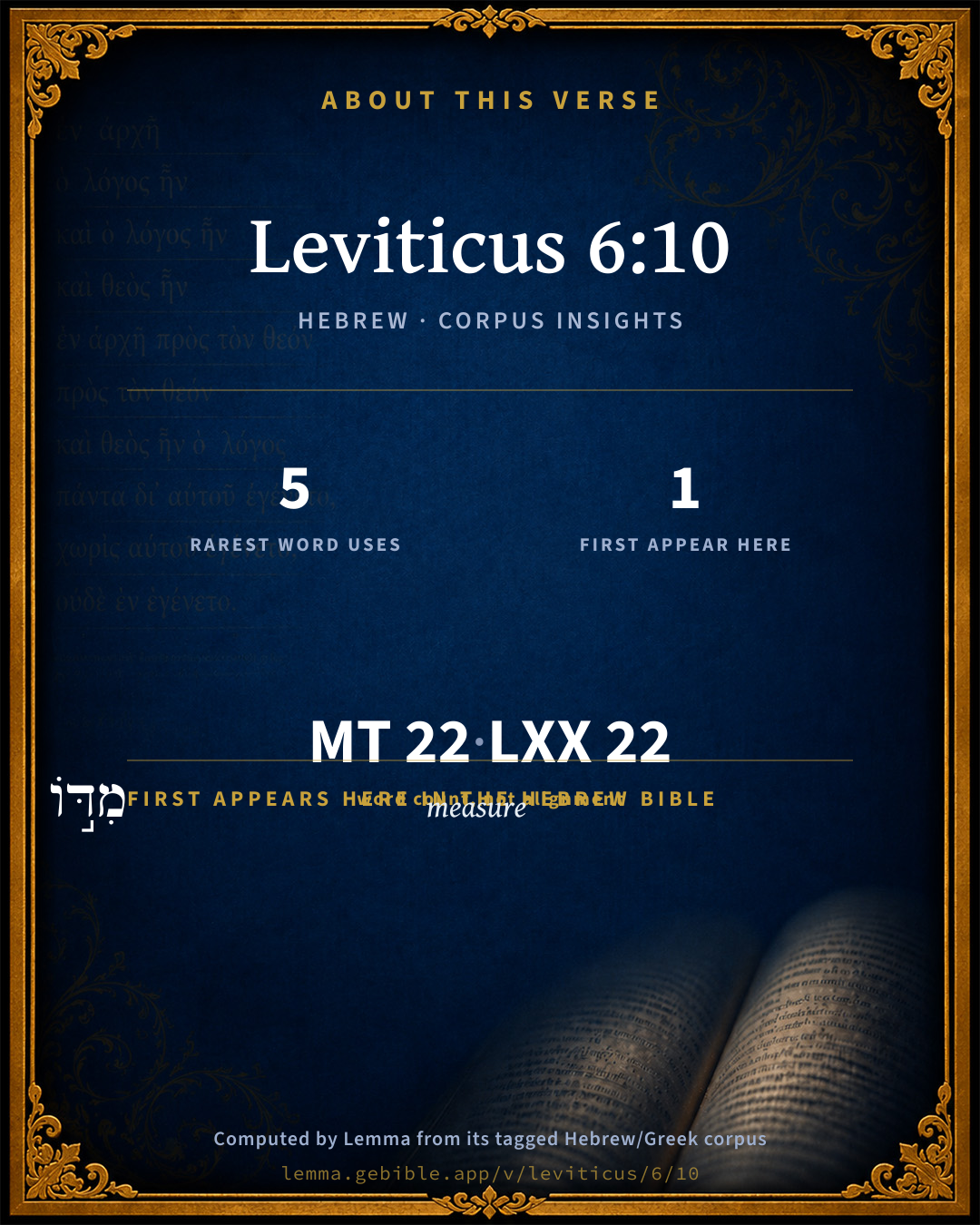
  • 1 first appearance in the Hebrew Bible
Full analysis ↓
Download a study sheet

One document with this verse’s original text, its word-by-word gloss line, the meaning frame, cross-references with their text, attributed commentary, and full source and license credits — printable, and it pastes into notes with its structure intact.

This verse Autodidact and up

Study sheet (.html) Plain text (.txt)

A passage Seminary Student

Up to 50 verses in one chapter. A passage sheet keeps up to 6 commentary sources and 12 cross-references per verse, in the order this page ranks them, and says so on the sheet whenever that leaves anything out. Ask for a single verse and you get the Autodidact verse sheet above.

Everything on this page stays free to read, with no account — the sheet is a download of what is already on screen, not access to it.

Want to remove ads? Support Godless Engineer
Compare translations 3

The same verse in 3 English versions, stacked beneath the original-language interlinear above. Click any original word for its lexicon entry.

Each is an independent rendering of the whole verse — the interlinear is not word-aligned to these translations.

Highlighted words mark where these versions differ — a whole-verse word diff, not a word-by-word alignment.

  • World English Bible Public Domain
    The priest shall put on his linen garment, and he shall put on his linen breeches upon his body; and he shall remove the ashes from where the fire has consumed the burnt offering on the altar, and he shall put them beside the altar.
  • King James Version Public Domain
    And the priest shall put on his linen garment, and his linen breeches shall he put upon his flesh, and take up the ashes which the fire hath consumed with the burnt offering on the altar, and he shall put them beside the altar.
  • unfoldingWord Literal Text CC BY-SA 4.0
    And the priest shall wear his linen robe, and the undergarments of linen he shall wear on his flesh. And he shall raise up the fatty ash, where the fire consumes the burnt offering on the altar, and he shall put it beside the altar.

unfoldingWord Literal Text — © unfoldingWord, licensed CC BY-SA 4.0. Word-aligned USFM3 via Door43 (git.door43.org/unfoldingWord/en_ult).

Versions to compare (up to 4)

3 of 4 selected

Show all 18 translations

Every available English version of this verse, each an independent rendering of the whole verse.

  • World English Bible Public Domain
    The priest shall put on his linen garment, and he shall put on his linen breeches upon his body; and he shall remove the ashes from where the fire has consumed the burnt offering on the altar, and he shall put them beside the altar.
  • Berean Standard Bible Public Domain
    And the priest shall put on his linen robe and linen undergarments, and he shall remove from the altar the ashes of the burnt offering that the fire has consumed and place them beside it.
  • Majority Standard Bible Public Domain
    And the priest shall put on his linen robe and linen undergarments, and he shall remove from the altar the ashes of the burnt offering that the fire has consumed and place them beside it.
  • King James Version Public Domain
    And the priest shall put on his linen garment, and his linen breeches shall he put upon his flesh, and take up the ashes which the fire hath consumed with the burnt offering on the altar, and he shall put them beside the altar.
  • American Standard Version (1901) Public Domain
    And the priest shall put on his linen garment, and his linen breeches shall he put upon his flesh; and he shall take up the ashes whereto the fire hath consumed the burnt-offering on the altar, and he shall put them beside the altar.
  • Revised Version (1885) Public Domain
    And the priest shall put on his linen garment, and his linen breeches shall he put upon his flesh; and he shall take up the ashes whereto the fire hath consumed the burnt offering on the altar, and he shall put them beside the altar.
  • Geneva Bible (1599) Public Domain
    And the Priest shall put on his linen garment, and shall put on his linen breeches vpon his flesh, and take away the ashes when the fire hath consumed the burnt offring vpon the altar, and he shall put them beside the altar.
  • Douay-Rheims (1899) Public Domain
    The priest shall be vested with the tunick and the linen breeches, and he shall take up the ashes of that which the devouring fire hath burnt, and putting them beside the altar,
  • Young's Literal Translation Public Domain
    that the priest hath put on his long robe of fine linen, and his fine linen trousers he doth put on his flesh, and hath lifted up the ashes which the fire consumeth with the burnt-offering on the altar, and hath put them near the altar;
  • Literal Standard Version CC BY-SA 4.0
    And the priest has put on his long robe of fine linen, and he puts his fine linen trousers on his flesh, and has lifted up the ashes which the fire consumes with the burnt-offering on the altar, and has put them near the altar;
  • Unlocked Literal Bible CC BY-SA 4.0
    The priest will put on his linen clothes, and he will also put on his linen underclothes. He will pick up the ashes that are left after the fire has consumed the burnt offering on the altar, and he will put the ashes beside the altar.
  • unfoldingWord Literal Text CC BY-SA 4.0
    And the priest shall wear his linen robe, and the undergarments of linen he shall wear on his flesh. And he shall raise up the fatty ash, where the fire consumes the burnt offering on the altar, and he shall put it beside the altar.
  • Darby Bible Public Domain
    And the priest shall put on his linen raiment, and his linen breeches shall he put on his flesh, and take up the ashes to which the fire hath consumed the burnt-offering on the altar, and he shall put them beside the altar.
  • World Messianic Bible Public Domain
    The priest shall put on his linen garment, and he shall put on his linen trousers upon his body; and he shall remove the ashes from where the fire has consumed the burnt offering on the altar, and he shall put them beside the altar.
  • Webster's Bible Public Domain
    \\6:17\\It shall not be baked with leaven. I have given it to them for their portion of my offerings made by fire; It is most holy, as is the sin-offering, and as the trespass-offering.
  • Free Bible Version CC BY-SA 4.0
    The priest shall put on his linen clothes and underwear, and he shall take from the altar the greasy ashes of the burnt offering that the fire has burned up and set them down beside the altar.
  • Bible in Basic English Public Domain
    It is not to be cooked with leaven. I have given it to them as their part of the offerings made by fire to me; it is most holy, as are the sin-offerings and the offerings for error.
  • JPS Tanakh (1917) Public Domain
    (6-3) And the priest shall put on his linen garment, and his linen breeches shall he put upon his flesh; and he shall take up the ashes whereto the fire hath consumed the burnt-offering on the altar, and he shall put them beside the altar.

Literal Standard Version (2020), Covenant Press — licensed CC BY-SA 4.0. Text via the HelloAO Bible API (eBible.org). Unlocked Literal Bible (unfoldingWord) — licensed CC BY-SA 4.0. Text via the HelloAO Bible API (eBible.org). unfoldingWord Literal Text — © unfoldingWord, licensed CC BY-SA 4.0. Word-aligned USFM3 via Door43 (git.door43.org/unfoldingWord/en_ult). Free Bible Version, Dr. Jonathan Gallagher — licensed CC BY-SA 4.0. Text via the HelloAO Bible API (eBible.org).

Word by word

More ways to search: Search by grammar → Find every occurrence → Compare this word →

Practice this passage: Drill this verse → Learn its vocabulary →

וּמִֽכְנְסֵי
miknâç
H4370
“and · drawers of”
Conjunction + Noun, Common, Masculine, Dual, Construct
Part of Speech
Conjunction + Noun
Type
Common
Gender
Masculine
Number
Dual
State
Construct
Full BDB Definition

Origin: from H3647 in the sense of hiding

TWOT: 1000a

underwear, drawers, trousers - a priestly undergarment of linen
  1. וְלָבַ֨שׁ lâbash H3847 “and · to clothe” Conjunction + Verb, Qal, Sequential Perfect, 3rd Person, Masculine, Singular
  2. הַכֹּהֵ֜ן kôhên H3548 “the · priest” Particle, Definite Article + Noun, Common, Masculine, Singular, Absolute
  3. מִדּ֣וֹ mad H4055 “measure · his” Noun, Common, Masculine, Singular, Construct + Suffix, Personal, 3rd Person, Masculine, Singular
  4. בַ֗ד bad H906 “linen” Noun, Common, Masculine, Singular, Absolute
  5. בַד֮ bad H906 “linen” Noun, Common, Masculine, Singular, Absolute
  6. יִלְבַּ֣שׁ lâbash H3847 “to clothe” Verb, Qal, Imperfect, 3rd Person, Masculine, Singular
  7. עַל ʻal H5921 “upon” Preposition
  8. בְּשָׂרוֹ֒ bâsâr H1320 “flesh · his” Noun, Common, Masculine, Singular, Construct + Suffix, Personal, 3rd Person, Masculine, Singular
  9. וְהֵרִ֣ים rûwm H7311 “and · to rise” Conjunction + Verb, Hiphil, Sequential Perfect, 3rd Person, Masculine, Singular
  10. אֶת ʼêth H853 “-” Particle, Direct Object
  11. הַדֶּ֗שֶׁן deshen H1880 “the · fatness” Particle, Definite Article + Noun, Common, Masculine, Singular, Absolute
  12. אֲשֶׁ֨ר ʼăsher H834 “which” Particle, Relative
  13. תֹּאכַ֥ל ʼâkal H398 “to eat” Verb, Qal, Imperfect, 3rd Person, Feminine, Singular
  14. הָאֵ֛שׁ ʼêsh H784 “the · fire” Particle, Definite Article + Noun, Common, Both, Singular, Absolute
  15. אֶת ʼêth H853 “-” Particle, Direct Object
  16. הָעֹלָ֖ה ʻôlâh H5930 “the · burnt offering” Particle, Definite Article + Noun, Common, Feminine, Singular, Absolute
  17. עַל ʻal H5921 “upon” Preposition
  18. הַמִּזְבֵּ֑חַ mizbêach H4196 “the · altar” Particle, Definite Article + Noun, Common, Masculine, Singular, Absolute
  19. וְשָׂמ֕וֹ sûwm H7760 “and · to put · him” Conjunction + Verb, Qal, Sequential Perfect, 3rd Person, Masculine, Singular + Suffix, Personal, 3rd Person, Masculine, Singular
  20. אֵ֖צֶל ʼêtsel H681 “beside” Preposition
  21. הַמִּזְבֵּֽחַ mizbêach H4196 “the · altar” Particle, Definite Article + Noun, Common, Masculine, Singular, Absolute

About this verse

These counts appear in no published source. They are computed here, from the morphology-tagged text and Lemma’s own curated glosses. What Lemma adds →

22
words
17
distinct lemmas
Pentateuch
section

Notable vocabulary

The rarest word here is וּמִֽכְנְסֵי drawers H4370 — appearing just 5 times in the whole Hebrew Bible.

First appearance in Scripture

This word makes its first canonical appearance in the Hebrew Bible here:

  • מִדּ֣וֹ measure H4055

Shared distinctive vocabulary

וּמִֽכְנְסֵי drawers H4370 occurs in 5 verses of the Hebrew Bible. Also found in:

Grammatical profile

  • 5 verbs
  • 11 nouns
  • 3 prepositions
  • 3 particles

Verb forms

  • וְלָבַ֨שׁ Qal · Sequential Perfect
  • יִלְבַּ֣שׁ Qal · Imperfect
  • וְהֵרִ֣ים Hiphil · Sequential Perfect
  • תֹּאכַ֥ל Qal · Imperfect
  • וְשָׂמ֕וֹ Qal · Sequential Perfect

Repetition

Words recur within this verse — often emphatic in Hebrew:

  • וְלָבַ֨שׁ to clothe H3847 ×2
  • בַ֗ד linen H906 ×2
  • עַל upon H5921 ×2
  • הַמִּזְבֵּ֑חַ altar H4196 ×2

Hebrew & Septuagint length

In English translation the verse runs 45 words from the Hebrew and 51 from the Septuagint (LXX English) — closely comparable.

A rough comparison of the two English renderings, which tokenize alike — not a word-level alignment.

Word counts can differ between the Hebrew and the Greek without any difference in meaning — e.g. the Hebrew direct-object marker אֵת has no separate Greek word, and Greek often adds the article ὁ.

In the original languages it is 22 Hebrew tokens and 22 Greek tokens — but the two are counted differently (Hebrew bundles its prefixes and suffixes into one token; the Greek is in lemma form), so that isn’t a like-for-like length.

Cross-references

14

Topical passages linked to Leviticus 6:10 in the Treasury of Scripture Knowledge — connected by theme and wording, ordered by reader-vote popularity; previews shown in the World English Bible.

  • Exodus 28:39–43 You shall weave the coat in checker work of fine linen, and you shall make a turban of fine linen, and you shall make a sash, the work of the embroiderer.
  • Leviticus 16:4 He shall put on the holy linen coat, and he shall have the linen breeches on his body, and shall put on the linen sash, and he shall be dressed with the linen turban. They are the holy garments. He shall bathe his body in water, and put them on.
  • Exodus 39:27–29 They made the coats of fine linen of woven work for Aaron, and for his sons,
  • Leviticus 1:9 but its innards and its legs he shall wash with water. The priest shall burn the whole on the altar, for a burnt offering, an offering made by fire, of a sweet savor to Yahweh.
  • Leviticus 1:13 but the innards and the legs he shall wash with water. The priest shall offer the whole, and burn it on the altar. It is a burnt offering, an offering made by fire, of a sweet savor to Yahweh.
  • Leviticus 1:16–17 and he shall take away its crop with its filth, and cast it beside the altar on the east part, in the place of the ashes.
  • Numbers 16:21 Separate yourselves from among this congregation, that I may consume them in a moment.
  • Numbers 16:35 Fire came forth from Yahweh, and devoured the two hundred fifty men who offered the incense.
  • Psalms 20:3 Remember all your offerings, And accept your burnt sacrifice. Selah.
  • Psalms 37:20 But the wicked shall perish. The enemies of Yahweh shall be like the beauty of the fields. They will vanish-- Vanish like smoke.
  • Ezekiel 44:17–18 It shall be that, when they enter in at the gates of the inner court, they shall be clothed with linen garments; and no wool shall come on them, while they minister in the gates of the inner court, and within.
  • Revelation 7:13 One of the elders answered, saying to me, "These who are arrayed in white robes, who are they, and from where did they come?"
  • Revelation 19:8 It was given to her that she would array herself in bright, pure, fine linen: for the fine linen is the righteous acts of the saints.
  • Revelation 19:14 The armies which are in heaven followed him on white horses, clothed in white, pure, fine linen.

Cross-references courtesy of OpenBible.info (CC BY 4.0).

Hebrew and Greek witnesses Masoretic Hebrew ↔ Greek Septuagint

The same verse in the two great witnesses to the Old Testament, shown verse-for-verse.

These are two independent witnesses, not word-aligned to each other, and the Septuagint is shown in lemma (dictionary) form.

Hebrew Leviticus 6:10 Masoretic · Westminster Leningrad Codex

וְלָבַ֨שׁ הַכֹּהֵ֜ן מִדּ֣וֹ בַ֗ד וּמִֽכְנְסֵי בַד֮ יִלְבַּ֣שׁ עַל בְּשָׂרוֹ֒ וְהֵרִ֣ים אֶת הַדֶּ֗שֶׁן אֲשֶׁ֨ר תֹּאכַ֥ל הָאֵ֛שׁ אֶת הָעֹלָ֖ה עַל הַמִּזְבֵּ֑חַ וְשָׂמ֕וֹ אֵ֖צֶל הַמִּזְבֵּֽחַ

The priest shall put on his linen garment, and he shall put on his linen breeches upon his body; and he shall remove the ashes from where the fire has consumed the burnt offering on the altar, and he shall put them beside the altar.

World English Bible · Public Domain

Greek LXX Leviticus 6:10 Septuagint · lemma form

οὐ πέπτω ζυμόω μερίς αὐτός δίδωμι αὐτός ἀπό ὁ κάρπωμα κύριος ἅγιος ἅγιος ὥσπερ ὁ ὁ ἁμαρτία καί ὥσπερ ὁ ὁ πλημμέλεια

And the priest shall put on the linen tunic, and he shall put the linen drawers on his body; and shall take away that which has been thoroughly burnt, which the fire shall have consumed, even the whole burnt offering from the altar, and he shall put it near the altar.

LXX2012 (modern English Septuagint) · Public Domain

Hebrew: Westminster Leningrad Codex (CC BY 4.0). Greek: Septuagint (public domain); English from LXX2012 (modern English Septuagint) (Public Domain). How the Septuagint differs from the Hebrew →

Targum (Aramaic paraphrase)

2

The Targum is the ancient Jewish Aramaic paraphrase of the Hebrew Scriptures — an interpretive translation, not the Hebrew text itself. Onkelos (literal) and Pseudo-Jonathan (expansive) render the Torah, and Jonathan the Prophets. Coverage is partial: where no permissively-licensed English translation exists for a verse, only the Aramaic is shown. This is verse-level text, not a word-by-word alignment to the Hebrew.

  1. Targum Onkelos Torah (Genesis–Deuteronomy)
    לָא תִתְאֲפֵי חֲמִיעַ חָלָקְהוֹן יְהָבִית יָתַהּ מִקֻרְבָּנָי קֹדֶשׁ קוּדְשִׁין הִיא כְּחַטָאתָא וְכַאֲשָׁמָא

    (no public-domain English translation for this verse)

    Targum Onkelos — Aramaic: “Onkelos Genesis” (public domain); “Onkelos Exodus” (public domain); “Onkelos Leviticus” (public domain); “Onkelos Numbers” (public domain); “Onkelos Deuteronomy” (public domain). English: “Sefaria Community Translation” (CC0 1.0 (public-domain dedication)); “J.W. Etheridge. The Targums of Onkelos and Jonathan Ben Uzziel on the Pentateuch. London: Longmans, Green, 1862” (public domain). Text via Sefaria.

  2. Targum Pseudo-Jonathan Torah (Genesis–Deuteronomy)
    לָא תִתְאֲפֵי חֲמִיעַ חוּלַקְהוֹן מִן מוֹתַר מִנְחָתָא דִיהָבִית לְהוֹן מִקָרְבָּנַי קוֹדֶשׁ קוּדְשִׁין הִיא הֵי כְחַטָאתָא וְהֵי כְאַשָׁמָא

    Their portion of the residue of the mincha of My oblations given to them shall not be baked with leaven; it is most sacred, as the sin offering and as the trespass offering.

    Targum Pseudo-Jonathan — Aramaic: “Targum Jonathan on Genesis” (public domain); “Targum Jonathan on Exodus” (public domain); “Targum Jonathan on Leviticus” (public domain); “Targum Jonathan on Numbers” (public domain); “Targum Jonathan on Deuteronomy” (public domain). English: “The Targum of Jonathan ben Uzziel, trans. J. W. Etheridge, London, 1862” (public domain). Text via Sefaria.

Commentary

Notes on Leviticus 6:10 from classic Christian and Jewish commentators (each source and its license shown beneath its notes). The classic Christian expositions comment on the surrounding passage and are grouped to its opening verse, so a note may address several verses; the Jewish commentaries on the Tanakh (Rashi and others) are per-verse, so they appear only where the commentator wrote on this verse.

Lemma curates 59 commentaries, every one of them public domain or Creative Commons licensed, each selected and text-cleaned for this edition rather than reprinted as found. About our sources →

Trapp's Complete Commentary

John Trapp

Lev 6:10 And the priest shall put on his linen garment, and his linen breeches shall he put upon his flesh, and take up the ashes which the fire hath consumed with the burnt offering on the altar, and he shall put them beside the altar.

Ver. 10. Beside the altar.] On the east side farthest from the sanctuary, {Lev 1:16} in reverence of the Divine Majesty.

John Trapp, A Commentary or Exposition upon All the Books of the Old and New Testament (1647–1656) — public domain. Text from a community e-Sword module.

The Biblical Illustrator

Joseph S. Exell

Lev_6:10-12

The priest shall put on his linen garment.

Sacred attire

I. In holy attire they serve at the altar.

1. Suggestive of the essential holiness of Christ.

2. Symbolic of their derived purity and righteousness.

3. Indicative of the spirit of service.

II. In altered garments they bear the ashes from the sanctuary.

1. The changed tone of feeling in the ministrant.

2. The altered scenes which a Christian frequents. (W. H. Jellie.)

The priests garments

The linen garment is the type of purity, as we see in the Book of Rev_19:8. The priest is the emblem of the Redeemer in his perfect purity coming to the work of atonement. The word for garment means a suit of clothes. It takes in the linen breeches, as well as all the other parts of the priests dress. His whole suit is to be the garb of purity. It is not glory; these ale not the golden garments. It is holy humanity; it is Jesus in humiliation, but without one stain of sin. There is a special reason for the direction as to the linen breeches. It is meant to denote the completeness of the purity that clothes him; it clothes him to his very skin, and covers the flesh of his nakedness (Exo_28:42). It was not only our unrighteousness and our corrupt nature that Jesus was free from, but also from that other part of our original sin which consists in the imputed guilt of Adam. Tile linen breeches that covered the nakedness of the priest, lead us back at once to our first parents sin, when they were naked and ashamed in the garden, after the Fall. Here we see this sin also covered. (A. A. Bonar.)

Take up the ashes.

He shall take up the ashes which the fire has consumed

By the figure which grammarians call ellipsis, or breviloquence, ashes is used for the material out of which ashes came, as Isa_47:2, speaks of grinding meal (Ainsworth). The wood was underneath the burnt-offering. This being done, the ashes were to be placed by themselves, for a little time, beside the altar. All eyes would thus see them and take notice of them, before they were carried out into a clean place. Probably there were two reasons for this action.

1. The fire was thus kept clear and bright, the ashes being removed. God thereby taught them that He was not careless as to this matter, but required that the type of His justice should be kept full and unobscured.

2. The ashes were shown for the purpose of making it manifest that the flame had not spared the victim, but had turned it into ashes. It was not a mere threatening when the angels foretold that Sodom and Gomorrah were to be destroyed for their sin; their doom (2Pe_2:6) is declared to have come on them, turning them to ashes. So here, all that was threatened is fulfilled. There the ashes lie; any eye may see them. The vengeance has been accomplished! The sacrifice is turned into ashes! Justice has found its object! The Lords arrows are not pointless; He performs all His threatenings, for He is holy. O Lord God of hosts, who is a strong Lord like unto Thee? or to Thy faithfulness round about Thee? (A. A. Bonar.)

Burn wood on it every morning, and lay the burnt-offering in order upon it.--

The daily sacrifice

By no Levitical rite or service was Christ, as the Lamb of God, more perfectly typified, than by the daily sacrifice. It significantly prefigured Him in His death, the satisfaction He yielded to the Father, and His intercession in behalf of men. It is Christ, then, that we have here; and--

I. In the perfectness of his character. The lamb was without spot; and He was without blemish. And this is what He needed to be. And yet He was more. He was marked not only for the absence of all defect, but for the presence of every excellence. He was absolutely and universally perfect. This was the case with the affections He cherished, the dispositions He cultivated, and the virtues He practised. Only what is perfect can satisfy an infinitely perfect God. All, therefore, that is defective and unholy is forbidden a place on His altar. Gods requirement extends to what is internal as well as to what is external. He demands truth in the inward parts as well as integrity in the outward life. The demand was fully met by Jesus. But what God required in the offering, He required also in those for whom it was presented. Only as we are personally what God requires, in righteousness of walk before Him, can we occupy the position to which we are invited, appreciate and enjoy the blessings of salvation, and fulfil the purposes of our high calling. But we may be that; provision for our being so has been made. Strengthened, therefore, with might by the Spirit in the inner man, there is no duty that we may not fulfil, and no appropriation of offered blessing that we may not make. Bus God not only strengthens for service; He Himself works in us, and for us, and by us--leading us to will and to do according to His good pleasure.

II. We have Christ here in his completeness of dedication to the father and to men. The lambs were, with the exception of the skin, wholly consumed by the fire; and Christ gave Himself to God for us. The primary object of His incarnation and mission to earth was--to glorify the Father. The path might be rugged, but leading to the glory of the Father, He cheerfully trod it; the Cross might be ignominious, but ensuring the glory of the Father, He gave Himself up to it. He made of Himself a whole burnt-offering to God. But it was a twofold gift He made of Himself when He laid Himself upon the altar. He gave Himself for us an offering and a sacrifice to God for a sweet-smelling savour (Eph_5:2). He loved me, and gave Himself for me. One of the purposes for which He became our substitute, delivered us from the dominion of evil, and endued us with Divine strength, was, that we might walk in His steps, and, in our measure, yield ourselves to God as He did. But is this being done? It is on record that, during the late civil war in America, and when victory was swaying from side to side, that commissioners from the Confederate States sought and obtained an interview with President Lincoln, with the view of trying to effect an arrangement for the independence of the territory they represented. They knew the tender-heartedness of Mr. Lincoln, and appealed to him to stay the effusion of blood which, at the moment, was flowing in torrents. They were willing to for go several of the States for which they had hitherto fought, if he would consent to the remainder being independent. They pleaded with him for hours, and made use of the strongest arguments and considerations they could adduce to gain their object. When they had finished, the president, who had patiently listened to all that had been said, raised his hand, and then bringing it down with emphasis on the map which lay before him, replied, Gentlemen, this Government must have the whole. And so God says, regarding the inner kingdom of every human heart. He will allow no partition or division there. The whole is His by right, and He will suffer no one to share with Him the throne He has erected for His own occupancy.

III. By the daily burnt-offering we are minded of Christs acceptableness to the father. The lamb was an offering of a sweet savour unto God, in which He had delight, and from which He derived satisfaction. And He was ever pleased with Christ. But is this remembered as it should be? Christ is much more thought of as providing for mens necessities than for Gods requirements; as appeasing justice than as giving delight to Him from whom He came; as ministering peace to the troubled than as satisfying the Fathers heart. But what Christ was to God, believers are intended to be, in their measure, also. Is this now, to any extent, the case? Has God satisfaction in all who call themselves by the name of His Son? Has He joy in that which you lay upon His altar, in the services that you fulfil, and in the measure of resemblance which you bear to His Beloved? Then Christ is brought before us here in the position He ever occupies on our behalf. A lamb was always before God, and Christ ever liveth to make intercession for us. Now, where Christ is in reference to the Father He ought to be in reference to all who bear His name. Only as this is the case, as He is ever before you, occupying the vision of your faith, filling the sphere of your life, and engaging your feelings and thoughts, will you become assimilated to His likeness and meet for His presence and glory above. (James Fleming, D. D.)

The Biblical Illustrator, edited by Joseph S. Exell (c. 1880s–1900s) — public domain. Text from a community e-Sword module.

Joseph Benson's Commentary

Lev 6:10. The ashes which the fire hath consumed — As the word אֶשׁרasher, rendered which here, also signifies when, and is so translated chap. Lev 4:22; Gen 30:38; Num 5:29, and in many other places, it is evident the passage here ought to have been translated, And take up the ashes when the fire hath consumed the burnt-offering.

Joseph Benson's Commentary on the Old and New Testaments (1811–1818) — public domain. Text from a community e-Sword module.

Tyndale Open Study Notes

Tyndale Open Resources

6:10 The priest was required to wear official linen clothing, the attire of his office, when officiating at the Tabernacle. This allowed everyone to know that he was there to carry out his official duties (Exod 28:40-43). The priest was to dress appropriately for service to the divine King. He was not to wear his official garb outside the Tabernacle (Lev 6:11; Ezek 44:19). • undergarments: See Exod 20:26.

Tyndale Open Study Notes — © Tyndale Open Resources, licensed CC BY-SA 4.0. Text via the HelloAO Bible API.

Geneva Bible (1599)

Geneva Bible translators

Upon his secret parts, Exod. 28:43.

In the ash pans appointed for that use.

Geneva Bible (1599) marginal notes — public domain. Text via Bolls.life.

Ellicott's Commentary for English Readers

(10) And the priest shall put on his linen garment.—The officiating priest was to put on his sacerdotal garments, which consisted of four pieces—viz., (1) the tunic, which was a long close robe of fine linen, with sleeves but without folds, covering the whole body, and reaching down to the feet; (2) linen breeches—better, linen drawers—which, according to the authorities during the second Temple, reached to the knees and were fastened by ribbons above the flanks; (3) a linen girdle, which, according to the same authorities, was three fingers wide and thirty-two cubits. long, and, like the veil of the court and of the sanctuary, was embroidered with figures; and (4) a mitre, or better, turban, which was likewise of fine linen, and was fastened to the head by means of ribbons, to prevent its falling off (Exo_28:4; Exo_28:40; Exo_29:5-10; Lev_8:13). Though the second and third only are here mentioned, there can hardly be any doubt that all the four garments were meant, and that the third and fourth are either omitted for the sake of brevity, or because they are included in the first term, which is the reason why some of the ancient versions have it in the plural.

Take up the ashes which the fire had consumed with the burnt offering.—Better, take up the ashes into which the fire had consumed the burnt offering. That is, the ashes into which the consuming fire had converted the victim.

He shall put them beside the altar.—During the second Temple, a priest was appointed by lot to take off from the altar every morning at least a shovelful of ashes and carry it without the camp, and when the ashes accumulated they were entirely removed to the same place.

A Bible Commentary for English Readers, edited by Charles John Ellicott (1878–1897) — public domain. Text from a community e-Sword module.

The Cambridge Bible for Schools and Colleges

gen. ed. J. J. S. Perowne

10. the priest shall put on] in the morning.

his linen garment] Perhaps the ‘coat of (in) chequer work’ mentioned Exo_28:4; Exo_28:39.

his linen breeches] Exo_28:42.

and he shall take up] The removal of the ashes was regarded as the completion of the sacrifice of the preceding day, and for it priestly garments were necessary: the Heb. verb is hçrîm (see note on Lev_7:14). The Jewish commentators, taking the word as implying a heave offering, have based on this word a ceremony observed in the second temple. The priest took a handful of the ashes as in the Meal-Offering (Lev_2:2) and laid it aside as a memorial of the preceding day’s service. This was called tĕrûmath haddéshçn, the heave offering of the ashes, and was part of the daily ritual. But this action would be described by ‘he shall take up from’ as in Lev_2:9.

The Cambridge Bible for Schools and Colleges (gen. ed. J. J. S. Perowne; Cambridge University Press, 1878–1918) — public domain. Text from a community e-Sword module.

John Gill's Exposition

And the priest shall put on his linen garment,.... "His measure" (q), as the word signifies, a garment that was just the measure of his body, and exactly fitted it; it was a sort of a shirt, which he wore next his body, and reached down to his feet; and in this he always officiated, and was an emblem of the purity and holiness of Christ our high priest, who was without sin, and so a fit person to take away the sin of others, by offering up himself without spot to God:

and his linen breeches shall he put upon his flesh; to cover his nakedness; that indecency might be prevented, and that he might not be exposed to ridicule; and though these two garments are only mentioned, yet the wise men say the word "put on" includes the bonnet and the girdle; for the removing of the ashes from the altar, which is the thing he was to be thus clothed to do, was done in the four garments, though the Scripture mentions but two (r):

and take up the ashes which the fire hath consumed, with the burnt offering on the altar; this was the first thing the priests did in a morning, and which in later times they cast lots for, and the first lot was for this service, and which was performed very early (s);"every day they cleansed or swept the altar, at cockcrowing or near it, whether before or after, and on the day of atonement at midnight, and at the feasts from the time of the first watch:"

and he shall put them beside the altar: without, at the corner of the altar, as Aben Ezra, on the east side of it; so says Jarchi, the priest takes a full censer of the innermost consumptions (that is, of the innermost parts of the sacrifice reduced to ashes), and puts them in the east of the rise of the altar; or, as by another (t) expressed, he takes the ashes in a censer, more or less, and lays them down at the east of the rise of the altar, and there leaves them, and this is the beginning of the morning service: and we are told by another writer (u), that there was a place called the house of ashes, and it was at the east of the rise of the altar, at a distance from the foot of it ten cubits and three hands' breadth; where the priest, before they began to sacrifice, laid the ashes of the sacrifices, and of the candlestick, and of the altar of incense, and of the offering of the fowl that were cast out.

(q) "est" "proprie vestis commensurata corpori", Munster; so Jarchi. (r) Maimon. in Misn. Tamid, c. 5. sect. 3. (s) Misn. Yoma, c. 1. sect. 8. (t) Bartenora in ib. (u) Jacob. Jud. Leo. Tabnitid Hecal, No. 90. apud Wagenseil. Sotah, p. 426.

John Gill's Exposition of the Whole Bible (1746–1763) — public domain (CC PDM 1.0). Text via the HelloAO Bible API.

Albert Barnes' Notes on the Bible

Ashes ... with the burnt-offering - Rather, the ashes to which the fire hath consumed the burnt-offering.

Albert Barnes' Notes on the Bible (1834–1885) — public domain. Text from a community e-Sword/MySword module.

Matthew Poole's English Annotations

His linen garment, i.e. his linen coat, of which see Exo 28:39,40. The ashes are said to be consumed improperly, When the wood is consumed into ashes; as meal is said to be ground, Isa 47:2, when the corn is ground into meal; and the naked to be stripped of their clothing, Job 22:6, when by being stripped they are made naked.

Matthew Poole's English Annotations on the Holy Bible (1683–1685) — public domain. Text from a community e-Sword/MySword module.

Whedon's Commentary on the Bible

Daniel D. Whedon

10. Linen breeches — Or drawers. These and the rest of the sacerdotal apparel are described in Exo_28:39-43. See notes. To symbolize holiness, the robe was to be composed of only one material. Mixed materials, as wool and flax, were forbidden to the common people.

Rev_19:19. Garments wholly of wool would not have suited the climate; and moreover, from their animal origin, were not regarded as pure. Linen robes are emblematical of purity. Rev_19:14. From immemorial antiquity Egypt was the great centre of the linen manufacture in the world. The verecundia of the Hebrew ritual in this and other places was a protest against some of the shameless forms of nature-worship prevalent among the idolatrous nations, and especially in some Egyptian rites according to the father of history (Herodotus, 2:60) and the pictures still visible on the monuments. Over the drawers was worn the cethoneth, or close-fitting cassock, also of fine linen, white, but with a diamond or chess-board pattern on it. This came nearly to the feet, and was woven without seam.

Daniel D. Whedon (gen. ed.), Commentary on the Old and New Testaments (1874–1909) — public domain. Text from a community e-Sword module.

John Wesley's Explanatory Notes

The ashes which the fire hath consumed - That is, the wood consumed into ashes.

John Wesley, Explanatory Notes Upon the Whole Bible (1754–1765) — public domain. Text via the GEBible commentary corpus.

unfoldingWord translationNotes

Door43 World Missions Community

his linen clothes

Linen is a white cloth. AT: "his white clothes" (See: Translate Unknowns)

He will pick up the ashes

"He will gather the ashes"

after the fire has consumed the burnt offering

The fire completely burning up the offering is spoken of as if it consumed or used up the burnt offering.

to a place that is clean

A place that is fit to be used for God's purposes is spoken of as if it were physically clean. (See: Metaphor)

translationWords

priest

consume

burnt offering

altar

clean

unfoldingWord translationNotes — © Distant Shores Media and the Door43 World Missions Community, licensed CC BY-SA 4.0. Source: git.door43.org/Door43/en_tn.

Rashi

Rabbi Shlomo Yitzchaki (Rashi)

לא תאפה חמץ חלקם IT SHALL NOT BE BAKEN AS ANYTHING LEAVENED FOR THEIR PORTION — The remains of the meal-offering which become the portion of the priests, are also forbidden to be baked in the form of leavened (Menachot 55a).

כחטאת וכאשם [IT IS MOST HOLY] AS THE SIN OFFERING OR THE GUILT OFFERING — the meal-offering of the sinner (v. 11) is as the sin-offering, therefore if he (the priest) takes the fistful out of it not as such (not having in mind that offering) it is invalid as is the sin-offering under such circumstances (cf. Rashi on 5:12); a free-will meal-offering (i.e. any of the other meal-offerings mentioned in ויקרא), however, is as the guilt-offering, therefore if he takes the fistful out of it not doing it as such, it is still valid (Sifra, Tzav, Chapter 3 3; Zevachim 11a).

Rashi on the Tanakh — English translations: “The Judaica Press complete Tanach with Rashi, translated by A. J. Rosenberg” (CC BY 4.0); “Pentateuch with Rashi's commentary by M. Rosenbaum and A.M. Silbermann, 1929-1934” (public domain); “The Metsudah Tanach series, Lakewood, N.J” (CC BY 4.0); and “The Book of Joshua, Metsudah Publications, 1997” (CC BY 4.0). Text via Sefaria.

Ramban (Nachmanides)

Rabbi Moshe ben Nachman (Ramban / Nachmanides)

I HAVE GIVEN IT AS THEIR PORTION OF MY OFFERINGS. Even to apportion it [i.e., the residue of the meal-offering which the priests are to eat] they are not permitted to do until after the parts given to the fire [i.e., the handful] have gone up on the altar. It is from here that we learn that the same law applies to all hallowed offerings, as it is written, I have given it as their portion of My offerings; it is most holy. It shall not be baked as anything leavened. Their portion … … The juxtaposition of the word chelkam (their portion) to the word chametz (leavened) is the reason for the Rabbis’ interpretation that the portion the priests receive from the meal-offering, neither may be baked with leaven. — even the residue [which the priests receive as their share of the meal-offering] may not be baked with leaven. As the sin-offering, and as the guilt-offering — this teaches that just as the sin-offering must come from ordinary money, (further, 16:6), that is, from the money which belongs to him. Sacred money, on the other hand, is not completely his to dispose of as he wishes. and can be offered only at daytime, and the priest performs all its acts with his right arm — so also this meal-offering must come from ordinary money, and be brought at daytime, and its acts must be performed with the priest’s right hand. Every male among the children of Aaron may eat of it — it may be apportioned even amongst those priests who have a bodily blemish [such as are mentioned further in Chapter 21:16-21 as disqualifying them from performing the acts of offering, but they may eat the residue of the meal-offering].Now with regards to the meal-offering of the priests He added [this command]: And every meal-offering of the priest shall be wholly burnt; it shall not be eaten. On this the Rabbi [Moshe ben Maimon] wrote in the Moreh Nebuchim that the reason [for the meal-offering of the priest being entirely burnt] is because every priest offered up his own meal-offering himself, and if he were to offer it and eat the residue of it himself, it would appear as if he had brought no offering. For nothing was offered of an ordinary individual’s meal-offering (the meal-offering of the individual). except the frankincense and the handful of the flour. If then, in addition to the fact that the whole offering was small, he who offered it were to eat it himself, he would imagine (and he will imagine).” Such is the text in Al Charizi’s translation of the Moreh Nebuchim, which Ramban follows. The intent would seem to be that the priest who is offering his own meal-offering will imagine that he has performed no Divine Service, and therefore he might violate the laws regarding the eating of the residue. Hence the Torah prohibited him from eating it. In Ibn Tibbon’s translation, however, the reading is: “V’lo yeira’eh (and it will not appear),” that is, to others, that a Service has been performed, and therefore they will hold the priest in disregard for eating it. That is why the Torah commanded that it be wholly burnt. that he had brought no offering at all. Therefore [the Torah required] that it be entirely burnt.

Ramban (Nachmanides) on the Tanakh — English translation: “Commentary on the Torah by Ramban (Nachmanides). Translated and annotated by Charles B. Chavel. New York, Shilo Pub. House, 1971-1976” (CC BY 4.0). Text via Sefaria.

Lesson kit

Teaching starters — assembled from the data on this page, not authored interpretation. Every prompt links to the verse data it draws on. Edit before teaching.

Leviticus, in the Pentateuch, opens this verse with 22 words (17 distinct Hebrew lemmas). Its most distinctive word is miknâç (“drawers”). A historical commentator’s framing appears above. Read the whole chapter for the surrounding context.

Discussion questions

  1. How does “drawers” (miknâç) shape what this verse is saying?
  2. This is the first place “measure” appears in Scripture (first appears here). What does its debut here establish?
  3. How does Exodus 28:42, which shares the word «drawers», read alongside this verse?
  4. What does the repetition of “to clothe” (2× in this one verse) do in this verse?
  5. The translations on this page render this verse differently — a whole-verse word diff, not a word-by-word alignment. What might account for the different wordings?
  6. «וְלָבַ֨שׁ» is a Qal Sequential Perfect verb. How does that grammatical form shape the action described?
  7. Compare how Trapp's Complete Commentary and The Biblical Illustrator read this verse. Where do they agree or differ?

Things to notice

Reading settings

Reading text

Shown beneath each verse's original-language words.

Old Testament
Old Testament edition

Read the OT as the Masoretic Hebrew (MT) or the Greek Septuagint (LXX).

English shown for the Greek Septuagint (in the Hebrew ↔ Greek comparison).

Comparing translations? Open the Compare panel on any verse page to stack up to four side by side.