Ezekiel 38:19

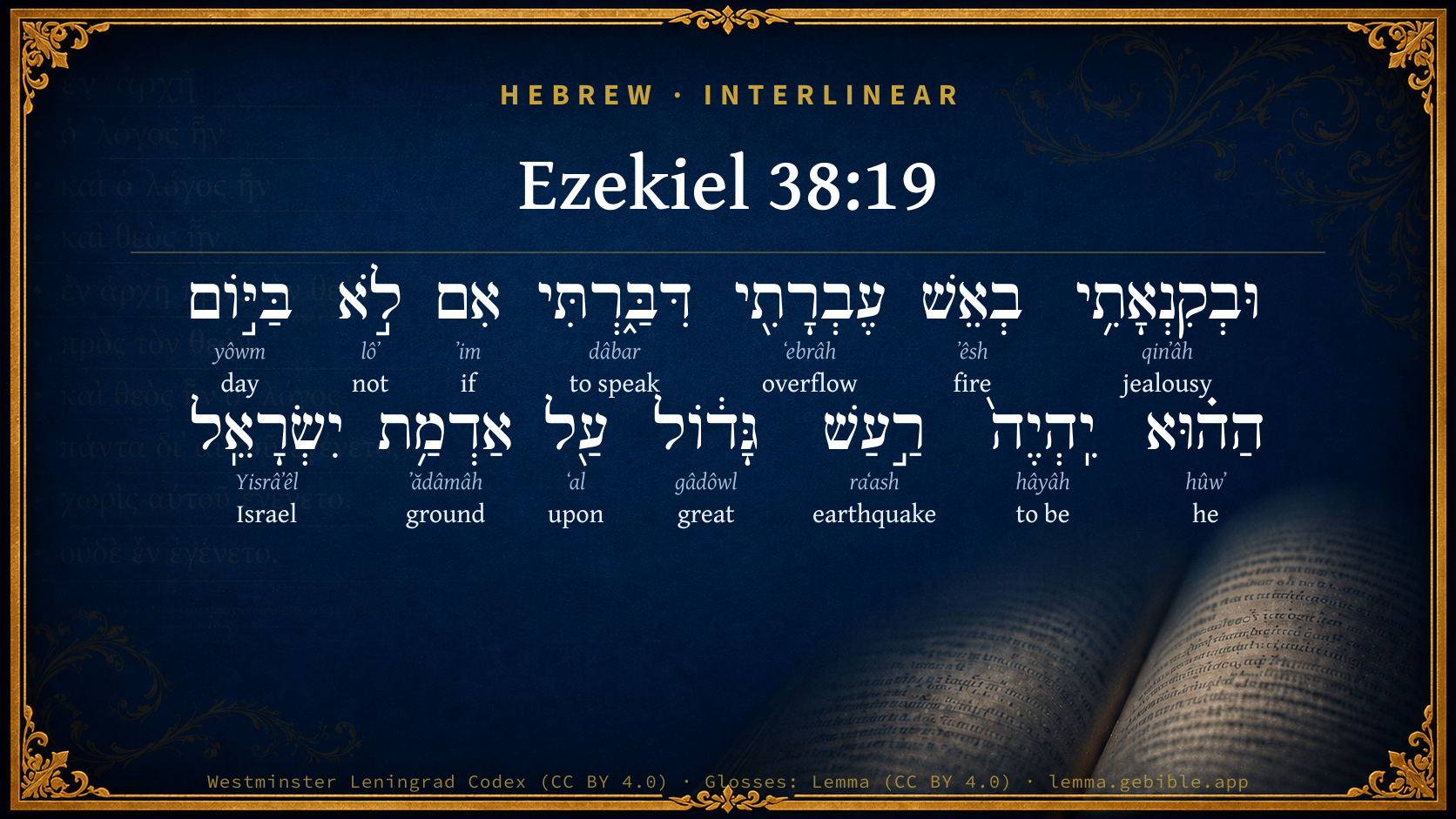
Hebrew (Westminster Leningrad Codex) Ezekiel 38:19 appears in the Hebrew Old Testament. The text above is from the Westminster Leningrad Codex. Each word links to its Strong’s number, a concise gloss, and parsing drawn from the Open Scriptures Hebrew Bible morphology. Click any word for its full Brown-Driver-Briggs (BDB) entry.
Download image
Cite this verse

Ezekiel 38:19 (World English Bible). Public Domain. Lemma interlinear Bible study tool, https://lemma.gebible.app/v/ezekiel/38/19.

Show BibTeX & RIS
BibTeX
RIS
English Translation
For in my jealousy and in the fire of my wrath have I spoken, Surely in that day there shall be a great shaking in the land of Israel;
World English Bible · Public Domain
Download a study sheet

One document with this verse’s original text, its word-by-word gloss line, the meaning frame, cross-references with their text, attributed commentary, and full source and license credits — printable, and it pastes into notes with its structure intact.

This verse Autodidact and up

Study sheet (.html) Plain text (.txt)

A passage Seminary Student

Up to 50 verses in one chapter. A passage sheet keeps up to 6 commentary sources and 12 cross-references per verse, in the order this page ranks them, and says so on the sheet whenever that leaves anything out. Ask for a single verse and you get the Autodidact verse sheet above.

Everything on this page stays free to read, with no account — the sheet is a download of what is already on screen, not access to it.

Want to remove ads? Support Godless Engineer
Compare translations 3

The same verse in 3 English versions, stacked beneath the original-language interlinear above. Click any original word for its lexicon entry.

Each is an independent rendering of the whole verse — the interlinear is not word-aligned to these translations.

Highlighted words mark where these versions differ — a whole-verse word diff, not a word-by-word alignment.

  • World English Bible Public Domain
    For in my jealousy and in the fire of my wrath have I spoken, Surely in that day there shall be a great shaking in the land of Israel;
  • King James Version Public Domain
    For in my jealousy and in the fire of my wrath have I spoken, Surely in that day there shall be a great shaking in the land of Israel;
  • unfoldingWord Literal Text CC BY-SA 4.0
    In my zeal and in the fire of my anger, I declare that on that day there will be a great earthquake in the land of Israel.

unfoldingWord Literal Text — © unfoldingWord, licensed CC BY-SA 4.0. Word-aligned USFM3 via Door43 (git.door43.org/unfoldingWord/en_ult).

Versions to compare (up to 4)

3 of 4 selected

Show all 18 translations

Every available English version of this verse, each an independent rendering of the whole verse.

  • World English Bible Public Domain
    For in my jealousy and in the fire of my wrath have I spoken, Surely in that day there shall be a great shaking in the land of Israel;
  • Berean Standard Bible Public Domain
    In My zeal and fiery rage I proclaim that on that day there will be a great earthquake in the land of Israel.
  • Majority Standard Bible Public Domain
    In My zeal and fiery rage I proclaim that on that day there will be a great earthquake in the land of Israel.
  • King James Version Public Domain
    For in my jealousy and in the fire of my wrath have I spoken, Surely in that day there shall be a great shaking in the land of Israel;
  • American Standard Version (1901) Public Domain
    For in my jealousy and in the fire of my wrath have I spoken, Surely in that day there shall be a great shaking in the land of Israel;
  • Revised Version (1885) Public Domain
    For in my jealousy and in the fire of my wrath have I spoken, Surely in that day there shall be a great shaking in the land of Israel;
  • Geneva Bible (1599) Public Domain
    For in mine indignation and in the fire of my wrath haue I spoken it: surely at that time there shalbe a great shaking in the land of Israel,
  • Douay-Rheims (1899) Public Domain
    And I have spoken in my zeal, and in the fire of my anger, that in that day there shall be a great commotion upon the land of Israel:
  • Young's Literal Translation Public Domain
    And in My zeal, in the fire of My wrath, I have spoken: Is there not in that day a great rushing on the land of Israel?
  • Literal Standard Version CC BY-SA 4.0
    And in My zeal, in the fire of My wrath, || I have spoken: Is there not a great rushing on the land of Israel in that day?
  • Unlocked Literal Bible CC BY-SA 4.0
    In my zeal and in the fire of my anger, I declare that on that day there will be a great earthquake in the land of Israel.
  • unfoldingWord Literal Text CC BY-SA 4.0
    In my zeal and in the fire of my anger, I declare that on that day there will be a great earthquake in the land of Israel.
  • Darby Bible Public Domain
    for in my jealousy, in the fire of my wrath have I spoken, Verily in that day there shall be a great shaking in the land of Israel;
  • World Messianic Bible Public Domain
    For in my jealousy and in the fire of my wrath I have spoken. Surely in that day there will be a great shaking in Eretz-Israel,
  • Webster's Bible Public Domain
    For in my jealousy and in the fire of my wrath have I spoken, Surely in that day there shall be a great shaking in the land of Israel.
  • Free Bible Version CC BY-SA 4.0
    In my passionate and furious anger I announce that at that time a violent earthquake will hit of the country of Israel.
  • Bible in Basic English Public Domain
    For in the fire of my wrath I have said, Truly, in that day there will be a great shaking in the land of Israel;
  • JPS Tanakh (1917) Public Domain
    For in My jealousy and in the fire of My wrath have I spoken: Surely in that day there shall be a great shaking in the land of Israel;

Literal Standard Version (2020), Covenant Press — licensed CC BY-SA 4.0. Text via the HelloAO Bible API (eBible.org). Unlocked Literal Bible (unfoldingWord) — licensed CC BY-SA 4.0. Text via the HelloAO Bible API (eBible.org). unfoldingWord Literal Text — © unfoldingWord, licensed CC BY-SA 4.0. Word-aligned USFM3 via Door43 (git.door43.org/unfoldingWord/en_ult). Free Bible Version, Dr. Jonathan Gallagher — licensed CC BY-SA 4.0. Text via the HelloAO Bible API (eBible.org).

Word by word

More ways to search: Search by grammar → Find every occurrence → Compare this word →

Practice this passage: Drill this verse → Learn its vocabulary →

רַ֣עַשׁ
raʻash
H7494
“earthquake”
Noun, Common, Masculine, Singular, Absolute
Part of Speech
Noun
Type
Common
Gender
Masculine
Number
Singular
State
Absolute
Full BDB Definition

Origin: from H7493

TWOT: 2195a

quaking, rattling, shaking - earthquake - quaking, trembling (of person) - shaking, quivering (of dart)
  1. וּבְקִנְאָתִ֥י qinʼâh H7068 “and · in/at · jealousy · my” Conjunction + Preposition + Noun, Common, Feminine, Singular, Construct + Suffix, Personal, 1st Person, Common, Singular
  2. בְאֵשׁ ʼêsh H784 “in/at · fire of” Preposition + Noun, Common, Both, Singular, Construct
  3. עֶבְרָתִ֖י ʻebrâh H5678 “overflow · my” Noun, Common, Feminine, Singular, Construct + Suffix, Personal, 1st Person, Common, Singular
  4. דִּבַּ֑רְתִּי dâbar H1696 “to speak” Verb, Piel, Perfect, 1st Person, Common, Singular
  5. אִם ʼim H518 “if” Conjunction
  6. לֹ֣א lôʼ H3808 “not” Particle, Negative
  7. בַּיּ֣וֹם yôwm H3117 “in/at the · day” Preposition, Determined + Noun, Common, Masculine, Singular, Absolute
  8. הַה֗וּא hûwʼ H1931 “the · he” Particle, Definite Article + Pronoun, Personal, 3rd Person, Masculine, Singular
  9. יִֽהְיֶה֙ hâyâh H1961 “to be” Verb, Qal, Imperfect, 3rd Person, Masculine, Singular
  10. גָּד֔וֹל gâdôwl H1419 “great” Adjective, Adjective, Masculine, Singular, Absolute
  11. עַ֖ל ʻal H5921 “upon” Preposition
  12. אַדְמַ֥ת ʼădâmâh H127 “ground of” Noun, Common, Feminine, Singular, Construct
  13. יִשְׂרָאֵֽל Yisrâʼêl H3478 “Israel” Noun, Proper

About this verse

These counts appear in no published source. They are computed here, from the morphology-tagged text and Lemma’s own curated glosses. What Lemma adds →

14
words
14
distinct lemmas
Prophets
section

Notable vocabulary

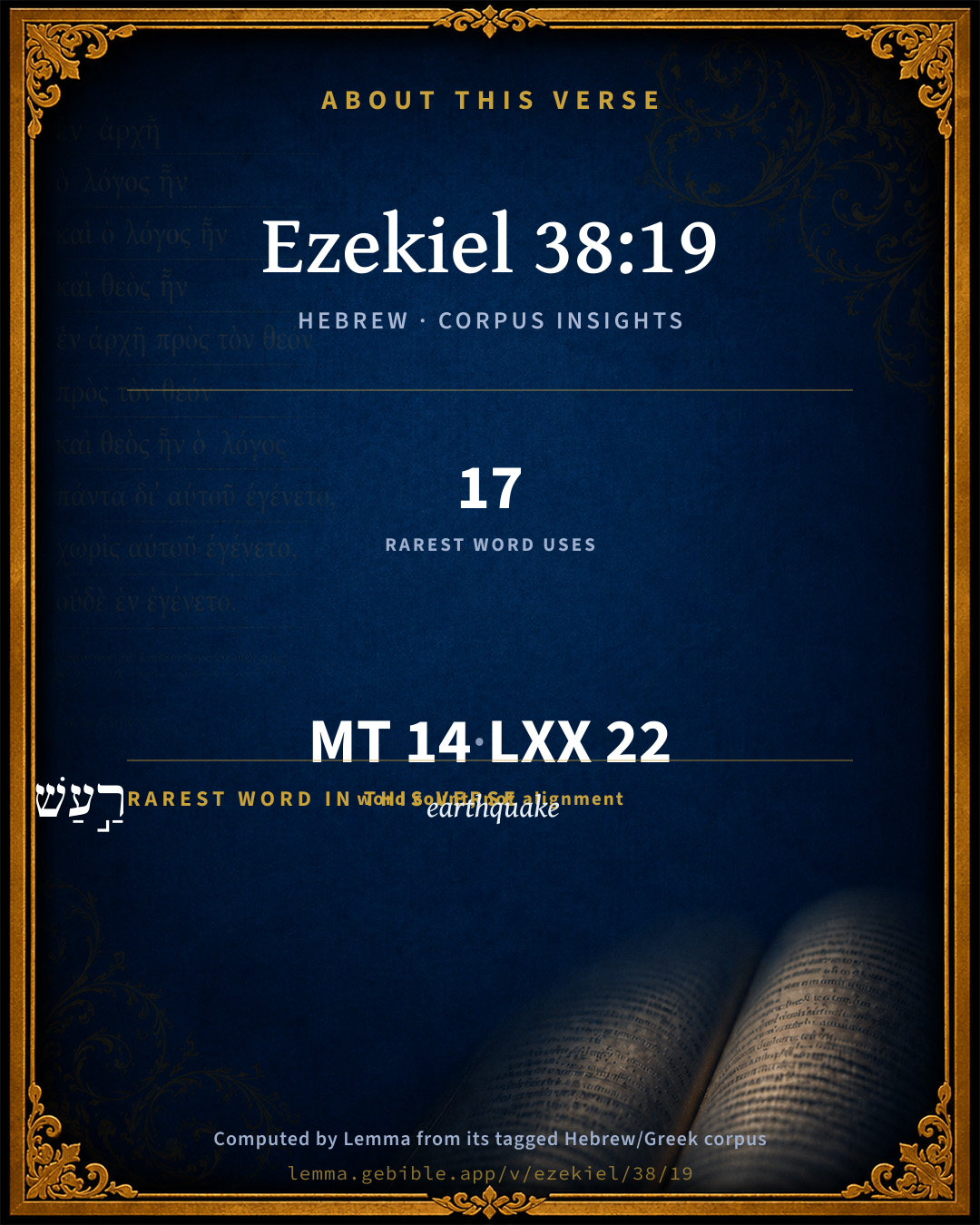
The rarest word here is רַ֣עַשׁ earthquake H7494 — appearing just 17 times in the whole Hebrew Bible.

Shared distinctive vocabulary

רַ֣עַשׁ earthquake H7494 occurs in 16 verses of the Hebrew Bible. Also found in:

Grammatical profile

  • 2 verbs
  • 7 nouns
  • 1 adjective
  • 1 pronoun
  • 1 preposition
  • 1 conjunction
  • 1 particle

Verb forms

  • דִּבַּ֑רְתִּי Piel · Perfect
  • יִֽהְיֶה֙ Qal · Imperfect

Hebrew & Septuagint length

In English translation the verse runs 29 words from the Hebrew and 32 from the Septuagint (LXX English) — closely comparable.

A rough comparison of the two English renderings, which tokenize alike — not a word-level alignment.

Word counts can differ between the Hebrew and the Greek without any difference in meaning — e.g. the Hebrew direct-object marker אֵת has no separate Greek word, and Greek often adds the article ὁ.

In the original languages it is 14 Hebrew tokens and 22 Greek tokens — but the two are counted differently (Hebrew bundles its prefixes and suffixes into one token; the Greek is in lemma form), so that isn’t a like-for-like length.

Cross-references

14

Topical passages linked to Ezekiel 38:19 in the Treasury of Scripture Knowledge — connected by theme and wording, ordered by reader-vote popularity; previews shown in the World English Bible.

  • Haggai 2:6–7 For this is what Yahweh of Hosts says: 'Yet once, it is a little while, and I will shake the heavens, the earth, the sea, and the dry land;
  • Haggai 2:21–22 "Speak to Zerubbabel, governor of Judah, saying, 'I will shake the heavens and the earth.
  • Hebrews 12:26 whose voice shook the earth, then, but now he has promised, saying, "Yet once more I will shake not only the earth, but also the heavens."
  • Ezekiel 5:13 Thus shall my anger be accomplished, and I will cause my wrath toward them to rest, and I shall be comforted; and they shall know that I, Yahweh, have spoken in my zeal, when I have accomplished my wrath on them.
  • Joel 3:16 Yahweh will roar from Zion, And thunder from Jerusalem; And the heavens and the earth will shake; But Yahweh will be a refuge to his people, And a stronghold to the children of Israel.
  • Revelation 11:13 In that day there was a great earthquake, and a tenth of the city fell. Seven thousand people were killed in the earthquake, and the rest were terrified, and gave glory to the God of heaven.
  • Revelation 16:18 There were lightnings, sounds, and thunders; and there was a great earthquake, such as was not since there were men on the earth, so great an earthquake, so mighty.
  • Revelation 16:20 Every island fled away, and the mountains were not found.
  • Deuteronomy 29:20 Yahweh will not pardon him, but then the anger of Yahweh and his jealousy will smoke against that man, and all the curse that is written in this book shall lie on him, and Yahweh will blot out his name from under the sky.
  • Psalms 18:7 Then the earth shook and trembled. The foundations also of the mountains quaked and were shaken, Because he was angry.
  • Isaiah 42:13 Yahweh will go forth as a mighty man; he will stir up [his] zeal like a man of war: he will cry, yes, he will shout aloud; he will do mightily against his enemies.
  • Ezekiel 39:25 Therefore thus says the Lord Yahweh: Now will I bring back the captivity of Jacob, and have mercy on the whole house of Israel; and I will be jealous for my holy name.
  • Joel 2:18 Then Yahweh was jealous for his land, And had pity on his people.
  • Zechariah 1:14 So the angel who talked with me said to me, "Proclaim, saying, 'Thus says Yahweh of Hosts: "I am jealous for Jerusalem and for Zion with a great jealousy.

Cross-references courtesy of OpenBible.info (CC BY 4.0).

Hebrew and Greek witnesses Masoretic Hebrew ↔ Greek Septuagint

The same verse in the two great witnesses to the Old Testament, shown verse-for-verse.

These are two independent witnesses, not word-aligned to each other, and the Septuagint is shown in lemma (dictionary) form.

Hebrew Ezekiel 38:19 Masoretic · Westminster Leningrad Codex

וּבְקִנְאָתִ֥י בְאֵשׁ עֶבְרָתִ֖י דִּבַּ֑רְתִּי אִם לֹ֣א בַּיּ֣וֹם הַה֗וּא יִֽהְיֶה֙ רַ֣עַשׁ גָּד֔וֹל עַ֖ל אַדְמַ֥ת יִשְׂרָאֵֽל

For in my jealousy and in the fire of my wrath have I spoken, Surely in that day there shall be a great shaking in the land of Israel;

World English Bible · Public Domain

Greek LXX Ezekiel 38:19 Septuagint · lemma form

καί ὁ ζῆλος ἐγώ ἐν πῦρ ὁ ὀργή ἐγώ λαλέω εἰ μήν ἐν ὁ ἡμέρα ἐκεῖνος εἰμί σεισμός μέγας ἐπί γῆ ἰσραήλ

that my wrath and my jealousy shall arise, I have spoken in the fire of my anger, verily in that day there shall be a great shaking in the land of Israel;

LXX2012 (modern English Septuagint) · Public Domain

Hebrew: Westminster Leningrad Codex (CC BY 4.0). Greek: Septuagint (public domain); English from LXX2012 (modern English Septuagint) (Public Domain). How the Septuagint differs from the Hebrew →

Targum (Aramaic paraphrase)

1

The Targum is the ancient Jewish Aramaic paraphrase of the Hebrew Scriptures — an interpretive translation, not the Hebrew text itself. Onkelos (literal) and Pseudo-Jonathan (expansive) render the Torah, and Jonathan the Prophets. Coverage is partial: where no permissively-licensed English translation exists for a verse, only the Aramaic is shown. This is verse-level text, not a word-by-word alignment to the Hebrew.

  1. Targum Jonathan Prophets (Joshua–Malachi)
    וּבְאִתְגְלָאָה פּוּרְעֲנוּתִי בְמִדְלַק אֶשַׁת רוּגְזִי גְזָרֵית בְמֵימְרִי אִם לָא בְּיוֹמָא הַהוּא יְהֵי זִיעַ סַגִי עַל אַרְעָא דְיִשְׂרָאֵל:

    (no public-domain English translation for this verse)

    Targum Jonathan — Aramaic: “Mikraot Gedolot” (public domain). English: “Sefaria Community Translation” (CC0 1.0 (public-domain dedication)); “London "Chaldee Paraphrase," 1871” (public domain). Text via Sefaria.

Commentary

Notes on Ezekiel 38:19 from classic Christian and Jewish commentators (each source and its license shown beneath its notes). The classic Christian expositions comment on the surrounding passage and are grouped to its opening verse, so a note may address several verses; the Jewish commentaries on the Tanakh (Rashi and others) are per-verse, so they appear only where the commentator wrote on this verse.

Lemma curates 59 commentaries, every one of them public domain or Creative Commons licensed, each selected and text-cleaned for this edition rather than reprinted as found. About our sources →

Trapp's Complete Commentary

John Trapp

Eze 38:19 For in my jealousy [and] in the fire of my wrath have I spoken, Surely in that day there shall be a great shaking in the land of Israel;

Ver. 19. For in my jealousy.] God first kindleth, and then speaketh, and then shaketh the earth. His wrath is like Elijah’s cloud, which was at first but a small matter to see to; or as thunder, which we hear at first a little roaring noise afar off, but stay awhile, it is a dreadful crack; or as fire, that at first burneth a little upon a few boards, but when it prevaileth, bursteth out in a most terrible flame.

John Trapp, A Commentary or Exposition upon All the Books of the Old and New Testament (1647–1656) — public domain. Text from a community e-Sword module.

Jamieson, Fausset & Brown

Robert Jamieson, A. R. Fausset & David Brown

great shaking--an earthquake: physical agitations after accompanying social and moral revolutions. Foretold also in Joe 3:16; (compare Hag 2:6-7; Mat 24:7, Mat 24:29; Rev 16:18).

Jamieson, Fausset & Brown — Commentary Critical and Explanatory on the Whole Bible (1871) — public domain (CC PDM 1.0). Text via the HelloAO Bible API.

The Cambridge Bible for Schools and Colleges

gen. ed. J. J. S. Perowne

19. have I spoken] i.e. do I speak; cf. Ezek. 21:36, Eze_36:5, Eze_39:25. The word “shaking” is the usual one for earthquake, but the general term is better here, Eze_38:20, cf. Hag_2:6-7.

The Cambridge Bible for Schools and Colleges (gen. ed. J. J. S. Perowne; Cambridge University Press, 1878–1918) — public domain. Text from a community e-Sword module.

John Gill's Exposition

So that the fishes of the sea shall shake at my presence,.... From whence it appears that this great shaking shall not be on account of the army of Gog, and the devastations that it shall make; but on account of the powerful presence of God, which will be manifest in the destruction of his army: and what is here said of the shaking of the fishes of the sea,

and the fowls of the heaven, and the beast of the field, and all creeping things that creep upon the earth, and all the men that are upon the earth, must be understood figuratively and hyperbolically, as Kimchi observes, and in allusion to earthquakes, which both shake and terrify all kind of creatures; the blow given to Gog will be so terrible, that all nature will seem to be thrown into a convulsion and agitation by it; see Jer 4:24,

and the mountains shall be thrown down; as they are sometimes by earthquakes; and as the mount of Olives will at this time cleave asunder; and perhaps other mountains will, as Kimchi observes, see Zac 14:2,

and the steep places shall fall; the Targum renders the word "towers"; and so the Syriac version, and Piscator: the word signifies stairs or steps (t), such as in a ladder; and is translated "stairs", Sol 2:14 it seems to me to design such mounts as are raised by besiegers of a city, by means of which they may be able to scale the walls of it, which Jarchi suggests; though he says he had heard it said that these, are rocks bending over and hanging, and appear as if they were falling; which agrees with our version; and it may be observed, in some of those precipices, there are like stairs or steps to go up them:

and every wall shall fall to the ground: this shows that the words are not to be taken literally, but figuratively; only to express how sensibly the power of God should be felt and perceived by all creatures, and in all parts of the land; since now the Jews will dwell in a land of unwalled villages, and in cities without walls, bars, and gates; see Eze 38:11.

(t) "gradus", Munster, Pagninus, Montanus.

John Gill's Exposition of the Whole Bible (1746–1763) — public domain (CC PDM 1.0). Text via the HelloAO Bible API.

Haydock's Catholic Bible Commentary

Israel. The Jews shall be full of dismay, (ver. 20.) as the tyrant will vent some threats; (Calmet) or this commotion was in his own army. (Haydock)

George Leo Haydock (1774–1849), Haydock's Catholic Family Bible and Commentary, 1859 edition — public domain. Excludes Psalms (Douay-Rheims chapter numbering differs from Protestant) and Deuterocanonical books (Catholic canon only).

Matthew Poole's English Annotations

In my jealousy for my own people, that I may preserve them, and for mine own glory, to vindicate that, as Eze 39:25; Zec 1:14.

In the fire of my wrath against mine enemies, Gog and all his herds.

Surely: it is in the Hebrew after the form of an oath, as Eze 36:5.

A great shaking; to be sure a very great disturbance and tumult, like an earthquake, as the word signifies, for such an army, such threats, such assaults, and sieges will shake cities, towns, and the hearts of the stoutest.

In the land of Israel; or against the land of Israel, which, for aught I know, will make the sense more obvious; the mighty preparations and the proud threats of Gog against Israel will make many hearts to quake, as well as foundations of cities.

Matthew Poole's English Annotations on the Holy Bible (1683–1685) — public domain. Text from a community e-Sword/MySword module.

The Pulpit Commentary

Vers. 19, 20. An earthquake.

In the day of God"s jealousy and wrath there is to be a great shaking of sea, air, and land, so that the very fishes and birds, as well as the beasts of the earth, will feel its shock.

I AN EARTHQUAKE MAY OCCUR. There were once two opposed schools of geology one believing that our earth had reached its present condition after successive violent catastrophes had wrought great and sudden changes on its surface; the other holding that the most striking results could be produced, and, therefore on the principle that the minimum cause is the only one that one can affirm have been produced, by the operation of the very forces which we now witness. This latter, the uniformitarian theory, has been so well established by Sir Charles Lyell, that few would now think of reviving the more dramatic hypothesis. Nevertheless, even this theory admits of many great and violent movements under the operation of present laws and forces. Earthquakes do now occur. So is it in the world of men. We are governed by orderly Divine laws. Yet we meet with great shocks in political changes, when empires topple to the dust; in social changes, when the old order is upset, as in the French Revolution; in domestic changes, when a man"s quiet home-life is ruthlessly upset, and sudden poverty, or the death of those he loves most, or fearful family divisions, shake him like an earthquake. There are earthquakes in religion, when the old beliefs are shaken or the old practices disturbed. Such an earthquake occurred at the advent of Christ, at the Reformation, etc. There are also spiritual earthquakes in the breasts of individual men. The crust of self-confidence is widely torn, and great chasms opened in well-settled notions. Some day the easy-going sinner will be astonished at the earthquake shock that will disturb his misplaced confidence.

II MEN SHOULD BE PREPARED FOR AN EARTHQUAKE. In countries where such an occurrence is frequent it is necessary to build the walls with especial solidity, and to bind them together with iron bands. Yet even there the lessons of experience fade away in a season of long security. It is strange how villages creep up the sides of slumbering volcanoes which may at any moment overwhelm them in torrents of lava. We ought to be prepared for the coming of trouble, although all is now quiet and smiling. This does not mean that we should be "anxious about the morrow," for "sufficient unto the day is the evil thereof." But the best way to dismiss anxiety is to be well fortified against the possibility of disaster. If we would be prepared for the upset of our earthly home comforts, we need to have a deeper foundation on which to rest, so that when the things which are shaken are removed the things which cannot be shaken may remain. (Heb_12:27)

III AN EARTHQUAKE MAY BE A BLESSING IN DISGUISE. At first it is ruinous, and the destruction, misery, and death that it spreads make it appear as a huge calamity. But in changing the face of the earth it may prepare for a better future. Political and social earthquakes throw down old abuses and clear the ground for a new and better order. God" upsets a man"s life that he may lead the man to build afresh on a more sure foundation. Earthquakes in human affairs should make us look above the earth and have our treasure in heaven first the kingdom of God and his righteousness."

The Pulpit Commentary (1880–1919), ed. H.D.M. Spence-Jones & Joseph S. Exell — public domain. Text from a community e-Sword module.

John Wesley's Explanatory Notes

For - For my own people, and for mine own glory. Have I spoken - Against mine enemies Gog, and all his herd. A great shaking - A great disturbance and tumult, like an earthquake.

John Wesley, Explanatory Notes Upon the Whole Bible (1754–1765) — public domain. Text via the GEBible commentary corpus.

unfoldingWord translationNotes

Door43 World Missions Community

General Information:

Yahweh continues giving Ezekiel his message about Gog.

In my zeal

Here "zeal" refers to Yahweh's desire to defend his honor against Gog's attacks.

in the fire of my anger

The intensity of Yahweh's anger is spoken of as if it were as hot as fire. AT: "because my anger was intense" (See: Metaphor)

They will shake before me

They will shake because they are afraid. This can be explicitly stated. AT: "They will shake with fear before me" (See: Assumed Knowledge and Implicit Information)

The mountains will be thrown down

This can be stated in active form. AT: "Yahweh will make mountains fall down" (See: Active or Passive)

translationWords

anger

unfoldingWord translationNotes — © Distant Shores Media and the Door43 World Missions Community, licensed CC BY-SA 4.0. Source: git.door43.org/Door43/en_tn.

Rashi

Rabbi Shlomo Yitzchaki (Rashi)

a great noise [Heb. רַעַשּׁ,] through noise and thunder, as he states.

Rashi on the Tanakh — English translations: “The Judaica Press complete Tanach with Rashi, translated by A. J. Rosenberg” (CC BY 4.0); “Pentateuch with Rashi's commentary by M. Rosenbaum and A.M. Silbermann, 1929-1934” (public domain); “The Metsudah Tanach series, Lakewood, N.J” (CC BY 4.0); and “The Book of Joshua, Metsudah Publications, 1997” (CC BY 4.0). Text via Sefaria.

Lesson kit

Teaching starters — assembled from the data on this page, not authored interpretation. Every prompt links to the verse data it draws on. Edit before teaching.

Ezekiel, in the Prophets, opens this verse with 14 words (14 distinct Hebrew lemmas). Its most distinctive word is raʻash (“earthquake”). A historical commentator’s framing appears above. Read the whole chapter for the surrounding context.

Discussion questions

  1. How does “earthquake” (raʻash) shape what this verse is saying?
  2. 1 Kings 19:11 shares the word «earthquake» with this verse. How do the two illuminate each other?
  3. These translations render this verse differently. What is at stake in choosing one wording over another?
  4. The verb «דִּבַּ֑רְתִּי» is Piel Perfect. How does its form color the action?
  5. Reading how Trapp's Complete Commentary and Jamieson, Fausset & Brown read this verse, where do the two commentators agree and where do they part?

Things to notice

Reading settings

Reading text

Shown beneath each verse's original-language words.

Old Testament
Old Testament edition

Read the OT as the Masoretic Hebrew (MT) or the Greek Septuagint (LXX).

English shown for the Greek Septuagint (in the Hebrew ↔ Greek comparison).

Comparing translations? Open the Compare panel on any verse page to stack up to four side by side.