
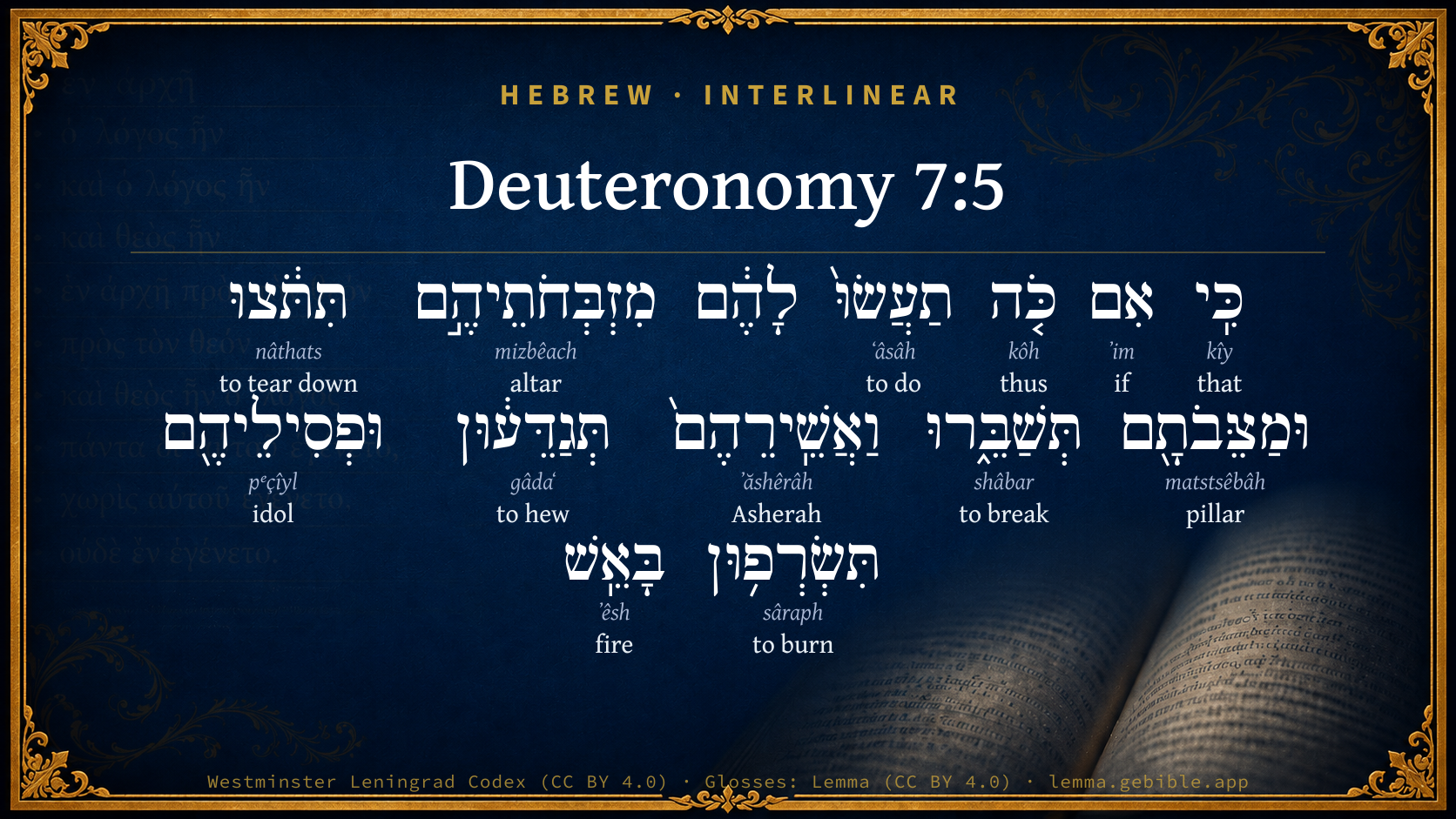
Deuteronomy 7:5

Hebrew (Westminster Leningrad Codex) Deuteronomy 7:5 appears in the Hebrew Old Testament. The text above is from the Westminster Leningrad Codex. Each word links to its Strong’s number, a concise gloss, and parsing drawn from the Open Scriptures Hebrew Bible morphology. Click any word for its full Brown-Driver-Briggs (BDB) entry.
Download image
Cite this verse

Deuteronomy 7:5 (World English Bible). Public Domain. Lemma interlinear Bible study tool, https://lemma.gebible.app/v/deuteronomy/7/5.

Show BibTeX & RIS
BibTeX
RIS
English Translation
But thus shall you deal with them: you shall break down their altars, and dash in pieces their pillars, and hew down their Asherim, and burn their engraved images with fire.
World English Bible · Public Domain
Highlights
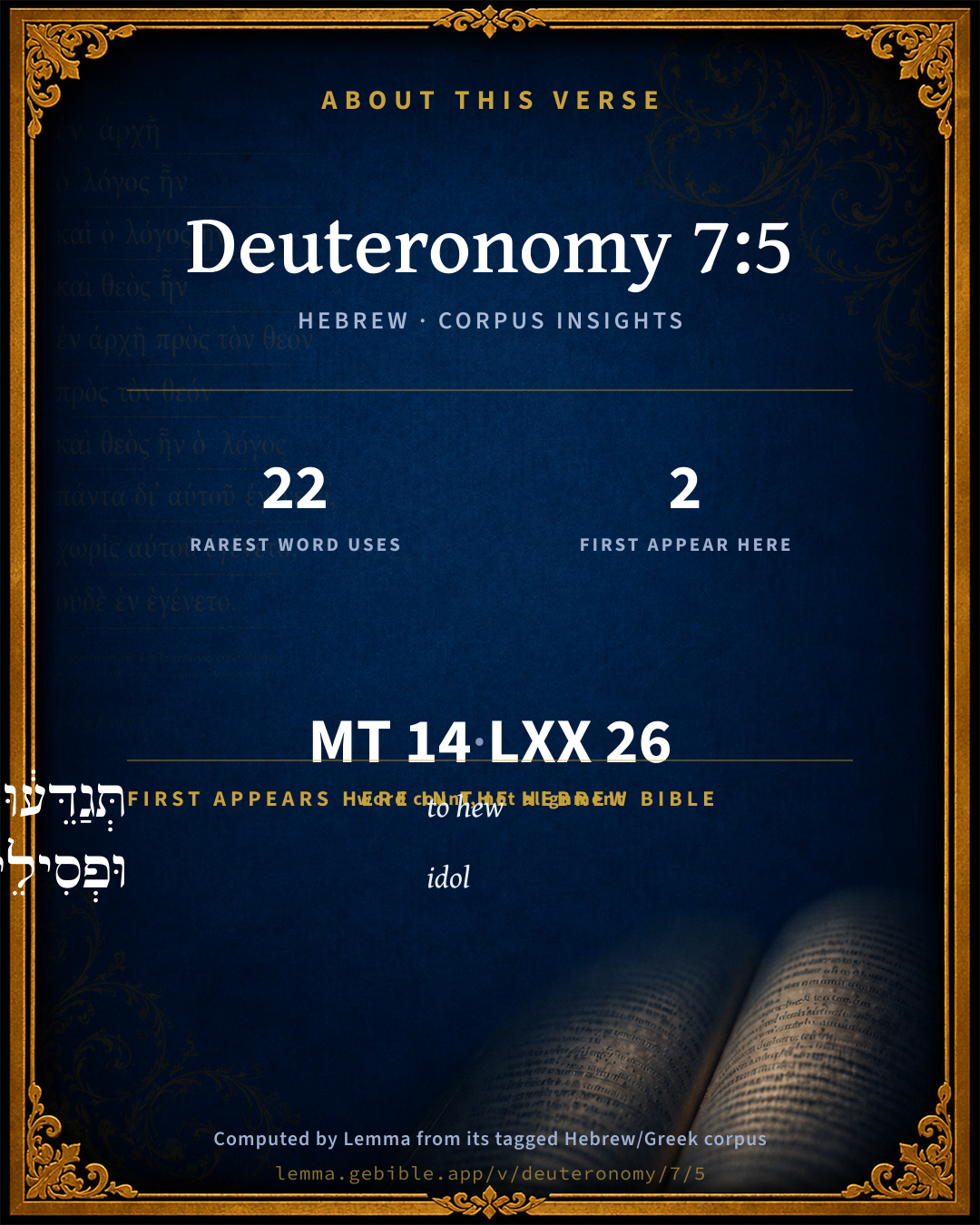
  • 2 first appearances in the Hebrew Bible
Full analysis ↓
Download a study sheet

One document with this verse’s original text, its word-by-word gloss line, the meaning frame, cross-references with their text, attributed commentary, and full source and license credits — printable, and it pastes into notes with its structure intact.

This verse Autodidact and up

Study sheet (.html) Plain text (.txt)

A passage Seminary Student

Up to 50 verses in one chapter. A passage sheet keeps up to 6 commentary sources and 12 cross-references per verse, in the order this page ranks them, and says so on the sheet whenever that leaves anything out. Ask for a single verse and you get the Autodidact verse sheet above.

Everything on this page stays free to read, with no account — the sheet is a download of what is already on screen, not access to it.

Want to remove ads? Support Godless Engineer
Compare translations 3

The same verse in 3 English versions, stacked beneath the original-language interlinear above. Click any original word for its lexicon entry.

Each is an independent rendering of the whole verse — the interlinear is not word-aligned to these translations.

Highlighted words mark where these versions differ — a whole-verse word diff, not a word-by-word alignment.

  • World English Bible Public Domain
    But thus shall you deal with them: you shall break down their altars, and dash in pieces their pillars, and hew down their Asherim, and burn their engraved images with fire.
  • King James Version Public Domain
    But thus shall ye deal with them; ye shall destroy their altars, and break down their images, and cut down their groves, and burn their graven images with fire.
  • unfoldingWord Literal Text CC BY-SA 4.0
    Thus you shall do to them: You shall break down their altars and smash their pillars and cut their Asherah poles to pieces and burn their idols in the fire.

unfoldingWord Literal Text — © unfoldingWord, licensed CC BY-SA 4.0. Word-aligned USFM3 via Door43 (git.door43.org/unfoldingWord/en_ult).

Versions to compare (up to 4)

3 of 4 selected

Show all 18 translations

Every available English version of this verse, each an independent rendering of the whole verse.

  • World English Bible Public Domain
    But thus shall you deal with them: you shall break down their altars, and dash in pieces their pillars, and hew down their Asherim, and burn their engraved images with fire.
  • Berean Standard Bible Public Domain
    Instead, this is what you are to do to them: tear down their altars, smash their sacred pillars, cut down their Asherah poles, and burn their idols in the fire.
  • Majority Standard Bible Public Domain
    Instead, this is what you are to do to them: tear down their altars, smash their sacred pillars, cut down their Asherah poles, and burn their idols in the fire.
  • King James Version Public Domain
    But thus shall ye deal with them; ye shall destroy their altars, and break down their images, and cut down their groves, and burn their graven images with fire.
  • American Standard Version (1901) Public Domain
    But thus shall ye deal with them: ye shall break down their altars, and dash in pieces their pillars, and hew down their Asherim, and burn their graven images with fire.
  • Revised Version (1885) Public Domain
    But thus shall ye deal with them; ye shall break down their altars, and dash in pieces their pillars, and hew down their Asherim, and burn their graven images with fire.
  • Geneva Bible (1599) Public Domain
    But thus ye shall deale with them, Ye shall ouerthrowe their altars, and breake downe their pillars, and ye shall cut downe their groues, and burne their grauen images with fire.
  • Douay-Rheims (1899) Public Domain
    But thus rather shall you deal with them: Destroy their altars, and break their statues, and cut down their groves, and burn their graven things.
  • Young's Literal Translation Public Domain
    `But thus thou dost to them: their altars ye break down, and their standing pillars ye shiver, and their shrines ye cut down, and their graven images ye burn with fire;
  • Literal Standard Version CC BY-SA 4.0
    But thus you do to them: you break down their altars, and you shatter their standing pillars, and you cut down their Asherim, and you burn their carved images with fire.
  • Unlocked Literal Bible CC BY-SA 4.0
    This is how you will deal with them: You will break down their altars, dash their stone pillars in pieces, cut down their Asherah poles, and burn their cast idols.
  • unfoldingWord Literal Text CC BY-SA 4.0
    Thus you shall do to them: You shall break down their altars and smash their pillars and cut their Asherah poles to pieces and burn their idols in the fire.
  • Darby Bible Public Domain
    But thus shall ye deal with them: ye shall break down their altars, and shatter their statues, and hew down their Asherahs, and burn their graven images with fire.
  • World Messianic Bible Public Domain
    But you shall deal with them like this: you shall break down their altars, dash their pillars in pieces, cut down their Asherah poles, and burn their engraved images with fire.
  • Webster's Bible Public Domain
    But thus shall ye deal with them; ye shall destroy their altars, and break down their images, and cut down their groves, and burn their graven images with fire.
  • Free Bible Version CC BY-SA 4.0
    On the contrary, this is what you are to do to them: tear down their altars, knock down their idolatrous pillars, cut down their Asherah poles, and burn down their idols.
  • Bible in Basic English Public Domain
    But this is what you are to do to them: their altars are to be pulled down and their pillars broken, and their holy trees cut down and their images burned with fire.
  • JPS Tanakh (1917) Public Domain
    But thus shall ye deal with them: ye shall break down their altars, and dash in pieces their pillars, and hew down their Asherim, and burn their graven images with fire.

Literal Standard Version (2020), Covenant Press — licensed CC BY-SA 4.0. Text via the HelloAO Bible API (eBible.org). Unlocked Literal Bible (unfoldingWord) — licensed CC BY-SA 4.0. Text via the HelloAO Bible API (eBible.org). unfoldingWord Literal Text — © unfoldingWord, licensed CC BY-SA 4.0. Word-aligned USFM3 via Door43 (git.door43.org/unfoldingWord/en_ult). Free Bible Version, Dr. Jonathan Gallagher — licensed CC BY-SA 4.0. Text via the HelloAO Bible API (eBible.org).

Word by word

More ways to search: Search by grammar → Find every occurrence → Compare this word →

Practice this passage: Drill this verse → Learn its vocabulary →

תְּגַדֵּע֔וּן
gâdaʻ
H1438
“to hew”
Verb, Piel, Imperfect, 2nd Person, Masculine, Plural + Suffix, n
Part of Speech
Verb
Stem
Piel
Form
Imperfect
Person
2nd Person
Gender
Masculine
Number
Plural
Full BDB Definition

Origin: a primitive root

TWOT: 316

to cut, hew, chop, cut down, hew down, hew off, cut off, cut in two, shave off - (Qal) to hew, chop in two - (Niphal) to be chopped off, be hewn off - (Piel) to cut off or down in two, hew off or down in two - (Pual) to chop down, hew down
  1. כִּֽי kîy H3588 “that” Conjunction
  2. אִם ʼim H518 “if” Conjunction
  3. כֹּ֤ה kôh H3541 “thus” Adverb
  4. תַעֲשׂוּ֙ ʻâsâh H6213 “to do” Verb, Qal, Imperfect, 2nd Person, Masculine, Plural
  5. מִזְבְּחֹתֵיהֶ֣ם mizbêach H4196 “altars · their” Noun, Common, Masculine, Plural, Construct + Suffix, Personal, 3rd Person, Masculine, Plural
  6. תִּתֹּ֔צוּ nâthats H5422 “to tear down” Verb, Qal, Imperfect, 2nd Person, Masculine, Plural
  7. וּמַצֵּבֹתָ֖ם matstsêbâh H4676 “and · pillars · their” Conjunction + Noun, Common, Feminine, Plural, Construct + Suffix, Personal, 3rd Person, Masculine, Plural
  8. תְּשַׁבֵּ֑רוּ shâbar H7665 “to break” Verb, Piel, Imperfect, 2nd Person, Masculine, Plural
  9. וַאֲשֵֽׁירֵהֶם֙ ʼăshêrâh H842 “and · Asherah · their” Conjunction + Noun, Proper + Suffix, Personal, 3rd Person, Masculine, Plural
  10. וּפְסִילֵיהֶ֖ם pᵉçîyl H6456 “and · idols · their” Conjunction + Noun, Common, Masculine, Plural, Construct + Suffix, Personal, 3rd Person, Masculine, Plural
  11. תִּשְׂרְפ֥וּן sâraph H8313 “to burn” Verb, Qal, Imperfect, 2nd Person, Masculine, Plural + Suffix, n
  12. בָּאֵֽשׁ ʼêsh H784 “in/at the · fire” Preposition, Determined + Noun, Common, Both, Singular, Absolute

About this verse

These counts appear in no published source. They are computed here, from the morphology-tagged text and Lemma’s own curated glosses. What Lemma adds →

14
words
13
distinct lemmas
Pentateuch
section

Notable vocabulary

The rarest word here is תְּגַדֵּע֔וּן to hew H1438 — appearing just 22 times in the whole Hebrew Bible.

First appearance in Scripture

These words make their first canonical appearance in the Hebrew Bible here:

  • תְּגַדֵּע֔וּן to hew H1438
  • וּפְסִילֵיהֶ֖ם idol H6456

Shared distinctive vocabulary

תְּגַדֵּע֔וּן to hew H1438 occurs in 22 verses of the Hebrew Bible. Also found in:

Grammatical profile

  • 5 verbs
  • 5 nouns
  • 1 preposition
  • 2 conjunctions
  • 1 adverb

Verb forms

  • תַעֲשׂוּ֙ Qal · Imperfect
  • תִּתֹּ֔צוּ Qal · Imperfect
  • תְּשַׁבֵּ֑רוּ Piel · Imperfect
  • תְּגַדֵּע֔וּן Piel · Imperfect
  • תִּשְׂרְפ֥וּן Qal · Imperfect

Hebrew & Septuagint length

In English translation the verse runs 31 words from the Hebrew and 35 from the Septuagint (LXX English) — closely comparable.

A rough comparison of the two English renderings, which tokenize alike — not a word-level alignment.

Word counts can differ between the Hebrew and the Greek without any difference in meaning — e.g. the Hebrew direct-object marker אֵת has no separate Greek word, and Greek often adds the article ὁ.

In the original languages it is 14 Hebrew tokens and 26 Greek tokens — but the two are counted differently (Hebrew bundles its prefixes and suffixes into one token; the Greek is in lemma form), so that isn’t a like-for-like length.

Cross-references

10

Topical passages linked to Deuteronomy 7:5 in the Treasury of Scripture Knowledge — connected by theme and wording, ordered by reader-vote popularity; previews shown in the World English Bible.

  • Exodus 23:24 You shall not bow down to their gods, nor serve them, nor follow their practices, but you shall utterly overthrow them and demolish their pillars.
  • Exodus 34:13 but you shall break down their altars, and dash in pieces their pillars, and you shall cut down their Asherim;
  • Deuteronomy 12:2–3 You shall surely destroy all the places in which the nations that you shall dispossess served their gods, on the high mountains, and on the hills, and under every green tree:
  • Leviticus 26:1 "'You shall make for yourselves no idols, neither shall you raise up an engraved image or a pillar, neither shall you place any figured stone in your land, to bow down to it: for I am Yahweh your God.
  • Deuteronomy 7:25 The engraved images of their gods shall you burn with fire: you shall not covet the silver or the gold that is on them, nor take it to you, lest you be snared therein; for it is an abomination to Yahweh your God.
  • Deuteronomy 9:21 I took your sin, the calf which you had made, and burnt it with fire, and stamped it, grinding it very small, until it was as fine as dust: and I cast the dust of it into the brook that descended out of the mountain.
  • Deuteronomy 16:22 Neither shall you set yourself up a pillar; which Yahweh your God hates.
  • Judges 6:25–26 It happened the same night, that Yahweh said to him, Take your father's bull, even the second bull seven years old, and throw down the altar of Baal that your father has, and cut down the Asherah that is by it;
  • 2 Kings 23:6–14 He brought out the Asherah from the house of Yahweh, outside of Jerusalem, to the brook Kidron, and burned it at the brook Kidron, and beat it to dust, and cast the dust of it on the graves of the common people.
  • Exodus 32:20 He took the calf which they had made, and burnt it with fire, ground it to powder, and scattered it on the water, and made the children of Israel drink of it.

Cross-references courtesy of OpenBible.info (CC BY 4.0).

Hebrew and Greek witnesses Masoretic Hebrew ↔ Greek Septuagint

The same verse in the two great witnesses to the Old Testament, shown verse-for-verse.

These are two independent witnesses, not word-aligned to each other, and the Septuagint is shown in lemma (dictionary) form.

Hebrew Deuteronomy 7:5 Masoretic · Westminster Leningrad Codex

כִּֽי אִם כֹּ֤ה תַעֲשׂוּ֙ לָהֶ֔ם מִזְבְּחֹתֵיהֶ֣ם תִּתֹּ֔צוּ וּמַצֵּבֹתָ֖ם תְּשַׁבֵּ֑רוּ וַאֲשֵֽׁירֵהֶם֙ תְּגַדֵּע֔וּן וּפְסִילֵיהֶ֖ם תִּשְׂרְפ֥וּן בָּאֵֽשׁ

But thus shall you deal with them: you shall break down their altars, and dash in pieces their pillars, and hew down their Asherim, and burn their engraved images with fire.

World English Bible · Public Domain

Greek LXX Deuteronomy 7:5 Septuagint · lemma form

ἀλλά οὕτως ποιέω αὐτός ὁ βωμός αὐτός κατααἱρέω καί ὁ στήλη αὐτός συντρίβω καί ὁ ἄλσος αὐτός ἐκκόπτω καί ὁ γλυπτός ὁ θεός αὐτός κατακαίω πῦρ

But thus shall you⌃ do to them; you⌃ shall destroy their altars, and shall break down their pillars, and shall cut down their groves, and shall burn with fire the graven images of their gods.

LXX2012 (modern English Septuagint) · Public Domain

Hebrew: Westminster Leningrad Codex (CC BY 4.0). Greek: Septuagint (public domain); English from LXX2012 (modern English Septuagint) (Public Domain). How the Septuagint differs from the Hebrew →

Targum (Aramaic paraphrase)

2

The Targum is the ancient Jewish Aramaic paraphrase of the Hebrew Scriptures — an interpretive translation, not the Hebrew text itself. Onkelos (literal) and Pseudo-Jonathan (expansive) render the Torah, and Jonathan the Prophets. Coverage is partial: where no permissively-licensed English translation exists for a verse, only the Aramaic is shown. This is verse-level text, not a word-by-word alignment to the Hebrew.

  1. Targum Onkelos Torah (Genesis–Deuteronomy)
    אֲרֵי אִם כְּדֵין תַּעַבְּדוּן לְהוֹן אֱגוֹרֵיהוֹן תְּתָרְעוּן וְקָמָתְהוֹן תְּתַבְּרוּן וַאֲשֵׁרֵיהוֹן תְּקוֹצְצוּן וְצַלְמֵי טַּעֲוָתְהוֹן תּוֹקְדוּן בְּנוּרָא

    (no public-domain English translation for this verse)

    Targum Onkelos — Aramaic: “Onkelos Genesis” (public domain); “Onkelos Exodus” (public domain); “Onkelos Leviticus” (public domain); “Onkelos Numbers” (public domain); “Onkelos Deuteronomy” (public domain). English: “Sefaria Community Translation” (CC0 1.0 (public-domain dedication)); “J.W. Etheridge. The Targums of Onkelos and Jonathan Ben Uzziel on the Pentateuch. London: Longmans, Green, 1862” (public domain). Text via Sefaria.

  2. Targum Pseudo-Jonathan Torah (Genesis–Deuteronomy)
    אֲרוּם אִין כְּדֵין תַּעַבְדוּן לְהוֹן אִיגוֹרֵיהוֹן תִּסְתְּרוּן וְקָמַתְהוֹן תְּתַבְּרוּן וְאִילָנֵי סִיגְדֵיהוֹן תְּקַצְצוּן וְצַלְמֵי טַעֲוַותְהוֹן תּוּקְדוּן בְּנוּרָא

    But this shall you do to them: you shall destroy their altars, break their statues in pieces, cut down their groves for worship, and burn the images of their idols with fire.

    Targum Pseudo-Jonathan — Aramaic: “Targum Jonathan on Genesis” (public domain); “Targum Jonathan on Exodus” (public domain); “Targum Jonathan on Leviticus” (public domain); “Targum Jonathan on Numbers” (public domain); “Targum Jonathan on Deuteronomy” (public domain). English: “The Targum of Jonathan ben Uzziel, trans. J. W. Etheridge, London, 1862” (public domain). Text via Sefaria.

Commentary

Notes on Deuteronomy 7:5 from classic Christian and Jewish commentators (each source and its license shown beneath its notes). The classic Christian expositions comment on the surrounding passage and are grouped to its opening verse, so a note may address several verses; the Jewish commentaries on the Tanakh (Rashi and others) are per-verse, so they appear only where the commentator wrote on this verse.

Lemma curates 59 commentaries, every one of them public domain or Creative Commons licensed, each selected and text-cleaned for this edition rather than reprinted as found. About our sources →

Trapp's Complete Commentary

John Trapp

Deu 7:5 But thus shall ye deal with them; ye shall destroy their altars, and break down their images, and cut down their groves, and burn their graven images with fire.

Ver. 5. And break down their images.] Cromwell did notable service here in Henry VIII’s time, by discovering the knavery of Popish priests, and pulling down those images and monuments of idolatry, the rood of grace, the blood of Hales, &c. And in Edward VI’s days, the same day the Popish pictures were publicly burnt at Paul’s Cross, the great victory was gotten by the English at Musselburgh field in Scotland. {a}

{a} Act. and Mon.

John Trapp, A Commentary or Exposition upon All the Books of the Old and New Testament (1647–1656) — public domain. Text from a community e-Sword module.

Joseph Benson's Commentary

Deu 7:5. Their groves — Which idolaters planted about the temples and altars of their gods. Hereby God designed to take away whatsoever might bring their idolatry to remembrance, or occasion the reviving of it.

Joseph Benson's Commentary on the Old and New Testaments (1811–1818) — public domain. Text from a community e-Sword module.

Tyndale Open Study Notes

Tyndale Open Resources

7:5 Engraved stone pillars called stelae usually represented pagan male deities. These sacred pillars were commonly found at shrines dedicated to Baal. • Asherah poles, usually made of wood, represented Canaanite fertility goddesses, particularly Asherah, the mother of the gods. These shrines might have developed as stylized sacred trees associated with fertility (see study note on 12:2).

Tyndale Open Study Notes — © Tyndale Open Resources, licensed CC BY-SA 4.0. Text via the HelloAO Bible API.

Geneva Bible (1599)

Geneva Bible translators

God would have his service pure without all idolatrous ceremonies and superstitions, Deut. 22:3.

Geneva Bible (1599) marginal notes — public domain. Text via Bolls.life.

Jamieson, Fausset & Brown

Robert Jamieson, A. R. Fausset & David Brown

thus shall ye deal with them; ye shall destroy their altars, &c.--The removal of the temples, altars, and everything that had been enlisted in the service, or might tend to perpetuate the remembrance, of Canaanite idolatry, was likewise highly expedient for preserving the Israelites from all risk of contamination. It was imitated by the Scottish Reformers, and although many ardent lovers of architecture and the fine arts have anathematized their proceedings as vandalism, yet there was profound wisdom in the favorite maxim of Knox--"pull down the nests, and the rooks will disappear."

Jamieson, Fausset & Brown — Commentary Critical and Explanatory on the Whole Bible (1871) — public domain (CC PDM 1.0). Text via the HelloAO Bible API.

Ellicott's Commentary for English Readers

(5) Ye shall destroy their altars. . . .—This course, if adopted in a conquered territory, would be certain to bring matters to a crisis. The inhabitants must rise in defence of the objects of their worship—a course which would end in their extermination—or they must adopt the worship of Jehovah.

Their groves.—Here the grove itself in which the idol was worshipped, and so in Deu_16:21. Sometimes the word is used for the image.

Burn their graven images with fire.—David treated the images of the Philistines thus (1Ch_14:12). Compare Isa_37:19.

A Bible Commentary for English Readers, edited by Charles John Ellicott (1878–1897) — public domain. Text from a community e-Sword module.

The Cambridge Bible for Schools and Colleges

gen. ed. J. J. S. Perowne

5. The change to the Pl., together with the fact that the v. does not direct the destruction of the persons of the heathen (which would have been relevant to the preceding), but only of their altars, etc., marks this verse as a quotation or later insertion. Deu_7:6 follows on 4. So Steuern., Berth. Cp. the editorial passages Exo_23:24 b, Exo_34:13. The original of all three passages may be the deuteronomic law, Deu_12:3.

pillars … Asherim] See on Deu_16:21 f.

The Cambridge Bible for Schools and Colleges (gen. ed. J. J. S. Perowne; Cambridge University Press, 1878–1918) — public domain. Text from a community e-Sword module.

John Gill's Exposition

But thus shall ye deal with them,.... The inhabitants of the land of Canaan:

ye shall destroy their altars; on which they sacrificed to their idols:

and break down their images; of their gods, and the statues and pillars erected to the honour of them:

and cut down their groves; sacred to idols, which were usually planted on hills, and about Heathen temples, and under which idols were placed to be worshipped. The Targum of Jonathan calls them trees of their adoration, under which they worshipped; though there was a worship paid to them, not indeed directly to them, or for their sakes, but for the sake of the idols they were sacred to, or were placed under them; so Maimonides (e) says, a tree which at first was planted to be worshipped is forbidden of any use (or profit); and this is the or "grove", spoken of in the law, a tree planted and lopped, of which a graven image is made for an idol; and so the tree that has been worshipped, though the body of it is, not forbidden, all the shoots and leaves, and the branches, and the fruits it produces all the time it is worshipped, are forbidden to be used: though the word here used sometimes seems to signify, not a grove of trees, but some image itself, since we read of it in the temple, Kg2 21:7,

and burn their graven images with fire; distinguished from their molten images, which may be meant in a preceding clause, and which are particularly mentioned as to be destroyed as well as these, Num 33:52.

(e) Hilchot Obede Cochabim, c. 8. sect. 3, 4. Vid. Misn. Avodah Zarah, c. 3. sect. 7.

John Gill's Exposition of the Whole Bible (1746–1763) — public domain (CC PDM 1.0). Text via the HelloAO Bible API.

Haydock's Catholic Bible Commentary

Things. This was to be done with regard to the idols of Chanaan, when it was first conquered, ver. 25. Afterwards David made no scruple in wearing a crown, which had been taken from the spoils of Melchon, the idol of the Ammonites, 1 Paralipomenon xx. 2. (Calmet)

George Leo Haydock (1774–1849), Haydock's Catholic Family Bible and Commentary, 1859 edition — public domain. Excludes Psalms (Douay-Rheims chapter numbering differs from Protestant) and Deuterocanonical books (Catholic canon only).

Matthew Poole's English Annotations

Idolaters planted groves about the temples and altars of their gods. Hereby God designed to take away whatsoever might bring their idolatry to remembrance, or occasion the reviving of it.

Matthew Poole's English Annotations on the Holy Bible (1683–1685) — public domain. Text from a community e-Sword/MySword module.

Whedon's Commentary on the Bible

Daniel D. Whedon

5. Cut down their groves — So most of the versions render this. It should be translated cut down their images of Asherah. Asherah was the name of a Phoenician goddess, by some thought to be the same as Astarte. The images of Asherah were upright wooden columns or trunks of trees stripped of their branches. Comp. 2Ki_23:6 : “And he brought out the grove from the house of the Lord.” Here the word translated groves should be rendered Asherah. The worship consisted in part of libidinous orgies.

Daniel D. Whedon (gen. ed.), Commentary on the Old and New Testaments (1874–1909) — public domain. Text from a community e-Sword module.

The Pulpit Commentary

Vers. 5-8. They were not only to have no fellowship with the idolaters, but they were to root out their idolatry, everting their altars and destroying their idols; and this because they were a holy people, graciously chosen of God to be his special possession a high privilege and honor which they were to be careful not to cast away.

Cut down their groves; rather, cut or hew in pieces their asherahs. These were, apparently, wooden pillars of considerable height, which were firmly planted in the ground? (comp. Jud 6:25-27; Deu_16:21) and were consecrated to the worship of a female deity, the companion of Baal; probably the same as that after-war, is known as Astarte, the Venus of the Syrians. (see note on Deu_16:21)

The Pulpit Commentary (1880–1919), ed. H.D.M. Spence-Jones & Joseph S. Exell — public domain. Text from a community e-Sword module.

John Wesley's Explanatory Notes

Their graves - Which idolaters planted about the temples and altars of their Gods. Hereby God designed to take away whatsoever might bring their idolatry to remembrance, or occasion the reviving of it.

John Wesley, Explanatory Notes Upon the Whole Bible (1754–1765) — public domain. Text via the GEBible commentary corpus.

Keil & Delitzsch

C. F. Keil & F. Delitzsch

The Israelites were rather to destroy the altars and idols of the Canaanites, according to the command in Exo 34:13; Exo 23:24.

Keil & Delitzsch — Biblical Commentary on the Old Testament (1861–1891) — public domain (CC PDM 1.0). Text via the HelloAO Bible API. (Old Testament only.)

Rashi

Rabbi Shlomo Yitzchaki (Rashi)

מזבחתיהם — a מזבח is something built up of several stones,

ומצבתם — alludes to a single stone (cf. Rashi on Deuteronomy 12:3).

ואשירהם — Trees which they worship (Avodah Zarah 48a).

ופסליהם — These are images.

Rashi on the Tanakh — English translations: “The Judaica Press complete Tanach with Rashi, translated by A. J. Rosenberg” (CC BY 4.0); “Pentateuch with Rashi's commentary by M. Rosenbaum and A.M. Silbermann, 1929-1934” (public domain); “The Metsudah Tanach series, Lakewood, N.J” (CC BY 4.0); and “The Book of Joshua, Metsudah Publications, 1997” (CC BY 4.0). Text via Sefaria.

Lesson kit

Teaching starters — assembled from the data on this page, not authored interpretation. Every prompt links to the verse data it draws on. Edit before teaching.

Deuteronomy, in the Pentateuch, opens this verse with 14 words (13 distinct Hebrew lemmas). Its most distinctive word is gâdaʻ (“to hew”). A historical commentator’s framing appears above. Read the whole chapter for the surrounding context.

Discussion questions

  1. What does “to hew” (gâdaʻ) contribute to the verse as a whole?
  2. 2 words make their first appearance in Scripture here. What does this debut establish?
  3. How does Deuteronomy 12:3, which shares the word «to hew», read alongside this verse?
  4. These translations render this verse differently. What is at stake in choosing one wording over another?
  5. «תַעֲשׂוּ֙» is a Qal Imperfect verb. How does that grammatical form shape the action described?
  6. Compare how Trapp's Complete Commentary and Joseph Benson's Commentary read this verse. Where do they agree or differ?

Things to notice

Reading settings

Reading text

Shown beneath each verse's original-language words.

Old Testament
Old Testament edition

Read the OT as the Masoretic Hebrew (MT) or the Greek Septuagint (LXX).

English shown for the Greek Septuagint (in the Hebrew ↔ Greek comparison).

Comparing translations? Open the Compare panel on any verse page to stack up to four side by side.