
Psalms 83:14

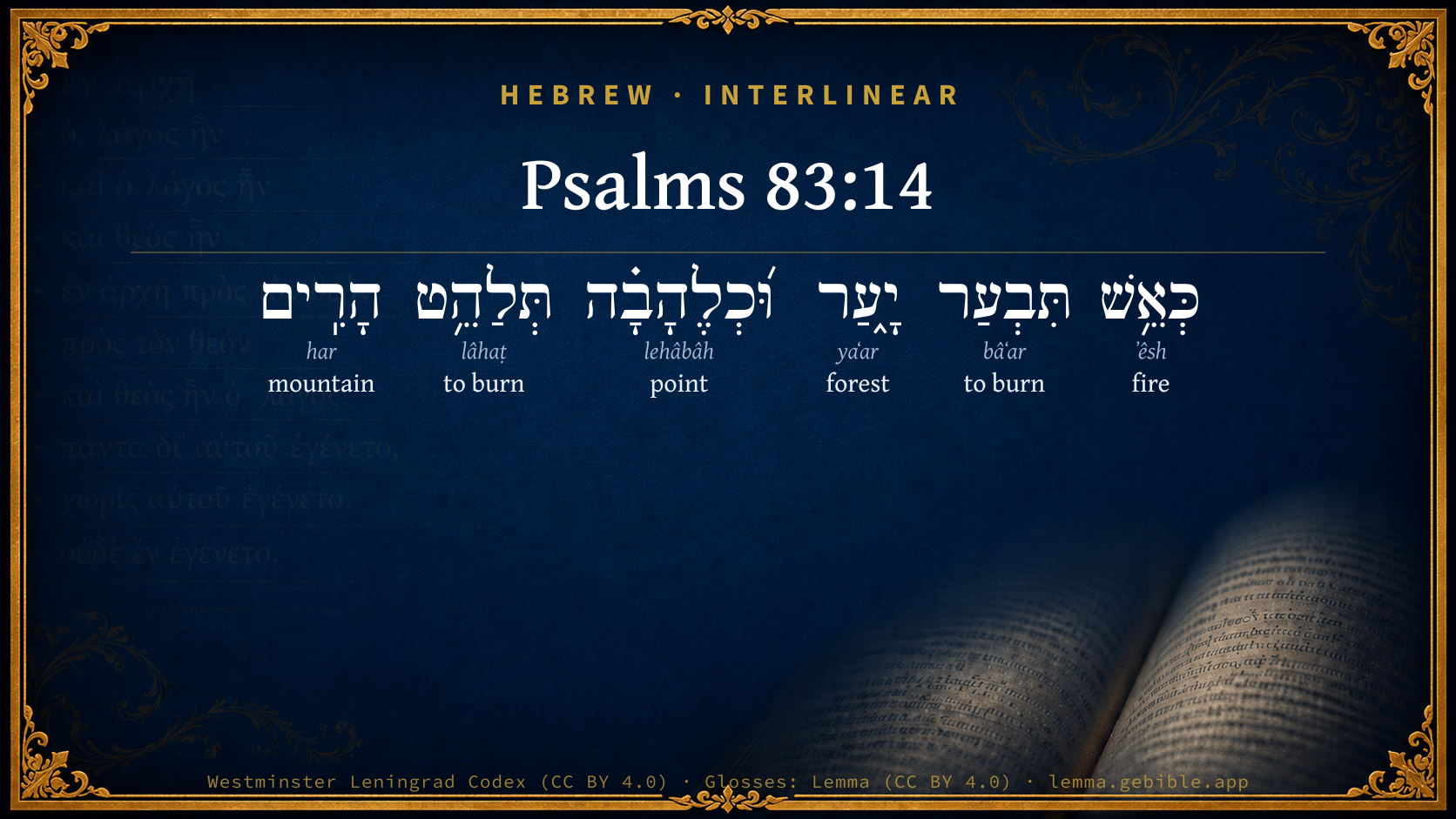
Hebrew (Westminster Leningrad Codex) Psalms 83:14 appears in the Hebrew Old Testament. The text above is from the Westminster Leningrad Codex. Each word links to its Strong’s number, a concise gloss, and parsing drawn from the Open Scriptures Hebrew Bible morphology. Click any word for its full Brown-Driver-Briggs (BDB) entry.
Download image
Cite this verse

Psalms 83:14 (World English Bible). Public Domain. Lemma interlinear Bible study tool, https://lemma.gebible.app/v/psalms/83/14.

Show BibTeX & RIS
BibTeX
RIS
English Translation
As the fire that burns the forest, As the flame that sets the mountains on fire,
World English Bible · Public Domain
Download a study sheet

One document with this verse’s original text, its word-by-word gloss line, the meaning frame, cross-references with their text, attributed commentary, and full source and license credits — printable, and it pastes into notes with its structure intact.

This verse Autodidact and up

Study sheet (.html) Plain text (.txt)

A passage Seminary Student

Up to 50 verses in one chapter. A passage sheet keeps up to 6 commentary sources and 12 cross-references per verse, in the order this page ranks them, and says so on the sheet whenever that leaves anything out. Ask for a single verse and you get the Autodidact verse sheet above.

Everything on this page stays free to read, with no account — the sheet is a download of what is already on screen, not access to it.

Want to remove ads? Support Godless Engineer
Compare translations 3

The same verse in 3 English versions, stacked beneath the original-language interlinear above. Click any original word for its lexicon entry.

Each is an independent rendering of the whole verse — the interlinear is not word-aligned to these translations.

Highlighted words mark where these versions differ — a whole-verse word diff, not a word-by-word alignment.

  • World English Bible Public Domain
    As the fire that burns the forest, As the flame that sets the mountains on fire,
  • King James Version Public Domain
    As the fire burneth a wood, and as the flame setteth the mountains on fire;
  • unfoldingWord Literal Text CC BY-SA 4.0
    As fire burns a forest, and as flame kindles mountains,

unfoldingWord Literal Text — © unfoldingWord, licensed CC BY-SA 4.0. Word-aligned USFM3 via Door43 (git.door43.org/unfoldingWord/en_ult).

Versions to compare (up to 4)

3 of 4 selected

Show all 18 translations

Every available English version of this verse, each an independent rendering of the whole verse.

  • World English Bible Public Domain
    As the fire that burns the forest, As the flame that sets the mountains on fire,
  • Berean Standard Bible Public Domain
    As fire consumes a forest, as a flame sets the mountains ablaze,
  • Majority Standard Bible Public Domain
    As fire consumes a forest, as a flame sets the mountains ablaze,
  • King James Version Public Domain
    As the fire burneth a wood, and as the flame setteth the mountains on fire;
  • American Standard Version (1901) Public Domain
    As the fire that burneth the forest, And as the flame that setteth the mountains on fire,
  • Revised Version (1885) Public Domain
    As the fire that burneth the forest, and as the flame that setteth the mountains on fire;
  • Geneva Bible (1599) Public Domain
    As the fire burneth the forest, and as the flame setteth the mountaines on fire:
  • Douay-Rheims (1899) Public Domain
    O my God, make them like a wheel; and as stubble before the wind.
  • Young's Literal Translation Public Domain
    As a fire doth burn a forest, And as a flame setteth hills on fire,
  • Literal Standard Version CC BY-SA 4.0
    As a fire burns a forest, || And as a flame sets hills on fire,
  • Unlocked Literal Bible CC BY-SA 4.0
    like the fire that burns the forest, and like the flame that sets the mountains on fire.
  • unfoldingWord Literal Text CC BY-SA 4.0
    As fire burns a forest, and as flame kindles mountains,
  • Darby Bible Public Domain
    As fire burneth a forest, and as the flame setteth the mountains on fire,
  • World Messianic Bible Public Domain
    As the fire that burns the forest, as the flame that sets the mountains on fire,
  • Webster's Bible Public Domain
    \\83:13\\O my God, make them like a wheel; as the stubble before the wind.
  • Free Bible Version CC BY-SA 4.0
    Just like fire that burns the forest, a flame that sets fire to the mountains,
  • Bible in Basic English Public Domain
    As fire burning a wood, and as a flame causing fire on the mountains,
  • JPS Tanakh (1917) Public Domain
    (83-15) As the fire that burneth the forest, and as the flame that setteth the mountains ablaze;

Literal Standard Version (2020), Covenant Press — licensed CC BY-SA 4.0. Text via the HelloAO Bible API (eBible.org). Unlocked Literal Bible (unfoldingWord) — licensed CC BY-SA 4.0. Text via the HelloAO Bible API (eBible.org). unfoldingWord Literal Text — © unfoldingWord, licensed CC BY-SA 4.0. Word-aligned USFM3 via Door43 (git.door43.org/unfoldingWord/en_ult). Free Bible Version, Dr. Jonathan Gallagher — licensed CC BY-SA 4.0. Text via the HelloAO Bible API (eBible.org).

Word by word

More ways to search: Search by grammar → Find every occurrence → Compare this word →

Practice this passage: Drill this verse → Learn its vocabulary →

About this verse

These counts appear in no published source. They are computed here, from the morphology-tagged text and Lemma’s own curated glosses. What Lemma adds →

6
words
6
distinct lemmas
Wisdom
section

Notable vocabulary

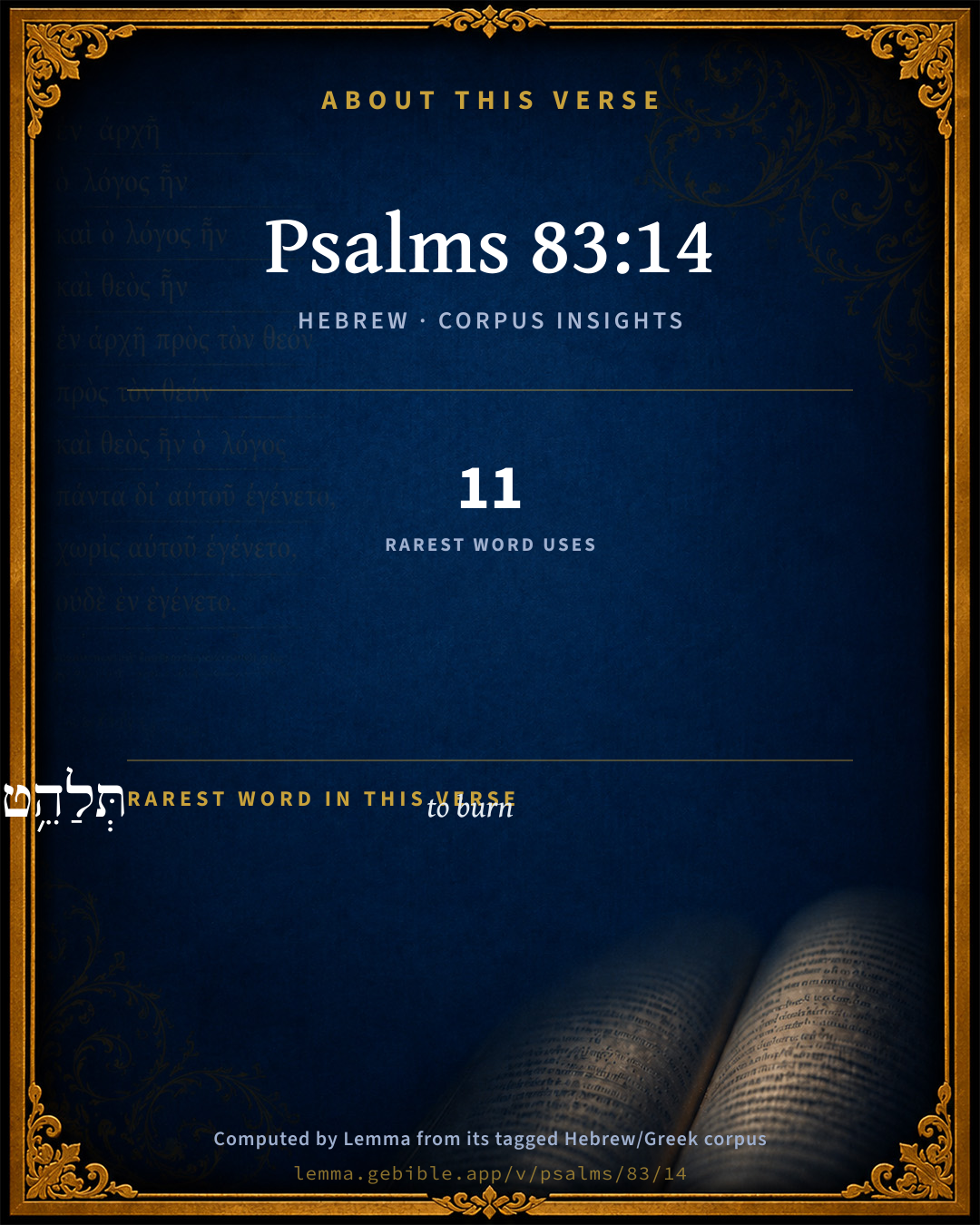
The rarest word here is תְּלַהֵ֥ט to burn H3857 — appearing just 11 times in the whole Hebrew Bible.

Shared distinctive vocabulary

תְּלַהֵ֥ט to burn H3857 occurs in 11 verses of the Hebrew Bible. Also found in:

Grammatical profile

  • 2 verbs
  • 4 nouns

Verb forms

  • תִּבְעַר Qal · Imperfect
  • תְּלַהֵ֥ט Piel · Imperfect

Hebrew & Septuagint length

In English translation the verse runs 16 words from the Hebrew and 15 from the Septuagint (LXX English) — closely comparable.

A rough comparison of the two English renderings, which tokenize alike — not a word-level alignment.

Word counts can differ between the Hebrew and the Greek without any difference in meaning — e.g. the Hebrew direct-object marker אֵת has no separate Greek word, and Greek often adds the article ὁ.

Cross-references

9

Topical passages linked to Psalms 83:14 in the Treasury of Scripture Knowledge — connected by theme and wording, ordered by reader-vote popularity; previews shown in the World English Bible.

  • Deuteronomy 32:22 For a fire is kindled in my anger, Burns to the lowest Sheol, Devours the earth with its increase, Sets on fire the foundations of the mountains.
  • Malachi 4:1 "For, behold, the day comes, it burns as a furnace; and all the proud, and all who work wickedness, will be stubble; and the day that comes will burn them up," says Yahweh of Hosts, "that it shall leave them neither root nor branch.
  • Isaiah 9:18 For wickedness burns as the fire; it devours the briers and thorns; yes, it kindles in the thickets of the forest, and they roll upward in a column of smoke.
  • Isaiah 30:33 For a Topheth is prepared of old; yes, for the king it is made ready; he has made it deep and large; the pile of it is fire and much wood; the breath of Yahweh, like a stream of sulfur, does kindle it.
  • Isaiah 33:11–12 You shall conceive chaff, you shall bring forth stubble: your breath is a fire that shall devour you.
  • Isaiah 64:1–2 Oh that you would tear the heavens, that you would come down, that the mountains might quake at your presence,
  • Ezekiel 20:47–48 and tell the forest of the South, Hear the word of Yahweh: Thus says the Lord Yahweh, Behold, I will kindle a fire in you, and it shall devour every green tree in you, and every dry tree: the flaming flame shall not be quenched, and all faces from the south to the north shall be burnt thereby.
  • Nahum 1:6 Who can stand before his indignation? Who can endure the fierceness of his anger? His wrath is poured out like fire, and the rocks are broken apart by him.
  • Nahum 1:10 For entangled like thorns, and drunken as with their drink, they are consumed utterly like dry stubble.

Cross-references courtesy of OpenBible.info (CC BY 4.0).

Hebrew and Greek witnesses Masoretic Hebrew ↔ Greek Septuagint

The same verse in the two great witnesses to the Old Testament, shown verse-for-verse.

You’re reading Greek Psalm 82 (Hebrew Psalm 83). The Septuagint counts the superscription, so verse numbers can differ from the Hebrew — chapter-level alignment, not verse-by-verse. Numbering follows Rahlfs.

These are two independent witnesses, not word-aligned to each other, and the Septuagint is shown in lemma (dictionary) form.

Hebrew Psalms 83:14 Masoretic · Westminster Leningrad Codex

כְּאֵ֥שׁ תִּבְעַר יָ֑עַר וּ֝כְלֶהָבָ֗ה תְּלַהֵ֥ט הָרִֽים

As the fire that burns the forest, As the flame that sets the mountains on fire,

World English Bible · Public Domain

Greek LXX Greek Psalm 82:14 Septuagint · lemma form

ὁ θεός ἐγώ τίθημι αὐτός ὡς τροχός ὡς καλάμη κατά πρόσωπον ἄνεμος

As fire which shall burn up a wood, as the flame may consume the mountains;

LXX2012 (modern English Septuagint) · Public Domain

Hebrew: Westminster Leningrad Codex (CC BY 4.0). Greek: Septuagint (public domain); English from LXX2012 (modern English Septuagint) (Public Domain). How the Septuagint differs from the Hebrew →

Commentary

Notes on Psalms 83:14 from classic Christian and Jewish commentators (each source and its license shown beneath its notes). The classic Christian expositions comment on the surrounding passage and are grouped to its opening verse, so a note may address several verses; the Jewish commentaries on the Tanakh (Rashi and others) are per-verse, so they appear only where the commentator wrote on this verse.

Lemma curates 59 commentaries, every one of them public domain or Creative Commons licensed, each selected and text-cleaned for this edition rather than reprinted as found. About our sources →

Trapp's Complete Commentary

John Trapp

Psa 83:14 As the fire burneth a wood, and as the flame setteth the mountains on fire;

Ver. 14. As the fire burneth a wood] Maxime quando a vento flabellatur , when blown up by a fierce wind it soon turneth a wood into a waste.

And as the flame setteth, the mountains on fire] Those sulphury mountains, such as Etna, Vesuvius, Peitra mala, a mountain in the highest part of the Apennines, which perpetually burneth, say travellers, Il Mercurio Italico, 178.

John Trapp, A Commentary or Exposition upon All the Books of the Old and New Testament (1647–1656) — public domain. Text from a community e-Sword module.

J. A. Alexander on Psalms

Joseph Addison Alexander

15. (Psa 83:14). As fire consumes a forest, and as a flame kindles mountains. The original construction is like a fire (which) consumes, like a flame (which) kindles. By mountains we are here to understand what covers them or grows upon them.

Joseph Addison Alexander, The Psalms Translated and Explained (1850) — public domain. Text from a community e-Sword module.

Tyndale Open Study Notes

Tyndale Open Resources

83:14-15 fire . . . fierce storm . . . tempest: These are images of God’s manifestation in judgment (see Isa 29:6).

Tyndale Open Study Notes — © Tyndale Open Resources, licensed CC BY-SA 4.0. Text via the HelloAO Bible API.

Adam Clarke's Commentary

Verse 14. The flame setteth the mountains on fire] This may refer to the burning of the straw and chaff, after the grain was threshed and winnowed. And as their threshing-floors were situated often on the hills or mountains, to take the advantage of the wind, the setting the mountains on fire may refer to the burning of the chaff, &c., in those places. Let them be like stubble driven away by the wind, and burnt by the fire.

Adam Clarke's Commentary on the Bible (1810–1826) — public domain. Text from a community e-Sword/MySword module.

Ellicott's Commentary for English Readers

(14, 15) These verses are rightly taken together. The figure occurs in Isa_10:17-18 (comp. Zec_12:6), but there as a metaphor; here as a simile. “Before the rains came the whole mountain side was in a blaze. Thorns and briars grow so luxuriantly here that they must be burned off always before the plough can operate. The peasants watch for a high wind, and then the fire catches easily, and spreads with great rapidity” (Thomson, Land and Book, p. 341). The mountains are pre-eminently the pastures. (Comp. Psa_50:10; Psa_147:8.)

A Bible Commentary for English Readers, edited by Charles John Ellicott (1878–1897) — public domain. Text from a community e-Sword module.

The Cambridge Bible for Schools and Colleges

gen. ed. J. J. S. Perowne

14, 15. As fire that consumeth a forest,

And as flame that burneth up mountains;

So shalt thou pursue them with thy tempest,

And dismay them with thy hurricane.

God’s wrath is a fiery blast which at once kindles and fans the flame (Isa_29:6; Isa_30:27; Isa_30:30; Isa_30:33), and pursues and consumes His enemies like a fire in the forest or on the mountains. “Before the rains came,” says Thomson (Land and Book, p. 341), “this whole mountain side was in a blaze. Thorns and briars grow so luxuriantly here that they must be burned off always before the plough can operate. The peasants watch for a high wind, and then the fire catches easily, and spreads with great rapidity.” Cp. Isa_10:16-19; Jer_21:14.

The Cambridge Bible for Schools and Colleges (gen. ed. J. J. S. Perowne; Cambridge University Press, 1878–1918) — public domain. Text from a community e-Sword module.

John Gill's Exposition

As the fire burneth the wood,.... Or "forest" (m); which is sometimes done purposely, and sometimes through carelessness, as Virgil (n) observes; and which is done very easily and swiftly, when fire is set to it; even all the trees of it, great and small, to which an army is sometimes compared, Isa 10:18, and as the flame setteth the mountains on fire; either the mountains themselves, as Etna, Vesuvius, and others; or rather the grass and trees that grow upon them, smitten by lightning from heaven, which may be meant by the flame: in like manner it is wished that the fire and flame of divine wrath would consume the confederate enemies of Israel, above mentioned; as wicked men are but as trees of the forest, and the grass of the mountains, or as thorns and briers, to the wrath of God, which is poured out as fire, and is signified by everlasting burnings.

(m) "sylvam", Montanus, Tigurine version, Junius & Tremellius, Piscator, &c. (n) Georgic. l. 2. v. 310.

John Gill's Exposition of the Whole Bible (1746–1763) — public domain (CC PDM 1.0). Text via the HelloAO Bible API.

Albert Barnes' Notes on the Bible

As the fire burneth a wood ... - The same idea is here presented under another form. No image of desolation is more fearful than that of fire raging in a forest; or of fire on the mountains. As trees and shrubs and grass fall before such a flame, so the prayer is, that they who had combined against the people of God might be swept away by his just displeasure.

Albert Barnes' Notes on the Bible (1834–1885) — public domain. Text from a community e-Sword/MySword module.

Matthew Poole's English Annotations

The mountains; understand by a metonymy the woods or forests upon the mountains, which in those hot countries, when they had once taken fire, either by lightning, or by the design of men, or by any accident, did burn with great speed and irresistible violence.

Matthew Poole's English Annotations on the Holy Bible (1683–1685) — public domain. Text from a community e-Sword/MySword module.

The Treasury of David

Charles H. Spurgeon

Ver. 14. As the fire burneth a wood. Long years have strewn the ground with deep deposits of leaves; these being dried in the sun are very apt to take fire, and when they do so the burning in terrific. The underwood and the ferns blaze, the bushes crackle, the great trees kindle and to their very tops are wrapped in fire, while the ground is all red as a furnace. In this way, O Lord, mete out destruction to thy foes, and bring all of them to an end.

The flame setteth the mountains on fire. Up the hill sides the hanging woods glow like a great sacrifice, and the forests on the mountain's crown smoke towards heaven. Even thus, O Lord, do thou conspicuously and terribly overthrow the enemies of thine Israel.

Ver. 14. Mountains on fire. Many of the mountains in this country are covered with dense forests. The leaves which fall every autumn accumulate, sometimes for years, until we have a particularly dry summer, when, somehow or other, either by accident or design, they are always set on fire, and burn sometimes for several days. The mountains in one of the States of the neighbouring Republic are on fire at this very moment while I am now writing, and have been burning for more than a week, and we can distinctly see the red glare in the sky above them, although from their great distance, even the tops of the mountains themselves from whence the flames arise are beyond the limits of our horizon. From "Philip Musgrave: or Memoirs of a Church of England Missionary in the North American Colonies." 1846.

Ver. 14. Fire has greater force on a mountain, where the wind is more powerful, than upon a wood situated in a valley. Honorius Augustodunensis.

Ver. 14. Humboldt saw forests on fire in South America and thus describes them. "Several parts of the vast forests which surround the mountain, had taken fire. Reddish flames, half enveloped in clouds of smoke, presented a very grand spectacle. The inhabitants set fire to the forests, to improve the pasturage, and to destroy the shrubs that choke the grass. Enormous conflagrations, too, are often caused by the carelessness of the Indians, who neglect, when they travel, to extinguish the fires by which they have dressed their food."

Ver. 14. Let us pray the divine aid to break this power and enmity of the natural man; that it may yield unto the word of grace; and let the wood, hay and stubble of all false doctrine perish before the brightness of the face of God. Edward Walter. 1854.

Charles H. Spurgeon's The Treasury of David (1869–1885) — public domain. Psalms only. Text from a community e-Sword/MySword module.

Whedon's Commentary on the Bible

Daniel D. Whedon

14. As the fire burneth a wood—A forest or a mountain on fire is simply unquenchable fire, leaving trees so few in number “that a child may write them.” Isa_10:16-19

Daniel D. Whedon (gen. ed.), Commentary on the Old and New Testaments (1874–1909) — public domain. Text from a community e-Sword module.

The Pulpit Commentary

As the fire burneth a wood, and as the flame setteth the mountains on fire. Cause them, i.e. , to consume away and perish, as a burning forest, or as blazing brushwood on a mountainside.

The Pulpit Commentary (1880–1919), ed. H.D.M. Spence-Jones & Joseph S. Exell — public domain. Text from a community e-Sword module.

John Wesley's Explanatory Notes

The mountains - The woods upon the mountains, which in those hot countries, when they have once taken fire, burn with irresistible violence.

John Wesley, Explanatory Notes Upon the Whole Bible (1754–1765) — public domain. Text via the GEBible commentary corpus.

Rashi

Rabbi Shlomo Yitzchaki (Rashi)

My God, make them like thistles, like stubble which are driven away by the wind. Now what is גלגל? It is the tips of the thorns of the field, which are called chardons in French, thistles. When winter arrives, they are plucked out and disintegrate, and little by little they fly [away]. The part that is plucked out of them resembles the wheels of a wagon, and the wind carries them.

Rashi on the Tanakh — English translations: “The Judaica Press complete Tanach with Rashi, translated by A. J. Rosenberg” (CC BY 4.0); “Pentateuch with Rashi's commentary by M. Rosenbaum and A.M. Silbermann, 1929-1934” (public domain); “The Metsudah Tanach series, Lakewood, N.J” (CC BY 4.0); and “The Book of Joshua, Metsudah Publications, 1997” (CC BY 4.0). Text via Sefaria.

Lesson kit

Teaching starters — assembled from the data on this page, not authored interpretation. Every prompt links to the verse data it draws on. Edit before teaching.

Psalms, in the Wisdom, opens this verse with 6 words (6 distinct Hebrew lemmas). Its most distinctive word is lâhaṭ (“to burn”). A historical commentator’s framing appears above. Read the whole chapter for the surrounding context.

Discussion questions

  1. What does “to burn” (lâhaṭ) contribute to the verse as a whole?
  2. Deuteronomy 32:22 shares the word «to burn» with this verse. How do the two illuminate each other?
  3. These translations render this verse differently; the difference is in the English rendering, not the original. What questions does that raise?
  4. The verb «תִּבְעַר» is Qal Imperfect. How does its form color the action?
  5. Reading how Trapp's Complete Commentary and J. A. Alexander on Psalms read this verse, where do the two commentators agree and where do they part?

Things to notice

Reading settings

Reading text

Shown beneath each verse's original-language words.

Old Testament
Old Testament edition

Read the OT as the Masoretic Hebrew (MT) or the Greek Septuagint (LXX).

English shown for the Greek Septuagint (in the Hebrew ↔ Greek comparison).

Comparing translations? Open the Compare panel on any verse page to stack up to four side by side.