
1 Kings 16:18

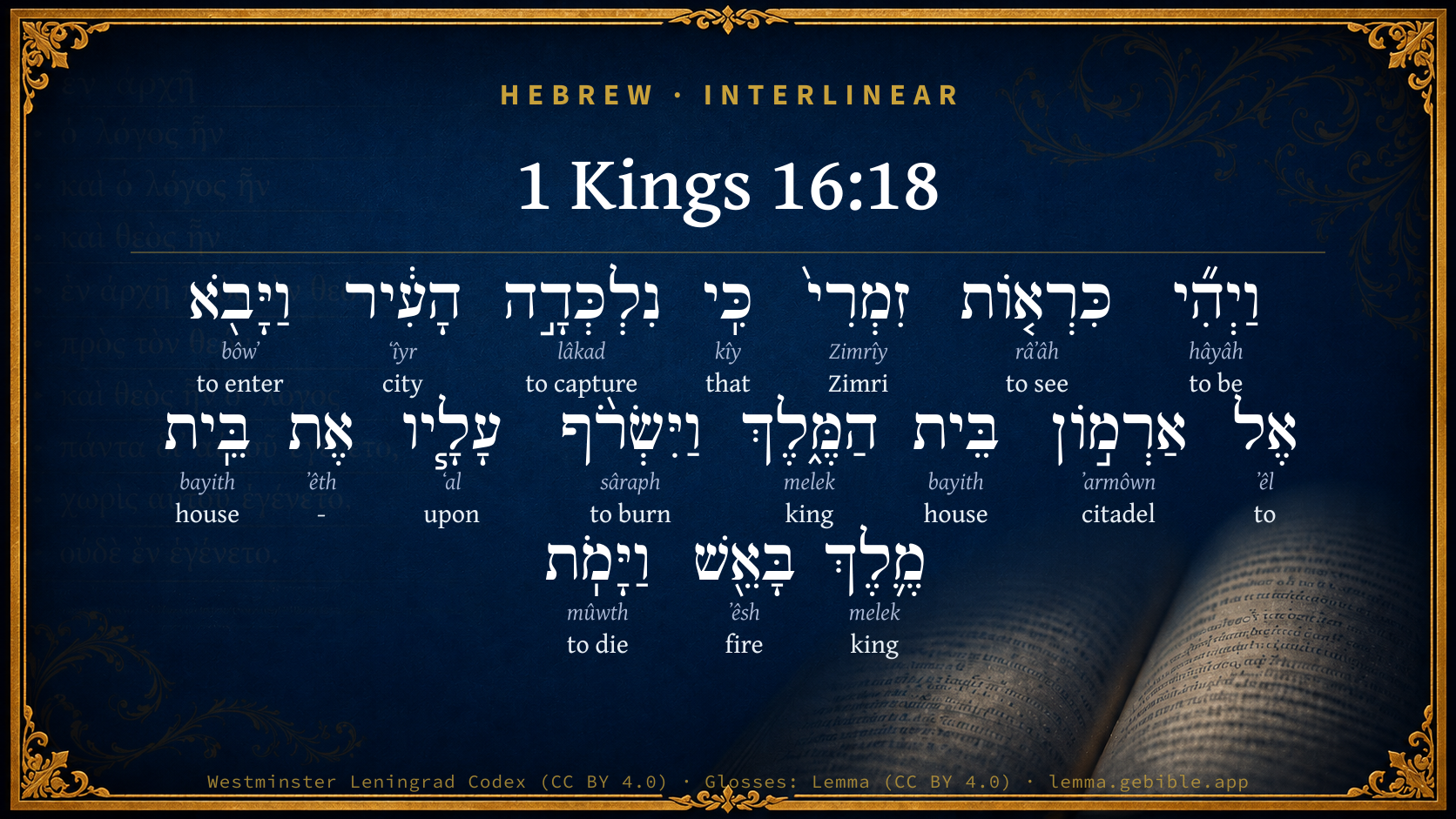
Hebrew (Westminster Leningrad Codex) 1 Kings 16:18 appears in the Hebrew Old Testament. The text above is from the Westminster Leningrad Codex. Each word links to its Strong’s number, a concise gloss, and parsing drawn from the Open Scriptures Hebrew Bible morphology. Click any word for its full Brown-Driver-Briggs (BDB) entry.
Download image
Cite this verse

1 Kings 16:18 (World English Bible). Public Domain. Lemma interlinear Bible study tool, https://lemma.gebible.app/v/1-kings/16/18.

Show BibTeX & RIS
BibTeX
RIS
English Translation
It happened, when Zimri saw that the city was taken, that he went into the castle of the king's house, and burnt the king's house over him with fire, and died,
World English Bible · Public Domain
Highlights
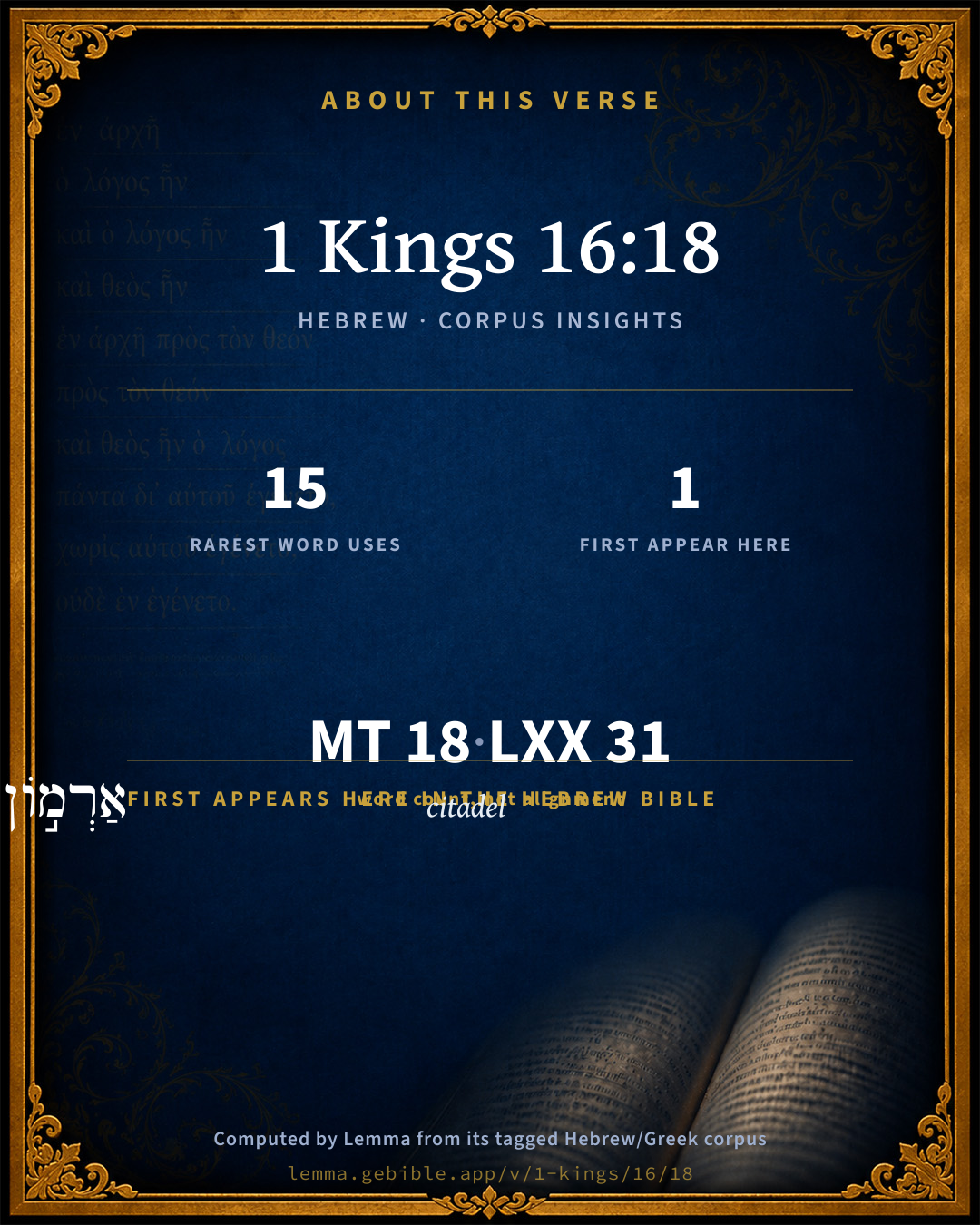
  • 1 first appearance in the Hebrew Bible
Full analysis ↓
Download a study sheet

One document with this verse’s original text, its word-by-word gloss line, the meaning frame, cross-references with their text, attributed commentary, and full source and license credits — printable, and it pastes into notes with its structure intact.

This verse Autodidact and up

Study sheet (.html) Plain text (.txt)

A passage Seminary Student

Up to 50 verses in one chapter. A passage sheet keeps up to 6 commentary sources and 12 cross-references per verse, in the order this page ranks them, and says so on the sheet whenever that leaves anything out. Ask for a single verse and you get the Autodidact verse sheet above.

Everything on this page stays free to read, with no account — the sheet is a download of what is already on screen, not access to it.

Want to remove ads? Support Godless Engineer
Compare translations 3

The same verse in 3 English versions, stacked beneath the original-language interlinear above. Click any original word for its lexicon entry.

Each is an independent rendering of the whole verse — the interlinear is not word-aligned to these translations.

Highlighted words mark where these versions differ — a whole-verse word diff, not a word-by-word alignment.

  • World English Bible Public Domain
    It happened, when Zimri saw that the city was taken, that he went into the castle of the king's house, and burnt the king's house over him with fire, and died,
  • King James Version Public Domain
    And it came to pass, when Zimri saw that the city was taken, that he went into the palace of the king's house, and burnt the king's house over him with fire, and died.
  • unfoldingWord Literal Text CC BY-SA 4.0
    And it happened, when Zimri saw that the city had been taken, that he entered into the citadel of the house of the king. And he burned the house of the king over himself with fire, and he died,

unfoldingWord Literal Text — © unfoldingWord, licensed CC BY-SA 4.0. Word-aligned USFM3 via Door43 (git.door43.org/unfoldingWord/en_ult).

Versions to compare (up to 4)

3 of 4 selected

Show all 18 translations

Every available English version of this verse, each an independent rendering of the whole verse.

  • World English Bible Public Domain
    It happened, when Zimri saw that the city was taken, that he went into the castle of the king's house, and burnt the king's house over him with fire, and died,
  • Berean Standard Bible Public Domain
    When Zimri saw that the city was captured, he entered the citadel of the royal palace and burned it down upon himself. So he died
  • Majority Standard Bible Public Domain
    When Zimri saw that the city was captured, he entered the citadel of the royal palace and burned it down upon himself. So he died
  • King James Version Public Domain
    And it came to pass, when Zimri saw that the city was taken, that he went into the palace of the king's house, and burnt the king's house over him with fire, and died.
  • American Standard Version (1901) Public Domain
    And it came to pass, when Zimri saw that the city was taken, that he went into the castle of the king's house, and burnt the king's house over him with fire, and died,
  • Revised Version (1885) Public Domain
    And it came to pass, when Zimri saw that the city was taken, that he went into the castle of the king’s house, and burnt the king’s house over him with fire, and died,
  • Geneva Bible (1599) Public Domain
    And when Zimri saw, that the citie was taken, he went into the palace of the Kings house, and burnt himselfe, and the Kings house with fire, and so dyed,
  • Douay-Rheims (1899) Public Domain
    And Zambri seeing that the city was about to be taken, went into the palace and burnt himself with the king's house: and he died
  • Young's Literal Translation Public Domain
    And it cometh to pass, at Zimri's seeing that the city hath been captured, that he cometh in unto a high place of the house of the king, and burneth over him the house of the king with fire, and dieth,
  • Literal Standard Version CC BY-SA 4.0
    And it comes to pass, at Zimri’s seeing that the city has been captured, that he comes into a high place of the house of the king, and burns the house of the king over himself with fire, and he dies,
  • Unlocked Literal Bible CC BY-SA 4.0
    So when Zimri saw that the city had been taken, he went into the fortress attached to the king's palace and set fire to the building over him; in this way he died in the flames.
  • unfoldingWord Literal Text CC BY-SA 4.0
    And it happened, when Zimri saw that the city had been taken, that he entered into the citadel of the house of the king. And he burned the house of the king over himself with fire, and he died,
  • Darby Bible Public Domain
    And it came to pass when Zimri saw that the city was taken, that he went into the citadel of the king's house, and burned the king's house over him with fire;
  • World Messianic Bible Public Domain
    When Zimri saw that the city was taken, he went into the fortified part of the king’s house and burned the king’s house over him with fire, and died,
  • Webster's Bible Public Domain
    And it came to pass, when Zimri saw that the city was taken, that he went into the palace of the king's house, and burnt the king's house over him with fire, and died,
  • Free Bible Version CC BY-SA 4.0
    When Zimri saw that the city had been taken he went into the fortress of the royal palace and set it on fire around him, and he died, because of the sins he had committed.
  • Bible in Basic English Public Domain
    And when Zimri saw that the town was taken, he went into the inner room of the king's house, and burning the house over his head, came to his end,
  • JPS Tanakh (1917) Public Domain
    And it came to pass, when Zimri saw that the city was taken, that he went into the castle of the king's house, and burnt the king's house over him with fire, and died;

Literal Standard Version (2020), Covenant Press — licensed CC BY-SA 4.0. Text via the HelloAO Bible API (eBible.org). Unlocked Literal Bible (unfoldingWord) — licensed CC BY-SA 4.0. Text via the HelloAO Bible API (eBible.org). unfoldingWord Literal Text — © unfoldingWord, licensed CC BY-SA 4.0. Word-aligned USFM3 via Door43 (git.door43.org/unfoldingWord/en_ult). Free Bible Version, Dr. Jonathan Gallagher — licensed CC BY-SA 4.0. Text via the HelloAO Bible API (eBible.org).

Word by word

More ways to search: Search by grammar → Find every occurrence → Compare this word →

Practice this passage: Drill this verse → Learn its vocabulary →

זִמְרִי֙
Zimrîy
H2174
“Zimri”
Noun, Proper
Part of Speech
Noun
Type
Proper
Full BDB Definition

Origin: from H2167

TWOT: None

Zimri = "my music" - the son of Salu, a Simeonite chieftain, slain by Phinehas with the Midianitish princess Cozbi - 5th king of the northern kingdom, murderer of the king, Elah, who reigned for 7 days before he killed himself by setting the palace on fire and was replaced by the general of the army, Omri - one of the five sons of Zerah and grandson of Judah - son of Jehoadah and descendant of Saul - an obscure name mentioned in connection with 'the mingled people' in Jeremiah; may be same as 'Zimran'
  1. וַיְהִ֞י hâyâh H1961 “and · to be” Conjunction + Verb, Qal, Sequential Imperfect, 3rd Person, Masculine, Singular
  2. כִּרְא֤וֹת râʼâh H7200 “like/as · to see” Preposition + Verb, Qal, Infinitive Construct
  3. כִּֽי kîy H3588 “that” Conjunction
  4. נִלְכְּדָ֣ה lâkad H3920 “to capture” Verb, Niphal, Perfect, 3rd Person, Feminine, Singular
  5. הָעִ֔יר ʻîyr H5892 “the · city” Particle, Definite Article + Noun, Common, Feminine, Singular, Absolute
  6. וַיָּבֹ֖א bôwʼ H935 “and · to enter” Conjunction + Verb, Qal, Sequential Imperfect, 3rd Person, Masculine, Singular
  7. אֶל ʼêl H413 “to” Preposition
  8. אַרְמ֣וֹן ʼarmôwn H759 “citadel of” Noun, Common, Masculine, Singular, Construct
  9. בֵּית bayith H1004 “house of” Noun, Common, Masculine, Singular, Construct
  10. הַמֶּ֑לֶךְ melek H4428 “the · king” Particle, Definite Article + Noun, Common, Masculine, Singular, Absolute
  11. וַיִּשְׂרֹ֨ף sâraph H8313 “and · to burn” Conjunction + Verb, Qal, Sequential Imperfect, 3rd Person, Masculine, Singular
  12. עָלָ֧יו ʻal H5921 “upon · him” Preposition + Suffix, Personal, 3rd Person, Masculine, Singular
  13. אֶת ʼêth H853 “-” Particle, Direct Object
  14. בֵּֽית bayith H1004 “house of” Noun, Common, Masculine, Singular, Construct
  15. מֶ֛לֶךְ melek H4428 “king” Noun, Common, Masculine, Singular, Absolute
  16. בָּאֵ֖שׁ ʼêsh H784 “in/at the · fire” Preposition, Determined + Noun, Common, Both, Singular, Absolute
  17. וַיָּמֹֽת mûwth H4191 “and · to die” Conjunction + Verb, Qal, Sequential Imperfect, 3rd Person, Masculine, Singular

About this verse

These counts appear in no published source. They are computed here, from the morphology-tagged text and Lemma’s own curated glosses. What Lemma adds →

18
words
16
distinct lemmas
Historical
section

Notable vocabulary

The rarest word here is זִמְרִי֙ Zimri H2174 — appearing just 15 times in the whole Hebrew Bible.

First appearance in Scripture

This word makes its first canonical appearance in the Hebrew Bible here:

  • אַרְמ֣וֹן citadel H759

Shared distinctive vocabulary

זִמְרִי֙ Zimri H2174 occurs in 13 verses of the Hebrew Bible. Also found in:

Grammatical profile

  • 6 verbs
  • 8 nouns
  • 2 prepositions
  • 1 conjunction
  • 1 particle

Verb forms

  • וַיְהִ֞י Qal · Sequential Imperfect
  • כִּרְא֤וֹת Qal · Infinitive Construct
  • נִלְכְּדָ֣ה Niphal · Perfect
  • וַיָּבֹ֖א Qal · Sequential Imperfect
  • וַיִּשְׂרֹ֨ף Qal · Sequential Imperfect
  • וַיָּמֹֽת Qal · Sequential Imperfect

Repetition

Words recur within this verse — often emphatic in Hebrew:

  • בֵּית house H1004 ×2
  • הַמֶּ֑לֶךְ king H4428 ×2

Hebrew & Septuagint length

In English translation the verse runs 31 words from the Hebrew and 35 from the Septuagint (LXX English) — closely comparable.

A rough comparison of the two English renderings, which tokenize alike — not a word-level alignment.

Word counts can differ between the Hebrew and the Greek without any difference in meaning — e.g. the Hebrew direct-object marker אֵת has no separate Greek word, and Greek often adds the article ὁ.

In the original languages it is 18 Hebrew tokens and 31 Greek tokens — but the two are counted differently (Hebrew bundles its prefixes and suffixes into one token; the Greek is in lemma form), so that isn’t a like-for-like length.

Cross-references

5

Topical passages linked to 1 Kings 16:18 in the Treasury of Scripture Knowledge — connected by theme and wording, ordered by reader-vote popularity; previews shown in the World English Bible.

  • 2 Samuel 17:23 When Ahithophel saw that his counsel was not followed, he saddled his donkey, and arose, and got him home, to his city, and set his house in order, and hanged himself; and he died, and was buried in the tomb of his father.
  • 1 Samuel 31:4–5 Then said Saul to his armor bearer, Draw your sword, and thrust me through therewith, lest these uncircumcised come and thrust me through, and abuse me. But his armor bearer would not; for he was sore afraid. Therefore Saul took his sword, and fell on it.
  • Judges 9:54 Then he called hastily to the young man his armor bearer, and said to him, Draw your sword, and kill me, that men not say of me, A woman killed him. His young man thrust him through, and he died.
  • Job 2:9–10 Then his wife said to him, "Do you still maintain your integrity? Renounce God, and die."
  • Matthew 27:5 He threw down the pieces of silver in the sanctuary, and departed. He went away and hanged himself.

Cross-references courtesy of OpenBible.info (CC BY 4.0).

Hebrew and Greek witnesses Masoretic Hebrew ↔ Greek Septuagint

The same verse in the two great witnesses to the Old Testament, shown verse-for-verse.

These are two independent witnesses, not word-aligned to each other, and the Septuagint is shown in lemma (dictionary) form.

Hebrew 1 Kings 16:18 Masoretic · Westminster Leningrad Codex

וַיְהִ֞י כִּרְא֤וֹת זִמְרִי֙ כִּֽי נִלְכְּדָ֣ה הָעִ֔יר וַיָּבֹ֖א אֶל אַרְמ֣וֹן בֵּית הַמֶּ֑לֶךְ וַיִּשְׂרֹ֨ף עָלָ֧יו אֶת בֵּֽית מֶ֛לֶךְ בָּאֵ֖שׁ וַיָּמֹֽת

It happened, when Zimri saw that the city was taken, that he went into the castle of the king's house, and burnt the king's house over him with fire, and died,

World English Bible · Public Domain

Greek LXX 1 Kings 16:18 Septuagint · lemma form

καί γίγνομαι ὡς ὁράω ζαμβρι ὅτι προ καταλαμβάνω αὐτός ὁ πόλις καί εἰςπορεύομαι εἰς ἄντρον ὁ οἶκος ὁ βασιλεύς καί ἐνπυρίζω ἐπί αὐτός ὁ οἶκος ὁ βασιλεύς ἐν πῦρ καί ἀποθνήσκω

And it came to pass when Zambri saw that his city was taken, that he goes into the inner chamber of the house of the king, and burnt the king's house over him, and died.

LXX2012 (modern English Septuagint) · Public Domain

On this verse, Ellicott's Commentary for English Readers discusses the Septuagint’s reading. Read the note in Commentary ↓

Hebrew: Westminster Leningrad Codex (CC BY 4.0). Greek: Septuagint (public domain); English from LXX2012 (modern English Septuagint) (Public Domain). How the Septuagint differs from the Hebrew →

Targum (Aramaic paraphrase)

1

The Targum is the ancient Jewish Aramaic paraphrase of the Hebrew Scriptures — an interpretive translation, not the Hebrew text itself. Onkelos (literal) and Pseudo-Jonathan (expansive) render the Torah, and Jonathan the Prophets. Coverage is partial: where no permissively-licensed English translation exists for a verse, only the Aramaic is shown. This is verse-level text, not a word-by-word alignment to the Hebrew.

  1. Targum Jonathan Prophets (Joshua–Malachi)
    וַהֲוָה כַּד חַזָא זִמְרִי אֲרֵי אִתְכְּבִישַׁת קַרְתָּא וְעַל לְאִידְרוֹן בֵּית מַלְכָּא וְאוֹקִיד עֲלוֹהִי יַת בֵּית מַלְכָּא בְּנוּרָא וּמִית:

    (no public-domain English translation for this verse)

    Targum Jonathan — Aramaic: “Mikraot Gedolot” (public domain). English: “Sefaria Community Translation” (CC0 1.0 (public-domain dedication)); “London "Chaldee Paraphrase," 1871” (public domain). Text via Sefaria.

Commentary

Notes on 1 Kings 16:18 from classic Christian and Jewish commentators (each source and its license shown beneath its notes). The classic Christian expositions comment on the surrounding passage and are grouped to its opening verse, so a note may address several verses; the Jewish commentaries on the Tanakh (Rashi and others) are per-verse, so they appear only where the commentator wrote on this verse.

Lemma curates 59 commentaries, every one of them public domain or Creative Commons licensed, each selected and text-cleaned for this edition rather than reprinted as found. About our sources →

Trapp's Complete Commentary

John Trapp

1Ki 16:18 And it came to pass, when Zimri saw that the city was taken, that he went into the palace of the king’s house, and burnt the king’s house over him with fire, and died,

Ver. 18. The city was taken.] And so himself like to be unkinged. Of the Ruteni it is storied, that many times they have each day a new king, or more, as any of them are of power to make themselves so. This must needs be regnum Cuclopicum.

And burnt the king’s house over him.] The like did Sardanapalus, the last king of Assyria, not willing to fall into the hands of Arbacus his own general, by whom he was besieged at Nineveh. {a}

{a} Diodor. Justin. Strabo.

John Trapp, A Commentary or Exposition upon All the Books of the Old and New Testament (1647–1656) — public domain. Text from a community e-Sword module.

Joseph Benson's Commentary

1Ki 16:18. When Zimri saw that the city was taken — Tirzah, though a beautiful city, it seems, was not fortified; so that Omri soon made himself master of it, and forced Zimri into the palace; which, as he was unable to defend, and yet unwilling to surrender it, he burned, and himself in it: grudging that his rival should ever enjoy so sumptuous a palace, and fearing that if he fell into the hands of his enemies, either alive or dead, he should be ignominiously treated. See to what desperate practices men’s wickedness sometimes brings them, and how it hurries them to their own ruin! See the disposition of incendiaries, who set palaces and kingdoms on fire, though they are themselves in danger of perishing in the flame!

Joseph Benson's Commentary on the Old and New Testaments (1811–1818) — public domain. Text from a community e-Sword module.

Tyndale Open Study Notes

Tyndale Open Resources

16:18-19 burned it down over himself: Zimri’s cowardice is evident in his suicide in the face of capture.

Tyndale Open Study Notes — © Tyndale Open Resources, licensed CC BY-SA 4.0. Text via the HelloAO Bible API.

Geneva Bible (1599)

Geneva Bible translators

Hebrew, burnt the King’s house upon him.

Geneva Bible (1599) marginal notes — public domain. Text via Bolls.life.

Ellicott's Commentary for English Readers

(18) The palace of the king’s house.—The same phrase is found in 2Ki_15:25. The word here rendered “palace” evidently means (as is clear from its derivation) “the high place,” or “citadel,” of the building. Some render it the “harem,” with which the curious rendering (ἄντρον) of the LXX.—signifying properly a cave or “lurking-place”—may perhaps, agree. But this is not suggested by the word itself. This desperate act of Zimri, which has many parallels in Eastern history, seems to indicate that there was held to be something especially treasonable, and therefore unpardonable, in his assassination of Elah. (See 1Ki_16:20, and 2Ki_9:31.)

A Bible Commentary for English Readers, edited by Charles John Ellicott (1878–1897) — public domain. Text from a community e-Sword module.

The Cambridge Bible for Schools and Colleges

gen. ed. J. J. S. Perowne

18. the palace [R.V. castle] of the king’s house] The word is most frequently rendered ‘palace’ in A.V.; but here and in 2Ki_15:25, the sense required is some strong and well barricaded part of the royal residence, where any one might retire and the enemy be unable to reach him. The root of the noun is probably a verb implying ‘height.’

The Cambridge Bible for Schools and Colleges (gen. ed. J. J. S. Perowne; Cambridge University Press, 1878–1918) — public domain. Text from a community e-Sword module.

John Gill's Exposition

In the thirty first year of Asa king of Judah began Omri to reign over Israel twelve years,.... Which are to be reckoned not from the thirty first of Asa; for Ahab the son of Omri began to reign in his thirty eighth year, and so his reign would be but seven or eight years; but they are reckoned from the twenty seventh of Asa, the beginning of it, when Elah was slain by Zimri, and he died, which to the end of the thirty eight of Asa make twelve years; for the division, according to the Jewish chronology (d), lasted four years; Jarchi says five (e); and from the beginning of that his reign is reckoned, though he did not reign over all Israel, or completely, until the thirty first of Asa, when Tibni died:

six years reigned he in Tirzah; the royal city of the kings of Israel, from Jeroboam to this time, and the other six he reigned in Samaria, built by him, as in the next verse.

(d) Seder Olam Rabba, c. 17. p. 45. (e) So Tzemach David, par. 1. fol. 11. 2.

John Gill's Exposition of the Whole Bible (1746–1763) — public domain (CC PDM 1.0). Text via the HelloAO Bible API.

Albert Barnes' Notes on the Bible

The palace of the king’s house - The tower of the king’s house. A particular part of the palace - either the “harem,” or, more probably, the keep or citadel, a tower stronger and loftier than the rest of the palace.

Zimri’s desperate act has been repeated more than once. That the last king of Assyria, the Sardanapalus of the Greeks, thus destroyed himself, is almost the only “fact” which we know concerning him.

Albert Barnes' Notes on the Bible (1834–1885) — public domain. Text from a community e-Sword/MySword module.

Haydock's Catholic Bible Commentary

Himself. Hebrew may also signify, "he (Amri) burnt him." --- Zambri, his rival. But the other sense is more natural. (Calmet) --- Thus Sardanapalus chose to destroy himself, with all his riches, (Justin i.; Atheneus xii. 7.) to prevent the dead body from being insulted. It was for this reason the Sylla, the first of the Cornelian family, ordered his remains to be burnt. (Cicero, Leg. i.) (Tirinus)

George Leo Haydock (1774–1849), Haydock's Catholic Family Bible and Commentary, 1859 edition — public domain. Excludes Psalms (Douay-Rheims chapter numbering differs from Protestant) and Deuterocanonical books (Catholic canon only).

Matthew Poole's English Annotations

Burnt the king’s house over him; or, and he burnt, &c. Either,

1. Omri burnt it over Zimri; for pronouns sometimes respect more remote nouns. Or rather,

2. Zimri, (to whom both the foregoing and following words apparently belong,) who burnt it upon himself, that neither himself nor the royal palace and treasures might come into the hands of his insulting adversary.

Matthew Poole's English Annotations on the Holy Bible (1683–1685) — public domain. Text from a community e-Sword/MySword module.

Whedon's Commentary on the Bible

Daniel D. Whedon

18. Palace of the king’s house — Rather, as Gesenius explains it, “Fortress of the king’s house; the innermost part, as the highest and strongest — the citadel. J.D. Michaelis, and after him most modern interpreters, here translate it the women’s apartment; but there is no trace of this in the ancient interpreters, nor is there any reason for departing from the simple explanation given above.”

Burnt the king’s house over him with fire — As Saracus, or Sardanapalus, is said to have done, when besieged in a similar way at Nineveh.

Daniel D. Whedon (gen. ed.), Commentary on the Old and New Testaments (1874–1909) — public domain. Text from a community e-Sword module.

The Pulpit Commentary

And it came to pass, when Zimri saw that the city was taken the meaning is probably that which Josephus gives: "When he saw that the city had none to defend it," or possibly, "when he saw that a breach was made", that he went into the palace wOmra" citadel, fortress, from altus fuit. So Gesen., Keil, Bight, al. The palace, no doubt, consisted of a string of buildings (1Ki_7:2-9) of which this was the highest and strongest part. Ewald thinks that the harem a word which has almost the same radicals or women"s apartment, is meant the most secluded portion of the great palace (Josephus understands it to mean "the inmost part"), and hence infers, as also from 2Ki_9:31, that the women of the palace had willingly submitted to the effeminate murderer of their lord, and that even the queen-mother had made advances towards him (vol. 4. p. 36). But, as Bight remarks there is nothing of this in the text, and Zimri"s desperate act rather shows daring and contempt of death than effeminacy or sensuality. And 2Ki_15:25 (cf. Psa_122:7) seems to point to a stronghold rather than a seraglio of the king"s house, and burnt the king"s house probably the palace which Jereboam had built. Ewald thinks it was this structure gave Tirzah its reputation for beauty; Song of Son_6:4 over him with fire According to the Syriac, the besiegers set fire to the palace. Similarly Jarchi. But the text is decisive. The parallel deed of Sardanapalus will occur to all readers. Rawlinson also refers to Heb 1:176, and 7:107, and died. This word is intimately connected with the verse following. But there is no need to rearrange the verses. The text, as it stands, conveys clearly enough that Zimri"s tragical death was a retribution for his sins. Bahr remarks that of Elah and Zimri we learn nothing, apart from the fact that they held to the sin of Jeroboam, except how they died.

The Pulpit Commentary (1880–1919), ed. H.D.M. Spence-Jones & Joseph S. Exell — public domain. Text from a community e-Sword module.

unfoldingWord translationNotes

Door43 World Missions Community

that the city had been taken

This can be stated in active form. AT: "that Omri and the army had taken the city" (See: Active or Passive)

what was evil in the sight of Yahweh

The sight of Yahweh represents Yahweh's judgment. AT: "what was evil in Yahweh's judgment" or "what Yahweh considers to be evil" (See: Metaphor)

walking in the way of Jeroboam

Here walking represents behaving. AT: "doing the same things that Jeroboam had done" (See: Metaphor)

so as to lead Israel to sin

Leading people to do something represents influencing them to do it. AT: "so as to influence Israel to sin" (See: Metaphor)

the treason that he carried out

This treason refers to Zimri's plot to kill Elah, the king of Israel. The full meaning of this statement can be made clear. AT: "how he plotted against King Elah" or "how he killed the king of Israel" (See: Assumed Knowledge and Implicit Information)

are they not written in the book of the events of the kings of Israel?

This question is used to either inform or remind the readers that the information about Zimri is in this other book. This rhetorical question can be translated as a statement. See how you translated a similar phrase concerning Judah in 1 Kings 14:29. AT: "they are written in the book of the events of the kings of Israel." (See: Rhetorical Question)

are they not written ... Israel?

This can be stated in active form. AT: "someone has written about them in the book of the events of the kings of Israel." (See: Active or Passive)

translationWords

stronghold

palace

fire

sin

evil

Yahweh

walk

Jeroboam

unfoldingWord translationNotes — © Distant Shores Media and the Door43 World Missions Community, licensed CC BY-SA 4.0. Source: git.door43.org/Door43/en_tn.

Lesson kit

Teaching starters — assembled from the data on this page, not authored interpretation. Every prompt links to the verse data it draws on. Edit before teaching.

1 Kings, in the Historical, opens this verse with 18 words (16 distinct Hebrew lemmas). Its most distinctive word is Zimrîy (“Zimri”). A historical commentator’s framing appears above. Read the whole chapter for the surrounding context.

Discussion questions

  1. How does “Zimri” (Zimrîy) shape what this verse is saying?
  2. This is the first place “citadel” appears in Scripture (first appears here). What does its debut here establish?
  3. How does Numbers 25:14, which shares the word «Zimri», read alongside this verse?
  4. What does the repetition of “house” (2× in this one verse) do in this verse?
  5. These translations render this verse differently; the difference is in the English rendering, not the original. What questions does that raise?
  6. «וַיְהִ֞י» is a Qal Sequential Imperfect verb. How does that grammatical form shape the action described?
  7. Compare how Trapp's Complete Commentary and Joseph Benson's Commentary read this verse. Where do they agree or differ?

Things to notice

Reading settings

Reading text

Shown beneath each verse's original-language words.

Old Testament
Old Testament edition

Read the OT as the Masoretic Hebrew (MT) or the Greek Septuagint (LXX).

English shown for the Greek Septuagint (in the Hebrew ↔ Greek comparison).

Comparing translations? Open the Compare panel on any verse page to stack up to four side by side.