Leviticus 7:19

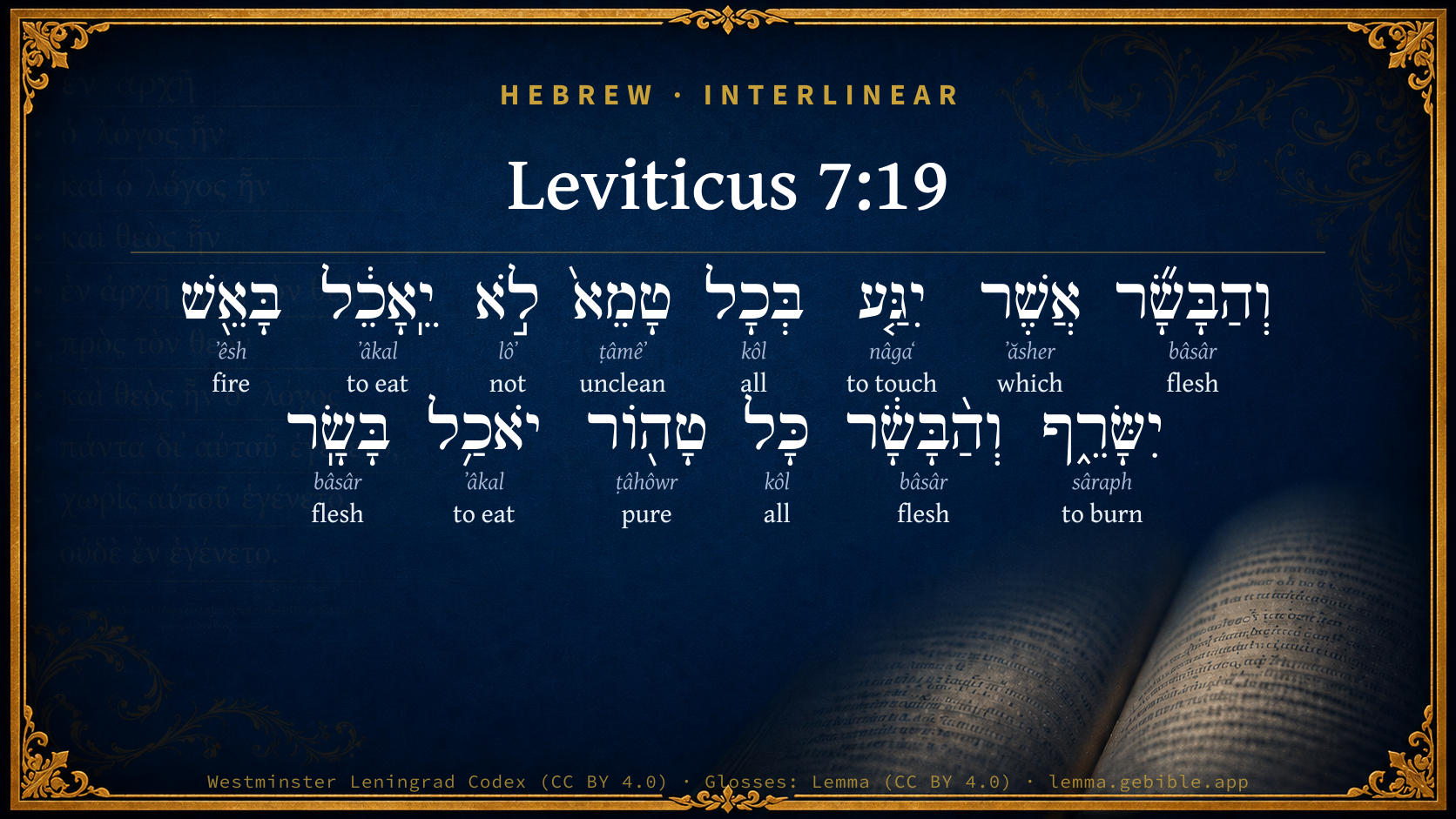
Hebrew (Westminster Leningrad Codex) Leviticus 7:19 appears in the Hebrew Old Testament. The text above is from the Westminster Leningrad Codex. Each word links to its Strong’s number, a concise gloss, and parsing drawn from the Open Scriptures Hebrew Bible morphology. Click any word for its full Brown-Driver-Briggs (BDB) entry.
Download image
Cite this verse

Leviticus 7:19 (World English Bible). Public Domain. Lemma interlinear Bible study tool, https://lemma.gebible.app/v/leviticus/7/19.

Show BibTeX & RIS
BibTeX
RIS
English Translation
"'The flesh that touches any unclean thing shall not be eaten. It shall be burned with fire. As for the flesh, everyone who is clean may eat it;
World English Bible · Public Domain
Download a study sheet

One document with this verse’s original text, its word-by-word gloss line, the meaning frame, cross-references with their text, attributed commentary, and full source and license credits — printable, and it pastes into notes with its structure intact.

This verse Autodidact and up

Study sheet (.html) Plain text (.txt)

A passage Seminary Student

Up to 50 verses in one chapter. A passage sheet keeps up to 6 commentary sources and 12 cross-references per verse, in the order this page ranks them, and says so on the sheet whenever that leaves anything out. Ask for a single verse and you get the Autodidact verse sheet above.

Everything on this page stays free to read, with no account — the sheet is a download of what is already on screen, not access to it.

Want to remove ads? Support Godless Engineer
Compare translations 3

The same verse in 3 English versions, stacked beneath the original-language interlinear above. Click any original word for its lexicon entry.

Each is an independent rendering of the whole verse — the interlinear is not word-aligned to these translations.

Highlighted words mark where these versions differ — a whole-verse word diff, not a word-by-word alignment.

  • World English Bible Public Domain
    "'The flesh that touches any unclean thing shall not be eaten. It shall be burned with fire. As for the flesh, everyone who is clean may eat it;
  • King James Version Public Domain
    And the flesh that toucheth any unclean thing shall not be eaten; it shall be burnt with fire: and as for the flesh, all that be clean shall eat thereof.
  • unfoldingWord Literal Text CC BY-SA 4.0
    And the meat that touches any unclean shall not be eaten. It shall be burned with fire. But the meat—any clean will eat meat.

unfoldingWord Literal Text — © unfoldingWord, licensed CC BY-SA 4.0. Word-aligned USFM3 via Door43 (git.door43.org/unfoldingWord/en_ult).

Versions to compare (up to 4)

3 of 4 selected

Show all 18 translations

Every available English version of this verse, each an independent rendering of the whole verse.

  • World English Bible Public Domain
    "'The flesh that touches any unclean thing shall not be eaten. It shall be burned with fire. As for the flesh, everyone who is clean may eat it;
  • Berean Standard Bible Public Domain
    Meat that touches anything unclean must not be eaten; it is to be burned up. As for any other meat, anyone who is ceremonially clean may eat it.
  • Majority Standard Bible Public Domain
    Meat that touches anything unclean must not be eaten; it is to be burned up. As for any other meat, anyone who is ceremonially clean may eat it.
  • King James Version Public Domain
    And the flesh that toucheth any unclean thing shall not be eaten; it shall be burnt with fire: and as for the flesh, all that be clean shall eat thereof.
  • American Standard Version (1901) Public Domain
    And the flesh that toucheth any unclean thing shall not be eaten; it shall be burnt with fire. And as for the flesh, every one that is clean shall eat thereof:
  • Revised Version (1885) Public Domain
    And the flesh that toucheth any unclean thing shall not be eaten; it shall be burnt with fire. And as for the flesh, every one that is clean shall eat thereof:
  • Geneva Bible (1599) Public Domain
    The flesh also that toucheth any vncleane thing, shall not be eaten, but burnt with fire: but of this flesh all that be cleane shall eate thereof.
  • Douay-Rheims (1899) Public Domain
    The flesh that hath touched any unclean thing, shall not be eaten, but shall be burnt with fire: he that is clean shall eat of it.
  • Young's Literal Translation Public Domain
    `And the flesh which cometh against any unclean thing is not eaten; with fire it is burnt; as to the flesh, every clean one doth eat of the flesh;
  • Literal Standard Version CC BY-SA 4.0
    And the flesh which comes against any unclean thing is not eaten; it is burned with fire; as for the flesh, every clean one eats of the flesh;
  • Unlocked Literal Bible CC BY-SA 4.0
    Any meat that touches an unclean thing must not be eaten. It must be burned. As for the rest of the meat, anyone who is clean may eat it.
  • unfoldingWord Literal Text CC BY-SA 4.0
    And the meat that touches any unclean shall not be eaten. It shall be burned with fire. But the meat—any clean will eat meat.
  • Darby Bible Public Domain
    And the flesh that toucheth anything unclean shall not be eaten; it shall be burned with fire. And as to the flesh, all that are clean may eat [the] flesh.
  • World Messianic Bible Public Domain
    “‘The meat that touches any unclean thing shall not be eaten. It shall be burned with fire. As for the meat, everyone who is clean may eat it;
  • Webster's Bible Public Domain
    And the flesh that toucheth any unclean thing shall not be eaten; it shall be burnt with fire: and as for the flesh, all that shall be clean shall eat of it.
  • Free Bible Version CC BY-SA 4.0
    If this meat touches anything unclean it must not be eaten; it must be burned. This meat may be eaten by those who are ceremonially clean.
  • Bible in Basic English Public Domain
    And flesh touched by any unclean thing may not be taken for food: it is to be burned with fire; and as for the flesh of the peace-offerings, everyone who is clean may take it as food:
  • JPS Tanakh (1917) Public Domain
    And the flesh that toucheth any unclean thing shall not be eaten; it shall be burnt with fire. And as for the flesh, every one that is clean may eat thereof.

Literal Standard Version (2020), Covenant Press — licensed CC BY-SA 4.0. Text via the HelloAO Bible API (eBible.org). Unlocked Literal Bible (unfoldingWord) — licensed CC BY-SA 4.0. Text via the HelloAO Bible API (eBible.org). unfoldingWord Literal Text — © unfoldingWord, licensed CC BY-SA 4.0. Word-aligned USFM3 via Door43 (git.door43.org/unfoldingWord/en_ult). Free Bible Version, Dr. Jonathan Gallagher — licensed CC BY-SA 4.0. Text via the HelloAO Bible API (eBible.org).

Word by word

More ways to search: Search by grammar → Find every occurrence → Compare this word →

Practice this passage: Drill this verse → Learn its vocabulary →

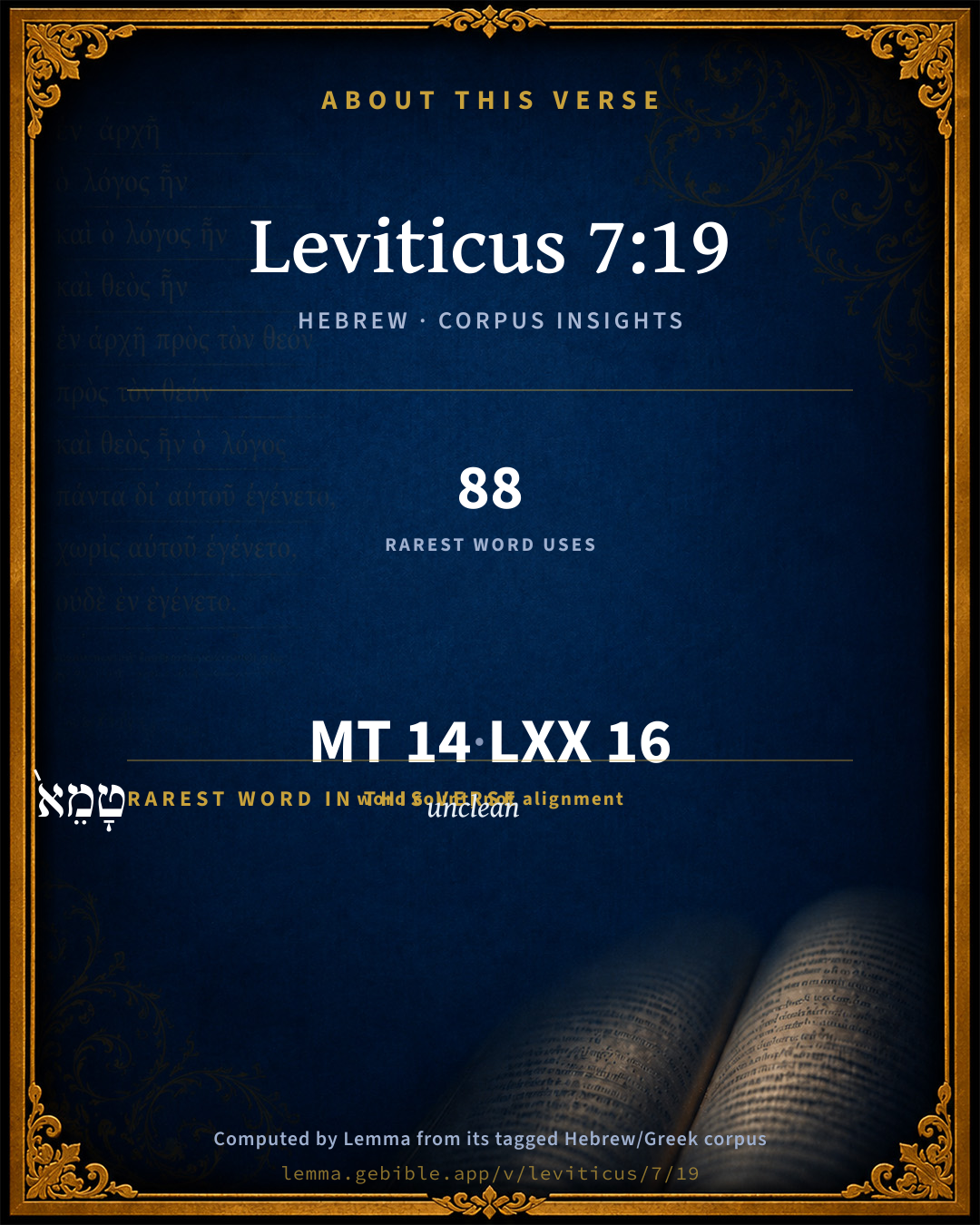
טָמֵא֙
ṭâmêʼ
H2931
“unclean”
Adjective, Adjective, Masculine, Singular, Absolute
Part of Speech
Adjective
Type
Adjective
Gender
Masculine
Number
Singular
State
Absolute
Full BDB Definition

Origin: from H2930

TWOT: 809a

unclean, impure - ethically and religiously - ritually - of places
  1. וְהַבָּשָׂ֞ר bâsâr H1320 “and · the · flesh” Conjunction + Particle, Definite Article + Noun, Common, Masculine, Singular, Absolute
  2. אֲשֶׁר ʼăsher H834 “which” Particle, Relative
  3. יִגַּ֤ע nâgaʻ H5060 “to touch” Verb, Qal, Imperfect, 3rd Person, Masculine, Singular
  4. בְּכָל kôl H3605 “in/at · all of” Preposition + Noun, Common, Masculine, Singular, Construct
  5. לֹ֣א lôʼ H3808 “not” Particle, Negative
  6. יֵֽאָכֵ֔ל ʼâkal H398 “to eat” Verb, Niphal, Imperfect, 3rd Person, Masculine, Singular
  7. בָּאֵ֖שׁ ʼêsh H784 “in/at the · fire” Preposition, Determined + Noun, Common, Both, Singular, Absolute
  8. יִשָּׂרֵ֑ף sâraph H8313 “to burn” Verb, Niphal, Imperfect, 3rd Person, Masculine, Singular
  9. וְהַ֨בָּשָׂ֔ר bâsâr H1320 “and · the · flesh” Conjunction + Particle, Definite Article + Noun, Common, Masculine, Singular, Absolute
  10. כָּל kôl H3605 “all of” Noun, Common, Masculine, Singular, Construct
  11. טָה֖וֹר ṭâhôwr H2889 “pure” Adjective, Adjective, Masculine, Singular, Absolute
  12. יֹאכַ֥ל ʼâkal H398 “to eat” Verb, Qal, Imperfect, 3rd Person, Masculine, Singular
  13. בָּשָֽׂר bâsâr H1320 “flesh” Noun, Common, Masculine, Singular, Absolute

About this verse

These counts appear in no published source. They are computed here, from the morphology-tagged text and Lemma’s own curated glosses. What Lemma adds →

14
words
10
distinct lemmas
Pentateuch
section

Grammatical profile

  • 4 verbs
  • 6 nouns
  • 2 adjectives
  • 2 particles

Verb forms

  • יִגַּ֤ע Qal · Imperfect
  • יֵֽאָכֵ֔ל Niphal · Imperfect
  • יִשָּׂרֵ֑ף Niphal · Imperfect
  • יֹאכַ֥ל Qal · Imperfect

Repetition

Words recur within this verse — often emphatic in Hebrew:

  • וְהַבָּשָׂ֞ר flesh H1320 ×3
  • בְּכָל all H3605 ×2
  • יֵֽאָכֵ֔ל to eat H398 ×2

Hebrew & Septuagint length

In English translation the verse runs 28 words from the Hebrew and 30 from the Septuagint (LXX English) — closely comparable.

A rough comparison of the two English renderings, which tokenize alike — not a word-level alignment.

Word counts can differ between the Hebrew and the Greek without any difference in meaning — e.g. the Hebrew direct-object marker אֵת has no separate Greek word, and Greek often adds the article ὁ.

In the original languages it is 14 Hebrew tokens and 16 Greek tokens — but the two are counted differently (Hebrew bundles its prefixes and suffixes into one token; the Greek is in lemma form), so that isn’t a like-for-like length.

Cross-references

9

Topical passages linked to Leviticus 7:19 in the Treasury of Scripture Knowledge — connected by theme and wording, ordered by reader-vote popularity; previews shown in the World English Bible.

  • Romans 14:20 Don't overthrow God's work for food's sake. All things indeed are clean, however it is evil for that man who creates a stumbling block by eating.
  • Leviticus 11:24–39 "'By these you will become unclean: whoever touches the carcass of them shall be unclean until the evening.
  • Numbers 19:11–16 He who touches the dead body of any man shall be unclean seven days:
  • Luke 11:41 But give for gifts to the needy those things which are within, and behold, all things will be clean to you.
  • Acts 10:15–16 A voice came to him again the second time, "What God has cleansed, you must not call unclean."
  • Acts 10:28 He said to them, "You yourselves know how it is an unlawful thing for a man who is a Jew to join himself or come to one of another nation, but God has shown me that I shouldn't call any man unholy or unclean.
  • Romans 14:14 I know, and am persuaded in the Lord Jesus, that nothing is unclean of itself; except that to him who considers anything to be unclean, to him it is unclean.
  • 2 Corinthians 6:17 Therefore, "'Come out from among them, And be separate,' says the Lord, 'Touch no unclean thing. I will receive you.
  • Titus 1:15 To the pure, all things are pure; but to those who are defiled and unbelieving, nothing is pure; but both their mind and their conscience are defiled.

Cross-references courtesy of OpenBible.info (CC BY 4.0).

Hebrew and Greek witnesses Masoretic Hebrew ↔ Greek Septuagint

The same verse in the two great witnesses to the Old Testament, shown verse-for-verse.

These are two independent witnesses, not word-aligned to each other, and the Septuagint is shown in lemma (dictionary) form.

Hebrew Leviticus 7:19 Masoretic · Westminster Leningrad Codex

וְהַבָּשָׂ֞ר אֲשֶׁר יִגַּ֤ע בְּכָל טָמֵא֙ לֹ֣א יֵֽאָכֵ֔ל בָּאֵ֖שׁ יִשָּׂרֵ֑ף וְהַ֨בָּשָׂ֔ר כָּל טָה֖וֹר יֹאכַ֥ל בָּשָֽׂר

"'The flesh that touches any unclean thing shall not be eaten. It shall be burned with fire. As for the flesh, everyone who is clean may eat it;

World English Bible · Public Domain

Greek LXX Leviticus 7:19 Septuagint · lemma form

καί κρέας ὅσος ἄν ἅπτομαι πᾶς ἀκάθαρτος οὐ βιβρώσκω ἐν πῦρ κατακαίω πᾶς καθαρός ἐσθίω κρέας

You shall also speak to the children of Israel, saying, He that offers a sacrifice of peace-offering, shall bring his gift to the Lord also from the sacrifice of peace-offering.

LXX2012 (modern English Septuagint) · Public Domain

On this verse, Keil & Delitzsch discusses the Septuagint’s reading. Read the note in Commentary ↓

Hebrew: Westminster Leningrad Codex (CC BY 4.0). Greek: Septuagint (public domain); English from LXX2012 (modern English Septuagint) (Public Domain). How the Septuagint differs from the Hebrew →

Targum (Aramaic paraphrase)

2

The Targum is the ancient Jewish Aramaic paraphrase of the Hebrew Scriptures — an interpretive translation, not the Hebrew text itself. Onkelos (literal) and Pseudo-Jonathan (expansive) render the Torah, and Jonathan the Prophets. Coverage is partial: where no permissively-licensed English translation exists for a verse, only the Aramaic is shown. This is verse-level text, not a word-by-word alignment to the Hebrew.

  1. Targum Onkelos Torah (Genesis–Deuteronomy)
    וּבְסַר קוּדְשָׁא דִי יִקְרַב בְּכָל מְסָאָב לָא יִתְאֲכֵל בְּנוּרָא יִתּוֹקָד וּבְסַר קוּדְשָׁא כָּל דִי דְכֵי לְקוּדְשָׁא יֵיכוּל בְּסַר קוּדְשָׁא

    (no public-domain English translation for this verse)

    Targum Onkelos — Aramaic: “Onkelos Genesis” (public domain); “Onkelos Exodus” (public domain); “Onkelos Leviticus” (public domain); “Onkelos Numbers” (public domain); “Onkelos Deuteronomy” (public domain). English: “Sefaria Community Translation” (CC0 1.0 (public-domain dedication)); “J.W. Etheridge. The Targums of Onkelos and Jonathan Ben Uzziel on the Pentateuch. London: Longmans, Green, 1862” (public domain). Text via Sefaria.

  2. Targum Pseudo-Jonathan Torah (Genesis–Deuteronomy)
    וּבְשַר קוּדְשַׁיָא דִי יִקְרַב בְּכָל מְסָאָב לֵית אֶפְשַׁר דְמִיתְאָכֵיל בְּנוּרָא יִתּוֹקָד וּבְשַר קוּדְשָׁא כָּל דְיִדְכֵּי לְקוּדְשָׁא יֵיכוּל בְּשַר קוּדְשָׁא

    And if the flesh of things hallowed touch any uncleanness, it must not be eaten, but be burned in fire; but (as to) flesh that is consecrated, every one who is clean by sanctification may eat the hallowed flesh.

    Targum Pseudo-Jonathan — Aramaic: “Targum Jonathan on Genesis” (public domain); “Targum Jonathan on Exodus” (public domain); “Targum Jonathan on Leviticus” (public domain); “Targum Jonathan on Numbers” (public domain); “Targum Jonathan on Deuteronomy” (public domain). English: “The Targum of Jonathan ben Uzziel, trans. J. W. Etheridge, London, 1862” (public domain). Text via Sefaria.

Commentary

Notes on Leviticus 7:19 from classic Christian and Jewish commentators (each source and its license shown beneath its notes). The classic Christian expositions comment on the surrounding passage and are grouped to its opening verse, so a note may address several verses; the Jewish commentaries on the Tanakh (Rashi and others) are per-verse, so they appear only where the commentator wrote on this verse.

Lemma curates 59 commentaries, every one of them public domain or Creative Commons licensed, each selected and text-cleaned for this edition rather than reprinted as found. About our sources →

Trapp's Complete Commentary

John Trapp

Lev 7:19 And the flesh that toucheth any unclean [thing] shall not be eaten; it shall be burnt with fire: and as for the flesh, all that be clean shall eat thereof.

Ver. 19. Shall not be eaten.] Because not fit to represent Christ.

John Trapp, A Commentary or Exposition upon All the Books of the Old and New Testament (1647–1656) — public domain. Text from a community e-Sword module.

The Biblical Illustrator

Joseph S. Exell

Lev_7:19-21

That soul shall be cut off.

Impurity forbidden

The gospel is a holy feast. It cannot be shared in by those who continue in their impurities. He that would enjoy it must be careful to depart from iniquity. Only the meek shall eat and be satisfied; that is, such as humbly surrender themselves to Gods requirements, and are really determined to forsake all known sin. There is a morality in religion, as well as faith and ecstasy. Grace does not make void the law. And faith without works is a dead and useless faith. Though we are redeemed by blood and justified gratuitously by believing in Christ, yet that redemption obligates us just as much, and still more, to a life of virtue and moral uprightness than the law itself. We are not under law, as those are under it for whom Christs mediation does not avail; but still we are under law to Christ, and bound through Him to a practical holiness, the pattern of which He has given in His own person and life. If His blood has purged us, it is that we might serve the living God. If we are Gods workmanship, created in Christ Jesus, it is unto good works, which God hath before ordained that we should walk in them. A pure life must needs go along with a good hope. Faith, if it hath not works, is dead, being alone. A good tree cannot produce evil fruit. And for a man to believe himself an accepted guest at the gospel feast while living in wilful, deliberate, and known sin, is a miserable antinomian delusion. The plain gospel truth upon this subject is, that, although we cannot be saved by our works alone, we certainly dare not hope to be saved without them, or without being heartily and effectually made up to do our best. Wherever grace is effective, a well-ordered morality must necessarily follow. (J. A. Seiss, D. D.)

The Biblical Illustrator, edited by Joseph S. Exell (c. 1880s–1900s) — public domain. Text from a community e-Sword module.

Joseph Benson's Commentary

Lev 7:19-21. All that be clean shall eat thereof — Whether priests, or offerers, or guests invited. Both the flesh and the eaters of it must be clean. The soul that eateth — Knowingly; for if it were done ignorantly, a sacrifice was accepted for it. Having his uncleanness upon him — Not being cleansed according to the appointment, Lev 11:24, &c. Shall be cut off from his people — That is, excluded from all the privileges of an Israelite. The intention of all these precepts was to preserve the greater reverence and regard for things sacred, and to signify, that all who live in sin not repented of and mortified, are rejected when they draw nigh to God in outward acts of worship.

Joseph Benson's Commentary on the Old and New Testaments (1811–1818) — public domain. Text from a community e-Sword module.

Keil & Delitzsch

C. F. Keil & F. Delitzsch

In the same way all sacrificial flesh that had come into contact with what was unclean, and been defiled in consequence, was to be burned and not eaten. Lev 7:19, which is not found in the Septuagint and Vulgate, reads thus: "and as for the flesh, every clean person shall eat flesh," i.e., take part in the sacrificial meal.

Keil & Delitzsch — Biblical Commentary on the Old Testament (1861–1891) — public domain (CC PDM 1.0). Text via the HelloAO Bible API. (Old Testament only.)

Tyndale Open Study Notes

Tyndale Open Resources

7:19-21 Anything that was ceremonially unclean could not come into contact with what was holy (7:20). Although uncleanness was not sinful in itself, it symbolized what was unholy (see Exod 19:10).

Tyndale Open Study Notes — © Tyndale Open Resources, licensed CC BY-SA 4.0. Text via the HelloAO Bible API.

Geneva Bible (1599)

Geneva Bible translators

Of the peace offering that is clean.

After it be sacrificed.

Geneva Bible (1599) marginal notes — public domain. Text via Bolls.life.

Ellicott's Commentary for English Readers

(19) And the flesh that toucheth.—Not only does the sacrificial flesh become desecrated when left by itself beyond the prescribed period, but when it comes in contact with what is unclean, man, woman, or animal, which might happen whilst it is carried from the altar to the place where it is eaten, it becomes defiled, and must be burnt, so that no profane use is made of it.

And as for the flesh, all that be clean shall eat thereof.—Better, And as for the flesh, every one that is clean may eat the flesh—that is, any one whom the offerer invites may partake of the sacrificial repast, provided he is legally clean.

A Bible Commentary for English Readers, edited by Charles John Ellicott (1878–1897) — public domain. Text from a community e-Sword module.

The Cambridge Bible for Schools and Colleges

gen. ed. J. J. S. Perowne

19–21. The sacrificial flesh must not be brought into contact with anything that is unclean, nor eaten by anyone that is unclean. Special cases of ritual impurity are enumerated in chs. 11–15.

The Cambridge Bible for Schools and Colleges (gen. ed. J. J. S. Perowne; Cambridge University Press, 1878–1918) — public domain. Text from a community e-Sword module.

John Gill's Exposition

But the soul that eateth of the flesh of the sacrifice of the peace offerings, that pertain unto the Lord,.... That are offered up to him, and so are holy, and therefore not to be eaten by unholy persons, or by any

having his uncleanness upon him; a profluvious person that has an issue running out of him, a gonorrhoea; see Lev 15:2.

even that soul shall be cut off from his people; be disfranchised as an Israelite, be debarred the privileges of the sanctuary, or be cut off by death before the usual time and term of man's life; so those that eat and drink unworthily in the supper of our Lord, where his flesh is eaten and his blood drank, eat and drink damnation to themselves, Co1 11:29.

John Gill's Exposition of the Whole Bible (1746–1763) — public domain (CC PDM 1.0). Text via the HelloAO Bible API.

Haydock's Catholic Bible Commentary

Shall eat of it. That is, of the flesh of the thanks-offering. (Challoner) --- People might eat the flesh of animals which had been touched by something unclean, Deuteronomy xii. 15, 22. But victims, defiled by any accident, were to be burnt. The others were to be eaten only by such as were clean. (Menochius)

George Leo Haydock (1774–1849), Haydock's Catholic Family Bible and Commentary, 1859 edition — public domain. Excludes Psalms (Douay-Rheims chapter numbering differs from Protestant) and Deuterocanonical books (Catholic canon only).

Matthew Poole's English Annotations

The flesh, to wit, of the holy offering, of which he is here treating; and therefore the general word is to be so limited; for other flesh one might eat in this case, Deu 12:15,22.

That toucheth any unclean thing, after its oblation; which might easily happen, as it was conveyed from the altar to the place where it was eaten; for it was not eaten in the holy place, as appears, because it was eaten by the priests, together with the offerers, who might not come thither.

As for the flesh, i.e. the other flesh; that which shall not be polluted by any unclean touch.

All that be clean, whether priests or offerers, or guests invited to the feast. See 1Sa 9:12; 20:26. Both the flesh and the eaters of it must be clean.

Matthew Poole's English Annotations on the Holy Bible (1683–1685) — public domain. Text from a community e-Sword/MySword module.

The Pulpit Commentary

That which is itself unclean makes whatever it touches unclean also.

So in the moral sphere, "evil communications corrupt good manners", (1Co_15:33) and "a little leaven leaveneth the whole lump", (1Co_5:6) and so with respect to the spread of heresy, "Their word will eat as doth a canker (or gangrene)". (2Ti_2:17)

On the other hand, that which is itself holy makes that which it touches to be holy. (Lev_6:18) Therefore, when the Holy One was on the earth, "the whole multitude sought to touch him: for there went virtue out of him, and healed them"; (Luk_6:19) and they "brought unto him all that were diseased; and besought him that they might only touch the hem of his garment: and as many as touched were made perfectly whole". (Mat_14:35, Mat_14:36) Thus the woman with an issue of blood "came behind him, and touched the border of his garment: and immediately her issue of blood stanched.... And when the woman saw that she was not hid, she came trembling, and falling down before him, she declared unto him before all the people for what cause she had touched him, and how she was healed immediately". (Luk_8:44-47) Hence, when mankind had fallen in Adam, for the restoration of the race a new Head was found in Christ Jesus, into whom each person is baptized, and by a mystical contact with whom he may be sanctified.

The Pulpit Commentary (1880–1919), ed. H.D.M. Spence-Jones & Joseph S. Exell — public domain. Text from a community e-Sword module.

John Wesley's Explanatory Notes

And the flesh - Namely of the holy offering, of which he is here treating; and therefore the general word is to be so limited; for other flesh one might eat in this case. That toucheth - After its oblation; which might easily happen, as it was conveyed from the altar to the place where it was eaten: for it was not eaten in the holy place, as appears, because it was eaten by the priests, together with the offerers, who might not come thither. The flesh - That is, the other flesh; that which shall not be polluted by any unclean touch. All that are clean - Whether priests or offerers, or guests invited to the feast.

John Wesley, Explanatory Notes Upon the Whole Bible (1754–1765) — public domain. Text via the GEBible commentary corpus.

unfoldingWord translationNotes

Door43 World Missions Community

Any meat that touches an unclean thing must not be eaten

This can be translated in active form. AT: "No one may eat meat that touches something unclean" (See: Active or Passive)

an unclean thing

Something that Yahweh has stated is unfit to touch or eat is spoken of as if it were physically unclean. (See: Metaphor)

It must be burned

This can be translated in active form. AT: "You must burn it" (See: Active or Passive)

anyone who is clean

A person who is acceptable for God's purposes is spoken of as if the person were physically clean. (See: Metaphor)

unclean person

A person who is not acceptable for God's purposes is spoken of as if the person were physically unclean. (See: Metaphor)

that person must be cut off from his people

A person being excluded from his community is spoken of as if he had been cut off from his people, as one would cut a piece of cloth or cut a branch from a tree. This can be translated in active form. AT: "that person may no longer live among his people" or "you must separate that person from his people" (See: Metaphor and Active or Passive)

translationWords

clean

clean

peace offering

Yahweh

cut off

people group

unfoldingWord translationNotes — © Distant Shores Media and the Door43 World Missions Community, licensed CC BY-SA 4.0. Source: git.door43.org/Door43/en_tn.

Rashi

Rabbi Shlomo Yitzchaki (Rashi)

והבשר AND THE FLESH of the sacred animals constituting peace-offerings (not that of פגול mentioned in v. 18, for this may not be eaten even though it does not touch an unclean thing), אשר יגע בכל טמא לא יאכל THAT TOUCHETH ANY UNCLEAN THING SHALL NOT BE EATEN.

והבשר — The word והבשר the second time it occurs in this verse is redundant (it should have stated: כל טהור יאכל בשר) but it is intended to include in the law mentioned here, the limb of a sacrifice that went forth (was brought out) in part from the place where it had to be eaten (in the case of שלמים, from Jerusalem, in that of קדשי קדשים, from the forecourt) — that the part that remained inside is permitted to be eaten (cf. Sifra, Tzav, Section 9 6).

כל טהור יאכל בשר ALL THAT ARE CLEAN MAY EAT FLESH — Why is this stated? Why should it not be assumed that a clean person may eat of the sacrifices? But, since it is stated, (Deuteronomy 12:27) “and the blood of thy sacrifices shall be poured upon the altar …, but the flesh thou mayest eat”, I might have thought, that as it speaks of thy sacrifices and states “thou mayest eat”, only the owner of the sacrifices may eat the peace-offerings! For this reason it is stated here: “all that are clean may eat flesh” (Sifra, Tzav, Section 9 7).

[והבשר כל טהור יאכל בשר ‎AND AS FOR THE FLESH ALL THAT ARE CLEAN MAY EAT FLESH — This is as much as to say: all that I have told thee (some editions read: שאסרתי לך, — “that I have forbidden thee”), is only in the case of the sin-offering and a guilt-offering: that if these went forth (were carried forth) without the hangings of the forecourt they are forbidden (נפסלים ביוצא), as it is said, (Leviticus 6:19) “in the enclosure of the tent of meeting”) shall they eat it”; but with regard to this flesh (that of שלמים) I tell thee, “all that are clean may eat flesh” even amidst all the people (some editions read: בכל העיר, “in the whole city”, which is what “amidst all the people” is intended to mean)].

Rashi on the Tanakh — English translations: “The Judaica Press complete Tanach with Rashi, translated by A. J. Rosenberg” (CC BY 4.0); “Pentateuch with Rashi's commentary by M. Rosenbaum and A.M. Silbermann, 1929-1934” (public domain); “The Metsudah Tanach series, Lakewood, N.J” (CC BY 4.0); and “The Book of Joshua, Metsudah Publications, 1997” (CC BY 4.0). Text via Sefaria.

Lesson kit

Teaching starters — assembled from the data on this page, not authored interpretation. Every prompt links to the verse data it draws on. Edit before teaching.

Leviticus, in the Pentateuch, opens this verse with 14 words (10 distinct Hebrew lemmas). Its most distinctive word is ṭâmêʼ (“unclean”). A historical commentator’s framing appears above. Read the whole chapter for the surrounding context.

Discussion questions

  1. The word ṭâmêʼ carries the sense “unclean.” How does it shape the verse?
  2. How does Romans 14:20, which shares this passage’s theme, read alongside this verse?
  3. What does the repetition of “flesh” (3× in this one verse) do in this verse?
  4. These translations render this verse differently; the difference is in the English rendering, not the original. What questions does that raise?
  5. «יִגַּ֤ע» is a Qal Imperfect verb. How does that grammatical form shape the action described?
  6. Compare how Trapp's Complete Commentary and The Biblical Illustrator read this verse. Where do they agree or differ?

Things to notice

Reading settings

Reading text

Shown beneath each verse's original-language words.

Old Testament
Old Testament edition

Read the OT as the Masoretic Hebrew (MT) or the Greek Septuagint (LXX).

English shown for the Greek Septuagint (in the Hebrew ↔ Greek comparison).

Comparing translations? Open the Compare panel on any verse page to stack up to four side by side.