Psalms 118:12

Hebrew (Westminster Leningrad Codex) Psalms 118:12 appears in the Hebrew Old Testament. The text above is from the Westminster Leningrad Codex. Each word links to its Strong’s number, a concise gloss, and parsing drawn from the Open Scriptures Hebrew Bible morphology. Click any word for its full Brown-Driver-Briggs (BDB) entry.
Download image
Cite this verse

Psalms 118:12 (World English Bible). Public Domain. Lemma interlinear Bible study tool, https://lemma.gebible.app/v/psalms/118/12.

Show BibTeX & RIS
BibTeX
RIS
English Translation
They surrounded me like bees. They are quenched like the burning thorns. In the name of Yahweh I cut them off.
World English Bible · Public Domain
Download a study sheet

One document with this verse’s original text, its word-by-word gloss line, the meaning frame, cross-references with their text, attributed commentary, and full source and license credits — printable, and it pastes into notes with its structure intact.

This verse Autodidact and up

Study sheet (.html) Plain text (.txt)

A passage Seminary Student

Up to 50 verses in one chapter. A passage sheet keeps up to 6 commentary sources and 12 cross-references per verse, in the order this page ranks them, and says so on the sheet whenever that leaves anything out. Ask for a single verse and you get the Autodidact verse sheet above.

Everything on this page stays free to read, with no account — the sheet is a download of what is already on screen, not access to it.

Want to remove ads? Support Godless Engineer
Compare translations 3

The same verse in 3 English versions, stacked beneath the original-language interlinear above. Click any original word for its lexicon entry.

Each is an independent rendering of the whole verse — the interlinear is not word-aligned to these translations.

Highlighted words mark where these versions differ — a whole-verse word diff, not a word-by-word alignment.

  • World English Bible Public Domain
    They surrounded me like bees. They are quenched like the burning thorns. In the name of Yahweh I cut them off.
  • King James Version Public Domain
    They compassed me about like bees: they are quenched as the fire of thorns: for in the name of the LORD I will destroy them.
  • unfoldingWord Literal Text CC BY-SA 4.0
    They surrounded me like bees; they were extinguished like a fire of thorns; in the name of Yahweh, indeed I fended them off.

unfoldingWord Literal Text — © unfoldingWord, licensed CC BY-SA 4.0. Word-aligned USFM3 via Door43 (git.door43.org/unfoldingWord/en_ult).

Versions to compare (up to 4)

3 of 4 selected

Show all 18 translations

Every available English version of this verse, each an independent rendering of the whole verse.

  • World English Bible Public Domain
    They surrounded me like bees. They are quenched like the burning thorns. In the name of Yahweh I cut them off.
  • Berean Standard Bible Public Domain
    They swarmed around me like bees, but they were extinguished like burning thorns; in the name of the LORD I cut them off.
  • Majority Standard Bible Public Domain
    They swarmed around me like bees, but they were extinguished like burning thorns; in the name of the LORD I cut them off.
  • King James Version Public Domain
    They compassed me about like bees: they are quenched as the fire of thorns: for in the name of the LORD I will destroy them.
  • American Standard Version (1901) Public Domain
    They compassed me about like bees; They are quenched as the fire of thorns: In the name of Jehovah I will cut them off.
  • Revised Version (1885) Public Domain
    They compassed me about like bees; they are quenched as the fire of thorns: in the name of the LORD I will cut them off.
  • Geneva Bible (1599) Public Domain
    They came about mee like bees, but they were quenched as a fire of thornes: for in the Name of the Lord I shall destroy them.
  • Douay-Rheims (1899) Public Domain
    They surrounded me like bees, and they burned like fire among thorns: and in the name of the Lord I was revenged on them
  • Young's Literal Translation Public Domain
    They compassed me about as bees, They have been extinguished as a fire of thorns, In the name of Jehovah I surely cut them off.
  • Literal Standard Version CC BY-SA 4.0
    They surrounded me as bees, || They have been extinguished as a fire of thorns, || In the Name of YHWH I surely cut them off.
  • Unlocked Literal Bible CC BY-SA 4.0
    They surrounded me like bees; they disappeared as quickly as fire among thorns; in Yahweh's name I cut them off.
  • unfoldingWord Literal Text CC BY-SA 4.0
    They surrounded me like bees; they were extinguished like a fire of thorns; in the name of Yahweh, indeed I fended them off.
  • Darby Bible Public Domain
    They encompassed me like bees; they are quenched as the fire of thorns: for in the name of Jehovah have I destroyed them.
  • World Messianic Bible Public Domain
    They surrounded me like bees. They are quenched like the burning thorns. In the LORD’s name I cut them off.
  • Webster's Bible Public Domain
    They encompassed me like bees; they are quenched as the fire of thorns: for in the name of the LORD I will destroy them.
  • Free Bible Version CC BY-SA 4.0
    Like a swarm of bees they attacked, but their attack died out as quickly as burning thorn twigs. I defeated them with the help of the Lord.
  • Bible in Basic English Public Domain
    They are round me like bees; but they are put out like a fire among thorns; for in the name of the Lord I will have them cut down.
  • JPS Tanakh (1917) Public Domain
    They compass me about like bees; they are quenched as the fire of thorns; verily, in the name of the LORD I will cut them off.

Literal Standard Version (2020), Covenant Press — licensed CC BY-SA 4.0. Text via the HelloAO Bible API (eBible.org). Unlocked Literal Bible (unfoldingWord) — licensed CC BY-SA 4.0. Text via the HelloAO Bible API (eBible.org). unfoldingWord Literal Text — © unfoldingWord, licensed CC BY-SA 4.0. Word-aligned USFM3 via Door43 (git.door43.org/unfoldingWord/en_ult). Free Bible Version, Dr. Jonathan Gallagher — licensed CC BY-SA 4.0. Text via the HelloAO Bible API (eBible.org).

Word by word

More ways to search: Search by grammar → Find every occurrence → Compare this word →

Practice this passage: Drill this verse → Learn its vocabulary →

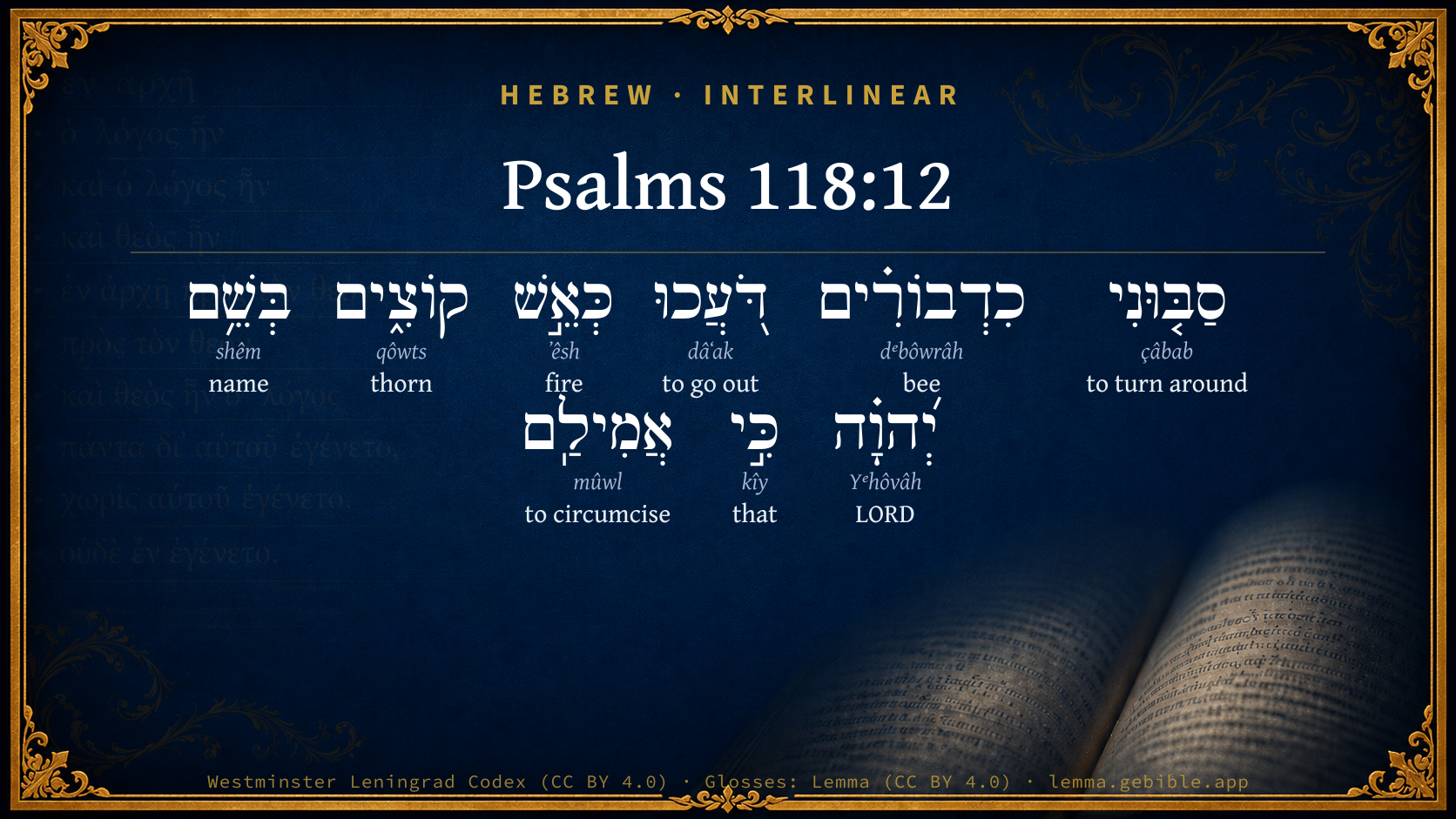
כִדְבוֹרִ֗ים
dᵉbôwrâh
H1682
“like/as · bees”
Preposition + Noun, Common, Feminine, Plural, Absolute
Part of Speech
Preposition + Noun
Type
Common
Gender
Feminine
Number
Plural
State
Absolute
Full BDB Definition

Origin: from H1696 (in the sense of orderly motion)

TWOT: 399f

bee
  1. סַבּ֤וּנִי çâbab H5437 “to turn around · me” Verb, Qal, Perfect, 3rd Person, Common, Plural + Suffix, Personal, 1st Person, Common, Singular
  2. דֹּ֭עֲכוּ dâʻak H1846 “to go out” Verb, Pual, Perfect, 3rd Person, Common, Plural
  3. כְּאֵ֣שׁ ʼêsh H784 “like/as · fire of” Preposition + Noun, Common, Both, Singular, Construct
  4. קוֹצִ֑ים qôwts H6975 “thorns” Noun, Common, Masculine, Plural, Absolute
  5. בְּשֵׁ֥ם shêm H8034 “in/at · name of” Preposition + Noun, Common, Masculine, Singular, Construct
  6. יְ֝הוָ֗ה Yᵉhôvâh H3068 “LORD” Noun, Proper
  7. כִּ֣י kîy H3588 “that” Conjunction
  8. אֲמִילַֽם mûwl H4135 “to circumcise · them” Verb, Hiphil, Imperfect, 1st Person, Common, Singular + Suffix, Personal, 3rd Person, Masculine, Plural

About this verse

These counts appear in no published source. They are computed here, from the morphology-tagged text and Lemma’s own curated glosses. What Lemma adds →

9
words
9
distinct lemmas
Wisdom
section

Notable vocabulary

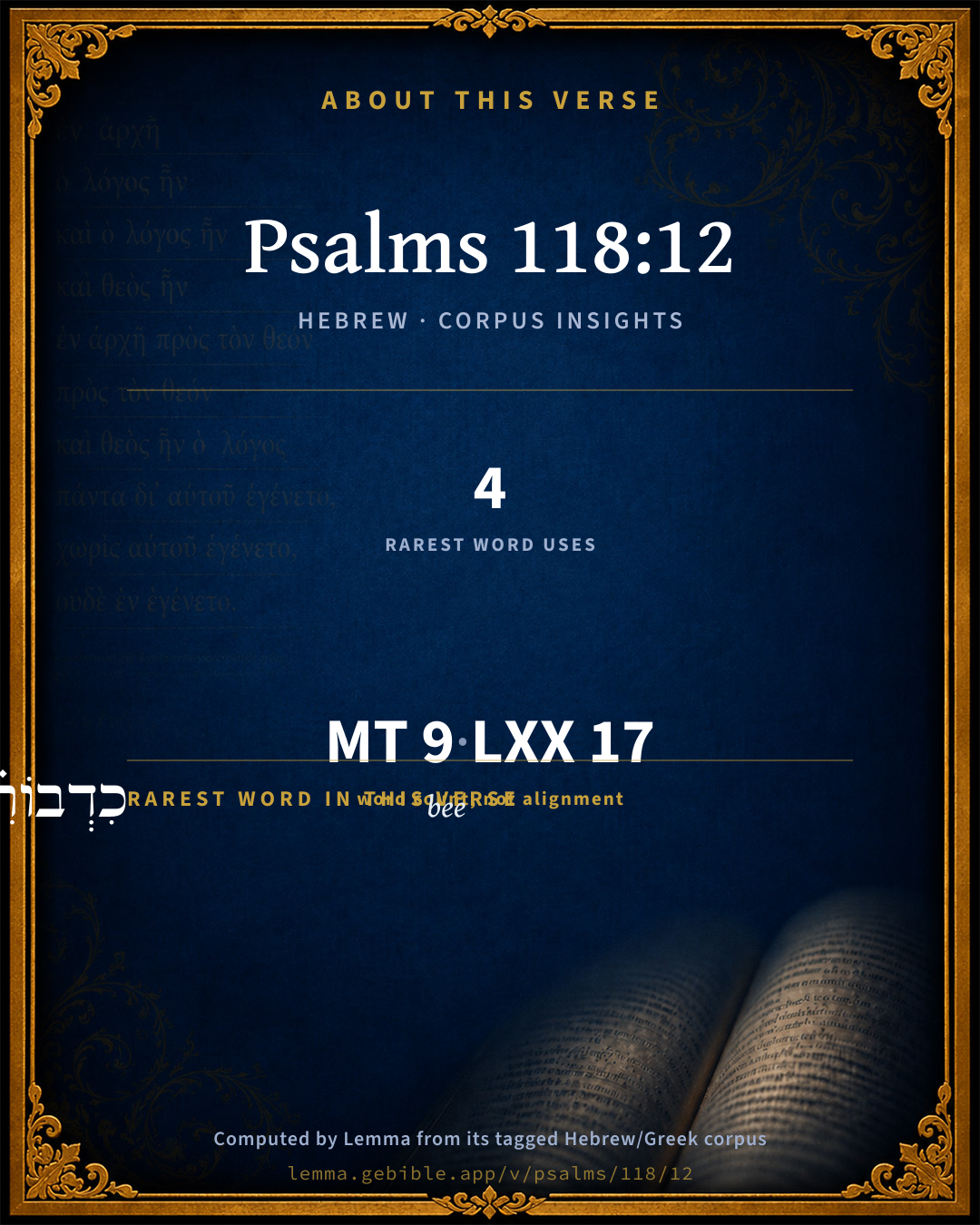
The rarest word here is כִדְבוֹרִ֗ים bee H1682 — appearing just 4 times in the whole Hebrew Bible.

Shared distinctive vocabulary

כִדְבוֹרִ֗ים bee H1682 occurs in 4 verses of the Hebrew Bible. Also found in:

Grammatical profile

  • 3 verbs
  • 5 nouns
  • 1 conjunction

Verb forms

  • סַבּ֤וּנִי Qal · Perfect
  • דֹּ֭עֲכוּ Pual · Perfect
  • אֲמִילַֽם Hiphil · Imperfect

Hebrew & Septuagint length

In English translation the verse runs 21 words from the Hebrew and 28 from the Septuagint (LXX English) — closely comparable.

A rough comparison of the two English renderings, which tokenize alike — not a word-level alignment.

Word counts can differ between the Hebrew and the Greek without any difference in meaning — e.g. the Hebrew direct-object marker אֵת has no separate Greek word, and Greek often adds the article ὁ.

In the original languages it is 9 Hebrew tokens and 17 Greek tokens — but the two are counted differently (Hebrew bundles its prefixes and suffixes into one token; the Greek is in lemma form), so that isn’t a like-for-like length.

Cross-references

17

Topical passages linked to Psalms 118:12 in the Treasury of Scripture Knowledge — connected by theme and wording, ordered by reader-vote popularity; previews shown in the World English Bible.

  • Deuteronomy 1:44 The Amorites, who lived in that hill-country, came out against you, and chased you, as bees do, and beat you down in Seir, even to Hormah.
  • 1 Samuel 17:45 Then said David to the Philistine, You come to me with a sword, and with a spear, and with a javelin: but I come to you in the name of Yahweh of hosts, the God of the armies of Israel, whom you have defied.
  • Psalms 20:5 We will triumph in your salvation. In the name of our God we will set up our banners: May Yahweh grant all your requests.
  • Psalms 20:1 May Yahweh answer you in the day of trouble. May the name of the God of Jacob set you up on high,
  • Ecclesiastes 7:6 For as the crackling of thorns under a pot, so is the laughter of the fool. This also is vanity.
  • 2 Samuel 23:6 But the ungodly shall be all of them as thorns to be thrust away, Because they can't be taken with the hand
  • Psalms 8:9 Yahweh, our Lord, How majestic is your name in all the earth!
  • Psalms 58:9 Before your pots can feel the heat of the thorns, He will sweep away the green and the burning alike.
  • 1 Chronicles 14:10–11 David inquired of God, saying, Shall I go up against the Philistines? and will you deliver them into my hand? Yahweh said to him, Go up; for I will deliver them into your hand.
  • 1 Chronicles 14:14–16 David inquired again of God; and God said to him, You shall not go up after them: turn away from them, and come on them over against the mulberry trees.
  • 2 Chronicles 14:11–12 Asa cried to Yahweh his God, and said, Yahweh, there is none besides you to help, between the mighty and him who has no strength: help us, Yahweh our God; for we rely on you, and in your name are we come against this multitude. Yahweh, you are our God; don't let man prevail against you.
  • 2 Chronicles 16:7–9 At that time Hanani the seer came to Asa king of Judah, and said to him, Because you have relied on the king of Syria, and have not relied on Yahweh your God, therefore is the host of the king of Syria escaped out of your hand.
  • 2 Chronicles 20:17–22 You shall not need to fight in this [battle]: set yourselves, stand you still, and see the salvation of Yahweh with you, O Judah and Jerusalem; don't be afraid, nor be dismayed: tomorrow go out against them: for Yahweh is with you.
  • Psalms 83:14–15 As the fire that burns the forest, As the flame that sets the mountains on fire,
  • Isaiah 27:4 Wrath is not in me: would that the briers and thorns were against me in battle! I would march on them, I would burn them together.
  • Nahum 1:10 For entangled like thorns, and drunken as with their drink, they are consumed utterly like dry stubble.
  • 2 Chronicles 22:7–8 Now the destruction of Ahaziah was of God, in that he went to Joram: for when he was come, he went out with Jehoram against Jehu the son of Nimshi, whom Yahweh had anointed to cut off the house of Ahab.

Cross-references courtesy of OpenBible.info (CC BY 4.0).

Hebrew and Greek witnesses Masoretic Hebrew ↔ Greek Septuagint

The same verse in the two great witnesses to the Old Testament, shown verse-for-verse.

You’re reading Greek Psalm 117 (Hebrew Psalm 118). The Septuagint counts the superscription, so verse numbers can differ from the Hebrew — chapter-level alignment, not verse-by-verse. Numbering follows Rahlfs.

These are two independent witnesses, not word-aligned to each other, and the Septuagint is shown in lemma (dictionary) form.

Hebrew Psalms 118:12 Masoretic · Westminster Leningrad Codex

סַבּ֤וּנִי כִדְבוֹרִ֗ים דֹּ֭עֲכוּ כְּאֵ֣שׁ קוֹצִ֑ים בְּשֵׁ֥ם יְ֝הוָ֗ה כִּ֣י אֲמִילַֽם

They surrounded me like bees. They are quenched like the burning thorns. In the name of Yahweh I cut them off.

World English Bible · Public Domain

Greek LXX Greek Psalm 117:12 Septuagint · lemma form

κυκλόω ἐγώ ὡσεί μέλισσα κηρίον καί ἐκκαίω ὡσεί πῦρ ἐν ἄκανθα καί ὁ ὄνομα κύριος ἀμύνω αὐτός

They compassed me about as bees do a honeycomb, and they burst into flame as fire among thorns: but in the name of the Lord I repulsed them.

LXX2012 (modern English Septuagint) · Public Domain

On this verse, Ellicott's Commentary for English Readers discusses the Septuagint’s reading. Read the note in Commentary ↓

Hebrew: Westminster Leningrad Codex (CC BY 4.0). Greek: Septuagint (public domain); English from LXX2012 (modern English Septuagint) (Public Domain). How the Septuagint differs from the Hebrew →

Commentary

Notes on Psalms 118:12 from classic Christian and Jewish commentators (each source and its license shown beneath its notes). The classic Christian expositions comment on the surrounding passage and are grouped to its opening verse, so a note may address several verses; the Jewish commentaries on the Tanakh (Rashi and others) are per-verse, so they appear only where the commentator wrote on this verse.

Lemma curates 59 commentaries, every one of them public domain or Creative Commons licensed, each selected and text-cleaned for this edition rather than reprinted as found. About our sources →

Trapp's Complete Commentary

John Trapp

Psa 118:12 They compassed me about like bees; they are quenched as the fire of thorns: for in the name of the LORD I will destroy them.

Ver. 12. They compassed me about like bees] Like so many swarms of bees, which, being angered,

- Venenum

Morsibus inspirant, et spicula caeca relinquunt

Affixae venis, animasque in vulnere ponunt

(Virgil)

Bees, to be revenged, lose their stings, and therewith their lives, or, at least, they become drones ever after (Aristot.). Wicked men are no less spiteful; they care not to undo themselves, so they may wrong the saints; yea, they are not unlike the scorpion, of which Pliny saith, that there is not one minute wherein it doth not put forth the sting.

They are quenched (or kindled) as the fire of thorns] Which is quickly kindled, and as quickly quenched, leaving no coals behind it. See Ecc 7:6. Ex spinis non fiunt carbones (Kimchi). The enemies of the Church may make a blaze, but they are but a blast.

John Trapp, A Commentary or Exposition upon All the Books of the Old and New Testament (1647–1656) — public domain. Text from a community e-Sword module.

The Biblical Illustrator

Joseph S. Exell

Psa_118:12

They compassed me about like bees.

Like bees

I know the bees can compass one about right well; but, as a rule, they compass about those who threaten to attack their home and to take away their little treasure. Let us think about a few things connected with the bees life.

1. Bees build their own house, and a beautiful house it is. The skill of the bees in building is wonderful. Every little room built by them has six sides; but all the rooms are not of the same size. They are made according to their requirements; but they are all so beautifully planned and partitioned that every room is just big enough for its purpose. There are no end of little nurseries, store-rooms, and ordinary living-rooms in a beehive. The bees house is a wonderful house; we could not build anything like it. Then, having built the house--

2. They are very busy in filling their larders. I know there are some drones. You never found a community anywhere without drones, and the poor bees are not perfect; but the bulk of them are very busy workers. There are, for instance, many wax-makers--those who produce wax and thus make up cells and construct walls. They also store the honey. Then there are the nurse-bees: such tender little creatures! They seem to tread softer and move about more quietly than the other bees. They see to all the sick, and to all the little children that are in the house, and feed, nurse, and watch over them.

3. They also reserve food for the winter. They fill a cell with honey and then seal it up, very much as your mother does with the preserve, when having filled a galley pot she puts a sheet of white paper on the top and seals it. Some of you boys wish it were not so well sealed. I have no doubt some little bees occasionally wish some of the cells were open; but they must not open them. They are not opened until the winter comes, and there is urgent need of food. Then older bees open those little cells just as your mother does the preserve pot, then they take just what is needed. Thus, there is such careful preparation for winter, that the bees can live right through until the spring comes back again, when they are able to begin to work and provide once more. Well now, could not we imitate the bees, could not we be active, and be ever doing our part? And even if we are put on the defence, can we not show strong characters, and let people learn that because we deal in honey we are not necessarily helpless? (D. Davies.)

Lessons from the bees

I. Loyalty. They all love their queen. She is their ruler and their mother, and they are her subjects and her children. Without her, home would be nothing. She is queen, and must be obeyed.

II. Loving the home. Bees are very much attached to their hive. No mother of a family loves her home more than a queen bee; and all the true worker bees take after their mother in this respect. Some people have a genius for helping; there are others who seem to have a genius for hindering.

III. Cleanliness. The care with which they remove dirt of all kinds is something remarkable. Every boy and girl may well follow the example of these wise little philosophers, the bees, and keep everything clean in their homes.

IV. Sympathy. I have seen a wounded bee carried at length, and laid on the bee-board in the warm sunshine. One bee would lick the sufferer from head to foot with his tongue, another would roll him over and over in the sunshine. After they had succeeded in doing this, they would carry him to his sick-bed. This shows us the sympathy of the bee, and sympathy is the most divine thing in the world.

V. Being happy in ones work. Place yourselves, says one who has written on this subject, before a hive, and see the indefatigable industry of its busy toilers. Let the bees hum inspire you with the honourable resolution to do all things cheerfully in the active duties of life. We ought to be happy and cheerful in our work. (R. Newton, D. D.)

The Biblical Illustrator, edited by Joseph S. Exell (c. 1880s–1900s) — public domain. Text from a community e-Sword module.

J. A. Alexander on Psalms

Joseph Addison Alexander

12. (Psa 118:12) They surround me like bees; they are quenched as a fire of thorns; in the name of Jehovah (I declare) that I will cut them off. This completes the trine repetition so characteristic of these psalms. The point of comparison with bees is their swarming multitude and irritating stings. Compare Deu 1:44. That with thorns is the rapidity and ease with which they are both kindled and extinguished. See above, on Psa 58:9.

Joseph Addison Alexander, The Psalms Translated and Explained (1850) — public domain. Text from a community e-Sword module.

Adam Clarke's Commentary

Verse 12. They compassed me about like bees; they are quenched as the fire of thorns] I shall refer to Dr. Delaney's note on this passage. The reader has here in miniature two of the finest images in Homer; which, if his curiosity demands to be gratified, he will find illustrated and enlarged, Iliad ii., ver. 86.

--------------- Επεσσευοντο δε λαοι.

Ηΰτε εθνεα εισι μελισσαων αδιναων,

Πετρης εκ γλαφυρης αιει νεον ερχομεναων,

Βοτρυδον δε πετονται επ' ανθεσιν ειαρινοισιν,

Αἱ μεν τ' ενθα ἁλις πεποτηαται, αἱ δε τε ανθα

Ὡς των εθνεα πολλα νεων απο και κλισιαων

Ηΐονος προπαροιθε βαθειης εστιχοωντο

Ιλαδον εις αγορην.

----------------The following host,

Poured forth by thousands, darkens all the coast.

As from some rocky cleft the shepherd sees,

Clustering in heaps on heaps, the driving bees,

Rolling and blackening, swarms succeeding swarms,

With deeper murmurs and more hoarse alarms:

Dusky they spread a close embodied crowd,

And o'er the vale descends the living cloud;

So from the tents and ships a lengthening train

Spreads all the beach, and wide o'ershades the plain;

Along the region runs a deafening sound;

Beneath their footsteps groans the trembling ground.

POPE

The other image, the fire consuming the thorns, we find in the same book, ver. 455: -

Ηΰτε πυρ αΐδηλον επιφλεγει ασπετον ὑλην,

Ουρεος εν κορυφης· ἑκαθεν δε τε φαινεται αυγη·

Ὡς των ερχομενων, απο χαλκου θεσπεσιοιο

Αιγλη παμφανοωσα δι' αιθερος ουρανον ἱκεν.

As on some mountain, through the lofty grove,

The crackling flames ascend and blaze above;

The fires expanding, as the winds arise,

Shoot their long beams, and kindle half the skies;

So, from the polished arms, and brazen shields,

A gleamy splendour flashed along the fields.

POPE.

The arms resembling a gleaming fire is common both to the psalmist and Homer; but the idea of that fire being quenched when the army was conquered, is peculiar to the psalmist.

Adam Clarke's Commentary on the Bible (1810–1826) — public domain. Text from a community e-Sword/MySword module.

Ellicott's Commentary for English Readers

(12) Like bees.—The image of the “bees” may be derived from Deu_1:44 (comp. Isa_7:18), but the LXX. suggest that the poet employed an original and far more expressive image, for they read, “as bees surround the comb.” Possibly the word comb dropped out of the Hebrew text, because the copyist was thinking of Deu_1:44.

The fire of thorns.—See Psa_58:9, Note. The rapidity with which a fire made of thorns burns gives the point of the comparison. The LXX. and Vulg. gave this more plainly by rendering, “they burnt out like a fire in thorns.” Shakespeare may have had this verse in his thought when he wrote:

“Shallow jesters and rash bavin (i.e., brushwood) wit,

Soon kindled and soon burnt.”—King Henry IV.

A Bible Commentary for English Readers, edited by Charles John Ellicott (1878–1897) — public domain. Text from a community e-Sword module.

The Cambridge Bible for Schools and Colleges

gen. ed. J. J. S. Perowne

12. like bees] Cp. Deu_1:44.

they were extinguished as a fire of thorns] The sudden collapse of their rage is compared to a fire of thorns which blazes up fiercely and then rapidly dies down. But the form of the preceding verses and the following line lead us to expect a climax in the description of their hostility rather than a description of their extinction, and the LXX may have preserved the true text:

They came about me like bees about wax;

They blazed like a fire among thorns;

In the name of Jehovah, I cut them off.

The corruption of the Massoretic text is most ingeniously explained by Baethgen. The Targ. ‘burning like a fire among thorns,’ seems to preserve a reminiscence of this reading. Aq. Symm. Jer. Syr. follow the Mass. text.

The Cambridge Bible for Schools and Colleges (gen. ed. J. J. S. Perowne; Cambridge University Press, 1878–1918) — public domain. Text from a community e-Sword module.

John Gill's Exposition

The Lord is my strength and song,.... It being in the name of the Lord the enemies of the psalmist were destroyed; and having obtained help of him when sore thrust at, he gives him all the glory, and ascribes nothing to himself. It was the Lord that strengthened him, helped him, and gave him the victory. The Lord is the author and giver of strength, natural and spiritual; he is the "strength" of the hearts and lives of his people, and of their salvation; and therefore is their "song", the matter of it: they sing of his nature and perfections, of his works of providence and grace, of his righteousness and salvation, as follows:

and is become my salvation; the author of temporal, spiritual, and eternal salvation; which the psalmist saw his interest in, and was assured of, and therefore sung praise on that account; see Exo 15:2.

John Gill's Exposition of the Whole Bible (1746–1763) — public domain (CC PDM 1.0). Text via the HelloAO Bible API.

Albert Barnes' Notes on the Bible

They compassed me about like bees -

(a) As thick or numerous as bees;

(b) armed as bees - or, their weapons might be compared to the stings of bees.

They are quenched as the fire of thorns - The Septuagint and the Vulgate render this, “They burn as the fire of thorns.” The connection would seem to demand this, but the Hebrew will not bear it. The figure is changed in the Hebrew, as is not uncommon. The mind of the psalmist at first recalls the number and the malignity of his foes; it then instantly adverts to the rapid manner in which they were destroyed. The illustration from the “fire of thorns” is derived from the fact that they quickly kindle into a blaze, and then the flame soon dies away. In Eastern countries it was common to burn over their fields in the dry time of the year, and thus to clear them of thorns and briars and weeds. Of course, at such a time they would kindle quickly, and burn rapidly, and would soon be consumed. So the psalmist says it was with his enemies. He came upon them, numerous as they were, as the fire runs over a field in a dry time, burning everything before it. Compare the notes at Isa 33:12.

For in the name of the Lord I will destroy them - That is, such was his purpose then; such was the reason why they so soon and suddenly disappeared.

Albert Barnes' Notes on the Bible (1834–1885) — public domain. Text from a community e-Sword/MySword module.

Matthew Poole's English Annotations

Like bees; in great numbers, and with great and potent fury, and to their own ruin, as bees do when they fly about a man, and leave their stings in him.

They are quenched: so this word is used Job 6:17; 18:5,6; 21:17. Or, as the LXX. and Chaldee render it, they burnt or flamed, i.e. raged against me like fire, as it follows. And this is supposed to be one of those Hebrew verbs, which have not only divers, but contrary significations.

As the fire of thorns; which flameth out terribly, and makes a crackling noise, and burneth fiercely, but quickly spends itself without any considerable or lasting effect.

For; or, but, as this very particle is frequently used, and here twice in this very phrase, Psa 118:10,11. So as the former part of the verse notes their hostile attempt, this notes their ill success and utter ruin. Here is an inversion of words in this last clause, which is not unusual in the Hebrew text. Although these words may be, and are by a learned man of our own, rendered as they lie in the Hebrew, I trust (which word may easily be understood out of Psa 118:8,9)

in the name of the Lord, therefore (for so the Hebrew chi is oft rendered, and is so taken by the Chaldee in this place)

I shall destroy them, or cut them off.

Matthew Poole's English Annotations on the Holy Bible (1683–1685) — public domain. Text from a community e-Sword/MySword module.

The Treasury of David

Charles H. Spurgeon

Ver. 12. They compassed me about like bees. They seemed to be everywhere, like a swarm of bees, attacking him at every point; nimbly flying from place to place, stinging him meanwhile, and inflicting grievous pain. They threatened at first to baffle him: what weapon could he use against them? They were so numerous, so inveterate; so contemptible, yet so audacious; so insignificant and yet so capable of inflicting agony, that to the eye of reason there appeared no possibility of doing anything with them. Like the swarm of flies Egypt, there was no standing against them; they threatened to sting a man to death with their incessant malice, their base insinuations, their dastardly falsehoods. He was in an evil case, but even there faith availed. All powerful faith adapts itself to all circumstances, it can cast out devils, and it can drive out bees. Surely, if it outlives the sting of death, it will not die from the sting of a bee.

They are quenched as the fire of thorns. Their fierce attacks soon came to an end, the bees lost their stings and the buzz of the swarm subsided; like thorns which blaze with fierce crackling and abundant flame, but die out in a handful of ashes very speedily, so did the nations which surrounded our hero soon cease their clamour and come to an inglorious end. They were soon hot and soon cold, their attack was as short as it was sharp. He had no need to crush the bees, for like crackling thorns they died out of themselves. For a third time he adds,

for in the name of the Lord will I destroy them, or "cut them down, "as men cut down thorns with a scythe or reaping hook.

What wonders have been wrought in the name of the Lord! It is the battle cry of faith, before which its adversaries fly apace. "The sword of the Lord and of Gideon" brings instant terror into the midst of the foe. The name of the Lord is the one weapon which never fails in the day of battle: he who knows how to use it may chase a thousand with his single arm. Alas! we too often go to work and to conflict in our own name, and the enemy knows it not, but scornfully asks, "Who are ye?" Let us take care never to venture into the presence of the foe without first of all arming ourselves with this impenetrable mail. If we knew this name better, and trusted it more, our life would be more fruitful and sublime.

"Jesus, the name high over all,

In hell, or earth, or sky,

Angels and men before it fall,

And devils fear and fly."

Ver. 12. They compassed me about like bees. Christ's enemies are so spiteful, that in fighting against his kingdom, they regard not what become of themselves, so they may hurt his people; but as the bee undoes herself in stinging, and loses her life or her power with her sting, so do they. All that the enemies of Christ's church can do against his people is but to trouble them externally; their wounds are like the sting of a bee, that is, unto pain and swelling, and a short trouble only, but are not deadly. David Dickson.

Ver. 12. They compassed me about like bees. Now, as the north east wind of course was adverse to any north east progress, it was necessary that the boat should be towed by the crew. As the rope was being drawn along through the grass on the banks it happened that it disturbed a swarm of bees. In a moment, like a great cloud, they burst upon the men who were dragging; everyone of them threw himself headlong into the water and hurried to regain the boat. The swarm followed at their heels, and in a few seconds filled every nook and cranny of the deck. What a scene of confusion ensued may readily be imagined.

Without any foreboding of ill, I was arranging my plants in my cabin, when I heard all around me a scampering which I took at first to be merely the frolics of my people, as that was the order of the day. I called out to enquire the meaning of the noise, but only got excited gestures and reproachful looks in answer. The cry of "Bees! bees!" soon broke upon my ear, and I proceeded to light a pipe. My attempt was entirely in vain; in an instant bees in thousands are about me, and I am mercilessly stung all over my face and hands. To no purpose do I try to protect my face with a handkerchief, and the more violently I fling my hands about, so much the more violent becomes the impetuosity of the irritated insects. The maddening pain is now on my cheek, now in my eye, now in my hair. The dogs from under my bed burst out frantically, overturning everything in their way. Losing well nigh all control over myself, I fling myself into the river; I dive down, but all in vain, for the stings rain down still upon my head. Not heeding the warning of my people, I creep through the reedy grass to the swampy bank. The grass lacerates my hands, and I try to gain the mainland, hoping to find shelter in the woods. All at once four powerful arms seize me and drag me back with such force that I think I must be choked in the mud. I am compelled to go back on board, and flight is not to be thought of... I felt ready, in the evening, for an encounter with half a score of buffaloes or a brace of lions rather than have anything more to do with bees; and this was a sentiment in which all the ship's company heartily concurred. George Schweinfurth, in "The Heart of Africa, "1873.

Ver. 12. David said of his enemies, that they came about him like bees; he doth not say like wasps. For though they used their stings, yet he found honey in them too. Peter Smith, 1644.

Ver. 12. They compassed me about like bees.

As wasps, provoked by children in their play,

Pour from their mansions by the broad highway,

In swarms the guiltless traveller engage,

Whet all their stings, and call forth all their rage,

All rise in arms, and with a general cry,

Assert their waxen domes, and buzzing progeny;

Thus from the tents the fervent legion swarms,

So loud their clamours, and so keen their arms. Homer.

Ver. 12. They are quenched as the fire of thorns. The illustration from the "fire of thorns" is derived from the fact that they quickly kindle into a blaze, and then the flame soon dies away. In Eastern countries it was common to burn over their fields in the dry time of the year, and thus to clear them of thorns and briers and weeds. Of course, at such a time they would kindle quickly, and burn rapidly, and would soon be consumed. So the Psalmist says it was with his enemies. He came upon them, numerous as they were, as the fire runs over a field in a dry time, burning everything before it. Albert Barnes.

Ver. 12. In the name of the LORD. This has been understood as the tessera, the sentence of attack, or signal to engage, like those of CyrusJupiter is our leader and allyJupiter our captain and preserver. Cyropaed. 1. 3 and 7; and Gideon, Jud 7:18. This interpretation being only founded on the repetition, may it not more probably be designed as suited to the musical performance? Samuel Burder.

Ver. 12.

1. Faith's innumerable annoyances.

2. Their speedy end.

3. Faith's complete victory.

Psalms 118:13*

Charles H. Spurgeon's The Treasury of David (1869–1885) — public domain. Psalms only. Text from a community e-Sword/MySword module.

Whedon's Commentary on the Bible

Daniel D. Whedon

12. Compassed me about—Repeated four times, which Perowne thinks marks their pertinacious hostility.

Like bees—Not only as to their number, but the madness with which they pursue those who attack or disturb them. Deu_1:44; Isa_7:18.

The fire of thorns—Which is sudden, violent, and quickly extinguished, answering to the figure of the attack by “bees.”

Daniel D. Whedon (gen. ed.), Commentary on the Old and New Testaments (1874–1909) — public domain. Text from a community e-Sword module.

The Pulpit Commentary

They compassed me about like bees; i.e. in vast numbers, and with intense energy, and a furious desire to injure (comp. Deu_1:44; and the powerful description of Virgil, "Georg.," 4:236-238). They are quenched as the fire of thorns. Their fury dies away and goes out suddenly, like a fire kindled among thorns, which blazes up with vast heat and noise, but in a short time dies down and disappears. For in the Name of the Lord I will destroy them (see the comment on ver. 11).

The Pulpit Commentary (1880–1919), ed. H.D.M. Spence-Jones & Joseph S. Exell — public domain. Text from a community e-Sword module.

John Wesley's Explanatory Notes

Bees - ln great numbers. Thorns - Which burns fiercely, but quickly spends itself.

John Wesley, Explanatory Notes Upon the Whole Bible (1754–1765) — public domain. Text via the GEBible commentary corpus.

Rashi

Rabbi Shlomo Yitzchaki (Rashi)

they were extinguished like a thorn fire Every expression of דעיכה coincides with an expression of springing and skipping. It hastens to spring and skip from its place. Therefore, it fits with an expression of fire or with an expression of water, like (Job 6:17): “they jump (נדעכו) from their place.” Similarly (Job 17:1), “my days flicker (נדעכו)”; similarly (Job 18:6), “and his candle that is over him shall go out (ידעך),” in the way that the flame springs from the wick and ascends upward when it is extinguished.

Rashi on the Tanakh — English translations: “The Judaica Press complete Tanach with Rashi, translated by A. J. Rosenberg” (CC BY 4.0); “Pentateuch with Rashi's commentary by M. Rosenbaum and A.M. Silbermann, 1929-1934” (public domain); “The Metsudah Tanach series, Lakewood, N.J” (CC BY 4.0); and “The Book of Joshua, Metsudah Publications, 1997” (CC BY 4.0). Text via Sefaria.

Lesson kit

Teaching starters — assembled from the data on this page, not authored interpretation. Every prompt links to the verse data it draws on. Edit before teaching.

Psalms, in the Wisdom, opens this verse with 9 words (9 distinct Hebrew lemmas). Its most distinctive word is dᵉbôwrâh (“bee”). A historical commentator’s framing appears above. Read the whole chapter for the surrounding context.

Discussion questions

  1. How does “bee” (dᵉbôwrâh) shape what this verse is saying?
  2. How does Deuteronomy 1:44, which shares the word «bee», read alongside this verse?
  3. These translations render this verse differently. What is at stake in choosing one wording over another?
  4. «סַבּ֤וּנִי» is a Qal Perfect verb. How does that grammatical form shape the action described?
  5. Compare how Trapp's Complete Commentary and The Biblical Illustrator read this verse. Where do they agree or differ?

Things to notice

Reading settings

Reading text

Shown beneath each verse's original-language words.

Old Testament
Old Testament edition

Read the OT as the Masoretic Hebrew (MT) or the Greek Septuagint (LXX).

English shown for the Greek Septuagint (in the Hebrew ↔ Greek comparison).

Comparing translations? Open the Compare panel on any verse page to stack up to four side by side.