
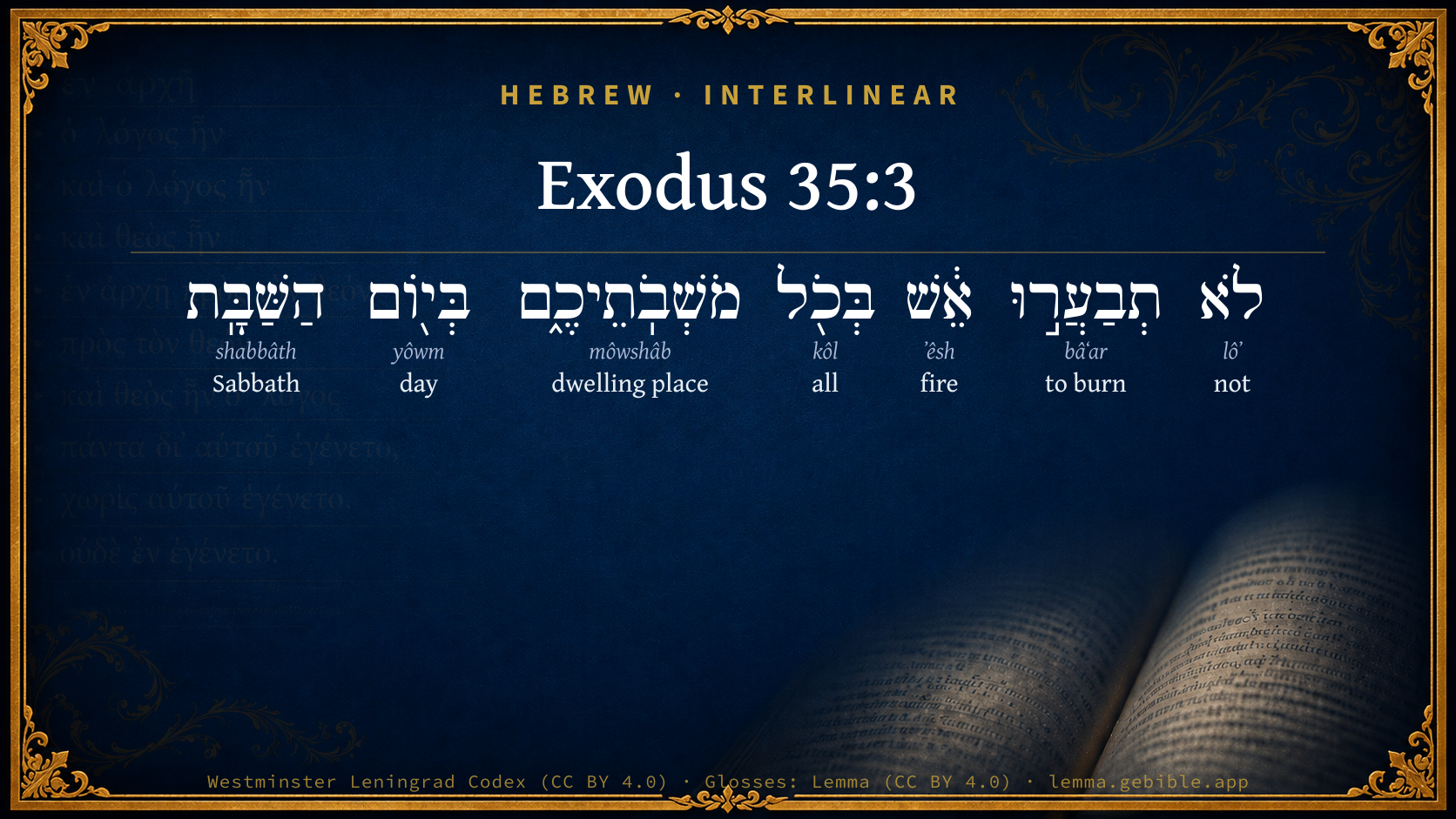
Exodus 35:3

Hebrew (Westminster Leningrad Codex) Exodus 35:3 appears in the Hebrew Old Testament. The text above is from the Westminster Leningrad Codex. Each word links to its Strong’s number, a concise gloss, and parsing drawn from the Open Scriptures Hebrew Bible morphology. Click any word for its full Brown-Driver-Briggs (BDB) entry.
Download image
Cite this verse

Exodus 35:3 (World English Bible). Public Domain. Lemma interlinear Bible study tool, https://lemma.gebible.app/v/exodus/35/3.

Show BibTeX & RIS
BibTeX
RIS
English Translation
You shall kindle no fire throughout your habitations on the Sabbath day.'"
World English Bible · Public Domain
Download a study sheet

One document with this verse’s original text, its word-by-word gloss line, the meaning frame, cross-references with their text, attributed commentary, and full source and license credits — printable, and it pastes into notes with its structure intact.

This verse Autodidact and up

Study sheet (.html) Plain text (.txt)

A passage Seminary Student

Up to 50 verses in one chapter. A passage sheet keeps up to 6 commentary sources and 12 cross-references per verse, in the order this page ranks them, and says so on the sheet whenever that leaves anything out. Ask for a single verse and you get the Autodidact verse sheet above.

Everything on this page stays free to read, with no account — the sheet is a download of what is already on screen, not access to it.

Want to remove ads? Support Godless Engineer
Compare translations 3

The same verse in 3 English versions, stacked beneath the original-language interlinear above. Click any original word for its lexicon entry.

Each is an independent rendering of the whole verse — the interlinear is not word-aligned to these translations.

Highlighted words mark where these versions differ — a whole-verse word diff, not a word-by-word alignment.

  • World English Bible Public Domain
    You shall kindle no fire throughout your habitations on the Sabbath day.'"
  • King James Version Public Domain
    Ye shall kindle no fire throughout your habitations upon the sabbath day.
  • unfoldingWord Literal Text CC BY-SA 4.0
    You shall not kindle a fire in any of your dwellings on the days of the Sabbath.”

unfoldingWord Literal Text — © unfoldingWord, licensed CC BY-SA 4.0. Word-aligned USFM3 via Door43 (git.door43.org/unfoldingWord/en_ult).

Versions to compare (up to 4)

3 of 4 selected

Show all 18 translations

Every available English version of this verse, each an independent rendering of the whole verse.

  • World English Bible Public Domain
    You shall kindle no fire throughout your habitations on the Sabbath day.'"
  • Berean Standard Bible Public Domain
    Do not light a fire in any of your dwellings on the Sabbath day.”
  • Majority Standard Bible Public Domain
    Do not light a fire in any of your dwellings on the Sabbath day.”
  • King James Version Public Domain
    Ye shall kindle no fire throughout your habitations upon the sabbath day.
  • American Standard Version (1901) Public Domain
    Ye shall kindle no fire throughout your habitations upon the sabbath day.
  • Revised Version (1885) Public Domain
    Ye shall kindle no fire throughout your habitations upon the sabbath day.
  • Geneva Bible (1599) Public Domain
    Ye shall kindle no fire throughout all your habitations vpon the Sabbath day.
  • Douay-Rheims (1899) Public Domain
    You shall kindle no fire in any of your habitations on the sabbath day.
  • Young's Literal Translation Public Domain
    ye do not burn a fire in any of your dwellings on the sabbath-day.'
  • Literal Standard Version CC BY-SA 4.0
    you do not burn a fire in any of your dwellings on the Sabbath day.”
  • Unlocked Literal Bible CC BY-SA 4.0
    You must not light a fire in any of your homes on the Sabbath day.”
  • unfoldingWord Literal Text CC BY-SA 4.0
    You shall not kindle a fire in any of your dwellings on the days of the Sabbath.”
  • Darby Bible Public Domain
    Ye shall kindle no fire throughout your dwellings upon the sabbath day.
  • World Messianic Bible Public Domain
    You shall kindle no fire throughout your habitations on the Sabbath day.’”
  • Webster's Bible Public Domain
    Ye shall kindle no fire throughout your habitations upon the sabbath-day.
  • Free Bible Version CC BY-SA 4.0
    Don't even light a fire in any of your homes on the Sabbath day.”
  • Bible in Basic English Public Domain
    No fire is to be lighted in any of your houses on the Sabbath day.
  • JPS Tanakh (1917) Public Domain
    Ye shall kindle no fire throughout your habitations upon the sabbath day.'

Literal Standard Version (2020), Covenant Press — licensed CC BY-SA 4.0. Text via the HelloAO Bible API (eBible.org). Unlocked Literal Bible (unfoldingWord) — licensed CC BY-SA 4.0. Text via the HelloAO Bible API (eBible.org). unfoldingWord Literal Text — © unfoldingWord, licensed CC BY-SA 4.0. Word-aligned USFM3 via Door43 (git.door43.org/unfoldingWord/en_ult). Free Bible Version, Dr. Jonathan Gallagher — licensed CC BY-SA 4.0. Text via the HelloAO Bible API (eBible.org).

Word by word

More ways to search: Search by grammar → Find every occurrence → Compare this word →

Practice this passage: Drill this verse → Learn its vocabulary →

About this verse

These counts appear in no published source. They are computed here, from the morphology-tagged text and Lemma’s own curated glosses. What Lemma adds →

7
words
7
distinct lemmas
Pentateuch
section

Shared distinctive vocabulary

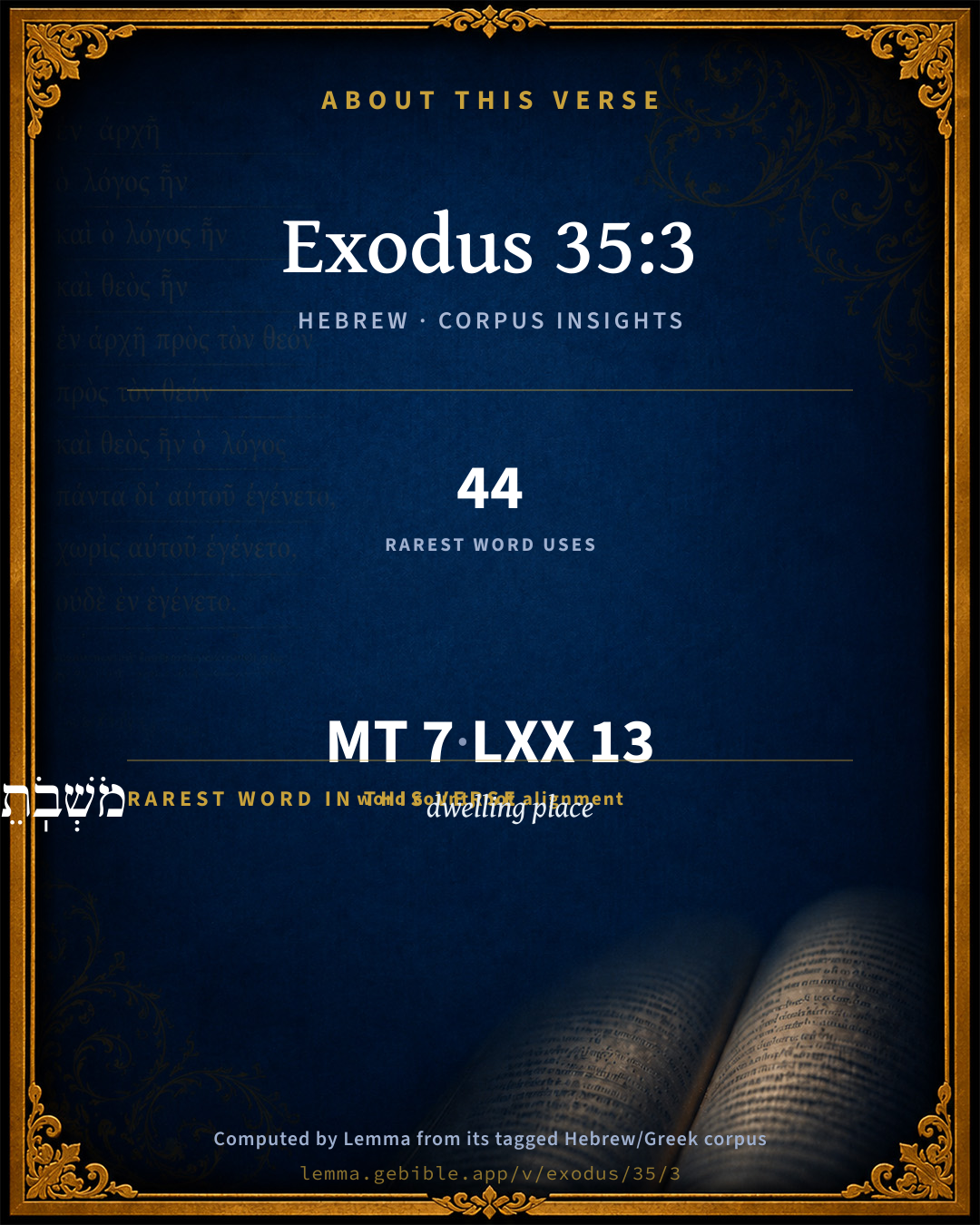
מֹשְׁבֹֽתֵיכֶ֑ם dwelling place H4186 occurs in 43 verses of the Hebrew Bible. Also found in:

Grammatical profile

  • 1 verb
  • 5 nouns
  • 1 particle

Verb forms

  • תְבַעֲר֣וּ Piel · Imperfect

Hebrew & Septuagint length

In English translation the verse runs 12 words from the Hebrew and 18 from the Septuagint (LXX English) — the Septuagint runs noticeably longer here. See the side-by-side →

A rough comparison of the two English renderings, which tokenize alike — not a word-level alignment.

Word counts can differ between the Hebrew and the Greek without any difference in meaning — e.g. the Hebrew direct-object marker אֵת has no separate Greek word, and Greek often adds the article ὁ.

In the original languages it is 7 Hebrew tokens and 13 Greek tokens — but the two are counted differently (Hebrew bundles its prefixes and suffixes into one token; the Greek is in lemma form), so that isn’t a like-for-like length.

Cross-references

4

Topical passages linked to Exodus 35:3 in the Treasury of Scripture Knowledge — connected by theme and wording, ordered by reader-vote popularity; previews shown in the World English Bible.

  • Exodus 16:23 He said to them, "This is that which Yahweh has spoken, 'Tomorrow is a solemn rest, a holy Sabbath to Yahweh. Bake that which you want to bake, and boil that which you want to boil; and all that remains over lay up for yourselves to be kept until the morning."
  • Exodus 12:16 In the first day there shall be to you a holy convocation, and in the seventh day a holy convocation; no manner of work shall be done in them, except that which every man must eat, that only may be done by you.
  • Numbers 15:32–36 While the children of Israel were in the wilderness, they found a man gathering sticks on the Sabbath day.
  • Isaiah 58:13 If you turn away your foot from the Sabbath, from doing your pleasure on my holy day; and call the Sabbath a delight, [and] the holy of Yahweh honorable; and shall honor it, not doing your own ways, nor finding your own pleasure, nor speaking [your own] words:

Cross-references courtesy of OpenBible.info (CC BY 4.0).

Hebrew and Greek witnesses Masoretic Hebrew ↔ Greek Septuagint

The same verse in the two great witnesses to the Old Testament, shown verse-for-verse.

Here the Septuagint runs noticeably longer than the Hebrew — LXX2012 (modern English Septuagint) 18 words vs World English Bible 12. A rough length comparison of the two English translations, not a word-level alignment — read both below.

These are two independent witnesses, not word-aligned to each other, and the Septuagint is shown in lemma (dictionary) form.

Hebrew Exodus 35:3 Masoretic · Westminster Leningrad Codex

לֹא תְבַעֲר֣וּ אֵ֔שׁ בְּכֹ֖ל מֹשְׁבֹֽתֵיכֶ֑ם בְּי֖וֹם הַשַּׁבָּֽת

You shall kindle no fire throughout your habitations on the Sabbath day.'"

World English Bible · Public Domain

Greek LXX Exodus 35:3 Septuagint · lemma form

οὐ καίω πῦρ ἐν πᾶς κατοικία σύ ὁ ἡμέρα ὁ σάββατον ἐγώ κύριος

You⌃ shall not burn a fire in any of your dwellings on the sabbath-day; I am the Lord.

LXX2012 (modern English Septuagint) · Public Domain

Hebrew: Westminster Leningrad Codex (CC BY 4.0). Greek: Septuagint (public domain); English from LXX2012 (modern English Septuagint) (Public Domain). How the Septuagint differs from the Hebrew →

Targum (Aramaic paraphrase)

2

The Targum is the ancient Jewish Aramaic paraphrase of the Hebrew Scriptures — an interpretive translation, not the Hebrew text itself. Onkelos (literal) and Pseudo-Jonathan (expansive) render the Torah, and Jonathan the Prophets. Coverage is partial: where no permissively-licensed English translation exists for a verse, only the Aramaic is shown. This is verse-level text, not a word-by-word alignment to the Hebrew.

  1. Targum Onkelos Torah (Genesis–Deuteronomy)
    לָא תְבַעֲרוּן אֶשָׁתָא בְּכֹל מוֹתְבָנֵיכוֹן בְּיוֹמָא דְשַׁבְּתָא:

    (no public-domain English translation for this verse)

    Targum Onkelos — Aramaic: “Onkelos Genesis” (public domain); “Onkelos Exodus” (public domain); “Onkelos Leviticus” (public domain); “Onkelos Numbers” (public domain); “Onkelos Deuteronomy” (public domain). English: “Sefaria Community Translation” (CC0 1.0 (public-domain dedication)); “J.W. Etheridge. The Targums of Onkelos and Jonathan Ben Uzziel on the Pentateuch. London: Longmans, Green, 1862” (public domain). Text via Sefaria.

  2. Targum Pseudo-Jonathan Torah (Genesis–Deuteronomy)
    עַמִּי בְּנֵי יִשְרָאֵל לָא תְבַעֲרוּן אֵישָׁתָא בְּכָל אֲתַר מוֹתְבָנֵיכוֹן בְּיוֹמָא דְשַׁבַּתָּא

    My people of the sons of Israel, ye shall not kindle a fire in any place of your habitations on the day of the Sabbath.

    Targum Pseudo-Jonathan — Aramaic: “Targum Jonathan on Genesis” (public domain); “Targum Jonathan on Exodus” (public domain); “Targum Jonathan on Leviticus” (public domain); “Targum Jonathan on Numbers” (public domain); “Targum Jonathan on Deuteronomy” (public domain). English: “The Targum of Jonathan ben Uzziel, trans. J. W. Etheridge, London, 1862” (public domain). Text via Sefaria.

Commentary

Notes on Exodus 35:3 from classic Christian and Jewish commentators (each source and its license shown beneath its notes). The classic Christian expositions comment on the surrounding passage and are grouped to its opening verse, so a note may address several verses; the Jewish commentaries on the Tanakh (Rashi and others) are per-verse, so they appear only where the commentator wrote on this verse.

Lemma curates 59 commentaries, every one of them public domain or Creative Commons licensed, each selected and text-cleaned for this edition rather than reprinted as found. About our sources →

Trapp's Complete Commentary

John Trapp

Exo 35:3 Ye shall kindle no fire throughout your habitations upon the sabbath day.

Ver. 3. Ye shall kindle no fire,] sc., For the furtherance of the work of the tabernacle: or, at least, that is not of absolute necessity. It might also signify that in the kingdom of heaven we shall be set free from all the fire and scorching heat of affliction.

John Trapp, A Commentary or Exposition upon All the Books of the Old and New Testament (1647–1656) — public domain. Text from a community e-Sword module.

The Biblical Illustrator

Joseph S. Exell

Exo_35:3

Ye shall kindle no fire.

The unkindled fire

In the old time it was a law that each night, at a prescribed hour, a bell should be rung, on hearing which the people were to put out their fires. This a law not about putting fires out each day, but against lighting a fire on one particular day. Why this law?

I. To show that on the Sabbath, especially, men should attend to the interests of the soul rather than to the comports of the body.

II. To remove frivolous excuses for non-attendance on religious worship.

III. To guard the time of females or servants from unrighteous invasion; and teach men that women had religious rights and duties equally with themselves.

IV. To inculcate in all the duty of self-sacrifice in matters relating to the soul and God. (Biblical Museum.)

The rest of plants

All creation seems to possess the instinct of rest. We well know how eagerly the human heart sighs for rest. But it is not so well known that even plants sleep. Their strange sleep, says Figuier, vaguely recalls to us the sleep of animals. In its sleep the leaf seems by its disposition to approach the age of infancy. It folds itself up, nearly as it lay folded in the bud before it opened, when it slept the lethargic sleep of winter, sheltered under the robust and hardy scales, or shut up in its warm down. We may say that the plant seeks every night to resume the position which it occupied in its early days, just as the animal rolls itself up, lying as if it lay in its mothers bosom. All the world seems to express the sentiment contained in the words uttered by one of old, who desired the wings of a dove in order to seek and obtain rest. (Scientific Illustrations.)

Sabbath breaking condemned

Dr. Beecher was seen one Monday morning leaving his house with a basket in his hand which he was carrying to the fish-market, and in which he intended to carry home a fish for the family table. Unknown to him, a young man of undecided religious principles was following and watching him. The minister soon came to the fish-market. Here Dr. Beecher picked up a fine-looking fish, and asked the fisherman if it was fresh and sweet. Certainly, replied the man, for I caught it myself yesterday, which was the Sabbath. Dr. Beecher at once dropped the fish, saying, Then I dont want it, and went on without another word. We are not informed whether the preacher obtained his fish, but when the young man who was following him that morning related his experience some time afterwards on his admission to the Christian Church, he stated that Dr. Beechers consistency evinced in the fish-market had been the turning-point in his career. It convinced him of the power of religion in life, had induced him to attend the ministry of the man who had won his respect, and he was converted.

The Biblical Illustrator, edited by Joseph S. Exell (c. 1880s–1900s) — public domain. Text from a community e-Sword module.

Joseph Benson's Commentary

Exo 35:3. Ye shall kindle no fire — For any servile work; throughout your habitations — No, not for the service of the tabernacle, as for the heating of tools, or the melting of metals, or other things belonging to it; which being made for God’s service, and deserving and requiring all expedition, they might probably conceive that such work might be done upon that day. And here also, as often elsewhere, under one kind of work, lighting a fire, every other kind is comprehended and forbidden. It is justly observed by Mr. Scott here, “If the kindling of fires in general on the sabbath days be here understood to be prohibited, it must either be viewed as a mere temporary institution, to continue only during the time when the people were miraculously provided for in the wilderness; or that some exceptions were allowed in favour of the sick, infirm, and children, who must suffer extremely, at some seasons, even in warm climates, for want of fire; or that a fire which was burning might be kept up, though a fresh one might not be kindled.” It is remarkable that “the subsequent parts of Scripture give no light on this subject,” further than that, “among the various instances recorded of the Israelites being reproved, and individuals punished, for neglecting to sanctify the sabbath, this is not once mentioned. The modern Jews understand the prohibition literally, yet they use fires in various ways on the sabbath, but employ other persons to kindle them, or to keep them up.”

Joseph Benson's Commentary on the Old and New Testaments (1811–1818) — public domain. Text from a community e-Sword module.

Adam Clarke's Commentary

Verse 3. Ye shall kindle no fire] The Jews understand this precept as forbidding the kindling of fire only for the purpose of doing work or dressing victuals; but to give them light and heat, they judge it lawful to light a fire on the Sabbath day, though themselves rarely kindle it - they get Christians to do this work for them.

Adam Clarke's Commentary on the Bible (1810–1826) — public domain. Text from a community e-Sword/MySword module.

The Cambridge Bible for Schools and Colleges

gen. ed. J. J. S. Perowne

3. An addition to the law of Exo_31:12-17. The explicit prohibition is not found elsewhere in the OT.; but it is implied in Exo_16:23.

in all your habitations] see on Exo_12:20.

The Cambridge Bible for Schools and Colleges (gen. ed. J. J. S. Perowne; Cambridge University Press, 1878–1918) — public domain. Text from a community e-Sword module.

John Gill's Exposition

Ye shall kindle no fire throughout your habitations upon the sabbath day. This law seems to be a temporary one, and not to be continued, nor is it said to be throughout their generations as elsewhere, where the law of the sabbath is given or repeated; it is to be restrained to the building of the tabernacle, and while that was about, to which it is prefaced; and it is designed to prevent all public or private working on the sabbath day, in anything belonging to that; having no fire to heat their tools or melt their metal, or do any thing for which that was necessary; for it can hardly be thought that this is to be taken in the strictest sense, as an entire prohibition of kindling a fire and the use of it on that day, which is so absolutely useful, and needful in various cases, and where acts of mercy and necessity require it; as in cold seasons of the year, for the warming and comforting of persons who otherwise would be unfit for religious exercises, and on the account of infants and aged persons, who could not subsist without it; and in cases of sickness, and various disorders which necessarily require it; and even for the preparation of food, which must be had on that day as on others, the sabbath being not a fast, but rather a festival, as it is with the Jews; and yet this law is interpreted by them in the most rigorous sense: they put kindling a fire among the principal works forbidden on that day (x), and that not only to bake bread and boil flesh, as Aben Ezra interprets it here, but to warm themselves with; nay, they think it unlawful to touch an hearth, or a coal of fire, or a firebrand, or anything that may give them any warmth in a cold season; and if, for the sake of infants or aged persons, there is need of a fire or heating a stove, they hire a Christian to do it, or so prepare and order matters the day before that it kindle of itself (y); and so Leo Modena (z) says,"they do not meddle with any fire, nor touch any wood that is on fire, nor kindle any, nor put it out; nor do they so much as light a candle on the sabbath day: and if the place be cold where they dwell, except they have any stoves, or hot houses, or else have some one that is no Jew to kindle a fire for them; or had so ordered the matter before hand that the fire should kindle of itself at such a time; they must even be content to sit in the cold all that day:''but here they nicely distinguish and observe, that it is said:

throughout your habitations; their private dwellings, but not the habitation of the Lord, or the house of the sanctuary; and on this score they allow of kindling a fire in Beth Moked (a), an apartment in the temple, where a fire was constantly kept for the priests that kept watch to warm themselves at.

(x) Misn. Sabbat, c. 7. sect. 2. (y) Buxtorf. Synagog. Jud. c. 16. p. 361. (z) History of the Rites, &c. of the Jews, par. 3. c. 1. sect. 3. (a) T. Bab. Sabbat, fol. 20. 1.

John Gill's Exposition of the Whole Bible (1746–1763) — public domain (CC PDM 1.0). Text via the HelloAO Bible API.

Albert Barnes' Notes on the Bible

This prohibition is here first distinctly expressed, but it is implied Exo 16:23.

Albert Barnes' Notes on the Bible (1834–1885) — public domain. Text from a community e-Sword/MySword module.

Haydock's Catholic Bible Commentary

No fire, to dress meat. The Rabbins say it is lawful to light a fire, to warm oneself, or for light. But they generally employ some other to do it for them. The Samaritans and Caraites look upon this as an evasion. (Calmet) --- It was customary to light candles and dress meat before sun-set on Friday. On other festivals, even the greatest, this was not required, as they were not instituted chiefly in memory of God’s rest, as the sabbath was, chap. xii. 16. (Haydock)

George Leo Haydock (1774–1849), Haydock's Catholic Family Bible and Commentary, 1859 edition — public domain. Excludes Psalms (Douay-Rheims chapter numbering differs from Protestant) and Deuterocanonical books (Catholic canon only).

Matthew Poole's English Annotations

This command seems to be only temporary and extraordinary during the present season and condition, and not extending to succeeding generations. For,

1. There are instances of temporary precepts both in the Old and New Testament, which yet are not in their places said to be so. Such were some of the precepts concerning the passover, Exo 12:11, as is confessed. And such was that law of abstaining from things strangled, and blood, Ac 15.

2. This precept is nakedly proposed, and not called a perpetual statute, nor enjoined to be observed in their generations, as other precepts are, to whom those, or some like clauses, are frequently added.

3. The sabbath is rather a feast day than a fast day. And the Jews did make feasts, and invited guests upon the sabbath day, which could not probably be without kindling a fire. And, which is more considerable, Christ himself, who fulfilled all righteousness, and therefore would not have joined in the violation of the sabbath, went to one of those feasts, Lu 14. And the Corinthians, as they received the Lord’s supper upon that day, which none question, so they had their feasts, as is confessed and apparent from 1Co 11:21,22, &c.

4. The kindling of a fire was no greater hinderance to the religious observation of the sabbath, than other things which were allowed upon that day, such as the washing and dressing of themselves, eating and drinking, &c.

5. This prohibition doth not seem to concern the dressing of meat, as many understand it, by comparing this with Exo 16:23, (which place I humbly conceive is misunderstood, as I have there intimated, for that was lawful to be done upon, their most solemn days, Exo 12:16) but the service of the tabernacle, which is the subject of this chapter, and the occasion of these words; and the sense seems to be this, You shall kindle no fire for any handiwork throughout your habitation, no, not for the service of this tabernacle, for the heating of any tools, or the melting of any metals, or other things belonging to it, which being to be made for God’s service, and deserving and requiring all expedition, they might probably conceive that such work might be done upon that day. And here also, as oft elsewhere, under one kind, all the rest are comprehended and forbidden.

Matthew Poole's English Annotations on the Holy Bible (1683–1685) — public domain. Text from a community e-Sword/MySword module.

Whedon's Commentary on the Bible

Daniel D. Whedon

3. Kindle no fire — This prohibition is implied in Exo_16:23, but is here first formally enunciated. The offence recorded in Num_15:32-36, looked toward the violation of this commandment.

Daniel D. Whedon (gen. ed.), Commentary on the Old and New Testaments (1874–1909) — public domain. Text from a community e-Sword module.

The Pulpit Commentary

Ye shall kindle no fire. The kindling of fire in early times involved considerable labour. It was ordinarily affected by rubbing two sticks together, or twisting one round rapidly between the two palms in a depression upon a board. Fire only came after a long time. Moreover, as in the warm climate of Arabia and Palestine artificial warmth was not needed, fire could only have been kindled there for cooking purposes, which involved further unnecessary work, and had already been forbidden. (Exo_16:23) The Karaite Jews still maintain the observance of this precept to the letter, even in cold climates, as in that of the Crimea, and allow neither fire nor light in their houses on the sabbath day; but the Jews generally view the precept as having had only a temporary force, and have lights and fires, like other persons, even in Palestine. Strict Jews, however, still cook no food on the sabbath day.

The Pulpit Commentary (1880–1919), ed. H.D.M. Spence-Jones & Joseph S. Exell — public domain. Text from a community e-Sword module.

John Wesley's Explanatory Notes

Ye shall kindle no fire - For any servile work, as that of smiths or plumbers. We do not find that ever this prohibition extended farther.

John Wesley, Explanatory Notes Upon the Whole Bible (1754–1765) — public domain. Text via the GEBible commentary corpus.

Rashi

Rabbi Shlomo Yitzchaki (Rashi)

לא תבערו אש YE SHALL NOT KINDLE A FIRE [THROUGHOUT YOUR HABITATIONS ON THEE SABBATH DAY] — There are some of our Rabbis who say that the law about kindling fire is singled out (more lit., goes forth from the general proposition; i. e. it is specially mentioned here although it is included in לא תעשה כל מלאכה, the law prohibiting all work on Sabbath) in order to constitute it a mere negative command (thus indicating that, like all other negative commands, its infringement is punishable by lashes but does not make the offender liable to death as does the doing of other work on Sabbath). Others, however, say that it was singled out in order to separate the various kinds of work comprised in the term כל מלאכה (thus indicating that each transgression of the Sabbath law is to be atoned for separately if several of them have been committed at the same time and under the same circumstances) (cf. Shabbat 70a; Yevamot 6b; Sanhedrin 35b; cf. also Pesachim 5b).

Rashi on the Tanakh — English translations: “The Judaica Press complete Tanach with Rashi, translated by A. J. Rosenberg” (CC BY 4.0); “Pentateuch with Rashi's commentary by M. Rosenbaum and A.M. Silbermann, 1929-1934” (public domain); “The Metsudah Tanach series, Lakewood, N.J” (CC BY 4.0); and “The Book of Joshua, Metsudah Publications, 1997” (CC BY 4.0). Text via Sefaria.

Ramban (Nachmanides)

Rabbi Moshe ben Nachman (Ramban / Nachmanides)

YE SHALL KINDLE NO FIRE THROUGHOUT YOUR HABITATIONS UPON THE SABBATH DAY. The meaning of this verse is clearly to prohibit also on the Sabbath doing any work necessary for the preparation of food, since He said, whosoever doeth work therein shall be put to death, and He further explained that they should also not kindle fire, in order to bake bread and boil meat, for fire is needed in the preparation of all food. This had to be stated because He did not say here: “whosoever doeth ‘any manner’ of work,” just as He said in the Ten Commandments, thou shalt not do any manner of work, but instead He merely said “work” without specifying any type. Therefore we might have excluded from the general statement [whosoever doeth work …] all activity necessary for the preparation of food, for we find it said about the feast of unleavened bread, thou shalt not do work therein, and yet the preparation of food is not included [in the scope of its prohibition]. It is for this reason that here He mentioned expressly that the preparation of food is also forbidden on the Sabbath.I have found a similar text in the Midrash: “Rabbi Nathan says: Ye shall kindle no fire throughout your habitations upon the Sabbath-day. Why is this said? Because it is stated, And Moses assembled all the congregation of the children of Israel. …, and as Ramban explained above. The insertion of the word “etc.” at the end of the verse mentioned in the text of Ramban, would clarify the matter completely. It is present in texts of the Mechilta. I might think that one should be allowed to light a candle, to put away food to be kept warm, and to make a fire on the Sabbath. Therefore Scripture says, Ye shall kindle no fire throughout your habitations upon the Sabbath-day.” This corresponds closely to that which we have said, that these works [mentioned in the Mechilta], since they are of direct benefit to the body, were not included in the first prohibition. Thus Rabbi Nathan wanted to say that the purpose of the verse here is not to prohibit baking, cooking, and the rest of the activities involved in the preparation of food, for these have already been prohibited to them by the verse, Bake that [on the sixth day of the week] which ye will bake [i.e., which ye intend to bake on the Sabbath], and seethe that which ye will seethe. But yet I might think that all activities which benefit man in such a way that the benefit is only to the body — such as lighting a candle, making fire, or washing one’s whole body in hot water — should be allowed, for these are part of the delight of the Sabbath. Therefore it says, Ye shall kindle no fire — to prohibit all [mentioned activities even if done for these purposes].Our Rabbis in the Talmud have yet another Midrash on this verse, because it does not say: “whosoever doeth any manner of work therein shall be put to death,” or: “whosoever kindles fire throughout your habitations shall be put to death.” Therefore they said that the kindling of fire was singled out in order to make it punishable in a less stringent manner, [namely by stripe], since it is a mere negative command, [whereas violation of the Sabbath by doing any of the other kinds of work is punishable by death]. But another Sage holds that it was singled out in order to separate it, since it was included in the prohibition, thou shalt not do any manner of work., one becomes liable to punishment for transgressing it alone, so also in the case of all the other thirty-nine categories of forbidden work on the Sabbath, one becomes liable upon transgressing each one of them by itself. For otherwise we might have thought that only if one has done all thirty-nine main classes of “work” he is liable to punishment; therefore kindling of fire was singled out in order to teach that the punishment applies even if he has done but one kind of “work” (Rashi, Yebamoth 6 b). For it is one of the thirteen rules of interpretation of the Torah: “If anything is included in a general proposition and is then made the subject of a special statement, that which is predicated of it is not to be understood as limited to itself alone, but is to be applied to the whole of the general proposition.” Similarly we might have thought that if one has done all thirty-nine main classes of “work” on the Sabbath through error he is liable to bring but one sin-offering, therefore kindling of fire was singled out to teach that he is liable to bring such an offering for each of the main classes of “work” he has done.

Ramban (Nachmanides) on the Tanakh — English translation: “Commentary on the Torah by Ramban (Nachmanides). Translated and annotated by Charles B. Chavel. New York, Shilo Pub. House, 1971-1976” (CC BY 4.0). Text via Sefaria.

Lesson kit

Teaching starters — assembled from the data on this page, not authored interpretation. Every prompt links to the verse data it draws on. Edit before teaching.

Exodus, in the Pentateuch, opens this verse with 7 words (7 distinct Hebrew lemmas). Its most distinctive word is môwshâb (“dwelling place”). The Greek Septuagint runs longer here. A historical commentator’s framing appears above. Read the whole chapter for the surrounding context.

Discussion questions

  1. What does “dwelling place” (môwshâb) contribute to the verse as a whole?
  2. How does Genesis 10:30, which shares the word «dwelling place», read alongside this verse?
  3. The Septuagint runs longer here than the Hebrew. What might account for the difference?
  4. These translations render this verse differently; the difference is in the English rendering, not the original. What questions does that raise?
  5. «תְבַעֲר֣וּ» is a Piel Imperfect verb. How does that grammatical form shape the action described?
  6. Compare how Trapp's Complete Commentary and The Biblical Illustrator read this verse. Where do they agree or differ?

Things to notice

Reading settings

Reading text

Shown beneath each verse's original-language words.

Old Testament
Old Testament edition

Read the OT as the Masoretic Hebrew (MT) or the Greek Septuagint (LXX).

English shown for the Greek Septuagint (in the Hebrew ↔ Greek comparison).

Comparing translations? Open the Compare panel on any verse page to stack up to four side by side.