
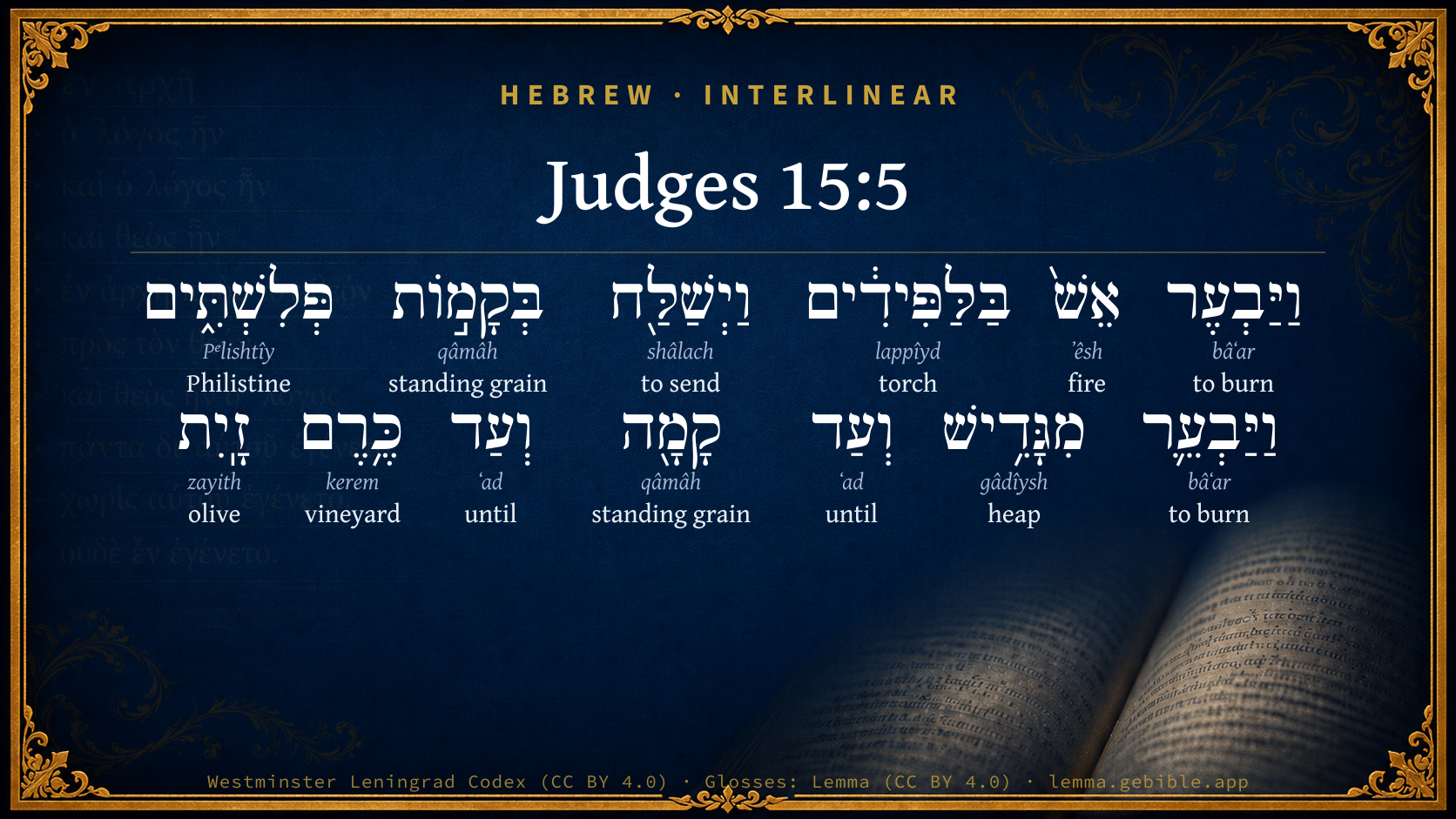
Judges 15:5

Hebrew (Westminster Leningrad Codex) Judges 15:5 appears in the Hebrew Old Testament. The text above is from the Westminster Leningrad Codex. Each word links to its Strong’s number, a concise gloss, and parsing drawn from the Open Scriptures Hebrew Bible morphology. Click any word for its full Brown-Driver-Briggs (BDB) entry.
Download image
Cite this verse

Judges 15:5 (World English Bible). Public Domain. Lemma interlinear Bible study tool, https://lemma.gebible.app/v/judges/15/5.

Show BibTeX & RIS
BibTeX
RIS
English Translation
When he had set the brands on fire, he let them go into the standing grain of the Philistines, and burnt up both the shocks and the standing grain, and also the olive groves.
World English Bible · Public Domain
Download a study sheet

One document with this verse’s original text, its word-by-word gloss line, the meaning frame, cross-references with their text, attributed commentary, and full source and license credits — printable, and it pastes into notes with its structure intact.

This verse Autodidact and up

Study sheet (.html) Plain text (.txt)

A passage Seminary Student

Up to 50 verses in one chapter. A passage sheet keeps up to 6 commentary sources and 12 cross-references per verse, in the order this page ranks them, and says so on the sheet whenever that leaves anything out. Ask for a single verse and you get the Autodidact verse sheet above.

Everything on this page stays free to read, with no account — the sheet is a download of what is already on screen, not access to it.

Want to remove ads? Support Godless Engineer
Compare translations 3

The same verse in 3 English versions, stacked beneath the original-language interlinear above. Click any original word for its lexicon entry.

Each is an independent rendering of the whole verse — the interlinear is not word-aligned to these translations.

Highlighted words mark where these versions differ — a whole-verse word diff, not a word-by-word alignment.

  • World English Bible Public Domain
    When he had set the brands on fire, he let them go into the standing grain of the Philistines, and burnt up both the shocks and the standing grain, and also the olive groves.
  • King James Version Public Domain
    And when he had set the brands on fire, he let them go into the standing corn of the Philistines, and burnt up both the shocks, and also the standing corn, with the vineyards and olives.
  • unfoldingWord Literal Text CC BY-SA 4.0
    And he kindled fire in the torches and sent into the grain of the Philistines, and he burned from stack and to grain, and to grove of olive tree.

unfoldingWord Literal Text — © unfoldingWord, licensed CC BY-SA 4.0. Word-aligned USFM3 via Door43 (git.door43.org/unfoldingWord/en_ult).

Versions to compare (up to 4)

3 of 4 selected

Show all 18 translations

Every available English version of this verse, each an independent rendering of the whole verse.

  • World English Bible Public Domain
    When he had set the brands on fire, he let them go into the standing grain of the Philistines, and burnt up both the shocks and the standing grain, and also the olive groves.
  • Berean Standard Bible Public Domain
    Then he lit the torches and released the foxes into the standing grain of the Philistines, burning up the piles of grain and the standing grain, as well as the vineyards and olive groves.
  • Majority Standard Bible Public Domain
    Then he lit the torches and released the foxes into the standing grain of the Philistines, burning up the piles of grain and the standing grain, as well as the vineyards and olive groves.
  • King James Version Public Domain
    And when he had set the brands on fire, he let them go into the standing corn of the Philistines, and burnt up both the shocks, and also the standing corn, with the vineyards and olives.
  • American Standard Version (1901) Public Domain
    And when he had set the brands on fire, he let them go into the standing grain of the Philistines, and burnt up both the shocks and the standing grain, and also the oliveyards.
  • Revised Version (1885) Public Domain
    And when he had set the brands on fire, he let them go into the standing corn of the Philistines, and burnt up both the shocks and the standing corn, and also the oliveyards.
  • Geneva Bible (1599) Public Domain
    And when he had set the brandes on fire, he sent them out into the standing corne of the Philistims, and burnt vp both the rickes and the standing corne with the vineyardes and oliues.
  • Douay-Rheims (1899) Public Domain
    And setting them on fire he let the foxes go, that they might run about hither and thither. And they presently went into the standing corn of the Philistines. Which being set on fire, both the corn that was already carried together, and that which was yet standing, was all burnt, insomuch, that the flame consumed also the vineyards and the oliveyards.
  • Young's Literal Translation Public Domain
    and kindleth fire in the torches, and sendeth `them' out into the standing corn of the Philistines, and burneth `it' from heap even unto standing corn, even unto vineyard -- olive-yard.
  • Literal Standard Version CC BY-SA 4.0
    and kindles fire in the torches, and sends [them] out into the standing grain of the Philistines, and burns [it] from heap even to standing grain, even to vineyard [and] olive-yard.
  • Unlocked Literal Bible CC BY-SA 4.0
    When he had set the torches on fire, he let the foxes go into the standing grain of the Philistines, and they set fire to both the stacked grain and the grain standing in the field, along with the vineyards and the olive orchards.
  • unfoldingWord Literal Text CC BY-SA 4.0
    And he kindled fire in the torches and sent into the grain of the Philistines, and he burned from stack and to grain, and to grove of olive tree.
  • Darby Bible Public Domain
    And when he had set fire to the torches, he let the foxes go into the standing grain of the Philistines, and burned up the shocks and the standing grain, as well as the olive orchards.
  • World Messianic Bible Public Domain
    When he had set the torches on fire, he let them go into the standing grain of the Philistines, and burned up both the shocks and the standing grain, and also the olive groves.
  • Webster's Bible Public Domain
    And when he had set the brands on fire, he let them go into the standing corn of the Philistines, and burnt up both the shocks and also the standing corn, with the vineyards and olives.
  • Free Bible Version CC BY-SA 4.0
    He attached a torch to each of the tied tails and set them on fire. Then he let them loose in the grain fields of the Philistines, setting fire to all the grain, harvested and unharvested, as well as the vineyards and olive groves.
  • Bible in Basic English Public Domain
    Then firing the sticks, he let the foxes loose among the uncut grain of the Philistines, and all the corded stems as well as the living grain and the vine-gardens and the olives went up in flames.
  • JPS Tanakh (1917) Public Domain
    And when he had set the torches on fire, he let them go into the standing corn of the Philistines, and burnt up both the shocks and the standing corn, and also the oliveyards.

Literal Standard Version (2020), Covenant Press — licensed CC BY-SA 4.0. Text via the HelloAO Bible API (eBible.org). Unlocked Literal Bible (unfoldingWord) — licensed CC BY-SA 4.0. Text via the HelloAO Bible API (eBible.org). unfoldingWord Literal Text — © unfoldingWord, licensed CC BY-SA 4.0. Word-aligned USFM3 via Door43 (git.door43.org/unfoldingWord/en_ult). Free Bible Version, Dr. Jonathan Gallagher — licensed CC BY-SA 4.0. Text via the HelloAO Bible API (eBible.org).

Word by word

More ways to search: Search by grammar → Find every occurrence → Compare this word →

Practice this passage: Drill this verse → Learn its vocabulary →

מִגָּדִ֥ישׁ
gâdîysh
H1430
“from · heap”
Preposition + Noun, Common, Masculine, Singular, Absolute
Part of Speech
Preposition + Noun
Type
Common
Gender
Masculine
Number
Singular
State
Absolute
Full BDB Definition

Origin: from an unused root (meaning to heap up)

TWOT: 319a , 320a

heap, stack, pile - tomb
  1. וַיַּבְעֶר bâʻar H1197 “and · to burn” Conjunction + Verb, Hiphil, Sequential Imperfect, 3rd Person, Masculine, Singular
  2. אֵשׁ֙ ʼêsh H784 “fire” Noun, Common, Both, Singular, Absolute
  3. בַּלַּפִּידִ֔ים lappîyd H3940 “in/at the · torches” Preposition, Determined + Noun, Common, Masculine, Plural, Absolute
  4. וַיְשַׁלַּ֖ח shâlach H7971 “and · to send” Conjunction + Verb, Piel, Sequential Imperfect, 3rd Person, Masculine, Singular
  5. בְּקָמ֣וֹת qâmâh H7054 “in/at · standing grain of” Preposition + Noun, Common, Feminine, Plural, Construct
  6. פְּלִשְׁתִּ֑ים Pᵉlishtîy H6430 “Philistines” Noun, Gentilic, Masculine, Plural, Absolute
  7. וַיַּבְעֵ֛ר bâʻar H1197 “and · to burn” Conjunction + Verb, Hiphil, Sequential Imperfect, 3rd Person, Masculine, Singular
  8. וְעַד ʻad H5704 “and · until” Conjunction + Preposition
  9. קָמָ֖ה qâmâh H7054 “standing grain” Noun, Common, Feminine, Singular, Absolute
  10. וְעַד ʻad H5704 “and · until” Conjunction + Preposition
  11. כֶּ֥רֶם kerem H3754 “vineyard of” Noun, Common, Both, Singular, Construct
  12. זָֽיִת zayith H2132 “olive” Noun, Common, Masculine, Singular, Absolute

About this verse

These counts appear in no published source. They are computed here, from the morphology-tagged text and Lemma’s own curated glosses. What Lemma adds →

13
words
10
distinct lemmas
Historical
section

Notable vocabulary

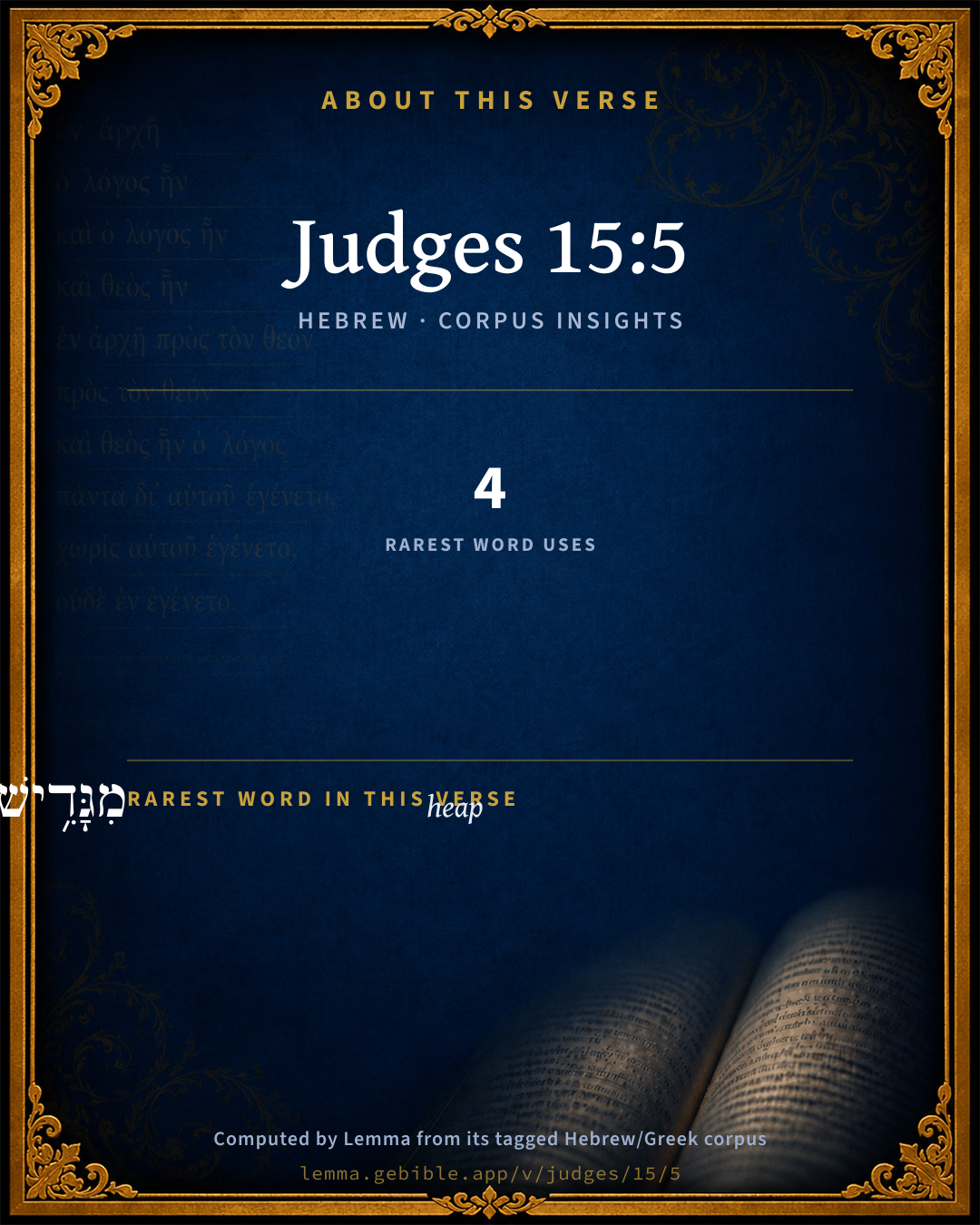
The rarest word here is מִגָּדִ֥ישׁ heap H1430 — appearing just 4 times in the whole Hebrew Bible.

Shared distinctive vocabulary

מִגָּדִ֥ישׁ heap H1430 occurs in 4 verses of the Hebrew Bible. Also found in:

Grammatical profile

  • 3 verbs
  • 8 nouns
  • 2 prepositions

Verb forms

  • וַיַּבְעֶר Hiphil · Sequential Imperfect
  • וַיְשַׁלַּ֖ח Piel · Sequential Imperfect
  • וַיַּבְעֵ֛ר Hiphil · Sequential Imperfect

Repetition

Words recur within this verse — often emphatic in Hebrew:

  • וַיַּבְעֶר to burn H1197 ×2
  • בְּקָמ֣וֹת standing grain H7054 ×2
  • וְעַד until H5704 ×2

Hebrew & Septuagint length

In English translation the verse runs 34 words from the Hebrew and 37 from the Septuagint (LXX English) — closely comparable.

A rough comparison of the two English renderings, which tokenize alike — not a word-level alignment.

Word counts can differ between the Hebrew and the Greek without any difference in meaning — e.g. the Hebrew direct-object marker אֵת has no separate Greek word, and Greek often adds the article ὁ.

Cross-references

2

Topical passages linked to Judges 15:5 in the Treasury of Scripture Knowledge — connected by theme and wording, ordered by reader-vote popularity; previews shown in the World English Bible.

  • Exodus 22:6 "If fire breaks out, and catches in thorns so that the shocks of grain, or the standing grain, or the field are consumed; he who kindled the fire shall surely make restitution.
  • 2 Samuel 14:30 Therefore he said to his servants, Behold, Joab's field is near mine, and he has barley there; go and set it on fire. Absalom's servants set the field on fire.

Cross-references courtesy of OpenBible.info (CC BY 4.0).

Hebrew and Greek witnesses Masoretic Hebrew ↔ Greek Septuagint

The same verse in the two great witnesses to the Old Testament, shown verse-for-verse.

These are two independent witnesses, not word-aligned to each other, and the Septuagint is shown in lemma (dictionary) form.

Hebrew Judges 15:5 Masoretic · Westminster Leningrad Codex

וַיַּבְעֶר אֵשׁ֙ בַּלַּפִּידִ֔ים וַיְשַׁלַּ֖ח בְּקָמ֣וֹת פְּלִשְׁתִּ֑ים וַיַּבְעֵ֛ר מִגָּדִ֥ישׁ וְעַד קָמָ֖ה וְעַד כֶּ֥רֶם זָֽיִת

When he had set the brands on fire, he let them go into the standing grain of the Philistines, and burnt up both the shocks and the standing grain, and also the olive groves.

World English Bible · Public Domain

Greek LXX Judges 15:5 Septuagint · lemma form

καί ἐκκαίω πῦρ ἐν ὁ λαμπάς καί ἐκ ἀποστέλλω ἐν ὁ στάχυς ὁ ἀλλόφυλος καί καίω ἀπό ἅλων καί ἕως στάχυς ὀρθός καί ἕως ἀμπελών καί ἐλαία

And he set fire to the torches, and sent the foxes into the corn of the Philistines; and every thing was burnt from the threshing floor to the standing corn, and even to the vineyard and olives.

LXX2012 (modern English Septuagint) · Public Domain

On this verse, The Cambridge Bible for Schools and Colleges discusses the Septuagint’s reading. Read the note in Commentary ↓

Hebrew: Westminster Leningrad Codex (CC BY 4.0). Greek: Septuagint (public domain); English from LXX2012 (modern English Septuagint) (Public Domain). How the Septuagint differs from the Hebrew →

Targum (Aramaic paraphrase)

1

The Targum is the ancient Jewish Aramaic paraphrase of the Hebrew Scriptures — an interpretive translation, not the Hebrew text itself. Onkelos (literal) and Pseudo-Jonathan (expansive) render the Torah, and Jonathan the Prophets. Coverage is partial: where no permissively-licensed English translation exists for a verse, only the Aramaic is shown. This is verse-level text, not a word-by-word alignment to the Hebrew.

  1. Targum Jonathan Prophets (Joshua–Malachi)
    וְאַדְלֵיק אֶשְׁתָּא בִּבְעוּרַיָא וּשְׁלַח בְּקָמַת פְּלִשְׁתָּאֵי וְאַדְלֵיק מִגָדִישַׁיָא וְעַד כַּרְמַיָא וְעַד זֵיתָא:

    (no public-domain English translation for this verse)

    Targum Jonathan — Aramaic: “Mikraot Gedolot” (public domain). English: “Sefaria Community Translation” (CC0 1.0 (public-domain dedication)); “London "Chaldee Paraphrase," 1871” (public domain). Text via Sefaria.

Commentary

Notes on Judges 15:5 from classic Christian and Jewish commentators (each source and its license shown beneath its notes). The classic Christian expositions comment on the surrounding passage and are grouped to its opening verse, so a note may address several verses; the Jewish commentaries on the Tanakh (Rashi and others) are per-verse, so they appear only where the commentator wrote on this verse.

Lemma curates 59 commentaries, every one of them public domain or Creative Commons licensed, each selected and text-cleaned for this edition rather than reprinted as found. About our sources →

Trapp's Complete Commentary

John Trapp

Jdg 15:5 And when he had set the brands on fire, he let [them] go into the standing corn of the Philistines, and burnt up both the shocks, and also the standing corn, with the vineyards [and] olives.

Ver. 5. With the vineyards and olives.] How this could be is hard to conceive: but in these things we must silence our reason, and exalt our faith. He that is scholar to carnal reason, hath a fool to his master.

John Trapp, A Commentary or Exposition upon All the Books of the Old and New Testament (1647–1656) — public domain. Text from a community e-Sword module.

Joseph Benson's Commentary

Jdg 15:5. He let them go, &c. — Successively at several times, and in divers places, so that they might not hinder one another, nor all run into the same field; but, being dispersed in all parts, might spread the plague further. But it will be asked, Why did he not employ some of the Israelites to set their corn on fire? The answer is easy: Because he wished to preserve them from the hatred and mischief to which this would have exposed them, and also to mortify the pride of the Philistines by making brute creatures, and particularly foxes, the instruments of bringing this calamity upon them.

Joseph Benson's Commentary on the Old and New Testaments (1811–1818) — public domain. Text from a community e-Sword module.

Geneva Bible (1599)

Geneva Bible translators

Or, that which was reaped and gathered.

Geneva Bible (1599) marginal notes — public domain. Text via Bolls.life.

Ellicott's Commentary for English Readers

(5) Into the standing corn of the Philistines.—He probably did this at night, when his actions would be unobserved, and no one would be at hand to quench the flames. We may imagine him watching the trails of fire from his rocky fastness, and exulting as the conflagration reddened the night. The heat of a tropical country makes everything so dry that his plan would be certain to succeed. To burn the crops of an Arab is to this day the deadliest of all injuries (Burckhardt). This was the method adopted by Absalom, in 2Sa_14:30, to gain an interview with Joab. It is needless to point out that the adoption of these rough, coarse, and cruel expedients must be as little judged by a later and better standard as his thirst for the revenge of personal wrongs. There can be no ground to question the literal truth of the narrative. It is in entire accordance with the custom of the East, and it finds curious confirmation from the story in Ovid’s Fasti, that every year, at the Cerealia, torches were tied to the tails of foxes, and they were let loose in the Roman circus, to commemorate the incident that on one occasion a young man at Carseoli, to punish a fox for depredations on his hen-coops, had wrapped it up in straw, and set it on fire, and that the creature had escaped into the corn-fields and burnt down the standing crops (Ovid, Fasti, iv. 681-711). The attempt of Bochart to establish any connection between this custom and the revenge of Samson is quite untenable, but the incident itself throws light on the possibility of the narrative. Ewald refers to Mêghadûta, liv. 4; Babrius, Fab., 11

Both the shocks, and also the standing corn.—Literally, from the heap, even up to the standing. The extent of the vengeance and its terrible future consequences would be fully, and we fear ruthlessly, estimated by Samson, as he saw the rivers of fire running and spreading through that vast plain of corn-land in harvest-time. (Comp. Exo_22:6.)

With the vineyards and olives.—Literally, and to vineyard, to olive. There may be some slight corruption in the text, or it may be an abbreviation of “from vineyard to vineyard, and from olive to olive.” (Comp. Mic_7:12.) The low vines festooning the trees and trellis-work, and the olives with their dry trunks, would be sure to suffer injury.

A Bible Commentary for English Readers, edited by Charles John Ellicott (1878–1897) — public domain. Text from a community e-Sword module.

The Cambridge Bible for Schools and Colleges

gen. ed. J. J. S. Perowne

5. oliveyards] lit. vineyard of oliveyard, which cannot be right; read vineyard and oliveyard, with LXX, Vulgate; cf. Jdg_14:5.

The Cambridge Bible for Schools and Colleges (gen. ed. J. J. S. Perowne; Cambridge University Press, 1878–1918) — public domain. Text from a community e-Sword module.

John Gill's Exposition

And when he had set the brands on fire,.... Disposed as before related; and foxes being naturally fearful of, and frightened with fire, and especially so near them as at their tails, would run into the first place they could for shelter:

he let them go into the standing corn of the Philistines; which being ripe, as it was now wheat harvest, would soon take fire; and taking fire, this would in course cause the foxes to run still further to other parts of standing corn, and set fire to them also; besides, it is reasonable to suppose that Samson did not let them go all at once on one spot, but disposed of them, some here, and some there, to do the greater and more speedy execution:

and burnt up both the shocks, and also the standing corn, with the vineyards and olives; for as it was in the time of harvest, in some places the corn was standing, and in other places it was cut down, and put into shocks or heaps; and to these the foxes would naturally run to shelter themselves, and so set fire to them, as well as they would make their way to the vineyards or oliveyards, either for shelter also, or for the sake of the grapes and olives, to satisfy their hunger, after having been detained long for this purpose; and thus by one means or another they destroyed the corn, the vines, and olives of the Philistines in those parts. Some would have it, in order to shun the difficulties objected by the enemies of revelation, that the word for "foxes" should be rendered "sheaves" or shocks of corn, set end to end (y), which the word for "tail" is said to signify; and firebrands or torches being set on fire, communicated it to standing corn, shocks of corn, vineyards, and oliveyards; but there is no need to put such a sense upon the words, as already observed; nor is the word translated "foxes" ever used in Scripture in any form for "sheaves" or shocks of corn, but always others; nor in any Jewish writings, nor in the sister dialects, Arabic, Chaldee, or Ethiopic; and in any place of Scripture where it is translated "fox" or "foxes", should the word "sheaves" or "shocks" be put, the sense would appear most ridiculous; nor is the word for "tail" ever used in Scripture, in a literal sense, but for the tail of a living creature; nor is the word for "took" or "caught" ever used of taking anything in common, but either of taking men or cities by force, or of creatures in nets, traps, and snares: and the sense which such a version of the words would give is not only contrary to the Hebrew text, and to the Chaldee paraphrase, but to all the ancient versions, Arabic, Syriac, Septuagint, and Vulgate Latin, and to Josephus. The memory of this great event was kept up, or a custom borrowed from it, as some learned men have observed in the Vulpinaria of the Romans, mentioned by Ovid (z), and others, which bore a great resemblance to this, and which was observed at the same time of the year, about the middle of April, or calends of May; which exactly agrees with the time of wheat harvest in Palestine; when in the Circus they used to send out foxes with burning torches fixed to their backs. Nor need this affair of Samson's seem more strange or incredible than the great number of creatures brought into the Circus at Rome, to be seen there together. Sylla first introduced one hundred lions, after him Pompey the great three hundred, and Julius Caesar, when he was dictator, four hundred, as Pliny (a) relates. Probus (b) sent into the amphitheatre at one time, which he made like a wood full of trees, 1000 ostriches, a like number of harts, does, boars, and other creatures each; and at another time one hundred lions, as many lionesses and leopards each, and three hundred bears; Heliogabalus (c) got together 1000 weasels, 10,000 mice, 10,000 weight of spiders and flies.

(y) Observ. Halens. apud Stockium in voc. p. 1126. & Hardtius apud Marck. Dissertat. Philolog. Exercitat. 5. sect. 7. p. 196. (z) Fasti, l. 4. Vid. Alex. ab Alex. Genial. Dier. l. 5. c. 26. (a) Nat. Hist. l. 8. c. 16. (b) Vopiscus in Vita Probi. (c) Ib. in "Vita ejus".

John Gill's Exposition of the Whole Bible (1746–1763) — public domain (CC PDM 1.0). Text via the HelloAO Bible API.

Matthew Poole's English Annotations

He let them go, to wit, successively at several times, and in divers places, with great care and discretion, so as they might not hinder one another, nor all run into the same field; but being dispersed in all parts, might spread the plague further; and withal might be kept at a distance from the fields and vineyards of the Israelites. It is not worthy of our inquiry what became of these foxes afterward, whether they were burnt by the firebrands, or run into holes, or were taken and killed by the Philistines. The truth of this history is notably attested by a custom of the Romans, which it is very probable they had from the Phoenicians, upon this occasion; for every year they had a solemnity in April, the very time of Canaan’s wheat harvest, wherein foxes were let loose with burning torches fastened to their backsides, &c.

Matthew Poole's English Annotations on the Holy Bible (1683–1685) — public domain. Text from a community e-Sword/MySword module.

Whedon's Commentary on the Bible

Daniel D. Whedon

5. Let them go — Hebrew, ישׁלח, sent them. A hundred and fifty pairs, starting forth from different points and running in different directions, each pair carrying a firebrand, would rapidly spread destruction far and wide.

The standing corn — Wheat yet uncut. This often, in the East, as on our western prairies, extends as far as eye can reach in one apparently unbroken field.

Shocks — Not carefully arranged shocks of bound sheaves, as with us, but heaps of the grain, either bound or unbound, loosely piled up for temporary convenience.

Vineyards and olives — Rather, gardens of olives. Large olive groves still abound in the plain of Philistia. “The cornfields of Philistia,” says Stanley, “then as now interspersed with olive groves, lay stretched in one unbroken expanse before him, to invite his facetious outrage. The mischievousness of the conflagration of the cornfields by means of the jackals is subordinate to the ludicrousness of the sight, as, from the hill of Zorah, the contriver of the scheme must have watched the streams of fire spreading through corn-fields and orchards in the plain below.”

Daniel D. Whedon (gen. ed.), Commentary on the Old and New Testaments (1874–1909) — public domain. Text from a community e-Sword module.

The Pulpit Commentary

The shocks and the standing corn. See ver. 1, note. With the vineyards and olives. The Hebrew text has the orchards of olive trees the word cherem, usually translated vineyard, meaning also any orchard; but the Septuagint in both codices supplies and, as does the A. Y., which gives the more probable sense, vineyards and olives. It is unlikely that the vineyards should not be mentioned, in a district abounding in them.

The Pulpit Commentary (1880–1919), ed. H.D.M. Spence-Jones & Joseph S. Exell — public domain. Text from a community e-Sword module.

John Wesley's Explanatory Notes

Let them go - Successively at several times; and in divers places, so that they might not hinder one another, nor all run into the same field; but being dispersed in all parts, might spread the plague farther; and withal might be kept at a distance from the fields and vineyards of the Israelites.

John Wesley, Explanatory Notes Upon the Whole Bible (1754–1765) — public domain. Text via the GEBible commentary corpus.

unfoldingWord translationNotes

Door43 World Missions Community

standing grain

grain that is still growing on its stalk in the field

stacked grain

the stalks of grain collected in piles after it has been harvested

orchards

An orchard is a place where fruit trees are grown.

the Timnite's son-in-law

The husband of a man's daughter is a "son-in-law."

Timnite

This is a person from Timnah. (See: How to Translate Names)

took Samson's wife and gave her to his friend

Samson's wife's father gave her in marriage to Samson's friend. This can be stated clearly. AT: "took Samson's wife and allowed her to marry Samson's friend" (See: Assumed Knowledge and Implicit Information)

burned up

The phrase "burned up" means to burn something completely. If a person is "burned up," it means that person is burned to death. (See: Idiom)

translationWords

fire

grain

Philistines

olive

ancestor

unfoldingWord translationNotes — © Distant Shores Media and the Door43 World Missions Community, licensed CC BY-SA 4.0. Source: git.door43.org/Door43/en_tn.

Lesson kit

Teaching starters — assembled from the data on this page, not authored interpretation. Every prompt links to the verse data it draws on. Edit before teaching.

Judges, in the Historical, opens this verse with 13 words (10 distinct Hebrew lemmas). Its most distinctive word is gâdîysh (“heap”). A historical commentator’s framing appears above. Read the whole chapter for the surrounding context.

Discussion questions

  1. What does “heap” (gâdîysh) contribute to the verse as a whole?
  2. How does Exodus 22:6, which shares the word «heap», read alongside this verse?
  3. What does the repetition of “to burn” (2× in this one verse) do in this verse?
  4. The translations on this page render this verse differently — a whole-verse word diff, not a word-by-word alignment. What might account for the different wordings?
  5. «וַיַּבְעֶר» is a Hiphil Sequential Imperfect verb. How does that grammatical form shape the action described?
  6. Compare how Trapp's Complete Commentary and Joseph Benson's Commentary read this verse. Where do they agree or differ?

Things to notice

Reading settings

Reading text

Shown beneath each verse's original-language words.

Old Testament
Old Testament edition

Read the OT as the Masoretic Hebrew (MT) or the Greek Septuagint (LXX).

English shown for the Greek Septuagint (in the Hebrew ↔ Greek comparison).

Comparing translations? Open the Compare panel on any verse page to stack up to four side by side.