
Leviticus 1:17

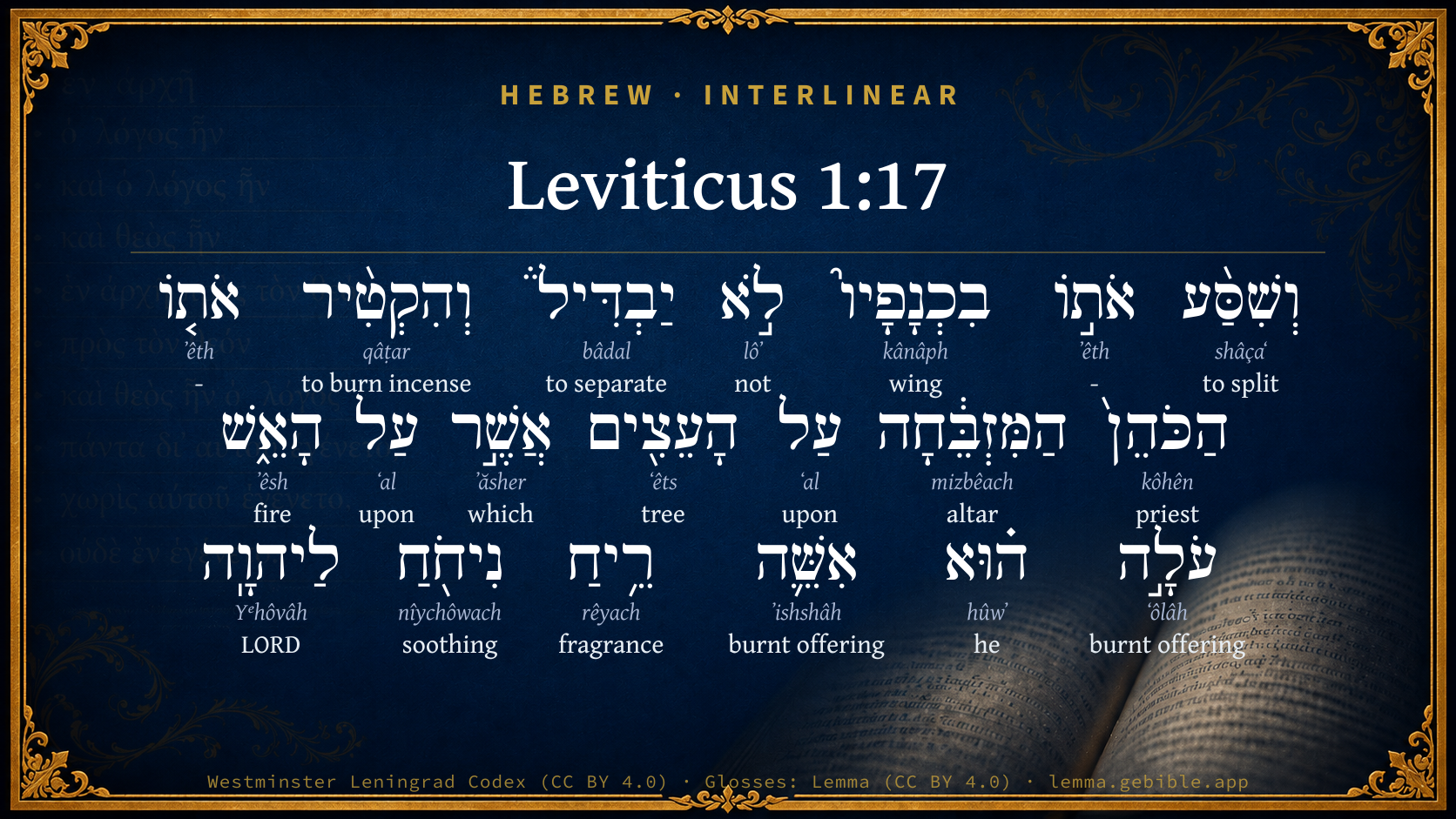
Hebrew (Westminster Leningrad Codex) Leviticus 1:17 appears in the Hebrew Old Testament. The text above is from the Westminster Leningrad Codex. Each word links to its Strong’s number, a concise gloss, and parsing drawn from the Open Scriptures Hebrew Bible morphology. Click any word for its full Brown-Driver-Briggs (BDB) entry.
Download image
Cite this verse

Leviticus 1:17 (World English Bible). Public Domain. Lemma interlinear Bible study tool, https://lemma.gebible.app/v/leviticus/1/17.

Show BibTeX & RIS
BibTeX
RIS
English Translation
He shall tear it by its wings, but shall not divide it apart. The priest shall burn it on the altar, on the wood that is on the fire. It is a burnt offering, an offering made by fire, of a sweet savor to Yahweh.
World English Bible · Public Domain
Highlights
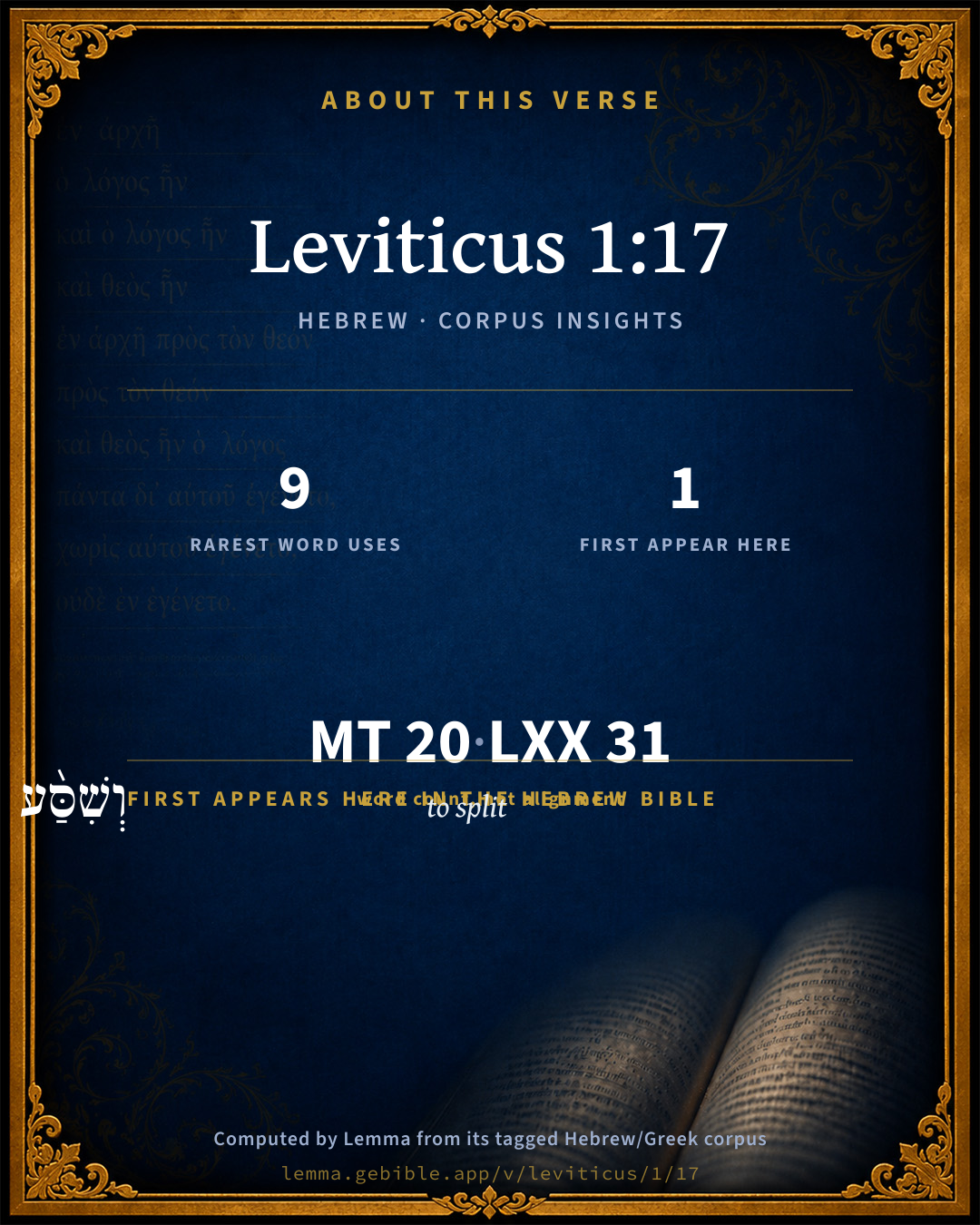
  • 1 first appearance in the Hebrew Bible
Full analysis ↓
Download a study sheet

One document with this verse’s original text, its word-by-word gloss line, the meaning frame, cross-references with their text, attributed commentary, and full source and license credits — printable, and it pastes into notes with its structure intact.

This verse Autodidact and up

Study sheet (.html) Plain text (.txt)

A passage Seminary Student

Up to 50 verses in one chapter. A passage sheet keeps up to 6 commentary sources and 12 cross-references per verse, in the order this page ranks them, and says so on the sheet whenever that leaves anything out. Ask for a single verse and you get the Autodidact verse sheet above.

Everything on this page stays free to read, with no account — the sheet is a download of what is already on screen, not access to it.

Want to remove ads? Support Godless Engineer
Compare translations 3

The same verse in 3 English versions, stacked beneath the original-language interlinear above. Click any original word for its lexicon entry.

Each is an independent rendering of the whole verse — the interlinear is not word-aligned to these translations.

Highlighted words mark where these versions differ — a whole-verse word diff, not a word-by-word alignment.

  • World English Bible Public Domain
    He shall tear it by its wings, but shall not divide it apart. The priest shall burn it on the altar, on the wood that is on the fire. It is a burnt offering, an offering made by fire, of a sweet savor to Yahweh.
  • King James Version Public Domain
    And he shall cleave it with the wings thereof, but shall not divide it asunder: and the priest shall burn it upon the altar, upon the wood that is upon the fire: it is a burnt sacrifice, an offering made by fire, of a sweet savor unto the LORD.
  • unfoldingWord Literal Text CC BY-SA 4.0
    And he shall tear it open by its wings; he shall not divide. And the priest shall cause it to become smoke on the altar, on the wood that on the fire. It a burnt offering, a gift of a scent of pleasing to Yahweh.

unfoldingWord Literal Text — © unfoldingWord, licensed CC BY-SA 4.0. Word-aligned USFM3 via Door43 (git.door43.org/unfoldingWord/en_ult).

Versions to compare (up to 4)

3 of 4 selected

Show all 18 translations

Every available English version of this verse, each an independent rendering of the whole verse.

  • World English Bible Public Domain
    He shall tear it by its wings, but shall not divide it apart. The priest shall burn it on the altar, on the wood that is on the fire. It is a burnt offering, an offering made by fire, of a sweet savor to Yahweh.
  • Berean Standard Bible Public Domain
    He shall tear it open by its wings, without dividing the bird completely. And the priest is to burn it on the altar atop the burning wood. It is a burnt offering, an offering made by fire, a pleasing aroma to the LORD.
  • Majority Standard Bible Public Domain
    He shall tear it open by its wings, without dividing the bird completely. And the priest is to burn it on the altar atop the burning wood. It is a burnt offering, a food offering, a pleasing aroma to the LORD.
  • King James Version Public Domain
    And he shall cleave it with the wings thereof, but shall not divide it asunder: and the priest shall burn it upon the altar, upon the wood that is upon the fire: it is a burnt sacrifice, an offering made by fire, of a sweet savor unto the LORD.
  • American Standard Version (1901) Public Domain
    and he shall rend it by the wings thereof, `but' shall not divide it asunder; and the priest shall burn it upon the altar, upon the wood that is upon the fire: it is a burnt-offering, an offering made by fire, of a sweet savor unto Jehovah.
  • Revised Version (1885) Public Domain
    and he shall rend it by the wings thereof, but shall not divide it asunder: and the priest shall burn it upon the altar, upon the wood that is upon the fire: it is a burnt offering, an offering made by fire, of a sweet savour unto the LORD.
  • Geneva Bible (1599) Public Domain
    And he shall cleaue it with his wings, but not deuide it asunder: and the Priest shall burne it vpon the altar vpon the wood that is in the fire: for it is a burnt offering, an oblation made by fire for a sweete sauour vnto the Lord.
  • Douay-Rheims (1899) Public Domain
    And he shall break the pinions thereof, and shall not cut, nor divide it with a knife, and shall burn it upon the altar, putting fire under the wood. It is a holocaust and oblation of most sweet savour to the Lord.
  • Young's Literal Translation Public Domain
    and he hath cleaved it with its wings (he doth not separate `it'), and the priest hath made it a perfume on the altar, on the wood, which `is' on the fire; it `is' a burnt-offering, a fire-offering of sweet fragrance to Jehovah.
  • Literal Standard Version CC BY-SA 4.0
    and he has cleaved it with its wings (he does not separate [it]), and the priest has made it an incense on the altar, on the wood, which [is] on the fire; it [is] a burnt-offering, a fire-offering of refreshing fragrance to YHWH.”
  • Unlocked Literal Bible CC BY-SA 4.0
    He must tear it open by its wings, but he must not divide it into two parts. Then the priest will burn it on the altar, on the wood that is on the fire. It will be a burnt offering, and it will produce a sweet aroma for Yahweh; it will be an offering made to him by fire.
  • unfoldingWord Literal Text CC BY-SA 4.0
    And he shall tear it open by its wings; he shall not divide. And the priest shall cause it to become smoke on the altar, on the wood that on the fire. It a burnt offering, a gift of a scent of pleasing to Yahweh.
  • Darby Bible Public Domain
    and he shall split it open at its wings, [but] shall not divide [it] asunder; and the priest shall burn it on the altar on the wood that is on the fire: it is a burnt-offering, an offering by fire to Jehovah of a sweet odour.
  • World Messianic Bible Public Domain
    He shall tear it by its wings, but shall not divide it apart. The priest shall burn it on the altar, on the wood that is on the fire. It is a burnt offering, an offering made by fire, of a pleasant aroma to the LORD.
  • Webster's Bible Public Domain
    And he shall cleave it with its wings, but shall not divide it asunder: and the priest shall burn it upon the altar, upon the wood that is upon the fire: it is a burnt sacrifice, an offering made by fire, of a sweet savor to the LORD.
  • Free Bible Version CC BY-SA 4.0
    He shall tear it open by its wings, but not completely apart. The priest is to burn it on the altar on the burning wood. It is a burnt offering, a food offering, to be accepted by the Lord.”
  • Bible in Basic English Public Domain
    And let it be broken open at the wings, but not cut in two; and let it be burned on the altar by the priest on the wood which is on the fire; it is a burned offering; an offering made by fire for a sweet smell to the Lord.
  • JPS Tanakh (1917) Public Domain
    And he shall rend it by the wings thereof, but shall not divide it asunder; and the priest shall make it smoke upon the altar, upon the wood that is upon the fire; it is a burnt-offering, an offering made by fire, of a sweet savour unto the LORD.

Literal Standard Version (2020), Covenant Press — licensed CC BY-SA 4.0. Text via the HelloAO Bible API (eBible.org). Unlocked Literal Bible (unfoldingWord) — licensed CC BY-SA 4.0. Text via the HelloAO Bible API (eBible.org). unfoldingWord Literal Text — © unfoldingWord, licensed CC BY-SA 4.0. Word-aligned USFM3 via Door43 (git.door43.org/unfoldingWord/en_ult). Free Bible Version, Dr. Jonathan Gallagher — licensed CC BY-SA 4.0. Text via the HelloAO Bible API (eBible.org).

Word by word

More ways to search: Search by grammar → Find every occurrence → Compare this word →

Practice this passage: Drill this verse → Learn its vocabulary →

וְשִׁסַּ֨ע
shâçaʻ
H8156
“and · to split”
Conjunction + Verb, Piel, Sequential Perfect, 3rd Person, Masculine, Singular
Part of Speech
Conjunction + Verb
Stem
Piel
Form
Sequential Perfect
Person
3rd Person
Gender
Masculine
Number
Singular
Full BDB Definition

Origin: a primitive root

TWOT: 2427

to divide, cleave, part, split - (Qal) cleaving, cleft (participle) - (Piel) to tear in two, cleave in two
  1. אֹת֣וֹ ʼêth H853 “- · him” Particle, Direct Object + Suffix, Personal, 3rd Person, Masculine, Singular
  2. בִכְנָפָיו֮ kânâph H3671 “in/at · wings · his” Preposition + Noun, Common, Feminine, Dual, Construct + Suffix, Personal, 3rd Person, Masculine, Singular
  3. לֹ֣א lôʼ H3808 “not” Particle, Negative
  4. יַבְדִּיל֒ bâdal H914 “to separate” Verb, Hiphil, Imperfect, 3rd Person, Masculine, Singular
  5. וְהִקְטִ֨יר qâṭar H6999 “and · to burn incense” Conjunction + Verb, Hiphil, Sequential Perfect, 3rd Person, Masculine, Singular
  6. אֹת֤וֹ ʼêth H853 “- · him” Particle, Direct Object + Suffix, Personal, 3rd Person, Masculine, Singular
  7. הַכֹּהֵן֙ kôhên H3548 “the · priest” Particle, Definite Article + Noun, Common, Masculine, Singular, Absolute
  8. הַמִּזְבֵּ֔חָה mizbêach H4196 “the · altar · toward” Particle, Definite Article + Noun, Common, Masculine, Singular, Absolute + Suffix, Demonstrative
  9. עַל ʻal H5921 “upon” Preposition
  10. הָעֵצִ֖ים ʻêts H6086 “the · trees” Particle, Definite Article + Noun, Common, Masculine, Plural, Absolute
  11. אֲשֶׁ֣ר ʼăsher H834 “which” Particle, Relative
  12. עַל ʻal H5921 “upon” Preposition
  13. הָאֵ֑שׁ ʼêsh H784 “the · fire” Particle, Definite Article + Noun, Common, Both, Singular, Absolute
  14. עֹלָ֣ה ʻôlâh H5930 “burnt offering” Noun, Common, Feminine, Singular, Absolute
  15. ה֗וּא hûwʼ H1931 “he” Pronoun, Personal, 3rd Person, Masculine, Singular
  16. אִשֵּׁ֛ה ʼishshâh H801 “burnt offering of” Noun, Common, Masculine, Singular, Construct
  17. רֵ֥יחַ rêyach H7381 “fragrance of” Noun, Common, Masculine, Singular, Construct
  18. נִיחֹ֖חַ nîychôwach H5207 “soothing” Noun, Common, Masculine, Singular, Absolute
  19. לַיהוָֽה Yᵉhôvâh H3068 “to/for · LORD” Preposition + Noun, Proper

About this verse

These counts appear in no published source. They are computed here, from the morphology-tagged text and Lemma’s own curated glosses. What Lemma adds →

20
words
18
distinct lemmas
Pentateuch
section

Notable vocabulary

The rarest word here is וְשִׁסַּ֨ע to split H8156 — appearing just 9 times in the whole Hebrew Bible.

First appearance in Scripture

This word makes its first canonical appearance in the Hebrew Bible here:

  • וְשִׁסַּ֨ע to split H8156

Shared distinctive vocabulary

וְשִׁסַּ֨ע to split H8156 occurs in 8 verses of the Hebrew Bible. Also found in:

Grammatical profile

  • 3 verbs
  • 10 nouns
  • 1 pronoun
  • 2 prepositions
  • 4 particles

Verb forms

  • וְשִׁסַּ֨ע Piel · Sequential Perfect
  • יַבְדִּיל֒ Hiphil · Imperfect
  • וְהִקְטִ֨יר Hiphil · Sequential Perfect

Repetition

A word recurs within this verse — often emphatic in Hebrew:

Hebrew & Septuagint length

In English translation the verse runs 45 words from the Hebrew and 45 from the Septuagint (LXX English) — the same length.

A rough comparison of the two English renderings, which tokenize alike — not a word-level alignment.

Word counts can differ between the Hebrew and the Greek without any difference in meaning — e.g. the Hebrew direct-object marker אֵת has no separate Greek word, and Greek often adds the article ὁ.

In the original languages it is 20 Hebrew tokens and 31 Greek tokens — but the two are counted differently (Hebrew bundles its prefixes and suffixes into one token; the Greek is in lemma form), so that isn’t a like-for-like length.

Cross-references

13

Topical passages linked to Leviticus 1:17 in the Treasury of Scripture Knowledge — connected by theme and wording, ordered by reader-vote popularity; previews shown in the World English Bible.

  • Genesis 15:10 He took him all these, and divided them in the middle, and laid each half opposite the other; but he didn't divide the birds.
  • Leviticus 1:9–10 but its innards and its legs he shall wash with water. The priest shall burn the whole on the altar, for a burnt offering, an offering made by fire, of a sweet savor to Yahweh.
  • Leviticus 1:13 but the innards and the legs he shall wash with water. The priest shall offer the whole, and burn it on the altar. It is a burnt offering, an offering made by fire, of a sweet savor to Yahweh.
  • Leviticus 5:8 He shall bring them to the priest, who shall first offer the one which is for the sin offering, and wring off its head from its neck, but shall not sever it completely.
  • Psalms 16:10 For you will not leave my soul in Sheol, Neither will you allow your holy one to see corruption.
  • Matthew 27:50 Jesus cried again with a loud voice, and yielded up his spirit.
  • John 19:30 When Jesus therefore had received the vinegar, he said, "It is finished." He bowed his head, and gave up his spirit.
  • Romans 4:25 who was delivered up for our trespasses, and was raised for our justification.
  • Hebrews 10:6–12 In whole burnt offerings and sacrifices for sin you had no pleasure.
  • Hebrews 13:15–16 Through him, then, let us offer up a sacrifice of praise to God continually, that is, the fruit of lips which make confession to his name.
  • 1 Peter 1:19–21 but with precious blood, as of a lamb without spot, the blood of Christ;
  • 1 Peter 3:18 Because Christ also suffered for sins once, the righteous for the unrighteous, that he might bring you to God; being put to death in the flesh, but made alive in the spirit;
  • Genesis 8:21 Yahweh smelled the sweet savor. Yahweh said in his heart, "I will not again curse the ground any more for man's sake, because the imagination of man's heart is evil from his youth; neither will I ever again strike everything living, as I have done.

Cross-references courtesy of OpenBible.info (CC BY 4.0).

Hebrew and Greek witnesses Masoretic Hebrew ↔ Greek Septuagint

The same verse in the two great witnesses to the Old Testament, shown verse-for-verse.

These are two independent witnesses, not word-aligned to each other, and the Septuagint is shown in lemma (dictionary) form.

Hebrew Leviticus 1:17 Masoretic · Westminster Leningrad Codex

וְשִׁסַּ֨ע אֹת֣וֹ בִכְנָפָיו֮ לֹ֣א יַבְדִּיל֒ וְהִקְטִ֨יר אֹת֤וֹ הַכֹּהֵן֙ הַמִּזְבֵּ֔חָה עַל הָעֵצִ֖ים אֲשֶׁ֣ר עַל הָאֵ֑שׁ עֹלָ֣ה ה֗וּא אִשֵּׁ֛ה רֵ֥יחַ נִיחֹ֖חַ לַיהוָֽה

He shall tear it by its wings, but shall not divide it apart. The priest shall burn it on the altar, on the wood that is on the fire. It is a burnt offering, an offering made by fire, of a sweet savor to Yahweh.

World English Bible · Public Domain

Greek LXX Leviticus 1:17 Septuagint · lemma form

καί ἐκκλαίω αὐτός ἐκ ὁ πτέρυξ καί οὐ διααἱρέω καί ἐπιτίθημι αὐτός ὁ ἱερεύς ἐπί ὁ θυσιαστήριον ἐπί ὁ ξύλον ὁ ἐπί ὁ πῦρ κάρπωμα εἰμί θυσία ὀσμή εὐωδία ὁ κύριος

And he shall break it off from the wings and shall not separate it, and the priest shall put it on the altar on the wood which is on the fire: it is a burnt offering, a sacrifice, a sweet smelling savor to the Lord.

LXX2012 (modern English Septuagint) · Public Domain

Hebrew: Westminster Leningrad Codex (CC BY 4.0). Greek: Septuagint (public domain); English from LXX2012 (modern English Septuagint) (Public Domain). How the Septuagint differs from the Hebrew →

Targum (Aramaic paraphrase)

2

The Targum is the ancient Jewish Aramaic paraphrase of the Hebrew Scriptures — an interpretive translation, not the Hebrew text itself. Onkelos (literal) and Pseudo-Jonathan (expansive) render the Torah, and Jonathan the Prophets. Coverage is partial: where no permissively-licensed English translation exists for a verse, only the Aramaic is shown. This is verse-level text, not a word-by-word alignment to the Hebrew. Some Onkelos verses here show an unreviewed machine translation (clearly flagged), not a published edition.

  1. Targum Onkelos Torah (Genesis–Deuteronomy)
    וִיפָרֵיק יָתֵיהּ בְּגַדְפוֹהִי לָא יַפְרֵישׁ וְיַסֵק יָתֵיהּ כַּהֲנָא לְמַדְבְּחָא עַל אָעַיָא דִי עַל אֶשָׁתָא עֲלָתָא הוּא קוּרְבַּן דְמִתְקַבֵּל בְּרַעֲוָא קֳדָם יְיָ

    Unreviewed machine translation (Claude Sonnet 5) — not public domain confidence: high

    And he shall split it by its wings; he shall not divide it completely. And the priest shall offer it up on the altar, upon the wood that is on the fire; it is a burnt offering, an offering that is received with favor before the Lord.

    Generated by an AI translate-then-audit pipeline and checked against an independent public-domain English translation of the underlying Hebrew for drift only. Not a published edition; pending human review.

    Aramaic base: public-domain Targum Onkelos (via Sefaria). The English above is the unreviewed machine translation, not public domain.

  2. Targum Pseudo-Jonathan Torah (Genesis–Deuteronomy)
    וְיִתְלַע יָתֵיהּ בְּגַדְפוֹי לָא יַפְרִישׁ גַדְפוֹי מִנֵיהּ וְיַסִיק יָתֵיהּ כַּהֲנָא לְמַדְבְּחָא עַל קֵיסִין דְעַל אֵישָׁתָא עֲלָתָא הוּא קָרְבַּן דְמִתְקַבֵּל בְּרַעֲוָא קֲדָם יְיָ

    And he shall cut it between its wings, but not to sever the wings from it; and the priest shall burn it at the altar upon the wood which is on the fire: it is a sacrifice, an oblation to be received with favour before the Lord.

    Targum Pseudo-Jonathan — Aramaic: “Targum Jonathan on Genesis” (public domain); “Targum Jonathan on Exodus” (public domain); “Targum Jonathan on Leviticus” (public domain); “Targum Jonathan on Numbers” (public domain); “Targum Jonathan on Deuteronomy” (public domain). English: “The Targum of Jonathan ben Uzziel, trans. J. W. Etheridge, London, 1862” (public domain). Text via Sefaria.

Commentary

Notes on Leviticus 1:17 from classic Christian and Jewish commentators (each source and its license shown beneath its notes). The classic Christian expositions comment on the surrounding passage and are grouped to its opening verse, so a note may address several verses; the Jewish commentaries on the Tanakh (Rashi and others) are per-verse, so they appear only where the commentator wrote on this verse.

Lemma curates 59 commentaries, every one of them public domain or Creative Commons licensed, each selected and text-cleaned for this edition rather than reprinted as found. About our sources →

Trapp's Complete Commentary

John Trapp

Lev 1:17 And he shall cleave it with the wings thereof, [but] shall not divide [it] asunder: and the priest shall burn it upon the altar, upon the wood that [is] upon the fire: it [is] a burnt sacrifice, an offering made by fire, of a sweet savour unto the LORD.

Ver. 17. And he shall cleave it.] That the inward part might be laid on the fire. See Psa 51:18-19 Mar 12:33.

John Trapp, A Commentary or Exposition upon All the Books of the Old and New Testament (1647–1656) — public domain. Text from a community e-Sword module.

Joseph Benson's Commentary

Lev 1:17. He shall cleave — The bird through the whole length, yet so as not to separate the one side from the other. A sweet savour unto the Lord — Yet, after all, “to love God with all our hearts, and to love our neighbour as ourselves, is better than all burnt-offerings and sacrifices.”

Joseph Benson's Commentary on the Old and New Testaments (1811–1818) — public domain. Text from a community e-Sword module.

Tyndale Open Study Notes

Tyndale Open Resources

1:17 tear . . . without tearing it apart: Cutting larger animals into pieces (1:6, 12) probably reflects the ancient rite of covenant-making, in which the participant passed between the two halves of a sacrificed animal (see Gen 15:10). Because of their small size, birds were not cut in half. If it was necessary to pass between them, they were arranged in pairs.

Tyndale Open Study Notes — © Tyndale Open Resources, licensed CC BY-SA 4.0. Text via the HelloAO Bible API.

Ellicott's Commentary for English Readers

(17) And he shall cleave it with the wings thereof.—Before placing it on the altar fire the priest made an incision in the wings, without, however, separating them wholly from the body, thus corresponding in some degree to the limbing of the quadruped. (See Lev_1:6.)

A Bible Commentary for English Readers, edited by Charles John Ellicott (1878–1897) — public domain. Text from a community e-Sword module.

The Cambridge Bible for Schools and Colleges

gen. ed. J. J. S. Perowne

17. rend it by the wings thereof] The action corresponds to that of dividing into parts (Lev_1:6 and Lev_1:12), but because of the small size of the bird the division is not completed.

a sweet savour] The offering of fowls is thus described, as well as the offerings of the herd and of the flock, to teach that, whether the offerer bring much or little, it is all one in the sight of God provided only that the heart be directed heavenwards. (Rashi, based on Talm. Menâḥoth.)

The Cambridge Bible for Schools and Colleges (gen. ed. J. J. S. Perowne; Cambridge University Press, 1878–1918) — public domain. Text from a community e-Sword module.

John Gill's Exposition

And he shall cleave it with the wings thereof,.... One wing being on one side, and the other on the other side:

but shall not divide it asunder; the body of the bird, though it was cleaved down in the middle, yet not parted asunder, nor any of its wings separated from it; the Targum of Jonathan paraphrases it, "but shall not separate its wings from it"; this denoted, that though, by the death of Christ, his soul and body were separated from each other, yet the human nature was not separated from his divine Person, the personal union between the two natures still continuing; nor was he divided from his divine Father, though he was forsaken by him, yet still in union with him as the Son of God; nor from the divine Spirit, by which he offered up himself to God, and by which he was quickened; nor from his church and people, for whom he suffered, they being united to him as members to their head:

and the priest shall burn it upon the altar, upon the wood that is upon the fire; in like manner as the ox, sheep, or goat were burnt: according to the Misnah, the priest went up the ascent (of the altar) and turned round about the circuit; when he came to the southeast horn, he cut its head (or nipped it) with his nail, over against its neck, and divided it, and squeezed out its blood by the wall of the altar, and turned the part nipped to the altar, and struck it at it, and rubbed it with salt, and cast it upon the fires; then he went to the body and removed the crop and its feathers (or dung) and the entrails that came out along with it, and threw them into the place of ashes; he cleaved but did not divide asunder, but if he divided it was right, then he rubbed it with salt, and cast it upon the fires (q):

it is a burnt sacrifice, an offering made by fire, of a sweet savour unto the Lord; See Gill on Lev 1:9 so with the Heathens, to the gods of the air they sacrificed fowls for burnt offerings (r).

(q) Misn. Zebachim, c. 6. sect. 5. (r) Porphyr. apud Euseb. Praepar. Evangel. l. 4. c. 9. p. 146. Vid. Maoreb. Saturnal. l. 3. c. 8.

Next: Leviticus Chapter 2

John Gill's Exposition of the Whole Bible (1746–1763) — public domain (CC PDM 1.0). Text via the HelloAO Bible API.

Haydock's Catholic Bible Commentary

Pinions, as if it were to be roasted. Eusebius remarks, that the pagans plunged their birds into the sea, then poured the blood round the altar, and afterwards burnt them. Abram did not divide the birds, Genesis xv. 10. (Calmet) --- Oblation. Hebrew, "made by fire;" or which must be all consumed, except the crop and feathers. (Haydock)

George Leo Haydock (1774–1849), Haydock's Catholic Family Bible and Commentary, 1859 edition — public domain. Excludes Psalms (Douay-Rheims chapter numbering differs from Protestant) and Deuterocanonical books (Catholic canon only).

Matthew Poole's English Annotations

Shall not divide it asunder; shall cleave the bird through the whole length, yet so as not to separate the one side from the other, and so as there may be a wing left on each side. See Gen 15:10.

Matthew Poole's English Annotations on the Holy Bible (1683–1685) — public domain. Text from a community e-Sword/MySword module.

Whedon's Commentary on the Bible

Daniel D. Whedon

17. Cleave it with the wings — The breast bone was to be split and the body laid open, so that there would be a wing on each side; but the halves were not to be completely separated from each other.

Daniel D. Whedon (gen. ed.), Commentary on the Old and New Testaments (1874–1909) — public domain. Text from a community e-Sword module.

Rashi

Rabbi Shlomo Yitzchaki (Rashi)

ושסע AND HE SHALL CLEAVE [IT] — The term שסע is used only for rending with the hands. Similarly it states in the story of Samson (Judges 14:6) “and he rent him (וישסעהו) as he would have rent a kid” (Zevachim 65b).

בכנפיו means: he shall rend it together with its feathers he need not pluck out the feathers that form its plumage before doing so.

בכנפיו means actually the feathers (not the wings). But surely you will not find even a common sort of man who can smell the odour of burnt feathers without being disgusted with it! Why, then, does Scripture say that it shall be offered with the feathers? In order that the altar should appear full up, as it were, and adorned with the sacrifice of the poor (since the bird with its feathers makes a finer show than without them) (Leviticus Rabbah 3:5).

לא יבדיל BUT HE SHALL NOT SEPARATE IT — he must not break it entirely into two pieces, but only rends it from behind. — It is stated here of a bird-offering “a pleasing odour [to the Lord]” and it is stated (v. 13) of an animal-sacrifice “a pleasing odour [to the Lord]”, to tell you: whether one offers much or little it is equally pleasing to God provided that he directs his heart to Heaven (Sifra, Vayikra Dibbura d'Nedavah, Section 9 7; Menachot 110a).

Rashi on the Tanakh — English translations: “The Judaica Press complete Tanach with Rashi, translated by A. J. Rosenberg” (CC BY 4.0); “Pentateuch with Rashi's commentary by M. Rosenbaum and A.M. Silbermann, 1929-1934” (public domain); “The Metsudah Tanach series, Lakewood, N.J” (CC BY 4.0); and “The Book of Joshua, Metsudah Publications, 1997” (CC BY 4.0). Text via Sefaria.

Ramban (Nachmanides)

Rabbi Moshe ben Nachman (Ramban / Nachmanides)

AND HE SHALL REND IT ‘BICHNAFAV’ — “together with its feathers. He need not pluck out the feathers of its plumage. Knafav means the actual feathers [not the wings].” This is the language of Rashi. But it is not correct, for if so, then Scripture does not mention from which place he is to rend [the bird], whether from its front or back. Rather, the meaning thereof is as follows: “he shall rend it at the place of its wings,” for the letter beth [in the word bichnafav] serves here as “the beth of apparatus,” [teaching that the rending is to be done from the back of the bird where “the wings” are, for knafav, as will be explained, means “its wings,” and not “its feathers” as Rashi explained]; similar to the expression, ba’aron, (in the ark), ba’bayith, (in the house), or ba’sadeh (in the field). Knafav does not mean “feathers” [as Rashi wrote], but is similar to all expressions of knafayim mentioned in Scripture [which mean wings]: every bird, whatever hath ‘kanaf’ (wings); and he stretcheth ‘knafav’ (his wings) towards the south. Similarly, ‘bichnaf’ (the skirt) of his robe. Notzah is the down [the soft under-plumage] on the body of birds, something like that which is written, a great eagle with great wings and long pinions, full of ‘hanotzah’ (down). Similarly we have learned [in the Mishnah]: “Large feathers and down are both capable of contracting uncleanness and conveying uncleanness, and join together [with the flesh to make up the required size that is needed to convey uncleanness].” The Rabbis have also said: 12:2. “excepting the beak and claws, the large feathers and the down.”

Ramban (Nachmanides) on the Tanakh — English translation: “Commentary on the Torah by Ramban (Nachmanides). Translated and annotated by Charles B. Chavel. New York, Shilo Pub. House, 1971-1976” (CC BY 4.0). Text via Sefaria.

Lesson kit

Teaching starters — assembled from the data on this page, not authored interpretation. Every prompt links to the verse data it draws on. Edit before teaching.

Leviticus, in the Pentateuch, opens this verse with 20 words (18 distinct Hebrew lemmas). Its most distinctive word is shâçaʻ (“to split”). A historical commentator’s framing appears above. Read the whole chapter for the surrounding context.

Discussion questions

  1. What does “to split” (shâçaʻ) contribute to the verse as a whole?
  2. This is the first place “to split” appears in Scripture (first appears here). What does its debut here establish?
  3. How does Leviticus 11:3, which shares the word «to split», read alongside this verse?
  4. What does the repetition of “upon” (2× in this one verse) do in this verse?
  5. The translations on this page render this verse differently — a whole-verse word diff, not a word-by-word alignment. What might account for the different wordings?
  6. «וְשִׁסַּ֨ע» is a Piel Sequential Perfect verb. How does that grammatical form shape the action described?
  7. Compare how Trapp's Complete Commentary and Joseph Benson's Commentary read this verse. Where do they agree or differ?

Things to notice

Reading settings

Reading text

Shown beneath each verse's original-language words.

Old Testament
Old Testament edition

Read the OT as the Masoretic Hebrew (MT) or the Greek Septuagint (LXX).

English shown for the Greek Septuagint (in the Hebrew ↔ Greek comparison).

Comparing translations? Open the Compare panel on any verse page to stack up to four side by side.