
Joshua 7:25

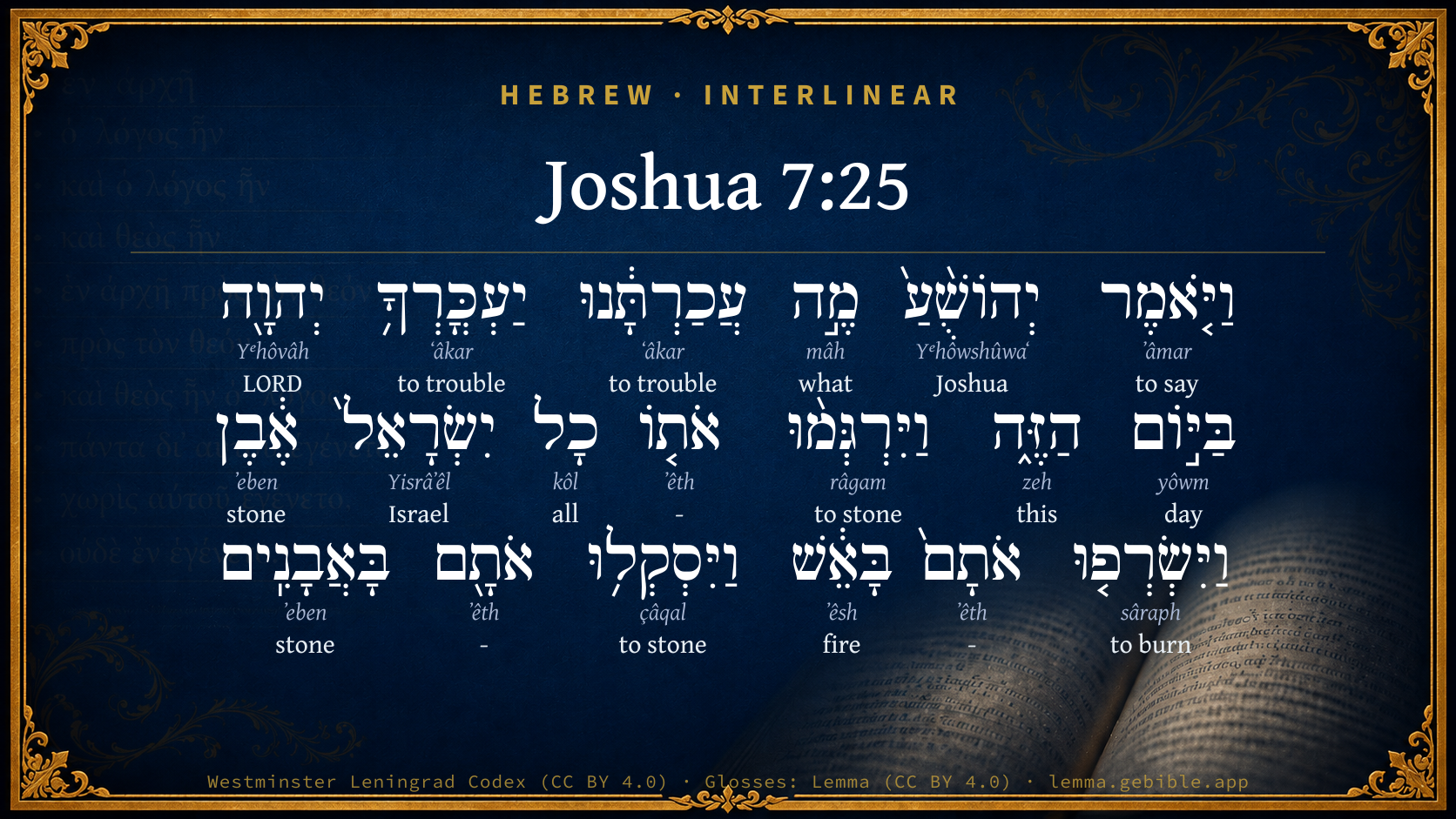
Hebrew (Westminster Leningrad Codex) Joshua 7:25 appears in the Hebrew Old Testament. The text above is from the Westminster Leningrad Codex. Each word links to its Strong’s number, a concise gloss, and parsing drawn from the Open Scriptures Hebrew Bible morphology. Click any word for its full Brown-Driver-Briggs (BDB) entry.
Download image
Cite this verse

Joshua 7:25 (World English Bible). Public Domain. Lemma interlinear Bible study tool, https://lemma.gebible.app/v/joshua/7/25.

Show BibTeX & RIS
BibTeX
RIS
English Translation
Joshua said, Why have you troubled us? Yahweh shall trouble you this day. All Israel stoned him with stones; and they burned them with fire, and stoned them with stones.
World English Bible · Public Domain
Download a study sheet

One document with this verse’s original text, its word-by-word gloss line, the meaning frame, cross-references with their text, attributed commentary, and full source and license credits — printable, and it pastes into notes with its structure intact.

This verse Autodidact and up

Study sheet (.html) Plain text (.txt)

A passage Seminary Student

Up to 50 verses in one chapter. A passage sheet keeps up to 6 commentary sources and 12 cross-references per verse, in the order this page ranks them, and says so on the sheet whenever that leaves anything out. Ask for a single verse and you get the Autodidact verse sheet above.

Everything on this page stays free to read, with no account — the sheet is a download of what is already on screen, not access to it.

Want to remove ads? Support Godless Engineer
Compare translations 3

The same verse in 3 English versions, stacked beneath the original-language interlinear above. Click any original word for its lexicon entry.

Each is an independent rendering of the whole verse — the interlinear is not word-aligned to these translations.

Highlighted words mark where these versions differ — a whole-verse word diff, not a word-by-word alignment.

  • World English Bible Public Domain
    Joshua said, Why have you troubled us? Yahweh shall trouble you this day. All Israel stoned him with stones; and they burned them with fire, and stoned them with stones.
  • King James Version Public Domain
    And Joshua said, Why hast thou troubled us? the LORD shall trouble thee this day. And all Israel stoned him with stones, and burned them with fire, after they had stoned them with stones.
  • unfoldingWord Literal Text CC BY-SA 4.0
    And Joshua said, “Why have you troubled us? Yahweh will trouble you on this day.” And all of Israel stoned him with stone. And they burned them with fire, and they stoned them with stones.

unfoldingWord Literal Text — © unfoldingWord, licensed CC BY-SA 4.0. Word-aligned USFM3 via Door43 (git.door43.org/unfoldingWord/en_ult).

Versions to compare (up to 4)

3 of 4 selected

Show all 18 translations

Every available English version of this verse, each an independent rendering of the whole verse.

  • World English Bible Public Domain
    Joshua said, Why have you troubled us? Yahweh shall trouble you this day. All Israel stoned him with stones; and they burned them with fire, and stoned them with stones.
  • Berean Standard Bible Public Domain
    “Why have you brought this trouble upon us?” said Joshua. “Today the LORD will bring trouble upon you!” And all Israel stoned him to death. Then they stoned the others and burned their bodies.
  • Majority Standard Bible Public Domain
    “Why have you brought this trouble upon us?” said Joshua. “Today the LORD will bring trouble upon you!” And all Israel stoned him to death. Then they stoned the others and burned their bodies.
  • King James Version Public Domain
    And Joshua said, Why hast thou troubled us? the LORD shall trouble thee this day. And all Israel stoned him with stones, and burned them with fire, after they had stoned them with stones.
  • American Standard Version (1901) Public Domain
    And Joshua said, Why hast thou troubled us? Jehovah shall trouble thee this day. And all Israel stoned him with stones; and they burned them with fire, and stoned them with stones.
  • Revised Version (1885) Public Domain
    And Joshua said, Why hast thou troubled us? the LORD shall trouble thee this day. And all Israel stoned him with stones; and they burned them with fire, and stoned them with stones.
  • Geneva Bible (1599) Public Domain
    And Ioshua said, In as much as thou hast troubled vs, the Lord shall trouble thee this day: and all Israel threwe stones at him, and burned them with fire, and stoned them with stones.
  • Douay-Rheims (1899) Public Domain
    Where Josue said: Because thou hast troubled us, the Lord trouble thee this day. And all Israel stoned him: and all things that were his, were consumed with fire.
  • Young's Literal Translation Public Domain
    And Joshua saith, `What! thou hast troubled us! -- Jehovah doth trouble thee this day;' and all Israel cast stones at him, and they burn them with fire, and they stone them with stones,
  • Literal Standard Version CC BY-SA 4.0
    And Joshua says, “Why have you troubled us? YHWH troubles you this day!” And all Israel cast stone at him, and they burn them with fire, and they stone them with stones,
  • Unlocked Literal Bible CC BY-SA 4.0
    Then Joshua said, “Why have you troubled us? Yahweh will trouble you today.” All Israel stoned him with stones. Then they stoned the rest with stones and burned them with fire.
  • unfoldingWord Literal Text CC BY-SA 4.0
    And Joshua said, “Why have you troubled us? Yahweh will trouble you on this day.” And all of Israel stoned him with stone. And they burned them with fire, and they stoned them with stones.
  • Darby Bible Public Domain
    And Joshua said, How hast thou troubled us! Jehovah will trouble thee this day. And all Israel stoned him with stones; and they burned them with fire, and stoned them with stones.
  • World Messianic Bible Public Domain
    Joshua said, “Why have you troubled us? The LORD will trouble you today.” All Israel stoned him with stones, and they burned them with fire and stoned them with stones.
  • Webster's Bible Public Domain
    And Joshua said, why hast thou troubled us? the LORD shall trouble thee this day. And all Israel stoned him with stones, and burned them with fire, after they had stoned them with stones.
  • Free Bible Version CC BY-SA 4.0
    Then Joshua said to Achan, “Why did you bring so much trouble down on us? Today the Lord will bring trouble down on you.” All the Israelites stoned Achan. Then when they had stoned the rest they burned their bodies.
  • Bible in Basic English Public Domain
    And Joshua said, Why have you been a cause of trouble to us? Today the Lord will send trouble on you. And all Israel took part in stoning him; they had him stoned to death and then burned with fire.
  • JPS Tanakh (1917) Public Domain
    And Joshua said: 'Why hast thou troubled us? the LORD shall trouble thee this day.' And all Israel stoned him with stones; and they burned them with fire, and stoned them with stones.

Literal Standard Version (2020), Covenant Press — licensed CC BY-SA 4.0. Text via the HelloAO Bible API (eBible.org). Unlocked Literal Bible (unfoldingWord) — licensed CC BY-SA 4.0. Text via the HelloAO Bible API (eBible.org). unfoldingWord Literal Text — © unfoldingWord, licensed CC BY-SA 4.0. Word-aligned USFM3 via Door43 (git.door43.org/unfoldingWord/en_ult). Free Bible Version, Dr. Jonathan Gallagher — licensed CC BY-SA 4.0. Text via the HelloAO Bible API (eBible.org).

Word by word

More ways to search: Search by grammar → Find every occurrence → Compare this word →

Practice this passage: Drill this verse → Learn its vocabulary →

עֲכַרְתָּ֔נוּ
ʻâkar
H5916
“to trouble · us”
Verb, Qal, Perfect, 2nd Person, Masculine, Singular + Suffix, Personal, 1st Person, Common, Plural
Part of Speech
Verb
Stem
Qal
Form
Perfect
Person
2nd Person
Gender
Masculine
Number
Singular
Full BDB Definition

Origin: a primitive root

TWOT: 1621

to trouble, stir up, disturb, make (someone) taboo - (Qal) to disturb, trouble - (Niphal) - to be disturbed, be stirred up - disturbance, calamity (participle)
  1. וַיֹּ֤אמֶר ʼâmar H559 “and · to say” Conjunction + Verb, Qal, Sequential Imperfect, 3rd Person, Masculine, Singular
  2. יְהוֹשֻׁ֨עַ֙ Yᵉhôwshûwaʻ H3091 “Joshua” Noun, Proper
  3. מֶ֣ה mâh H4100 “what” Particle, Interrogative
  4. יַעְכֳּרְךָ֥ ʻâkar H5916 “to trouble · you” Verb, Qal, Imperfect, 3rd Person, Masculine, Singular + Suffix, Personal, 2nd Person, Masculine, Singular
  5. יְהוָ֖ה Yᵉhôvâh H3068 “LORD” Noun, Proper
  6. בַּיּ֣וֹם yôwm H3117 “in/at the · day” Preposition, Determined + Noun, Common, Masculine, Singular, Absolute
  7. הַזֶּ֑ה zeh H2088 “the · this” Particle, Definite Article + Pronoun, Demonstrative, Masculine, Singular
  8. וַיִּרְגְּמ֨וּ râgam H7275 “and · to stone” Conjunction + Verb, Qal, Sequential Imperfect, 3rd Person, Masculine, Plural
  9. אֹת֤וֹ ʼêth H853 “- · him” Particle, Direct Object + Suffix, Personal, 3rd Person, Masculine, Singular
  10. כָל kôl H3605 “all of” Noun, Common, Masculine, Singular, Construct
  11. יִשְׂרָאֵל֙ Yisrâʼêl H3478 “Israel” Noun, Proper
  12. אֶ֔בֶן ʼeben H68 “stone” Noun, Common, Feminine, Singular, Absolute
  13. וַיִּשְׂרְפ֤וּ sâraph H8313 “and · to burn” Conjunction + Verb, Qal, Sequential Imperfect, 3rd Person, Masculine, Plural
  14. אֹתָם֙ ʼêth H853 “- · them” Particle, Direct Object + Suffix, Personal, 3rd Person, Masculine, Plural
  15. בָּאֵ֔שׁ ʼêsh H784 “in/at the · fire” Preposition, Determined + Noun, Common, Both, Singular, Absolute
  16. וַיִּסְקְל֥וּ çâqal H5619 “and · to stone” Conjunction + Verb, Qal, Sequential Imperfect, 3rd Person, Masculine, Plural
  17. אֹתָ֖ם ʼêth H853 “- · them” Particle, Direct Object + Suffix, Personal, 3rd Person, Masculine, Plural
  18. בָּאֲבָנִֽים ʼeben H68 “in/at the · stones” Preposition, Determined + Noun, Common, Feminine, Plural, Absolute

About this verse

These counts appear in no published source. They are computed here, from the morphology-tagged text and Lemma’s own curated glosses. What Lemma adds →

19
words
15
distinct lemmas
Historical
section

Notable vocabulary

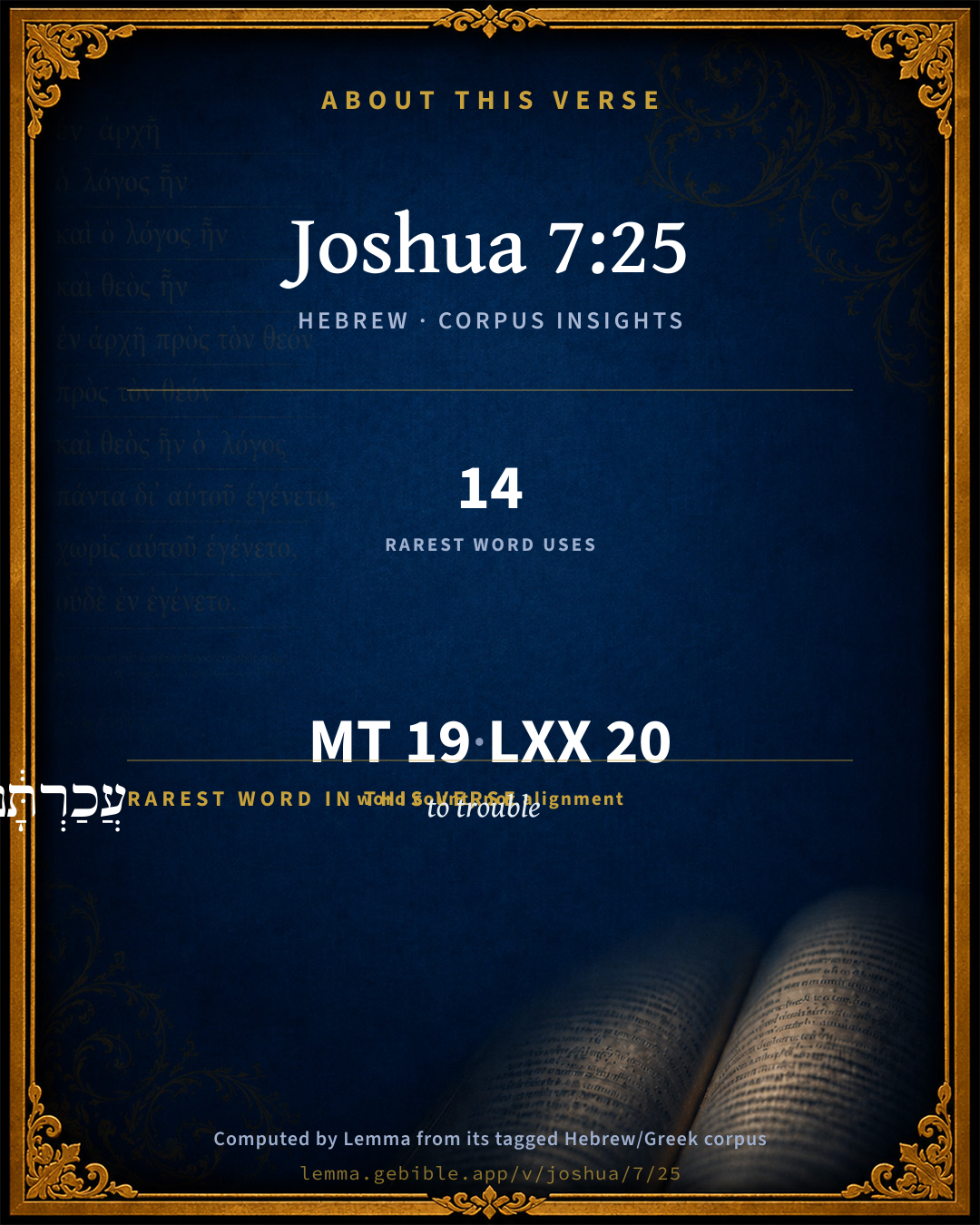
The rarest word here is עֲכַרְתָּ֔נוּ to trouble H5916 — appearing just 14 times in the whole Hebrew Bible.

Shared distinctive vocabulary

עֲכַרְתָּ֔נוּ to trouble H5916 occurs in 13 verses of the Hebrew Bible. Also found in:

Grammatical profile

  • 6 verbs
  • 8 nouns
  • 1 pronoun
  • 4 particles

Verb forms

  • וַיֹּ֤אמֶר Qal · Sequential Imperfect
  • עֲכַרְתָּ֔נוּ Qal · Perfect
  • יַעְכֳּרְךָ֥ Qal · Imperfect
  • וַיִּרְגְּמ֨וּ Qal · Sequential Imperfect
  • וַיִּשְׂרְפ֤וּ Qal · Sequential Imperfect
  • וַיִּסְקְל֥וּ Qal · Sequential Imperfect

Repetition

Words recur within this verse — often emphatic in Hebrew:

  • עֲכַרְתָּ֔נוּ to trouble H5916 ×2
  • אֶ֔בֶן stone H68 ×2

Hebrew & Septuagint length

In English translation the verse runs 30 words from the Hebrew and 25 from the Septuagint (LXX English) — closely comparable.

A rough comparison of the two English renderings, which tokenize alike — not a word-level alignment.

Word counts can differ between the Hebrew and the Greek without any difference in meaning — e.g. the Hebrew direct-object marker אֵת has no separate Greek word, and Greek often adds the article ὁ.

In the original languages it is 19 Hebrew tokens and 20 Greek tokens — but the two are counted differently (Hebrew bundles its prefixes and suffixes into one token; the Greek is in lemma form), so that isn’t a like-for-like length.

Cross-references

19

Topical passages linked to Joshua 7:25 in the Treasury of Scripture Knowledge — connected by theme and wording, ordered by reader-vote popularity; previews shown in the World English Bible.

  • Joshua 6:18 But as for you, only keep yourselves from the devoted thing, lest when you have devoted it, you take of the devoted thing; so would you make the camp of Israel accursed, and trouble it.
  • 1 Chronicles 2:7 The sons of Carmi: Achar, the troubler of Israel, who committed a trespass in the devoted thing.
  • Leviticus 24:14 "Bring out of the camp him who cursed; and let all who heard him lay their hands on his head, and let all the congregation stone him.
  • Deuteronomy 17:5 then shall you bring forth that man or that woman, who has done this evil thing, to your gates, even the man or the woman; and you shall stone them to death with stones.
  • Leviticus 20:2 "Moreover, you shall tell the children of Israel, 'Anyone of the children of Israel, or of the strangers who live as foreigners in Israel, who gives any of his seed to Molech; he shall surely be put to death. The people of the land shall stone him with stones.
  • Joshua 7:11–13 Israel has sinned; yes, they have even transgressed my covenant which I commanded them: yes, they have even taken of the devoted thing, and have also stolen, and dissembled also; and they have even put it among their own stuff.
  • Genesis 34:30 Jacob said to Simeon and Levi, "You have troubled me, to make me odious to the inhabitants of the land, among the Canaanites and the Perizzites. I am few in number. They will gather themselves together against me and strike me, and I will be destroyed, I and my house."
  • Genesis 38:24 It happened about three months later, that it was told Judah, saying, "Tamar, your daughter-in-law, has played the prostitute; and moreover, behold, she is with child by prostitution." Judah said, "Bring her forth, and let her be burnt."
  • Leviticus 20:14 "'If a man takes a wife and her mother, it is wickedness: they shall be burned with fire, both he and they; that there may be no wickedness among you.
  • Leviticus 21:9 "'The daughter of any priest, if she profanes herself by playing the prostitute, she profanes her father: she shall be burned with fire.
  • Deuteronomy 13:10 You shall stone him to death with stones, because he has sought to draw you away from Yahweh your God, who brought you out of the land of Egypt, out of the house of bondage.
  • Deuteronomy 21:21 All the men of his city shall stone him to death with stones: so shall you put away the evil from the midst of you; and all Israel shall hear, and fear.
  • Deuteronomy 22:21–24 then they shall bring out the young lady to the door of her father's house, and the men of her city shall stone her to death with stones, because she has done folly in Israel, to play the prostitute in her father's house: so shall you put away the evil from the midst of you.
  • Joshua 7:15 It shall be, that he who is taken with the devoted thing shall be burnt with fire, he and all that he has; because he has transgressed the covenant of Yahweh, and because he has done folly in Israel.
  • 1 Kings 18:17–18 It happened, when Ahab saw Elijah, that Ahab said to him, Is it you, you troubler of Israel?
  • Habakkuk 2:6–9 Won't all these take up a parable against him, and a taunting proverb against him, and say, 'Woe to him who increases that which is not his, and who enriches himself by extortion! How long?'
  • Galatians 5:12 I wish that those who disturb you would cut themselves off.
  • 2 Thessalonians 1:6 Since it is a righteous thing with God to repay affliction to those who afflict you,
  • Hebrews 12:15 looking carefully lest there be any man who falls short of the grace of God; lest any root of bitterness springing up trouble you, and thereby the many be defiled;

Cross-references courtesy of OpenBible.info (CC BY 4.0).

Hebrew and Greek witnesses Masoretic Hebrew ↔ Greek Septuagint

The same verse in the two great witnesses to the Old Testament, shown verse-for-verse.

These are two independent witnesses, not word-aligned to each other, and the Septuagint is shown in lemma (dictionary) form.

Hebrew Joshua 7:25 Masoretic · Westminster Leningrad Codex

וַיֹּ֤אמֶר יְהוֹשֻׁ֨עַ֙ מֶ֣ה עֲכַרְתָּ֔נוּ יַעְכֳּרְךָ֥ יְהוָ֖ה בַּיּ֣וֹם הַזֶּ֑ה וַיִּרְגְּמ֨וּ אֹת֤וֹ כָל יִשְׂרָאֵל֙ אֶ֔בֶן וַיִּשְׂרְפ֤וּ אֹתָם֙ בָּאֵ֔שׁ וַיִּסְקְל֥וּ אֹתָ֖ם בָּאֲבָנִֽים

Joshua said, Why have you troubled us? Yahweh shall trouble you this day. All Israel stoned him with stones; and they burned them with fire, and stoned them with stones.

World English Bible · Public Domain

Greek LXX Joshua 7:25 Septuagint · lemma form

καί εἶπον ἰησοῦς ὁ αχαρ τίς ὀλεθρεύω ἐγώ ἐκὀλεθρεύω σύ κύριος καθά καί σήμερον καί λιθοβολέω αὐτός λίθος πᾶς ἰσραήλ

And Joshua said to Achar, Why have you destroyed us? the Lord destroy you as at this day. And all Israel stoned him with stones.

LXX2012 (modern English Septuagint) · Public Domain

On this verse, Adam Clarke's Commentary discusses the Septuagint’s reading. Read the note in Commentary ↓

Hebrew: Westminster Leningrad Codex (CC BY 4.0). Greek: Septuagint (public domain); English from LXX2012 (modern English Septuagint) (Public Domain). How the Septuagint differs from the Hebrew →

Targum (Aramaic paraphrase)

1

The Targum is the ancient Jewish Aramaic paraphrase of the Hebrew Scriptures — an interpretive translation, not the Hebrew text itself. Onkelos (literal) and Pseudo-Jonathan (expansive) render the Torah, and Jonathan the Prophets. Coverage is partial: where no permissively-licensed English translation exists for a verse, only the Aramaic is shown. This is verse-level text, not a word-by-word alignment to the Hebrew.

  1. Targum Jonathan Prophets (Joshua–Malachi)
    וַאֲמַר יְהוֹשֻׁעַ מָה עַכַרְתָּנָא יַעְכְּרִינָךְ יְיָ בְּיוֹמָא הָדֵין וּרְגָמוּ יָתֵיהּ כָּל יִשְׂרָאֵל בְּאַבְנַיָא וְאוֹקִידוּ יַתְהוֹן בְּנוּרָא בָּתַר דִרְגִימוּ יַתְהוֹן בְּאַבְנַיָא:

    (no public-domain English translation for this verse)

    Targum Jonathan — Aramaic: “Mikraot Gedolot” (public domain). English: “Sefaria Community Translation” (CC0 1.0 (public-domain dedication)); “London "Chaldee Paraphrase," 1871” (public domain). Text via Sefaria.

Commentary

Notes on Joshua 7:25 from classic Christian and Jewish commentators (each source and its license shown beneath its notes). The classic Christian expositions comment on the surrounding passage and are grouped to its opening verse, so a note may address several verses; the Jewish commentaries on the Tanakh (Rashi and others) are per-verse, so they appear only where the commentator wrote on this verse.

Lemma curates 59 commentaries, every one of them public domain or Creative Commons licensed, each selected and text-cleaned for this edition rather than reprinted as found. About our sources →

Trapp's Complete Commentary

John Trapp

Jos 7:25 And Joshua said, Why hast thou troubled us? the LORD shall trouble thee this day. And all Israel stoned him with stones, and burned them with fire, after they had stoned them with stones.

Ver. 25. Why hast thou troubled us?] There was a young man among the Suitzers that went about to trouble and alter their free state. Him they condemned to death, and appointed his father for executioner, because he bred him no better. {a}

{a} Bishop Ridley told Stephen Gardiner that it was the hand of God that he was now in prison, because he had so troubled others in his time. - Act. and Mon.

John Trapp, A Commentary or Exposition upon All the Books of the Old and New Testament (1647–1656) — public domain. Text from a community e-Sword module.

The Biblical Illustrator

Joseph S. Exell

Jos_7:25-26

And Joshua said, Why hast thou troubled us?

the Lord shall trouble thee this day.

The troubles of sin

I. That sin is a very troublesome thing.

1. The load of guilt by which it oppresses us.

2. The shifts, subterfuges, and tricks resorted to for the purpose of concealing our sins, or transferring the blame to others, are convincing proofs that sin troubles us.

3. Sin troubles us by its corrupt and restless influence on the tempers and dispositions.

4. But it is chiefly into futurity that we are to look for the troubles of sin (Pro_11:21; Eze_18:4; Rom_6:23).

II. However artfully concealed, sin must be exposed.

1. The most secret sins are often revealed in this world.

2. Those sins that escape detection here, will be manifested in the last day (Ecc_12:14).

III. When the sinner is exposed, he is left without any reasonable excuse. Joshua said, Why hast thou troubled us? What could he say? Could he plead ignorance of the law? No; it was published in the camp of Israel. The weakness of human nature? No; he had strength to do his duty. The prevalence of temptation? No; others had similar temptations, and yet conquered. And what shall we have to say when God shall summon us to His bar?

IV. That punishment treads upon the heels of sin. The Lord shall trouble thee this day.

1. God has power to trouble sinners. The whole creation is a capacious reservoir of means, which He can employ at His pleasure.

2. God will trouble sinners. He will either bring them to repentance, when they shall look upon Him whom they have pierced, and mourn, or He will vex them in His wrath, and dash them in pieces as a potters vessel.

Infer--

1. What a powerful preventive this should be to deter us from committing sin.

2. See the madness of sinners, who, for the sake of a few sordid despicable pleasures, which always leave a sting behind, will desperately plunge themselves into an abyss of troubles which know no bound nor termination.

3. Since sin is so troublesome, let us all seek a deliverance from its dominion and influence.

4. Learn what ideas you should entertain of those who seek to entice you to sin. They are agents of the devil, and you should shun them as you would shun perdition. (Sketches of Four Hundred Sermons.)

Israel stoned him with stones, and burned them with fire.

Achans punishment

The punishment of Achan himself offers no difficulty. He knew the decree, and chose to stake his life against a few valuable articles which excited his rapacity. The maintenance of discipline in an army is at all times of first importance. In the Peninsula War two men were shot for stealing apples, pilfering having been proclaimed a capital crime. The Duke of Wellington was a humane man, but he knew the need of obedience to law and the value of a striking example. The Israelites were a nation and army in one. Regard for the general welfare, above all private aggrandisement, had to be encouraged. The sense of a common interest would soon be undermined, if a pilfering spirit set in and a greedy selfishness received any countenance. Moreover, at all costs, reverence for their Deity had to be upheld. His majesty must be vindicated. Disastrous results could only follow upon a diminution of the religious sentiment among the people. But the association of Achans family in his terrible penalty, as a calm judicial proceeding, sends a thrill of horror through our hearts. But then, we are the heirs of all the ages, in the foremost files of time. We enjoy the inheritance of millenniums of Divine education. We could not expect Joshua to act in advance of the spirit of his time. The ancient world was deficient in its conception of what a man was. It was long before it came to regard him as an individual, a being complete in himself. So long as one man continued to be considered as part of another, or in any sense the property of another, so long fathers might pledge the lives of their children, and whole families expiate the crimes of a single member without shocking the public sense of justice, But is it not said that the destruction of Achans family was by the express command of Jehovah? Is not this the explanation? The command, shaping itself within the mind of Joshua in the form of an overmastering conviction, would be that justice should be executed. Joshua could only understand justice in the sense in which his contemporaries understood it. His moral sense would give the character and colour to the justice to be dealt out. His inmost conviction, which was, in truth, the inspired message of his God, forced upon him the necessity for a signal vindication of the majesty of loyalty and uprightness, and he acted up to the light which he possessed. (T. W. M. Lund, M. A.)

The troubling of Achan

Two questions present themselves. Why should all Israel have been put to shame and defeat for the sin of one man? And why should God have required the whole congregation in this dramatic way to take part in the execution of the offender? To our minds at first thought it would seem likely to brutalise the hearts of the people, that all should be required to take part in that bloody vengeance. For the sake of example, God might wish the whole congregation to be present at the taking of the lot. He could have pointed out the criminal to Joshua in some simple and direct way, but He chose to give all Israel a most salutary warning. That the unerring finger of Jehovah should thus single out the guilty man was a striking object-lesson concerning the truth that no sin is so secret as to be hidden from the all-searching God. But this does not explain why all the people should have been made to suffer shame and defeat because of Achans sin, for the great investigation might have been made just as thoroughly before the defeat at Ai. We might say, perhaps, that Israel needed the lesson of this defeat to teach them their dependence upon God for the smallest as well as the greatest victory. We fancy we can detect a little vein of boastfulness in the words of the scouts (verse 3). And if we ask concerning the thirty and six men who perished while Israel was receiving this lesson in humility, we may reply that such matters must be left, and can without disquietude be left in the hands of God. We cannot know about individual lives. God certainly in all cases deals wisely and mercifully. Yet we have not progressed very far in our solution of this difficulty, that God permitted all Israel to suffer for the sin of one man. And it is a difficulty worth trying to solve, because it is of the same sort as that which meets us every day of our lives, and makes heedless men question the justice and fairness of Almighty God. Who is there that has not suffered hurt, or trouble, or unhappiness, from the misdoings of his neighbours? The embezzler gets the money of hundreds of poor and unsuspecting people invested in his dazzling schemes, and then goes off with his booty, leaving desolation and misery behind. How many people suffer from the malignity or hatred of their fellows, because they have innocently offended them. Aye, how many suffer, often most cruelly, from the heedlessness and thoughtlessness of others, who never meant to do harm, but talked foolishly and excessively about things they did not understand. We think of the mischief we have endured at the hands of others, knowing that we deserved nothing of it; and we say, Why does God allow the innocent thus to suffer for other mens sins? Perhaps, indeed, it is to remind us that we are not so guiltless as we fancy. We dwell upon the harm done us by others, and we seldom think of the many ways in which we do others harm, it may be quite thoughtlessly, but still very mischievously. Our hasty and ill-considered words, our unlovely examples, how much mischief these may do our fellow-men, while we are quite oblivious of it. A young man is dishonest, and makes off with large sums of his employers money; we condemn him heartily, and yet it may be in the sight of God that the very atmosphere in which he was brought up in our midst was so filled with the praise of wealth and the excellence of shrewdness and business ability, the power of capital, and the good things which money can bring into ones life, that our words and views have been the teachers which fostered in the transgressors heart the very sin we now so unsparingly condemn. May it not be that the very wrongs we so often have to suffer undeserved]y at the hands of others are the merciful agencies of God, to let us endure a little of the penalty our own careless words and evil examples deserve, which constantly, all unsuspected by ourselves, are doing mischief to our neighbours? We have no right, then, even to complain of injustice in the fact that we have to suffer for other mens sins, unless we can be sure that our sins do not cause as great injury to the souls, if not to the bodies, of many of our fellow-men. There is a deeper sense yet in which we may take this lesson of all Israel suffering for Achans transgression. God thus taught His people the solidarity of their national life as His people. In other words, that men have responsibility for their neighbours. No one in Israel might say, This is none of my affair, for God showed them that the sin of one man affected the whole community; therefore the whole community had a certain responsibility towards individual transgression. Civilised nations all admit this responsibility of humanity, at least to a certain degree. Men hear of flood or famine or pestilence in some far-off part of the world, devastating populous districts in India, or China, or some distant island of the Pacific. Immediately the sentiment of humanity opens their purses, and relief goes forth generously to the sufferers. Why should we concern ourselves to help those savages, who would as likely as not murder us if we went among them as travellers? Because they are men; they share in our common humanity, and we may not forget our brotherhood of race. Why should European nations send war-ships to the Red Sea and the East African coast to stop the Arabian slave trade? What right have they to interfere? You reply that the slave-trade is brutal and inhuman, and the sentiment of humanity compels those who have the power to interfere, to save the poor blacks from their fiendish persecutors. Carry the same thought a little further, and you get the higher Christian conception of mans duty to all his fellow-men. What is the greatest evil in the world? You reply sin, because sin is the root of all other evils. Well, then, we Christians owe it to humanity to do all that lies in our power to take sin away from the world. That is the great principle of Christian missions. No matter if the missions do not seem to be very successful, we shall not have missed this lesson of the sufferings we have to endure for other mens sins if we have bravely done what was in our power to make known to our fellow-men the efficacy of the precious blood of Christ. Our other question was, Why did God require the whole congregation to take part in the stoning of Achan? There are evils of ignorance, there are also evils of wanton defiance of the known law of right. So long as men sin in ignorance and superstition we may be moved only by compassion to help them. The missionary spirit must always be that of Christlike pity for them that are ignorant and out of the way. England sends her heroic missionaries into the heart of Africa and of China while at the same time she patrols the Red Sea with warships to stop at the cannons mouth the slave trade, and sends an army up the Irrawaddy to conquer the monster King Theebaw of Burmah, and so to put a stop to his terrible cruelties. Is there inconsistency in this? No. It was quite as much the duty of Israel to stone Achan as it was to teach their children with loving assiduity the enormity of disobeying Jehovah. We owe it to God to do what lies in our power to put down flagrant iniquity. We are much too careless about this in our Christian lives. We may not punish individuals, for God commits that authority to the State; but we are bound to confront and denounce all iniquitous principle, to stand up and fight against God-defying sin. No matter if we do not succeed in slaying Achan. No matter if men tell us to mind our own business, and not to interfere with them. It is a great thing to have thrown a stone for the Lord, even if it has seemed in no wise to hurt the enemy. (Arthur Ritchie.)

They raised over him a great heap of stones.--

Nemesis

Again we stand beside a heap of stones. Again it will be profitable to put and to answer the question, What mean ye by these stones? This is the third occasion on which such a question might arise. The first heap of stones was raised on the brink of Jordan; the second lay some miles distant; the third is still further in the land. The first heap was a token of Jehovahs might; for taken from the river-bed by twelve stalwart warriors, they told to all succeeding generations that by a strong hand and a stretched-out arm Israel was brought into Canaan. The second heap, stretched far and wide, the ruins of a famous city, was the token of Jehovahs judgment. This third heap in the valley of Achor, the cairn erected over the dead body of Achan, was the token of Jehovahs discipline. The twelve stones speak of Jehovahs relation to the sin of those who trust Him and accept His leadership. He buries all their iniquities, He brings them into His promised inheritance, and gives them a permanent place therein. The ruined city speaks of Jehovahs relation to the sin of these who stubbornly resist Him. He smites them with a rod of iron. This rugged pile speaks of Jehovahs relation to the sin of those who profess to obey Him, but who in their deeds deny Him. If He judges the world, much more must He judge His own house. The twelve stones on Jordans bank were a monument of Israels hope. He who had led them over, and brought them in, would assuredly bless them with all earthly blessings in His fair heritage. The ruins of Jericho were a monument of Israels faith. For nothing but faith could have been so patient, so docile, so mighty, so victorious By faith the walls of Jericho fell down. The heap in the valley of Achor was a monument of Israels love. They heaped up this cairn of condemnation to show their detestation of the crime of which Achan was guilty. Thus this act revealed their love to God in the strongest light. By this third heap we stand, and as we do so, let us ponder the discovery of Achans crime, its confession, and its punishment. Joshua gave himself no rest till he got to the root of this matter. Though appalled by such severe tokens of the Divine displeasure, he did not murmur against God, but persistently made inquiry of God. He did not complain of God, he complained to God; and his faithful persistency was rewarded (verses 10-12). Get thee up. My mind has not changed. My arm is not shortened. My word is not broken. Get thee up, for the discovery and punishment of this sin. The discovery of Achans sin was, therefore, the result of Divine directions. It was God who set everything in motion for the detection of the hidden criminal. The discovery was undertaken most solemnly, as a deeply spiritual and religious act (verse 13). Three times in the course of their history had the children of Israel been thus called solemnly to sanctify themselves. On the first occasion, it was at the foot of Sinai, in prospect of the giving of the law. On the second occasion it was at Jordan, in prospect of entering into the land. On the third occasion, it was here, in prospect of the discovery and punishment of the transgressor. To receive Gods will, to enter into Gods inheritance, to purge away transgression, such things demand the most thorough consecration. It is plain from the Divine record that Israel went about this solemn work in the right way. There was no burst of ungovernable excitement and blind popular fury. With judicial calmness and religious reverence, the terrible drama was begun, continued, and ended. It was also prosecuted deliberately. There was no unseemly haste or confusion. A proclamation was made in the evening previous as to the manner of procedure on the following day; and then the carrying out of the process of casting lots must have been slow and deliberate. What a night must that have been for Joshua l How thankfully must he have laid himself to rest in the blessed consciousness that as surely as the darkness of night would fly before the dawning day, so all his difficulties would vanish, and all the disgrace of Israel would be blotted out. And what a night must that have been for Achan! He would feel as did another whose mental torture a great poet has described--

Macbeth hath murdered sleep, the innocent sleep,

Sleep that knits up the ravelled sleave of care,

Balm of hurt minds.

Oh! what a long, black, miserable night was that. The voice cried, Sleep no more, and on the morrow, as with bloodshot eyes he took his place in the ranks of his tribe, what must have been his terror! And then to mark the circle of condetonation closing upon him, growing less and less at each casting of the lot, he rooted meanwhile to the dark spot, its centre, till at last, pointed out by the finger of God, he stood alone, the incarnation of disaster and disgrace, the hateful object for every eye in Israel, the awful focus of their fiery indignation, burning into his soul one thought, one agony, We have found thee, O our enemy. The method of discovery was most impressive for the people, revealing so marvellously the finger of God. Whatever the precise process of the lot may have been, and that is hard to discover, there was no difficulty, hesitation, timidity, uncertainty, or partiality in its carrying out. The method of discovering the crime was also the most merciful that could have been adopted for the offender. It gave him time to think; a blessed space for repentance; an opportunity, if there was any spark of spiritual life within, to cast off the incubus of iniquity. Every step would serve to convince him how utterly foolish it was to promise himself secrecy in sin, and how certainly at the last God would discriminate between the innocent and the guilty, however for a little while they were involved in the same condemnation. Thus Achan stands exposed in the sight of all Israel. Joshua, filled with unutterable compassion for the trembling sinner, though absolutely certain of his guilt, has no harsh word to utter, but only seeks to win him to a right frame of mind. Nothing could be more touching than this venerable leaders words. He deals with him as a grey-haired father with a wayward son, urging him to the only course that in the circumstances could yield one spark of consolation (verse 19). Achan breaks down under this unexpected kindness. He had looked for nothing but harsh reproof and unmitigated severity; therefore in broken accents he replies, Indeed I have sinned, &c. This confession is worthy of notice, and has some features which relieve the darkness of the scene. To begin with, it was voluntary. There was here no extortion of a confession from unwilling lips. Joshua spoke in love, calling him my son. It is evident that he has no personal ill-will, no hard spirit of revenge. He appealed to the glory of God. Thus Joshua brought forth this free confession of Achans guilt. His confession was as full as it was free. The miserable man kept nothing back. He made a clean breast of it. His full confession shows that penitents cannot be too particular. His confession was also personal. He felt that it was first of all, and above all, a matter between himself and God, and therefore, though others, in all likelihood, were sharers in his guilt (for he could not well have hid these things in his tent without the cognisance of his family), still he made no mention of them, he condemned none but himself, for he felt himself the greatest sinner. Also Achans confession was sincere. He did not attempt in the faintest degree to excuse himself. He pleaded no palliation of his offence. Surely, therefore, in this confession we have a gleam of light thrown across the gloom of this narrative. Just as in a picture of this dark valley and its black pile of stones, we have seen one white bird hovering amid the gloom, so this confession is the white bird of hope hovering over Achans grave, and relieving somewhat the blackness of its darkness, His punishment trod swiftly on the heels of his confession. This punishment was at once a solemn expression of the evil of sin, a vindication of Gods truth and justice, a prelude to future victory, and a monument to all succeeding ages, declaring, be sure your sin will find you out. We are also told that all Achans substance was destroyed, that which he possessed, as well as that which he stole. What a poor prize had Achan then in the things he so much admired. No good ever comes of ill-gotten gains. In regard to this punishment of Achan, the fate of his family deserves to be noticed. What happened to them? Two explanations have been offered. The first is that they shared Achans sin and therefore shared his punishment. Another explanation is that Achans family were spared. This rests on the fact that there is a change from the plural in verse 24 to the singular in verse 25. Joshua took Achan and all his possessions and all his family to the scene of execution, but the punishment fell only on Achan, for Joshua said (verse 25): Why hast thou troubled us? the Lord will trouble thee this day. And all Israel stoned him with stones, and burned them (his cattle and goods) with fire after they had stoned them with stones. Whichever is the true explanation we may rest assured that the demands of justice were not ignored. Thus we leave Achan, and surely as we stand by this heap of stones and consider his sad end, these words come to mind--the love of money is the root of all evil, which while some coveted after, they have erred from the faith and pierced themselves through with many sorrows. Looking again at this event, we are struck with the parallelism between the early history of Israel as recorded in the Book of Joshua and the early history of the Church as recorded in the Acts of the Apostles. The taking of Jericho corresponds in its mighty triumph to the Day of Pentecost and the casting down of the walls of rebellion and prejudice through the proclamation of the gospel. Then the sin of Achan is strikingly paralleled by that of Ananias and Sapphira. The cause of transgression was the same in both, and the punishments present a striking resemblance. It was a salutary lesson taught both to Israel and to the Church. It showed that the God who dwelt among men was a consuming fire, that His judgment must follow shortly and surely on the heels of sin, and that holiness is the only source and secret of success in the work of the Lord. (A. B. Mackay.)

The valley of Achor.--

The valley of Achor

I. We should grieve more for sin than for its results. As soon as we have committed sin, we look furtively round to see whether we have been watched, and then we take measures to tie up the consequences which would naturally accrue. Failing this, we are deeply humiliated. We dread the consequences of sin more than sin; discovery more than misdoing; what others may say and do more than the look of pain and sorrow on the face that looks out on us from the encircling throng of glorified spirits. But with God it is not so. It is our sin, one of the most grievous features in which is our failure to recognise its intrinsic evil, that presses Him down, as a cart groans beneath its load. The true way to a proper realisation of sin is to cultivate the friendship of the holy God. The more we know Him, the more utterly we shall enter into His thought about the subtle evil of our heart. We shall find sin lurking where we least anticipated, in our motives, in our religious acts, in our hasty judgment of others, in our want of tender, sensitive, pitying love, in our censorious condemnation of those who may be restrained by the action of a more sensitive conscience than our own from claiming all that we claim to possess. We shall learn that every look, tone, gesture, word, thought, which is not consistent with perfect love indicates that the virus of sin has not yet been expelled from our nature, and we shall come to mourn not so much for the result of sin as for the sin itself.

II. We should submit ourselves to the judgment of God. And the Lord said unto Joshua, Get thee up; wherefore liest thou thus upon thy face? It was as if He said, Thou grievest for the effect, grieve rather for the cause. I am well able to preserve My people from the assaults of their foes, though all Canaan beset them, and I am equally able to maintain the honour of My name. These are not the main matters for concern, but that a worm is already gnawing at the root of the gourd, and a plague is already eating out the vitals of the people whom I have redeemed. With My right arm I will screen you from attack, whilst you give yourselves to the investigation and destruction of the accursed thing. Whenever there is perpetual failure in our life, we may be sure that there is some secret evil lurking in heart and life, just as diphtheria breaking out repeatedly in a household is an almost certain indication that there is an escape of sewer gas from the drains.

1. In searching out the causes of failure we must be willing to know the worst, and this is almost the hardest condition. Ostrich-like, we all hide our heads in the sand from unwelcome tidings. It is the voice of an iron resolution, or of mature Christian experience, that can say without faltering, Let me know the worst. But as we bare ourselves to the good Physician let us remember that He is our husband, that His eyes film with love and pity, that He desires to indicate the source of our sorrow only to remove it, so that for Him and for us there may be the vigour of perfect soul-health and consequent bliss.

2. When God deals with sin He traces back its genealogy. Notice the particularity with which twice over the sacred historian gives the list of Achans progenitors. It is always, Achan, the son of Carmi, the son of Zabdi, the son of Zerah, of the tribe of Judah (verses 1, 16-18). Sin is sporadic. To deal with it thoroughly we need to go back to its parentage. A long period will often intervene between the first germ of sin, in a permitted thought or glance of evil, and its flower or fruit in act. We generally deal with the wrong that flames out before the sight of our fellows; we should go behind to the spark as it lay smouldering for hours before, and to the carelessness which left it there. We only awake when the rock disintegrates and begins to fall on our cottage roof; God would lead us back to the moment when a tiny seed, borne on the breeze, floating through the air, found a lodgment in some crevice of our heart, and, although the soil was scanty, succeeded in keeping its foothold, till it had struck down its tiny anchor into a crack, and gathered strength enough to split the rock which had given it welcome. And by this insight into small beginnings our God would forearm us against great catastrophes.

3. It is a good thing at times to muster the clans of heart and life. We must make the principal tribes of our being pass before God. The public, and private, our behaviour in the business, the family, the church, until one of them is taken. Then to take that department and go through its various aspects and engagements, analysing it in days, or duties; resolving it into its various elements, and scrutinising each. This duty of self-examination should be pursued by those who have least relish for it, as probably they really need it; whilst they who are naturally of an introspective or morbid disposition should not engage themselves in it to any large extent. And whoever undertakes it should do so in reliance on the Holy Spirit, and give ten glances to the blessed Lord for every one that is taken at the corruptions of the natural heart. It is looking off unto Jesus which is the real secret of soul-growth.

III. We should hold no parley with discovered sin. God never reveals an evil which He does not require us to remove. And if heart and flesh fail, if our hand refuses to obey our faltering will, if the paralysis of evil has so far enfeebled us that we cannot lift the stone, or wield the knife, or strike the flint stones for the fire, then He will do for us what must be done, but which we cannot do. Some are cast in a mould so strong that they can dare to raise the hatchet, and cut off the arm just madly bitten, and before poison has passed from it into the system; others must await the surgeons knife. But the one lesson for all the inner life is to be willing for God to do His work in us, through us, or for us. So the valley of Achor becomes the door of hope. From that sterile, mountain-guarded valley, Israel marched to victory; or, to use the highly-coloured imagery of Hosea, it was as though the massive slabs opened in the cliffs, and the people passed into cornfields, vineyards, and olive-yards, singing amid their rich luxuriance as they sang in their youth in the day when they came up out of Egypt. Ah! metaphor as true as fair! For all our inner life there is no valley of Achor where the work of execution is faithfully performed in which there is not a door of hope, entrance into the garden of the Lord, and a song so sweet, so joyous, so triumphant, as though the buoyancy of youth were wed with the experience and mellowness of age. (F. B. Meyer, B. A.)

.

The Biblical Illustrator, edited by Joseph S. Exell (c. 1880s–1900s) — public domain. Text from a community e-Sword module.

Joseph Benson's Commentary

Jos 7:25-26. They burned them with fire after they had stoned them — God would have their dead carcasses burned, to show his utmost detestation of such persons as break forth into sins of such public scandal and mischief. A great heap of stones — As a monument of the sin and judgment here mentioned, that others might be warned by the example; and as a brand of infamy, as Jos 8:29; 2Sa 18:17. The valley of Achor — Or, the valley of trouble, from the double trouble expressed Jos 7:25.

Joseph Benson's Commentary on the Old and New Testaments (1811–1818) — public domain. Text from a community e-Sword module.

Tyndale Open Study Notes

Tyndale Open Resources

7:25 Stoning was one prescribed means of execution (see, e.g., Exod 19:13).

Tyndale Open Study Notes — © Tyndale Open Resources, licensed CC BY-SA 4.0. Text via the HelloAO Bible API.

Geneva Bible (1599)

Geneva Bible translators

He declareth that this is God’s judgment because he had offended, and caused others to be slain.

Geneva Bible (1599) marginal notes — public domain. Text via Bolls.life.

Adam Clarke's Commentary

Verse 25. Why hast thou troubled us?] Here is a reference to the meaning of Achan's or Achar's name, מה עכרתנו meh ACHAR-tanu; and as עכר achar is used here, and not עכן achan, and the valley is called the valley of Achor, and not the valley of Achan, hence some have supposed that Achar was his proper name, as it is read 1Ch 2:7, and in some MSS., and ancient versions. See Clarke on Jos 7:17.

And all Israel stoned him with stones, and burned them with fire, after they had stoned then with stones.] With great deference to the judgment of others, I ask, Can it be fairly proved from the text that the sons and daughters of Achan were stoned to death and burnt as well as their father? The text certainly leaves it doubtful, but seems rather to intimate that Achan alone was stoned, and that his substance was burnt with fire. The reading of the present HEBREW text is, They stoned HIM with stones, and burnt THEM with fire, after they had stoned THEM with stones. The singular number being used in the first clause of the verse, and the plural in the last, leaves the matter doubtful. The VULGATE is very clear: Lapidavitque EUM omnis Israel; et cuncta quae illius erant, igne consumpta sunt, "All Israel stoned him; and all that he had was consumed with fire." The SEPTUAGINT add this and the first clause of the next verse together: Και ελιθοβολησαν αυτον λιθοις πας Ισραηλ, και επεστησαν αυτῳ σωρον λιθων μεγαν: And all Israel stoned HIM with stones, and raised over HIM a great heap of stones. The Syriac says simply, They stoned HIM with stones, and burned what pertained to HIM with fire. The TARGUM is the same as the Hebrew. The ANGLO-SAXON seems to refer the whole to Achan and his GOODS: [Anglo-Saxon] And HIM they stoned there, and burnt his goods. The ARABIC version alone says, They stoned HIM and his CHILDREN, and his goods, [Arabic]. Instead of burnt THEM, אתם otham, two of De Rossi's MSS. read אתו otho, HIM; which reading, if genuine, would make the different members of the verse agree better. It is possible that Achan, his oxen, asses, sheep, tent, and all his household goods, were destroyed, but his sons and daughters left uninjured. But it may be asked, Why are they brought out into the valley with the rest? Why, that they might see and fear, and be for ever deterred by their father's punishment from imitating his example.

I have gone thus far into this important transaction, in which the justice and mercy of God are so much concerned, that I might be able to assign to each its due. That Achan's life was forfeited to justice by his transgression, no one doubts: he sinned against a known and positive law. His children could not suffer with him, because of the law, De 24:16, unless they had been accomplices in his guilt: of this there is no evidence; and the text in question, which speaks of Achan's punishment, is extremely dubious, as far as it relates to this point. One circumstance that strengthens the supposition that the children were not included, is the command of the Lord, Jos 7:15: "HE that is taken with the accursed thing, shall be burnt with fire; he, and all that he hath." Now, all that he hath may certainly refer to his goods, and not to his children; and his punishment, and the destruction of his property would answer every purpose of public justice, both as a punishment and preventive of the crime; and both mercy and justice require that the innocent shall not suffer with the guilty, unless in very extraordinary cases, where God may permit the righteous or the innocent to be involved in those public calamities by which the ungodly are swept away from the face of the earth: but in the case before us, no necessity of this kind urged it, and therefore I conclude that Achan alone suffered, and that his repentance and confession were genuine and sincere; and that, while JUSTICE required his life, MERCY was extended to the salvation of his soul.

Adam Clarke's Commentary on the Bible (1810–1826) — public domain. Text from a community e-Sword/MySword module.

John Calvin's Commentaries

25. And Joshua said, etc The invective seems excessively harsh; as if it had been his intention to drive the wretched man to frantic madness, when he ought rather to have exhorted him to patience. I have no doubt that he spoke thus for the sake of the people, in order to furnish a useful example to all, and my conclusion, therefore, is, that he did not wish to overwhelm Achan with despair, but only to show in his person how grievous a crime it is to disturb the Church of God. It may be, however, that the haughty Achan complained that his satisfaction, by which he thought that he had sufficiently discharged himself, was not accepted, and that Joshua inveighed thus bitterly against him with the view of correcting or breaking his contumacy. The question seems to imply that he was expostulating, and when he appeals to God as judge, he seems to be silencing an obstinate man. The throwing of stones by the whole people was a general sign of detestation, by which they declared that they had no share in the crime which they thus avenged, and that they held it in abhorrence. The heap of stones was intended partly as a memorial to posterity, and partly to prevent any one from imprudently gathering particles of gold or silver on the spot, if it had remained unoccupied. For although the Lord had previously ordered that the gold of Jericho should be offered to him, he would not allow his sanctuary to be polluted by the proceeds of theft.

John Calvin's Commentaries (1540-1563) — public domain. Text from the Calvin Translation Society English edition (1840s-50s) via the Christian Classics Ethereal Library (ccel.org). Calvin's coverage is partial (roughly two-thirds of the Bible); uncommented books and verses are honest gaps, never fabricated. The 19th-century editor's footnotes and remarks are omitted so the notes are faithfully Calvin's own voice.

The Cambridge Bible for Schools and Colleges

gen. ed. J. J. S. Perowne

25. Why hast thou troubled us?] Compare the question of Ahab to Elijah, “Art thou he that troubleth Israel?” (1Ki_18:17). “For thou disturblidist us, the Lord schall disturble the in this dai,” Wyclif.

And all Israel stoned him] The use of the singular here and in the following verse is deserving of notice. It suggests that it does not necessarily follow that the sons and daughters of Achan were burned with him. In this case “the plural number used would refer only to the oxen, asses, and sheep, and all that Achan possessed.” Edersheim. Stoning was the ordinary mode of execution (Exo_17:4), especially for idolatry and blasphemy (1Ki_21:10).

and burned them with fire] This was a terrible aggravation of the ordinary punishment of death, Lev_20:14.

The Cambridge Bible for Schools and Colleges (gen. ed. J. J. S. Perowne; Cambridge University Press, 1878–1918) — public domain. Text from a community e-Sword module.

John Gill's Exposition

And Joshua said, why hast thou troubled us?.... Been the occasion of so much trouble to us, by committing this sin:

the Lord shall trouble thee this day; by the destruction of him and all that belonged to him: this is said to show that his punishment was of God, and according to his will: in the Misnah (r) an emphasis is laid on the phrase "this day", and it is observed,"this day thou shalt be troubled, but thou shalt not be troubled in the world to come;''suggesting that though temporal punishment was inflicted on him, yet his iniquity was forgiven, and he would be saved with an everlasting, salvation; and as it may be hoped from the ingenuous confession that he made, that he had true repentance for it, and forgiveness of it:

and all Israel stoned him with stones; hence some gather, that only Achan himself suffered death, and not his sons and daughters:

and burnt them with fire after they had stoned them with stones; which the Jewish commentators understand of his oxen, asses, and sheep; so Jarchi, Ben Gersom, and Abarbinel: likewise his tent, and household goods, the Babylonish garment, gold and silver, were burnt, and he himself also, for that is the express order, Jos 7:15; the Jews say, as particularly Jarchi observes, that he was stoned because he profaned the sabbath, it being on the sabbath day that Jericho was taken, and stoning was the punishment of the sabbath breaker, and he was burnt on the account of the accursed thing; so Abendana.

(r) Sanhedrin ut supra. (Hilchot Sanhedrin, c. 18. sect. 6.)

John Gill's Exposition of the Whole Bible (1746–1763) — public domain (CC PDM 1.0). Text via the HelloAO Bible API.

Haydock's Catholic Bible Commentary

Day. Hence some have drawn a very weak argument, to prove the repentance of Achan, as if he had only to undergo a temporary punishment. It is probable, however, that his sincere confession, proceeding from a penitent heart, might influence God to shew him mercy. --- Fire. Children, as well as his other effects; though some have supposed that the former were spared, as they are not here specified. Hebrew seems to include them; "and burnt them with fire after they had stoned them with stones." Chaldean says they were stoned first. (Calmet)

George Leo Haydock (1774–1849), Haydock's Catholic Family Bible and Commentary, 1859 edition — public domain. Excludes Psalms (Douay-Rheims chapter numbering differs from Protestant) and Deuterocanonical books (Catholic canon only).

Matthew Poole's English Annotations

Stoned him with stones, and burned him with fire; which is easily understood, both out of the following words, and from God’s command to do so, Jos 7:15, which doubtless was here executed.

Quest. How could both these deaths be inflicted upon them?

Answ. It seems they were stoned to death, which was the punishment of such offenders, Num 15:35, and not burned to death; and therefore the stoning only of Achan is mentioned here, and not his burning; and God would have their dead carcasses burned to show his utmost detestation of such persons as break forth into sins of such a public scandal and mischief. And for the burning of Achan, commanded Jos 7:15, it seems not likely to be meant of his burning alive, because that burning is common to him, and all that he hath, as is there expressed; but of the burning of his dead carcass, and other lifeless things, as the manner was with accursed things, Deu 13:16.

Matthew Poole's English Annotations on the Holy Bible (1683–1685) — public domain. Text from a community e-Sword/MySword module.

Whedon's Commentary on the Bible

Daniel D. Whedon

25. Why hast thou troubled us? — The verb here used has, in the Hebrew, (achar,) a sound much like Achan’s name. See note on Jos_7:26.

And all Israel stoned him — Here note the propriety of requiring the whole nation by their various representatives to participate in the execution of the law. The great principle embodied is this: The execution of civil law rests largely upon public opinion. When this becomes so corrupt that it will not uphold the law, it becomes a dead letter on the statute book. [

Stoned him… burned them… had stoned them — This interchange of singular and plural pronouns does not show that only Achan was stoned, and not his children, but may indicate that he was the person most prominent in the punishment. To urge from this change of number that only Achan was stoned would oblige us to urge that the rest were burned alive without having first been stoned. Two different Hebrew words are here rendered stoned, רגם and סקל. The former seems to mean in this place to pelt with stones, the latter to cover with stones. So we may more accurately render, All Israel pelted him with stones, and burned them with fire, and covered them with stones. Per-haps here is an intimation, too, that they stoned Achan with a fiercer violence than they did his family and possessions.]

Daniel D. Whedon (gen. ed.), Commentary on the Old and New Testaments (1874–1909) — public domain. Text from a community e-Sword module.

The Pulpit Commentary

Stoned him with stones. The word here is not the same as in the last part of the verse. It has been suggested that the former word signifies to stone a living person, the second to heap up stones upon a dead one; and this derives confirmation from the fact that the former word has the signification of piling up, while the latter rather gives the idea of the weight of the pile. Some have gathered from the use of the singular here, that Achan only was stoned; but the use of the plural immediately afterwards implies the contrary, unless, with Knobel, we have recourse to the suggestion that "them" is a "mistake of the Deuteronomist" for "him." It is of course possible that his family were only taken there to witness the solemn judgment upon their father. But the use of the singular and plural in Hebrew is frequently very indefinite. (see Jud_1:11:17, 19 Psa_66:6. See note above, on Jos_6:25)

The Pulpit Commentary (1880–1919), ed. H.D.M. Spence-Jones & Joseph S. Exell — public domain. Text from a community e-Sword module.

John Wesley's Explanatory Notes

With stones - And burned him with fire; which is easily understood both out of the following words, and from God's command to do so. They were stoned (which was the punishment of such offenders, Lev. xxiv, 14 Num. xv, 35,) and not burned to death; but God would have their dead carcases burned to shew his utmost detestation of such persons as break forth into sins of such a public scandal and mischief.

John Wesley, Explanatory Notes Upon the Whole Bible (1754–1765) — public domain. Text via the GEBible commentary corpus.

unfoldingWord translationNotes

Door43 World Missions Community

Why have you troubled us?

Joshua uses this question to rebuke Achan. AT: "You have troubled us" (See: Rhetorical Question)

Then they stoned the rest with stones and burned them with fire.

Possible meanings are 1) the Israelites burned Achan's family to death and then covered them with stones or 2) the Israelites stoned Achan's family to death and then burned the dead bodies or 3) that Achan and his possessions were stoned and then burned.

Yahweh turned away his burning anger

Turning away his anger represents stopping being angry. Burning anger represents strong anger. AT: "Yahweh stopped being angry" (See: Metaphor)

until this present day

It was still called the valley of Achor at the time the author wrote this. AT: "even today" or "even now"

translationWords

Joshua

trouble

Yahweh

Israel

stone

unfoldingWord translationNotes — © Distant Shores Media and the Door43 World Missions Community, licensed CC BY-SA 4.0. Source: git.door43.org/Door43/en_tn.

Rashi

Rabbi Shlomo Yitzchaki (Rashi)

And [they] stoned him. He had desecrated the Shabbos.

And they burned them. This refers to the tent, and all other movable objects.

And they stoned them. This refers to the ox(en) and other animals.

Rashi on the Tanakh — English translations: “The Judaica Press complete Tanach with Rashi, translated by A. J. Rosenberg” (CC BY 4.0); “Pentateuch with Rashi's commentary by M. Rosenbaum and A.M. Silbermann, 1929-1934” (public domain); “The Metsudah Tanach series, Lakewood, N.J” (CC BY 4.0); and “The Book of Joshua, Metsudah Publications, 1997” (CC BY 4.0). Text via Sefaria.

Lesson kit

Teaching starters — assembled from the data on this page, not authored interpretation. Every prompt links to the verse data it draws on. Edit before teaching.

Joshua, in the Historical, opens this verse with 19 words (15 distinct Hebrew lemmas). Its most distinctive word is ʻâkar (“to trouble”). A historical commentator’s framing appears above. Read the whole chapter for the surrounding context.

Discussion questions

  1. How does “to trouble” (ʻâkar) shape what this verse is saying?
  2. Genesis 34:30 shares the word «to trouble» with this verse. How do the two illuminate each other?
  3. “to trouble” occurs 2× in this one verse. What is the effect of the repetition?
  4. These translations render this verse differently. What is at stake in choosing one wording over another?
  5. The verb «וַיֹּ֤אמֶר» is Qal Sequential Imperfect. How does its form color the action?
  6. Reading how Trapp's Complete Commentary and The Biblical Illustrator read this verse, where do the two commentators agree and where do they part?

Things to notice

Reading settings

Reading text

Shown beneath each verse's original-language words.

Old Testament
Old Testament edition

Read the OT as the Masoretic Hebrew (MT) or the Greek Septuagint (LXX).

English shown for the Greek Septuagint (in the Hebrew ↔ Greek comparison).

Comparing translations? Open the Compare panel on any verse page to stack up to four side by side.