
2 Chronicles 33:6

Hebrew (Westminster Leningrad Codex) 2 Chronicles 33:6 appears in the Hebrew Old Testament. The text above is from the Westminster Leningrad Codex. Each word links to its Strong’s number, a concise gloss, and parsing drawn from the Open Scriptures Hebrew Bible morphology. Click any word for its full Brown-Driver-Briggs (BDB) entry.
Download image
Cite this verse

2 Chronicles 33:6 (World English Bible). Public Domain. Lemma interlinear Bible study tool, https://lemma.gebible.app/v/2-chronicles/33/6.

Show BibTeX & RIS
BibTeX
RIS
English Translation
He also made his children to pass through the fire in the valley of the son of Hinnom; and he practiced sorcery, and used enchantments, and practiced sorcery, and dealt with those who had familiar spirits, and with wizards: he worked much evil in the sight of Yahweh, to provoke him to anger.
World English Bible · Public Domain
Download a study sheet

One document with this verse’s original text, its word-by-word gloss line, the meaning frame, cross-references with their text, attributed commentary, and full source and license credits — printable, and it pastes into notes with its structure intact.

This verse Autodidact and up

Study sheet (.html) Plain text (.txt)

A passage Seminary Student

Up to 50 verses in one chapter. A passage sheet keeps up to 6 commentary sources and 12 cross-references per verse, in the order this page ranks them, and says so on the sheet whenever that leaves anything out. Ask for a single verse and you get the Autodidact verse sheet above.

Everything on this page stays free to read, with no account — the sheet is a download of what is already on screen, not access to it.

Want to remove ads? Support Godless Engineer
Compare translations 3

The same verse in 3 English versions, stacked beneath the original-language interlinear above. Click any original word for its lexicon entry.

Each is an independent rendering of the whole verse — the interlinear is not word-aligned to these translations.

Highlighted words mark where these versions differ — a whole-verse word diff, not a word-by-word alignment.

  • World English Bible Public Domain
    He also made his children to pass through the fire in the valley of the son of Hinnom; and he practiced sorcery, and used enchantments, and practiced sorcery, and dealt with those who had familiar spirits, and with wizards: he worked much evil in the sight of Yahweh, to provoke him to anger.
  • King James Version Public Domain
    And he caused his children to pass through the fire in the valley of the son of Hinnom: also he observed times, and used enchantments, and used witchcraft, and dealt with a familiar spirit, and with wizards: he wrought much evil in the sight of the LORD, to provoke him to anger.
  • unfoldingWord Literal Text CC BY-SA 4.0
    And he himself caused his sons to pass through the fire in the Valley of Ben Hinnom and he practiced soothsaying, and divination, and he practiced magic, and he dealt with mediums and spirits. He multiplied doing what was evil in the eyes of Yahweh to provoke him to anger.

unfoldingWord Literal Text — © unfoldingWord, licensed CC BY-SA 4.0. Word-aligned USFM3 via Door43 (git.door43.org/unfoldingWord/en_ult).

Versions to compare (up to 4)

3 of 4 selected

Show all 18 translations

Every available English version of this verse, each an independent rendering of the whole verse.

  • World English Bible Public Domain
    He also made his children to pass through the fire in the valley of the son of Hinnom; and he practiced sorcery, and used enchantments, and practiced sorcery, and dealt with those who had familiar spirits, and with wizards: he worked much evil in the sight of Yahweh, to provoke him to anger.
  • Berean Standard Bible Public Domain
    He sacrificed his sons in the fire in the Valley of Hinnom. He practiced sorcery, divination, and witchcraft, and consulted mediums and spiritists. He did great evil in the sight of the LORD, provoking Him to anger.
  • Majority Standard Bible Public Domain
    He sacrificed his sons in the fire in the Valley of Ben-hinnom. He practiced sorcery, divination, and witchcraft, and consulted mediums and spiritists. He did great evil in the sight of the LORD, provoking Him to anger.
  • King James Version Public Domain
    And he caused his children to pass through the fire in the valley of the son of Hinnom: also he observed times, and used enchantments, and used witchcraft, and dealt with a familiar spirit, and with wizards: he wrought much evil in the sight of the LORD, to provoke him to anger.
  • American Standard Version (1901) Public Domain
    He also made his children to pass through the fire in the valley of the son of Hinnom; and he practised augury, and used enchantments, and practised sorcery, and dealt with them that had familiar spirits, and with wizards: he wrought much evil in the sight of Jehovah, to provoke him to anger.
  • Revised Version (1885) Public Domain
    He also made his Children to pass through the fire in the valley of the son of Hinnom: and he practised augury, and used enchantments, and practised sorcery, and dealt with them that had familiar spirits, and with wizards: he wrought much evil in the sight of the LORD, to provoke him to anger.
  • Geneva Bible (1599) Public Domain
    And he caused his sonnes to passe through the fire in the valley of Ben-hinnom: he gaue him selfe to witchcraft and to charming and to sorcerie, and he vsed them that had familiar spirits, and soothsayers: hee did very much euill in the sight of the Lord to anger him.
  • Douay-Rheims (1899) Public Domain
    And he made his sons to pass through the fire in the valley of Benennom: he observed dreams, followed divinations, gave himself up to magic arts, had with him magicians, and enchanters: and he wrought many evils before the Lord, to provoke him to anger.
  • Young's Literal Translation Public Domain
    And he hath caused his sons to pass over through fire in the valley of the son of Hinnom, and observed clouds and used enchantments and witchcraft, and dealt with a familiar spirit, and a wizard; he hath multiplied to do the evil thing in the eyes of Jehovah, to provoke him to anger.
  • Literal Standard Version CC BY-SA 4.0
    And he has caused his sons to pass over through fire in the Valley of the Son of Hinnom, and observed clouds and used enchantments and witchcraft, and dealt with a familiar spirit, and a wizard; he has multiplied to do evil in the eyes of YHWH, to provoke him to anger.
  • Unlocked Literal Bible CC BY-SA 4.0
    In the Valley of Ben Hinnom he caused his sons to pass through the fire. He practiced sorcery, divination and he read omens, and he consulted with those who talked with the dead and with those who talked with spirits. Manasseh did much evil in the sight of Yahweh, and he provoked him to anger.
  • unfoldingWord Literal Text CC BY-SA 4.0
    And he himself caused his sons to pass through the fire in the Valley of Ben Hinnom and he practiced soothsaying, and divination, and he practiced magic, and he dealt with mediums and spirits. He multiplied doing what was evil in the eyes of Yahweh to provoke him to anger.
  • Darby Bible Public Domain
    He also caused his children to pass through the fire in the valley of the son of Hinnom; and he used magic and divination and sorcery, and appointed necromancers and soothsayers: he wrought evil beyond measure in the sight of Jehovah, to provoke him to anger.
  • World Messianic Bible Public Domain
    He also made his children to pass through the fire in the valley of the son of Hinnom. He practiced sorcery, divination, and witchcraft, and dealt with those who had familiar spirits and with wizards. He did much evil in the LORD’s sight, to provoke him to anger.
  • Webster's Bible Public Domain
    And he caused his children to pass through the fire in the valley of the son of Hinnom: also he observed times, and used enchantments, and used witchcraft, and dealt with a familiar spirit, and with wizards: he wrought much evil in the sight of the LORD, to provoke him to anger.
  • Free Bible Version CC BY-SA 4.0
    He sacrificed his children by burning them to death in the Valley of Ben-hinnom. He practiced sorcery, divination, and witchcraft, and visited mediums and spiritists. He did a great deal of evil in the Lord's sight, making him angry.
  • Bible in Basic English Public Domain
    More than this, he made his children go through the fire in the valley of the son of Hinnom; and he made use of secret arts, and signs for reading the future, and unnatural powers, and gave positions to those who had control of spirits and to wonder-workers: he did much evil in the eyes of the Lord, moving him to wrath.
  • JPS Tanakh (1917) Public Domain
    He also made his children to pass through the fire in the valley of the son of Hinnom; and he practised soothsaying, and used enchantments, and practised sorcery, and appointed them that divined by a ghost or a familiar spirit; he wrought much evil in the sight of the LORD, to provoke Him.

Literal Standard Version (2020), Covenant Press — licensed CC BY-SA 4.0. Text via the HelloAO Bible API (eBible.org). Unlocked Literal Bible (unfoldingWord) — licensed CC BY-SA 4.0. Text via the HelloAO Bible API (eBible.org). unfoldingWord Literal Text — © unfoldingWord, licensed CC BY-SA 4.0. Word-aligned USFM3 via Door43 (git.door43.org/unfoldingWord/en_ult). Free Bible Version, Dr. Jonathan Gallagher — licensed CC BY-SA 4.0. Text via the HelloAO Bible API (eBible.org).

Word by word

More ways to search: Search by grammar → Find every occurrence → Compare this word →

Practice this passage: Drill this verse → Learn its vocabulary →

וְֽכִשֵּׁ֔ף
kâshaph
H3784
“and · to practice witchcraft”
Conjunction + Verb, Piel, Perfect, 3rd Person, Masculine, Singular
Part of Speech
Conjunction + Verb
Stem
Piel
Form
Perfect
Person
3rd Person
Gender
Masculine
Number
Singular
Full BDB Definition

Origin: a primitive root

TWOT: 1051

(Piel) to practice witchcraft or sorcery, use witchcraft - sorcerer, sorceress (participle)
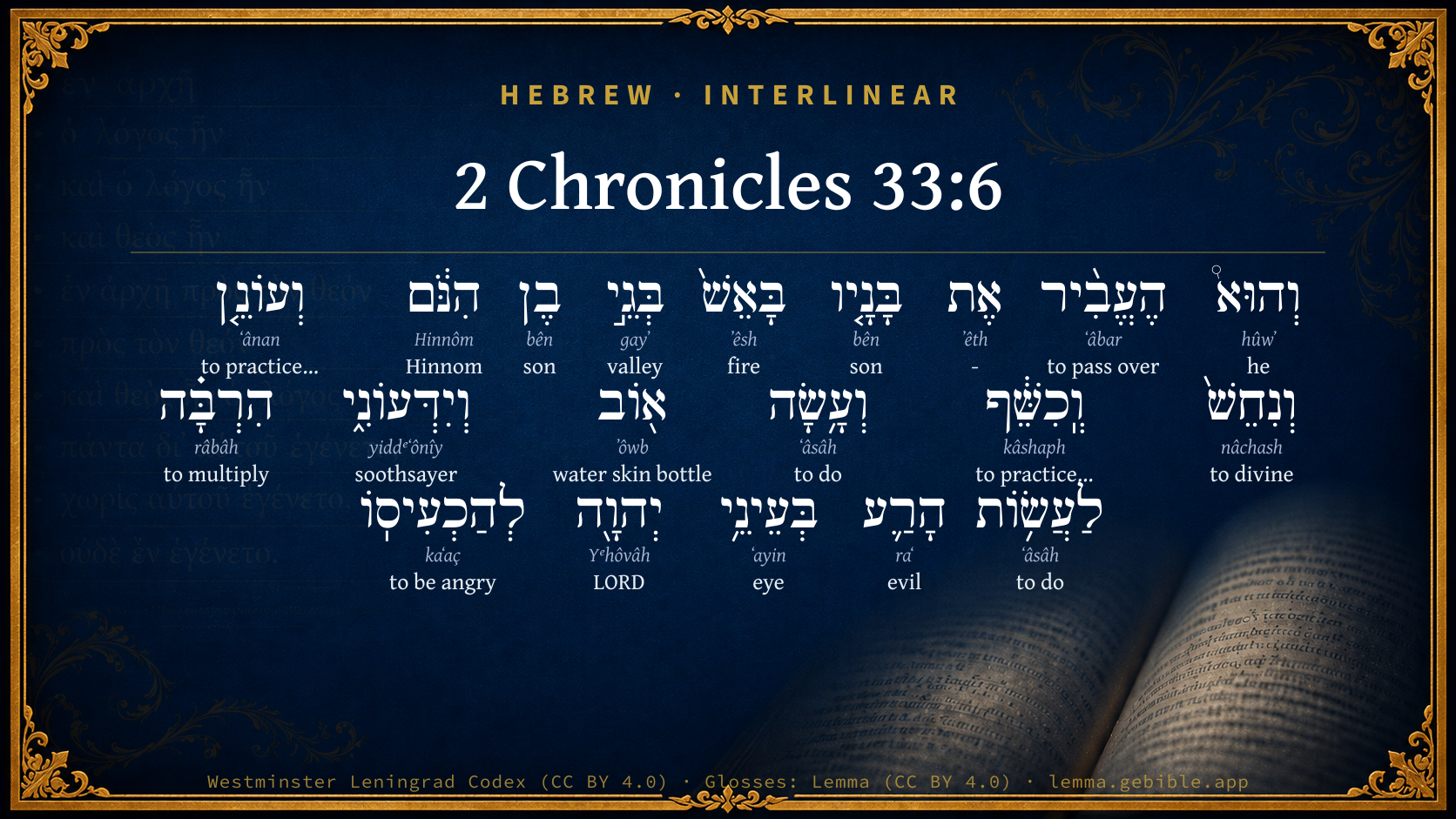
  1. וְהוּא֩ hûwʼ H1931 “and · he” Conjunction + Pronoun, Personal, 3rd Person, Masculine, Singular
  2. הֶעֱבִ֨יר ʻâbar H5674 “to pass over” Verb, Hiphil, Perfect, 3rd Person, Masculine, Singular
  3. אֶת ʼêth H853 “-” Particle, Direct Object
  4. בָּנָ֤יו bên H1121 “sons · his” Noun, Common, Masculine, Plural, Construct + Suffix, Personal, 3rd Person, Masculine, Singular
  5. בָּאֵשׁ֙ ʼêsh H784 “in/at the · fire” Preposition, Determined + Noun, Common, Both, Singular, Absolute
  6. בְּגֵ֣י gayʼ H1516 “in/at · valley of” Preposition + Noun, Common, Both, Singular, Construct
  7. בֶן bên H1121 “son” Noun, Proper
  8. הִנֹּ֔ם Hinnôm H2011 “Hinnom” Noun, Proper
  9. וְעוֹנֵ֤ן ʻânan H6049 “and · to practice sorcery” Conjunction + Verb, Poel, Perfect, 3rd Person, Masculine, Singular
  10. וְנִחֵשׁ֙ nâchash H5172 “and · to divine” Conjunction + Verb, Piel, Perfect, 3rd Person, Masculine, Singular
  11. וְעָ֥שָׂה ʻâsâh H6213 “and · to do” Conjunction + Verb, Qal, Perfect, 3rd Person, Masculine, Singular
  12. א֖וֹב ʼôwb H178 “water skin bottle” Noun, Common, Masculine, Singular, Absolute
  13. וְיִדְּעוֹנִ֑י yiddᵉʻônîy H3049 “and · soothsayer” Conjunction + Noun, Common, Masculine, Singular, Absolute
  14. הִרְבָּ֗ה râbâh H7235 “to multiply” Verb, Hiphil, Perfect, 3rd Person, Masculine, Singular
  15. לַעֲשׂ֥וֹת ʻâsâh H6213 “to do” Preposition + Verb, Qal, Infinitive Construct
  16. הָרַ֛ע raʻ H7451 “the · evil” Particle, Definite Article + Adjective, Adjective, Masculine, Singular, Absolute
  17. בְּעֵינֵ֥י ʻayin H5869 “in/at · eyes of” Preposition + Noun, Common, Both, Dual, Construct
  18. יְהוָ֖ה Yᵉhôvâh H3068 “LORD” Noun, Proper
  19. לְהַכְעִיסֽוֹ kaʻaç H3707 “to be angry · him” Preposition + Verb, Hiphil, Infinitive Construct + Suffix, Personal, 3rd Person, Masculine, Singular

About this verse

These counts appear in no published source. They are computed here, from the morphology-tagged text and Lemma’s own curated glosses. What Lemma adds →

20
words
18
distinct lemmas
Historical
section

Notable vocabulary

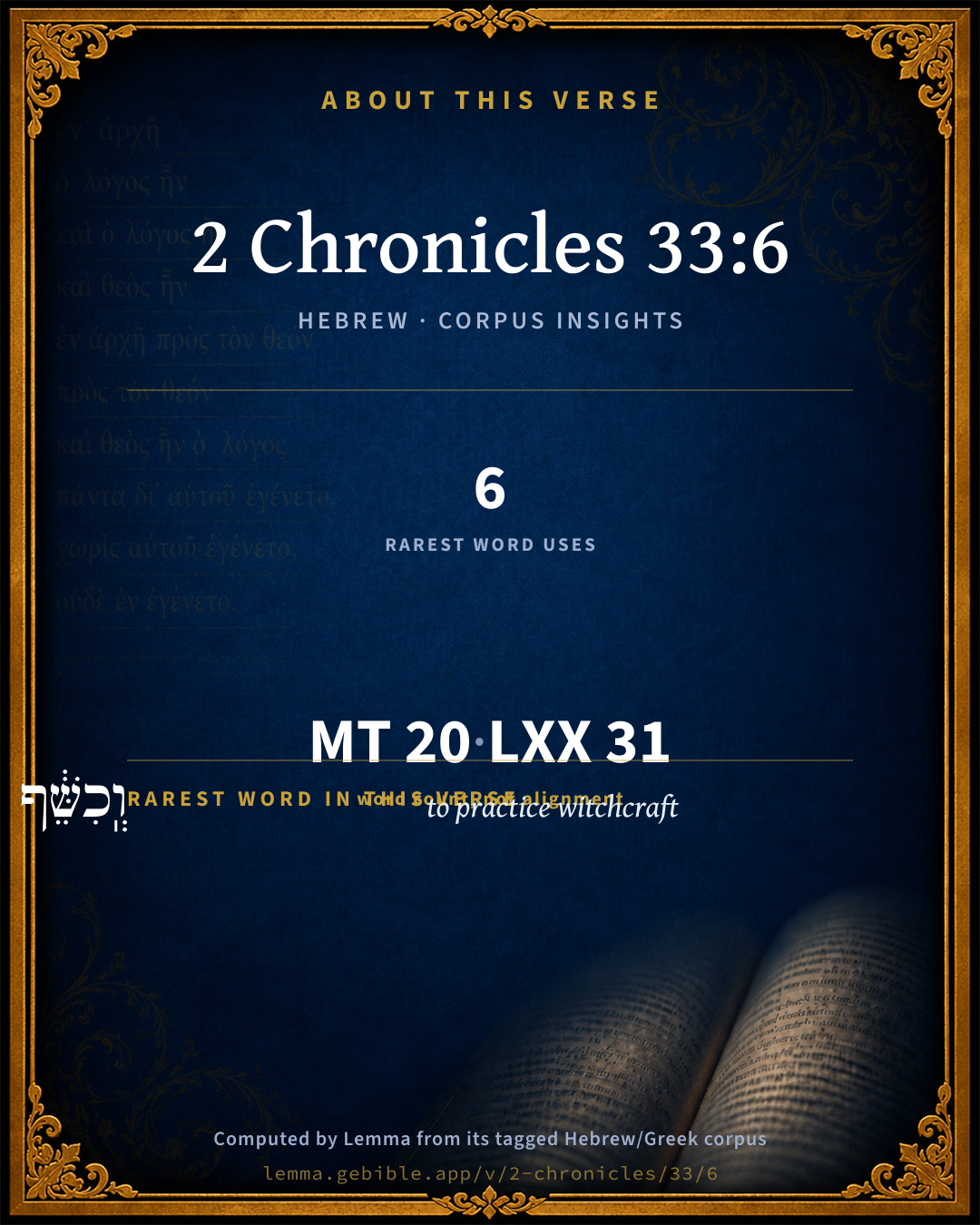
The rarest word here is וְֽכִשֵּׁ֔ף to practice witchcraft H3784 — appearing just 6 times in the whole Hebrew Bible.

Shared distinctive vocabulary

וְֽכִשֵּׁ֔ף to practice witchcraft H3784 occurs in 6 verses of the Hebrew Bible. Also found in:

Grammatical profile

  • 8 verbs
  • 9 nouns
  • 1 adjective
  • 1 pronoun
  • 1 particle

Verb forms

  • הֶעֱבִ֨יר Hiphil · Perfect
  • וְעוֹנֵ֤ן Poel · Perfect
  • וְנִחֵשׁ֙ Piel · Perfect
  • וְֽכִשֵּׁ֔ף Piel · Perfect
  • וְעָ֥שָׂה Qal · Perfect
  • הִרְבָּ֗ה Hiphil · Perfect
  • לַעֲשׂ֥וֹת Qal · Infinitive Construct
  • לְהַכְעִיסֽוֹ Hiphil · Infinitive Construct

Repetition

Words recur within this verse — often emphatic in Hebrew:

  • בָּנָ֤יו son H1121 ×2
  • וְעָ֥שָׂה to do H6213 ×2

Hebrew & Septuagint length

In English translation the verse runs 53 words from the Hebrew and 40 from the Septuagint (LXX English) — closely comparable.

A rough comparison of the two English renderings, which tokenize alike — not a word-level alignment.

Word counts can differ between the Hebrew and the Greek without any difference in meaning — e.g. the Hebrew direct-object marker אֵת has no separate Greek word, and Greek often adds the article ὁ.

In the original languages it is 20 Hebrew tokens and 31 Greek tokens — but the two are counted differently (Hebrew bundles its prefixes and suffixes into one token; the Greek is in lemma form), so that isn’t a like-for-like length.

Cross-references

22

Topical passages linked to 2 Chronicles 33:6 in the Treasury of Scripture Knowledge — connected by theme and wording, ordered by reader-vote popularity; previews shown in the World English Bible.

  • Leviticus 18:21 "'You shall not give any of your children to sacrifice to Molech; neither shall you profane the name of your God: I am Yahweh.
  • Leviticus 19:26 "'You shall not eat any meat with the blood still in it; neither shall you use enchantments, nor practice sorcery.
  • Leviticus 19:31 "'Don't turn to those who are mediums, nor to the wizards. Don't seek them out, to be defiled by them. I am Yahweh your God.
  • Leviticus 20:6 "'The person that turns to those who are mediums, and to the wizards, to play the prostitute after them, I will even set my face against that person, and will cut him off from among his people.
  • 2 Kings 21:6 He made his son to pass through the fire, and practiced sorcery, and used enchantments, and dealt with those who had familiar spirits, and with wizards: he worked much evil in the sight of Yahweh, to provoke him to anger.
  • 2 Chronicles 28:3 Moreover he burnt incense in the valley of the son of Hinnom, and burnt his children in the fire, according to the abominations of the nations whom Yahweh cast out before the children of Israel.
  • 1 Chronicles 10:13 So Saul died for his trespass which he committed against Yahweh, because of the word of Yahweh, which he didn't keep; and also because he asked counsel of one who had a familiar spirit, to inquire [thereby],
  • Isaiah 8:19 When they shall tell you, "Consult with those who have familiar spirits and with the wizards, who chirp and who mutter:" shouldn't a people consult with their God? on behalf of the living [should they consult] with the dead?
  • Isaiah 47:9–12 but these two things shall come to you in a moment in one day, the loss of children, and widowhood; in their full measure shall they come on you, in the multitude of your sorceries, and the great abundance of your enchantments.
  • Jeremiah 7:31–32 They have built the high places of Topheth, which is in the valley of the son of Hinnom, to burn their sons and their daughters in the fire; which I didn't command, neither came it into my mind.
  • Leviticus 20:2 "Moreover, you shall tell the children of Israel, 'Anyone of the children of Israel, or of the strangers who live as foreigners in Israel, who gives any of his seed to Molech; he shall surely be put to death. The people of the land shall stone him with stones.
  • Leviticus 20:27 "'A man or a woman that is a medium, or is a wizard, shall surely be put to death: they shall stone them with stones; their blood shall be upon them.'"
  • Deuteronomy 12:31 You shall not do so to Yahweh your God: for every abomination to Yahweh, which he hates, have they done to their gods; for even their sons and their daughters do they burn in the fire to their gods.
  • Deuteronomy 18:10–14 There shall not be found with you anyone who makes his son or his daughter to pass through the fire, one who uses divination, one who practices sorcery, or an enchanter, or a sorcerer,
  • 1 Samuel 15:23 For rebellion is as the sin of witchcraft, and stubbornness is as idolatry and teraphim. Because you have rejected the word of Yahweh, he has also rejected you from being king.
  • 2 Kings 17:17 They caused their sons and their daughters to pass through the fire, and used divination and enchantments, and sold themselves to do that which was evil in the sight of Yahweh, to provoke him to anger.
  • 2 Kings 23:10 He defiled Topheth, which is in the valley of the children of Hinnom, that no man might make his son or his daughter to pass through the fire to Molech.
  • 2 Kings 23:24 Moreover those who had familiar spirits, and the wizards, and the teraphim, and the idols, and all the abominations that were seen in the land of Judah and in Jerusalem, did Josiah put away, that he might confirm the words of the law which were written in the book that Hilkiah the priest found in the house of Yahweh.
  • Isaiah 19:3 The spirit of Egypt shall fail in the midst of it; and I will destroy the counsel of it: and they shall seek to the idols, and to the charmers, and to those who have familiar spirits, and to the wizards.
  • Ezekiel 23:37 For they have committed adultery, and blood is in their hands; and with their idols have they committed adultery; and they have also caused their sons, whom they bore to me, to pass through [the fire] to them to be devoured.
  • Ezekiel 23:39 For when they had slain their children to their idols, then they came the same day into my sanctuary to profane it; and, behold, thus have they done in the midst of my house.
  • Galatians 5:20 idolatry, sorcery, hatred, strife, jealousies, outbursts of anger, rivalries, divisions, heresies,

Cross-references courtesy of OpenBible.info (CC BY 4.0).

Hebrew and Greek witnesses Masoretic Hebrew ↔ Greek Septuagint

The same verse in the two great witnesses to the Old Testament, shown verse-for-verse.

These are two independent witnesses, not word-aligned to each other, and the Septuagint is shown in lemma (dictionary) form.

Hebrew 2 Chronicles 33:6 Masoretic · Westminster Leningrad Codex

וְהוּא֩ הֶעֱבִ֨יר אֶת בָּנָ֤יו בָּאֵשׁ֙ בְּגֵ֣י בֶן הִנֹּ֔ם וְעוֹנֵ֤ן וְנִחֵשׁ֙ וְֽכִשֵּׁ֔ף וְעָ֥שָׂה א֖וֹב וְיִדְּעוֹנִ֑י הִרְבָּ֗ה לַעֲשׂ֥וֹת הָרַ֛ע בְּעֵינֵ֥י יְהוָ֖ה לְהַכְעִיסֽוֹ

He also made his children to pass through the fire in the valley of the son of Hinnom; and he practiced sorcery, and used enchantments, and practiced sorcery, and dealt with those who had familiar spirits, and with wizards: he worked much evil in the sight of Yahweh, to provoke him to anger.

World English Bible · Public Domain

Greek LXX 2 Chronicles 33:6 Septuagint · lemma form

καί αὐτός διαἄγω ὁ τέκνον αὐτός ἐν πῦρ ἐν γαι καί κληδονίζω καί οἰωνίζομαι καί φαρμακεύω καί ποιέω ἐγγαστρίμυθος καί ἐπαοιδός πληθύνω ὁ ποιέω ὁ πονηρός ἐναντίον κύριος ὁ παραὀργίζω αὐτός

He also passed his children through the fire in the valley of Benennom; and he divined, and used auspices, and sorceries, and appointed those who had divining spirits, and enchanters, and wrought abundant wickedness before the Lord, to provoke him.

LXX2012 (modern English Septuagint) · Public Domain

On this verse, The Cambridge Bible for Schools and Colleges discusses the Septuagint’s reading. Read the note in Commentary ↓

Hebrew: Westminster Leningrad Codex (CC BY 4.0). Greek: Septuagint (public domain); English from LXX2012 (modern English Septuagint) (Public Domain). How the Septuagint differs from the Hebrew →

Commentary

Notes on 2 Chronicles 33:6 from classic Christian and Jewish commentators (each source and its license shown beneath its notes). The classic Christian expositions comment on the surrounding passage and are grouped to its opening verse, so a note may address several verses; the Jewish commentaries on the Tanakh (Rashi and others) are per-verse, so they appear only where the commentator wrote on this verse.

Lemma curates 59 commentaries, every one of them public domain or Creative Commons licensed, each selected and text-cleaned for this edition rather than reprinted as found. About our sources →

Trapp's Complete Commentary

John Trapp

2Ch 33:6 And he caused his children to pass through the fire in the valley of the son of Hinnom: also he observed times, and used enchantments, and used witchcraft, and dealt with a familiar spirit, and with wizards: he wrought much evil in the sight of the LORD, to provoke him to anger.

Ver. 6. And he caused his children to pass, &c.] Thinking thereby to merit remission of sin, {Mic 6:7} and to obtain victories, as that king of Moab did. {2Ki 3:27}

And he observed times, and used enchantments.] Five of those six sorts of witchcraft mentioned by Moses, {Deu 18:9-14} Manasseh fell into. See 2Ki 21:6.

John Trapp, A Commentary or Exposition upon All the Books of the Old and New Testament (1647–1656) — public domain. Text from a community e-Sword module.

Geneva Bible (1599)

Geneva Bible translators

Read 2 Kings 16:3.

Geneva Bible (1599) marginal notes — public domain. Text via Bolls.life.

Ellicott's Commentary for English Readers

(6) He.—Emphatic. Not in Kings.

Caused his children . . . fire.—The plural, as in 2Ch_28:3, is rhetorical. Kings, “his son.”

In the valley of the son of Hinnom.—Explanatory addition by the chronicler.

Also he observed times, and used enchantments.—And he practised augury and divination. Forbidden, Lev_19:26. The first words seem strictly to mean “observed clouds; “the second, “observed serpents.”

And used witchcraft.—And muttered spells or charms. This word does not occur in the parallel place, but all the offences here ascribed to Manasseh are forbidden in Deu_18:10-11.

And dealt with a familiar spirit, and with wizards.—And appointed a necromancer and a wizard. Kings has wizards. The source of all these modes of soothsaying was Babylon. Like the first king of Israel, Manasseh appears to have despaired of help or counsel from Jehovah. (Comp. Jer_44:17-18.) The heavy yoke of Assyria again weighed the nation down, and the great deliverance under Hezekiah was almost forgotten. “To all the Palestinian nations the Assyrian crisis had made careless confidence in the help of their national deities a thing impossible. As life was embittered by foreign bondage, the darker aspects of heathenism became dominant. The wrath of the gods seemed more real than their favour; atoning ordinances were multiplied, human sacrifices became more frequent, the terror which hung over all the nations that groaned under the Assyrian yoke found habitual expression in the ordinances of worship; and it was this aspect of heathenism that came to the front in Manasseh’s imitations of foreign religion” (Robertson Smith, The Prophets of Israel, p. 366).

He wrought much evil.—Literally, he multiplied doing the evil. He was worse than his evil predecessors

A Bible Commentary for English Readers, edited by Charles John Ellicott (1878–1897) — public domain. Text from a community e-Sword module.

The Cambridge Bible for Schools and Colleges

gen. ed. J. J. S. Perowne

6. And he caused] R.V. He also made. There is stress on the pronoun “He” (that wicked one!).

to pass through the fire] Cp. 2Ch_28:3, note.

in the valley of the son of Hinnom] Cp. Jer_7:31-32.

observed times] R.V. practised augury. The precise meaning of the Heb. word (‘ônçn) is quite uncertain. “Augury” among the Romans consisted chiefly in observing birds and interpreting the observations made, but augurs observed also various natural phenomena.

used witchcraft] R.V. practised sorcery. The Heb. word (kishshçph) is said to mean “make a magic brew with shredded herbs.”

with a familiar spirit] R.V. with them that had familiar spirits. The Heb. word (ôb) probably means a necromancer who uses ventriloquism in the practice of his art. The witch of Endor (1 Samuel 28) was such a person. LXX. here has [ἐποίησεν] ἐνγαστριμύθους, i.e. “he appointed ventriloquists.”

The Cambridge Bible for Schools and Colleges (gen. ed. J. J. S. Perowne; Cambridge University Press, 1878–1918) — public domain. Text from a community e-Sword module.

Haydock's Catholic Bible Commentary

Valley. Heb. Ge-ben-hinnon, "the vale of the son of Ennom," (H.) a Jebusite, who had formerly possessed that part of the valley of Cedron. M. Syriac write Gena, whence comes Greek: geenna a place at the foot of Moria, and the sink of the city. A constant fire was kept up to burn dead bodies. Kimchi. D.

George Leo Haydock (1774–1849), Haydock's Catholic Family Bible and Commentary, 1859 edition — public domain. Excludes Psalms (Douay-Rheims chapter numbering differs from Protestant) and Deuterocanonical books (Catholic canon only).

The Pulpit Commentary

Caused his children. Parallel, (2Ki_21:6) "his son," in the singular number. (see also 2Ki_16:3 compared with our 2Ch_28:3) There can be no doubt that this worst of cruel abominations, learned from Ammon and Moab, amounted to nothing less than the sacrifice of the child in the fire. It is, perhaps, something remarkable that we do not encounter anywhere any description of the exact manner of administration of this cruelty, and of its taking effect on the pitiable victim. The solemn commands of Lev_18:21 and Deu_18:10 bespeak sufficiently distinctly the prevision and earnest precaution of the Divine Ruler of Israel, through Moses, on behalf of his people. The following references all bear on the subject, and will be studied with advantage in order given: 2Ki_3:27 2Ki_17:17; Mic_6:7; Amo_5:26; Jer_7:32 Jer_19:4; Eze_16:20 Eze_20:26. In the valley of the son of Hinnom. (Jos_15:8 Jos_18:16) On an elevation at the eastern extremity of this valley it was that Solomon erected "high places" to Moloch, entailing on himself a long and dire responsibility. (1Ki_11:7) Consult also our 2Ch_28:3 and note there; with added reference, Stanley"s "Sinai and Palestine,"pp. 172, 482. Also he observed times; Revised Version, and he practised augury. The Hebrew word is newOw. This root is found once in piel infinitive, (Gen_9:14) and is rendered (Authorized Version), "when I bring a cloud," etc.; beside, it is found in all ten times, always in poel, in preterite twice (the present passage and parallel), future once, (Lev_19:26) participle seven times (Deu_18:10, Deu_18:14; Jud_1:9:37, margin) in which six places it is rendered (Authorized Version) "observing times," once in Isaiah and Micah with rendering "soothsayers," again in Isaiah "sorcerers," and in Jeremiah "enchanter." There is difficulty in fixing its exact meaning, though its general meaning may be embraced in the words of the Revised Version. A likely meaning, judging from derivation, may be the practising augury from observing of the clouds. The passages in Leviticus and Deuteronomy are those that of old solemnly prohibited it. And used enchantments; Hebrew, vjeniw; the root is the familiar word for "serpent." The verb occurs eleven times, always in piel. The prohibition to practise such "enchantment" or divination is found in Lev_19:26 Lev_18:10; the five occasions of the use of the word in Genesis, however, (Gen_30:27 Gen_44:5, Gen_44:15) argue that it was not a thing intrinsically bad, but bad probably from. certain, so to say, simoniacal possibilities to which it lent itself. There lay in it some assumption, no doubt, of superhuman help, and the wickedness may have consisted in assuming it where it was not real. And used witchcraft; Hebrew, pCekiw; Revised Version, and practised sorcery. The word is found six times in piel. The prohibition is found in Deu_18:10; the rendering of the word (Authorized Version) is by the term "sorcery" three times, and "witch" or "witchcraft" the other three times. Dealt with a familiar Spirit, and with wizards. The prohibitions are in Lev_19:31 Lev_20:6, Lev_20:27; Deu_18:11. See as illustrations 1Sa_28:3-21; and notice the language of Isa_8:19, "that chirp and mutter;" and Isa_19:3.

The Pulpit Commentary (1880–1919), ed. H.D.M. Spence-Jones & Joseph S. Exell — public domain. Text from a community e-Sword module.

Rashi

Rabbi Shlomo Yitzchaki (Rashi)

and those who divine by the jidoa bone - Heb. יִדְּעוֹנִי spelled in full with a “vav,” because he did much [evil], and he added to the graven image of the idol that he made. They would take the bone of an animal known as jidoa, and place it in their mouths, whence it would speak.

Rashi on the Tanakh — English translations: “The Judaica Press complete Tanach with Rashi, translated by A. J. Rosenberg” (CC BY 4.0); “Pentateuch with Rashi's commentary by M. Rosenbaum and A.M. Silbermann, 1929-1934” (public domain); “The Metsudah Tanach series, Lakewood, N.J” (CC BY 4.0); and “The Book of Joshua, Metsudah Publications, 1997” (CC BY 4.0). Text via Sefaria.

Lesson kit

Teaching starters — assembled from the data on this page, not authored interpretation. Every prompt links to the verse data it draws on. Edit before teaching.

2 Chronicles, in the Historical, opens this verse with 20 words (18 distinct Hebrew lemmas). Its most distinctive word is kâshaph (“to practice witchcraft”). A historical commentator’s framing appears above. Read the whole chapter for the surrounding context.

Discussion questions

  1. How does “to practice witchcraft” (kâshaph) shape what this verse is saying?
  2. Exodus 7:11 shares the word «to practice witchcraft» with this verse. How do the two illuminate each other?
  3. “son” occurs 2× in this one verse. What is the effect of the repetition?
  4. These translations render this verse differently; the difference is in the English rendering, not the original. What questions does that raise?
  5. The verb «הֶעֱבִ֨יר» is Hiphil Perfect. How does its form color the action?
  6. Reading how Trapp's Complete Commentary and Geneva Bible (1599) read this verse, where do the two commentators agree and where do they part?

Things to notice

Reading settings

Reading text

Shown beneath each verse's original-language words.

Old Testament
Old Testament edition

Read the OT as the Masoretic Hebrew (MT) or the Greek Septuagint (LXX).

English shown for the Greek Septuagint (in the Hebrew ↔ Greek comparison).

Comparing translations? Open the Compare panel on any verse page to stack up to four side by side.