
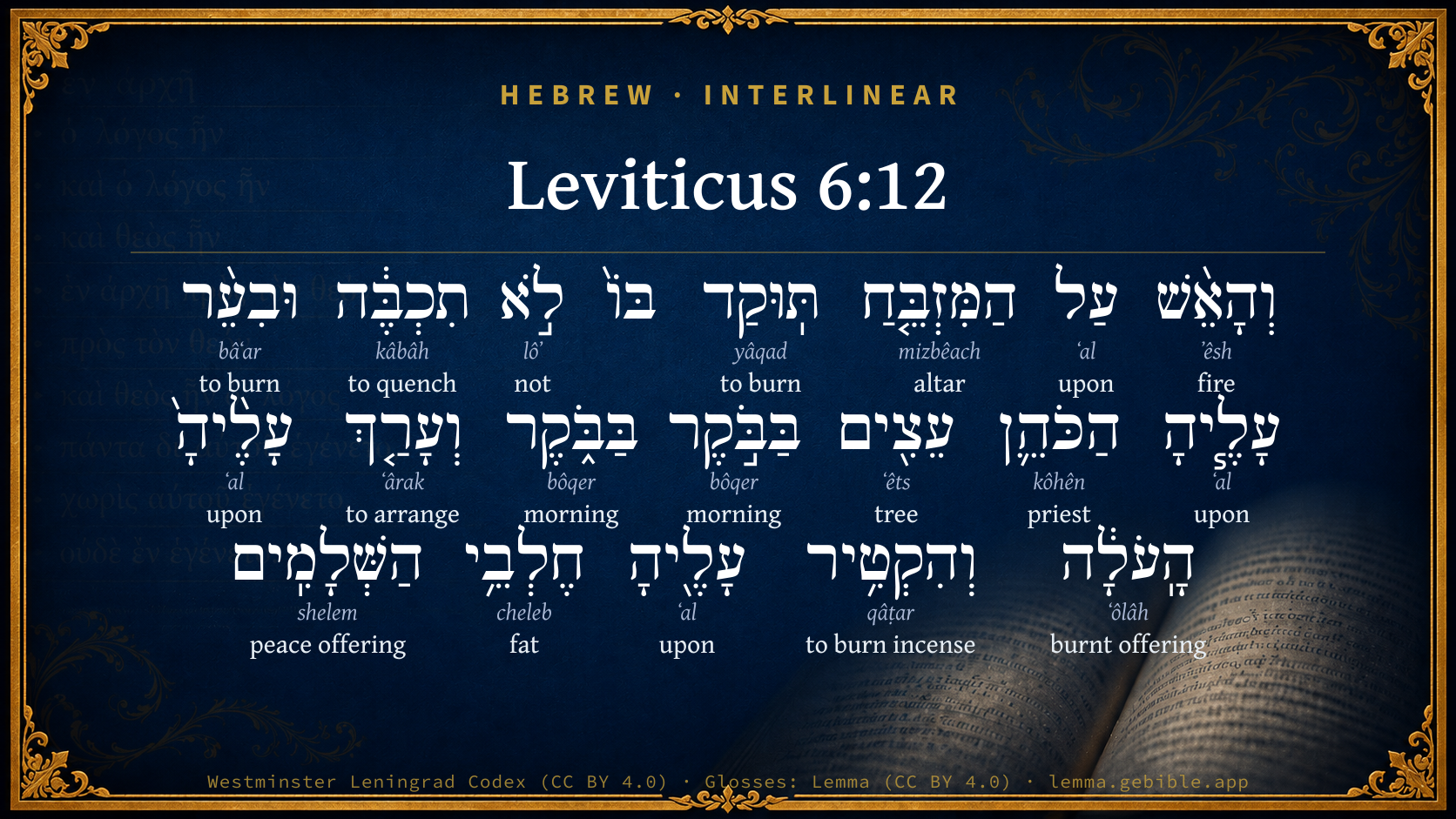
Leviticus 6:12

Hebrew (Westminster Leningrad Codex) Leviticus 6:12 appears in the Hebrew Old Testament. The text above is from the Westminster Leningrad Codex. Each word links to its Strong’s number, a concise gloss, and parsing drawn from the Open Scriptures Hebrew Bible morphology. Click any word for its full Brown-Driver-Briggs (BDB) entry.
Download image
Cite this verse

Leviticus 6:12 (World English Bible). Public Domain. Lemma interlinear Bible study tool, https://lemma.gebible.app/v/leviticus/6/12.

Show BibTeX & RIS
BibTeX
RIS
English Translation
The fire on the altar shall be kept burning on it, it shall not go out; and the priest shall burn wood on it every morning: and he shall lay the burnt offering in order upon it, and shall burn on it the fat of the peace offerings.
World English Bible · Public Domain
Highlights
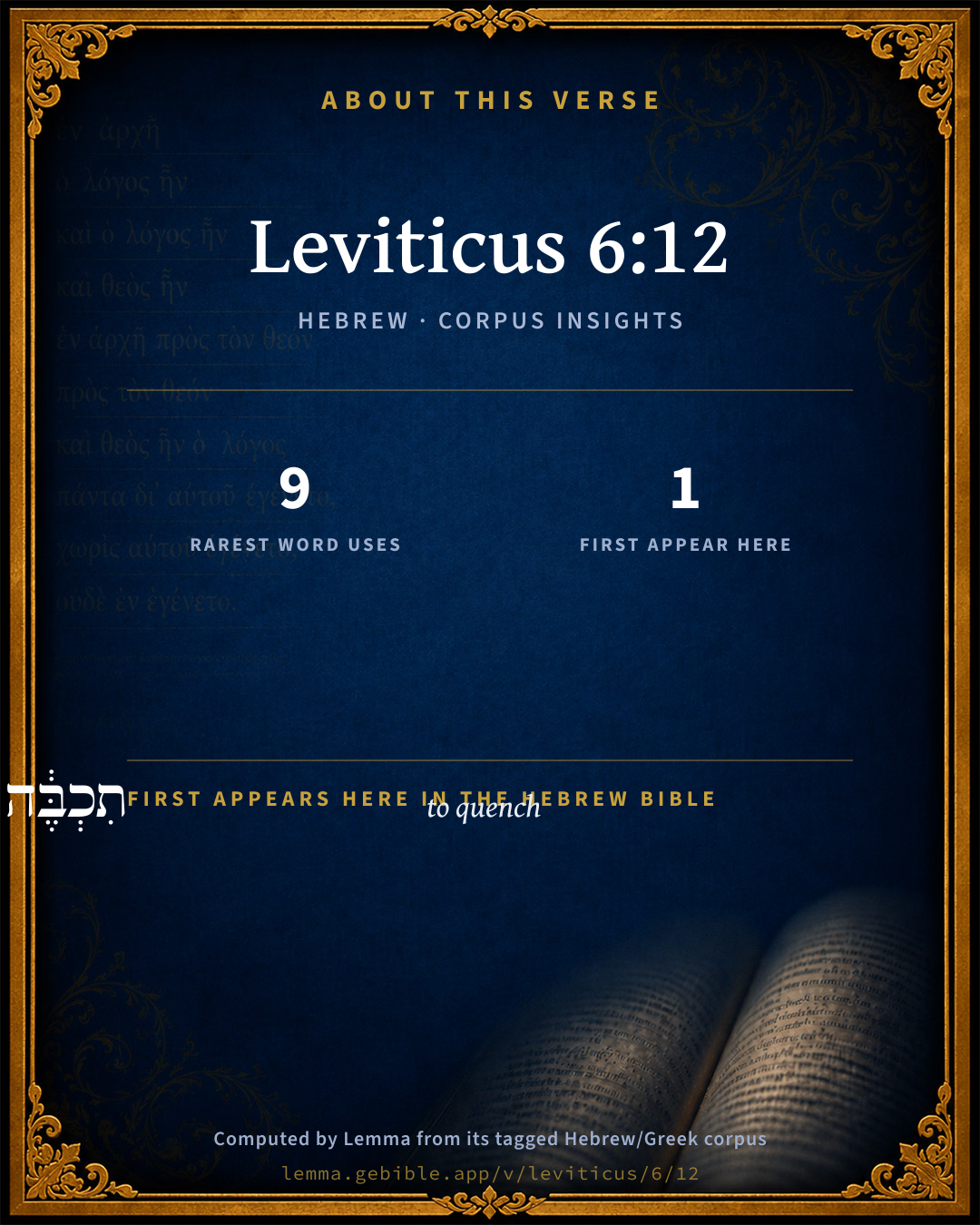
  • 1 first appearance in the Hebrew Bible
Full analysis ↓
Download a study sheet

One document with this verse’s original text, its word-by-word gloss line, the meaning frame, cross-references with their text, attributed commentary, and full source and license credits — printable, and it pastes into notes with its structure intact.

This verse Autodidact and up

Study sheet (.html) Plain text (.txt)

A passage Seminary Student

Up to 50 verses in one chapter. A passage sheet keeps up to 6 commentary sources and 12 cross-references per verse, in the order this page ranks them, and says so on the sheet whenever that leaves anything out. Ask for a single verse and you get the Autodidact verse sheet above.

Everything on this page stays free to read, with no account — the sheet is a download of what is already on screen, not access to it.

Want to remove ads? Support Godless Engineer
Compare translations 3

The same verse in 3 English versions, stacked beneath the original-language interlinear above. Click any original word for its lexicon entry.

Each is an independent rendering of the whole verse — the interlinear is not word-aligned to these translations.

Highlighted words mark where these versions differ — a whole-verse word diff, not a word-by-word alignment.

  • World English Bible Public Domain
    The fire on the altar shall be kept burning on it, it shall not go out; and the priest shall burn wood on it every morning: and he shall lay the burnt offering in order upon it, and shall burn on it the fat of the peace offerings.
  • King James Version Public Domain
    And the fire upon the altar shall be burning in it; it shall not be put out: and the priest shall burn wood on it every morning, and lay the burnt offering in order upon it; and he shall burn thereon the fat of the peace offerings.
  • unfoldingWord Literal Text CC BY-SA 4.0
    But the fire on the altar shall be made to burn on it. It shall not go out, and the priest shall burn wood on it, in the morning, in the morning. And he shall arrange the burnt offering on it and he shall cause the fat of the peace offerings to become smoke on it.

unfoldingWord Literal Text — © unfoldingWord, licensed CC BY-SA 4.0. Word-aligned USFM3 via Door43 (git.door43.org/unfoldingWord/en_ult).

Versions to compare (up to 4)

3 of 4 selected

Show all 18 translations

Every available English version of this verse, each an independent rendering of the whole verse.

  • World English Bible Public Domain
    The fire on the altar shall be kept burning on it, it shall not go out; and the priest shall burn wood on it every morning: and he shall lay the burnt offering in order upon it, and shall burn on it the fat of the peace offerings.
  • Berean Standard Bible Public Domain
    The fire on the altar shall be kept burning; it must not be extinguished. Every morning the priest is to add wood to the fire, arrange the burnt offering on it, and burn the fat portions of the peace offerings on it.
  • Majority Standard Bible Public Domain
    The fire on the altar shall be kept burning; it must not be extinguished. Every morning the priest is to add wood to the fire, arrange the burnt offering on it, and burn the fat portions of the peace offerings on it.
  • King James Version Public Domain
    And the fire upon the altar shall be burning in it; it shall not be put out: and the priest shall burn wood on it every morning, and lay the burnt offering in order upon it; and he shall burn thereon the fat of the peace offerings.
  • American Standard Version (1901) Public Domain
    And the fire upon the altar shall be kept burning thereon, it shall not go out; and the priest shall burn wood on it every morning: and he shall lay the burnt-offering in order upon it, and shall burn thereon the fat of the peace-offerings.
  • Revised Version (1885) Public Domain
    And the fire upon the altar shall be kept burning thereon, it shall not go out; and the priest shall burn wood on it every morning: and he shall lay the burnt offering in order upon it, and shall burn thereon the fat of the peace offerings.
  • Geneva Bible (1599) Public Domain
    But the fire vpon the altar shall burne thereon and neuer be put out: wherefore the Priest shall burne wood on it euery morning, and lay the burnt offering in order vpon it, and he shall burne thereon the fat of the peace offrings.
  • Douay-Rheims (1899) Public Domain
    And the fire on the altar shall always burn, and the priest shall feed it, putting wood on it every day in the morning, and laying on the holocaust, shall burn thereupon the fat of the peace offerings.
  • Young's Literal Translation Public Domain
    `And the fire on the altar is burning on it, it is not quenched, and the priest hath burned on it wood morning by morning, and hath arranged on it the burnt-offering, and hath made perfume on it `with' the fat of the peace-offerings;
  • Literal Standard Version CC BY-SA 4.0
    And the fire on the altar is burning on it, it is not quenched, and the priest has burned wood on it morning by morning, and has arranged the burnt-offering on it, and has made incense on it [with] the fat of the peace-offerings;
  • Unlocked Literal Bible CC BY-SA 4.0
    The fire on the altar will be kept burning. It must not go out, and the priest will burn wood on it every morning. He will arrange the burnt offering as required on it, and he will burn on it the fat of the peace offerings.
  • unfoldingWord Literal Text CC BY-SA 4.0
    But the fire on the altar shall be made to burn on it. It shall not go out, and the priest shall burn wood on it, in the morning, in the morning. And he shall arrange the burnt offering on it and he shall cause the fat of the peace offerings to become smoke on it.
  • Darby Bible Public Domain
    And the fire upon the altar shall be kept burning on it: it shall not be put out; and the priest shall burn wood on it every morning, and lay the burnt-offering in order upon it; and he shall burn thereon the fat of the peace-offerings.
  • World Messianic Bible Public Domain
    The fire on the altar shall be kept burning on it, it shall not go out; and the priest shall burn wood on it every morning. He shall lay the burnt offering in order upon it, and shall burn on it the fat of the peace offerings.
  • Webster's Bible Public Domain
    \\6:19\\And the LORD spoke to Moses, saying,
  • Free Bible Version CC BY-SA 4.0
    The fire on the altar must be kept burning—don't let it go out. Each morning the priest is to add wood to the fire, carefully place the burnt offering on it, and burn the fat parts of the peace offerings on it.
  • Bible in Basic English Public Domain
    And the Lord said to Moses,
  • JPS Tanakh (1917) Public Domain
    (6-5) And the fire upon the altar shall be kept burning thereby, it shall not go out; and the priest shall kindle wood on it every morning; and he shall lay the burnt-offering in order upon it, and shall make smoke thereon the fat of the peace-offerings.

Literal Standard Version (2020), Covenant Press — licensed CC BY-SA 4.0. Text via the HelloAO Bible API (eBible.org). Unlocked Literal Bible (unfoldingWord) — licensed CC BY-SA 4.0. Text via the HelloAO Bible API (eBible.org). unfoldingWord Literal Text — © unfoldingWord, licensed CC BY-SA 4.0. Word-aligned USFM3 via Door43 (git.door43.org/unfoldingWord/en_ult). Free Bible Version, Dr. Jonathan Gallagher — licensed CC BY-SA 4.0. Text via the HelloAO Bible API (eBible.org).

Word by word

More ways to search: Search by grammar → Find every occurrence → Compare this word →

Practice this passage: Drill this verse → Learn its vocabulary →

תּֽוּקַד
yâqad
H3344
“to burn”
Verb, Hophal, Imperfect, 3rd Person, Feminine, Singular
Part of Speech
Verb
Stem
Hophal
Form
Imperfect
Person
3rd Person
Gender
Feminine
Number
Singular
Full BDB Definition

Origin: a primitive root

TWOT: 901

to burn, kindle, be kindled - (Qal) to be kindled - (Hophal) to burn, be burning
  1. וְהָאֵ֨שׁ ʼêsh H784 “and · the · fire” Conjunction + Particle, Definite Article + Noun, Common, Both, Singular, Absolute
  2. עַל ʻal H5921 “upon” Preposition
  3. הַמִּזְבֵּ֤חַ mizbêach H4196 “the · altar” Particle, Definite Article + Noun, Common, Masculine, Singular, Absolute
  4. לֹ֣א lôʼ H3808 “not” Particle, Negative
  5. תִכְבֶּ֔ה kâbâh H3518 “to quench” Verb, Qal, Imperfect, 3rd Person, Feminine, Singular
  6. וּבִעֵ֨ר bâʻar H1197 “and · to burn” Conjunction + Verb, Piel, Sequential Perfect, 3rd Person, Masculine, Singular
  7. עָלֶ֧יהָ ʻal H5921 “upon · her” Preposition + Suffix, Personal, 3rd Person, Feminine, Singular
  8. הַכֹּהֵ֛ן kôhên H3548 “the · priest” Particle, Definite Article + Noun, Common, Masculine, Singular, Absolute
  9. עֵצִ֖ים ʻêts H6086 “trees” Noun, Common, Masculine, Plural, Absolute
  10. בַּבֹּ֣קֶר bôqer H1242 “in/at the · morning” Preposition, Determined + Noun, Common, Masculine, Singular, Absolute
  11. בַּבֹּ֑קֶר bôqer H1242 “in/at the · morning” Preposition, Determined + Noun, Common, Masculine, Singular, Absolute
  12. וְעָרַ֤ךְ ʻârak H6186 “and · to arrange” Conjunction + Verb, Qal, Sequential Perfect, 3rd Person, Masculine, Singular
  13. עָלֶ֨יהָ֙ ʻal H5921 “upon · her” Preposition + Suffix, Personal, 3rd Person, Feminine, Singular
  14. הָֽעֹלָ֔ה ʻôlâh H5930 “the · burnt offering” Particle, Definite Article + Noun, Common, Feminine, Singular, Absolute
  15. וְהִקְטִ֥יר qâṭar H6999 “and · to burn incense” Conjunction + Verb, Hiphil, Sequential Perfect, 3rd Person, Masculine, Singular
  16. עָלֶ֖יהָ ʻal H5921 “upon · her” Preposition + Suffix, Personal, 3rd Person, Feminine, Singular
  17. חֶלְבֵ֥י cheleb H2459 “fat of” Noun, Common, Masculine, Plural, Construct
  18. הַשְּׁלָמִֽים shelem H8002 “the · peace offerings” Particle, Definite Article + Noun, Common, Masculine, Plural, Absolute

About this verse

These counts appear in no published source. They are computed here, from the morphology-tagged text and Lemma’s own curated glosses. What Lemma adds →

20
words
15
distinct lemmas
Pentateuch
section

Notable vocabulary

The rarest word here is תּֽוּקַד to burn H3344 — appearing just 9 times in the whole Hebrew Bible.

First appearance in Scripture

This word makes its first canonical appearance in the Hebrew Bible here:

  • תִכְבֶּ֔ה to quench H3518

Shared distinctive vocabulary

תּֽוּקַד to burn H3344 occurs in 9 verses of the Hebrew Bible. Also found in:

Grammatical profile

  • 5 verbs
  • 9 nouns
  • 5 prepositions
  • 1 particle

Verb forms

  • תּֽוּקַד Hophal · Imperfect
  • תִכְבֶּ֔ה Qal · Imperfect
  • וּבִעֵ֨ר Piel · Sequential Perfect
  • וְעָרַ֤ךְ Qal · Sequential Perfect
  • וְהִקְטִ֥יר Hiphil · Sequential Perfect

Repetition

Words recur within this verse — often emphatic in Hebrew:

  • עַל upon H5921 ×4
  • בַּבֹּ֣קֶר morning H1242 ×2

Hebrew & Septuagint length

In English translation the verse runs 48 words from the Hebrew and 46 from the Septuagint (LXX English) — closely comparable.

A rough comparison of the two English renderings, which tokenize alike — not a word-level alignment.

Word counts can differ between the Hebrew and the Greek without any difference in meaning — e.g. the Hebrew direct-object marker אֵת has no separate Greek word, and Greek often adds the article ὁ.

Cross-references

8

Topical passages linked to Leviticus 6:12 in the Treasury of Scripture Knowledge — connected by theme and wording, ordered by reader-vote popularity; previews shown in the World English Bible.

  • Leviticus 9:24 There came forth fire from before Yahweh, and consumed the burnt offering and the fat upon the altar: and when all the people saw it, they shouted, and fell on their faces.
  • Exodus 29:38–42 "Now this is that which you shall offer on the altar: two lambs a year old day by day continually.
  • Leviticus 1:7–9 The sons of Aaron the priest shall put fire on the altar, and lay wood in order on the fire;
  • Leviticus 3:3–5 He shall offer of the sacrifice of peace offerings an offering made by fire to Yahweh; the fat that covers the innards, and all the fat that is on the innards,
  • Nehemiah 13:31 and for the wood-offering, at times appointed, and for the first fruits. Remember me, my God, for good.
  • Leviticus 3:9–11 He shall offer from the sacrifice of peace offerings an offering made by fire to Yahweh; its fat, the entire tail fat, he shall take away close to the backbone; and the fat that covers the inwards, and all the fat that is on the inwards,
  • Leviticus 3:14–16 He shall offer from it as his offering, an offering made by fire to Yahweh; the fat that covers the innards, and all the fat that is on the innards,
  • Numbers 4:13–14 They shall take away the ashes from the altar, and spread a purple cloth on it.

Cross-references courtesy of OpenBible.info (CC BY 4.0).

Hebrew and Greek witnesses Masoretic Hebrew ↔ Greek Septuagint

The same verse in the two great witnesses to the Old Testament, shown verse-for-verse.

These are two independent witnesses, not word-aligned to each other, and the Septuagint is shown in lemma (dictionary) form.

Hebrew Leviticus 6:12 Masoretic · Westminster Leningrad Codex

וְהָאֵ֨שׁ עַל הַמִּזְבֵּ֤חַ תּֽוּקַד בּוֹ֙ לֹ֣א תִכְבֶּ֔ה וּבִעֵ֨ר עָלֶ֧יהָ הַכֹּהֵ֛ן עֵצִ֖ים בַּבֹּ֣קֶר בַּבֹּ֑קֶר וְעָרַ֤ךְ עָלֶ֨יהָ֙ הָֽעֹלָ֔ה וְהִקְטִ֥יר עָלֶ֖יהָ חֶלְבֵ֥י הַשְּׁלָמִֽים

The fire on the altar shall be kept burning on it, it shall not go out; and the priest shall burn wood on it every morning: and he shall lay the burnt offering in order upon it, and shall burn on it the fat of the peace offerings.

World English Bible · Public Domain

Greek LXX Leviticus 6:12 Septuagint · lemma form

καί λαλέω κύριος πρός μωυσῆς λέγω

And the fire on the altar shall be kept burning on it, and shall not be extinguished; and the priest shall burn on it wood every morning, and shall heap on it the whole burnt offering, and shall lay on it the fat of the peace-offering.

LXX2012 (modern English Septuagint) · Public Domain

Hebrew: Westminster Leningrad Codex (CC BY 4.0). Greek: Septuagint (public domain); English from LXX2012 (modern English Septuagint) (Public Domain). How the Septuagint differs from the Hebrew →

Targum (Aramaic paraphrase)

2

The Targum is the ancient Jewish Aramaic paraphrase of the Hebrew Scriptures — an interpretive translation, not the Hebrew text itself. Onkelos (literal) and Pseudo-Jonathan (expansive) render the Torah, and Jonathan the Prophets. Coverage is partial: where no permissively-licensed English translation exists for a verse, only the Aramaic is shown. This is verse-level text, not a word-by-word alignment to the Hebrew.

  1. Targum Onkelos Torah (Genesis–Deuteronomy)
    וּמַלִיל יְיָ עִם מֹשֶׁה לְמֵימָר

    (no public-domain English translation for this verse)

    Targum Onkelos — Aramaic: “Onkelos Genesis” (public domain); “Onkelos Exodus” (public domain); “Onkelos Leviticus” (public domain); “Onkelos Numbers” (public domain); “Onkelos Deuteronomy” (public domain). English: “Sefaria Community Translation” (CC0 1.0 (public-domain dedication)); “J.W. Etheridge. The Targums of Onkelos and Jonathan Ben Uzziel on the Pentateuch. London: Longmans, Green, 1862” (public domain). Text via Sefaria.

  2. Targum Pseudo-Jonathan Torah (Genesis–Deuteronomy)
    וּמַלֵיל יְיָ עִם משֶׁה לְמֵימָר

    And the Lord spake with Mosheh, saying:

    Targum Pseudo-Jonathan — Aramaic: “Targum Jonathan on Genesis” (public domain); “Targum Jonathan on Exodus” (public domain); “Targum Jonathan on Leviticus” (public domain); “Targum Jonathan on Numbers” (public domain); “Targum Jonathan on Deuteronomy” (public domain). English: “The Targum of Jonathan ben Uzziel, trans. J. W. Etheridge, London, 1862” (public domain). Text via Sefaria.

Commentary

Notes on Leviticus 6:12 from classic Christian and Jewish commentators (each source and its license shown beneath its notes). The classic Christian expositions comment on the surrounding passage and are grouped to its opening verse, so a note may address several verses; the Jewish commentaries on the Tanakh (Rashi and others) are per-verse, so they appear only where the commentator wrote on this verse.

Lemma curates 59 commentaries, every one of them public domain or Creative Commons licensed, each selected and text-cleaned for this edition rather than reprinted as found. About our sources →

John Gill's Exposition

And the fire upon the altar shall be burning in it, it shall not be put out,.... There were three fires, or piles of wood for fire continually; the first was a large one, on which the daily sacrifice was burnt; the second less, and called the pile of the incense, because they took from it fire in a censer to burn the morning and evening incense; and the third was only for preserving the fire that it might not go out: and of this it is written, Lev 6:12 (x); and Maimonides (y) observes, that some say, the first of these is meant by the burning all night, Lev 6:9 and the second by the fire of the altar burning in it, Lev 6:12 but his own sense is, the third is meant by it; and in the sense of R. Joses, these three fires were all burning upon the altar; the first was towards the east side of the altar, the second towards the southwest, as being nearer to the rise of the altar, where the priests were, and the third was made in any part of the altar as was thought fit (z); and this is the fire not to be put out, and he that quenched it, though but one coal, was to be beaten, yea, though it be brought down from the altar (a):

and the priest shall burn wood in it every morning: until the fourth hour of the day, according to the Targum of Jonathan; that is, unto ten o'clock in the morning:

and lay the burnt offering in order upon it; both morning and evening, and as often as any sacrifices of that kind were offered up:

and he shall burn thereon the fat of the peace offerings; that which was upon the inwards and covered them, and upon the kidneys, and flanks, and caul of the liver; see Lev 3:3.

(x) Maimon. Hilchot Tamidin, c. 2. sect. 4. Bartenora in Misn. Tamid, c. 2. sect. 4. & in Yoma, c. 4. sect. 6. (y) In ib. sect. 5. & in Yoma, c. 4. sect. 6. (z) Maimon. Hilchot Tamidin, c. 2. sect. 7, 8, 9. (a) Ibid. sect. 6.

John Gill's Exposition of the Whole Bible (1746–1763) — public domain (CC PDM 1.0). Text via the HelloAO Bible API.

Trapp's Complete Commentary

John Trapp

Lev 6:12 And the fire upon the altar shall be burning in it; it shall not be put out: and the priest shall burn wood on it every morning, and lay the burnt offering in order upon it; and he shall burn thereon the fat of the peace offerings.

Ver. 12. It shall not be put out.] No more should our faith, love, zeal (that flame of God, as Solomon calls it, Son 8:9), that should never go out; the waters should not quench it, nor the ashes cover it. {Son 8:10 2Ti 1:6}

John Trapp, A Commentary or Exposition upon All the Books of the Old and New Testament (1647–1656) — public domain. Text from a community e-Sword module.

Joseph Benson's Commentary

Lev 6:12-13. It shall not be put out — The fire coming down from heaven, was to be perpetually preserved, and not suffered to go out, partly that there might be no occasion or temptation to offer strange fire, and partly to teach them whence they were to expect the acceptance of all their sacrifices, even from the divine mercy, through the influence of the Holy Spirit, signified by the fire that came down from heaven, which was a usual token of God’s favourable acceptance. Every morning — Though the evening also be doubtless intended, yet the morning is only mentioned, because then the altar was cleansed, and the ashes taken away, and a new fire made. Thereon — Upon the burnt-offering, which thereby would be sooner consumed, that so a way might be made for other sacrifices.

Joseph Benson's Commentary on the Old and New Testaments (1811–1818) — public domain. Text from a community e-Sword module.

Tyndale Open Study Notes

Tyndale Open Resources

6:12-13 This passage cautions that the fire on the bronze altar must be constantly tended and never allowed to go out, perhaps anticipating the tragedy of the “wrong kind of fire” offered by Nadab and Abihu (10:1-2).

Tyndale Open Study Notes — © Tyndale Open Resources, licensed CC BY-SA 4.0. Text via the HelloAO Bible API.

Ellicott's Commentary for English Readers

(12) And the fire upon the altar shall be burning in it.—Better, and the fire upon the altar shall burn by it. This is almost a literal repetition of the last clause in Lev_6:9, and is here introduced to caution the priest whose function it is to remove the ashes. When engaged in this act, he is to take great care that in taking off the ashes from the altar, he does not knock away the fat pieces of the burnt offering, which constitute the fuel, from the fire, and thus cause it to go out, but let it burn by the fat all night.

And the priest shall burn wood on it every morning.—In the morning, however, the priest is to replenish the burning fuel on the altar with the wood provided at the expense of the congregation, and a store of which was kept in the precincts of the sanctuary. (See Lev_1:7.)

A Bible Commentary for English Readers, edited by Charles John Ellicott (1878–1897) — public domain. Text from a community e-Sword module.

The Cambridge Bible for Schools and Colleges

gen. ed. J. J. S. Perowne

12. Further directions for keeping the fire continually burning. The first clause repeats the last of Lev_6:9 (see note there). The wood for the Burnt-Offering of the morning is kindled from the fire which has been kept in all night. It is clear that this instruction refers to the daily Burnt-Offering, and not to those brought by private persons (cp. ch. 1).

A continuous fire was maintained on certain heathen altars. See Dillm. ad loc. who adduces among others that of Demeter (Ceres) at Mantinea.

The Cambridge Bible for Schools and Colleges (gen. ed. J. J. S. Perowne; Cambridge University Press, 1878–1918) — public domain. Text from a community e-Sword module.

Haydock's Catholic Bible Commentary

Fat, along with the whole burnt-offering. (Menochius)

George Leo Haydock (1774–1849), Haydock's Catholic Family Bible and Commentary, 1859 edition — public domain. Excludes Psalms (Douay-Rheims chapter numbering differs from Protestant) and Deuterocanonical books (Catholic canon only).

Matthew Poole's English Annotations

The fire coming down from heaven, Lev 9:24, was to be perpetually preserved, and not suffered to go out, partly that there might be no occasion nor temptation to offer strange fire, nor to mingle their inventions with God’s appointments; and partly to teach them whence they were to expect the acceptance of all their sacrifices, even from the Divine mercy and grace, signified by the fire which came down from heaven, which was a usual token of God’s favourable acceptance. See Poole "Gen 4:4", See Poole Gen 4:5.

Every morning; though the evening also be doubtless intended, as it appears from Lev 6:9, and from the nature of the thing; yet the morning is only mentioned, because then the altar was cleansed, and the ashes taken away, and a new fire made.

He shall burn thereon, i.e. upon the burnt-offering, which thereby would be sooner consumed, that so way might be made for other sacrifices, which were many.

Matthew Poole's English Annotations on the Holy Bible (1683–1685) — public domain. Text from a community e-Sword/MySword module.

John Wesley's Explanatory Notes

It shall not be put out - The fire coming down from heaven, was to be perpetually preserved, and not suffered to go out, partly that there might be no occasion or temptation to offer strange fire; and partly to teach them whence they were to expect the acceptance of all their sacrifices, even from the divine mercy, signified by the fire that came down from heaven which was an usual token of God's favourable acceptance. Every morning - Though the evening also be doubtless intended, yet the morning is only mentioned, because then the altar was cleansed, and the ashes taken away, and a new fire made. Thereon - Upon the burnt- offering, which thereby would be sooner consumed, that the way might be made for other sacrifices.

John Wesley, Explanatory Notes Upon the Whole Bible (1754–1765) — public domain. Text via the GEBible commentary corpus.

Keil & Delitzsch

C. F. Keil & F. Delitzsch

The fire of the altar was also to be kept burning "with it" (בּו, viz., the burnt-offering) the whole day through without going out. For this purpose the priest was to burn wood upon it (the altar-fire), and lay the burnt-offering in order upon it, and cause the fat portions of the peace-offerings to ascend in smoke, - that is to say, whenever peace-offerings were brought, for they were not prescribed for every day.

Keil & Delitzsch — Biblical Commentary on the Old Testament (1861–1891) — public domain (CC PDM 1.0). Text via the HelloAO Bible API. (Old Testament only.)

unfoldingWord translationNotes

Door43 World Missions Community

The fire on the altar will be kept burning

This can be translated in active form. AT: "The priest will keep the fire on the altar burning" (See: Active or Passive)

as required on it

This can be stated in active form. AT: "on it as Yahweh demands" (See: Active or Passive and Assumed Knowledge and Implicit Information)

translationWords

fire

altar

priest

burnt offering

peace offering

unfoldingWord translationNotes — © Distant Shores Media and the Door43 World Missions Community, licensed CC BY-SA 4.0. Source: git.door43.org/Door43/en_tn.

Lesson kit

Teaching starters — assembled from the data on this page, not authored interpretation. Every prompt links to the verse data it draws on. Edit before teaching.

Leviticus, in the Pentateuch, opens this verse with 20 words (15 distinct Hebrew lemmas). Its most distinctive word is yâqad (“to burn”). A historical commentator’s framing appears above. Read the whole chapter for the surrounding context.

Discussion questions

  1. The word yâqad carries the sense “to burn.” How does it shape the verse?
  2. This is the first place “to quench” appears in Scripture (first appears here). What does its debut here establish?
  3. How does Leviticus 6:9, which shares the word «to burn», read alongside this verse?
  4. What does the repetition of “upon” (4× in this one verse) do in this verse?
  5. These translations render this verse differently; the difference is in the English rendering, not the original. What questions does that raise?
  6. «תּֽוּקַד» is a Hophal Imperfect verb. How does that grammatical form shape the action described?
  7. Compare how John Gill's Exposition and Trapp's Complete Commentary read this verse. Where do they agree or differ?

Things to notice

  • 1 word makes its first canonical appearance in Scripture here.
  • These translations choose different wording for 14 words in this verse.
  • “upon” occurs 4× in this single verse.
  • 15 distinct Hebrew lemmas span 20 words in this verse.

Reading settings

Reading text

Shown beneath each verse's original-language words.

Old Testament
Old Testament edition

Read the OT as the Masoretic Hebrew (MT) or the Greek Septuagint (LXX).

English shown for the Greek Septuagint (in the Hebrew ↔ Greek comparison).

Comparing translations? Open the Compare panel on any verse page to stack up to four side by side.