1 Samuel 30:3

Hebrew (Westminster Leningrad Codex) 1 Samuel 30:3 appears in the Hebrew Old Testament. The text above is from the Westminster Leningrad Codex. Each word links to its Strong’s number, a concise gloss, and parsing drawn from the Open Scriptures Hebrew Bible morphology. Click any word for its full Brown-Driver-Briggs (BDB) entry.
Download image
Cite this verse

1 Samuel 30:3 (World English Bible). Public Domain. Lemma interlinear Bible study tool, https://lemma.gebible.app/v/1-samuel/30/3.

Show BibTeX & RIS
BibTeX
RIS
English Translation
When David and his men came to the city, behold, it was burned with fire; and their wives, and their sons, and their daughters, were taken captive.
World English Bible · Public Domain
Download a study sheet

One document with this verse’s original text, its word-by-word gloss line, the meaning frame, cross-references with their text, attributed commentary, and full source and license credits — printable, and it pastes into notes with its structure intact.

This verse Autodidact and up

Study sheet (.html) Plain text (.txt)

A passage Seminary Student

Up to 50 verses in one chapter. A passage sheet keeps up to 6 commentary sources and 12 cross-references per verse, in the order this page ranks them, and says so on the sheet whenever that leaves anything out. Ask for a single verse and you get the Autodidact verse sheet above.

Everything on this page stays free to read, with no account — the sheet is a download of what is already on screen, not access to it.

Want to remove ads? Support Godless Engineer
Compare translations 3

The same verse in 3 English versions, stacked beneath the original-language interlinear above. Click any original word for its lexicon entry.

Each is an independent rendering of the whole verse — the interlinear is not word-aligned to these translations.

Highlighted words mark where these versions differ — a whole-verse word diff, not a word-by-word alignment.

  • World English Bible Public Domain
    When David and his men came to the city, behold, it was burned with fire; and their wives, and their sons, and their daughters, were taken captive.
  • King James Version Public Domain
    So David and his men came to the city, and, behold, it was burned with fire; and their wives, and their sons, and their daughters, were taken captives.
  • unfoldingWord Literal Text CC BY-SA 4.0
    And David and his men came to the city, and behold, it was burned with fire! And their wives and their sons and their daughters had been taken captive.

unfoldingWord Literal Text — © unfoldingWord, licensed CC BY-SA 4.0. Word-aligned USFM3 via Door43 (git.door43.org/unfoldingWord/en_ult).

Versions to compare (up to 4)

3 of 4 selected

Show all 18 translations

Every available English version of this verse, each an independent rendering of the whole verse.

  • World English Bible Public Domain
    When David and his men came to the city, behold, it was burned with fire; and their wives, and their sons, and their daughters, were taken captive.
  • Berean Standard Bible Public Domain
    When David and his men came to the city, they found it burned down and their wives and sons and daughters taken captive.
  • Majority Standard Bible Public Domain
    When David and his men came to the city, they found it burned down and their wives and sons and daughters taken captive.
  • King James Version Public Domain
    So David and his men came to the city, and, behold, it was burned with fire; and their wives, and their sons, and their daughters, were taken captives.
  • American Standard Version (1901) Public Domain
    And when David and his men came to the city, behold, it was burned with fire; and their wives, and their sons, and their daughters, were taken captive.
  • Revised Version (1885) Public Domain
    And when David and his men came to the city, behold, it was burned with fire; and their wives, and their sons, and their daughters, were taken captives.
  • Geneva Bible (1599) Public Domain
    So Dauid and his men came to the city, and beholde, it was burnt with fire, and their wiues, and their sonnes, and their daughters were taken prisoners.
  • Douay-Rheims (1899) Public Domain
    So when David and his men came to the city, and found it burnt with fire, and that their wives and their sons, and their daughters were taken captives,
  • Young's Literal Translation Public Domain
    And David cometh in -- and his men -- unto the city, and lo, burnt with fire, and their wives, and their sons, and their daughters have been taken captive!
  • Literal Standard Version CC BY-SA 4.0
    And David comes in—and his men—to the city, and behold, [it is] burned with fire, and their wives, and their sons, and their daughters have been taken captive.
  • Unlocked Literal Bible CC BY-SA 4.0
    When David and his men came to the city, it was burned, and their wives, their sons, and their daughters were taken captive.
  • unfoldingWord Literal Text CC BY-SA 4.0
    And David and his men came to the city, and behold, it was burned with fire! And their wives and their sons and their daughters had been taken captive.
  • Darby Bible Public Domain
    And David and his men came to the city, and behold, it was burnt with fire; and their wives, and their sons, and their daughters were taken captives.
  • World Messianic Bible Public Domain
    When David and his men came to the city, behold, it was burned with fire; and their wives, their sons, and their daughters were taken captive.
  • Webster's Bible Public Domain
    So David and his men came to the city, and behold, it was burned with fire; and their wives, and their sons, and their daughters, were taken captives.
  • Free Bible Version CC BY-SA 4.0
    When David and his men arrived back in town, they found it burned to the ground, and their wives and children captured.
  • Bible in Basic English Public Domain
    And when David and his men came to the town, they saw that it had been burned down, and their wives and their sons and daughters had been made prisoners.
  • JPS Tanakh (1917) Public Domain
    And when David and his men came to the city, behold, it was burned with fire; and their wives, and their sons, and their daughters, were taken captives.

Literal Standard Version (2020), Covenant Press — licensed CC BY-SA 4.0. Text via the HelloAO Bible API (eBible.org). Unlocked Literal Bible (unfoldingWord) — licensed CC BY-SA 4.0. Text via the HelloAO Bible API (eBible.org). unfoldingWord Literal Text — © unfoldingWord, licensed CC BY-SA 4.0. Word-aligned USFM3 via Door43 (git.door43.org/unfoldingWord/en_ult). Free Bible Version, Dr. Jonathan Gallagher — licensed CC BY-SA 4.0. Text via the HelloAO Bible API (eBible.org).

Word by word

More ways to search: Search by grammar → Find every occurrence → Compare this word →

Practice this passage: Drill this verse → Learn its vocabulary →

נִשְׁבּֽוּ
shâbâh
H7617
“to capture”
Verb, Niphal, Perfect, 3rd Person, Common, Plural
Part of Speech
Verb
Stem
Niphal
Form
Perfect
Person
3rd Person
Gender
Common
Number
Plural
Full BDB Definition

Origin: a primitive root

TWOT: 2311

to take captive - (Qal) - to take captive - captive (participle) - to lead captive - (Niphal) to be taken captive
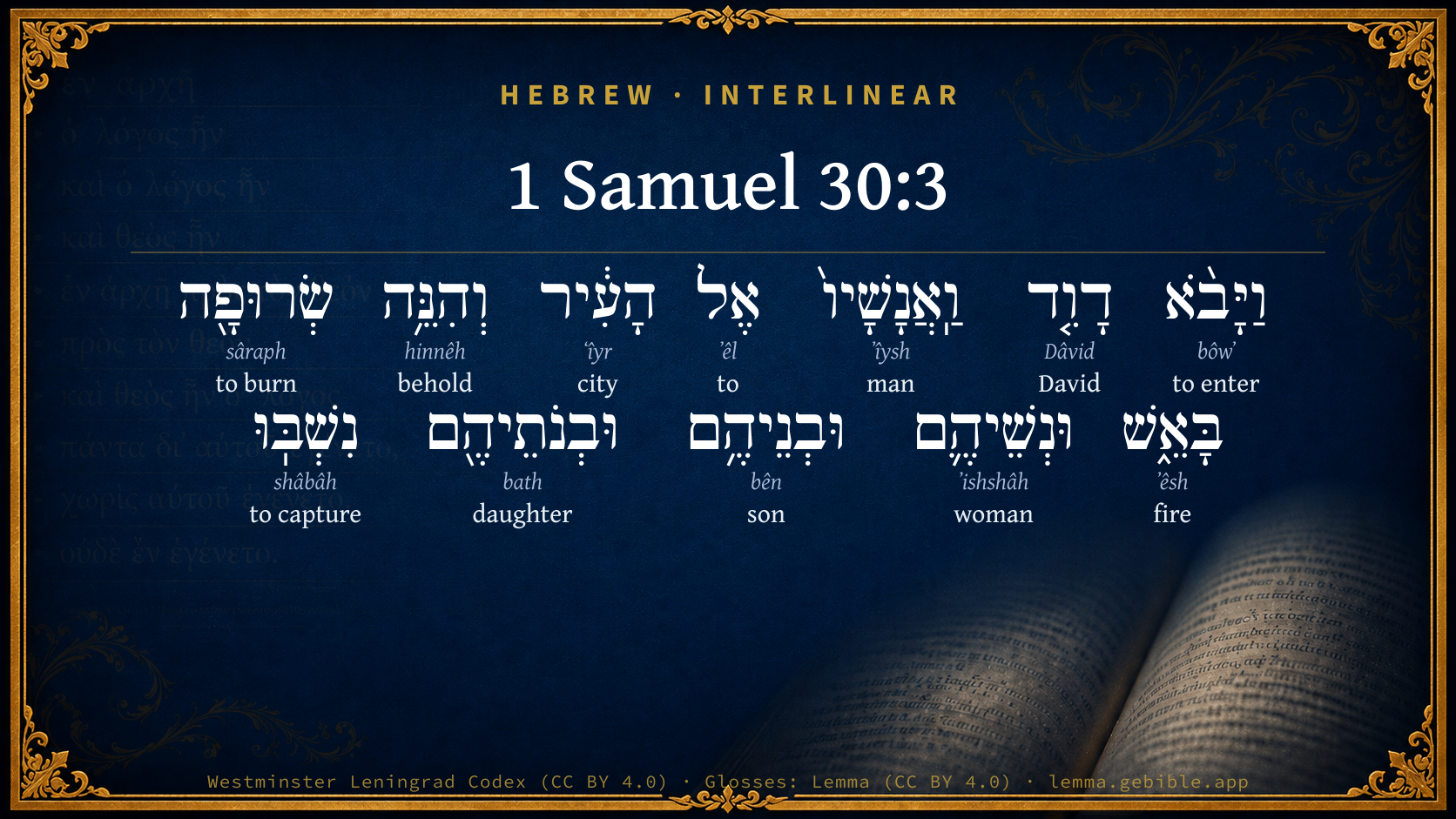
  1. וַיָּבֹ֨א bôwʼ H935 “and · to enter” Conjunction + Verb, Qal, Sequential Imperfect, 3rd Person, Masculine, Singular
  2. דָוִ֤ד Dâvid H1732 “David” Noun, Proper
  3. וַֽאֲנָשָׁיו֙ ʼîysh H376 “and · men · his” Conjunction + Noun, Common, Masculine, Plural, Construct + Suffix, Personal, 3rd Person, Masculine, Singular
  4. אֶל ʼêl H413 “to” Preposition
  5. הָעִ֔יר ʻîyr H5892 “the · city” Particle, Definite Article + Noun, Common, Feminine, Singular, Absolute
  6. וְהִנֵּ֥ה hinnêh H2009 “and · behold” Conjunction + Particle, Demonstrative
  7. שְׂרוּפָ֖ה sâraph H8313 “burnt” Verb, Qal, Participle Passive, Feminine, Singular, Absolute
  8. בָּאֵ֑שׁ ʼêsh H784 “in/at the · fire” Preposition, Determined + Noun, Common, Both, Singular, Absolute
  9. וּנְשֵׁיהֶ֛ם ʼishshâh H802 “and · women · their” Conjunction + Noun, Common, Feminine, Plural, Construct + Suffix, Personal, 3rd Person, Masculine, Plural
  10. וּבְנֵיהֶ֥ם bên H1121 “and · sons · their” Conjunction + Noun, Common, Masculine, Plural, Construct + Suffix, Personal, 3rd Person, Masculine, Plural
  11. וּבְנֹתֵיהֶ֖ם bath H1323 “and · daughters · their” Conjunction + Noun, Common, Feminine, Plural, Construct + Suffix, Personal, 3rd Person, Masculine, Plural

About this verse

These counts appear in no published source. They are computed here, from the morphology-tagged text and Lemma’s own curated glosses. What Lemma adds →

12
words
12
distinct lemmas
Historical
section

Shared distinctive vocabulary

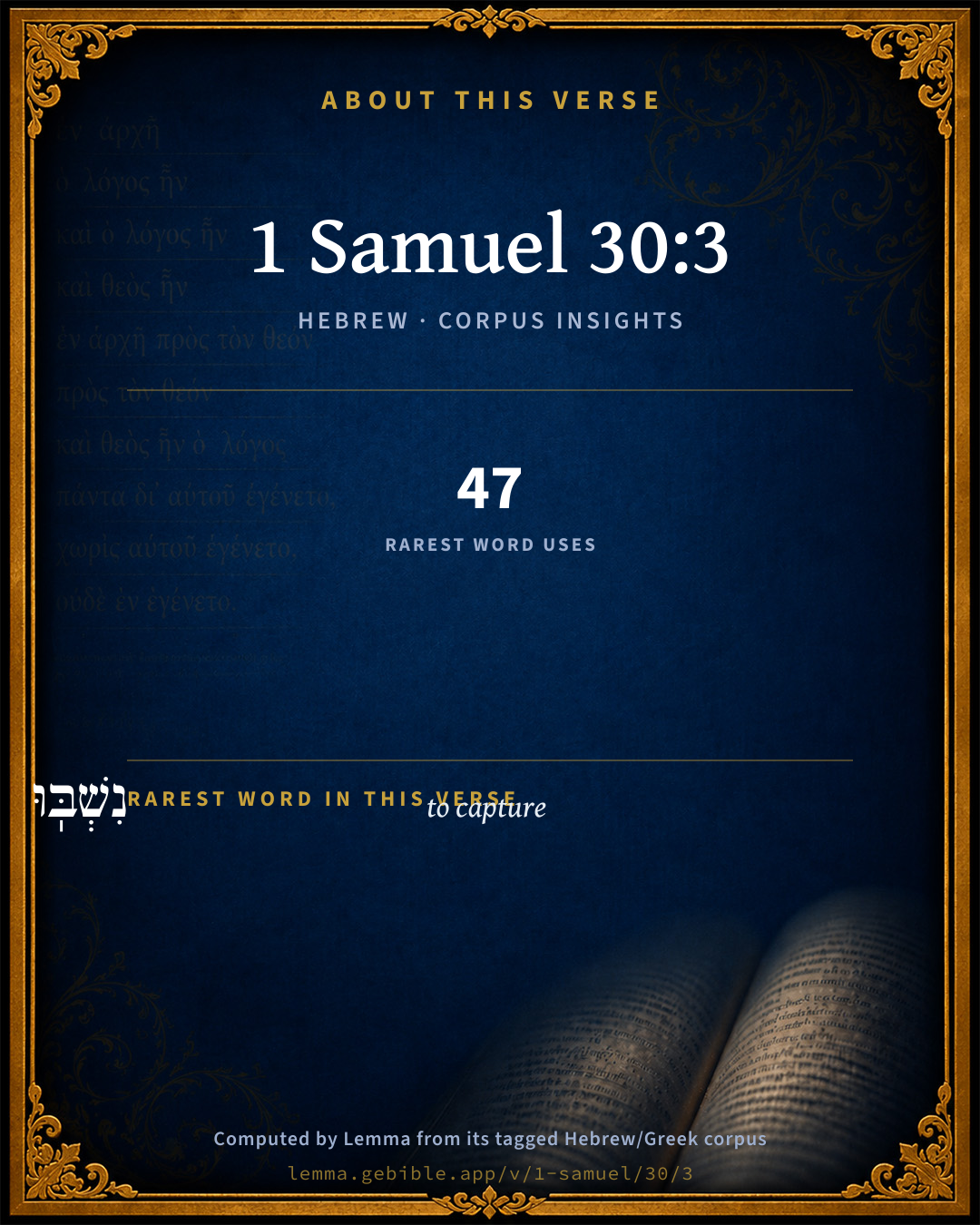
נִשְׁבּֽוּ to capture H7617 occurs in 42 verses of the Hebrew Bible. Also found in:

Grammatical profile

  • 3 verbs
  • 7 nouns
  • 1 preposition
  • 1 particle

Verb forms

  • וַיָּבֹ֨א Qal · Sequential Imperfect
  • שְׂרוּפָ֖ה Qal · Participle Passive
  • נִשְׁבּֽוּ Niphal · Perfect

Hebrew & Septuagint length

In English translation the verse runs 27 words from the Hebrew and 28 from the Septuagint (LXX English) — closely comparable.

A rough comparison of the two English renderings, which tokenize alike — not a word-level alignment.

Word counts can differ between the Hebrew and the Greek without any difference in meaning — e.g. the Hebrew direct-object marker אֵת has no separate Greek word, and Greek often adds the article ὁ.

Cross-references

4

Topical passages linked to 1 Samuel 30:3 in the Treasury of Scripture Knowledge — connected by theme and wording, ordered by reader-vote popularity; previews shown in the World English Bible.

  • Psalms 34:19 Many are the afflictions of the righteous, But Yahweh delivers him out of them all.
  • Hebrews 12:6 For whom the Lord loves, he chastens, And scourges every son whom he receives."
  • 1 Peter 1:6–7 Wherein you greatly rejoice, though now for a little while, if need be, you have been put to grief in various trials,
  • Revelation 3:9 Behold, I give of the synagogue of Satan, of those who say they are Jews, and they are not, but lie. Behold, I will make them to come and worship before your feet, and to know that I have loved you.

Cross-references courtesy of OpenBible.info (CC BY 4.0).

Hebrew and Greek witnesses Masoretic Hebrew ↔ Greek Septuagint

The same verse in the two great witnesses to the Old Testament, shown verse-for-verse.

These are two independent witnesses, not word-aligned to each other, and the Septuagint is shown in lemma (dictionary) form.

Hebrew 1 Samuel 30:3 Masoretic · Westminster Leningrad Codex

וַיָּבֹ֨א דָוִ֤ד וַֽאֲנָשָׁיו֙ אֶל הָעִ֔יר וְהִנֵּ֥ה שְׂרוּפָ֖ה בָּאֵ֑שׁ וּנְשֵׁיהֶ֛ם וּבְנֵיהֶ֥ם וּבְנֹתֵיהֶ֖ם נִשְׁבּֽוּ

When David and his men came to the city, behold, it was burned with fire; and their wives, and their sons, and their daughters, were taken captive.

World English Bible · Public Domain

Greek LXX 1 Samuel 30:3 Septuagint · lemma form

καί ἔρχομαι δαυίδ καί ὁ ἀνήρ αὐτός εἰς ὁ πόλις καί ἰδού ἐνπυρίζω ἐν πῦρ ὁ δέ γυνή αὐτός καί ὁ υἱός αὐτός καί ὁ θυγάτηρ αὐτός αἰχμαλωτεύω

And David and his men came into the city, and, behold, it was burnt with fire; and their wives, and their sons, and their daughters were carried captive.

LXX2012 (modern English Septuagint) · Public Domain

Hebrew: Westminster Leningrad Codex (CC BY 4.0). Greek: Septuagint (public domain); English from LXX2012 (modern English Septuagint) (Public Domain). How the Septuagint differs from the Hebrew →

Targum (Aramaic paraphrase)

1

The Targum is the ancient Jewish Aramaic paraphrase of the Hebrew Scriptures — an interpretive translation, not the Hebrew text itself. Onkelos (literal) and Pseudo-Jonathan (expansive) render the Torah, and Jonathan the Prophets. Coverage is partial: where no permissively-licensed English translation exists for a verse, only the Aramaic is shown. This is verse-level text, not a word-by-word alignment to the Hebrew.

  1. Targum Jonathan Prophets (Joshua–Malachi)
    וַאֲתָא דָוִד וְגַבְרוֹהִי לְקַרְתָּא וְהָא קַלְיָא בְּנוּרָא וּנְשֵׁיהוֹן וּבְנֵיהוֹן וּבְנָתֵיהוֹן אִשְׁתָּבִיאוּ:

    (no public-domain English translation for this verse)

    Targum Jonathan — Aramaic: “Mikraot Gedolot” (public domain). English: “Sefaria Community Translation” (CC0 1.0 (public-domain dedication)); “London "Chaldee Paraphrase," 1871” (public domain). Text via Sefaria.

Commentary

Notes on 1 Samuel 30:3 from classic Christian and Jewish commentators (each source and its license shown beneath its notes). The classic Christian expositions comment on the surrounding passage and are grouped to its opening verse, so a note may address several verses; the Jewish commentaries on the Tanakh (Rashi and others) are per-verse, so they appear only where the commentator wrote on this verse.

Lemma curates 59 commentaries, every one of them public domain or Creative Commons licensed, each selected and text-cleaned for this edition rather than reprinted as found. About our sources →

Trapp's Complete Commentary

John Trapp

1Sa 30:3 So David and his men came to the city, and, behold, [it was] burned with fire; and their wives, and their sons, and their daughters, were taken captives.

Ver. 3. And, behold, it was burned with fire.] Such is the woe and the waste of war. And now David was at his worst, - this sad accident was worse to him than all the evil that had befallen him from his youth until now, as Joab said in another case:, {2Sa 19:7} - a sign that deliverance was at next near by; as when things are at worst, we say they will mend.

John Trapp, A Commentary or Exposition upon All the Books of the Old and New Testament (1647–1656) — public domain. Text from a community e-Sword module.

Geneva Bible (1599)

Geneva Bible translators

For these only remained in the city, when the men were gone to war.

Geneva Bible (1599) marginal notes — public domain. Text via Bolls.life.

Jamieson, Fausset & Brown

Robert Jamieson, A. R. Fausset & David Brown

David and his men came to the city, and, behold, it was burned with fire--The language implies that the smoke of the conflagration was still visible, and the sacking very recent.

Jamieson, Fausset & Brown — Commentary Critical and Explanatory on the Whole Bible (1871) — public domain (CC PDM 1.0). Text via the HelloAO Bible API.

Ellicott's Commentary for English Readers

(3) And behold, it was burned with fire.—A terrible reception for David and his free lances, on their return from their ill-omened expedition with the great Philistine army, to find only the charred and smoking ruins of their homes; not one of all their dear ones, whom they had left behind—as they thought in security—left to tell the story of the disaster. It was the Egyptian slave who had fallen sick, and, in consequence, had been deserted, and whom they came upon in the course of the pursuit, who gave them the details, and told them the story of the invasion, and described the route taken by the marauding force on their return to their country.

A Bible Commentary for English Readers, edited by Charles John Ellicott (1878–1897) — public domain. Text from a community e-Sword module.

John Gill's Exposition

So David and his men came to the city,.... Or however to the place where it had stood, and where it now lay in ruins:

and, behold, it was burnt with fire; the whole city was laid in ashes:

and their wives, and their sons, and their daughters, were taken captives; as it appeared afterwards; for upon their first coming they knew not but they were all destroyed; and which they might reasonably suppose from their former treatment of them, unless there were any left upon the spot which could inform them how things were, which does not appear, and which must make their distress the greater.

John Gill's Exposition of the Whole Bible (1746–1763) — public domain (CC PDM 1.0). Text via the HelloAO Bible API.

unfoldingWord translationNotes

Door43 World Missions Community

their wives ... sons ... daughters

belonging to David and his men

it was burned, and their wives ... daughters were taken captive

This can be translated in active form. AT: "they saw that someone had burned it and taken their wives ... captive" (See: Active or Passive)

the people that were with him

These were mainly his army of men.

translationWords

David

captive

people group

raise

voice

power

unfoldingWord translationNotes — © Distant Shores Media and the Door43 World Missions Community, licensed CC BY-SA 4.0. Source: git.door43.org/Door43/en_tn.

Lesson kit

Teaching starters — assembled from the data on this page, not authored interpretation. Every prompt links to the verse data it draws on. Edit before teaching.

1 Samuel, in the Historical, opens this verse with 12 words (12 distinct Hebrew lemmas). Its most distinctive word is shâbâh (“to capture”). A historical commentator’s framing appears above. Read the whole chapter for the surrounding context.

Discussion questions

  1. How does “to capture” (shâbâh) shape what this verse is saying?
  2. Genesis 14:14 shares the word «to capture» with this verse. How do the two illuminate each other?
  3. These translations render this verse differently; the difference is in the English rendering, not the original. What questions does that raise?
  4. The verb «וַיָּבֹ֨א» is Qal Sequential Imperfect. How does its form color the action?
  5. Reading how Trapp's Complete Commentary and Geneva Bible (1599) read this verse, where do the two commentators agree and where do they part?

Things to notice

Reading settings

Reading text

Shown beneath each verse's original-language words.

Old Testament
Old Testament edition

Read the OT as the Masoretic Hebrew (MT) or the Greek Septuagint (LXX).

English shown for the Greek Septuagint (in the Hebrew ↔ Greek comparison).

Comparing translations? Open the Compare panel on any verse page to stack up to four side by side.