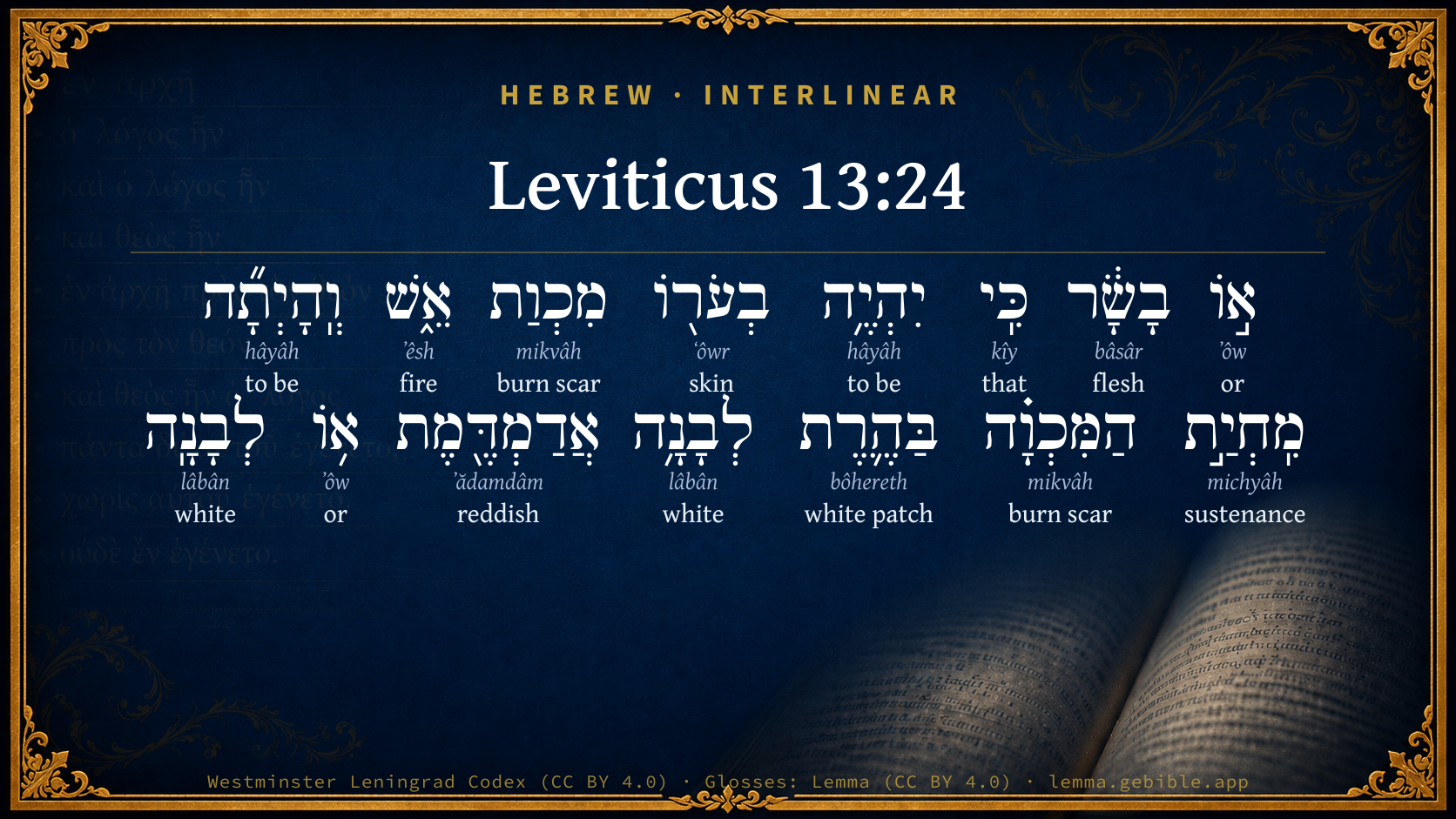
Leviticus 13:24

Hebrew (Westminster Leningrad Codex) Leviticus 13:24 appears in the Hebrew Old Testament. The text above is from the Westminster Leningrad Codex. Each word links to its Strong’s number, a concise gloss, and parsing drawn from the Open Scriptures Hebrew Bible morphology. Click any word for its full Brown-Driver-Briggs (BDB) entry.
Download image
Cite this verse

Leviticus 13:24 (World English Bible). Public Domain. Lemma interlinear Bible study tool, https://lemma.gebible.app/v/leviticus/13/24.

Show BibTeX & RIS
BibTeX
RIS
English Translation
"Or when the body has a burn from fire on its skin, and the raw flesh of the burn becomes a bright spot, reddish-white, or white,
World English Bible · Public Domain
Highlights Full analysis ↓
Download a study sheet

One document with this verse’s original text, its word-by-word gloss line, the meaning frame, cross-references with their text, attributed commentary, and full source and license credits — printable, and it pastes into notes with its structure intact.

This verse Autodidact and up

Study sheet (.html) Plain text (.txt)

A passage Seminary Student

Up to 50 verses in one chapter. A passage sheet keeps up to 6 commentary sources and 12 cross-references per verse, in the order this page ranks them, and says so on the sheet whenever that leaves anything out. Ask for a single verse and you get the Autodidact verse sheet above.

Everything on this page stays free to read, with no account — the sheet is a download of what is already on screen, not access to it.

Want to remove ads? Support Godless Engineer
Compare translations 3

The same verse in 3 English versions, stacked beneath the original-language interlinear above. Click any original word for its lexicon entry.

Each is an independent rendering of the whole verse — the interlinear is not word-aligned to these translations.

Highlighted words mark where these versions differ — a whole-verse word diff, not a word-by-word alignment.

  • World English Bible Public Domain
    "Or when the body has a burn from fire on its skin, and the raw flesh of the burn becomes a bright spot, reddish-white, or white,
  • King James Version Public Domain
    Or if there be any flesh, in the skin whereof there is a hot burning, and the quick flesh that burneth have a white bright spot, somewhat reddish, or white;
  • unfoldingWord Literal Text CC BY-SA 4.0
    Or flesh, when it has a burn of fire on his skin, and the preservation of the burn has become a reddish-white or white spot,

unfoldingWord Literal Text — © unfoldingWord, licensed CC BY-SA 4.0. Word-aligned USFM3 via Door43 (git.door43.org/unfoldingWord/en_ult).

Versions to compare (up to 4)

3 of 4 selected

Show all 18 translations

Every available English version of this verse, each an independent rendering of the whole verse.

  • World English Bible Public Domain
    "Or when the body has a burn from fire on its skin, and the raw flesh of the burn becomes a bright spot, reddish-white, or white,
  • Berean Standard Bible Public Domain
    When there is a burn on someone’s skin and the raw area of the burn becomes reddish-white or white,
  • Majority Standard Bible Public Domain
    When there is a burn on someone’s skin and the raw area of the burn becomes reddish-white or white,
  • King James Version Public Domain
    Or if there be any flesh, in the skin whereof there is a hot burning, and the quick flesh that burneth have a white bright spot, somewhat reddish, or white;
  • American Standard Version (1901) Public Domain
    Or when the flesh hath in the skin thereof a burning by fire, and the quick `flesh' of the burning become a bright spot, reddish-white, or white;
  • Revised Version (1885) Public Domain
    Or when the flesh hath in the skin thereof a burning by fire, and the quick flesh of the burning become a bright spot, reddish-white, or white;
  • Geneva Bible (1599) Public Domain
    If there be any flesh, in whose skin there is an hote burning, and the quick flesh of ye burning haue a white spot, somewhat reddish or pale,
  • Douay-Rheims (1899) Public Domain
    The flesh also and skin that hath been burnt, and after it is healed hath a white or a red scar,
  • Young's Literal Translation Public Domain
    `Or when flesh hath in its skin a fiery burning, and the quickening of the burning, the bright white spot, hath been very red or white,
  • Literal Standard Version CC BY-SA 4.0
    Or when flesh has a fiery burning in its skin, and the quickening of the burning, the bright white spot, has been reddish or white,
  • Unlocked Literal Bible CC BY-SA 4.0
    When the skin has a burn and the raw flesh of the burn has become a reddish-white or white spot,
  • unfoldingWord Literal Text CC BY-SA 4.0
    Or flesh, when it has a burn of fire on his skin, and the preservation of the burn has become a reddish-white or white spot,
  • Darby Bible Public Domain
    Or if in the flesh, in the skin thereof, there is a burning inflammation, and the place of the inflammation become a bright spot white-reddish or white,
  • World Messianic Bible Public Domain
    “Or when the body has a burn from fire on its skin, and the raw flesh of the burn becomes a bright spot, reddish-white, or white,
  • Webster's Bible Public Domain
    Or if there is any flesh, in the skin of which there is a hot burning, and the live flesh that burneth hath a white bright spot, somewhat reddish or white;
  • Free Bible Version CC BY-SA 4.0
    If someone has a burn on their skin and the place where it's raw changes into a reddish-white or white spot,
  • Bible in Basic English Public Domain
    Or if there is a burn on the skin of the flesh, and if the diseased flesh in the burn becomes a bright place, red and white or white,
  • JPS Tanakh (1917) Public Domain
    Or when the flesh hath in the skin thereof a burning by fire, and the quick flesh of the burning become a bright spot, reddish-white, or white;

Literal Standard Version (2020), Covenant Press — licensed CC BY-SA 4.0. Text via the HelloAO Bible API (eBible.org). Unlocked Literal Bible (unfoldingWord) — licensed CC BY-SA 4.0. Text via the HelloAO Bible API (eBible.org). unfoldingWord Literal Text — © unfoldingWord, licensed CC BY-SA 4.0. Word-aligned USFM3 via Door43 (git.door43.org/unfoldingWord/en_ult). Free Bible Version, Dr. Jonathan Gallagher — licensed CC BY-SA 4.0. Text via the HelloAO Bible API (eBible.org).

Word by word

More ways to search: Search by grammar → Find every occurrence → Compare this word →

Practice this passage: Drill this verse → Learn its vocabulary →

מִכְוַת
mikvâh
H4348
“burn scar of”
Noun, Common, Feminine, Singular, Construct
Part of Speech
Noun
Type
Common
Gender
Feminine
Number
Singular
State
Construct
Full BDB Definition

Origin: from H3554

TWOT: 961c

burnt spot, burn scar
  1. א֣וֹ ʼôw H176 “or” Conjunction
  2. בָשָׂ֔ר bâsâr H1320 “flesh” Noun, Common, Masculine, Singular, Absolute
  3. כִּֽי kîy H3588 “that” Conjunction
  4. יִהְיֶ֥ה hâyâh H1961 “to be” Verb, Qal, Imperfect, 3rd Person, Masculine, Singular
  5. בְעֹר֖וֹ ʻôwr H5785 “in/at · skin · his” Preposition + Noun, Common, Masculine, Singular, Construct + Suffix, Personal, 3rd Person, Masculine, Singular
  6. אֵ֑שׁ ʼêsh H784 “fire” Noun, Common, Both, Singular, Absolute
  7. וְֽהָיְתָ֞ה hâyâh H1961 “and · to be” Conjunction + Verb, Qal, Perfect, 3rd Person, Feminine, Singular
  8. מִֽחְיַ֣ת michyâh H4241 “sustenance of” Noun, Common, Feminine, Singular, Construct
  9. הַמִּכְוָ֗ה mikvâh H4348 “the · burn scar” Particle, Definite Article + Noun, Common, Feminine, Singular, Absolute
  10. בַּהֶ֛רֶת bôhereth H934 “white patch” Noun, Common, Feminine, Singular, Absolute
  11. לְבָנָ֥ה lâbân H3836 “white” Adjective, Adjective, Feminine, Singular, Absolute
  12. אֲדַמְדֶּ֖מֶת ʼădamdâm H125 “reddish” Adjective, Adjective, Feminine, Singular, Absolute
  13. א֥וֹ ʼôw H176 “or” Conjunction
  14. לְבָנָֽה lâbân H3836 “white” Adjective, Adjective, Feminine, Singular, Absolute

About this verse

These counts appear in no published source. They are computed here, from the morphology-tagged text and Lemma’s own curated glosses. What Lemma adds →

15
words
11
distinct lemmas
Pentateuch
section

Notable vocabulary

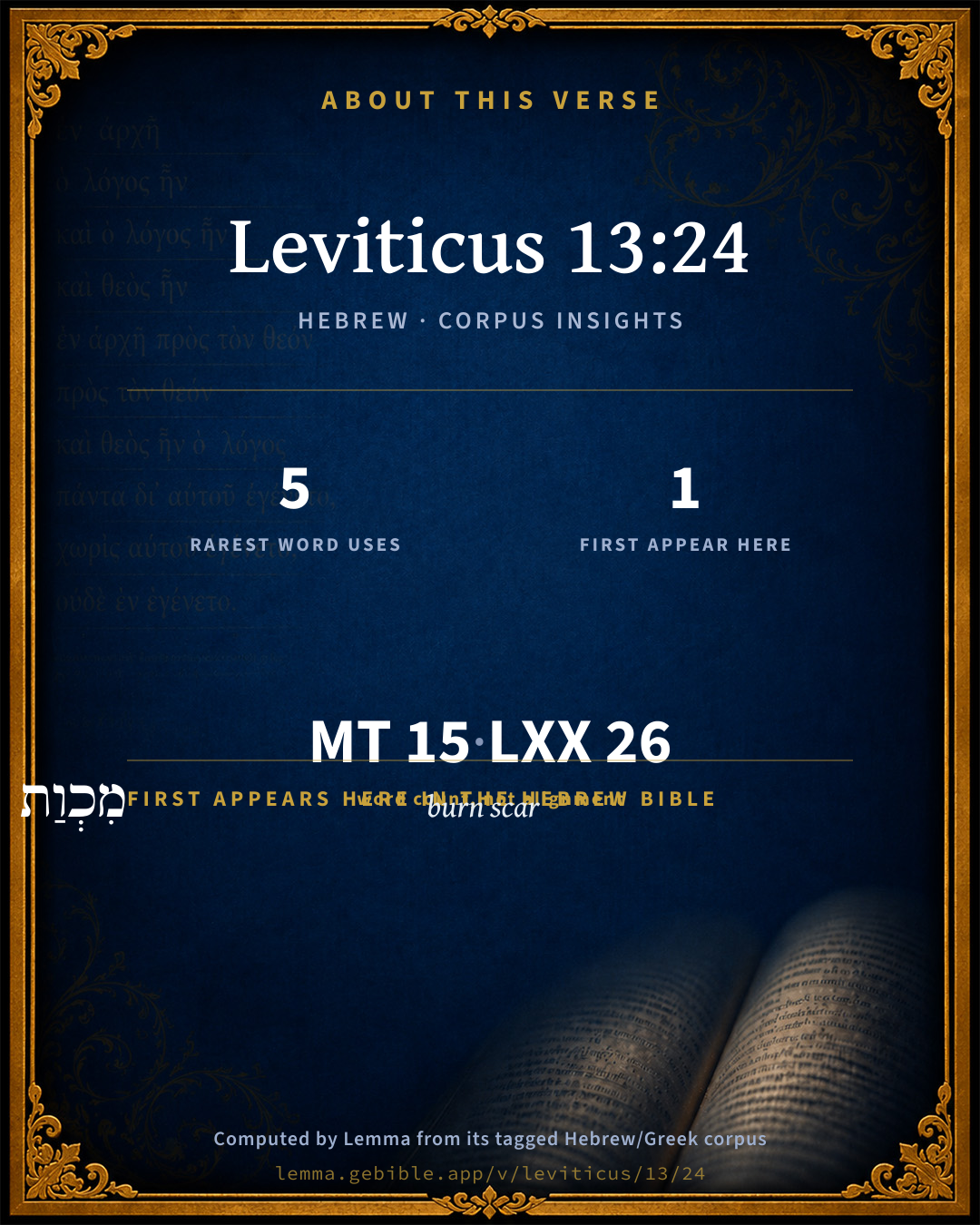
The rarest word here is מִכְוַת burn scar H4348 — appearing just 5 times in the whole Hebrew Bible.

First appearance in Scripture

This word makes its first canonical appearance in the Hebrew Bible here:

  • מִכְוַת burn scar H4348

Shared distinctive vocabulary

מִכְוַת burn scar H4348 occurs in 3 verses of the Hebrew Bible. Also found in:

Grammatical profile

  • 2 verbs
  • 7 nouns
  • 3 adjectives
  • 3 conjunctions

Verb forms

  • יִהְיֶ֥ה Qal · Imperfect
  • וְֽהָיְתָ֞ה Qal · Perfect

Repetition

Words recur within this verse — often emphatic in Hebrew:

  • יִהְיֶ֥ה to be H1961 ×2
  • מִכְוַת burn scar H4348 ×2
  • לְבָנָ֥ה white H3836 ×2
  • א֣וֹ or H176 ×2

Hebrew & Septuagint length

In English translation the verse runs 26 words from the Hebrew and 39 from the Septuagint (LXX English) — the Septuagint runs noticeably longer here. See the side-by-side →

A rough comparison of the two English renderings, which tokenize alike — not a word-level alignment.

Word counts can differ between the Hebrew and the Greek without any difference in meaning — e.g. the Hebrew direct-object marker אֵת has no separate Greek word, and Greek often adds the article ὁ.

In the original languages it is 15 Hebrew tokens and 26 Greek tokens — but the two are counted differently (Hebrew bundles its prefixes and suffixes into one token; the Greek is in lemma form), so that isn’t a like-for-like length.

Cross-references

1

Topical passages linked to Leviticus 13:24 in the Treasury of Scripture Knowledge — connected by theme and wording, ordered by reader-vote popularity; previews shown in the World English Bible.

  • Isaiah 3:24 It shall happen that instead of sweet spices, there shall be rottenness; Instead of a belt, a rope; Instead of well set hair, baldness; Instead of a robe, a girding of sackcloth; And branding instead of beauty.

Cross-references courtesy of OpenBible.info (CC BY 4.0).

Hebrew and Greek witnesses Masoretic Hebrew ↔ Greek Septuagint

The same verse in the two great witnesses to the Old Testament, shown verse-for-verse.

Here the Septuagint runs noticeably longer than the Hebrew — LXX2012 (modern English Septuagint) 39 words vs World English Bible 26. A rough length comparison of the two English translations, not a word-level alignment — read both below.

These are two independent witnesses, not word-aligned to each other, and the Septuagint is shown in lemma (dictionary) form.

Hebrew Leviticus 13:24 Masoretic · Westminster Leningrad Codex

א֣וֹ בָשָׂ֔ר כִּֽי יִהְיֶ֥ה בְעֹר֖וֹ מִכְוַת אֵ֑שׁ וְֽהָיְתָ֞ה מִֽחְיַ֣ת הַמִּכְוָ֗ה בַּהֶ֛רֶת לְבָנָ֥ה אֲדַמְדֶּ֖מֶת א֥וֹ לְבָנָֽה

"Or when the body has a burn from fire on its skin, and the raw flesh of the burn becomes a bright spot, reddish-white, or white,

World English Bible · Public Domain

Greek LXX Leviticus 13:24 Septuagint · lemma form

καί σάρξ ἐάν γίγνομαι ἐν ὁ δέρμα αὐτός κατάκαυμα πῦρ καί γίγνομαι ἐν ὁ δέρμα αὐτός ὁ ὑγιάζω ὁ κατάκαυμα αὐγάζω τηλαυγής λευκός ὑποπυρρίζω ἤ ἔκλευκος

And if the flesh be in his skin in a state of fiery inflammation, and there should be in his skin the part which is healed of the inflammation, bright, clear, and white, suffused with red or very white;

LXX2012 (modern English Septuagint) · Public Domain

Hebrew: Westminster Leningrad Codex (CC BY 4.0). Greek: Septuagint (public domain); English from LXX2012 (modern English Septuagint) (Public Domain). How the Septuagint differs from the Hebrew →

Targum (Aramaic paraphrase)

2

The Targum is the ancient Jewish Aramaic paraphrase of the Hebrew Scriptures — an interpretive translation, not the Hebrew text itself. Onkelos (literal) and Pseudo-Jonathan (expansive) render the Torah, and Jonathan the Prophets. Coverage is partial: where no permissively-licensed English translation exists for a verse, only the Aramaic is shown. This is verse-level text, not a word-by-word alignment to the Hebrew.

  1. Targum Onkelos Torah (Genesis–Deuteronomy)
    אוֹ בִסְרָא אֲרֵי יְהֵי בְמַשְׁכֵּהּ כְּוָאָה דְנוּר וּתְהֵי רֹשֶׁם כְּוָאָה בַּהֲרָא חַוְרָא סֲמקָא אוֹ חַוְרָא

    (no public-domain English translation for this verse)

    Targum Onkelos — Aramaic: “Onkelos Genesis” (public domain); “Onkelos Exodus” (public domain); “Onkelos Leviticus” (public domain); “Onkelos Numbers” (public domain); “Onkelos Deuteronomy” (public domain). English: “Sefaria Community Translation” (CC0 1.0 (public-domain dedication)); “J.W. Etheridge. The Targums of Onkelos and Jonathan Ben Uzziel on the Pentateuch. London: Longmans, Green, 1862” (public domain). Text via Sefaria.

  2. Targum Pseudo-Jonathan Torah (Genesis–Deuteronomy)
    אוֹ בַּר נַשׁ אֲרוּם יְהֵי בְּמוֹשְׁכֵיהּ כְוָואָה דְנוּר וּתְהֵי רוֹשָׁם כְּוָואָה בַּהֲקֵי חִוְרָא סוֹמְקָא מְעַרְבִין אוֹ חִוְורָא בִּלְחוֹדָא

    Or if there be in a man's skin a hot burning, and in the burning wound a spot of white mixed with red, or white only;

    Targum Pseudo-Jonathan — Aramaic: “Targum Jonathan on Genesis” (public domain); “Targum Jonathan on Exodus” (public domain); “Targum Jonathan on Leviticus” (public domain); “Targum Jonathan on Numbers” (public domain); “Targum Jonathan on Deuteronomy” (public domain). English: “The Targum of Jonathan ben Uzziel, trans. J. W. Etheridge, London, 1862” (public domain). Text via Sefaria.

Commentary

Notes on Leviticus 13:24 from classic Christian and Jewish commentators (each source and its license shown beneath its notes). The classic Christian expositions comment on the surrounding passage and are grouped to its opening verse, so a note may address several verses; the Jewish commentaries on the Tanakh (Rashi and others) are per-verse, so they appear only where the commentator wrote on this verse.

Lemma curates 59 commentaries, every one of them public domain or Creative Commons licensed, each selected and text-cleaned for this edition rather than reprinted as found. About our sources →

Tyndale Open Study Notes

Tyndale Open Resources

13:24-25 The priest was to inspect the burned area to see if the wound had become infected (see 13:9-17). • hair . . . turned white: See 13:18-23.

Tyndale Open Study Notes — © Tyndale Open Resources, licensed CC BY-SA 4.0. Text via the HelloAO Bible API.

Geneva Bible (1599)

Geneva Bible translators

If he have a white spot in the place where the burning was, and was after healed.

Geneva Bible (1599) marginal notes — public domain. Text via Bolls.life.

Ellicott's Commentary for English Readers

(24) Or if there be any flesh, in the skin whereof there is.—Rather, or if there is in the skin of the flesh. As a burn or inflammation arising from contact with pitch or hot water was adduced in Lev_13:18, the verse before us specifies a sore, pustule, or blister occasioned by “a burning of fire,” as the Margin of the Authorised Version rightly has it, and not a hot burning, as it is in the text. The ancient canons distinctly define this by “that which is burnt with a coal or with embers, whatsoever is from the force of actual fire, is the burning here meant,” in contradistinction to the burn or inflammation mentioned in Lev_13:18.

And the quick flesh that burneth.—Rather, and the sound flesh of the burning (see Lev_13:10), that is, the tender flesh which is renewed (after it has lost the purulent matter in it) and exhibits these symptoms.

A Bible Commentary for English Readers, edited by Charles John Ellicott (1878–1897) — public domain. Text from a community e-Sword module.

John Gill's Exposition

Or if there be any flesh, in the skin whereof there is a hot burning,.... Or "a burning of fire" (r): it is asked, what is a burning? that which is burnt with a coal or with hot ashes; all that is from the force of fire is burning (s); that is, whatever sore, pustule, or blister, is occasioned by fire touching the part, or by anything heated by fire:

and the quick flesh that burneth have a white bright spot, somewhat reddish, or white; the Targum of Jonathan is, a white spot mixed with red, or only white; and so Aben Ezra interprets the last clause: this seems to set aside Bochart's interpretation of the word "adamdemeth", which we render "somewhat reddish", and be, very white, bright, and glittering since white is here opposed unto it; though it may be, the sense is, that the flesh burnt has a bright white spot in it, exceeding glittering; or however, at least, a white one: by the "quick flesh" that burneth, Gersom says, is meant the weak, the tender flesh which is renewed there, after it is healed from the purulent matter in it.

(r) "adustio ignis", Pagninus, Montanus, Junius & Termellius, Piscator. (s) Misn. Negaim, c. 9. sect. 1. & Maimon. in ib. c. 6. sect. 8.

John Gill's Exposition of the Whole Bible (1746–1763) — public domain (CC PDM 1.0). Text via the HelloAO Bible API.

Albert Barnes' Notes on the Bible

The sense of this verse is: “Or if there be flesh of which the skin has been affected by severe inflammation, and the sore of the inflammation has become a glossy spot, somewhat reddish or white.”

Albert Barnes' Notes on the Bible (1834–1885) — public domain. Text from a community e-Sword/MySword module.

Haydock's Catholic Bible Commentary

Scar. If it had proceeded from burning it would have been black. (Menochius)

George Leo Haydock (1774–1849), Haydock's Catholic Family Bible and Commentary, 1859 edition — public domain. Excludes Psalms (Douay-Rheims chapter numbering differs from Protestant) and Deuterocanonical books (Catholic canon only).

Matthew Poole's English Annotations

A hot burning, Heb. a burning of fire, by the touch of any hot iron, or burning coals, which doth naturally and usually make an ulcer or sore in which the following spot is. Or white, i.e. or only white, without any mixture of red in it. This clause seems to overthrow that exposition of the Hebrew word adamdam which is given by a learned man, Lev 13:19, because this colour which is here said to be only white, is distinguished from that which is here called adamdam, which therefore must be some other colour than that of snow, which though very light or bright, yet is only white.

Matthew Poole's English Annotations on the Holy Bible (1683–1685) — public domain. Text from a community e-Sword/MySword module.

Whedon's Commentary on the Bible

Daniel D. Whedon

24. A hot burning — The Hebrew is, “a burning of fire.” It is supposed to describe persons scarred by burns whose scars have become eruptive.

Rules very similar to the above are laid down for determining these cases, except that only one week was to be spent in quarantine, since the scar furnishes an apparent cause for the symptoms.

Daniel D. Whedon (gen. ed.), Commentary on the Old and New Testaments (1874–1909) — public domain. Text from a community e-Sword module.

The Pulpit Commentary

Vers. 24-28. The method of discriminating between a leprous spot and the scar of a burn. If there be any flesh, in the skin whereof there is a hot burning. This rendering indicates that the authors of the Authorized Version thought a disease of the nature of a carbuncle to be meant; but it is better to take the words literally as they are translated in the margin, If there be any flesh, in the skin whereof there is a burning of fire; that is, a scar from a burn, The leprous spot and the scar are to be distinguished as in the previous case. An old nicer or burn is a more likely place for a leprous spot to appear than any part of the body which is sound, just as in the moral sphere sin fixes on some old wound of the soul to burst out in.

The Pulpit Commentary (1880–1919), ed. H.D.M. Spence-Jones & Joseph S. Exell — public domain. Text from a community e-Sword module.

John Wesley's Explanatory Notes

A hot burning - A burning of fire, by the touch of any hot- iron, or burning coals, which naturally makes an ulcer or sore in which the following spot is.

John Wesley, Explanatory Notes Upon the Whole Bible (1754–1765) — public domain. Text via the GEBible commentary corpus.

unfoldingWord translationNotes

Door43 World Missions Community

General Information:

Yahweh continues telling Moses and Aaron what the people must do when someone has a skin disease.

infectious disease

See how you translated these words in Leviticus 13:3.

the priest must pronounce him unclean

The man whom other people must not touch is spoken of as if he were physically unclean. (See: Metaphor)

translationWords

priest

clean

unfoldingWord translationNotes — © Distant Shores Media and the Door43 World Missions Community, licensed CC BY-SA 4.0. Source: git.door43.org/Door43/en_tn.

Rashi

Rabbi Shlomo Yitzchaki (Rashi)

מחית המכוה IIEALED FLESH OF THE BURNT PART — sainement in old French The text means that when the burnt part was healed it turned into a bright spot variegated or evenly white (i.e. ‎'וכו‎‎ והיתה denotes “and the healed flesh became a white bright spot etc.”). The symptoms of cleanness or uncleanness of a burn and the symptoms of a boil are exactly similar. Why, then, has Scripture mentioned them separately (in two paragraphs, instead of saying ואדם כי יהיה בעור בשרו שחין ומכוה )? To tell us that they cannot be combined one with the other to make up the minimum size of a spot which is a symptom of leprosy — if, e. g., there develops a leprous spot the size of a half of a גריס (a גריס is a half-bean; חצי גריס is a half of this), in a boil (שחין), and one of the size of a half גריס in a burn (מכוה), they do not come under the law of a full ‎‎‏ גריס(the minimum size for an unclean spot) (Chullin 8a).

Rashi on the Tanakh — English translations: “The Judaica Press complete Tanach with Rashi, translated by A. J. Rosenberg” (CC BY 4.0); “Pentateuch with Rashi's commentary by M. Rosenbaum and A.M. Silbermann, 1929-1934” (public domain); “The Metsudah Tanach series, Lakewood, N.J” (CC BY 4.0); and “The Book of Joshua, Metsudah Publications, 1997” (CC BY 4.0). Text via Sefaria.

Lesson kit

Teaching starters — assembled from the data on this page, not authored interpretation. Every prompt links to the verse data it draws on. Edit before teaching.

Leviticus, in the Pentateuch, opens this verse with 15 words (11 distinct Hebrew lemmas). Its most distinctive word is mikvâh (“burn scar”). The Greek Septuagint runs longer here. A historical commentator’s framing appears above. Read the whole chapter for the surrounding context.

Discussion questions

  1. How does “burn scar” (mikvâh) shape what this verse is saying?
  2. The word “burn scar” first appears here in Scripture. What is being introduced at this debut?
  3. Leviticus 13:25 shares the word «burn scar» with this verse. How do the two illuminate each other?
  4. “to be” occurs 2× in this one verse. What is the effect of the repetition?
  5. Compared with the Hebrew, the Septuagint runs longer here. What questions does that raise?
  6. The translations on this page render this verse differently — a whole-verse word diff, not a word-by-word alignment. What might account for the different wordings?
  7. The verb «יִהְיֶ֥ה» is Qal Imperfect. How does its form color the action?
  8. Reading how Tyndale Open Study Notes and Geneva Bible (1599) read this verse, where do the two commentators agree and where do they part?

Things to notice

Reading settings

Reading text

Shown beneath each verse's original-language words.

Old Testament
Old Testament edition

Read the OT as the Masoretic Hebrew (MT) or the Greek Septuagint (LXX).

English shown for the Greek Septuagint (in the Hebrew ↔ Greek comparison).

Comparing translations? Open the Compare panel on any verse page to stack up to four side by side.