
Joshua 8:19

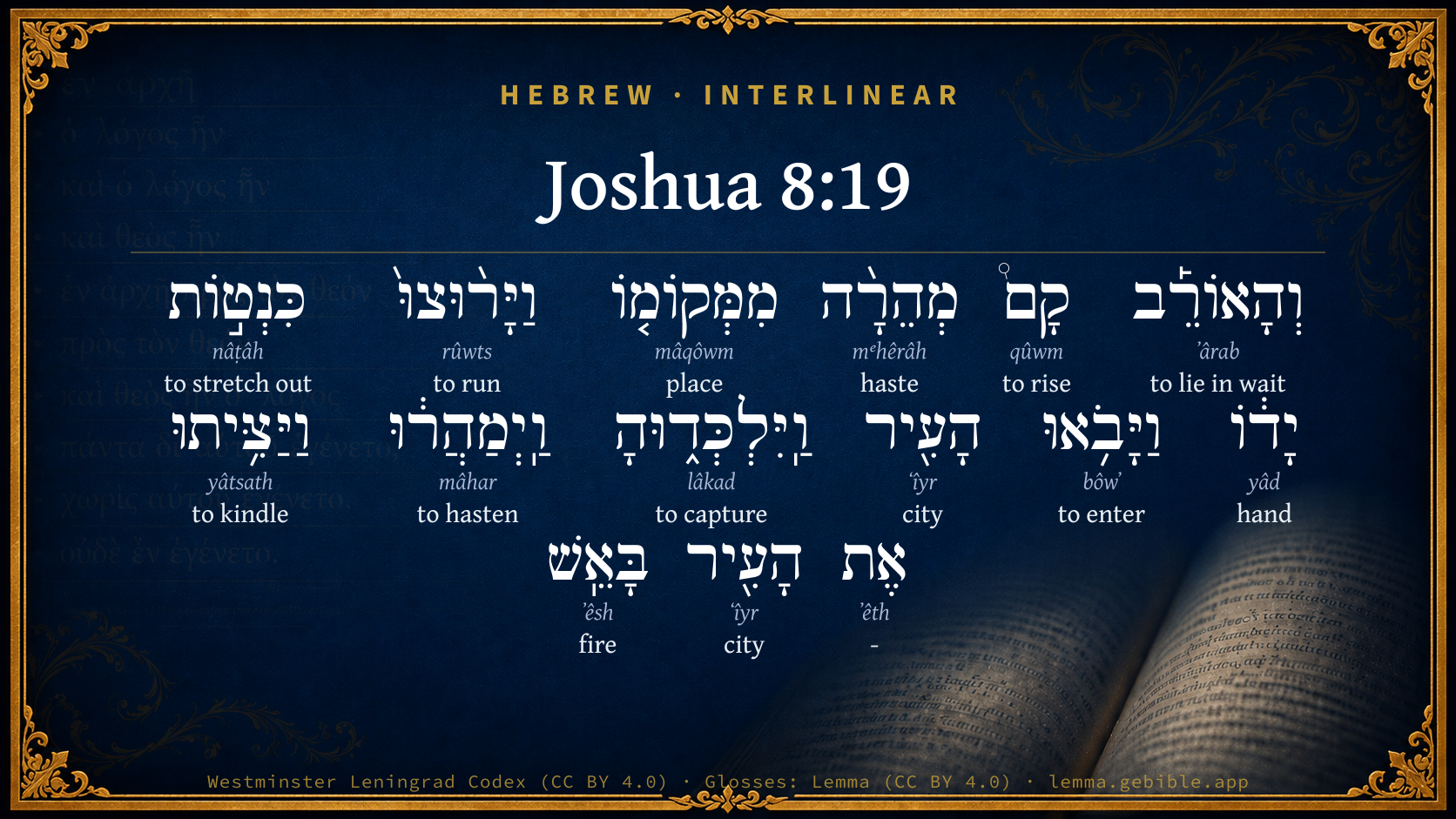
Hebrew (Westminster Leningrad Codex) Joshua 8:19 appears in the Hebrew Old Testament. The text above is from the Westminster Leningrad Codex. Each word links to its Strong’s number, a concise gloss, and parsing drawn from the Open Scriptures Hebrew Bible morphology. Click any word for its full Brown-Driver-Briggs (BDB) entry.
Download image
Cite this verse

Joshua 8:19 (World English Bible). Public Domain. Lemma interlinear Bible study tool, https://lemma.gebible.app/v/joshua/8/19.

Show BibTeX & RIS
BibTeX
RIS
English Translation
The ambush arose quickly out of their place, and they ran as soon as he had stretched out his hand, and entered into the city, and took it; and they hurried and set the city on fire.
World English Bible · Public Domain
Download a study sheet

One document with this verse’s original text, its word-by-word gloss line, the meaning frame, cross-references with their text, attributed commentary, and full source and license credits — printable, and it pastes into notes with its structure intact.

This verse Autodidact and up

Study sheet (.html) Plain text (.txt)

A passage Seminary Student

Up to 50 verses in one chapter. A passage sheet keeps up to 6 commentary sources and 12 cross-references per verse, in the order this page ranks them, and says so on the sheet whenever that leaves anything out. Ask for a single verse and you get the Autodidact verse sheet above.

Everything on this page stays free to read, with no account — the sheet is a download of what is already on screen, not access to it.

Want to remove ads? Support Godless Engineer
Compare translations 3

The same verse in 3 English versions, stacked beneath the original-language interlinear above. Click any original word for its lexicon entry.

Each is an independent rendering of the whole verse — the interlinear is not word-aligned to these translations.

Highlighted words mark where these versions differ — a whole-verse word diff, not a word-by-word alignment.

  • World English Bible Public Domain
    The ambush arose quickly out of their place, and they ran as soon as he had stretched out his hand, and entered into the city, and took it; and they hurried and set the city on fire.
  • King James Version Public Domain
    And the ambush arose quickly out of their place, and they ran as soon as he had stretched out his hand: and they entered into the city, and took it, and hasted and set the city on fire.
  • unfoldingWord Literal Text CC BY-SA 4.0
    And the ambush rose quickly from its place, and they ran when he stretched out his hand. And they entered the city and captured it and hurried and burned the city with fire.

unfoldingWord Literal Text — © unfoldingWord, licensed CC BY-SA 4.0. Word-aligned USFM3 via Door43 (git.door43.org/unfoldingWord/en_ult).

Versions to compare (up to 4)

3 of 4 selected

Show all 18 translations

Every available English version of this verse, each an independent rendering of the whole verse.

  • World English Bible Public Domain
    The ambush arose quickly out of their place, and they ran as soon as he had stretched out his hand, and entered into the city, and took it; and they hurried and set the city on fire.
  • Berean Standard Bible Public Domain
    and as soon as he did so, the men in ambush rose quickly from their position. They rushed forward, entered the city, captured it, and immediately set it on fire.
  • Majority Standard Bible Public Domain
    and as soon as he did so, the men in ambush rose quickly from their position. They rushed forward, entered the city, captured it, and immediately set it on fire.
  • King James Version Public Domain
    And the ambush arose quickly out of their place, and they ran as soon as he had stretched out his hand: and they entered into the city, and took it, and hasted and set the city on fire.
  • American Standard Version (1901) Public Domain
    And the ambush arose quickly out of their place, and they ran as soon as he had stretched out his hand, and entered into the city, and took it; and they hasted and set the city on fire.
  • Revised Version (1885) Public Domain
    And the ambush arose quickly out of their place, and they ran as soon as he had stretched out his hand, and entered into the city, and took it; and they hasted and set the city on fire.
  • Geneva Bible (1599) Public Domain
    And they that lay in wait, arose quickly out of their place, and ranne as soone as he had stretched out his hand, and they entred into the citie, and tooke it, and hasted, and set the citie on fire.
  • Douay-Rheims (1899) Public Domain
    And when he had lifted up his shield towards the city, the ambush that lay hid, rose up immediately: and going to the city, took it and set it on fire.
  • Young's Literal Translation Public Domain
    and the ambush hath risen `with' haste, out of its place, and they run at the stretching out of his hand, and go into the city, and capture it, and hasten, and burn the city with fire.
  • Literal Standard Version CC BY-SA 4.0
    and the ambush has risen [with] haste, out of its place, and they run at the stretching out of his hand, and go into the city, and capture it, and hurry, and burn the city with fire.
  • Unlocked Literal Bible CC BY-SA 4.0
    The soldiers hiding in ambush quickly rushed out of their place as he reached out with his hand. They ran and entered the city and captured it. They quickly set the city on fire.
  • unfoldingWord Literal Text CC BY-SA 4.0
    And the ambush rose quickly from its place, and they ran when he stretched out his hand. And they entered the city and captured it and hurried and burned the city with fire.
  • Darby Bible Public Domain
    And the ambush arose quickly from their place, and they ran when he stretched out his hand, and came into the city, and took it, and hasted and set the city on fire.
  • World Messianic Bible Public Domain
    The ambush arose quickly out of their place, and they ran as soon as he had stretched out his hand and entered into the city and took it. They hurried and set the city on fire.
  • Webster's Bible Public Domain
    And the ambush arose quickly out of their place, and they ran as soon as he had stretched out his hand: and they entered into the city, and took it, and hasted, and set the city on fire.
  • Free Bible Version CC BY-SA 4.0
    As soon as they saw this signal the men lying in ambush got up and rushed into the town. They captured it, and quickly set it on fire.
  • Bible in Basic English Public Domain
    Then the secret force came quickly from their place, and running forward when they saw his hand stretched out, went into the town and took it, and put fire to it straight away.
  • JPS Tanakh (1917) Public Domain
    And the ambush arose quickly out of their place, and they ran as soon as he had stretched out his hand, and entered into the city, and took it; and they hastened and set the city on fire.

Literal Standard Version (2020), Covenant Press — licensed CC BY-SA 4.0. Text via the HelloAO Bible API (eBible.org). Unlocked Literal Bible (unfoldingWord) — licensed CC BY-SA 4.0. Text via the HelloAO Bible API (eBible.org). unfoldingWord Literal Text — © unfoldingWord, licensed CC BY-SA 4.0. Word-aligned USFM3 via Door43 (git.door43.org/unfoldingWord/en_ult). Free Bible Version, Dr. Jonathan Gallagher — licensed CC BY-SA 4.0. Text via the HelloAO Bible API (eBible.org).

Word by word

More ways to search: Search by grammar → Find every occurrence → Compare this word →

Practice this passage: Drill this verse → Learn its vocabulary →

מְהֵרָ֨ה
mᵉhêrâh
H4120
“haste”
Noun, Common, Feminine, Singular, Absolute
Part of Speech
Noun
Type
Common
Gender
Feminine
Number
Singular
State
Absolute
Full BDB Definition

Origin: from H4118

TWOT: 1152d

haste, speed - hastily, speedily (as adverb) - in haste (with preposition)
  1. וְהָאוֹרֵ֡ב ʼârab H693 “and · the · lying in wait” Conjunction + Particle, Definite Article + Verb, Qal, Participle Active, Masculine, Singular, Absolute
  2. קָם֩ qûwm H6965 “to rise” Verb, Qal, Perfect, 3rd Person, Masculine, Singular
  3. מִמְּקוֹמ֤וֹ mâqôwm H4725 “from · place · his” Preposition + Noun, Common, Masculine, Singular, Construct + Suffix, Personal, 3rd Person, Masculine, Singular
  4. וַיָּר֨וּצוּ֙ rûwts H7323 “and · to run” Conjunction + Verb, Qal, Sequential Imperfect, 3rd Person, Masculine, Plural
  5. כִּנְט֣וֹת nâṭâh H5186 “like/as · to stretch out” Preposition + Verb, Qal, Infinitive Construct
  6. יָד֔וֹ yâd H3027 “hand · his” Noun, Common, Both, Singular, Construct + Suffix, Personal, 3rd Person, Masculine, Singular
  7. וַיָּבֹ֥אוּ bôwʼ H935 “and · to enter” Conjunction + Verb, Qal, Sequential Imperfect, 3rd Person, Masculine, Plural
  8. הָעִ֖יר ʻîyr H5892 “the · city” Particle, Definite Article + Noun, Common, Feminine, Singular, Absolute
  9. וַֽיִּלְכְּד֑וּהָ lâkad H3920 “and · to capture · her” Conjunction + Verb, Qal, Sequential Imperfect, 3rd Person, Masculine, Plural + Suffix, Personal, 3rd Person, Feminine, Singular
  10. וַֽיְמַהֲר֔וּ mâhar H4116 “and · to hasten” Conjunction + Verb, Piel, Sequential Imperfect, 3rd Person, Masculine, Plural
  11. וַיַּצִּ֥יתוּ yâtsath H3341 “and · to kindle” Conjunction + Verb, Hiphil, Sequential Imperfect, 3rd Person, Masculine, Plural
  12. אֶת ʼêth H853 “-” Particle, Direct Object
  13. הָעִ֖יר ʻîyr H5892 “the · city” Particle, Definite Article + Noun, Common, Feminine, Singular, Absolute
  14. בָּאֵֽשׁ ʼêsh H784 “in/at the · fire” Preposition, Determined + Noun, Common, Both, Singular, Absolute

About this verse

These counts appear in no published source. They are computed here, from the morphology-tagged text and Lemma’s own curated glosses. What Lemma adds →

15
words
14
distinct lemmas
Historical
section

Notable vocabulary

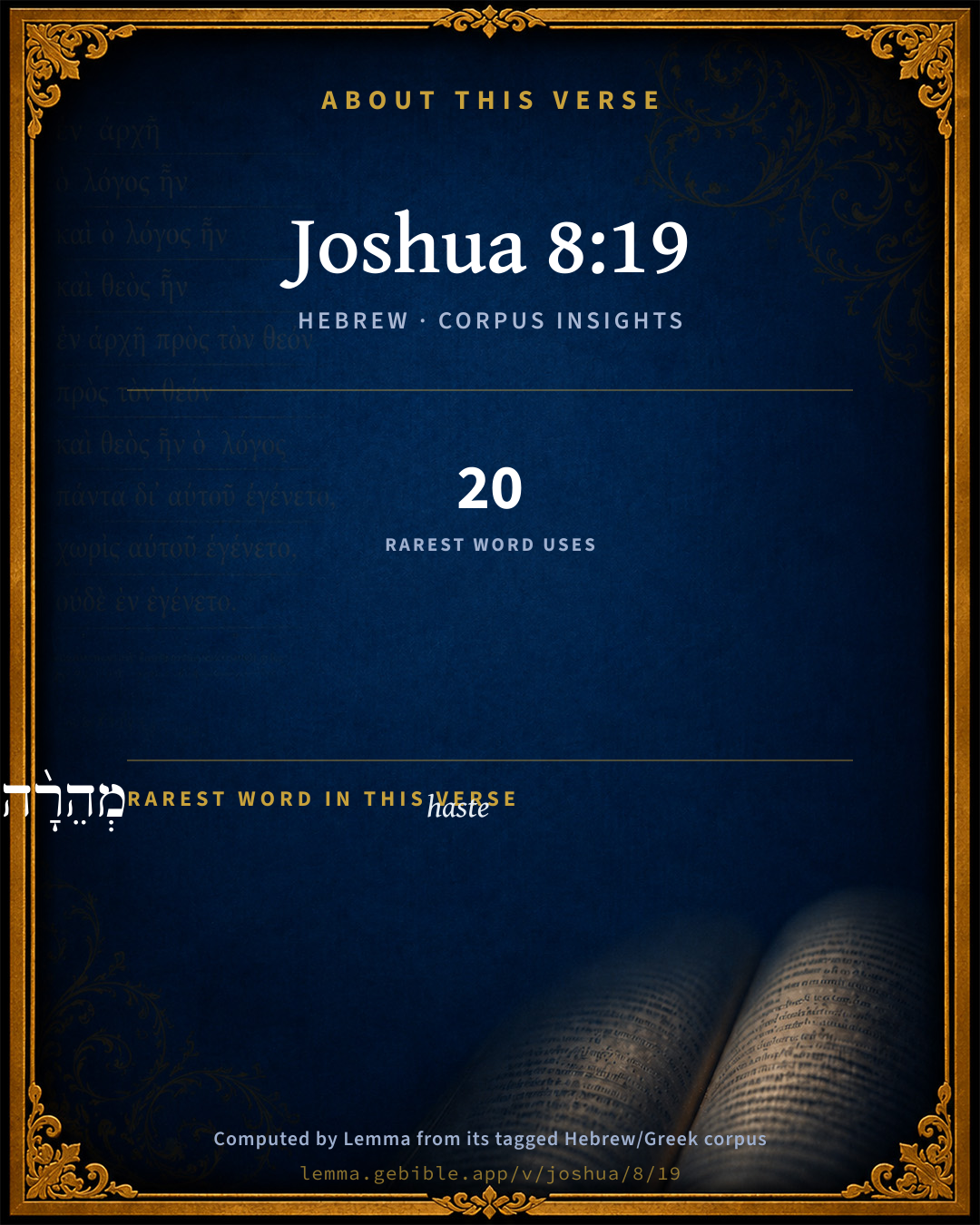
The rarest word here is מְהֵרָ֨ה haste H4120 — appearing just 20 times in the whole Hebrew Bible.

Shared distinctive vocabulary

מְהֵרָ֨ה haste H4120 occurs in 20 verses of the Hebrew Bible. Also found in:

Grammatical profile

  • 8 verbs
  • 6 nouns
  • 1 particle

Verb forms

  • וְהָאוֹרֵ֡ב Qal · Participle Active
  • קָם֩ Qal · Perfect
  • וַיָּר֨וּצוּ֙ Qal · Sequential Imperfect
  • כִּנְט֣וֹת Qal · Infinitive Construct
  • וַיָּבֹ֥אוּ Qal · Sequential Imperfect
  • וַֽיִּלְכְּד֑וּהָ Qal · Sequential Imperfect
  • וַֽיְמַהֲר֔וּ Piel · Sequential Imperfect
  • וַיַּצִּ֥יתוּ Hiphil · Sequential Imperfect

Repetition

A word recurs within this verse — often emphatic in Hebrew:

  • הָעִ֖יר city H5892 ×2

Hebrew & Septuagint length

In English translation the verse runs 37 words from the Hebrew and 50 from the Septuagint (LXX English) — closely comparable.

A rough comparison of the two English renderings, which tokenize alike — not a word-level alignment.

Word counts can differ between the Hebrew and the Greek without any difference in meaning — e.g. the Hebrew direct-object marker אֵת has no separate Greek word, and Greek often adds the article ὁ.

Hebrew and Greek witnesses Masoretic Hebrew ↔ Greek Septuagint

The same verse in the two great witnesses to the Old Testament, shown verse-for-verse.

These are two independent witnesses, not word-aligned to each other, and the Septuagint is shown in lemma (dictionary) form.

Hebrew Joshua 8:19 Masoretic · Westminster Leningrad Codex

וְהָאוֹרֵ֡ב קָם֩ מְהֵרָ֨ה מִמְּקוֹמ֤וֹ וַיָּר֨וּצוּ֙ כִּנְט֣וֹת יָד֔וֹ וַיָּבֹ֥אוּ הָעִ֖יר וַֽיִּלְכְּד֑וּהָ וַֽיְמַהֲר֔וּ וַיַּצִּ֥יתוּ אֶת הָעִ֖יר בָּאֵֽשׁ

The ambush arose quickly out of their place, and they ran as soon as he had stretched out his hand, and entered into the city, and took it; and they hurried and set the city on fire.

World English Bible · Public Domain

Greek LXX Joshua 8:19 Septuagint · lemma form

καί ὁ ἔνεδρον ἐκ ἀναἵστημι ἐν τάχος ἐκ ὁ τόπος αὐτός καί ἐκἔρχομαι ὅτε ἐκτείνω ὁ χείρ καί ἔρχομαι ἐπί ὁ πόλις καί καταλαμβάνω αὐτός καί σπεύδω ἐνπίμπρημι ὁ πόλις ἐν πῦρ

And Joshua stretched out his hand and his spear toward the city, and the ambuscade rose up quickly out of their place; and they came forth when he stretched out his hand; and they entered into the city, and took it; and they hasted and burnt the city with fire.

LXX2012 (modern English Septuagint) · Public Domain

Hebrew: Westminster Leningrad Codex (CC BY 4.0). Greek: Septuagint (public domain); English from LXX2012 (modern English Septuagint) (Public Domain). How the Septuagint differs from the Hebrew →

Targum (Aramaic paraphrase)

1

The Targum is the ancient Jewish Aramaic paraphrase of the Hebrew Scriptures — an interpretive translation, not the Hebrew text itself. Onkelos (literal) and Pseudo-Jonathan (expansive) render the Torah, and Jonathan the Prophets. Coverage is partial: where no permissively-licensed English translation exists for a verse, only the Aramaic is shown. This is verse-level text, not a word-by-word alignment to the Hebrew.

  1. Targum Jonathan Prophets (Joshua–Malachi)
    וּכְמָנָא קָם בִּפְרִיעַ מֵאַתְרֵיהּ וּרְהָטוּ כִּדְאָרֵים יְדֵיהּ וְעָלוּ לְקַרְתָּא וְכַבְּשׁוּהָ וְאוֹחִיאוּ וְאַדְלִיקוּ יַת קַרְתָּא בְּנוּרָא:

    (no public-domain English translation for this verse)

    Targum Jonathan — Aramaic: “Mikraot Gedolot” (public domain). English: “Sefaria Community Translation” (CC0 1.0 (public-domain dedication)); “London "Chaldee Paraphrase," 1871” (public domain). Text via Sefaria.

Commentary

Notes on Joshua 8:19 from classic Christian and Jewish commentators (each source and its license shown beneath its notes). The classic Christian expositions comment on the surrounding passage and are grouped to its opening verse, so a note may address several verses; the Jewish commentaries on the Tanakh (Rashi and others) are per-verse, so they appear only where the commentator wrote on this verse.

Lemma curates 59 commentaries, every one of them public domain or Creative Commons licensed, each selected and text-cleaned for this edition rather than reprinted as found. About our sources →

Trapp's Complete Commentary

John Trapp

Jos 8:19 And the ambush arose quickly out of their place, and they ran as soon as he had stretched out his hand: and they entered into the city, and took it, and hasted and set the city on fire.

Ver. 19. And the ambush arose quickly, and they ran, and hasted.] For they knew that opportunities are headlong, and once past they cannot be recovered. Armies as well as courts have their cito, cito Alexander being asked how in so short a time he had overrun so great a part of the habitable world, answered, Mηδεν αναβαλλομενος, by making no delays.

John Trapp, A Commentary or Exposition upon All the Books of the Old and New Testament (1647–1656) — public domain. Text from a community e-Sword module.

Joseph Benson's Commentary

Jos 8:19-23. They entered and set the city on fire — That is, some part of it, sufficient to raise a smoke, and give notice to their brethren of their success. But certainly not all of it, because in that case they would have lost the prey which God had allowed them. Indeed, it is evident from verse

28, that the main part of the city was not burned till after the battle, and they had taken out all the cattle and other spoils that were therein. The people that fled turned back — That is, the Israelites, who had counterfeited a flight, turned upon the men of Ai, who pursued them. The other issued out of the city — Namely, those who lay in ambush, and were now in possession of the city. The king they took alive — Reserved him to a more ignominious death.

Joseph Benson's Commentary on the Old and New Testaments (1811–1818) — public domain. Text from a community e-Sword module.

Adam Clarke's Commentary

Verse 19. Set the city on fire.] See Clarke on Jos 8:8.

Adam Clarke's Commentary on the Bible (1810–1826) — public domain. Text from a community e-Sword/MySword module.

John Gill's Exposition

And the ambush arose quickly out of their place,.... As soon as the sentinels set in proper places observed the signal, and gave them notice of it, which was the stretching out of the spear, as appears by what follows:

and they ran as soon as he had stretched out his hand; and the spear in his hand; from whence it is plain, that though the Lord is said to bid Joshua do this now, he had orders from him for it before and the ambush must have been made acquainted with it before they were sent away; and this was only a renewal of the order from the Lord, and which pointed out the proper time, the very crisis, when it should be stretched out:

and they entered into the city; without any difficulty, the gates being open:

and took it; took possession of it, and the strong holds in it:

and hasted and set the city on fire; that is, they made haste to set some houses on fire as the signal to the army of Israel to return.

John Gill's Exposition of the Whole Bible (1746–1763) — public domain (CC PDM 1.0). Text via the HelloAO Bible API.

Matthew Poole's English Annotations

i.e. Not all of it, as appears both from Jos 8:28, and because then they had lost that prey which God had allowed them; but some part of it, enough to raise a smoke, and give notice to their brethren of their success.

Matthew Poole's English Annotations on the Holy Bible (1683–1685) — public domain. Text from a community e-Sword/MySword module.

Whedon's Commentary on the Bible

Daniel D. Whedon

19. And set the city on fire — Not only for its destruction, but also for a signal to the army which was feigning a retreat to turn upon their pursuers, whose place of safety was now cut off. In Jos_8:28 the burning of the city occurs after the pillage, but that is to be understood of the completion and consequence of what the ambush had begun.

Daniel D. Whedon (gen. ed.), Commentary on the Old and New Testaments (1874–1909) — public domain. Text from a community e-Sword module.

The Pulpit Commentary

HOMILIES BY R. GLOVER Ver. 19. On trying again.

A Jewish proverb says there are three men who get no pity an unsecured creditor, a henpecked husband, and a man that does not try again. This faculty of trying again is one of the qualities of noble natures. Napoleon at once blamed and praised the English for never knowing when they were beaten. Here Joshua exhibits the same kind of quality. He gathers from his defeat humility, purity, prudence, but never thinks of gathering from it despair. If they have been defeated before this once, they must try again with purer hands and in stronger force. And, trying again thus, they succeed grandly. Let me say a little on "trying again." In the spiritual as in the carnal warfare indeed, in all parts of our manifold life we need to learn this lesson. I therefore ask you to consider one or two reasons why we should always try again.

I Because NO FAILURE IS ALTOGETHER LOSS, AND ESPECIALLY NO FAILURE OF FIRST EFFORTS. If you ask why a first effort is so often a failure, you will find one great reason is, that in it we are trying to learn too many things at once. If it is a first effort to make a toy for a child, how many things are to be learned while making it; the qualities of the material with which we work, the use of our tools, an eye for form and size, the way to combine effectively the various parts. Now, if in the making of it we had only to learn one thing instead of four, we might manage; but to learn simultaneously all of them is beyond our power, and so we fail. But the failure does not mean total loss of time and material; for though we have not learned all we need in order to effect our object, we may have learned half, and learning the other half the second trial we then succeed. So here; there were some things Joshua and Israel had to learn: e.g., not to despise an enemy; to conquer brave foes as well as timorous ones; not to act on the suggestion even of the wisest captains without first inquiring of God; that victory without purity was impossible. Here, elate with their success at Jericho, Joshua does not ask the counsel of God, which would have forbidden movement till the stain of Achan was removed, and sends only a "few thousands" to perform a task for which a much stronger force was requisite. And God mercifully lets him make a failure on a scale easily retrieved, and so prevents a failure through similar mistakes, which, from its magnitude might have been irretrievable. In almost every case of failure, the great cause of it is that there were some things the learning of which was essential but had not been attained. We had not the measure of the obstacles to be overcome a knowledge of our own weakness, an acquaintance with the methods by which the result desired could be alone effected. And the art of life consists very much simply in turning such failures to good account. It is all but impossible to avoid making them. A child cannot learn to walk without some fails; and we are but children of a larger growth, who learn through improving our failures. And the wisest man is not he who makes fewest failures, but he who turns the failures that he makes to best account, addresses himself to learn their lessons. A failure is a schoolmaster, who can teach the art of succeeding better than any one else can do it. Do not yield, then, because you fail once, or even many times. Failures are never entirely losses. Secondly, observe

II THOSE WHO USE WELL THEIR FAILURES FIND THEM FOLLOWED BY GRAND SUCCESS. Joshua, learning from the first failure to hallow the people, to consult God, to take His way, to send a larger force, when he tried again took Ai without the slightest difficulty. Moses failed on his first attempt to raise Israel against their oppressors. He was going to do it in the strength of his youthful enthusiasm, and expected to find they would hail him as a judge and a deliverer. He failed, was rejected of Israel, and had to become a fugitive from Pharaoh. But in his second effort, going at God"s command, in His way and with His backing, he succeeded in the grand emancipation. Israel failed in its first attempt to enter the promised land through their fear and faithlessness; repairing these faults, their second was successful The disciples failed to cast out the devil from the child; learning the need of deeper sympathy (prayer and fasting), their next efforts were crowned with complete success. Mark broke down in his first missionary effort, leaving Paul and Silas to pursue it alone. But prayer and gracious shame so retrieved the failure that he was Paul"s truest comrade in the pains and dangers of his last imprisonment. Peter failed in his first effort to confess his Master among his foes; but learning lowliness and prayer from failure, he lived to retrieve it grandly. It is so in all departments of life. Alfred the Great and Bruce, for instance, both learned the art of victory from the experience of defeat. Great inventors have rarely hit on their great secrets the first time they have attempted to achieve their purpose, The story of almost all great inventions has been failure well improved. The first efforts of poets do not always give the promise of their later powers. So is it in all directions of Christian life. If in your effort to confess Christ you fail, try again, and success will come with the greater earnestness and humility of your second effort. If you make a resolution and break it, try again with more of prayer, and the second effort will succeed. If you make some effort to do good, but your hand" bungles, and shame covers you, the next effort you make on a smaller scale, perhaps more wisely, modestly, and earnestly, will be a blessed success. And if it is not one but many efforts have failed, and life itself seems one long mishap and unsuccessful effort still, do not despair. "Deem not the irrevocable past As wholly wasted, wholly vain; For, rising on its wrecks, at last To nobler greatness we attain. Longfellow"s "Ladder of St. Augustine.

Therefore let us always "try again. G.

The Pulpit Commentary (1880–1919), ed. H.D.M. Spence-Jones & Joseph S. Exell — public domain. Text from a community e-Sword module.

John Wesley's Explanatory Notes

Set the city on fire - Not all of it, as appears from ver. 28, and because then they had lost that prey which God had allowed them; but part of it, enough to raise a smoke, and give notice to their brethren of their success.

John Wesley, Explanatory Notes Upon the Whole Bible (1754–1765) — public domain. Text via the GEBible commentary corpus.

Lesson kit

Teaching starters — assembled from the data on this page, not authored interpretation. Every prompt links to the verse data it draws on. Edit before teaching.

Joshua, in the Historical, opens this verse with 15 words (14 distinct Hebrew lemmas). Its most distinctive word is mᵉhêrâh (“haste”). A historical commentator’s framing appears above. Read the whole chapter for the surrounding context.

Discussion questions

  1. The word mᵉhêrâh carries the sense “haste.” How does it shape the verse?
  2. Numbers 16:46 shares the word «haste» with this verse. How do the two illuminate each other?
  3. “city” occurs 2× in this one verse. What is the effect of the repetition?
  4. The translations on this page render this verse differently — a whole-verse word diff, not a word-by-word alignment. What might account for the different wordings?
  5. The verb «וְהָאוֹרֵ֡ב» is Qal Participle Active. How does its form color the action?
  6. Reading how Trapp's Complete Commentary and Joseph Benson's Commentary read this verse, where do the two commentators agree and where do they part?

Things to notice

Reading settings

Reading text

Shown beneath each verse's original-language words.

Old Testament
Old Testament edition

Read the OT as the Masoretic Hebrew (MT) or the Greek Septuagint (LXX).

English shown for the Greek Septuagint (in the Hebrew ↔ Greek comparison).

Comparing translations? Open the Compare panel on any verse page to stack up to four side by side.