
Job 31:12

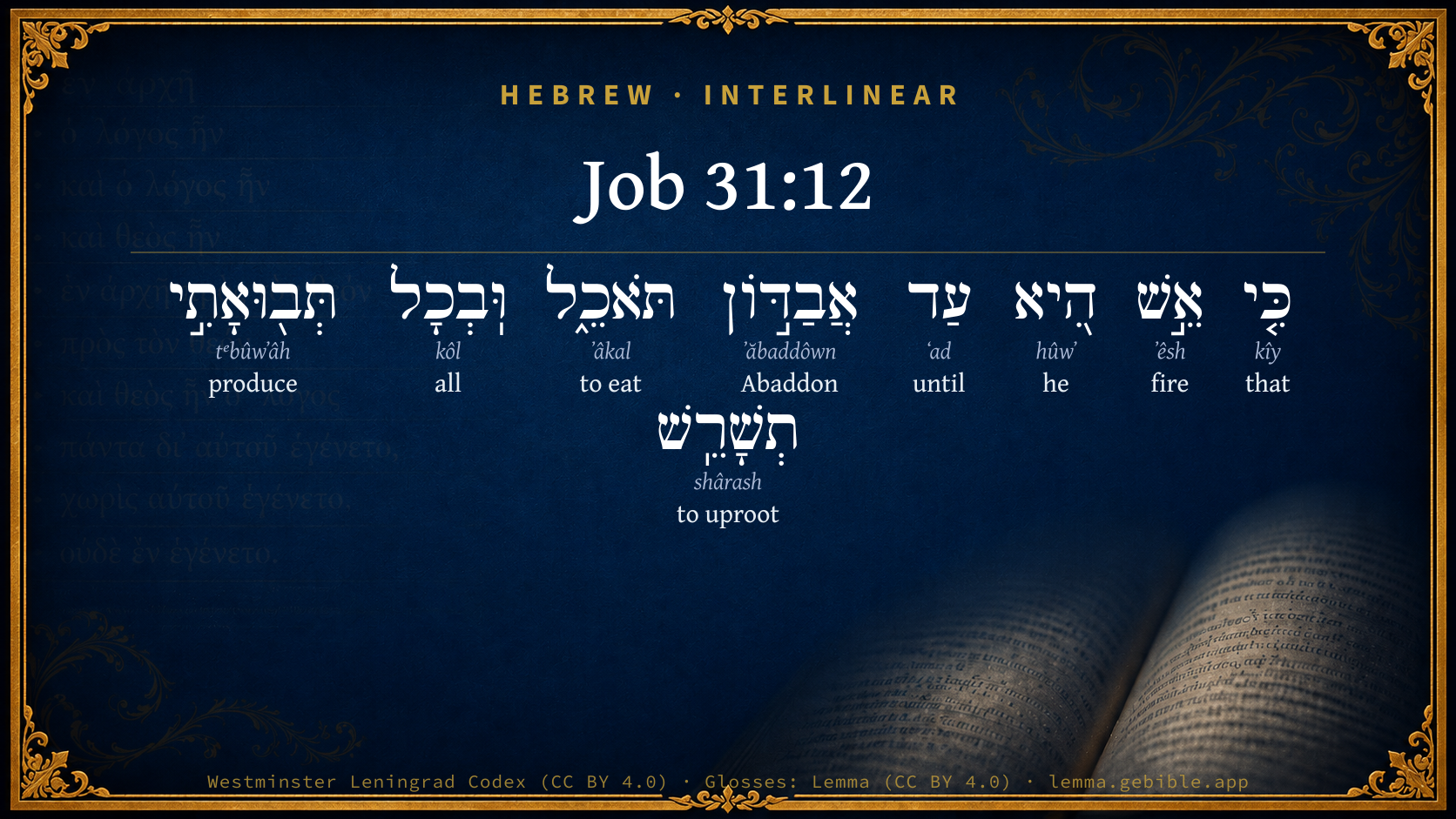
Hebrew (Westminster Leningrad Codex) Job 31:12 appears in the Hebrew Old Testament. The text above is from the Westminster Leningrad Codex. Each word links to its Strong’s number, a concise gloss, and parsing drawn from the Open Scriptures Hebrew Bible morphology. Click any word for its full Brown-Driver-Briggs (BDB) entry.
Download image
Cite this verse

Job 31:12 (World English Bible). Public Domain. Lemma interlinear Bible study tool, https://lemma.gebible.app/v/job/31/12.

Show BibTeX & RIS
BibTeX
RIS
English Translation
For it is a fire that consumes to destruction, And would root out all my increase.
World English Bible · Public Domain
Download a study sheet

One document with this verse’s original text, its word-by-word gloss line, the meaning frame, cross-references with their text, attributed commentary, and full source and license credits — printable, and it pastes into notes with its structure intact.

This verse Autodidact and up

Study sheet (.html) Plain text (.txt)

A passage Seminary Student

Up to 50 verses in one chapter. A passage sheet keeps up to 6 commentary sources and 12 cross-references per verse, in the order this page ranks them, and says so on the sheet whenever that leaves anything out. Ask for a single verse and you get the Autodidact verse sheet above.

Everything on this page stays free to read, with no account — the sheet is a download of what is already on screen, not access to it.

Want to remove ads? Support Godless Engineer
Compare translations 3

The same verse in 3 English versions, stacked beneath the original-language interlinear above. Click any original word for its lexicon entry.

Each is an independent rendering of the whole verse — the interlinear is not word-aligned to these translations.

Highlighted words mark where these versions differ — a whole-verse word diff, not a word-by-word alignment.

  • World English Bible Public Domain
    For it is a fire that consumes to destruction, And would root out all my increase.
  • King James Version Public Domain
    For it is a fire that consumeth to destruction, and would root out all mine increase.
  • unfoldingWord Literal Text CC BY-SA 4.0
    For it a fire, it consumes unto Abaddon, and it would uproot all of my harvest.

unfoldingWord Literal Text — © unfoldingWord, licensed CC BY-SA 4.0. Word-aligned USFM3 via Door43 (git.door43.org/unfoldingWord/en_ult).

Versions to compare (up to 4)

3 of 4 selected

Show all 18 translations

Every available English version of this verse, each an independent rendering of the whole verse.

  • World English Bible Public Domain
    For it is a fire that consumes to destruction, And would root out all my increase.
  • Berean Standard Bible Public Domain
    For it is a fire that burns down to Abaddon; it would root out my entire harvest.
  • Majority Standard Bible Public Domain
    For it is a fire that burns down to Abaddon; it would root out my entire harvest.
  • King James Version Public Domain
    For it is a fire that consumeth to destruction, and would root out all mine increase.
  • American Standard Version (1901) Public Domain
    For it is a fire that consumeth unto Destruction, And would root out all mine increase.
  • Revised Version (1885) Public Domain
    For it is a fire that consumeth unto Destruction, and would root out all mine increase.
  • Geneva Bible (1599) Public Domain
    Yea, this is a fire that shall deuoure to destruction, and which shall roote out al mine increase,
  • Douay-Rheims (1899) Public Domain
    It is a fire that devoureth even to destruction, and rooteth up all things that spring.
  • Young's Literal Translation Public Domain
    For a fire it `is', to destruction it consumeth, And among all mine increase doth take root,
  • Literal Standard Version CC BY-SA 4.0
    For it [is] a fire, it consumes to destruction, || And takes root among all my increase,
  • Unlocked Literal Bible CC BY-SA 4.0
    For that is a fire that consumes as far as Abaddon, and it would burn all my harvest to the root.
  • unfoldingWord Literal Text CC BY-SA 4.0
    For it a fire, it consumes unto Abaddon, and it would uproot all of my harvest.
  • Darby Bible Public Domain
    For it is a fire that consumeth to destruction, and would root out all mine increase.
  • World Messianic Bible Public Domain
    for it is a fire that consumes to destruction, and would root out all my increase.
  • Webster's Bible Public Domain
    For it is a fire that consumeth to destruction, and would root out all my increase.
  • Free Bible Version CC BY-SA 4.0
    for this sin is like a fire that leads to destruction, destroying everything I have.
  • Bible in Basic English Public Domain
    It would be a fire burning even to destruction, and taking away all my produce.
  • JPS Tanakh (1917) Public Domain
    For it is a fire that consumeth unto destruction, and would root out all mine increase.

Literal Standard Version (2020), Covenant Press — licensed CC BY-SA 4.0. Text via the HelloAO Bible API (eBible.org). Unlocked Literal Bible (unfoldingWord) — licensed CC BY-SA 4.0. Text via the HelloAO Bible API (eBible.org). unfoldingWord Literal Text — © unfoldingWord, licensed CC BY-SA 4.0. Word-aligned USFM3 via Door43 (git.door43.org/unfoldingWord/en_ult). Free Bible Version, Dr. Jonathan Gallagher — licensed CC BY-SA 4.0. Text via the HelloAO Bible API (eBible.org).

Word by word

More ways to search: Search by grammar → Find every occurrence → Compare this word →

Practice this passage: Drill this verse → Learn its vocabulary →

About this verse

These counts appear in no published source. They are computed here, from the morphology-tagged text and Lemma’s own curated glosses. What Lemma adds →

9
words
9
distinct lemmas
Wisdom
section

Notable vocabulary

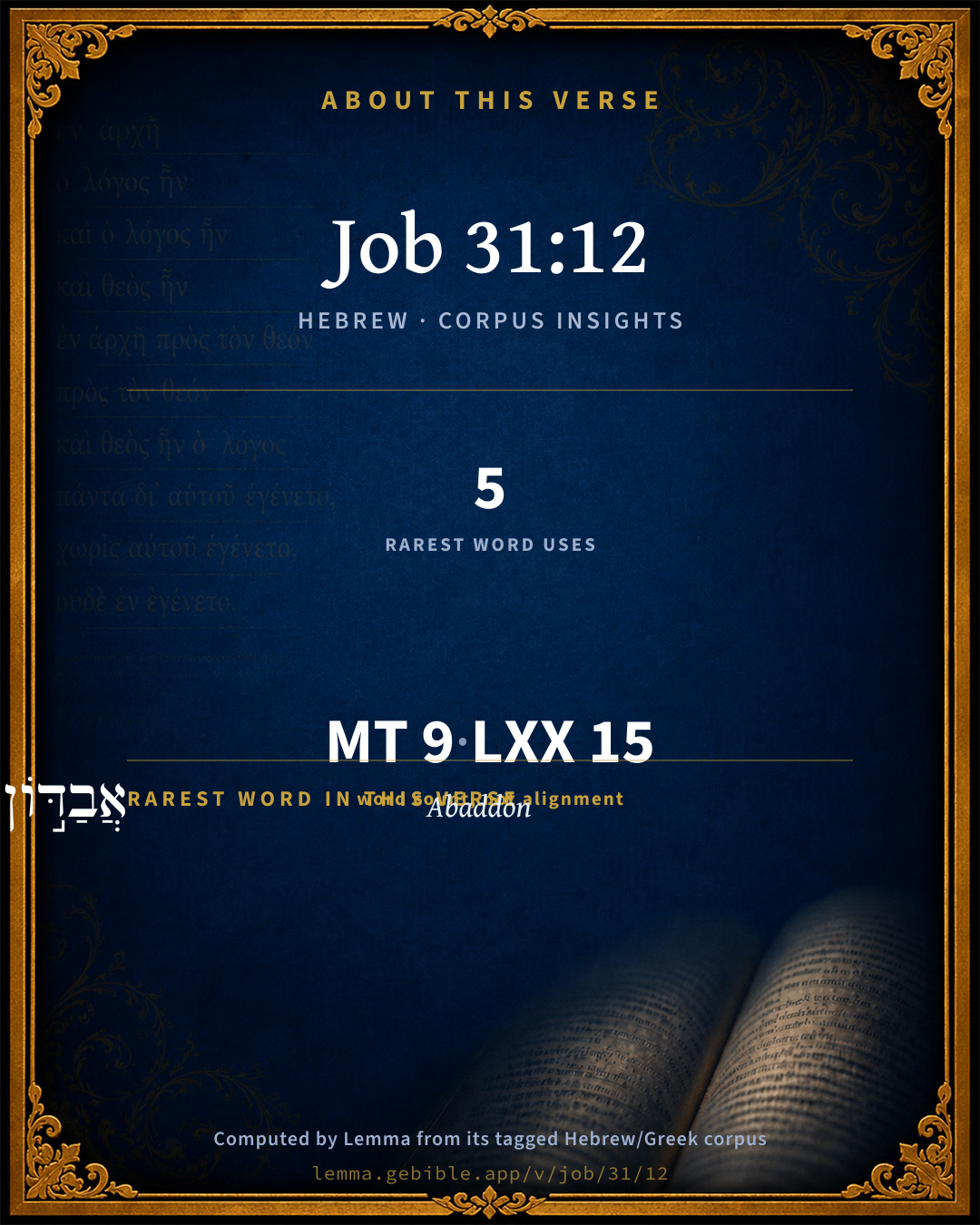
The rarest word here is אֲבַדּ֣וֹן Abaddon H11 — appearing just 5 times in the whole Hebrew Bible.

Shared distinctive vocabulary

אֲבַדּ֣וֹן Abaddon H11 occurs in 5 verses of the Hebrew Bible. Also found in:

Grammatical profile

  • 2 verbs
  • 4 nouns
  • 1 pronoun
  • 1 preposition
  • 1 conjunction

Verb forms

  • תֹּאכֵ֑ל Qal · Imperfect
  • תְשָׁרֵֽשׁ Piel · Imperfect

Hebrew & Septuagint length

In English translation the verse runs 16 words from the Hebrew and 16 from the Septuagint (LXX English) — the same length.

A rough comparison of the two English renderings, which tokenize alike — not a word-level alignment.

Word counts can differ between the Hebrew and the Greek without any difference in meaning — e.g. the Hebrew direct-object marker אֵת has no separate Greek word, and Greek often adds the article ὁ.

In the original languages it is 9 Hebrew tokens and 15 Greek tokens — but the two are counted differently (Hebrew bundles its prefixes and suffixes into one token; the Greek is in lemma form), so that isn’t a like-for-like length.

Cross-references

8

Topical passages linked to Job 31:12 in the Treasury of Scripture Knowledge — connected by theme and wording, ordered by reader-vote popularity; previews shown in the World English Bible.

  • Proverbs 6:27 Can a man scoop fire into his lap, And his clothes not be burned?
  • Jeremiah 5:7–9 How can I pardon you? your children have forsaken me, and sworn by them that are no gods: when I had fed them to the full, they committed adultery, and assembled themselves in troops at the prostitutes' houses.
  • Job 15:30 He shall not depart out of darkness; The flame shall dry up his branches, By the breath of God's mouth shall he go away.
  • Job 20:28 The increase of his house shall depart; They shall rush away in the day of his wrath.
  • Job 26:6 Sheol is naked before God, And Abaddon has no covering.
  • Proverbs 3:33 Yahweh's curse is in the house of the wicked, But he blesses the habitation of the righteous.
  • Malachi 3:5 I will come near to you to judgment; and I will be a swift witness against the sorcerers, and against the adulterers, and against the perjurers, and against those who oppress the hireling in his wages, the widow, and the fatherless, and who deprive the foreigner of justice, and don't fear me," says Yahweh of Hosts.
  • Hebrews 13:4 Let marriage be held in honor among all, and let the bed be undefiled: but God will judge the sexually immoral and adulterers.

Cross-references courtesy of OpenBible.info (CC BY 4.0).

Hebrew and Greek witnesses Masoretic Hebrew ↔ Greek Septuagint

The same verse in the two great witnesses to the Old Testament, shown verse-for-verse.

These are two independent witnesses, not word-aligned to each other, and the Septuagint is shown in lemma (dictionary) form.

Hebrew Job 31:12 Masoretic · Westminster Leningrad Codex

כִּ֤י אֵ֣שׁ הִ֭יא עַד אֲבַדּ֣וֹן תֹּאכֵ֑ל וּֽבְכָל תְּב֖וּאָתִ֣י תְשָׁרֵֽשׁ

For it is a fire that consumes to destruction, And would root out all my increase.

World English Bible · Public Domain

Greek LXX Job 31:12 Septuagint · lemma form

πῦρ γάρ εἰμί καίω ἐπί πᾶς ὁ μέρος ὅς δέ ἄν ἐπιἔρχομαι ἐκ ῥίζα ἀποὀλλύω

For it is a fire burning on every side, and whoever it attacks, it utterly destroys.

LXX2012 (modern English Septuagint) · Public Domain

Hebrew: Westminster Leningrad Codex (CC BY 4.0). Greek: Septuagint (public domain); English from LXX2012 (modern English Septuagint) (Public Domain). How the Septuagint differs from the Hebrew →

Commentary

Notes on Job 31:12 from classic Christian and Jewish commentators (each source and its license shown beneath its notes). The classic Christian expositions comment on the surrounding passage and are grouped to its opening verse, so a note may address several verses; the Jewish commentaries on the Tanakh (Rashi and others) are per-verse, so they appear only where the commentator wrote on this verse.

Lemma curates 59 commentaries, every one of them public domain or Creative Commons licensed, each selected and text-cleaned for this edition rather than reprinted as found. About our sources →

Trapp's Complete Commentary

John Trapp

Job 31:12 For it [is] a fire [that] consumeth to destruction, and would root out all mine increase.

Ver. 12. For it is a fire that consumeth to destruction] Ad Gehennam usque, to the place of destruction. Heb. to Abaddon, that burneth as low as hell itself. In case men should be slack to punish this heinous crime, yet whoremongers and adulterers God will judge, Heb 13:3, shutting them out of heaven, Rev 22:15 (for what should any such dirty dog do trampling on that golden pavement?), and thrusting them into hell, as he did the filthy Sodomites, Jdg 1:7, beside that hell above ground which he rained from heaven upon them, hot fire for their burning lusts, and stinking brimstone for their stinking brutishness. How God signally punished this sin in Charles II, king of Navarre, roasting him to death. {See Trapp on "Gen 19:24"} Joan of Naples also, and Mary of Arragon, wife to the Emperor Otho III, burnt at a stake, are set upon record as instances of the Divine displeasure against adultery, a fire which burns hearts and consumes houses.

And would root out all mine increase] Leaving me nothing. As a devouring fire burns up men, cattle, houses, corn, trees, &c.; so doth this sin all a man’s income, baring him to the very bones, and exhausting him to the utmost: so that, like Tiberius at Capreae, he doth indies perire, which is a bitterness beyond that of death, Ecc 7:26. Or like Samson, befooled and bereft of all by Delilah, who had not her name for nought, for it comes from Dalal, to exhaust and impoverish. And indeed such kind of creatures do ordinarily drain the strength, exhaust the purses, dry up the credit, waste and consume the all of the mightiest Samsons, besides the loss of their immortal souls, and perpetual shame at the last day (when all their faults shall be written in their foreheads), unless the matter be taken up in the judge’s privy chamber of mercy; and unless, by timely repentance, course be taken to stop his open judicial proceeding in court.

John Trapp, A Commentary or Exposition upon All the Books of the Old and New Testament (1647–1656) — public domain. Text from a community e-Sword module.

Tyndale Open Study Notes

Tyndale Open Resources

31:12 The association of fire with hell or the grave is rare in the Old Testament (cp. Deut 32:22).

Tyndale Open Study Notes — © Tyndale Open Resources, licensed CC BY-SA 4.0. Text via the HelloAO Bible API.

Geneva Bible (1599)

Geneva Bible translators

He showeth that albeit man neglect the punishment of adultery, yet the wrath of God will never cease till such be destroyed.

Geneva Bible (1599) marginal notes — public domain. Text via Bolls.life.

Jamieson, Fausset & Brown

Robert Jamieson, A. R. Fausset & David Brown

(Pro 6:27-35; Pro 8:6-23, Pro 8:26-27). No crime more provokes God to send destruction as a consuming fire; none so desolates the soul.

Jamieson, Fausset & Brown — Commentary Critical and Explanatory on the Whole Bible (1871) — public domain (CC PDM 1.0). Text via the HelloAO Bible API.

Adam Clarke's Commentary

Verse 12. For it is a fire] Nothing is so destructive of domestic peace. Where jealousy exists, unmixed misery dwells; and the adulterer and fornicator waste their substance on the unlawful objects of their impure affections.

Adam Clarke's Commentary on the Bible (1810–1826) — public domain. Text from a community e-Sword/MySword module.

The Cambridge Bible for Schools and Colleges

gen. ed. J. J. S. Perowne

12. to destruction] Heb. abaddon, i. e. Sheol or Death, as a place, ch. Job_26:6, Job_28:22. As to the complete ruin which this sin entailed comp. the passage Pro_6:24-35, particularly the last verses; see also Pro_5:8-14; Pro_7:26-27.

The Cambridge Bible for Schools and Colleges (gen. ed. J. J. S. Perowne; Cambridge University Press, 1878–1918) — public domain. Text from a community e-Sword module.

John Gill's Exposition

If I did despise the cause of my manservant, or of my maidservant,.... Whether it was a cause that related to any controversy or quarrel among themselves when it was brought before him, he did not reject it, because of the meanness of the contending parties, and the state of servitude they were in; but he received it and searched into it, heard patiently what each had to say, examined them thoroughly, entered into the merits of the cause, and either reconciled them, or passed a righteous sentence, punished the delinquent, and protected the innocent; or, if it was a cause relating to himself, any complaint of their work, or wages, or food, or clothing, as it seems to be from what follows:

when they contended with me; had anything to complain of, or to object to him on the above account, or any other, where there was any show or colour of foundation for it; otherwise it cannot be thought he would indulge a saucy, impudent, and contradicting behaviour in them towards him: masters in those times and countries had an unlimited, and exercised a despotic power over their servants, and used them with great rigour, and refused to do them justice upon complaints; but Job behaved as if he had had the rules of the apostle before him to act by in his conduct towards his servants, Eph 6:9; and even condescended to submit the cause between him and his servants to other judges or arbitrators, or rather took cognizance of it himself, heard patiently and carefully what they had to allege, and did them justice.

John Gill's Exposition of the Whole Bible (1746–1763) — public domain (CC PDM 1.0). Text via the HelloAO Bible API.

Albert Barnes' Notes on the Bible

For it is a fire that consumeth to destruction - This may mean that such an offence would be a crime that would provoke God to send destruction, like a consuming fire upon the offender (Rosenmuller and Noyes), or more likely it is designed to be descriptive of the nature of the sin itself. According to this, the meaning is, that indulgence in this sin tends wholly to ruin and destroy a man. It is like a consuming fire, which sweeps away everything before it. It is destructive to the body, the morals, the soul. Accordingly, it may be remarked that there is no one vice which pours such desolation through the soul as licentiousness. See Rush on the Diseases of the Mind. It corrupts and taints all the fountains of morals, and utterly annihilates all purity of the heart. An intelligent gentleman, and a careful observer of the state of things in society, once remarked to me, that on coming to the city of Philadelphia, it was his fortune to be in the same boarding-house with a number of young men, nearly all of whom were known to him to be of licentious habits. He has lived to watch their course of life; and he remarked, that there was not one of them who did not ultimately show that he was essentially corrupt and unprincipled in every department of morals. There is not any one propensity of man that spreads such a withering influence over the soul as this; and, however it may be accounted for, it is certain that indulgence in this vice is a certain evidence that the whole soul is corrupt, and that no reliance is to be placed on the man’s virtue in any respect, or in reference to any relation of life.

And would root out all mine increase - By its desolating effects on my heart and life. The meaning is, that it would utterly ruin him; compare Luk 15:13, Luk 15:30. How many a wretched sensualist can bear testimony to the truth of this statement! How many a young man has been wholly ruined in reference to his worldly interests, as well as in reference to his soul, by this vice compare Prov. 7: No young man could do a better service to himself than to commit the whole of that chapter to memory, and so engrave it on his soul that it never could be forgotten.

Albert Barnes' Notes on the Bible (1834–1885) — public domain. Text from a community e-Sword/MySword module.

Haydock's Catholic Bible Commentary

Spring; the children, Ecclesiasticus xxiii. 35., and Wisdom iv. 3. (Calmet) --- Protestants, "all mine increase." (Haydock) --- Adulteresses were formerly consigned to the flames. The injured husband would resent the offence, and even dislike her former children. Love is also like a fire, and those who entertain it, may soon consume all their substance (Menochius) in feasting and presents. Above all, the fire of God’s indignation in hell will still pursue the libidinous.

George Leo Haydock (1774–1849), Haydock's Catholic Family Bible and Commentary, 1859 edition — public domain. Excludes Psalms (Douay-Rheims chapter numbering differs from Protestant) and Deuterocanonical books (Catholic canon only).

Matthew Poole's English Annotations

For this sin would be as a secret but consuming fire, wasting my estate and reputation, and body and soul too, provoking God and enraging the husband, and bringing down some extraordinary vengeance upon me; and therefore the fear of God kept me from this and such-like wickedness.

All mine increase, i.e. all my estate: compare Pro 6:27.

Matthew Poole's English Annotations on the Holy Bible (1683–1685) — public domain. Text from a community e-Sword/MySword module.

Whedon's Commentary on the Bible

Daniel D. Whedon

12. Destruction — Hebrews Abaddon. The sin spoken of is a fire that ceases not to burn till it has taken hold of hell itself. (Pro_7:27.) “It drags him whom it has seized down with it into the deepest depth of ruin, and as it were melts him away.” — Delitzsch. See Caryl, in loc. In the earliest ages adultery was punished by burning. Gen_38:24.

Daniel D. Whedon (gen. ed.), Commentary on the Old and New Testaments (1874–1909) — public domain. Text from a community e-Sword module.

The Pulpit Commentary

For it is a fire that consumeth to destruction; i.e. it is a thing which brings down the wrath of God upon a man, so that "a fire is kindled in his anger, which shall burn unto the lowest hell". (Deu_32:22) Compare the sentence on David for his great transgression. (2Sa_12:9-12) And would root out all mine increase; i.e. "would destroy all my estate;" either by leading me to waste my substance upon my companion in sin, or by bringing down God"s judgments upon me to my temporal ruin.

The Pulpit Commentary (1880–1919), ed. H.D.M. Spence-Jones & Joseph S. Exell — public domain. Text from a community e-Sword module.

John Wesley's Explanatory Notes

Destruction - Lust is a fire in the soul; it consumes all that is good there, the convictions, the comforts; and lays the conscience waste. It consumes the body, consumes the substance, roots out all the increase. It kindles the fire of God's wrath, which if not quenched by the blood of Christ, will burn to the lowest hell.

John Wesley, Explanatory Notes Upon the Whole Bible (1754–1765) — public domain. Text via the GEBible commentary corpus.

Rashi

Rabbi Shlomo Yitzchaki (Rashi)

and it uproots all my grain i.e., this fire. Therefore, I refrained from committing [this sin]. When he speaks with an expression of uprooting, he says תְּשָׁרֵשׁ, and to express roots, he also uses תַּשְׁרֵשׁ. Similarly, יְשֹׁרָשׁוּ is an expression of uprooting and יַשְׁרִשׁוּ is an expression of a root.

Rashi on the Tanakh — English translations: “The Judaica Press complete Tanach with Rashi, translated by A. J. Rosenberg” (CC BY 4.0); “Pentateuch with Rashi's commentary by M. Rosenbaum and A.M. Silbermann, 1929-1934” (public domain); “The Metsudah Tanach series, Lakewood, N.J” (CC BY 4.0); and “The Book of Joshua, Metsudah Publications, 1997” (CC BY 4.0). Text via Sefaria.

Lesson kit

Teaching starters — assembled from the data on this page, not authored interpretation. Every prompt links to the verse data it draws on. Edit before teaching.

Job, in the Wisdom, opens this verse with 9 words (9 distinct Hebrew lemmas). Its most distinctive word is ʼăbaddôwn (“Abaddon”). A historical commentator’s framing appears above. Read the whole chapter for the surrounding context.

Discussion questions

  1. What does “Abaddon” (ʼăbaddôwn) contribute to the verse as a whole?
  2. Job 26:6 shares the word «Abaddon» with this verse. How do the two illuminate each other?
  3. The translations on this page render this verse differently — a whole-verse word diff, not a word-by-word alignment. What might account for the different wordings?
  4. The verb «תֹּאכֵ֑ל» is Qal Imperfect. How does its form color the action?
  5. Reading how Trapp's Complete Commentary and Tyndale Open Study Notes read this verse, where do the two commentators agree and where do they part?

Things to notice

Reading settings

Reading text

Shown beneath each verse's original-language words.

Old Testament
Old Testament edition

Read the OT as the Masoretic Hebrew (MT) or the Greek Septuagint (LXX).

English shown for the Greek Septuagint (in the Hebrew ↔ Greek comparison).

Comparing translations? Open the Compare panel on any verse page to stack up to four side by side.