
Deuteronomy 1:33

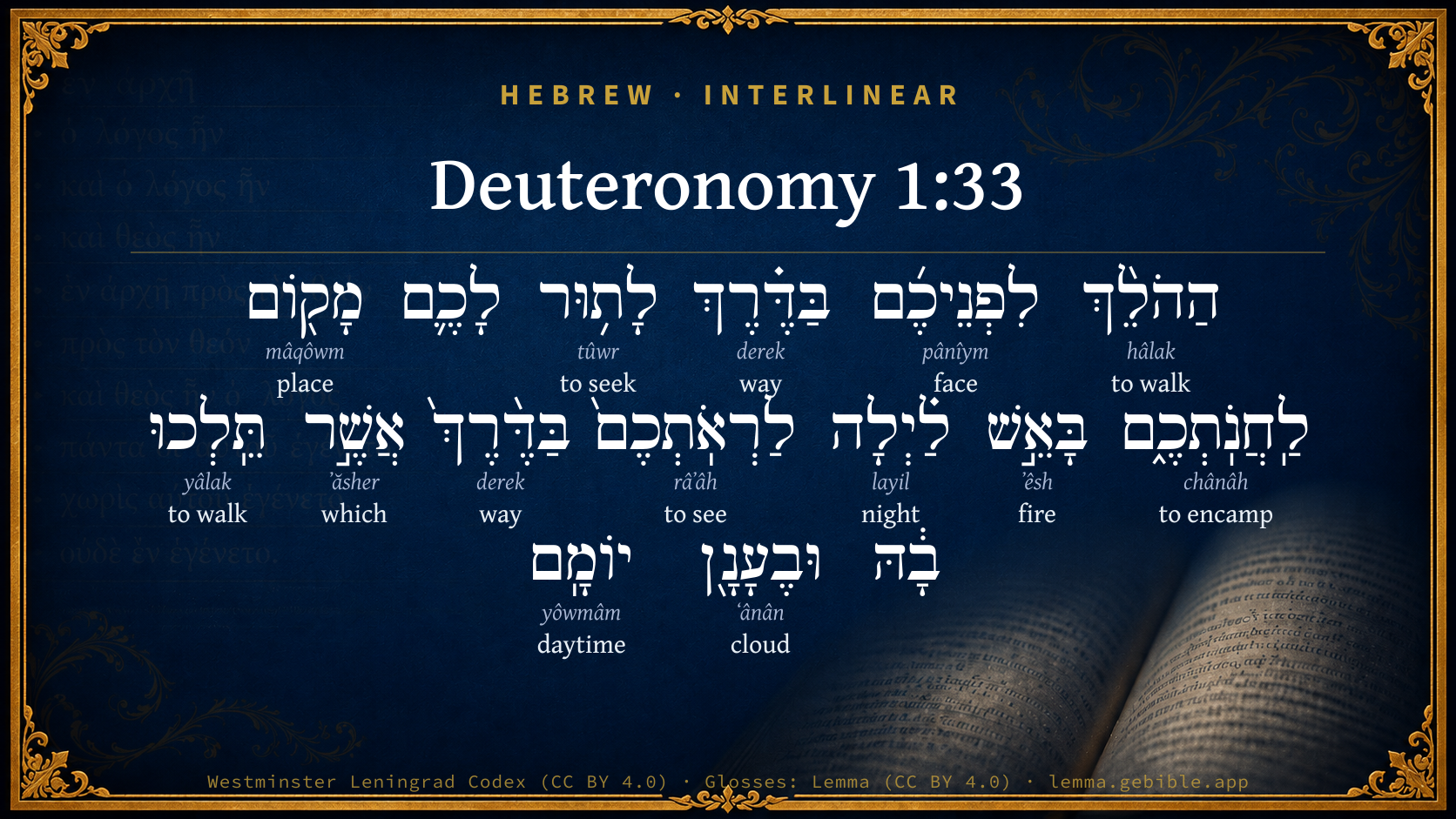
Hebrew (Westminster Leningrad Codex) Deuteronomy 1:33 appears in the Hebrew Old Testament. The text above is from the Westminster Leningrad Codex. Each word links to its Strong’s number, a concise gloss, and parsing drawn from the Open Scriptures Hebrew Bible morphology. Click any word for its full Brown-Driver-Briggs (BDB) entry.
Download image
Cite this verse

Deuteronomy 1:33 (World English Bible). Public Domain. Lemma interlinear Bible study tool, https://lemma.gebible.app/v/deuteronomy/1/33.

Show BibTeX & RIS
BibTeX
RIS
English Translation
who went before you in the way, to seek you out a place to pitch your tents in, in fire by night, to show you by what way you should go, and in the cloud by day.
World English Bible · Public Domain
Download a study sheet

One document with this verse’s original text, its word-by-word gloss line, the meaning frame, cross-references with their text, attributed commentary, and full source and license credits — printable, and it pastes into notes with its structure intact.

This verse Autodidact and up

Study sheet (.html) Plain text (.txt)

A passage Seminary Student

Up to 50 verses in one chapter. A passage sheet keeps up to 6 commentary sources and 12 cross-references per verse, in the order this page ranks them, and says so on the sheet whenever that leaves anything out. Ask for a single verse and you get the Autodidact verse sheet above.

Everything on this page stays free to read, with no account — the sheet is a download of what is already on screen, not access to it.

Want to remove ads? Support Godless Engineer
Compare translations 3

The same verse in 3 English versions, stacked beneath the original-language interlinear above. Click any original word for its lexicon entry.

Each is an independent rendering of the whole verse — the interlinear is not word-aligned to these translations.

Highlighted words mark where these versions differ — a whole-verse word diff, not a word-by-word alignment.

  • World English Bible Public Domain
    who went before you in the way, to seek you out a place to pitch your tents in, in fire by night, to show you by what way you should go, and in the cloud by day.
  • King James Version Public Domain
    Who went in the way before you, to search you out a place to pitch your tents in, in fire by night, to show you by what way ye should go, and in a cloud by day.
  • unfoldingWord Literal Text CC BY-SA 4.0
    the one who went to your faces on the way to seek out a place for you to make your camp, in fire night to show you the way that you should go in it, and in a cloud day.

unfoldingWord Literal Text — © unfoldingWord, licensed CC BY-SA 4.0. Word-aligned USFM3 via Door43 (git.door43.org/unfoldingWord/en_ult).

Versions to compare (up to 4)

3 of 4 selected

Show all 18 translations

Every available English version of this verse, each an independent rendering of the whole verse.

  • World English Bible Public Domain
    who went before you in the way, to seek you out a place to pitch your tents in, in fire by night, to show you by what way you should go, and in the cloud by day.
  • Berean Standard Bible Public Domain
    who went before you on the journey, in the fire by night and in the cloud by day, to seek out a place for you to camp and to show you the road to travel.
  • Majority Standard Bible Public Domain
    who went before you on the journey, in the fire by night and in the cloud by day, to seek out a place for you to camp and to show you the road to travel.
  • King James Version Public Domain
    Who went in the way before you, to search you out a place to pitch your tents in, in fire by night, to show you by what way ye should go, and in a cloud by day.
  • American Standard Version (1901) Public Domain
    who went before you in the way, to seek you out a place to pitch your tents in, in fire by night, to show you by what way ye should go, and in the cloud by day.
  • Revised Version (1885) Public Domain
    who went before you in the way, to seek you out a place to pitch your tents in, in fire by night, to shew you by what way ye should go, and in the cloud by day.
  • Geneva Bible (1599) Public Domain
    Who went in the way before you, to search you out a place to pitch your tentes in, in fire by night, that ye might see what way to goe, and in a cloude by day.
  • Douay-Rheims (1899) Public Domain
    And in the wilderness (as thou hast seen) the Lord thy God hath carried thee, as a man is wont to carry his little son, all the way that you have come, until you came to this place.
  • Young's Literal Translation Public Domain
    who is going before you in the way to search out to you a place for your encamping, in fire by night, to shew you in the way in which ye go, and in a cloud by day.
  • Literal Standard Version CC BY-SA 4.0
    who is going before you in the way to search out for you a place for your encamping, in fire by night, to show you in the way in which you go, and in a cloud by day.
  • Unlocked Literal Bible CC BY-SA 4.0
    who went before you on the way to find a place for you to make camp, in fire by night and in a cloud by day.
  • unfoldingWord Literal Text CC BY-SA 4.0
    the one who went to your faces on the way to seek out a place for you to make your camp, in fire night to show you the way that you should go in it, and in a cloud day.
  • Darby Bible Public Domain
    who went in the way before you, to search you out a place for your encamping, in fire by night, to shew you by what way ye should go, and in the cloud by day.
  • World Messianic Bible Public Domain
    who went before you on the way, to seek out a place for you to pitch your tents in: in fire by night, to show you by what way you should go, and in the cloud by day.
  • Webster's Bible Public Domain
    Who went in the way before you, to search out for you a place to pitch your tents in, in fire by night, to show you by what way ye should go, and in a cloud by day.
  • Free Bible Version CC BY-SA 4.0
    who led you on the journey, present in the fire by night and in the cloud by day, looking to find a place for you to camp and to show you the way to go.
  • Bible in Basic English Public Domain
    Who goes before you on your way, looking for a place where you may put up your tents, in fire by night, lighting up the way you are to go, and in a cloud by day.
  • JPS Tanakh (1917) Public Domain
    Who went before you in the way, to seek you out a place to pitch your tents in: in fire by night, to show you by what way ye should go, and in the cloud by day.'

Literal Standard Version (2020), Covenant Press — licensed CC BY-SA 4.0. Text via the HelloAO Bible API (eBible.org). Unlocked Literal Bible (unfoldingWord) — licensed CC BY-SA 4.0. Text via the HelloAO Bible API (eBible.org). unfoldingWord Literal Text — © unfoldingWord, licensed CC BY-SA 4.0. Word-aligned USFM3 via Door43 (git.door43.org/unfoldingWord/en_ult). Free Bible Version, Dr. Jonathan Gallagher — licensed CC BY-SA 4.0. Text via the HelloAO Bible API (eBible.org).

Word by word

More ways to search: Search by grammar → Find every occurrence → Compare this word →

Practice this passage: Drill this verse → Learn its vocabulary →

לָת֥וּר
tûwr
H8446
“to seek”
Preposition + Verb, Qal, Infinitive Construct
Part of Speech
Preposition + Verb
Stem
Qal
Form
Infinitive Construct
Full BDB Definition

Origin: a primitive root

TWOT: 2500

to seek, search out, spy out, explore - (Qal) - to seek out, select, find out how to do something - to spy out, explore - explorers, spies (participle) - to go about - merchant, trader (participle) - (Hiphil) to make a search, make a reconnaissance
  1. הַהֹלֵ֨ךְ hâlak H1980 “the · walking” Particle, Definite Article + Verb, Qal, Participle Active, Masculine, Singular, Absolute
  2. לִפְנֵיכֶ֜ם pânîym H6440 “to/for · face(s) · your” Preposition + Noun, Common, Both, Plural, Construct + Suffix, Personal, 2nd Person, Masculine, Plural
  3. בַּדֶּ֗רֶךְ derek H1870 “in/at the · way” Preposition, Determined + Noun, Common, Both, Singular, Absolute
  4. מָק֖וֹם mâqôwm H4725 “place” Noun, Common, Masculine, Singular, Absolute
  5. לַֽחֲנֹֽתְכֶ֑ם chânâh H2583 “to encamp · you” Preposition + Verb, Qal, Infinitive Construct + Suffix, Personal, 2nd Person, Masculine, Plural
  6. בָּאֵ֣שׁ ʼêsh H784 “in/at the · fire” Preposition, Determined + Noun, Common, Both, Singular, Absolute
  7. לַ֗יְלָה layil H3915 “night” Noun, Common, Masculine, Singular, Absolute
  8. לַרְאֹֽתְכֶם֙ râʼâh H7200 “to see · you” Preposition + Verb, Hiphil, Infinitive Construct + Suffix, Personal, 2nd Person, Masculine, Plural
  9. בַּדֶּ֨רֶךְ֙ derek H1870 “in/at the · way” Preposition, Determined + Noun, Common, Both, Singular, Absolute
  10. אֲשֶׁ֣ר ʼăsher H834 “which” Particle, Relative
  11. תֵּֽלְכוּ yâlak H3212 “to walk” Verb, Qal, Imperfect, 2nd Person, Masculine, Plural
  12. וּבֶעָנָ֖ן ʻânân H6051 “and · in/at the · cloud” Conjunction + Preposition, Determined + Noun, Common, Masculine, Singular, Absolute
  13. יוֹמָֽם yôwmâm H3119 “daytime” Adverb

About this verse

These counts appear in no published source. They are computed here, from the morphology-tagged text and Lemma’s own curated glosses. What Lemma adds →

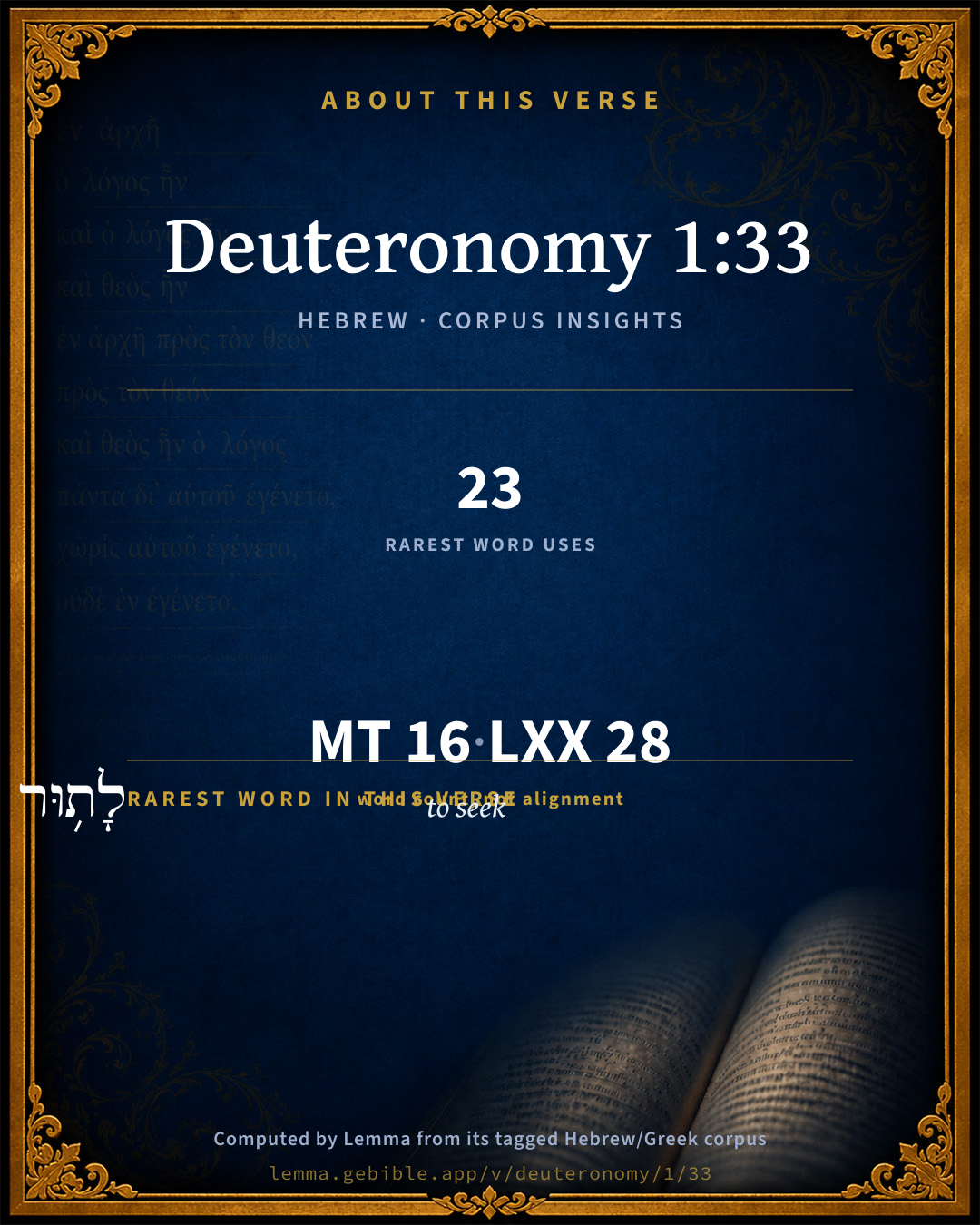
16
words
13
distinct lemmas
Pentateuch
section

Notable vocabulary

The rarest word here is לָת֥וּר to seek H8446 — appearing just 23 times in the whole Hebrew Bible.

Shared distinctive vocabulary

לָת֥וּר to seek H8446 occurs in 22 verses of the Hebrew Bible. Also found in:

Grammatical profile

  • 5 verbs
  • 7 nouns
  • 2 prepositions
  • 1 adverb
  • 1 particle

Verb forms

  • הַהֹלֵ֨ךְ Qal · Participle Active
  • לָת֥וּר Qal · Infinitive Construct
  • לַֽחֲנֹֽתְכֶ֑ם Qal · Infinitive Construct
  • לַרְאֹֽתְכֶם֙ Hiphil · Infinitive Construct
  • תֵּֽלְכוּ Qal · Imperfect

Repetition

A word recurs within this verse — often emphatic in Hebrew:

  • בַּדֶּ֗רֶךְ way H1870 ×2

Hebrew & Septuagint length

In English translation the verse runs 37 words from the Hebrew and 31 from the Septuagint (LXX English) — closely comparable.

A rough comparison of the two English renderings, which tokenize alike — not a word-level alignment.

Word counts can differ between the Hebrew and the Greek without any difference in meaning — e.g. the Hebrew direct-object marker אֵת has no separate Greek word, and Greek often adds the article ὁ.

In the original languages it is 16 Hebrew tokens and 28 Greek tokens — but the two are counted differently (Hebrew bundles its prefixes and suffixes into one token; the Greek is in lemma form), so that isn’t a like-for-like length.

Cross-references

15

Topical passages linked to Deuteronomy 1:33 in the Treasury of Scripture Knowledge — connected by theme and wording, ordered by reader-vote popularity; previews shown in the World English Bible.

  • Numbers 10:33 They set forward from the Mount of Yahweh three days' journey; and the ark of the covenant of Yahweh went before them three days' journey, to seek out a resting-place for them.
  • Psalms 78:14 In the daytime he also led them with a cloud, And all night with a light of fire.
  • Numbers 9:15–22 On the day that the tabernacle was raised up, the cloud covered the tabernacle, even the Tent of the Testimony: and at evening it was over the tabernacle as it were the appearance of fire, until morning.
  • Nehemiah 9:12 Moreover in a pillar of cloud you led them by day; and in a pillar of fire by night, to give them light in the way in which they should go.
  • Ezekiel 20:6 in that day I swore to them, to bring them forth out of the land of Egypt into a land that I had searched out for them, flowing with milk and honey, which is the glory of all lands.
  • Exodus 13:21–22 Yahweh went before them by day in a pillar of cloud, to lead them on their way, and by night in a pillar of fire, to give them light, that they might go by day and by night:
  • Exodus 14:19–20 The angel of God, who went before the camp of Israel, moved and went behind them; and the pillar of cloud moved from before them, and stood behind them.
  • Numbers 10:11–12 It happened in the second year, in the second month, on the twentieth day of the month, that the cloud was taken up from over the tent of the testimony.
  • Numbers 14:14 and they will tell it to the inhabitants of this land. They have heard that you Yahweh are in the midst of this people; for you Yahweh are seen face to face, and your cloud stands over them, and you go before them, in a pillar of cloud by day, and in a pillar of fire by night.
  • Psalms 105:39 He spread a cloud for a covering, Fire to give light in the night.
  • Isaiah 4:5–6 Yahweh will create over the whole habitation of Mount Zion, and over her assemblies, a cloud and smoke by day, and the shining of a flaming fire by night; for over all the glory will be a canopy.
  • Zechariah 2:5 For I,' says Yahweh, 'will be to her a wall of fire around it, and I will be the glory in the midst of her.
  • Exodus 40:34–38 Then the cloud covered the tent of meeting, and the glory of Yahweh filled the tent.
  • Exodus 14:24 It happened in the morning watch, that Yahweh looked out on the host of the Egyptians through the pillar of fire and of cloud, and confused the Egyptian army.
  • Psalms 77:20 You led your people like a flock, By the hand of Moses and Aaron.

Cross-references courtesy of OpenBible.info (CC BY 4.0).

Hebrew and Greek witnesses Masoretic Hebrew ↔ Greek Septuagint

The same verse in the two great witnesses to the Old Testament, shown verse-for-verse.

These are two independent witnesses, not word-aligned to each other, and the Septuagint is shown in lemma (dictionary) form.

Hebrew Deuteronomy 1:33 Masoretic · Westminster Leningrad Codex

הַהֹלֵ֨ךְ לִפְנֵיכֶ֜ם בַּדֶּ֗רֶךְ לָת֥וּר לָכֶ֛ם מָק֖וֹם לַֽחֲנֹֽתְכֶ֑ם בָּאֵ֣שׁ לַ֗יְלָה לַרְאֹֽתְכֶם֙ בַּדֶּ֨רֶךְ֙ אֲשֶׁ֣ר תֵּֽלְכוּ בָ֔הּ וּבֶעָנָ֖ן יוֹמָֽם

who went before you in the way, to seek you out a place to pitch your tents in, in fire by night, to show you by what way you should go, and in the cloud by day.

World English Bible · Public Domain

Greek LXX Deuteronomy 1:33 Septuagint · lemma form

ὅς προπορεύομαι πρότερος σύ ἐν ὁ ὁδός ἐκλέγω σύ τόπος ὁδηγέω σύ ἐν πῦρ νύξ δεικνύω σύ ὁ ὁδός κατά ὅς πορεύομαι ἐπί αὐτός καί ἐν νεφέλη ἡμέρα

who goes before you in the way to choose you a place, guiding you in fire by night, showing you the way by which you⌃ go, and a cloud by day.

LXX2012 (modern English Septuagint) · Public Domain

Hebrew: Westminster Leningrad Codex (CC BY 4.0). Greek: Septuagint (public domain); English from LXX2012 (modern English Septuagint) (Public Domain). How the Septuagint differs from the Hebrew →

Targum (Aramaic paraphrase)

2

The Targum is the ancient Jewish Aramaic paraphrase of the Hebrew Scriptures — an interpretive translation, not the Hebrew text itself. Onkelos (literal) and Pseudo-Jonathan (expansive) render the Torah, and Jonathan the Prophets. Coverage is partial: where no permissively-licensed English translation exists for a verse, only the Aramaic is shown. This is verse-level text, not a word-by-word alignment to the Hebrew.

  1. Targum Onkelos Torah (Genesis–Deuteronomy)
    דִי מְדַבֵּר קֳדָמֵיכוֹן בְּאָרְחָא לְאַתְקְנָאָה לְכוֹן אֲתַר בֵּית מֵישְׁרִי לְאַשְׁרָיוּתְכוֹן בְּעַמוּדָא דְאֶשָׁתָא בְּלֵילְיָא לְאַחֲזָיוּתְכוֹן בְּאָרְחָא דִי תְהָכוּן בַּהּ וּבְעַמוּדָא דַעֲנָנָא בִּימָמָא

    (no public-domain English translation for this verse)

    Targum Onkelos — Aramaic: “Onkelos Genesis” (public domain); “Onkelos Exodus” (public domain); “Onkelos Leviticus” (public domain); “Onkelos Numbers” (public domain); “Onkelos Deuteronomy” (public domain). English: “Sefaria Community Translation” (CC0 1.0 (public-domain dedication)); “J.W. Etheridge. The Targums of Onkelos and Jonathan Ben Uzziel on the Pentateuch. London: Longmans, Green, 1862” (public domain). Text via Sefaria.

  2. Targum Pseudo-Jonathan Torah (Genesis–Deuteronomy)
    דִּמְדַבֵּר קֳדָמֵיכוֹן בְּאָרְחָא לְאִיתַקְנָא לְכוֹן אֲתַר בֵּית מֵשְׁרוֹי לְאַשְׁרָיוּתְכוֹן בְּעַמּוּדָא דְאֵישָׁא בְּלֵילְיָא לְאַנְהָרוּתְכוֹן בְּאָרְחָא דְתֶהֱכוֹן בָּהּ וְעַמּוּדָא דַעֲנָנָא בִּימָמָא

    who led before you in the way to prepare for you the place of your encampments, in the pillar of fire by night to light you in the way you should go, and in the pillar of the cloud by day.

    Targum Pseudo-Jonathan — Aramaic: “Targum Jonathan on Genesis” (public domain); “Targum Jonathan on Exodus” (public domain); “Targum Jonathan on Leviticus” (public domain); “Targum Jonathan on Numbers” (public domain); “Targum Jonathan on Deuteronomy” (public domain). English: “The Targum of Jonathan ben Uzziel, trans. J. W. Etheridge, London, 1862” (public domain). Text via Sefaria.

Commentary

Notes on Deuteronomy 1:33 from classic Christian and Jewish commentators (each source and its license shown beneath its notes). The classic Christian expositions comment on the surrounding passage and are grouped to its opening verse, so a note may address several verses; the Jewish commentaries on the Tanakh (Rashi and others) are per-verse, so they appear only where the commentator wrote on this verse.

Lemma curates 59 commentaries, every one of them public domain or Creative Commons licensed, each selected and text-cleaned for this edition rather than reprinted as found. About our sources →

The Biblical Illustrator

Joseph S. Exell

Deu_1:33

To show you by what way ye should go.

The Bible like the pillar of cloud and fire

I. As the pillar of cloud and fire was a blessing to the Jews, so is the Bible a blessing to all ages.

1. Consider the characteristics of the Bible as set forth by those of the pillar. That pillar had its own history.

(1) It was Divine in its origin. It was not a common cloud, nor yet an exhalation from the marshy ground. It was evidently, from the history, a supernatural phenomenon. Does not the Word of God give light, and show the path of duty when all is dark around? Is not its glorious guidance given in the perplexities of this wilderness? All the raging storms of this life diminish not its lustre.

(2) The Bible, like the pillar, is exactly fitted for the object for which it is designed. It is a light to my path and a lamp to my feet, said the Psalmist. Oh, how I love Thy law; it is my meditation all the day. How sweet are Thy words unto my taste! yea, sweeter than honey to my mouth!

(3) The pillar had two sides, and so has the Bible. The pillar was the same to all in itself, but it looked light and gave light to the Lords hosts, and it looked dark and cast a deep shadow as seen by their opponents. Such, too, is the Bible. To the child of God it is all good, all cheering; to the ungodly it is all dark and terrible. It speaks of Gods power. The power of God is the hope of the Christian, for it is power to help; but the power of God is the terror of the ungodly, for it is power to punish.

2. Consider the general influence of the Bible on the world as illustrated by the influence of the cloud upon those who went with it. The cloud benefited many who never knew or felt its value. In the camp of Israel there were many who were very thoughtless, as there are many in every age, yet did they enjoy the light and beat and guidance. They owed much of their comfort to that mystic cloud, but never felt or even thought of their obligation. Just so is it in reference to the Bible. Its influence is found in many a home where it is not acknowledged.

II. Some of those who were blessed by the light and comforts of the mystic cloud were barred at last from Canaan, as some who have been blessed by Bible truth will never find their way to heaven. When that man on yon northern hills was surrounded by thick mist--when in that mist he lost his way and was overtaken by the chill, dark night, and lost his footing on the narrow ledge along which the path led him, and fell headlong into the deep abyss and was killed--the sight was very sad. But I can point you to a sadder scene than that. It is to see a man walk over some terrible precipice when the sun of heaven is shining to show his danger, and his eyes are open to it. But the saddest sight of all is to see, lost for ever, men and women who have been instructed in the Bible. Many who know the way to heaven come short of it through unbelief.

III. Those who were faithful to God were led by the mystic cloud to Canaan; so shall all believers be led by the Word of God to heaven. Out of all the people who left Egyptian bondage only two entered the land of promise, Caleb and Joshua. The benefits of the fiery cloud were lost upon the rest. The cloud led them ever Jordan, and left them safe in possession of the land. Thus it ever is. Those who are faithful to God find His Word their guide and comfort to the end. Its promises turn their darkness into day, and calm all storms of inward fear. (E. Lewis, B. A.)

The Biblical Illustrator, edited by Joseph S. Exell (c. 1880s–1900s) — public domain. Text from a community e-Sword module.

Tyndale Open Study Notes

Tyndale Open Resources

1:33 Physical manifestations of God (called theophanies), such as the pillar of fire and the pillar of cloud, assured God’s people of his presence and power. As he moved forward by these visible displays, they could also move, knowing that he would faithfully lead them to their final destination (Exod 13:21-22; 14:24; Ps 18:9-10).

Tyndale Open Study Notes — © Tyndale Open Resources, licensed CC BY-SA 4.0. Text via the HelloAO Bible API.

Ellicott's Commentary for English Readers

(33) Who went in the way before you, to search you out a place.—Comp. Num_10:33, “The ark of the covenant of the Lord went before them . . . to search out a resting place for them;” and St. Joh_14:2, “I go to prepare a place for you;” and Heb_6:20, “Whither the forerunner is for us entered, even Jesus.” On the whole manner of this cloud-guidance, see Num_9:15-23.

A Bible Commentary for English Readers, edited by Charles John Ellicott (1878–1897) — public domain. Text from a community e-Sword module.

The Cambridge Bible for Schools and Colleges

gen. ed. J. J. S. Perowne

33. who went before you] See on Deu_1:30, and cp. Exo_13:21.

to seek you out a place] The same verb, tûr, which P uses for exploring; see on Deu_1:22. This is the only instance of its use in D. Some, therefore, take the verse as a later gloss, which but repeats what is described in Deu_1:30 f. (yet repetition is a mark of D’s style), while the rest of the verse consists of variations of JE, Exo_13:21, Num_14:14. For P’s additions to the close of this episode see above.

fire by night … cloud by day] See on Exo_13:21.

The Cambridge Bible for Schools and Colleges (gen. ed. J. J. S. Perowne; Cambridge University Press, 1878–1918) — public domain. Text from a community e-Sword module.

John Wesley's Explanatory Notes

Your words - That is to say, your murmurings, your unthankful, impatient, distrustful and rebellious speeches.

John Wesley, Explanatory Notes Upon the Whole Bible (1754–1765) — public domain. Text via the GEBible commentary corpus.

Rashi

Rabbi Shlomo Yitzchaki (Rashi)

לראתכם — This word is the same as לְהַרְאֹתְכֶם. Similar, too, is לנחתם הדרך (like לְהַנְחֹתָם; see Rashi on Exodus 13:21). So also (Psalms 26:7) לשמיע בקול תודה [like לְהַשְׁמִיעַ], also, (2 Kings 9:15) ללכת לגיד ביזרעל [like לְהַגִּיד]

Rashi on the Tanakh — English translations: “The Judaica Press complete Tanach with Rashi, translated by A. J. Rosenberg” (CC BY 4.0); “Pentateuch with Rashi's commentary by M. Rosenbaum and A.M. Silbermann, 1929-1934” (public domain); “The Metsudah Tanach series, Lakewood, N.J” (CC BY 4.0); and “The Book of Joshua, Metsudah Publications, 1997” (CC BY 4.0). Text via Sefaria.

Lesson kit

Teaching starters — assembled from the data on this page, not authored interpretation. Every prompt links to the verse data it draws on. Edit before teaching.

Deuteronomy, in the Pentateuch, opens this verse with 16 words (13 distinct Hebrew lemmas). Its most distinctive word is tûwr (“to seek”). A historical commentator’s framing appears above. Read the whole chapter for the surrounding context.

Discussion questions

  1. How does “to seek” (tûwr) shape what this verse is saying?
  2. Numbers 10:33 shares the word «to seek» with this verse. How do the two illuminate each other?
  3. “way” occurs 2× in this one verse. What is the effect of the repetition?
  4. These translations render this verse differently; the difference is in the English rendering, not the original. What questions does that raise?
  5. The verb «הַהֹלֵ֨ךְ» is Qal Participle Active. How does its form color the action?
  6. Reading how The Biblical Illustrator and Tyndale Open Study Notes read this verse, where do the two commentators agree and where do they part?

Things to notice

Reading settings

Reading text

Shown beneath each verse's original-language words.

Old Testament
Old Testament edition

Read the OT as the Masoretic Hebrew (MT) or the Greek Septuagint (LXX).

English shown for the Greek Septuagint (in the Hebrew ↔ Greek comparison).

Comparing translations? Open the Compare panel on any verse page to stack up to four side by side.