
Numbers 11:2

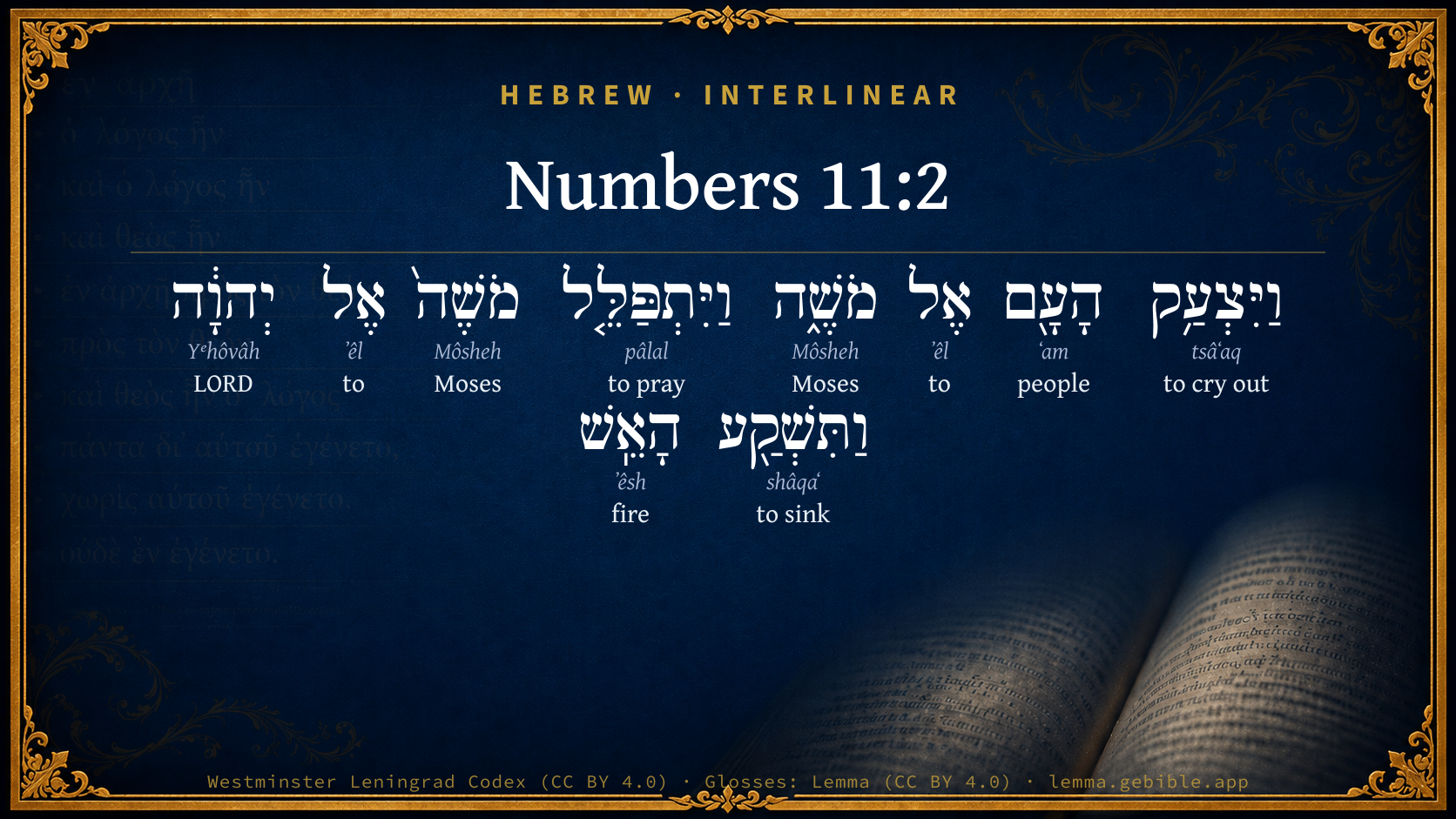
Hebrew (Westminster Leningrad Codex) Numbers 11:2 appears in the Hebrew Old Testament. The text above is from the Westminster Leningrad Codex. Each word links to its Strong’s number, a concise gloss, and parsing drawn from the Open Scriptures Hebrew Bible morphology. Click any word for its full Brown-Driver-Briggs (BDB) entry.
Download image
Cite this verse

Numbers 11:2 (World English Bible). Public Domain. Lemma interlinear Bible study tool, https://lemma.gebible.app/v/numbers/11/2.

Show BibTeX & RIS
BibTeX
RIS
English Translation
The people cried to Moses; and Moses prayed to Yahweh, and the fire abated.
World English Bible · Public Domain
Highlights
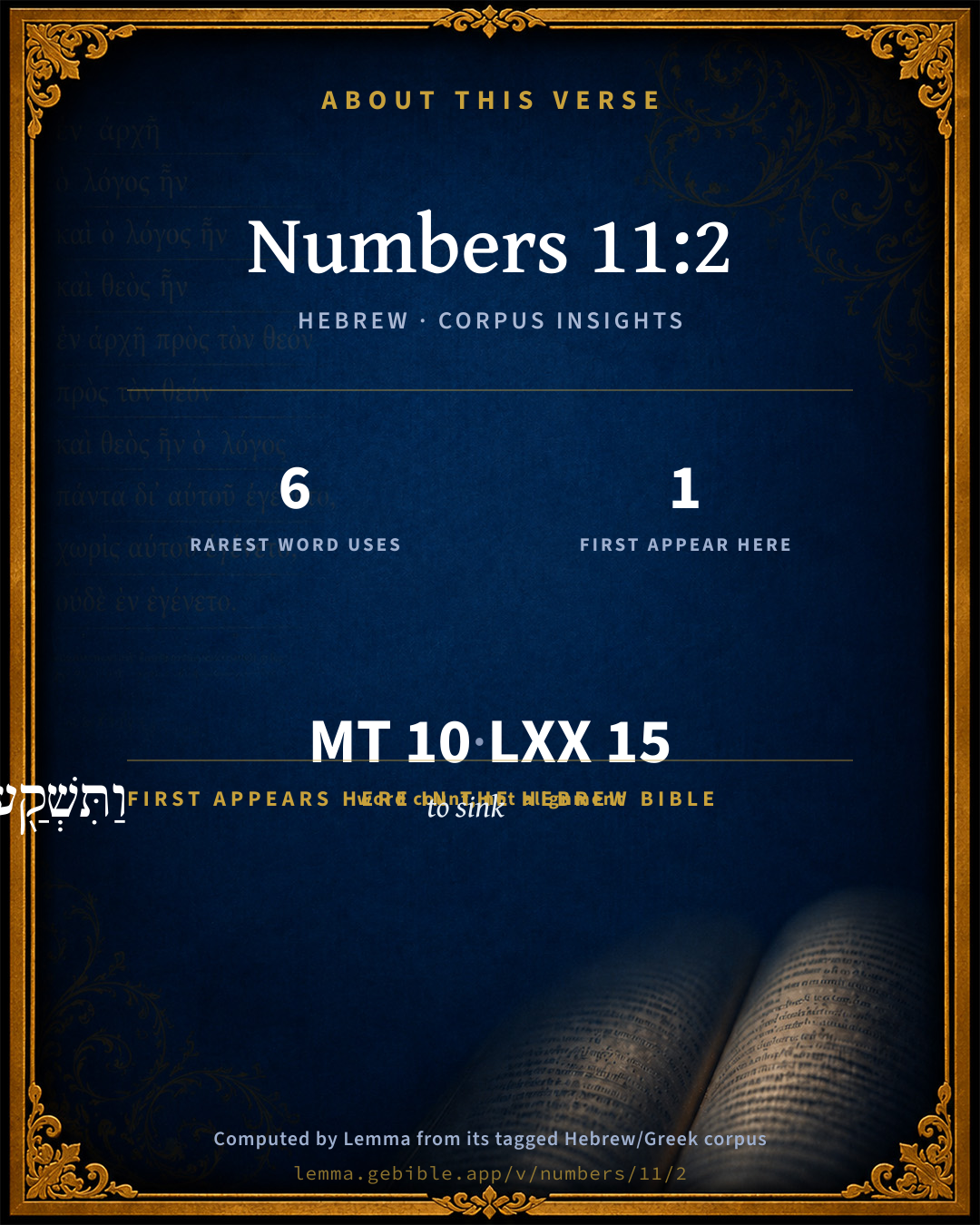
  • 1 first appearance in the Hebrew Bible
Full analysis ↓
Download a study sheet

One document with this verse’s original text, its word-by-word gloss line, the meaning frame, cross-references with their text, attributed commentary, and full source and license credits — printable, and it pastes into notes with its structure intact.

This verse Autodidact and up

Study sheet (.html) Plain text (.txt)

A passage Seminary Student

Up to 50 verses in one chapter. A passage sheet keeps up to 6 commentary sources and 12 cross-references per verse, in the order this page ranks them, and says so on the sheet whenever that leaves anything out. Ask for a single verse and you get the Autodidact verse sheet above.

Everything on this page stays free to read, with no account — the sheet is a download of what is already on screen, not access to it.

Want to remove ads? Support Godless Engineer
Compare translations 3

The same verse in 3 English versions, stacked beneath the original-language interlinear above. Click any original word for its lexicon entry.

Each is an independent rendering of the whole verse — the interlinear is not word-aligned to these translations.

Highlighted words mark where these versions differ — a whole-verse word diff, not a word-by-word alignment.

  • World English Bible Public Domain
    The people cried to Moses; and Moses prayed to Yahweh, and the fire abated.
  • King James Version Public Domain
    And the people cried unto Moses; and when Moses prayed unto the LORD, the fire was quenched.
  • unfoldingWord Literal Text CC BY-SA 4.0
    And the people cried out to Moses, and Moses prayed to Yahweh, and the fire sank;

unfoldingWord Literal Text — © unfoldingWord, licensed CC BY-SA 4.0. Word-aligned USFM3 via Door43 (git.door43.org/unfoldingWord/en_ult).

Versions to compare (up to 4)

3 of 4 selected

Show all 18 translations

Every available English version of this verse, each an independent rendering of the whole verse.

  • World English Bible Public Domain
    The people cried to Moses; and Moses prayed to Yahweh, and the fire abated.
  • Berean Standard Bible Public Domain
    And the people cried out to Moses, and he prayed to the LORD, and the fire died down.
  • Majority Standard Bible Public Domain
    And the people cried out to Moses, and he prayed to the LORD, and the fire died down.
  • King James Version Public Domain
    And the people cried unto Moses; and when Moses prayed unto the LORD, the fire was quenched.
  • American Standard Version (1901) Public Domain
    And the people cried unto Moses; and Moses prayed unto Jehovah, and the fire abated.
  • Revised Version (1885) Public Domain
    And the people cried unto Moses; and Moses prayed unto the LORD, and the fire abated.
  • Geneva Bible (1599) Public Domain
    Then the people cryed vnto Moses: and when Moses praied vnto the Lord, the fire was quenched.
  • Douay-Rheims (1899) Public Domain
    And when the people cried to Moses, Moses prayed to the Lord, and the fire was swallowed up.
  • Young's Literal Translation Public Domain
    And the people cry unto Moses, and Moses prayeth unto Jehovah, and the fire is quenched;
  • Literal Standard Version CC BY-SA 4.0
    And the people cry to Moses, and Moses prays to YHWH, and the fire is quenched;
  • Unlocked Literal Bible CC BY-SA 4.0
    Then people called out to Moses, so Moses prayed to Yahweh, and the fire stopped.
  • unfoldingWord Literal Text CC BY-SA 4.0
    And the people cried out to Moses, and Moses prayed to Yahweh, and the fire sank;
  • Darby Bible Public Domain
    And the people cried to Moses; and Moses prayed to Jehovah -- and the fire abated.
  • World Messianic Bible Public Domain
    The people cried to Moses; and Moses prayed to the LORD, and the fire abated.
  • Webster's Bible Public Domain
    And the people cried to Moses; and when Moses prayed to the LORD, the fire was quenched.
  • Free Bible Version CC BY-SA 4.0
    The people cried to Moses for help. He prayed to the Lord and the fire subsided.
  • Bible in Basic English Public Domain
    And the people made an outcry to Moses, and Moses made prayer to the Lord, and the fire was stopped.
  • JPS Tanakh (1917) Public Domain
    And the people cried unto Moses; and Moses prayed unto the LORD, and the fire abated.

Literal Standard Version (2020), Covenant Press — licensed CC BY-SA 4.0. Text via the HelloAO Bible API (eBible.org). Unlocked Literal Bible (unfoldingWord) — licensed CC BY-SA 4.0. Text via the HelloAO Bible API (eBible.org). unfoldingWord Literal Text — © unfoldingWord, licensed CC BY-SA 4.0. Word-aligned USFM3 via Door43 (git.door43.org/unfoldingWord/en_ult). Free Bible Version, Dr. Jonathan Gallagher — licensed CC BY-SA 4.0. Text via the HelloAO Bible API (eBible.org).

Word by word

More ways to search: Search by grammar → Find every occurrence → Compare this word →

Practice this passage: Drill this verse → Learn its vocabulary →

וַתִּשְׁקַ֖ע
shâqaʻ
H8257
“and · to sink”
Conjunction + Verb, Qal, Sequential Imperfect, 3rd Person, Feminine, Singular
Part of Speech
Conjunction + Verb
Stem
Qal
Form
Sequential Imperfect
Person
3rd Person
Gender
Feminine
Number
Singular
Full BDB Definition

Origin: a primitive root

TWOT: 2456

to sink, sink down, subside - (Qal) to sink - (Niphal) to sink, collapse - (Hiphil) to sink down, cause to settle
  1. וַיִּצְעַ֥ק tsâʻaq H6817 “and · to cry out” Conjunction + Verb, Qal, Sequential Imperfect, 3rd Person, Masculine, Singular
  2. הָעָ֖ם ʻam H5971 “the · people” Particle, Definite Article + Noun, Common, Masculine, Singular, Absolute
  3. אֶל ʼêl H413 “to” Preposition
  4. מֹשֶׁ֑ה Môsheh H4872 “Moses” Noun, Proper
  5. וַיִּתְפַּלֵּ֤ל pâlal H6419 “and · to pray” Conjunction + Verb, Hithpael, Sequential Imperfect, 3rd Person, Masculine, Singular
  6. מֹשֶׁה֙ Môsheh H4872 “Moses” Noun, Proper
  7. אֶל ʼêl H413 “to” Preposition
  8. יְהוָ֔ה Yᵉhôvâh H3068 “LORD” Noun, Proper
  9. הָאֵֽשׁ ʼêsh H784 “the · fire” Particle, Definite Article + Noun, Common, Both, Singular, Absolute

About this verse

These counts appear in no published source. They are computed here, from the morphology-tagged text and Lemma’s own curated glosses. What Lemma adds →

10
words
8
distinct lemmas
Pentateuch
section

Notable vocabulary

The rarest word here is וַתִּשְׁקַ֖ע to sink H8257 — appearing just 6 times in the whole Hebrew Bible.

First appearance in Scripture

This word makes its first canonical appearance in the Hebrew Bible here:

  • וַתִּשְׁקַ֖ע to sink H8257

Shared distinctive vocabulary

וַתִּשְׁקַ֖ע to sink H8257 occurs in 6 verses of the Hebrew Bible. Also found in:

Grammatical profile

  • 3 verbs
  • 5 nouns
  • 2 prepositions

Verb forms

  • וַיִּצְעַ֥ק Qal · Sequential Imperfect
  • וַיִּתְפַּלֵּ֤ל Hithpael · Sequential Imperfect
  • וַתִּשְׁקַ֖ע Qal · Sequential Imperfect

Repetition

Words recur within this verse — often emphatic in Hebrew:

  • מֹשֶׁ֑ה Moses H4872 ×2
  • אֶל to H413 ×2

Hebrew & Septuagint length

In English translation the verse runs 14 words from the Hebrew and 17 from the Septuagint (LXX English) — closely comparable.

A rough comparison of the two English renderings, which tokenize alike — not a word-level alignment.

Word counts can differ between the Hebrew and the Greek without any difference in meaning — e.g. the Hebrew direct-object marker אֵת has no separate Greek word, and Greek often adds the article ὁ.

In the original languages it is 10 Hebrew tokens and 15 Greek tokens — but the two are counted differently (Hebrew bundles its prefixes and suffixes into one token; the Greek is in lemma form), so that isn’t a like-for-like length.

Cross-references

20

Topical passages linked to Numbers 11:2 in the Treasury of Scripture Knowledge — connected by theme and wording, ordered by reader-vote popularity; previews shown in the World English Bible.

  • Numbers 21:7 The people came to Moses, and said, We have sinned, because we have spoken against Yahweh, and against you; pray to Yahweh, that he take away the serpents from us. Moses prayed for the people.
  • James 5:16 Confess your offenses to one another, and pray one for another, that you may be healed. The effective, earnest prayer of a righteous man is powerfully effective.
  • Numbers 16:45–48 Get away from among this congregation, that I may consume them in a moment. They fell on their faces.
  • Genesis 18:23–33 Abraham drew near, and said, "Will you consume the righteous with the wicked?
  • Exodus 32:10–14 Now therefore leave me alone, that my wrath may burn hot against them, and that I may consume them; and I will make of you a great nation."
  • Exodus 32:31–32 Moses returned to Yahweh, and said, "Oh, this people have sinned a great sin, and have made themselves gods of gold.
  • Exodus 34:9 He said, "If now I have found favor in your sight, Lord, please let the Lord go in the midst of us; although this is a stiff-necked people; pardon our iniquity and our sin, and take us for your inheritance."
  • Numbers 14:13–20 Moses said to Yahweh, Then the Egyptians will hear it; for you brought up this people in your might from among them;
  • Deuteronomy 9:19–20 For I was afraid of the anger and hot displeasure, with which Yahweh was angry against you to destroy you. But Yahweh listened to me that time also.
  • Psalms 78:34–35 When he killed them, then they inquired after him. They returned and sought God earnestly.
  • Psalms 106:23 Therefore he said that he would destroy them, Had Moses, his chosen, not stood before him in the breach, To turn away his wrath, so that he wouldn't destroy them.
  • Isaiah 37:4 It may be Yahweh your God will hear the words of Rabshakeh, whom the king of Assyria his master has sent to defy the living God, and will rebuke the words which Yahweh your God has heard. Therefore lift up your prayer for the remnant that is left.
  • Jeremiah 15:1 Then said Yahweh to me, Though Moses and Samuel stood before me, yet my mind would not be toward this people: cast them out of my sight, and let them go forth.
  • Jeremiah 37:3 Zedekiah the king sent Jehucal the son of Shelemiah, and Zephaniah the son of Maaseiah, the priest, to the prophet Jeremiah, saying, Pray now to Yahweh our God for us.
  • Jeremiah 42:2 and said to Jeremiah the prophet, Let, we pray you, our supplication be presented before you, and pray for us to Yahweh your God, even for all this remnant; for we are left but a few of many, as your eyes do see us:
  • Amos 7:2–6 It happened that, when they made an end of eating the grass of the land, then I said, "Lord Yahweh, forgive, I beg you! How could Jacob stand? For he is small."
  • Acts 8:24 Simon answered, "Pray for me to the Lord, that none of the things which you have spoken happen to me."
  • Hebrews 7:26 For such a high priest was fitting for us: holy, guiltless, undefiled, separated from sinners, and made higher than the heavens;
  • 1 John 2:1–2 My little children, I write these things to you so that you may not sin. If anyone sins, we have a Counselor with the Father, Jesus Christ, the righteous.
  • 1 John 5:16 If anyone sees his brother sinning a sin not leading to death, he shall ask, and God will give him life for those who sin not leading to death. There is a sin leading to death. I don't say that he should make a request concerning this.

Cross-references courtesy of OpenBible.info (CC BY 4.0).

Hebrew and Greek witnesses Masoretic Hebrew ↔ Greek Septuagint

The same verse in the two great witnesses to the Old Testament, shown verse-for-verse.

These are two independent witnesses, not word-aligned to each other, and the Septuagint is shown in lemma (dictionary) form.

Hebrew Numbers 11:2 Masoretic · Westminster Leningrad Codex

וַיִּצְעַ֥ק הָעָ֖ם אֶל מֹשֶׁ֑ה וַיִּתְפַּלֵּ֤ל מֹשֶׁה֙ אֶל יְהוָ֔ה וַתִּשְׁקַ֖ע הָאֵֽשׁ

The people cried to Moses; and Moses prayed to Yahweh, and the fire abated.

World English Bible · Public Domain

Greek LXX Numbers 11:2 Septuagint · lemma form

καί κράζω ὁ λαός πρός μωυσῆς καί εὔχομαι μωυσῆς πρός κύριος καί κοπάζω ὁ πῦρ

And the people cried to Moses: and Moses prayed to the Lord, and the fire was quenched.

LXX2012 (modern English Septuagint) · Public Domain

Hebrew: Westminster Leningrad Codex (CC BY 4.0). Greek: Septuagint (public domain); English from LXX2012 (modern English Septuagint) (Public Domain). How the Septuagint differs from the Hebrew →

Targum (Aramaic paraphrase)

2

The Targum is the ancient Jewish Aramaic paraphrase of the Hebrew Scriptures — an interpretive translation, not the Hebrew text itself. Onkelos (literal) and Pseudo-Jonathan (expansive) render the Torah, and Jonathan the Prophets. Coverage is partial: where no permissively-licensed English translation exists for a verse, only the Aramaic is shown. This is verse-level text, not a word-by-word alignment to the Hebrew.

  1. Targum Onkelos Torah (Genesis–Deuteronomy)
    וּצְוַח עַמָא עַל משֶׁה וְצַלִי משֶׁה קֳדָם יְיָ וְאִשְׁתְּקַעַת אֶשָׁתָא

    (no public-domain English translation for this verse)

    Targum Onkelos — Aramaic: “Onkelos Genesis” (public domain); “Onkelos Exodus” (public domain); “Onkelos Leviticus” (public domain); “Onkelos Numbers” (public domain); “Onkelos Deuteronomy” (public domain). English: “Sefaria Community Translation” (CC0 1.0 (public-domain dedication)); “J.W. Etheridge. The Targums of Onkelos and Jonathan Ben Uzziel on the Pentateuch. London: Longmans, Green, 1862” (public domain). Text via Sefaria.

  2. Targum Pseudo-Jonathan Torah (Genesis–Deuteronomy)
    וְצָוַח עַמָא עַל משֶׁה דְיִבְעֵי עֲלֵיהוֹן וְצַלֵי משֶׁה קֳדָם יְיָ וְאִשְׁתְּקָעַת אֵישָׁתָא בְּאַתְרָא

    And the people cried to Mosheh to pray for them; and Mosheh did pray before the Lord, and the fire was extinguished where it was.

    Targum Pseudo-Jonathan — Aramaic: “Targum Jonathan on Genesis” (public domain); “Targum Jonathan on Exodus” (public domain); “Targum Jonathan on Leviticus” (public domain); “Targum Jonathan on Numbers” (public domain); “Targum Jonathan on Deuteronomy” (public domain). English: “The Targum of Jonathan ben Uzziel, trans. J. W. Etheridge, London, 1862” (public domain). Text via Sefaria.

Commentary

Notes on Numbers 11:2 from classic Christian and Jewish commentators (each source and its license shown beneath its notes). The classic Christian expositions comment on the surrounding passage and are grouped to its opening verse, so a note may address several verses; the Jewish commentaries on the Tanakh (Rashi and others) are per-verse, so they appear only where the commentator wrote on this verse.

Lemma curates 59 commentaries, every one of them public domain or Creative Commons licensed, each selected and text-cleaned for this edition rather than reprinted as found. About our sources →

Trapp's Complete Commentary

John Trapp

Num 11:2 And the people cried unto Moses; and when Moses prayed unto the LORD, the fire was quenched.

Ver. 2. And the people cried to Moses.] That lord chancellor of heaven, as one calleth him, that could rule with God, and overrule. Of Moses it might be said, as once of Luther, Iste vir potuit apud Deum quod voluit, He might have whatsoever he would of God.

John Trapp, A Commentary or Exposition upon All the Books of the Old and New Testament (1647–1656) — public domain. Text from a community e-Sword module.

Joseph Benson's Commentary

Num 11:2. The people cried unto Moses — This calamity threw them into such consternation, that they immediately applied to Moses to deprecate the divine displeasure.

Joseph Benson's Commentary on the Old and New Testaments (1811–1818) — public domain. Text from a community e-Sword module.

Tyndale Open Study Notes

Tyndale Open Resources

11:2-3 The people sought Moses’ intercession again (cp. Exod 15:25; 32:11-14), which brought an end to the fire of God’s judgment. • Taberah: Cp. Num 11:34-35; see Deut 9:22.

Tyndale Open Study Notes — © Tyndale Open Resources, licensed CC BY-SA 4.0. Text via the HelloAO Bible API.

Adam Clarke's Commentary

Verse 2. The fire was quenched] Was sunk, or swallowed up, as in the margin. The plague, of whatever sort, ceased to act, and the people had respite.

Adam Clarke's Commentary on the Bible (1810–1826) — public domain. Text from a community e-Sword/MySword module.

Ellicott's Commentary for English Readers

(2) The fire was quenched.—Better, subsided or sunk down. No precise information is given as to the extent of the fire, or as to the objects which it destroyed. It broke out in the extremity of the encampment, and it was arrested in its progress at the supplication of Moses. It seems, however, more probable that it consumed some of the Israelites themselves, than that it consumed only some of their tents. Some suppose that the reference is to the simoom, or fiery south wind, which sometimes blows in the Eastern desert, and which stifles those over whom it sweeps.

A Bible Commentary for English Readers, edited by Charles John Ellicott (1878–1897) — public domain. Text from a community e-Sword module.

The Cambridge Bible for Schools and Colleges

gen. ed. J. J. S. Perowne

2. Moses prayed] The word hithpallçl (‘pray,’ ‘intercede’) is used in the Pentateuch only by E (Num_21:7, Gen_20:7; Gen_20:17) and D (Deu_9:20; Deu_9:26). In his self-forgetfulness Moses was always ready to intercede for those who had sinned; cf. Num_12:13, Num_14:13-19, Num_16:22, Exo_32:31 f., Num_34:9. This gives point to Ben Sira’s description of him (Sir_45:1) as ‘beloved of God and men.’

Taberah] i.e. a ‘burning’ or ‘conflagration.’

The Cambridge Bible for Schools and Colleges (gen. ed. J. J. S. Perowne; Cambridge University Press, 1878–1918) — public domain. Text from a community e-Sword module.

John Gill's Exposition

And the people cried unto Moses,.... And entreated him to pray for them, being frightened at the fire which consumed many of them, lest it should spread and become general among them:

and when Moses prayed unto the Lord; as he did, in which he was a type of Christ, the mediator between God and man, the advocate of his people, an intercessor for transgressors:

the fire was quenched; it stopped and proceeded no further; as through Christ's mediation God is pacified with his people for all that they have done, and his wrath, and all the effects of it, are turned away from them, and entirely cease with respect to them; or it "sunk down" (r) into its place, as the Targum of Jonathan, as if it rose out of the earth. This may serve to confirm the notion of its being a burning wind, to which the idea of sinking down and subsiding well agrees.

(r) "sunk down", so Ainsworth; "compressus est", Junius & Tremellius, Piscator, Drusius; "resedit", Tigurine version.

John Gill's Exposition of the Whole Bible (1746–1763) — public domain (CC PDM 1.0). Text via the HelloAO Bible API.

Haydock's Catholic Bible Commentary

Up, as rain is by the earth, Amos ix. 5.

George Leo Haydock (1774–1849), Haydock's Catholic Family Bible and Commentary, 1859 edition — public domain. Excludes Psalms (Douay-Rheims chapter numbering differs from Protestant) and Deuterocanonical books (Catholic canon only).

Matthew Poole's English Annotations

The people, the murmurers being penitent, or others for fear.

Unto Moses, whom they knew to be very prevalent with God.

Matthew Poole's English Annotations on the Holy Bible (1683–1685) — public domain. Text from a community e-Sword/MySword module.

Whedon's Commentary on the Bible

Daniel D. Whedon

2. The fire was quenched — R.V., “abated;” literally, it sank down, through the intercession of Moses. The conduct of the people indicates the deep-felt human need of a mediator to shield the soul of the sinner from the divine wrath.

Daniel D. Whedon (gen. ed.), Commentary on the Old and New Testaments (1874–1909) — public domain. Text from a community e-Sword module.

The Pulpit Commentary

And the people cried unto Moses. Fear brought them to their senses, and they knew that their only hope was in their mediator, who had already saved them by his intercession from a worse destruction. (Exo_32:30-34) The fire was quenched. Rather, "went out." As its beginning was supernatural, or at least was so ordered as to appear so, its end also was due to the Divine intervention, not to human efforts.

The Pulpit Commentary (1880–1919), ed. H.D.M. Spence-Jones & Joseph S. Exell — public domain. Text from a community e-Sword module.

John Wesley's Explanatory Notes

The people - The murmurers, being penitent; or others for fear.

John Wesley, Explanatory Notes Upon the Whole Bible (1754–1765) — public domain. Text via the GEBible commentary corpus.

Rashi

Rabbi Shlomo Yitzchaki (Rashi)

ויצעק העם אל משה AND THE PEOPLE CRIED UNTO MOSES — A parable! This may be compared to the case of an earthly king who was angry with his son, and the son went to a friend of his father and said to him, “Go and ask forgiveness for me from father!” (Sifrei Bamidbar 86).

ותשקע האש THEN THE FIRE SANK — it sank on the very spot; because if it had turned along one of the sides of the camp it would gradually have rolled along the whole of that side (Sifrei Bamidbar 86).

Rashi on the Tanakh — English translations: “The Judaica Press complete Tanach with Rashi, translated by A. J. Rosenberg” (CC BY 4.0); “Pentateuch with Rashi's commentary by M. Rosenbaum and A.M. Silbermann, 1929-1934” (public domain); “The Metsudah Tanach series, Lakewood, N.J” (CC BY 4.0); and “The Book of Joshua, Metsudah Publications, 1997” (CC BY 4.0). Text via Sefaria.

Lesson kit

Teaching starters — assembled from the data on this page, not authored interpretation. Every prompt links to the verse data it draws on. Edit before teaching.

Numbers, in the Pentateuch, opens this verse with 10 words (8 distinct Hebrew lemmas). Its most distinctive word is shâqaʻ (“to sink”). A historical commentator’s framing appears above. Read the whole chapter for the surrounding context.

Discussion questions

  1. The word shâqaʻ carries the sense “to sink.” How does it shape the verse?
  2. The word “to sink” first appears here in Scripture. What is being introduced at this debut?
  3. Job 41:1 shares the word «to sink» with this verse. How do the two illuminate each other?
  4. “Moses” occurs 2× in this one verse. What is the effect of the repetition?
  5. These translations render this verse differently; the difference is in the English rendering, not the original. What questions does that raise?
  6. The verb «וַיִּצְעַ֥ק» is Qal Sequential Imperfect. How does its form color the action?
  7. Reading how Trapp's Complete Commentary and Joseph Benson's Commentary read this verse, where do the two commentators agree and where do they part?

Things to notice

Reading settings

Reading text

Shown beneath each verse's original-language words.

Old Testament
Old Testament edition

Read the OT as the Masoretic Hebrew (MT) or the Greek Septuagint (LXX).

English shown for the Greek Septuagint (in the Hebrew ↔ Greek comparison).

Comparing translations? Open the Compare panel on any verse page to stack up to four side by side.