
Ezekiel 1:13

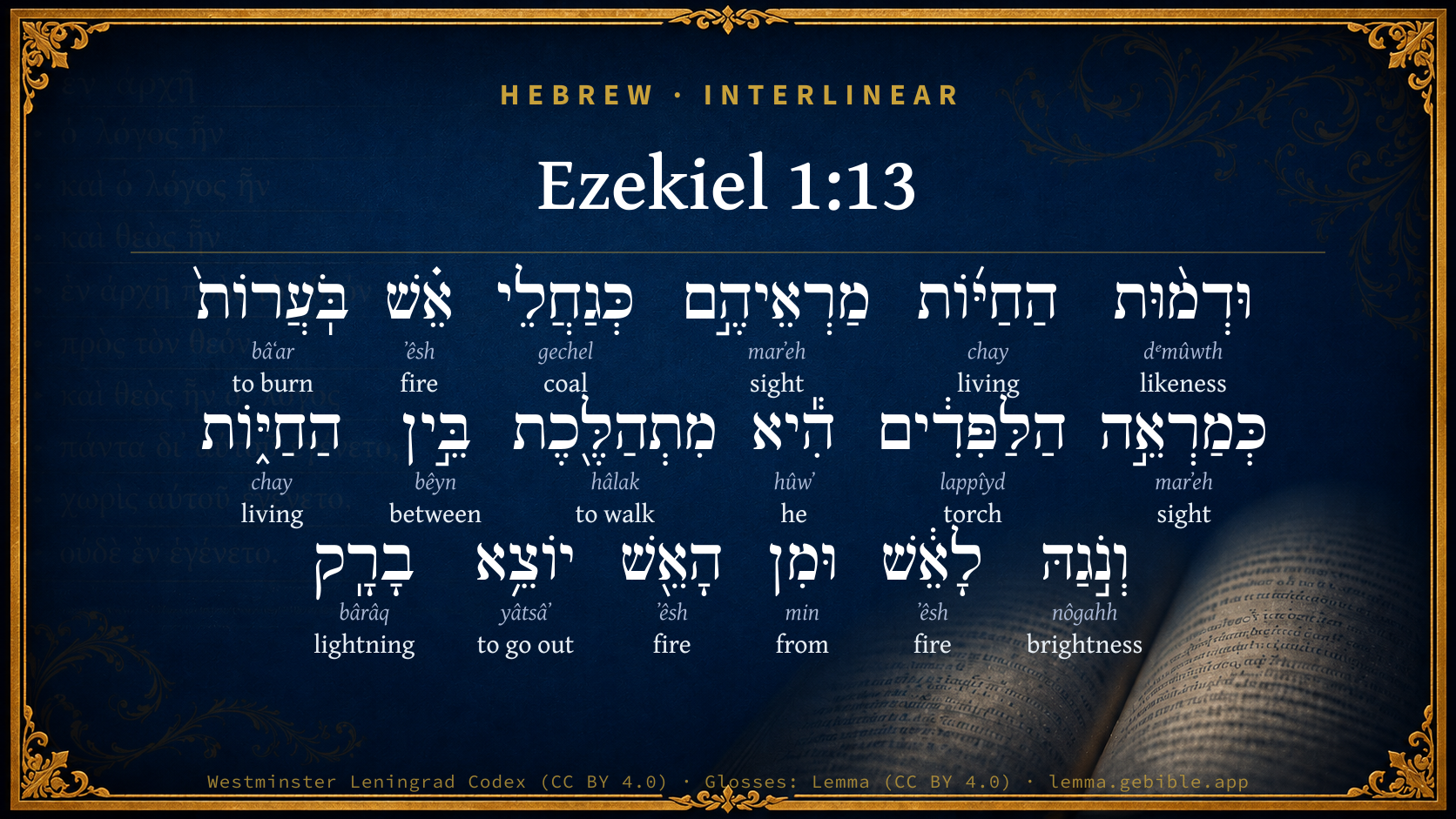
Hebrew (Westminster Leningrad Codex) Ezekiel 1:13 appears in the Hebrew Old Testament. The text above is from the Westminster Leningrad Codex. Each word links to its Strong’s number, a concise gloss, and parsing drawn from the Open Scriptures Hebrew Bible morphology. Click any word for its full Brown-Driver-Briggs (BDB) entry.
Download image
Cite this verse

Ezekiel 1:13 (World English Bible). Public Domain. Lemma interlinear Bible study tool, https://lemma.gebible.app/v/ezekiel/1/13.

Show BibTeX & RIS
BibTeX
RIS
English Translation
As for the likeness of the living creatures, their appearance was like burning coals of fire, like the appearance of torches: [the fire] went up and down among the living creatures; and the fire was bright, and out of the fire went forth lightning.
World English Bible · Public Domain
Download a study sheet

One document with this verse’s original text, its word-by-word gloss line, the meaning frame, cross-references with their text, attributed commentary, and full source and license credits — printable, and it pastes into notes with its structure intact.

This verse Autodidact and up

Study sheet (.html) Plain text (.txt)

A passage Seminary Student

Up to 50 verses in one chapter. A passage sheet keeps up to 6 commentary sources and 12 cross-references per verse, in the order this page ranks them, and says so on the sheet whenever that leaves anything out. Ask for a single verse and you get the Autodidact verse sheet above.

Everything on this page stays free to read, with no account — the sheet is a download of what is already on screen, not access to it.

Want to remove ads? Support Godless Engineer
Compare translations 3

The same verse in 3 English versions, stacked beneath the original-language interlinear above. Click any original word for its lexicon entry.

Each is an independent rendering of the whole verse — the interlinear is not word-aligned to these translations.

Highlighted words mark where these versions differ — a whole-verse word diff, not a word-by-word alignment.

  • World English Bible Public Domain
    As for the likeness of the living creatures, their appearance was like burning coals of fire, like the appearance of torches: [the fire] went up and down among the living creatures; and the fire was bright, and out of the fire went forth lightning.
  • King James Version Public Domain
    As for the likeness of the living creatures, their appearance was like burning coals of fire, and like the appearance of lamps: it went up and down among the living creatures; and the fire was bright, and out of the fire went forth lightning.
  • unfoldingWord Literal Text CC BY-SA 4.0
    As for the likeness of the living creatures, their appearance was like burning coals of fire, like the appearance of torches; bright fire also moved about among the creatures, and there were flashes of lightning.

unfoldingWord Literal Text — © unfoldingWord, licensed CC BY-SA 4.0. Word-aligned USFM3 via Door43 (git.door43.org/unfoldingWord/en_ult).

Versions to compare (up to 4)

3 of 4 selected

Show all 18 translations

Every available English version of this verse, each an independent rendering of the whole verse.

  • World English Bible Public Domain
    As for the likeness of the living creatures, their appearance was like burning coals of fire, like the appearance of torches: [the fire] went up and down among the living creatures; and the fire was bright, and out of the fire went forth lightning.
  • Berean Standard Bible Public Domain
    In the midst of the living creatures was the appearance of glowing coals of fire, or of torches. Fire moved back and forth between the living creatures; it was bright, and lightning flashed out of it.
  • Majority Standard Bible Public Domain
    In the midst of the living creatures was the appearance of glowing coals of fire, or of torches. Fire moved back and forth between the living creatures; it was bright, and lightning flashed out of it.
  • King James Version Public Domain
    As for the likeness of the living creatures, their appearance was like burning coals of fire, and like the appearance of lamps: it went up and down among the living creatures; and the fire was bright, and out of the fire went forth lightning.
  • American Standard Version (1901) Public Domain
    As for the likeness of the living creatures, their appearance was like burning coals of fire, like the appearance of torches: `the fire' went up and down among the living creatures; and the fire was bright, and out of the fire went forth lightning.
  • Revised Version (1885) Public Domain
    As for the likeness of the living creatures, their appearance was like burning coals of fire, like the appearance of torches; it went up and down among the living creatures: and the fire was bright, and out of the fire went forth lightning.
  • Geneva Bible (1599) Public Domain
    The similitude also of the beasts, and their appearance was like burning coles of fire, and like the appearance of lampes: for the fire ran among the beastes, and the fire gaue a glister, and out of the fire there went lightning.
  • Douay-Rheims (1899) Public Domain
    And as for the likeness of the living creatures, their appearance was like that of burning coals of fire, and like the appearance of lamps. This was the vision running to and fro in the midst of the living creatures, a bright fire, and lightning going forth from the fire.
  • Young's Literal Translation Public Domain
    As to the likeness of the living creatures, their appearances `are' as coals of fire -- burning as the appearance of lamps; it is going up and down between the living creatures, and brightness `is' to the fire, and out of the fire is going forth lightning.
  • Literal Standard Version CC BY-SA 4.0
    As for the likeness of the living creatures, their appearances [are] as coals of fire—burning as the appearance of lamps; it is going up and down between the living creatures, and brightness [is] to the fire, and lightning is going forth out of the fire.
  • Unlocked Literal Bible CC BY-SA 4.0
    As for the likeness of the living creatures, their appearance was like burning coals of fire, like the appearance of torches; bright fire also moved about among the creatures, and there were flashes of lightning.
  • unfoldingWord Literal Text CC BY-SA 4.0
    As for the likeness of the living creatures, their appearance was like burning coals of fire, like the appearance of torches; bright fire also moved about among the creatures, and there were flashes of lightning.
  • Darby Bible Public Domain
    And as for the likeness of the living creatures, their appearance was like burning coals of fire, as the appearance of torches: it went up and down among the living creatures; and the fire was bright; and out of the fire went forth lightning.
  • World Messianic Bible Public Domain
    As for the likeness of the living creatures, their appearance was like burning coals of fire, like the appearance of torches. The fire went up and down among the living creatures. The fire was bright, and lightning went out of the fire.
  • Webster's Bible Public Domain
    As for the likeness of the living creatures, their appearance was like burning coals of fire, and like the appearance of lamps: it went up and down among the living creatures; and the fire was bright, and out of the fire went forth lightning.
  • Free Bible Version CC BY-SA 4.0
    These beings looked like bright burning coals or torches. Blazing fire moved to and fro between the beings, and lightning flashed out from the fire.
  • Bible in Basic English Public Domain
    And between the living beings it was like burning coals of fire, as if flames were going one after the other between the living beings; and the fire was bright, and out of the fire went thunder-flames.
  • JPS Tanakh (1917) Public Domain
    As for the likeness of the living creatures, their appearance was like coals of fire, burning like the appearance of torches; it flashed up and down among the living creatures; and there was brightness to the fire, and out of the fire went forth lightning.

Literal Standard Version (2020), Covenant Press — licensed CC BY-SA 4.0. Text via the HelloAO Bible API (eBible.org). Unlocked Literal Bible (unfoldingWord) — licensed CC BY-SA 4.0. Text via the HelloAO Bible API (eBible.org). unfoldingWord Literal Text — © unfoldingWord, licensed CC BY-SA 4.0. Word-aligned USFM3 via Door43 (git.door43.org/unfoldingWord/en_ult). Free Bible Version, Dr. Jonathan Gallagher — licensed CC BY-SA 4.0. Text via the HelloAO Bible API (eBible.org).

Word by word

More ways to search: Search by grammar → Find every occurrence → Compare this word →

Practice this passage: Drill this verse → Learn its vocabulary →

הַלַּפִּדִ֔ים
lappîyd
H3940
“the · torches”
Particle, Definite Article + Noun, Common, Masculine, Plural, Absolute
Part of Speech
Particle + Noun
Type
Common
Gender
Masculine
Number
Plural
State
Absolute
Full BDB Definition

Origin: from an unused root probably meaning to shine

TWOT: 1122a

torch
  1. וּדְמ֨וּת dᵉmûwth H1823 “and · likeness of” Conjunction + Noun, Common, Feminine, Singular, Construct
  2. הַחַיּ֜וֹת chay H2416 “the · living things” Particle, Definite Article + Noun, Common, Feminine, Plural, Absolute
  3. מַרְאֵיהֶ֣ם marʼeh H4758 “sight · their” Noun, Common, Masculine, Singular, Construct + Suffix, Personal, 3rd Person, Masculine, Plural
  4. כְּגַחֲלֵי gechel H1513 “like/as · coals of” Preposition + Noun, Common, Both, Plural, Construct
  5. אֵ֗שׁ ʼêsh H784 “fire” Noun, Common, Both, Singular, Absolute
  6. בֹּֽעֲרוֹת֙ bâʻar H1197 “burning” Verb, Qal, Participle Active, Feminine, Plural, Absolute
  7. כְּמַרְאֵ֣ה marʼeh H4758 “like/as · sight of” Preposition + Noun, Common, Masculine, Singular, Construct
  8. הִ֕יא hûwʼ H1931 “he” Pronoun, Personal, 3rd Person, Feminine, Singular
  9. מִתְהַלֶּ֖כֶת hâlak H1980 “walking” Verb, Hithpael, Participle Active, Feminine, Singular, Absolute
  10. בֵּ֣ין bêyn H996 “between” Preposition
  11. הַחַיּ֑וֹת chay H2416 “the · living things” Particle, Definite Article + Noun, Common, Feminine, Plural, Absolute
  12. וְנֹ֣גַהּ nôgahh H5051 “and · brightness” Conjunction + Noun, Common, Feminine, Singular, Absolute
  13. לָאֵ֔שׁ ʼêsh H784 “to/for the · fire” Preposition, Determined + Noun, Common, Both, Singular, Absolute
  14. וּמִן min H4480 “and · from” Conjunction + Preposition
  15. הָאֵ֖שׁ ʼêsh H784 “the · fire” Particle, Definite Article + Noun, Common, Both, Singular, Absolute
  16. יוֹצֵ֥א yâtsâʼ H3318 “going out” Verb, Qal, Participle Active, Masculine, Singular, Absolute
  17. בָרָֽק bârâq H1300 “lightning” Noun, Common, Masculine, Singular, Absolute

About this verse

These counts appear in no published source. They are computed here, from the morphology-tagged text and Lemma’s own curated glosses. What Lemma adds →

18
words
14
distinct lemmas
Prophets
section

Notable vocabulary

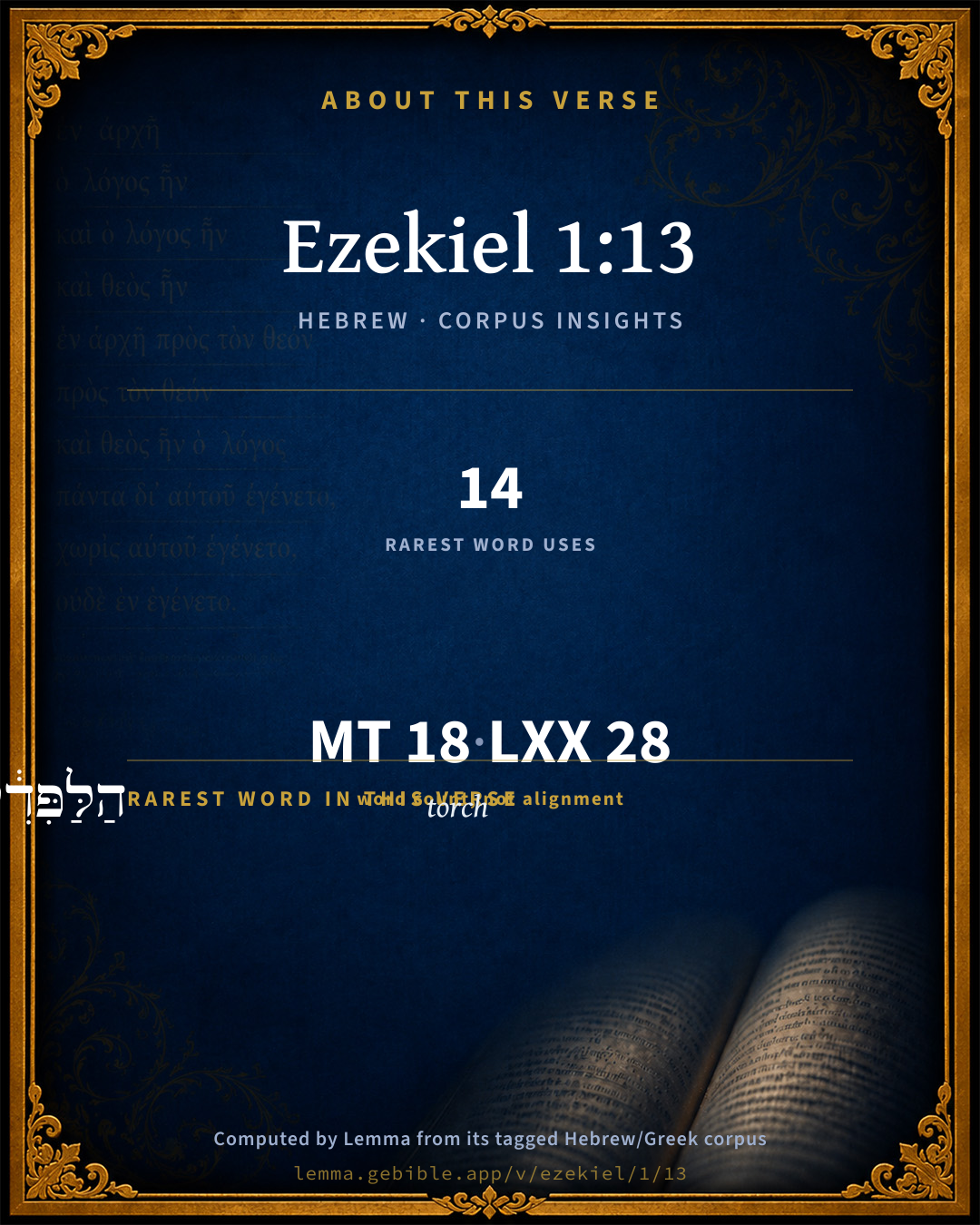
The rarest word here is הַלַּפִּדִ֔ים torch H3940 — appearing just 14 times in the whole Hebrew Bible.

Shared distinctive vocabulary

הַלַּפִּדִ֔ים torch H3940 occurs in 13 verses of the Hebrew Bible. Also found in:

Grammatical profile

  • 3 verbs
  • 12 nouns
  • 1 pronoun
  • 2 prepositions

Verb forms

  • בֹּֽעֲרוֹת֙ Qal · Participle Active
  • מִתְהַלֶּ֖כֶת Hithpael · Participle Active
  • יוֹצֵ֥א Qal · Participle Active

Repetition

Words recur within this verse — often emphatic in Hebrew:

  • אֵ֗שׁ fire H784 ×3
  • הַחַיּ֜וֹת living H2416 ×2
  • מַרְאֵיהֶ֣ם sight H4758 ×2

Hebrew & Septuagint length

In English translation the verse runs 44 words from the Hebrew and 41 from the Septuagint (LXX English) — closely comparable.

A rough comparison of the two English renderings, which tokenize alike — not a word-level alignment.

Word counts can differ between the Hebrew and the Greek without any difference in meaning — e.g. the Hebrew direct-object marker אֵת has no separate Greek word, and Greek often adds the article ὁ.

In the original languages it is 18 Hebrew tokens and 28 Greek tokens — but the two are counted differently (Hebrew bundles its prefixes and suffixes into one token; the Greek is in lemma form), so that isn’t a like-for-like length.

Cross-references

8

Topical passages linked to Ezekiel 1:13 in the Treasury of Scripture Knowledge — connected by theme and wording, ordered by reader-vote popularity; previews shown in the World English Bible.

  • Psalms 104:4 He makes his messengers winds; His servants flames of fire.
  • Revelation 4:5 Out of the throne proceed lightnings, sounds, and thunders. There were seven lamps of fire burning before his throne, which are the seven Spirits of God.
  • Genesis 15:17 It came to pass that, when the sun went down, and it was dark, behold, a smoking furnace, and a flaming torch passed between these pieces.
  • Ezekiel 1:7 Their feet were straight feet; and the sole of their feet was like the sole of a calf's foot; and they sparkled like burnished brass.
  • Daniel 10:5–6 I lifted up my eyes, and looked, and, behold, a man clothed in linen, whose loins were girded with pure gold of Uphaz:
  • Matthew 28:3 His appearance was like lightning, and his clothing white as snow.
  • Revelation 10:1 I saw a mighty angel coming down out of the sky, clothed with a cloud. A rainbow was on his head. His face was like the sun, and his feet like pillars of fire.
  • Revelation 18:1 After these things, I saw another angel coming down out of the sky, having great authority. The earth was illuminated with his glory.

Cross-references courtesy of OpenBible.info (CC BY 4.0).

Hebrew and Greek witnesses Masoretic Hebrew ↔ Greek Septuagint

The same verse in the two great witnesses to the Old Testament, shown verse-for-verse.

These are two independent witnesses, not word-aligned to each other, and the Septuagint is shown in lemma (dictionary) form.

Hebrew Ezekiel 1:13 Masoretic · Westminster Leningrad Codex

וּדְמ֨וּת הַחַיּ֜וֹת מַרְאֵיהֶ֣ם כְּגַחֲלֵי אֵ֗שׁ בֹּֽעֲרוֹת֙ כְּמַרְאֵ֣ה הַלַּפִּדִ֔ים הִ֕יא מִתְהַלֶּ֖כֶת בֵּ֣ין הַחַיּ֑וֹת וְנֹ֣גַהּ לָאֵ֔שׁ וּמִן הָאֵ֖שׁ יוֹצֵ֥א בָרָֽק

As for the likeness of the living creatures, their appearance was like burning coals of fire, like the appearance of torches: [the fire] went up and down among the living creatures; and the fire was bright, and out of the fire went forth lightning.

World English Bible · Public Domain

Greek LXX Ezekiel 1:13 Septuagint · lemma form

καί ἐν μέσος ὁ ζῷον ὅρασις ὡς ἄνθραξ πῦρ καίω ὡς ὄψις λαμπάς συνστρέφω ἀνά μέσος ὁ ζῷον καί φέγγος ὁ πῦρ καί ἐκ ὁ πῦρ ἐκπορεύομαι ἀστραπή

And in the midst of the living creatures there was an appearance as of burning coals of fire, as an appearance of lamps turning among the living creatures; and the brightness of fire, and out of the fire came forth lightning.

LXX2012 (modern English Septuagint) · Public Domain

On this verse, The Cambridge Bible for Schools and Colleges discusses the Septuagint’s reading. Read the note in Commentary ↓

Hebrew: Westminster Leningrad Codex (CC BY 4.0). Greek: Septuagint (public domain); English from LXX2012 (modern English Septuagint) (Public Domain). How the Septuagint differs from the Hebrew →

Targum (Aramaic paraphrase)

1

The Targum is the ancient Jewish Aramaic paraphrase of the Hebrew Scriptures — an interpretive translation, not the Hebrew text itself. Onkelos (literal) and Pseudo-Jonathan (expansive) render the Torah, and Jonathan the Prophets. Coverage is partial: where no permissively-licensed English translation exists for a verse, only the Aramaic is shown. This is verse-level text, not a word-by-word alignment to the Hebrew.

  1. Targum Jonathan Prophets (Joshua–Malachi)
    וּדְמוּת בִּרְיָתָא חֲזְוֵיהֶן כְּגוּמְרִין דְאֶשָׁא בָּעֲרָן כְּחֵזוּ בְעוּרַיָא אֶשְׁתָּא מִשְׁתַּלְהֲבָא בֵּין בִּרְיָתָא וְזֵיהוֹרַיָא לְאֶשְׁתָּא וּמִן אֶשְׁתָּא נָפֵיק בַּרְקָא:

    (no public-domain English translation for this verse)

    Targum Jonathan — Aramaic: “Mikraot Gedolot” (public domain). English: “Sefaria Community Translation” (CC0 1.0 (public-domain dedication)); “London "Chaldee Paraphrase," 1871” (public domain). Text via Sefaria.

Commentary

Notes on Ezekiel 1:13 from classic Christian and Jewish commentators (each source and its license shown beneath its notes). The classic Christian expositions comment on the surrounding passage and are grouped to its opening verse, so a note may address several verses; the Jewish commentaries on the Tanakh (Rashi and others) are per-verse, so they appear only where the commentator wrote on this verse.

Lemma curates 59 commentaries, every one of them public domain or Creative Commons licensed, each selected and text-cleaned for this edition rather than reprinted as found. About our sources →

Trapp's Complete Commentary

John Trapp

Eze 1:13 As for the likeness of the living creatures, their appearance [was] like burning coals of fire, [and] like the appearance of lamps: it went up and down among the living creatures; and the fire was bright, and out of the fire went forth lightning.

Ver. 13. Their appearance was like burning coals of fire.] Angels are actuosi et efficaces ut ignis, of a fiery nature, and of a fiery operation, as is also the Holy Spirit, {Isa 4:4 Mat 3:11 Act 2:3} whereby they are actuated. Angels are all on a light fire, as it were, with zeal for God and indignation against sin; let us be similarly affected. Paul was a heavenly spark; John Baptist, "a burning and shining light." Chrysostom saith that Peter was a man made all of fire, walking among stubble; Basil was a pillar of fire; Latimer cried out, Deest ignis. In Bucholcere vivida omnia fuerunt, &c. {a}

It went up and down among the living creatures.] The fire and flame did. Heb., It made itself to walk of its own accord and pleasure.

And the fire was bright.] Let us also labour to kindle and keep quick the fire of zeal upon the hearth of our hearts, without all smoke or smudge of sin.

And out of the fire went out lightnings.] "The Lord is known by the judgment which he executeth"; his noble works done by those instruments of his, the holy angels, are quickly noted and noticed, as in Sennacherib’s army.

{a} Melch. Adam.

John Trapp, A Commentary or Exposition upon All the Books of the Old and New Testament (1647–1656) — public domain. Text from a community e-Sword module.

Joseph Benson's Commentary

Eze 1:13-14. As for the likeness of the living creatures — Their colour, or aspect; their appearance was like burning coals — They were inflamed by the Spirit of God with a holy zeal for his glory, and with indignation against impenitent sinners. This might also be intended as a symbolical declaration, that after the long patience of God, all things now tended to vengeance, and the executing of his judgments upon the Jews; for executing which he would use these angels as ministers. And like the appearance of lamps — This probably signified, that the uprightness of the divine justice should shine forth, or be made manifest in these judgments. It went up and down among the living creatures — That is, the fire moved itself up and down. Milton’s expression, (Paradise Lost, 6:756,) is, “And careening fires between.” That is, fires which ran swiftly, and, as it were, tilted at each other: emblematical of the terrible effects of the ministry of these living creatures on the objects of divine vengeance. Out of the fire went forth lightning — Significative of the irresistible force of the divine judgments, and the terrible and sudden destruction to be produced by them. And the living creatures ran and returned as a flash of lightning — With inexpressible velocity: the swiftness of their motions every way resembled flashes of lightning. “They ran to do their work, and execute their orders,” says Henry, “and then returned to give an account of what they had done, and receive new instructions. They ran into the lower world, to do what was to be done there: and when they had done, returned as a flash of lightning, to the upper world, to the vision of God. Thus we should be in the affairs of this world: though we run into them, we must not repose in them, but our souls must presently return like lightning to God, their rest and centre.”

Joseph Benson's Commentary on the Old and New Testaments (1811–1818) — public domain. Text from a community e-Sword module.

Jamieson, Fausset & Brown

Robert Jamieson, A. R. Fausset & David Brown

likeness . . . appearance--not tautology. "Likeness" expresses the general form; "appearance," the particular aspect.

coals of fire--denoting the intensely pure and burning justice wherewith God punishes by His angels those who, like Israel, have hardened themselves against His long-suffering. So in Isa 6:2, Isa 6:6, instead of cherubim, the name "seraphim," the burning ones, is applied, indicating God's consuming righteousness; whence their cry to Him is, "Holy! holy! holy!" and the burning coal is applied to his lips, for the message through his mouth was to be one of judicial severance of the godly from the ungodly, to the ruin of the latter.

lamps--torches. The fire emitted sparks and flashes of light, as torches do.

went up and down--expressing the marvellous vigor of God's Spirit, in all His movements never resting, never wearied.

fire . . . bright--indicating the glory of God.

out of the fire . . . lightning--God's righteousness will at last cause the bolt of His wrath to fall on the guilty; as now, on Jerusalem.

Jamieson, Fausset & Brown — Commentary Critical and Explanatory on the Whole Bible (1871) — public domain (CC PDM 1.0). Text via the HelloAO Bible API.

Adam Clarke's Commentary

Verse 13. Like burning coals of fire] The whole substance appeared to be of flame; and among them frequent coruscations of fire, like vibrating lamps, often emitting lightning, or rather sparks of fire, as we have seen struck out of strongly ignited iron in a forge. The flames might be something like what is called warring wheels in pyrotechny. They seemed to conflict together.

Adam Clarke's Commentary on the Bible (1810–1826) — public domain. Text from a community e-Sword/MySword module.

John Calvin's Commentaries

As I said yesterday, something divine ought to shine forth in this vision, because God set forth the face of a man and of an ox, of an eagle and of a lion, and in this he accommodates himself to the stupidity of the people, as I have said, and also to the capacity of the Prophet, because, as we are men, we cannot penetrate beyond the sky. God therefore bore in mind his Prophet, and all the pious, while, at the same time, he wished indirectly to reprove the people’s sluggishness. At the same time, if the face of a man had not been different from common forms, the vision had not excited such admiration in the mind of the Prophet. Hence something heavenly ought to be mixed with the earthly figures. This is the reason why the living creatures were like burning fire Now we begin to understand what this difference means; as when God appeared to Moses, if there had been nothing wonderful in it, Moses would not have thought that he was called by God, but he acknowledged God in the bush, because he saw that the bush was on fire and yet not consumed. (Exodus 3:2, 3.) Then he began to be aroused, and to reflect within himself, that a divine vision was presented to him. The same is to be diligently observed in this place. And hence we gather, how humanely, nay, how indulgently, God deals with us. For, as on his part, he sees how small is our comprehension, so he descends to us: hence the faces of the living creatures, the stature of their body, and what we have formerly mentioned. Now, however, since he sees us torpid upon the ground, and lying there, as it were idle, so he raises us up: this is the meaning of what Ezekiel now says, viz., the appearance of the living creatures was like burning coals. And since coals taken out of the fire sometimes die out, he says the coals were burning. The Prophet would of necessity be moved when he saw that. the living creatures were not really such, that is, when he saw in the form of the animals something celestial, and exceeding the standard of nature, and even the senses of man: and this also ]s profitable to the rest of man.-kind. For when we read this vision we acknowledge what the Prophet narrates to be so evident, that God shines forth in it, and does not suffer his Prophet to doubt. Hence his teaching, which is marked by such certain proofs, is better confirmed to us. In the meantime, it is desirable to impress upon the memory what we said yesterday, that there is something terrific in this vision, since the people were hardened against all threats, nay, even blows themselves. For God had already inflicted severe judgments, not only on the kingdom of Israel, but on the city itself, and the whole land of Judah. Even the captives were champing their bits and roaring, because driven into exile, and, in the meantime, those who remained in the city thought that they were treated nobly. Wherefore such was their security, that it was necessary to put terrors before them, as we shall see a little while afterwards. And it is also said, the fire burned before God, where he not only wishes his own glory to be beheld by us, but where he wishes to strike fear, as he did at the promulgation of the law. (Exodus 19:20) And David, in the 18th Psalm, narrates that God appeared to him in this way when he was preserved by him: (Psalm 18:8-15:) doubtless he understands that God unfolded his formidable power against the unbelieving. So also in this place, he says, the appearance of the living creatures was like fiery and burning coals, and then he adds another image, that they were like lamps, which some explain as firebrands or burnt wood. But another opinion is more general, and more approved by me. The Prophet now expresses the form of the fire more dearly, viz., that the coals were like lamps For lamps send out their brightness to a distance, and seem to scatter their rays in every direction, like the sun when it shines through the serene air. On the whole, the Prophet means, that the fire was not obscure but full of sparks, and shows that rays were diffused like lighted lamps. Afterwards he says, they walked between the living creatures The Prophet sees, as it were, a fiery form amidst the living creatures themselves. Thus God wished to show the vigor of his own spirit in all actions, that we should not measure it in our manner, according to the depravity which is innate with us. For when we discourse concerning the works of God, we conceive what our reason comprehends, and we wish in some way to affix in our minds an image of God. But God shows, that when he works there is a wonderful vigor, as if fire were moving to and fro. Hence that vigor is incomprehensible to us.

Afterwards he says, The fire was bright, and lightning issued from it This would affect the Prophet’s mind, when he saw fire glittering in an unaccustomed manner. We know that fire is often bright, especially when flame is added; but the Prophet here intends something very uncommon, as if he had said that the fire is not like that arising from lighted wood, but that it was resplendent, whence we may readily collect that God here sets before us his visible glory: and for the same reason he says, lightning issued from the fire Hence arises the splendor just mentioned, since lightning is mingled with the fire. But we know that lightning cannot be beheld without fear; for in a moment the air seems inflamed, just as if God would in some way or other absorb the world: hence the appearance of lightning is always terrible to us. He was unwilling, indeed, that his Prophet should be frightened, except as far as was needful to humble him. But, as I stated at the beginning, this vision was not offered to the Prophet for his private use, but that it might be useful to the whole people. Meanwhile the Prophet, as he was but human, had need of this preparation, that he might be humbled. For we always attribute something to pride, which renders our senses obtuse, so as to be incapable of the glory of God. Therefore when God wishes to become familiarly known to us, he strips us of all pride and all security: lastly, humility is the beginning of true intelligence. Now we understand why lightning issued from the fire: he afterwards confirms this.

John Calvin's Commentaries (1540-1563) — public domain. Text from the Calvin Translation Society English edition (1840s-50s) via the Christian Classics Ethereal Library (ccel.org). Calvin's coverage is partial (roughly two-thirds of the Bible); uncommented books and verses are honest gaps, never fabricated. The 19th-century editor's footnotes and remarks are omitted so the notes are faithfully Calvin's own voice.

Ellicott's Commentary for English Readers

(13) Like the appearance of lamps.—The word “and” before this phrase is not in the original, and should be omitted. The words are merely a further explanation. The cherubim were like burning coals of fire, like torches or lightnings. The word “lamps” does not refer to the material, but to the light, and whether in the Hebrew or in its Greek equivalent, is translated by torches (Nah_2:4; Joh_18:3),firebrands (Jdg_15:4), or lightnings (Exo_20:18). Ezekiel could find no single word to express his meaning, and has therefore given two, that between them the idea of the fiery brilliancy may be better conveyed.

It went up and down.—“ It” refers to the fire. This indescribable fiery appearance went up and down among the living creatures, “bright” in itself, and throwing out coruscations of “lightning.”

A Bible Commentary for English Readers, edited by Charles John Ellicott (1878–1897) — public domain. Text from a community e-Sword module.

The Cambridge Bible for Schools and Colleges

gen. ed. J. J. S. Perowne

13. A slight correction of the text after LXX. is necessary in this verse, which should read as R.V. marg., and in the midst of the living creatures was an appearance like burning coals of fire, like the appearance of torches. The description of the living creatures themselves was finished in Eze_1:12; in this verse the prophet refers to the fire that was between them (ch. Eze_10:2; Eze_10:6 seq.). The whole phenomenon represents not only a chariot on which Jehovah rides, but also a throne on which he sits and a place where he abides. Hence as in Isaiah 6 there is an altar with fire. With the idea of Isaiah, however, the prophet has combined the other that coals of fire accompany the manifestation of Jehovah (Psa_18:13), and the altar fire gives out flashes like the lightning. This again has suggested the combinations in Rev_6:9; Rev_8:3-5.

The Cambridge Bible for Schools and Colleges (gen. ed. J. J. S. Perowne; Cambridge University Press, 1878–1918) — public domain. Text from a community e-Sword module.

John Gill's Exposition

As for the likeness of the living creatures,.... That is, of their bodies; for their faces, feet, hands, and wings are described before:

their appearance was like burning coals of fire: because of their ministerial gifts; the gifts of the Spirit are compared to fire, and like coals of fire are to be stirred up, and not covered or quenched; Act 2:3; and because of their clear shining light in the truths of the Gospel; and because of their ardent love to Christ, and the souls of men; the coals whereof give a most vehement flame, which all the waters of reproach and persecution cannot quench, Sol 8:6; and because of their burning zeal for the glory of God, and the interest of the Redeemer; hence they are called "seraphim", fiery or burning Isa 6:2;

and like the appearance of lamps: so the ministers of the Gospel are compared to lamps, which hold forth the light of the Gospel to the sons of men; they are the lights or lamps of the world, and some of them are bright burning and shining ones, as John was, Mat 5:14;

it went up and down among the living creatures; that is, fire went up and down among them; so the Targum,

"and fire inflamed was among the creatures;''

by which may be meant the word of God, comparable to fire, Jer 20:9; common to all the ministers of the Gospel, by which their minds are enlightened, and their hearts are warmed and filled with zeal, and by which they are the means of enlightening and warming others:

and the fire was bright; and clear, as the word of God is:

and out of the fire went forth lightning; by means of the ministry of the word, the kingdom and interest of Christ spread like lightning in the world, from east to west; so the coming of the son of man in his kingdom and power is compared to lightning, Mat 24:27; it denotes the quick, penetrating, and enlightening power and efficacy of the word.

John Gill's Exposition of the Whole Bible (1746–1763) — public domain (CC PDM 1.0). Text via the HelloAO Bible API.

Albert Barnes' Notes on the Bible

Lamps - “like the appearance of” flames. Omit the “and” before “like.” The “bright flames” resembled “coals of fire.”

It went up - i. e. “fire went up.”

Albert Barnes' Notes on the Bible (1834–1885) — public domain. Text from a community e-Sword/MySword module.

Matthew Poole's English Annotations

He further describeth what he had more briefly spoken of Eze 1:6. There you had their shape and make, here you have their colour.

The likeness; in which they were seen by the prophet.

Their appearance was like burning coals of fire; their aspect was of a fiery colour, to affright and alarm secure sinners. That God who had hitherto appeared most patient and long-suffering, now makes discoveries of himself in dreadful displeasure, which would burn, as Num 11:1-3, or Isa 10:17, or Jer 4:4; that would consume their glory, and there be none to quench it, Jer 7:20; 21:12. God doth by his prophet here forewarn them of very great miseries coming on them, wrath as fire, as coals, and burning, every word adding weight to the. phrase. It notes also the zeal and fervent affection of these living creatures doing the will of God.

And like the appearance of lamps: it was not a furious and unbounded fire, it was as that which burneth in the lamp, limited, it should not devour but the wicked. Or it may note the care and wisdom wherewith these executions should be made, as if all were done in the light of lamps, as in dark places we take candies to light us in our work. Or it may intimate the hope for the good among the Jews, as lamps doth, Isa 62:1, and destruction of enemies, as Zec 12:6. Or if it may be interpreted by Dan 10:6, where the lamp that burneth expresseth the Divine wisdom and love, and possibly the knowledge and love of Christ, as Rev 1:15, it will well suit with the whole vision, and with what next follows.

It went up and down; this fire, or the burning lamp or both, went up and down, stood not still, nor was carried, but, as the Hebrew,

made itself walk up and down. It moved itself, which is too much to ascribe to creatures; God only is an unmoved mover: so it will lead our thoughts to God, who moved all these living creatures.

This fire was bright; it was not the dark and sooty fire of malice and hell. It shined, as always God’s zeal for his own glory, and as angels’ zeal for the glory of their God, doth. Or it was so bright as to discover itself in more than ordinary glory.

Out of the fire went forth lightning: with this God gave the law, Exo 19:16; contends with enemies, 2Sa 22:15; Zec 9:14. These lightnings, as they are terrible to sinners, and strike an awe upon saints; so they tell both that there is more than ordinary of God to be looked to in them. His judgments as lightning call upon us to fear, seek, and shelter ourselves with God.

Matthew Poole's English Annotations on the Holy Bible (1683–1685) — public domain. Text from a community e-Sword/MySword module.

Whedon's Commentary on the Bible

Daniel D. Whedon

13. The Greek text seems to be preferable here: “And in the midst of the living creatures was an appearance as of coals of fire burning, as the appearance of torches turning about in the midst of the living creatures,” etc. (LXX.; see also Eze_10:2). The term “coals of fire” is used, Psa_18:12, of the “fireballs of the thunderstorm,” and in Exo_20:18, the lightnings are called “torches.” Has this any reference to Isaiah’s vision (Isaiah 6), with its altar and coals? St. John also (Rev_4:5; Rev_8:3-5) saw the lightnings coming from the throne and the altar which was before it, and counted the torches “which are the seven spirits of God.”

Daniel D. Whedon (gen. ed.), Commentary on the Old and New Testaments (1874–1909) — public domain. Text from a community e-Sword module.

The Pulpit Commentary

Like burning coals of fire, etc. It may not be amiss to note the fact that the phrase throughout the Bible denotes incandescent wood. The nearest approach to its use by Ezekiel is in 2Sa_22:9, 2Sa_22:13. For "lamps," read, with the Revised Version, "torches." Here the vision of Ezekiel, in which the living creatures were thus incandescent, bathed, as it were, in the fire that played around them, yet not consumed, followed in the path of previous symbols of the burning bush, (Exo_3:2) of the pillar of fire by night, (Exo_13:22) of the fire on Sinai, (Exo_19:18) of the "fire of the Lord", (Num_11:1-3) and the "fire of God". (2Ki_1:12) Speaking generally, "fire," as distinct from "light," seems to be the symbol of the power of God as manifested against evil. "Our God is a consuming Fire" (Deu_4:24; Heb_12:29) The red light of fire has in it an element of terror which is absent from the stainless white of the eternal glory, or from the sapphire of the visible firmament. Lightning. (comp. Exo_19:16; Dan_10:6; Rev_4:5 Rev_8:5 Rev_11:19 Rev_16:18)

The bright fire.

the fire was bright." Either the living creatures themselves seem to be transformed into fire, to be glowing with fire, or the prophet means to tell us that he saw a bright fire in the midst of them. In any case this fire is part of the heavenly vision. It is symbolical of the life of perfection.

I CONSIDER HOW GOOD IT IS FOR THE FIRE TO BE BRIGHT. There are men in whose breasts the fire of God burns dimly. The embers smoulder in a dull mass, threatening speedy extinction. Love is chilling, faith is fainting; as for the flame of hope, that is long since dead. On the other hand, the bright fire may stand for fresh warmth of soul, a burning zeal, a passion of devotion, a glow of heavenly love. Let us note the advantages of this.

1. Light. The bright fire shines. Truth is obscure in the dull soul. Out of burning love springs the flame that illumines many a dark mystery.

2. Power. Heat is a source of energy in the human body as well as in the furnace of the steam-engine. Spiritual heat is spiritual force. Lethargy and paralysis seize the soul when it has ceased to glow with heavenly devotion.

3. Purification. The bright fire burns up foul refuse, which would only lie on a dull fire in a lump that gives off evil odours, while it quenches the flames that are too feeble to consume it. Evil thoughts and passions only disappear when they are burnt up in the fires of devotion.

4. Cheering. There is no pleasanter image than that of an English fireside. When the winter storm howls out of doors, the open fire within is a centre about which the family gladly gathers, and where domestic life spends its happiest hours. So there is a cheerful glow in the company of souls among whom the fire of God burns. Gloomy religion is a sign of cold-heartedness. But the brightest glow of earthly devotion is as a foretaste of the warmth and brightness and joy of God"s heavenly home, where he is gathering his children one by one from the frosts and wilds of earth around the great fire of his own love.

II INQUIRE HOW THE DULL FIRE MAY BE BRIGHTENED. The first inquiry must be as to whether the fire is alight at all whether it has been extinguished, or whether it has ever been lit. No bellows or fuel will bring fire into the cold, black grate. It may be that the fire of devotion to God has never been kindled in a man"s breast. For him the first need is for a spark from the heavenly altar. Fire kindles fire. Christ"s glowing heat sets our dull heart beating in response. "We love him, because he first loved us." But the fire may be alight and yet it may burn but poorly. Here, however, we must beware of a mistake. The fire that crackles and blazes most has not necessarily the most strength and beat. It may be only the "flash in the pan," while quiet glowing coals will last longer and give out more power. Yet even these may fail. Let us see what is then needed.

1. Fresh air. The coals may have "caked." They must be stirred and broken up. One vigorous thrust with the poker may startle the dull cinders into a brisk blaze. Souls need shaking up. Crusty habits must be broken. Changes, shocks of surprise, blows of trouble, all do their work to let the air of heaven in upon the dull fire of the self-contained soul.

2. More fuel. A fire cannot live forever on its own cinders. Old grey ashes will not burn again. Souls need fresh fuel new truth, repeated stores of grace, food in Scripture and in Christ, nourishment from communion with God.

3. A free vent. While the chimney is foul the fire wilt be dull.. The upward movement of the flame of devotion may be choked by the sooty accretions of earth. It must have a free course to the sky. It must also have scope for the play of its energy in life and work. Then it will leap up bright and strong.

The Pulpit Commentary (1880–1919), ed. H.D.M. Spence-Jones & Joseph S. Exell — public domain. Text from a community e-Sword module.

John Wesley's Explanatory Notes

The fire - This fire stood not still, but as the Hebrew is, Made itself walk up and down. It moved itself, which is too much to ascribe to creatures: God only moved all these living creatures.

John Wesley, Explanatory Notes Upon the Whole Bible (1754–1765) — public domain. Text via the GEBible commentary corpus.

unfoldingWord translationNotes

Door43 World Missions Community

Connecting Statement:

Ezekiel continues to describe his vision.

As for the likeness of the living creatures, their appearance was like burning coals

Here the abstract noun "likeness" means that what Ezekiel saw looked like these things. Both "likeness" and "appearance" are abstract nouns that can be translated as verbs. AT: "As for what the living creatures looked like, they were similar to burning coals" (See: Abstract Nouns)

there were flashes of lightning

"lightning came out from the fire."

The living creatures were moving swiftly back and forth, and they had the appearance of lightning

Lightning flashes and then disappears quickly, and the creatures moved from one place to another quickly. The abstract noun "appearance" can be translated as a verb. AT: "The living creatures were moving swiftly back and forth, and they looked like lightning" (See: Simile and Abstract Nouns)

translationWords

creature

fire

unfoldingWord translationNotes — © Distant Shores Media and the Door43 World Missions Community, licensed CC BY-SA 4.0. Source: git.door43.org/Door43/en_tn.

Rashi

Rabbi Shlomo Yitzchaki (Rashi)

it was going among the living beings That appearance (מַרְאָה) was going among all the living beings.

there was a brightness to the fire More than [there is to] our fire.

lightning Heb. בָּרָק, flandours in Old French, lightning flashes.

Rashi on the Tanakh — English translations: “The Judaica Press complete Tanach with Rashi, translated by A. J. Rosenberg” (CC BY 4.0); “Pentateuch with Rashi's commentary by M. Rosenbaum and A.M. Silbermann, 1929-1934” (public domain); “The Metsudah Tanach series, Lakewood, N.J” (CC BY 4.0); and “The Book of Joshua, Metsudah Publications, 1997” (CC BY 4.0). Text via Sefaria.

Lesson kit

Teaching starters — assembled from the data on this page, not authored interpretation. Every prompt links to the verse data it draws on. Edit before teaching.

Ezekiel, in the Prophets, opens this verse with 18 words (14 distinct Hebrew lemmas). Its most distinctive word is lappîyd (“torch”). A historical commentator’s framing appears above. Read the whole chapter for the surrounding context.

Discussion questions

  1. What does “torch” (lappîyd) contribute to the verse as a whole?
  2. Genesis 15:17 shares the word «torch» with this verse. How do the two illuminate each other?
  3. “fire” occurs 3× in this one verse. What is the effect of the repetition?
  4. The translations on this page render this verse differently — a whole-verse word diff, not a word-by-word alignment. What might account for the different wordings?
  5. The verb «בֹּֽעֲרוֹת֙» is Qal Participle Active. How does its form color the action?
  6. Reading how Trapp's Complete Commentary and Joseph Benson's Commentary read this verse, where do the two commentators agree and where do they part?

Things to notice

Reading settings

Reading text

Shown beneath each verse's original-language words.

Old Testament
Old Testament edition

Read the OT as the Masoretic Hebrew (MT) or the Greek Septuagint (LXX).

English shown for the Greek Septuagint (in the Hebrew ↔ Greek comparison).

Comparing translations? Open the Compare panel on any verse page to stack up to four side by side.