
Ezekiel 8:2

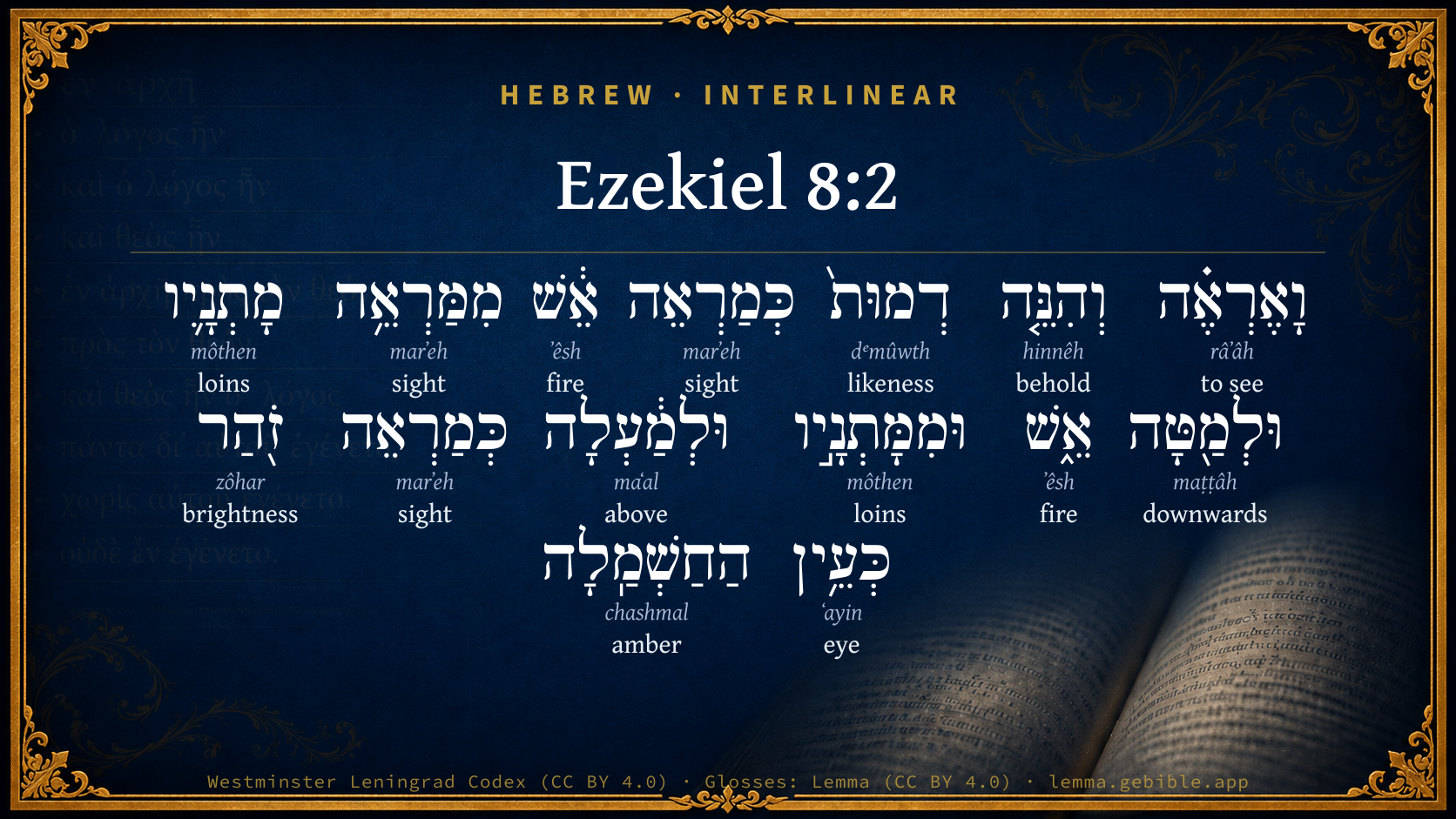
Hebrew (Westminster Leningrad Codex) Ezekiel 8:2 appears in the Hebrew Old Testament. The text above is from the Westminster Leningrad Codex. Each word links to its Strong’s number, a concise gloss, and parsing drawn from the Open Scriptures Hebrew Bible morphology. Click any word for its full Brown-Driver-Briggs (BDB) entry.
Download image
Cite this verse

Ezekiel 8:2 (World English Bible). Public Domain. Lemma interlinear Bible study tool, https://lemma.gebible.app/v/ezekiel/8/2.

Show BibTeX & RIS
BibTeX
RIS
English Translation
Then I saw, and, behold, a likeness as the appearance of fire; from the appearance of his loins and downward, fire; and from his loins and upward, as the appearance of brightness, as it were glowing metal.
World English Bible · Public Domain
Highlights
  • 1 first appearance in the Hebrew Bible
Full analysis ↓
Download a study sheet

One document with this verse’s original text, its word-by-word gloss line, the meaning frame, cross-references with their text, attributed commentary, and full source and license credits — printable, and it pastes into notes with its structure intact.

This verse Autodidact and up

Study sheet (.html) Plain text (.txt)

A passage Seminary Student

Up to 50 verses in one chapter. A passage sheet keeps up to 6 commentary sources and 12 cross-references per verse, in the order this page ranks them, and says so on the sheet whenever that leaves anything out. Ask for a single verse and you get the Autodidact verse sheet above.

Everything on this page stays free to read, with no account — the sheet is a download of what is already on screen, not access to it.

Want to remove ads? Support Godless Engineer
Compare translations 3

The same verse in 3 English versions, stacked beneath the original-language interlinear above. Click any original word for its lexicon entry.

Each is an independent rendering of the whole verse — the interlinear is not word-aligned to these translations.

Highlighted words mark where these versions differ — a whole-verse word diff, not a word-by-word alignment.

  • World English Bible Public Domain
    Then I saw, and, behold, a likeness as the appearance of fire; from the appearance of his loins and downward, fire; and from his loins and upward, as the appearance of brightness, as it were glowing metal.
  • King James Version Public Domain
    Then I beheld, and lo a likeness as the appearance of fire: from the appearance of his loins even downward, fire; and from his loins even upward, as the appearance of brightness, as the colour of amber.
  • unfoldingWord Literal Text CC BY-SA 4.0
    So I looked, and behold, there was a likeness with the appearance of a man. From the appearance of his hips downward there was fire. And from his hips upward there was the appearance of something shining, like glowing metal.

unfoldingWord Literal Text — © unfoldingWord, licensed CC BY-SA 4.0. Word-aligned USFM3 via Door43 (git.door43.org/unfoldingWord/en_ult).

Versions to compare (up to 4)

3 of 4 selected

Show all 18 translations

Every available English version of this verse, each an independent rendering of the whole verse.

  • World English Bible Public Domain
    Then I saw, and, behold, a likeness as the appearance of fire; from the appearance of his loins and downward, fire; and from his loins and upward, as the appearance of brightness, as it were glowing metal.
  • Berean Standard Bible Public Domain
    Then I looked and saw a figure like that of a man. From His waist down His appearance was like fire, and from His waist up He was as bright as the gleam of amber.
  • Majority Standard Bible Public Domain
    Then I looked and saw a figure like that of a man. From His waist down His appearance was like fire, and from His waist up He was as bright as the gleam of amber.
  • King James Version Public Domain
    Then I beheld, and lo a likeness as the appearance of fire: from the appearance of his loins even downward, fire; and from his loins even upward, as the appearance of brightness, as the colour of amber.
  • American Standard Version (1901) Public Domain
    Then I beheld, and, lo, a likeness as the appearance of fire; from the appearance of his loins and downward, fire; and from his loins and upward, as the appearance of brightness, as it were glowing metal.
  • Revised Version (1885) Public Domain
    Then I beheld, and, lo, a likeness as the appearance of fire; from the appearance of his loins and downward, fire: and from his loins and upward, as the appearance of brightness, as the colour of amber.
  • Geneva Bible (1599) Public Domain
    Then I beheld, and lo, there was a likenesse, as the appearance of fire, to looke to, from his loynes downeward, and from his loynes vpward, as the appearance of brightnes, and like vnto amber.
  • Douay-Rheims (1899) Public Domain
    And I saw, and behold a likeness as the appearance of fire: from the appearance of his loins, and downward, fire: and from his loins, and upward, as the appearance of brightness, as the appearance of amber.
  • Young's Literal Translation Public Domain
    and I look, and lo, a likeness as the appearance of fire, from the appearance of His loins and downward -- fire, and from His loins and upward, as the appearance of brightness, as the colour of copper.
  • Literal Standard Version CC BY-SA 4.0
    and I look, and behold, a likeness as the appearance of fire, from the appearance of His loins and downward—fire, and from His loins and upward, as the appearance of brightness, as the color of electrum.
  • Unlocked Literal Bible CC BY-SA 4.0
    So I looked, and behold, there was a likeness with the appearance of a man. From the appearance of his hips downward there was fire. And from his hips upward there was the appearance of something shining, like glowing metal.
  • unfoldingWord Literal Text CC BY-SA 4.0
    So I looked, and behold, there was a likeness with the appearance of a man. From the appearance of his hips downward there was fire. And from his hips upward there was the appearance of something shining, like glowing metal.
  • Darby Bible Public Domain
    And I looked, and behold, a likeness as the appearance of fire; from the appearance of his loins and downward, fire; and from his loins and upward, as the appearance of brightness, as the look of glowing brass.
  • World Messianic Bible Public Domain
    Then I saw, and behold, a likeness as the appearance of fire—from the appearance of his waist and downward, fire, and from his waist and upward, as the appearance of brightness, as it were glowing metal.
  • Webster's Bible Public Domain
    Then I beheld, and lo a likeness as the appearance of fire: from the appearance of his loins even downward, fire; and from his loins even upward, as the appearance of brightness, as the color of amber.
  • Free Bible Version CC BY-SA 4.0
    I looked around and saw a being that looked like a man. From what seemed to be his waist downwards, he looked like fire. From what seemed to be his waist upwards, he looked like brightly glowing metal.
  • Bible in Basic English Public Domain
    And looking, I saw a form like fire; from the middle of his body and down there was fire: and up from the middle of his body a sort of shining, like electrum.
  • JPS Tanakh (1917) Public Domain
    Then I beheld, and lo a likeness as the appearance of fire: from the appearance of his loins and downward, fire; and from his loins and upward, as the appearance of brightness, as the colour of electrum.

Literal Standard Version (2020), Covenant Press — licensed CC BY-SA 4.0. Text via the HelloAO Bible API (eBible.org). Unlocked Literal Bible (unfoldingWord) — licensed CC BY-SA 4.0. Text via the HelloAO Bible API (eBible.org). unfoldingWord Literal Text — © unfoldingWord, licensed CC BY-SA 4.0. Word-aligned USFM3 via Door43 (git.door43.org/unfoldingWord/en_ult). Free Bible Version, Dr. Jonathan Gallagher — licensed CC BY-SA 4.0. Text via the HelloAO Bible API (eBible.org).

Word by word

More ways to search: Search by grammar → Find every occurrence → Compare this word →

Practice this passage: Drill this verse → Learn its vocabulary →

זֹ֖הַר
zôhar
H2096
“brightness”
Noun, Common, Masculine, Singular, Absolute
Part of Speech
Noun
Type
Common
Gender
Masculine
Number
Singular
State
Absolute
Full BDB Definition

Origin: from H2094

TWOT: 531a

brightness, shining
  1. וָאֶרְאֶ֗ה râʼâh H7200 “and · to see” Conjunction + Verb, Qal, Sequential Imperfect, 1st Person, Common, Singular
  2. וְהִנֵּ֤ה hinnêh H2009 “and · behold” Conjunction + Particle, Demonstrative
  3. דְמוּת֙ dᵉmûwth H1823 “likeness” Noun, Common, Feminine, Singular, Absolute
  4. כְּמַרְאֵה marʼeh H4758 “like/as · sight of” Preposition + Noun, Common, Masculine, Singular, Construct
  5. אֵ֔שׁ ʼêsh H784 “fire” Noun, Common, Both, Singular, Absolute
  6. מִמַּרְאֵ֥ה marʼeh H4758 “from · sight of” Preposition + Noun, Common, Masculine, Singular, Construct
  7. מָתְנָ֛יו môthen H4975 “loins · his” Noun, Common, Masculine, Dual, Construct + Suffix, Personal, 3rd Person, Masculine, Singular
  8. וּלְמַ֖טָּה maṭṭâh H4295 “and · to/for · downwards” Conjunction + Preposition + Adverb
  9. אֵ֑שׁ ʼêsh H784 “fire” Noun, Common, Both, Singular, Absolute
  10. וּמִמָּתְנָ֣יו môthen H4975 “and · from · loins · his” Conjunction + Preposition + Noun, Common, Masculine, Dual, Construct + Suffix, Personal, 3rd Person, Masculine, Singular
  11. וּלְמַ֔עְלָה maʻal H4605 “and · to/for · above · toward” Conjunction + Preposition + Adverb + Suffix, Demonstrative
  12. כְּמַרְאֵה marʼeh H4758 “like/as · sight of” Preposition + Noun, Common, Masculine, Singular, Construct
  13. כְּעֵ֥ין ʻayin H5869 “like/as · eye of” Preposition + Noun, Common, Both, Singular, Construct
  14. הַחַשְׁמַֽלָה chashmal H2830 “the · amber” Particle, Definite Article + Noun, Common, Masculine, Singular, Absolute + Suffix, h

About this verse

These counts appear in no published source. They are computed here, from the morphology-tagged text and Lemma’s own curated glosses. What Lemma adds →

15
words
11
distinct lemmas
Prophets
section

Notable vocabulary

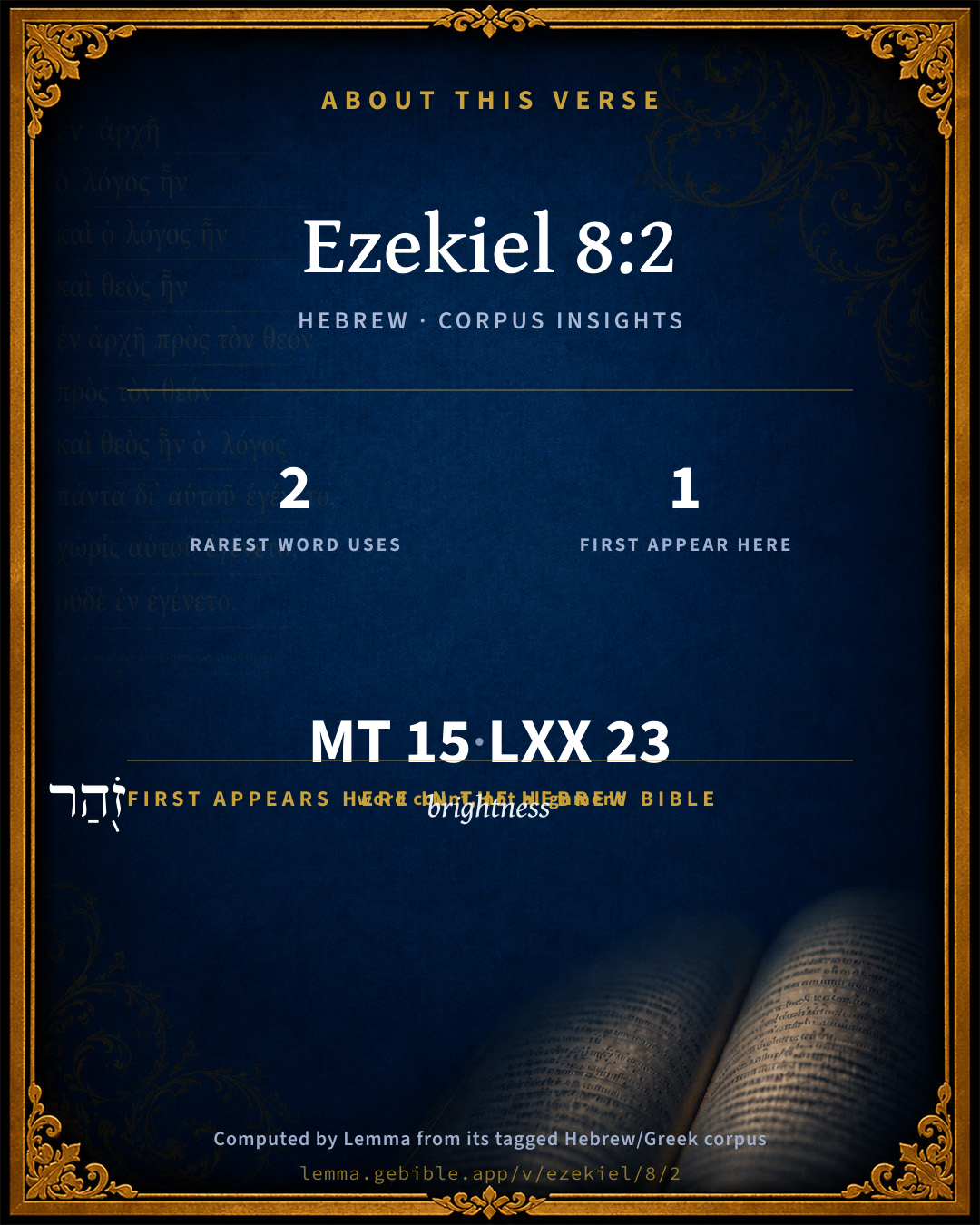
The rarest word here is זֹ֖הַר brightness H2096 — appearing just 2 times in the whole Hebrew Bible.

First appearance in Scripture

This word makes its first canonical appearance in the Hebrew Bible here:

  • זֹ֖הַר brightness H2096

Shared distinctive vocabulary

זֹ֖הַר brightness H2096 occurs in 2 verses of the Hebrew Bible. Also found in:

Grammatical profile

  • 1 verb
  • 11 nouns
  • 2 adverbs
  • 1 particle

Verb forms

  • וָאֶרְאֶ֗ה Qal · Sequential Imperfect

Repetition

Words recur within this verse — often emphatic in Hebrew:

  • כְּמַרְאֵה sight H4758 ×3
  • אֵ֔שׁ fire H784 ×2
  • מָתְנָ֛יו loins H4975 ×2

Hebrew & Septuagint length

In English translation the verse runs 37 words from the Hebrew and 30 from the Septuagint (LXX English) — closely comparable.

A rough comparison of the two English renderings, which tokenize alike — not a word-level alignment.

Word counts can differ between the Hebrew and the Greek without any difference in meaning — e.g. the Hebrew direct-object marker אֵת has no separate Greek word, and Greek often adds the article ὁ.

In the original languages it is 15 Hebrew tokens and 23 Greek tokens — but the two are counted differently (Hebrew bundles its prefixes and suffixes into one token; the Greek is in lemma form), so that isn’t a like-for-like length.

Cross-references

4

Topical passages linked to Ezekiel 8:2 in the Treasury of Scripture Knowledge — connected by theme and wording, ordered by reader-vote popularity; previews shown in the World English Bible.

  • Ezekiel 1:4 I looked, and, behold, a stormy wind came out of the north, a great cloud, with flashing lightning, and a brightness round about it, and out of the midst of it as it were glowing metal, out of the midst of the fire.
  • Ezekiel 1:26–27 Above the expanse that was over their heads was the likeness of a throne, as the appearance of a sapphire stone; and on the likeness of the throne was a likeness as the appearance of a man on it above.
  • Daniel 7:9–10 I saw until thrones were placed, and one who was ancient of days sat: his clothing was white as snow, and the hair of his head like pure wool; his throne was fiery flames, [and] the wheels of it burning fire.
  • Revelation 1:14–15 His head and his hair were white as white wool, like snow. His eyes were like a flame of fire.

Cross-references courtesy of OpenBible.info (CC BY 4.0).

Hebrew and Greek witnesses Masoretic Hebrew ↔ Greek Septuagint

The same verse in the two great witnesses to the Old Testament, shown verse-for-verse.

These are two independent witnesses, not word-aligned to each other, and the Septuagint is shown in lemma (dictionary) form.

Hebrew Ezekiel 8:2 Masoretic · Westminster Leningrad Codex

וָאֶרְאֶ֗ה וְהִנֵּ֤ה דְמוּת֙ כְּמַרְאֵה אֵ֔שׁ מִמַּרְאֵ֥ה מָתְנָ֛יו וּלְמַ֖טָּה אֵ֑שׁ וּמִמָּתְנָ֣יו וּלְמַ֔עְלָה כְּמַרְאֵה זֹ֖הַר כְּעֵ֥ין הַחַשְׁמַֽלָה

Then I saw, and, behold, a likeness as the appearance of fire; from the appearance of his loins and downward, fire; and from his loins and upward, as the appearance of brightness, as it were glowing metal.

World English Bible · Public Domain

Greek LXX Ezekiel 8:2 Septuagint · lemma form

καί ὁράω καί ἰδού ὁμοίωμα ἀνήρ ἀπό ὁ ὀσφύς αὐτός καί ἕως κάτω πῦρ καί ἀπό ὁ ὀσφύς αὐτός ὑπεράνω ὡς ὅρασις ἠλέκτρον

And I looked, and, behold, the likeness of a man: from his loins and downwards there was fire, and from his loins upwards there was as the appearance of amber.

LXX2012 (modern English Septuagint) · Public Domain

On this verse, Jamieson, Fausset & Brown discusses the Septuagint’s reading. Read the note in Commentary ↓

Hebrew: Westminster Leningrad Codex (CC BY 4.0). Greek: Septuagint (public domain); English from LXX2012 (modern English Septuagint) (Public Domain). How the Septuagint differs from the Hebrew →

Targum (Aramaic paraphrase)

1

The Targum is the ancient Jewish Aramaic paraphrase of the Hebrew Scriptures — an interpretive translation, not the Hebrew text itself. Onkelos (literal) and Pseudo-Jonathan (expansive) render the Torah, and Jonathan the Prophets. Coverage is partial: where no permissively-licensed English translation exists for a verse, only the Aramaic is shown. This is verse-level text, not a word-by-word alignment to the Hebrew.

  1. Targum Jonathan Prophets (Joshua–Malachi)
    וַחֲזֵית וְהָא דְמוּת כְּחֵיזוּ אֶשְׁתָּא חֵיזוּ יְקַר דְלָא יָכְלָא עֵינָא לְמֶחֱזֵי וְלֵית אֶפְשַׁר לְאִסְתַּכָּלָא בֵּיהּ וּלְרַע חֵיזוּ אֶשְׁתָּא וְחֵיזוּ יְקָר דְלָא יָכְלָא עֵינָא לְמֶחֱזֵי וְלָא אֶפְשַׁר לְאִסְתַּכָּלָא בֵּיהּ וּלְעֵילָא כְּחֵיזוּ זָהֳרָא כְּעֵין חַשְׁמַל:

    (no public-domain English translation for this verse)

    Targum Jonathan — Aramaic: “Mikraot Gedolot” (public domain). English: “Sefaria Community Translation” (CC0 1.0 (public-domain dedication)); “London "Chaldee Paraphrase," 1871” (public domain). Text via Sefaria.

Commentary

Notes on Ezekiel 8:2 from classic Christian and Jewish commentators (each source and its license shown beneath its notes). The classic Christian expositions comment on the surrounding passage and are grouped to its opening verse, so a note may address several verses; the Jewish commentaries on the Tanakh (Rashi and others) are per-verse, so they appear only where the commentator wrote on this verse.

Lemma curates 59 commentaries, every one of them public domain or Creative Commons licensed, each selected and text-cleaned for this edition rather than reprinted as found. About our sources →

Trapp's Complete Commentary

John Trapp

Eze 8:2 Then I beheld, and lo a likeness as the appearance of fire: from the appearance of his loins even downward, fire; and from his loins even upward, as the appearance of brightness, as the colour of amber.

Ver. 2. Then I beheld, and lo a likeness.] Of a man, likely. This was the Lord Christ, whose eyes are like a flaming fire, {Rev 1:14} and even our God (as well as the Jews’ God) is a consuming fire. {Heb 12:29} Here, in the fire, was set forth his vengeance against the wicked; in his brightness upwards, his majesty, say some; his clemency, say others.

As the colour of amber.] Or, Of a coal intensely hot, as Eze 1:27

John Trapp, A Commentary or Exposition upon All the Books of the Old and New Testament (1647–1656) — public domain. Text from a community e-Sword module.

Joseph Benson's Commentary

Eze 8:2. I beheld, and lo a likeness — Namely, of a man; the man whom he had seen upon the throne; as the appearance of fire — This seems to have been the same appearance as that mentioned before, Eze 1:27, signifying that God was about to inflict heavy judgments on the Jewish nation, but so as not entirely to destroy it. It is probable, while those who are here called the elders of Judah were sitting before the prophet with silence and attention, waiting for an answer to some inquiries they had made of him, as God’s prophet, concerning what was to be the future condition of the Jewish nation, that Ezekiel was on a sudden seized with an ecstasy, and had the things he gives an account of in the following verses presented before his eyes; or such a strong impression of them made upon his mind, that it seemed to him as if he actually saw them.

Joseph Benson's Commentary on the Old and New Testaments (1811–1818) — public domain. Text from a community e-Sword module.

Tyndale Open Study Notes

Tyndale Open Resources

8:2-3 While the leaders were gathered, Ezekiel saw in a vision what appeared to be a man. The description is similar to the description in 1:26-27. This time, however, Ezekiel was lifted . . . up into the sky and transported . . . to Jerusalem. • appeared to be . . . looked like . . . seemed to be: What Ezekiel saw defied human description (see study note on 1:4-28).

Tyndale Open Study Notes — © Tyndale Open Resources, licensed CC BY-SA 4.0. Text via the HelloAO Bible API.

Geneva Bible (1599)

Geneva Bible translators

As Ezek. 1:27.

Geneva Bible (1599) marginal notes — public domain. Text via Bolls.life.

Jamieson, Fausset & Brown

Robert Jamieson, A. R. Fausset & David Brown

likeness--understand, "of a man," that is, of Messiah, the Angel of the covenant, in the person of whom alone God manifests Himself (Eze 1:26; Joh 1:18). The "fire," from "His loins downward," betokens the vengeance of God kindled against the wicked Jews, while searching and purifying the remnant to be spared. The "brightness . . . upward" betokens His unapproachable majesty (Ti1 6:16). For Hebrew, eesh, "fire," the Septuagint, &c., read ish, "a man."

colour of amber--the glitter of chasmal [FAIRBAIRN], (see on Eze 1:4, "polished brass").

Jamieson, Fausset & Brown — Commentary Critical and Explanatory on the Whole Bible (1871) — public domain (CC PDM 1.0). Text via the HelloAO Bible API.

Adam Clarke's Commentary

Verse 2. The appearance of fire] See Clarke on Eze 1:27.

Adam Clarke's Commentary on the Bible (1810–1826) — public domain. Text from a community e-Sword/MySword module.

John Calvin's Commentaries

Some translate the last word angel, but in my opinion erroneously: for עין, gnin, properly signifies color, and I have already refuted that error in the first chapter. I am not clear as to what color it was, hence I follow the received opinion that, it was like amber. Now the Prophet says, he saw a likeness, or image composed of two parts; for from the loins downward it was like fire, but upwards it was brightness. By the word דמות, demoth, I do not doubt that he means the image of a man. God, therefore, appeared to his servant under some image; nor is the human figure out of place, because if it had been any other figure without doubt the Prophet had been silent. But we have already seen that God had put on the human form, and so represented himself in the person of his only begotten Son, as we have said, and shall see again in the tenth chapter. This, therefore, is the likeness of which the Prophet speaks, but he uses this word on purpose, that we may know that it was not a true and solid and substantial thing called body. As to the Prophet’s beholding a figure or likeness, this took place only in a bare vision, not that God then put on a body; and concerning this point also I have treated at length in the first chapter, and shortly I shall glance at it again. Now as to his saying, one part of the figure was fiery, but in another, the aspect of splendor, he seems here to express what the Jews ought to hope for, when at length they perceived God to be near, from whom they thought themselves very far off, since they so boldly despised his law and all the prophecies. As to the splendor, God’s majesty and incomprehensible glory is signified. For if brightness blinds our eyes, what would happen if we endeavor to penetrate to that immense light of which the sun is only a little spark? Since, therefore, Ezekiel says, there was the likeness of splendor above his loins, he doubtless shows how formidable the majesty of God ought to be to us. For God dwells in light, but inaccessible, as the Apostle says: but below, says he, was the appearance of fire, namely, because he must not. wait till the Jews received any joy from the presence of God. (1 Timothy 6:16.) We know, indeed, that hypocrites always boast rashly in the name of God, as Amos reproves them, What is to you the day of the Lord? it is a day of darkness and not light. (Amos 5:18.) For they boast that God would be entreated in their miseries, and that he must assist them, because he had taken them under his protection. The Prophet refutes this arrogance, and says, that the day of the Lord would be darkness. So also in this place, God appeared in the form of fire towards the earth, that the Jews should tremble when they saw the vengeance of God lighted up to consume them. Therefore in the splendor God’s majesty was shown, which humbled the Prophet and all the pious, that they should receive the vision reverently; for in the fire God’s vengeance was shown, lest the Jews should make for themselves too wide a shield of the name of God, which they extended falsely and fallaciously.

John Calvin's Commentaries (1540-1563) — public domain. Text from the Calvin Translation Society English edition (1840s-50s) via the Christian Classics Ethereal Library (ccel.org). Calvin's coverage is partial (roughly two-thirds of the Bible); uncommented books and verses are honest gaps, never fabricated. The 19th-century editor's footnotes and remarks are omitted so the notes are faithfully Calvin's own voice.

Ellicott's Commentary for English Readers

(2) A likeness as the appearance of fire.—This is not, as often supposed, a reappearance of the vision of Ezekiel 1. That vision bursts again on the prophet after he has been carried in the spirit to the Temple at Jerusalem (Eze_8:4). This is not expressly described as a human form, but from the mention of the loins, and of “the form of an hand,” in Eze_8:3 it is implied that it was so. No further description is given, except that it was something bright and glorious like fire; and by the repetition of the words “likeness,” “appearance,” and “form of an hand,” the prophet here, as in Ezekiel 1, takes pains to show that it was only a vision, not an outward reality. It is also to be remembered that this and the subsequent vision occurred while the elders were sitting before the prophet. They saw nothing themselves, but must have witnessed his ecstasy, and thus have been prepared for his telling them at its close (Eze_11:25) “all the things that the Lord had showed” him. “The colour of amber” is the same as in Eze_1:4, where see Note.

A Bible Commentary for English Readers, edited by Charles John Ellicott (1878–1897) — public domain. Text from a community e-Sword module.

The Cambridge Bible for Schools and Colleges

gen. ed. J. J. S. Perowne

2. as the appearance of fire] More naturally, the appearance of a man, as LXX., cf. ch. Eze_1:26-27, “the appearance of a man” (a different word, however), where the description is the same, viz. fire from the loins downwards and amber from the loins upwards. The prophet speaks with reverential vagueness of God—“a likeness as the appearance of a man,” and “he put forth the likeness of a hand.”

The Cambridge Bible for Schools and Colleges (gen. ed. J. J. S. Perowne; Cambridge University Press, 1878–1918) — public domain. Text from a community e-Sword module.

John Gill's Exposition

And then one beheld, and lo a likeness as the appearance of fire,.... The Septuagint and Arabic versions render it, "behold the likeness of a man"; reading "a man", for "fire"; but without supposing such a reading, for which there is no foundation, this likeness may very well be understood of the likeness of a man; since mention is made of his joins in the next clause, and of his hand in Eze 8:3; and the description agrees with the appearance of a man in Eze 1:26; it was usual for the Son of God, who doubtless is here meant, to appear in a human form; and so Junius and Tremellius supply the words,

"and lo a likeness "of a man", as in the appearance of fire:''

it was the form of a fiery man that was seen, as he is further described:

from the appearance of his loins, even downward, fire; his lower parts, thighs, legs, and feet; expressive either of the light of grace communicated from Christ to his people; or of his fervent love towards them, or flaming zeal for God and his house; or rather of his wrath against an idolatrous people; see Rev 1:15; a like description is in Eze 1:27;

and from his loins, even upward, as the appearance of brightness; his upper parts, back, belly, breast, shoulders, arms, head, &c. which may denote his incomprehensible majesty and glory; his glory being the glory of the only begotten, the brightness of his Father's glory, and the express image of his person. The Targum renders both the one and the other part of the description thus,

"and I saw, and twelve a likeness as the look of fire, the look of glory, which the eye cannot see, nor is it possible to look upon it; and beneath the look of fire, and the look of glory, which the eye cannot behold, nor is it possible to contemplate it; and above, as the look of brightness:''

as the colour of amber: or "chasmal": which some take to be the name of an angel. The Syriac version is, "as the look of God"; See Gill on Eze 1:4; and See Gill on Eze 1:27.

John Gill's Exposition of the Whole Bible (1746–1763) — public domain (CC PDM 1.0). Text via the HelloAO Bible API.

Albert Barnes' Notes on the Bible

The appearance of fire - In margin reference, seen as the appearance of a man enthroned upon the cherubim. Here He stands apart from the throne revealing Himself to His servant. Compare Dan 3:25 note.

Amber - See the margin reference note.

Albert Barnes' Notes on the Bible (1834–1885) — public domain. Text from a community e-Sword/MySword module.

Haydock's Catholic Bible Commentary

Likeness. Septuagint add, "of a man," as it had appeared [in] chap. i. 27.

George Leo Haydock (1774–1849), Haydock's Catholic Family Bible and Commentary, 1859 edition — public domain. Excludes Psalms (Douay-Rheims chapter numbering differs from Protestant) and Deuterocanonical books (Catholic canon only).

Matthew Poole's English Annotations

A likeness of a man; that man whom he had seen upon the throne, i.e. of Christ.

The appearance of fire: see Eze 1:26-28. This fire denotes the wrath of God against Jerusalem, and it is observed it was fire downward, wrath already coming down upon the Jews.

The appearance of brightness, to signify the majesty and glory of Christ. See more Eze 1:27.

Matthew Poole's English Annotations on the Holy Bible (1683–1685) — public domain. Text from a community e-Sword/MySword module.

Whedon's Commentary on the Bible

Daniel D. Whedon

2. As the appearance of fire — Literally, as the appearance of a man (Eze_1:26). The Hebrew words for “man” and “fire” are very nearly alike and have been mistaken here by some copyist. Here again we notice how guardedly the prophet speaks. He does not dare to say that he saw a man possessing Jehovah’s glory (see notes Eze_1:26-27), but he sees a “likeness as the appearance of a man,” who had the “appearance of brightness” and put forth the “likeness of a hand,” etc. This is evidently the same One formerly mentioned as the appearance of “a man upon the throne.” Whether the throne chariot accompanies him now is not stated.

Daniel D. Whedon (gen. ed.), Commentary on the Old and New Testaments (1874–1909) — public domain. Text from a community e-Sword module.

The Pulpit Commentary

I beheld, and lo a likeness, etc. The vision opens with a theophany like that of ch. 1.; but here, as there, Ezekiel uses the word which emphasizes the fact that what he had seen was but a "likeness" of the ineffable glory, an image of the Unseen. (For "amber," see Eze_1:4, Eze_1:27) In this case we note the absence of the cherubic figures. It is simply the "appearance of tile likeness of the glory of Jehovah," seen now in the glow of fire, without the milder, more hopeful brightness of the rainbow. (Eze_1:28)

Ver. 2. A revelation of fire.

The prophet is visited with a series of new visions under fresh circumstances. No longer walking among the weeping captives by the waters of Babylon, or standing in solitude upon the great plain, Ezekiel is now in his own house receiving a deputation of Jewish leading men, who have evidently bees impressed by his earlier prophecies, and who have come to consult him on the condition and prospects of his nation, when he is seized with an inspired rapture. The house and the visitors melt away from his consciousness, and there in the very presence of these waiting and astonished guests the prophet"s eyes are opened to a vision of God, and he is carried in imagination to scenes of sin and shame in the temple at Jerusalem. Was ever there a more unlikely time and setting of revelation? Truly the Spirit breatheth where it listeth. God may visit a soul in company as well as in solitude, in the home as well as in the temple or in the seclusion of nature. He, is ever present. The only question in When and how will the veil be lifted?

I A VISION OF GOD. It is evidently a Divine appearance, a theophany, that is here portrayed. Not that man at any time can see God with the outward eye, for flesh cannot see spirit. But in vision and representative form God now manifests himself to Ezekiel.

1. The vision of God precedes the revelation of truth. It was usual for this great seer of visions, Ezekiel, to have a new series of revelations opened by some overwhelming manifestation of God"s presence. The same occurred with St. John"s visions in the Apocalypse. We must know God before we can understand Divine truth. The vision of God in the soul must come first. Then truth can be seen in his light.

2. The vision of God precedes the revelation of man. Ezekiel is about to see awful sights of sin. He must first behold the pure fire of God"s presence. We cannot know man till we see him in the light of God. The Bible that gives us our highest knowledge of God also gives us our deepest insight into man. Vague ideas of God lead to light thoughts of sin. When about to visit the haunts of wickedness, the Christian should first come into communion with God. This will help him to see the horror of sin, to keep himself from contamination, and to feel the right commiseration for the fallen.

II A VISION OF FIRE. The Divine manifestation seems to have been in a human shape, but in one of fire burning flames below, brilliant radiance above.

1. The fire below suggests wrath against sin. "Our God is a consuming. (Heb_12:29) Christ came to baptize with fire, and to burn up the chaff with unquenchable fire. (Mat_3:11, Mat_3:12) There is a righteous indignation against sin, the lack of which would mean moral feebleness. God burns to consume all evil.

2. The brightness above suggests the supreme glory of God. The crowning characteristic of God is nut wrath. Above the fire is the serene radiance. There is terror in the holiness of God when this touches the sin of man. Yet God himself is supremely calm and beautiful. If we can rise from the flaming wrath about his feet, and behold the beauty of his countenance, we shall see on it the expression of eternal goodness.

The Pulpit Commentary (1880–1919), ed. H.D.M. Spence-Jones & Joseph S. Exell — public domain. Text from a community e-Sword module.

John Wesley's Explanatory Notes

A likeness - Of a man; the man whom he had seen upon the throne. Fire - This fire might denote the wrath of God against Jerusalem.

John Wesley, Explanatory Notes Upon the Whole Bible (1754–1765) — public domain. Text via the GEBible commentary corpus.

Rashi

Rabbi Shlomo Yitzchaki (Rashi)

from the appearance of its loins, etc. It is forbidden to reflect on this verse.

Rashi on the Tanakh — English translations: “The Judaica Press complete Tanach with Rashi, translated by A. J. Rosenberg” (CC BY 4.0); “Pentateuch with Rashi's commentary by M. Rosenbaum and A.M. Silbermann, 1929-1934” (public domain); “The Metsudah Tanach series, Lakewood, N.J” (CC BY 4.0); and “The Book of Joshua, Metsudah Publications, 1997” (CC BY 4.0). Text via Sefaria.

Lesson kit

Teaching starters — assembled from the data on this page, not authored interpretation. Every prompt links to the verse data it draws on. Edit before teaching.

Ezekiel, in the Prophets, opens this verse with 15 words (11 distinct Hebrew lemmas). Its most distinctive word is zôhar (“brightness”). A historical commentator’s framing appears above. Read the whole chapter for the surrounding context.

Discussion questions

  1. How does “brightness” (zôhar) shape what this verse is saying?
  2. This is the first place “brightness” appears in Scripture (first appears here). What does its debut here establish?
  3. How does Daniel 12:3, which shares the word «brightness», read alongside this verse?
  4. What does the repetition of “sight” (3× in this one verse) do in this verse?
  5. The translations on this page render this verse differently — a whole-verse word diff, not a word-by-word alignment. What might account for the different wordings?
  6. «וָאֶרְאֶ֗ה» is a Qal Sequential Imperfect verb. How does that grammatical form shape the action described?
  7. Compare how Trapp's Complete Commentary and Joseph Benson's Commentary read this verse. Where do they agree or differ?

Things to notice

Reading settings

Reading text

Shown beneath each verse's original-language words.

Old Testament
Old Testament edition

Read the OT as the Masoretic Hebrew (MT) or the Greek Septuagint (LXX).

English shown for the Greek Septuagint (in the Hebrew ↔ Greek comparison).

Comparing translations? Open the Compare panel on any verse page to stack up to four side by side.