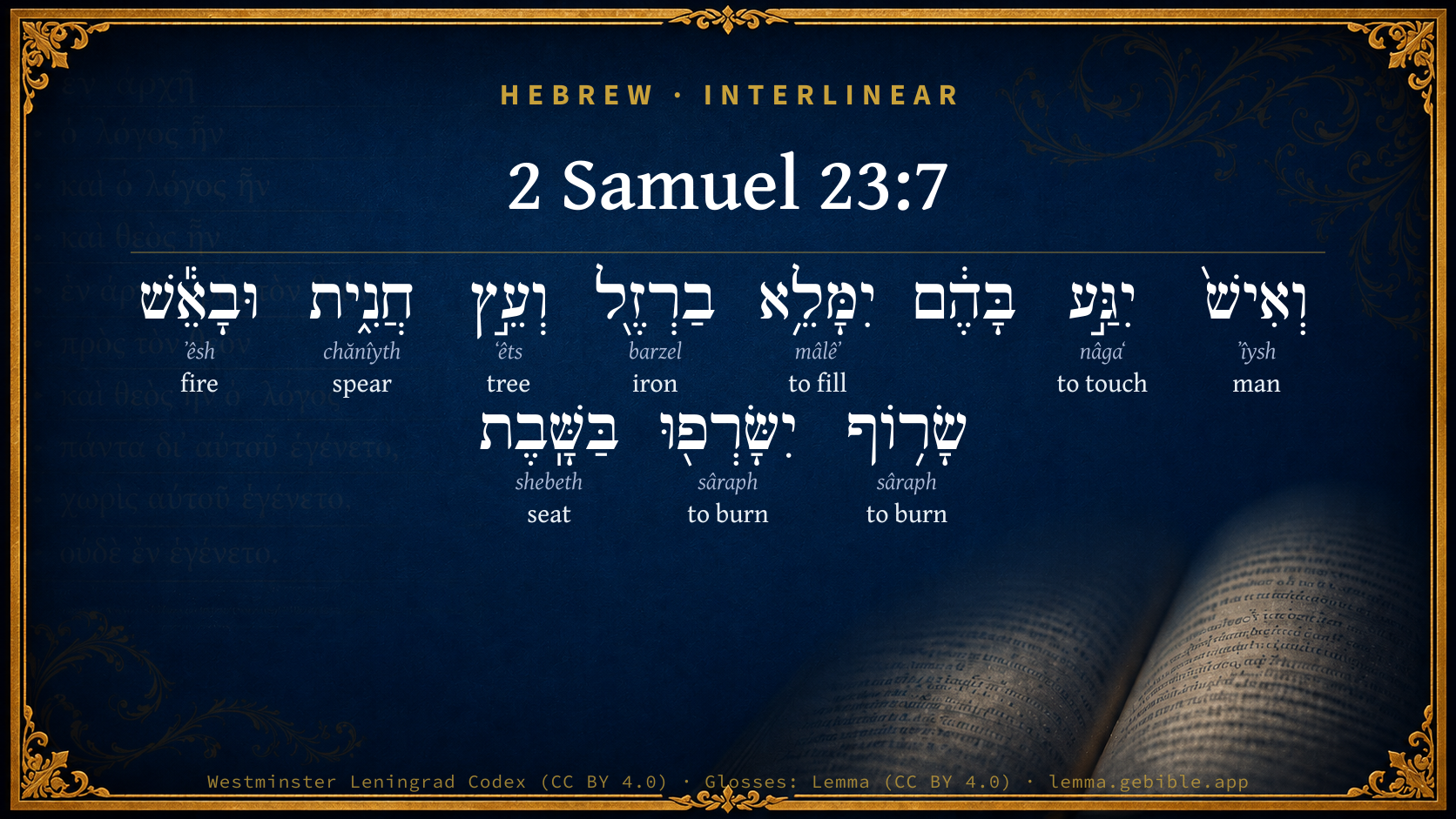
2 Samuel 23:7

Hebrew (Westminster Leningrad Codex) 2 Samuel 23:7 appears in the Hebrew Old Testament. The text above is from the Westminster Leningrad Codex. Each word links to its Strong’s number, a concise gloss, and parsing drawn from the Open Scriptures Hebrew Bible morphology. Click any word for its full Brown-Driver-Briggs (BDB) entry.
Download image
Cite this verse

2 Samuel 23:7 (World English Bible). Public Domain. Lemma interlinear Bible study tool, https://lemma.gebible.app/v/2-samuel/23/7.

Show BibTeX & RIS
BibTeX
RIS
English Translation
But the man who touches them Must be armed with iron and the staff of a spear: They shall be utterly burned with fire in [their] place
World English Bible · Public Domain
Highlights Full analysis ↓
Download a study sheet

One document with this verse’s original text, its word-by-word gloss line, the meaning frame, cross-references with their text, attributed commentary, and full source and license credits — printable, and it pastes into notes with its structure intact.

This verse Autodidact and up

Study sheet (.html) Plain text (.txt)

A passage Seminary Student

Up to 50 verses in one chapter. A passage sheet keeps up to 6 commentary sources and 12 cross-references per verse, in the order this page ranks them, and says so on the sheet whenever that leaves anything out. Ask for a single verse and you get the Autodidact verse sheet above.

Everything on this page stays free to read, with no account — the sheet is a download of what is already on screen, not access to it.

Want to remove ads? Support Godless Engineer
Compare translations 3

The same verse in 3 English versions, stacked beneath the original-language interlinear above. Click any original word for its lexicon entry.

Each is an independent rendering of the whole verse — the interlinear is not word-aligned to these translations.

Highlighted words mark where these versions differ — a whole-verse word diff, not a word-by-word alignment.

  • World English Bible Public Domain
    But the man who touches them Must be armed with iron and the staff of a spear: They shall be utterly burned with fire in [their] place
  • King James Version Public Domain
    But the man that shall touch them must be fenced with iron and the staff of a spear; and they shall be utterly burned with fire in the same place.
  • unfoldingWord Literal Text CC BY-SA 4.0
    But the man touches them will be filled iron or the wood of a spear. And burning, they will be burned in the fire in place.”

unfoldingWord Literal Text — © unfoldingWord, licensed CC BY-SA 4.0. Word-aligned USFM3 via Door43 (git.door43.org/unfoldingWord/en_ult).

Versions to compare (up to 4)

3 of 4 selected

Show all 18 translations

Every available English version of this verse, each an independent rendering of the whole verse.

  • World English Bible Public Domain
    But the man who touches them Must be armed with iron and the staff of a spear: They shall be utterly burned with fire in [their] place
  • Berean Standard Bible Public Domain
    The man who touches them must be armed with iron or with the shaft of a spear. The fire burns them to ashes in the place where they lie.”
  • Majority Standard Bible Public Domain
    The man who touches them must be armed with iron or with the shaft of a spear. The fire burns them to ashes in the place where they lie.”
  • King James Version Public Domain
    But the man that shall touch them must be fenced with iron and the staff of a spear; and they shall be utterly burned with fire in the same place.
  • American Standard Version (1901) Public Domain
    But the man that toucheth them Must be armed with iron and the staff of a spear: And they shall be utterly burned with fire in `their' place.
  • Revised Version (1885) Public Domain
    But the man that toucheth them must be armed with iron and the staff of a spear; and they shall be utterly burned with fire in their place.
  • Geneva Bible (1599) Public Domain
    But the man that shall touch them, must be defensed with yron, or with the shaft of a speare: and they shall be burnt with fire in the same place.
  • Douay-Rheims (1899) Public Domain
    And if a man will touch them, he must be armed with iron and with the staff of a lance: but they shall be set on fire and burnt to nothing.
  • Young's Literal Translation Public Domain
    And the man who cometh against them Is filled with iron and the staff of a spear, And with fire they are utterly burnt In the cessation.'
  • Literal Standard Version CC BY-SA 4.0
    And the man who comes against them || Is filled with iron and the staff of a spear, || And they are utterly burned with fire || In the cessation.”
  • Unlocked Literal Bible CC BY-SA 4.0
    The man who touches them must use an iron tool or the shaft of a spear. They must be burned up where they lie.'”
  • unfoldingWord Literal Text CC BY-SA 4.0
    But the man touches them will be filled iron or the wood of a spear. And burning, they will be burned in the fire in place.”
  • Darby Bible Public Domain
    And the man that will touch them provideth himself with iron and the staff of a spear; And they shall be utterly burned with fire in [their] place.
  • World Messianic Bible Public Domain
    The man who touches them must be armed with iron and the staff of a spear. They will be utterly burned with fire in their place.”
  • Webster's Bible Public Domain
    But the man that shall touch them must be fenced with iron and the staff of a spear; and they shall be utterly burned with fire in the same place.
  • Free Bible Version CC BY-SA 4.0
    The only way to deal with them is to use an iron tool or the handle of a spear. They are completely burned up right where they are.”
  • Bible in Basic English Public Domain
    But anyone touching them has to be armed with iron and the rod of a spear; and they will be burned with fire, every one of them.
  • JPS Tanakh (1917) Public Domain
    But the man that toucheth them must be armed with iron and the staff of a spear; and they shall be utterly burned with fire in their place.

Literal Standard Version (2020), Covenant Press — licensed CC BY-SA 4.0. Text via the HelloAO Bible API (eBible.org). Unlocked Literal Bible (unfoldingWord) — licensed CC BY-SA 4.0. Text via the HelloAO Bible API (eBible.org). unfoldingWord Literal Text — © unfoldingWord, licensed CC BY-SA 4.0. Word-aligned USFM3 via Door43 (git.door43.org/unfoldingWord/en_ult). Free Bible Version, Dr. Jonathan Gallagher — licensed CC BY-SA 4.0. Text via the HelloAO Bible API (eBible.org).

Word by word

More ways to search: Search by grammar → Find every occurrence → Compare this word →

Practice this passage: Drill this verse → Learn its vocabulary →

בַּשָּֽׁבֶת
shebeth
H7675
“in/at the · seat”
Preposition, Determined + Noun, Common, Feminine, Singular, Absolute
Part of Speech
Preposition + Noun
Type
Common
Gender
Feminine
Number
Singular
State
Absolute
Full BDB Definition

Origin: infinitive of H3427

TWOT: 922a

(Qal) seat, dwelling, place
  1. וְאִישׁ֙ ʼîysh H376 “and · man” Conjunction + Noun, Common, Masculine, Singular, Absolute
  2. יִגַּ֣ע nâgaʻ H5060 “to touch” Verb, Qal, Imperfect, 3rd Person, Masculine, Singular
  3. יִמָּלֵ֥א mâlêʼ H4390 “to fill” Verb, Niphal, Imperfect, 3rd Person, Masculine, Singular
  4. בַרְזֶ֖ל barzel H1270 “iron” Noun, Common, Masculine, Singular, Absolute
  5. וְעֵ֣ץ ʻêts H6086 “and · tree of” Conjunction + Noun, Common, Masculine, Singular, Construct
  6. חֲנִ֑ית chănîyth H2595 “spear” Noun, Common, Feminine, Singular, Absolute
  7. וּבָאֵ֕שׁ ʼêsh H784 “and · in/at the · fire” Conjunction + Preposition, Determined + Noun, Common, Both, Singular, Absolute
  8. שָׂר֥וֹף sâraph H8313 “to burn” Verb, Qal, Infinitive Absolute
  9. יִשָּׂרְפ֖וּ sâraph H8313 “to burn” Verb, Niphal, Imperfect, 3rd Person, Masculine, Plural

About this verse

These counts appear in no published source. They are computed here, from the morphology-tagged text and Lemma’s own curated glosses. What Lemma adds →

11
words
9
distinct lemmas
Historical
section

Notable vocabulary

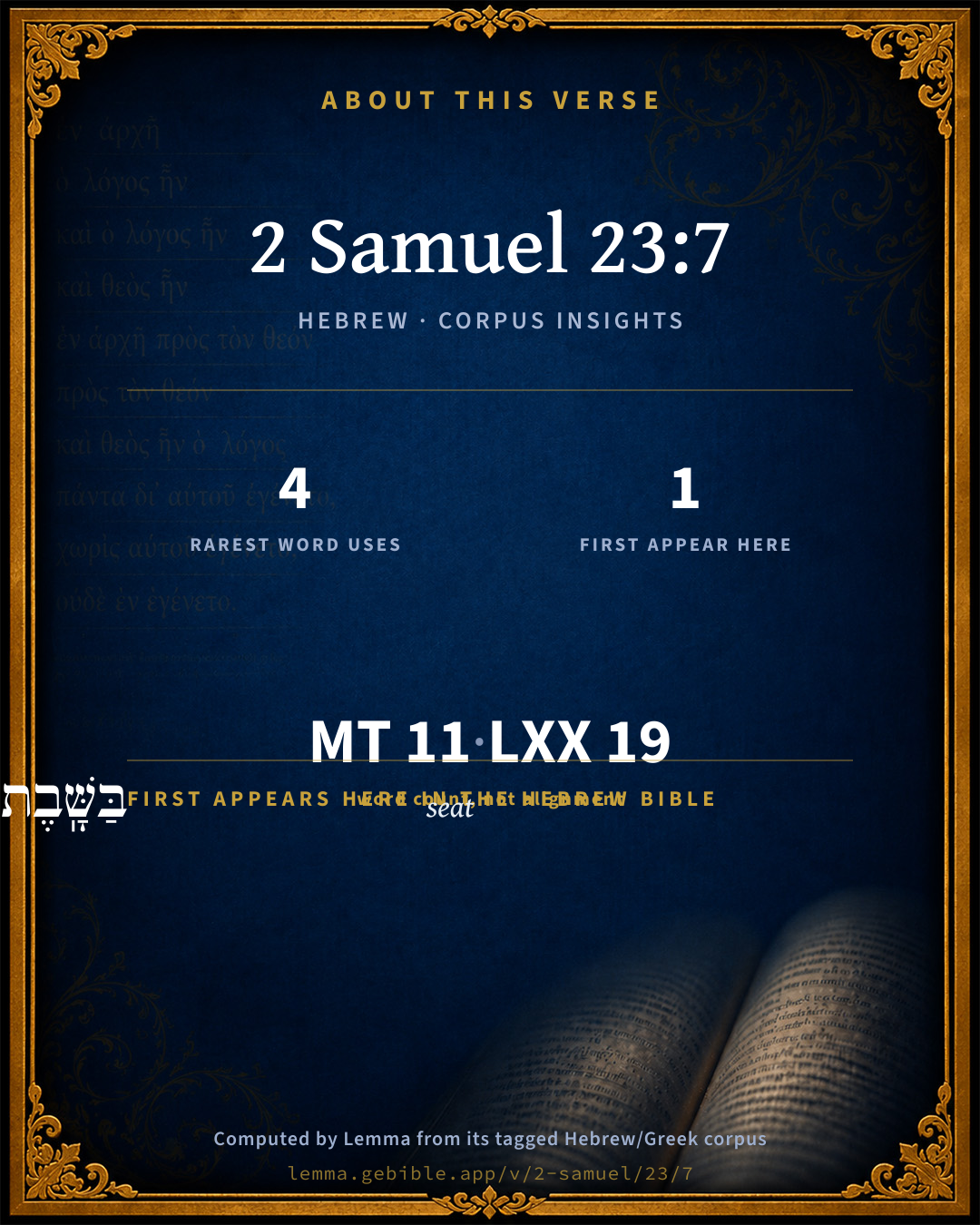
The rarest word here is בַּשָּֽׁבֶת seat H7675 — appearing just 4 times in the whole Hebrew Bible.

First appearance in Scripture

This word makes its first canonical appearance in the Hebrew Bible here:

  • בַּשָּֽׁבֶת seat H7675

Shared distinctive vocabulary

בַּשָּֽׁבֶת seat H7675 occurs in 4 verses of the Hebrew Bible. Also found in:

Grammatical profile

  • 4 verbs
  • 6 nouns
  • 1 preposition

Verb forms

  • יִגַּ֣ע Qal · Imperfect
  • יִמָּלֵ֥א Niphal · Imperfect
  • שָׂר֥וֹף Qal · Infinitive Absolute
  • יִשָּׂרְפ֖וּ Niphal · Imperfect

Repetition

A word recurs within this verse — often emphatic in Hebrew:

  • שָׂר֥וֹף to burn H8313 ×2

Hebrew & Septuagint length

In English translation the verse runs 27 words from the Hebrew and 40 from the Septuagint (LXX English) — the Septuagint runs noticeably longer here. See the side-by-side →

A rough comparison of the two English renderings, which tokenize alike — not a word-level alignment.

Word counts can differ between the Hebrew and the Greek without any difference in meaning — e.g. the Hebrew direct-object marker אֵת has no separate Greek word, and Greek often adds the article ὁ.

In the original languages it is 11 Hebrew tokens and 19 Greek tokens — but the two are counted differently (Hebrew bundles its prefixes and suffixes into one token; the Greek is in lemma form), so that isn’t a like-for-like length.

Cross-references

10

Topical passages linked to 2 Samuel 23:7 in the Treasury of Scripture Knowledge — connected by theme and wording, ordered by reader-vote popularity; previews shown in the World English Bible.

  • Hebrews 6:8 but if it bears thorns and thistles, it is rejected and near being cursed, whose end is to be burned.
  • 2 Thessalonians 2:8 Then the lawless one will be revealed, whom the Lord will kill with the breath of his mouth, and bring to nothing by the brightness of his coming;
  • 2 Samuel 22:8–10 Then the earth shook and trembled, The foundations of heaven quaked Were shaken, because he was angry.
  • Isaiah 27:4 Wrath is not in me: would that the briers and thorns were against me in battle! I would march on them, I would burn them together.
  • Matthew 3:10–12 "Even now the axe lies at the root of the trees. Therefore, every tree that doesn't bring forth good fruit is cut down, and cast into the fire.
  • Matthew 13:42 and will cast them into the furnace of fire. There will be weeping and the gnashing of teeth.
  • Luke 19:14 But his citizens hated him, and sent an envoy after him, saying, 'We don't want this man to reign over us.'
  • Luke 19:27 But bring those enemies of mine who didn't want me to reign over them here, and kill them before me.'"
  • John 15:6 If a man doesn't remain in me, he is thrown out as a branch, and is withered; and they gather them, throw them into the fire, and they are burned.
  • 2 Thessalonians 1:8 giving vengeance to those who don't know God, and to those who don't obey the Gospel of our Lord Jesus,

Cross-references courtesy of OpenBible.info (CC BY 4.0).

Hebrew and Greek witnesses Masoretic Hebrew ↔ Greek Septuagint

The same verse in the two great witnesses to the Old Testament, shown verse-for-verse.

Here the Septuagint runs noticeably longer than the Hebrew — LXX2012 (modern English Septuagint) 40 words vs World English Bible 27. A rough length comparison of the two English translations, not a word-level alignment — read both below.

These are two independent witnesses, not word-aligned to each other, and the Septuagint is shown in lemma (dictionary) form.

Hebrew 2 Samuel 23:7 Masoretic · Westminster Leningrad Codex

וְאִישׁ֙ יִגַּ֣ע בָּהֶ֔ם יִמָּלֵ֥א בַרְזֶ֖ל וְעֵ֣ץ חֲנִ֑ית וּבָאֵ֕שׁ שָׂר֥וֹף יִשָּׂרְפ֖וּ בַּשָּֽׁבֶת

But the man who touches them Must be armed with iron and the staff of a spear: They shall be utterly burned with fire in [their] place

World English Bible · Public Domain

Greek LXX 2 Samuel 23:7 Septuagint · lemma form

καί ἀνήρ οὐ κοπιάω ἐν αὐτός καί πλήρης σίδηρος καί ξύλον δόρυ καί ἐν πῦρ καίω καίω αἰσχύνη αὐτός

and a man shall not labor among them; and one shall have that which is fully armed with iron, and the staff of a spear, and he shall burn them with fire, and they shall be burnt in their shame.

LXX2012 (modern English Septuagint) · Public Domain

On this verse, Ellicott's Commentary for English Readers discusses the Septuagint’s reading. Read the note in Commentary ↓

Hebrew: Westminster Leningrad Codex (CC BY 4.0). Greek: Septuagint (public domain); English from LXX2012 (modern English Septuagint) (Public Domain). How the Septuagint differs from the Hebrew →

Targum (Aramaic paraphrase)

1

The Targum is the ancient Jewish Aramaic paraphrase of the Hebrew Scriptures — an interpretive translation, not the Hebrew text itself. Onkelos (literal) and Pseudo-Jonathan (expansive) render the Torah, and Jonathan the Prophets. Coverage is partial: where no permissively-licensed English translation exists for a verse, only the Aramaic is shown. This is verse-level text, not a word-by-word alignment to the Hebrew.

  1. Targum Jonathan Prophets (Joshua–Malachi)
    וְאַף כָּל אֱנַשׁ דִמְשָׁרֵי לְמִיקְרַב בְּחוֹבִין אָזְלִין וְתַקְפִין עֲלוֹהִי עַד דְחָפִין לֵיהּ כַּלְבוּשׁ דְפַרְזְלָא דְלָא יָכְלִין לֵיהּ בַּאָעֵי מוּרְנִין וְרוֹמָחִין בְּכֵין לֵית פּוּרְעֲנוּתְהוֹן בְּיַד אֱנַשׁ אֱלָהֵין בְּאֶשְׁתָּא עֲתִידִין לְאִתּוֹקָדָא יְתּוֹקְדוּן בְּאִתְגְלָאָה בֵּית דִינָא רַבָּא לְמִתַּב עַל כּוּרְסֵי דִינָא לְמֵידַן יַת עַלְמָא:

    (no public-domain English translation for this verse)

    Targum Jonathan — Aramaic: “Mikraot Gedolot” (public domain). English: “Sefaria Community Translation” (CC0 1.0 (public-domain dedication)); “London "Chaldee Paraphrase," 1871” (public domain). Text via Sefaria.

Commentary

Notes on 2 Samuel 23:7 from classic Christian and Jewish commentators (each source and its license shown beneath its notes). The classic Christian expositions comment on the surrounding passage and are grouped to its opening verse, so a note may address several verses; the Jewish commentaries on the Tanakh (Rashi and others) are per-verse, so they appear only where the commentator wrote on this verse.

Lemma curates 59 commentaries, every one of them public domain or Creative Commons licensed, each selected and text-cleaned for this edition rather than reprinted as found. About our sources →

Trapp's Complete Commentary

John Trapp

2Sa 23:7 But the man [that] shall touch them must be fenced with iron and the staff of a spear; and they shall be utterly burned with fire in the [same] place.

Ver. 7. And they shall be utterly burnt with fire in the same place,] sc., Where they grew, or whither they are thrust away. Certain it is they shall be utterly destroyed here or in hell, as those stubborn Jews were who crucified Christ. The Romans came upon them with their iron weapons, killed innumerable of them in the very same place, and burnt down their city. "And when the king heard thereof," - that as thorns they drew blood of his dearest servants, or at least were as thorns in their eyes, {Jos 4:13} untractable, untameable, and, therefore, fit for the fire, {Heb 6:8} - "he was wroth, and sent forth his armies," the Romans, "and destroyed those murderers, and burnt up their city." {Mat 22:7}

John Trapp, A Commentary or Exposition upon All the Books of the Old and New Testament (1647–1656) — public domain. Text from a community e-Sword module.

Ellicott's Commentary for English Readers

(7) Fenced with iron.—The thorns are to be handled with an iron hook on the end of a spear staff. The phrase, “in the same place,” is used only here, and its meaning is quite uncertain. The Vulg. translates, to nothing, meaning to utter destruction; the LXX. substitutes the word shame. The English rendering is as well sustained as any.

The Chaldee Targum upon these verses is very interesting, as giving the ancient Jewish interpretation of the prophecy. It is a much enlarged paraphrase, but gives a Messianic application to the whole. The following is a close translation of 2Sa_23:1-3 : “(1) These are the words of the prophecy of David, which he prophesied concerning the end of the age, concerning the days of consolation which are to come. David the son of Jesse said, and the man who was exalted to the kingdom said, the anointed by the word of the God of Jacob, and appointed that he might preside over the sweetness of the praises of Israel. (2) David said, In the spirit of prophecy of the Lord I speak these things, and the words of His holiness do I order in my mouth. (3) David said, The God of Israel spake concerning me, the Strong One of Israel who ruleth over the sons of men, the true Judge, said that He would appoint for me a king; He is the Messiah, who shall arise and rule in the fear of the Lord.”

A Bible Commentary for English Readers, edited by Charles John Ellicott (1878–1897) — public domain. Text from a community e-Sword module.

The Cambridge Bible for Schools and Colleges

gen. ed. J. J. S. Perowne

7. But the man, &c.] But the man who toucheth them must arm himself with iron and a spear shaft. The thorns cannot be touched by hand, but must be torn up with an iron hook fastened to a long handle. The expression is chosen so as to be applicable to the enemies who are figured, as well as to the thorns which figure them.

burnt with fire] Cp. Mat_3:10; Mat_13:30; Luk_19:27; Heb_6:8.

in the same place] Or perhaps, until they are consumed. But the word is probably not part of the true text, and should be omitted altogether.

The Cambridge Bible for Schools and Colleges (gen. ed. J. J. S. Perowne; Cambridge University Press, 1878–1918) — public domain. Text from a community e-Sword module.

John Gill's Exposition

But the man that shall touch them must be fenced with iron and the staff of a spear,.... To remove these thorns, or sons of Belial, out of the way, or to defend himself against them; or weapons of war must be made use of to conquer and destroy them, according to the sense of Ben Gersom, and which De Dieu follows; a man that meddles with them must expect to be as much hurt and wounded by them, all over the body, as if not only the point or iron head of a spear, but the wood or handle of the spear, were thrust up in him; but the former sense seems best:

and they shall be utterly burnt with fire in the same place: where the thorns grew, or whither they are removed, or are sitting; where persons are sitting to warm themselves by them: and this may be understood of the destruction of wicked rulers, when their kingdom is taken from them, and they are consumed root and branch; and was true not only of Saul, and his posterity, as some apply it, and of Jeroboam, and those like to him, as the above Jewish writer; but of the wicked Jews, and their rulers, those sons of Belial, who rejected the yoke of Christ, and would not have him to rule over them; to whom the Lord sent the Roman armies fenced with swords and spears, and burnt their city, and destroyed them in the same place; and may take in antichrist, and antichristian states, those sons of Belial, of the wicked and lawless one, the son of perdition, whose city, Rome, shall be burnt with fire; and even all wicked men, at the great day of judgment, to which the Targum refers these words; when they, whose end, like thorns, is to be burnt, will be cast into the lake which burns with fire and brimstone.

John Gill's Exposition of the Whole Bible (1746–1763) — public domain (CC PDM 1.0). Text via the HelloAO Bible API.

Matthew Poole's English Annotations

The staff of a spear; so the meaning is, he must fill his hand, or arm himself with some iron weapon, whereby he may cut them down; or, with the staff of a spear, or some such like thing, whereby he may thrust them away from himself, that they do him no hurt. Or thus, he will be filled, or will fill himself, i. e. his hand, wherewith he attempted to touch and take them, with thorns, as

with iron and the staff of a spear; i.e. he will be as surely and sorely wounded, as if one should run the iron head and part of the wood of a spear into his hand.

And they shall be utterly burned, or, therefore; because men cannot safely touch them, therefore they will burn them up. Or, or, i.e. if they do not cut them down with iron, or thrust them away with the staff of a spear, they will burn and consume them.

In the same place, or, in their place, where they grow or stand; and they will not trouble not hazard themselves to remove them. Withal, it may imply that they shall be destroyed when and where they thought themselves most secure, even in their own place. And it may possibly intimate, that those children of Belial, the wicked and unbelieving Jews, who rejected and rebelled against the Messiah, David’s successor, and their lawful King, should be destroyed in their great, and strong, and holy city Jerusalem, where the greatest part of that people were gathered together as fuel for the fire, and were destroyed together by the Romans under Titus, where also their wicked predecessors had been destroyed by Nebuchadnezzar in former times.

Matthew Poole's English Annotations on the Holy Bible (1683–1685) — public domain. Text from a community e-Sword/MySword module.

John Wesley's Explanatory Notes

Fenced - He must arm himself with some iron weapon, whereby he may cut them down; or, with the staff of a spear, or some such thing, whereby he may thrust them away from himself, that they do him no hurt. Burnt - Or, if they do not cut them down or thrust them away they will burn and consume them. The place - Or, in their place, where they grow or stand.

John Wesley, Explanatory Notes Upon the Whole Bible (1754–1765) — public domain. Text via the GEBible commentary corpus.

Rashi

Rabbi Shlomo Yitzchaki (Rashi)

Any man wanting to touch them should don. He must cover his body with armor and arm himself with a weapon to cut it down

They will be completely burnt totally consumed by fire. There is no solution other then burning [these thorns] and to sit and warm oneself by the fire. So too, for the wicked there is no solution other then burning in Gehennom.

[While one] sits. [A reference to] God sitting on the throne of Judgement.

Rashi on the Tanakh — English translations: “The Judaica Press complete Tanach with Rashi, translated by A. J. Rosenberg” (CC BY 4.0); “Pentateuch with Rashi's commentary by M. Rosenbaum and A.M. Silbermann, 1929-1934” (public domain); “The Metsudah Tanach series, Lakewood, N.J” (CC BY 4.0); and “The Book of Joshua, Metsudah Publications, 1997” (CC BY 4.0). Text via Sefaria.

Lesson kit

Teaching starters — assembled from the data on this page, not authored interpretation. Every prompt links to the verse data it draws on. Edit before teaching.

2 Samuel, in the Historical, opens this verse with 11 words (9 distinct Hebrew lemmas). Its most distinctive word is shebeth (“seat”). The Greek Septuagint runs longer here. A historical commentator’s framing appears above. Read the whole chapter for the surrounding context.

Discussion questions

  1. How does “seat” (shebeth) shape what this verse is saying?
  2. This is the first place “seat” appears in Scripture (first appears here). What does its debut here establish?
  3. How does 1 Kings 10:19, which shares the word «seat», read alongside this verse?
  4. What does the repetition of “to burn” (2× in this one verse) do in this verse?
  5. The Septuagint runs longer here than the Hebrew. What might account for the difference?
  6. These translations render this verse differently; the difference is in the English rendering, not the original. What questions does that raise?
  7. «יִגַּ֣ע» is a Qal Imperfect verb. How does that grammatical form shape the action described?
  8. Compare how Trapp's Complete Commentary and Ellicott's Commentary for English Readers read this verse. Where do they agree or differ?

Things to notice

Reading settings

Reading text

Shown beneath each verse's original-language words.

Old Testament
Old Testament edition

Read the OT as the Masoretic Hebrew (MT) or the Greek Septuagint (LXX).

English shown for the Greek Septuagint (in the Hebrew ↔ Greek comparison).

Comparing translations? Open the Compare panel on any verse page to stack up to four side by side.