
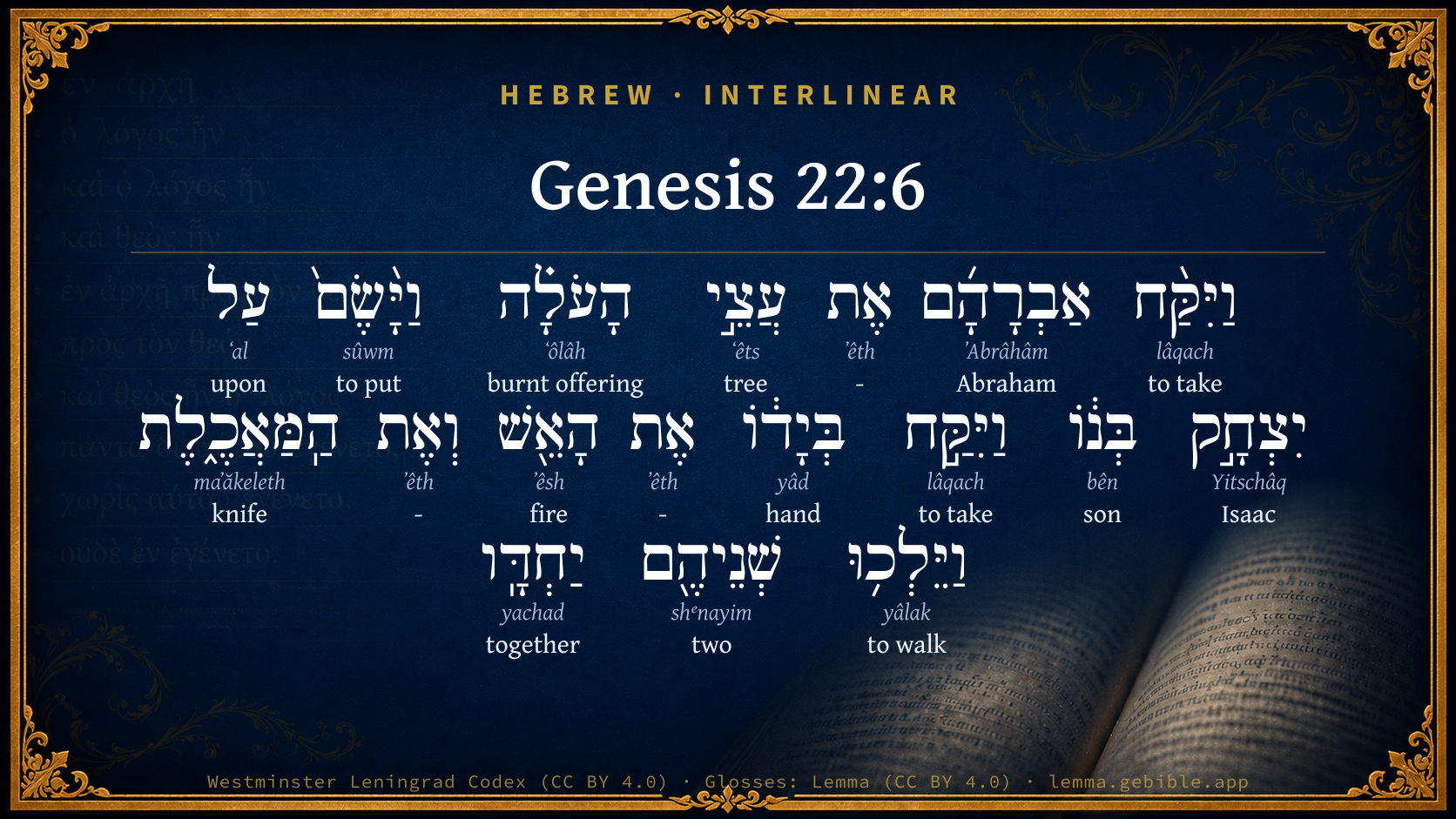
Genesis 22:6

Hebrew (Westminster Leningrad Codex) Genesis 22:6 appears in the Hebrew Old Testament. The text above is from the Westminster Leningrad Codex. Each word links to its Strong’s number, a concise gloss, and parsing drawn from the Open Scriptures Hebrew Bible morphology. Click any word for its full Brown-Driver-Briggs (BDB) entry.
Download image
Cite this verse

Genesis 22:6 (World English Bible). Public Domain. Lemma interlinear Bible study tool, https://lemma.gebible.app/v/genesis/22/6.

Show BibTeX & RIS
BibTeX
RIS
English Translation
Abraham took the wood of the burnt offering and laid it on Isaac his son. He took in his hand the fire and the knife. They both went together.
World English Bible · Public Domain
Highlights
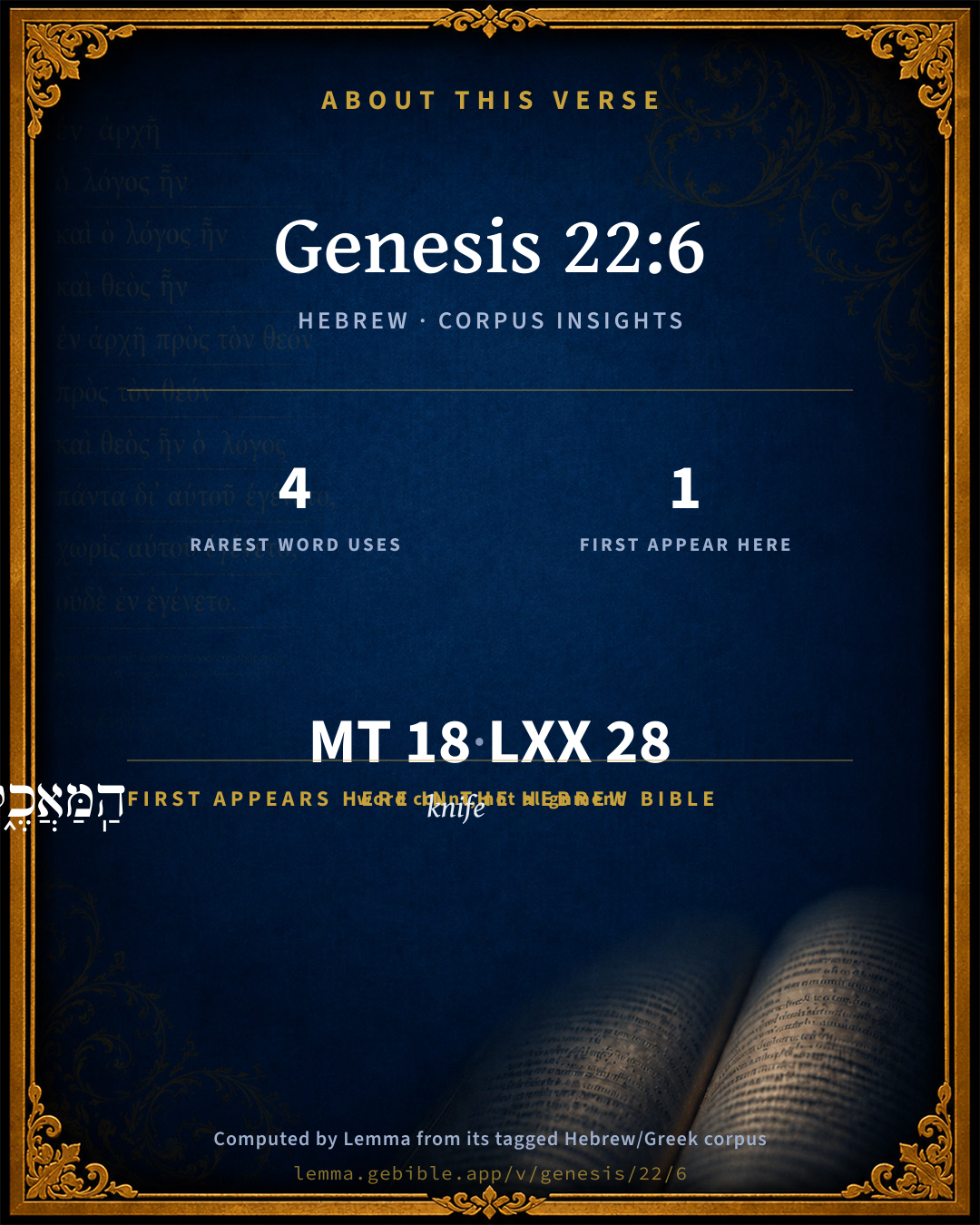
  • 1 first appearance in the Hebrew Bible
Full analysis ↓
Download a study sheet

One document with this verse’s original text, its word-by-word gloss line, the meaning frame, cross-references with their text, attributed commentary, and full source and license credits — printable, and it pastes into notes with its structure intact.

This verse Autodidact and up

Study sheet (.html) Plain text (.txt)

A passage Seminary Student

Up to 50 verses in one chapter. A passage sheet keeps up to 6 commentary sources and 12 cross-references per verse, in the order this page ranks them, and says so on the sheet whenever that leaves anything out. Ask for a single verse and you get the Autodidact verse sheet above.

Everything on this page stays free to read, with no account — the sheet is a download of what is already on screen, not access to it.

Want to remove ads? Support Godless Engineer
Compare translations 3

The same verse in 3 English versions, stacked beneath the original-language interlinear above. Click any original word for its lexicon entry.

Each is an independent rendering of the whole verse — the interlinear is not word-aligned to these translations.

Highlighted words mark where these versions differ — a whole-verse word diff, not a word-by-word alignment.

  • World English Bible Public Domain
    Abraham took the wood of the burnt offering and laid it on Isaac his son. He took in his hand the fire and the knife. They both went together.
  • King James Version Public Domain
    And Abraham took the wood of the burnt offering, and laid it upon Isaac his son; and he took the fire in his hand, and a knife; and they went both of them together.
  • unfoldingWord Literal Text CC BY-SA 4.0
    Then Abraham took the wood for the burnt offering and put on Isaac his son, and he took in his hand the fire and the knife. Then the two of them went on together,

unfoldingWord Literal Text — © unfoldingWord, licensed CC BY-SA 4.0. Word-aligned USFM3 via Door43 (git.door43.org/unfoldingWord/en_ult).

Versions to compare (up to 4)

3 of 4 selected

Show all 18 translations

Every available English version of this verse, each an independent rendering of the whole verse.

  • World English Bible Public Domain
    Abraham took the wood of the burnt offering and laid it on Isaac his son. He took in his hand the fire and the knife. They both went together.
  • Berean Standard Bible Public Domain
    Abraham took the wood for the burnt offering and placed it on his son Isaac. He himself carried the fire and the sacrificial knife, and the two of them walked on together.
  • Majority Standard Bible Public Domain
    Abraham took the wood for the burnt offering and placed it on his son Isaac. He himself carried the fire and the sacrificial knife, and the two of them walked on together.
  • King James Version Public Domain
    And Abraham took the wood of the burnt offering, and laid it upon Isaac his son; and he took the fire in his hand, and a knife; and they went both of them together.
  • American Standard Version (1901) Public Domain
    And Abraham took the wood of the burnt-offering, and laid it upon Isaac his son. And he took in his hand the fire and the knife. And they went both of them together.
  • Revised Version (1885) Public Domain
    And Abraham took the wood of the burnt offering, and laid it upon Isaac his son; and he took in his hand the fire and the knife; and they went both of them together.
  • Geneva Bible (1599) Public Domain
    Then Abraham tooke the wood of the burnt offering, and layed it vpon Izhak his sonne, and he tooke the fire in his hand, and the knife: and they went both together.
  • Douay-Rheims (1899) Public Domain
    And he took the wood for the holocaust, and laid it upon Isaac his son: and he himself carried in his hands fire and a sword. And as they two went on together,
  • Young's Literal Translation Public Domain
    And Abraham taketh the wood of the burnt-offering, and placeth on Isaac his son, and he taketh in his hand the fire, and the knife; and they go on both of them together.
  • Literal Standard Version CC BY-SA 4.0
    And Abraham takes the wood of the burnt-offering, and places on his son Isaac, and he takes in his hand the fire, and the knife; and they go on both of them together.
  • Unlocked Literal Bible CC BY-SA 4.0
    Then Abraham took the wood for the burnt offering and put it on Isaac his son. He took in his own hand the fire and the knife; and they went both of them together.
  • unfoldingWord Literal Text CC BY-SA 4.0
    Then Abraham took the wood for the burnt offering and put on Isaac his son, and he took in his hand the fire and the knife. Then the two of them went on together,
  • Darby Bible Public Domain
    And Abraham took the wood of the burnt-offering, and laid it on Isaac his son; and he took the fire in his hand, and the knife, and they went both of them together.
  • World Messianic Bible Public Domain
    Abraham took the wood of the burnt offering and laid it on Isaac his son. He took in his hand the fire and the knife. They both went together.
  • Webster's Bible Public Domain
    And Abraham took the wood of the burnt-offering, and laid it upon Isaac his son; and he took the fire in his hand, and a knife: and they went both of them together.
  • Free Bible Version CC BY-SA 4.0
    Abraham had Isaac carry the wood for the burnt offering, while he carried the fire and the knife, and they walked up together.
  • Bible in Basic English Public Domain
    And Abraham put the wood for the burned offering on his son's back, and he himself took the fire and the knife in his hand, and the two of them went on together.
  • JPS Tanakh (1917) Public Domain
    And Abraham took the wood of the burnt-offering, and laid it upon Isaac his son; and he took in his hand the fire and the knife; and they went both of them together.

Literal Standard Version (2020), Covenant Press — licensed CC BY-SA 4.0. Text via the HelloAO Bible API (eBible.org). Unlocked Literal Bible (unfoldingWord) — licensed CC BY-SA 4.0. Text via the HelloAO Bible API (eBible.org). unfoldingWord Literal Text — © unfoldingWord, licensed CC BY-SA 4.0. Word-aligned USFM3 via Door43 (git.door43.org/unfoldingWord/en_ult). Free Bible Version, Dr. Jonathan Gallagher — licensed CC BY-SA 4.0. Text via the HelloAO Bible API (eBible.org).

Word by word

More ways to search: Search by grammar → Find every occurrence → Compare this word →

Practice this passage: Drill this verse → Learn its vocabulary →

הַֽמַּאֲכֶ֑לֶת
maʼăkeleth
H3979
“the · knife”
Particle, Definite Article + Noun, Common, Feminine, Singular, Absolute
Part of Speech
Particle + Noun
Type
Common
Gender
Feminine
Number
Singular
State
Absolute
Full BDB Definition

Origin: from H398

TWOT: 85e

knife
  1. וַיִּקַּ֨ח lâqach H3947 “and · to take” Conjunction + Verb, Qal, Sequential Imperfect, 3rd Person, Masculine, Singular
  2. אַבְרָהָ֜ם ʼAbrâhâm H85 “Abraham” Noun, Proper
  3. אֶת ʼêth H853 “-” Particle, Direct Object
  4. עֲצֵ֣י ʻêts H6086 “trees of” Noun, Common, Masculine, Plural, Construct
  5. הָעֹלָ֗ה ʻôlâh H5930 “the · burnt offering” Particle, Definite Article + Noun, Common, Feminine, Singular, Absolute
  6. וַיָּ֨שֶׂם֙ sûwm H7760 “and · to put” Conjunction + Verb, Qal, Sequential Imperfect, 3rd Person, Masculine, Singular
  7. עַל ʻal H5921 “upon” Preposition
  8. יִצְחָ֣ק Yitschâq H3327 “Isaac” Noun, Proper
  9. בְּנ֔וֹ bên H1121 “son · his” Noun, Common, Masculine, Singular, Construct + Suffix, Personal, 3rd Person, Masculine, Singular
  10. וַיִּקַּ֣ח lâqach H3947 “and · to take” Conjunction + Verb, Qal, Sequential Imperfect, 3rd Person, Masculine, Singular
  11. בְּיָד֔וֹ yâd H3027 “in/at · hand · his” Preposition + Noun, Common, Both, Singular, Construct + Suffix, Personal, 3rd Person, Masculine, Singular
  12. אֶת ʼêth H853 “-” Particle, Direct Object
  13. הָאֵ֖שׁ ʼêsh H784 “the · fire” Particle, Definite Article + Noun, Common, Both, Singular, Absolute
  14. וְאֶת ʼêth H853 “and · -” Conjunction + Particle, Direct Object
  15. וַיֵּלְכ֥וּ yâlak H3212 “and · to walk” Conjunction + Verb, Qal, Sequential Imperfect, 3rd Person, Masculine, Plural
  16. שְׁנֵיהֶ֖ם shᵉnayim H8147 “two · their” Adjective, Cardinal number, Masculine, Dual, Construct + Suffix, Personal, 3rd Person, Masculine, Plural
  17. יַחְדָּֽו yachad H3162 “together” Adverb

About this verse

These counts appear in no published source. They are computed here, from the morphology-tagged text and Lemma’s own curated glosses. What Lemma adds →

18
words
15
distinct lemmas
Pentateuch
section

Notable vocabulary

The rarest word here is הַֽמַּאֲכֶ֑לֶת knife H3979 — appearing just 4 times in the whole Hebrew Bible.

First appearance in Scripture

This word makes its first canonical appearance in the Hebrew Bible here:

  • הַֽמַּאֲכֶ֑לֶת knife H3979

Shared distinctive vocabulary

הַֽמַּאֲכֶ֑לֶת knife H3979 occurs in 4 verses of the Hebrew Bible. Also found in:

Grammatical profile

  • 4 verbs
  • 8 nouns
  • 1 adjective
  • 1 preposition
  • 1 adverb
  • 3 particles

Verb forms

  • וַיִּקַּ֨ח Qal · Sequential Imperfect
  • וַיָּ֨שֶׂם֙ Qal · Sequential Imperfect
  • וַיִּקַּ֣ח Qal · Sequential Imperfect
  • וַיֵּלְכ֥וּ Qal · Sequential Imperfect

Repetition

A word recurs within this verse — often emphatic in Hebrew:

  • וַיִּקַּ֨ח to take H3947 ×2

Hebrew & Septuagint length

In English translation the verse runs 29 words from the Hebrew and 34 from the Septuagint (LXX English) — closely comparable.

A rough comparison of the two English renderings, which tokenize alike — not a word-level alignment.

Word counts can differ between the Hebrew and the Greek without any difference in meaning — e.g. the Hebrew direct-object marker אֵת has no separate Greek word, and Greek often adds the article ὁ.

In the original languages it is 18 Hebrew tokens and 28 Greek tokens — but the two are counted differently (Hebrew bundles its prefixes and suffixes into one token; the Greek is in lemma form), so that isn’t a like-for-like length.

Cross-references

4

Topical passages linked to Genesis 22:6 in the Treasury of Scripture Knowledge — connected by theme and wording, ordered by reader-vote popularity; previews shown in the World English Bible.

  • John 19:17 He went out, bearing his cross, to the place called "The Place of a Skull," which is called in Hebrew, "Golgotha,"
  • 1 Peter 2:24 who his own self bore our sins in his body on the tree, that we, having died to sins, might live to righteousness; by whose stripes you were healed.
  • Isaiah 53:6 All we like sheep have gone astray; everyone has turned to his own way; and Yahweh has laid on him the iniquity of us all.
  • Matthew 8:17 that it might be fulfilled which was spoken through Isaiah the prophet, saying: "He took our infirmities, and bore our diseases."

Cross-references courtesy of OpenBible.info (CC BY 4.0).

Hebrew and Greek witnesses Masoretic Hebrew ↔ Greek Septuagint

The same verse in the two great witnesses to the Old Testament, shown verse-for-verse.

These are two independent witnesses, not word-aligned to each other, and the Septuagint is shown in lemma (dictionary) form.

Hebrew Genesis 22:6 Masoretic · Westminster Leningrad Codex

וַיִּקַּ֨ח אַבְרָהָ֜ם אֶת עֲצֵ֣י הָעֹלָ֗ה וַיָּ֨שֶׂם֙ עַל יִצְחָ֣ק בְּנ֔וֹ וַיִּקַּ֣ח בְּיָד֔וֹ אֶת הָאֵ֖שׁ וְאֶת הַֽמַּאֲכֶ֑לֶת וַיֵּלְכ֥וּ שְׁנֵיהֶ֖ם יַחְדָּֽו

Abraham took the wood of the burnt offering and laid it on Isaac his son. He took in his hand the fire and the knife. They both went together.

World English Bible · Public Domain

Greek LXX Genesis 22:6 Septuagint · lemma form

λαμβάνω δέ αβρααμ ὁ ξύλον ὁ ὁλοκάρπωσις καί ἐπιτίθημι ισαακ ὁ υἱός αὐτός λαμβάνω δέ καί ὁ πῦρ μετά χείρ καί ὁ μάχαιρα καί πορεύομαι ὁ δύο ἅμα

And Abraam took the wood of the whole burnt offering, and laid it on Isaac his son, and he took into his hands both the fire and the knife, and the two went together.

LXX2012 (modern English Septuagint) · Public Domain

Hebrew: Westminster Leningrad Codex (CC BY 4.0). Greek: Septuagint (public domain); English from LXX2012 (modern English Septuagint) (Public Domain). How the Septuagint differs from the Hebrew →

Targum (Aramaic paraphrase)

2

The Targum is the ancient Jewish Aramaic paraphrase of the Hebrew Scriptures — an interpretive translation, not the Hebrew text itself. Onkelos (literal) and Pseudo-Jonathan (expansive) render the Torah, and Jonathan the Prophets. Coverage is partial: where no permissively-licensed English translation exists for a verse, only the Aramaic is shown. This is verse-level text, not a word-by-word alignment to the Hebrew.

  1. Targum Onkelos Torah (Genesis–Deuteronomy)
    וּנְסֵיב אַבְרָהָם יָת אָעֵי דַּעֲלָתָא וְשַׁוִּי עַל יִצְחָק בְּרֵהּ וּנְסֵיב בִּידֵהּ יָת אֶשָּׁתָא וְיָת סַכִּינָא וַאֲזָלוּ תַרְוֵיהוֹן כַּחֲדָא

    (no public-domain English translation for this verse)

    Targum Onkelos — Aramaic: “Onkelos Genesis” (public domain); “Onkelos Exodus” (public domain); “Onkelos Leviticus” (public domain); “Onkelos Numbers” (public domain); “Onkelos Deuteronomy” (public domain). English: “Sefaria Community Translation” (CC0 1.0 (public-domain dedication)); “J.W. Etheridge. The Targums of Onkelos and Jonathan Ben Uzziel on the Pentateuch. London: Longmans, Green, 1862” (public domain). Text via Sefaria.

  2. Targum Pseudo-Jonathan Torah (Genesis–Deuteronomy)
    וּנְסֵיב אַבְרָהָם יַת קִיסֵי דְעָלָתָא וְשַׁוִי עִילוֹ יִצְחָק בְּרֵיהּ וּנְסִיב בִּידֵיהּ יַת אֵישָׁתָא וְיַת סַכִּינָא וְאָזָלוּ תַּרְוֵויהוֹם כַּחֲדָא

    And Abraham took the wood of the offering and laid it upon Izhak his son, and in his hand he took the fire and the knife; and they went both of them together.

    Targum Pseudo-Jonathan — Aramaic: “Targum Jonathan on Genesis” (public domain); “Targum Jonathan on Exodus” (public domain); “Targum Jonathan on Leviticus” (public domain); “Targum Jonathan on Numbers” (public domain); “Targum Jonathan on Deuteronomy” (public domain). English: “The Targum of Jonathan ben Uzziel, trans. J. W. Etheridge, London, 1862” (public domain). Text via Sefaria.

Commentary

Notes on Genesis 22:6 from classic Christian and Jewish commentators (each source and its license shown beneath its notes). The classic Christian expositions comment on the surrounding passage and are grouped to its opening verse, so a note may address several verses; the Jewish commentaries on the Tanakh (Rashi and others) are per-verse, so they appear only where the commentator wrote on this verse.

Lemma curates 59 commentaries, every one of them public domain or Creative Commons licensed, each selected and text-cleaned for this edition rather than reprinted as found. About our sources →

Trapp's Complete Commentary

John Trapp

Gen 22:6 And Abraham took the wood of the burnt offering, and laid [it] upon Isaac his son; and he took the fire in his hand, and a knife; and they went both of them together.

Ver. 6. And laid it upon Isaac his son.] Who was herein a lively type of Christ, bearing the cross whereon he was offered up. Tω σωματι των χολαζομενων εχαστος εκφερει τον εαυτου σταυρον, , saith Plutarch, speaking of the Roman fashion of crucifying malefactors. And surely it was by a wonderful providence of God that the Jews brought our Saviour to Pilate to be put to death; since they hated nothing more than to confirm or countenance the Roman tyranny among them by any means. Hence Gamaliel gave counsel to dismiss the apostles. {Act 5:38} And hence the chief priests and rulers took it as so exceedingly heinous that Paul was taken out of their hands by the chief captain. {Act 23:10} But God had a hand in it, that this and other types and scriptures might be fulfilled, that foretold the very manner of his death on a tree. Let the Jews stumble now at the cross, and fall backward. Let the Gentiles jeer us, as Lucian {a} doth, for that we deny the multitude of their gods, and yet believe in a crucified God, {b} Let us desire to know nothing but Christ, and him crucified; and if ever we desire to be kings in heaven, - and every man must be aut Caesar, aut nullus , a king or a captive, - let us seek by the eye of faith to see the Sun of Righteousness in the west (as Strato’s servant taught him): let us look upon Christ hanging on the cross, dying on that altar, and we shall live for ever.

{a} Aνασκολοπισμενον ( horreo dicere) σοφιστην προσκυνουνθες - In Vita Peregr.

{b} Omnis homo aut est cum Christo regnaturus, aut cum diabolo crucianduv . - Aug. Justin, lib. 18.

John Trapp, A Commentary or Exposition upon All the Books of the Old and New Testament (1647–1656) — public domain. Text from a community e-Sword module.

Joseph Benson's Commentary

Gen 22:6. Isaac’s carrying the wood was a type of Christ, who carried his own cross, while Abraham, with a steady and undaunted resolution, carried the fatal knife and fire.

Joseph Benson's Commentary on the Old and New Testaments (1811–1818) — public domain. Text from a community e-Sword module.

Adam Clarke's Commentary

Verse 6. Took the wood - and laid it upon Isaac] Probably the mountain-top to which they were going was too difficult to be ascended by the ass; therefore either the father or the son must carry the wood, and it was most becoming in the latter.

Adam Clarke's Commentary on the Bible (1810–1826) — public domain. Text from a community e-Sword/MySword module.

The Cambridge Bible for Schools and Colleges

gen. ed. J. J. S. Perowne

6. laid it upon Isaac] Isaac carries the heavy weight of the wood; Abraham, the more dangerous burden of the fire (i.e. a brazier) and the knife.

The Cambridge Bible for Schools and Colleges (gen. ed. J. J. S. Perowne; Cambridge University Press, 1878–1918) — public domain. Text from a community e-Sword module.

John Gill's Exposition

And Abraham took the wood of the burnt offering,.... Which Josephus (a) says was laid upon the ass, and carried by that; and if so, he took it from thence: but it is probable it was carried by his two servants, since it was not more than Isaac himself afterwards carried, as in the next clause:

and laid it upon Isaac his son: who was a grown man, and able to carry it: in this also he was a type of Christ, on whom the wood of his cross was laid, and which he bore when he went to be crucified, Joh 19:17; and this wood may be also a figure of our sins laid on him by his Father, and which he bore in his body on the tree, Pe1 2:24; and which were like wood to fire, fuel for the wrath of God, which came down upon him for them:

and he took the fire in his hand, and a knife; a vessel in one hand, in which fire was to kindle the wood with, and a knife in the other hand to slay the sacrifice with; the one to slay his son with, and the other to burn him with; and to carry these for such purposes must be very trying. This is the first time we read in Scripture of fire for use, or of a knife. Some say the first inventor of fire was Prometheus, others Phoroneus (b), from whence he seems to have his name; but according to Sanchoniatho (c), the immediate posterity of Cain first invented it, whose names were light, fire, and flame; and these, he says, found out the way of generating fire, by rubbing pieces of wood against each other, and taught men the use of it. "Knife", in the Hebrew language, has its name from eating and consuming, as Ben Melech observes; some render it a "sword" (d), but wrongly, and which has led the painter into a mistake, to represent Abraham with a sword in his hand to slay his son:

and they went both of them together; from the place where they left the young men, to the place where the sacrifice was to be offered.

(a) Antiqu. l. 1. c. 13. sect. 2. (b) Pausan. Corinthiaca sive, l. 2. p. 119. (c) Apud Euseb. Evangel. Praepar. l. 1. c. 10. p. 34. (d) "gladium", V. L. Pagninus, Montanus, Calvin.

John Gill's Exposition of the Whole Bible (1746–1763) — public domain (CC PDM 1.0). Text via the HelloAO Bible API.

Matthew Poole's English Annotations

Isaac, though called a lad, Gen 22:5, was now a grown man, at least five and twenty years old, and therefore well able to bear that burden; and in this act he was an eminent type of Christ, who carried that wood upon which he was crucified.

Matthew Poole's English Annotations on the Holy Bible (1683–1685) — public domain. Text from a community e-Sword/MySword module.

Whedon's Commentary on the Bible

Daniel D. Whedon

6. The wood… upon Isaac — How does this suggest the only-begotten Son of God bearing his wooden cross to Calvary! Joh_19:17. Fire in his hand — Either a stick of wood that would long endure as a burning ember, or coals in a firepot.

Daniel D. Whedon (gen. ed.), Commentary on the Old and New Testaments (1874–1909) — public domain. Text from a community e-Sword module.

The Pulpit Commentary

And Abraham took the wood of the burnt offering, and laid it upon Isaac his son; instinctively the mind reverts to the cross-bearing of Abraham"s greater Son (Joh_19:17) and he took the fire in his hand, and a knife (to him terribly suggestive weapons); and they went both of them together. Doubtless in silence on Abraham"s part and wonder on Isaac"s, since as yet no declaration had been made of the true purpose of their journey.

The Pulpit Commentary (1880–1919), ed. H.D.M. Spence-Jones & Joseph S. Exell — public domain. Text from a community e-Sword module.

John Wesley's Explanatory Notes

Isaac's carrying the wood was a type of Christ, who carried his own cross, while Abraham, with a steady and undaunted resolution, carried the fatal knife and fire.

John Wesley, Explanatory Notes Upon the Whole Bible (1754–1765) — public domain. Text via the GEBible commentary corpus.

Rashi

Rabbi Shlomo Yitzchaki (Rashi)

המאכלת — means a knife. It is called מאכלת from אכל to eat, because it devours the meat, — just as you say, (Deuteronomy 32:42 “And my sword shall devour (תאכל) flesh”— or because it makes animal flesh fit for eating (מאכלת) (by killing the animal; because while the animal is living its flesh is unfit for eating). Another explanation: זאת נקראת This knife is called מאכלת (and the term is never used of an ordinary knife) because Israel still eats of the reward given for it (Genesis Rabbah 56:3).

וילכו שניהם יחדיו AND THEY WENT BOTH OF THEM TOGETHER — Abraham who was aware that he was going to slay his son walked along with the same willingness and joy as Isaac who had no idea of the matter.

Rashi on the Tanakh — English translations: “The Judaica Press complete Tanach with Rashi, translated by A. J. Rosenberg” (CC BY 4.0); “Pentateuch with Rashi's commentary by M. Rosenbaum and A.M. Silbermann, 1929-1934” (public domain); “The Metsudah Tanach series, Lakewood, N.J” (CC BY 4.0); and “The Book of Joshua, Metsudah Publications, 1997” (CC BY 4.0). Text via Sefaria.

Radak

Rabbi David Kimhi (Radak)

ויקח, he did not take the donkey along so that the lads should not think that they were going to a distant location. Also, there would not be anyone guarding the donkey at the time when he would be occupied with binding and slaughtering Yitzchok. Furthermore, he did not want the donkey to enter such sacred precincts.

Radak on the Tanakh — English translations: “Sefaria Community Translation” (CC0 1.0 (public-domain dedication)); “Eliyahu Munk, HaChut Hameshulash” (CC BY 4.0); “Rabbi Mike Feuer, Jerusalem Anthology” (CC BY 4.0); and “R. David Kimhi on the first book of Psalms, Translated by R.G. Finch, London, 1919” (public domain). Text via Sefaria.

Lesson kit

Teaching starters — assembled from the data on this page, not authored interpretation. Every prompt links to the verse data it draws on. Edit before teaching.

Genesis, in the Pentateuch, opens this verse with 18 words (15 distinct Hebrew lemmas). Its most distinctive word is maʼăkeleth (“knife”). A historical commentator’s framing appears above. Read the whole chapter for the surrounding context.

Discussion questions

  1. How does “knife” (maʼăkeleth) shape what this verse is saying?
  2. The word “knife” first appears here in Scripture. What is being introduced at this debut?
  3. Genesis 22:10 shares the word «knife» with this verse. How do the two illuminate each other?
  4. “to take” occurs 2× in this one verse. What is the effect of the repetition?
  5. These translations render this verse differently; the difference is in the English rendering, not the original. What questions does that raise?
  6. The verb «וַיִּקַּ֨ח» is Qal Sequential Imperfect. How does its form color the action?
  7. Reading how Trapp's Complete Commentary and Joseph Benson's Commentary read this verse, where do the two commentators agree and where do they part?

Things to notice

Reading settings

Reading text

Shown beneath each verse's original-language words.

Old Testament
Old Testament edition

Read the OT as the Masoretic Hebrew (MT) or the Greek Septuagint (LXX).

English shown for the Greek Septuagint (in the Hebrew ↔ Greek comparison).

Comparing translations? Open the Compare panel on any verse page to stack up to four side by side.