Job 20:26

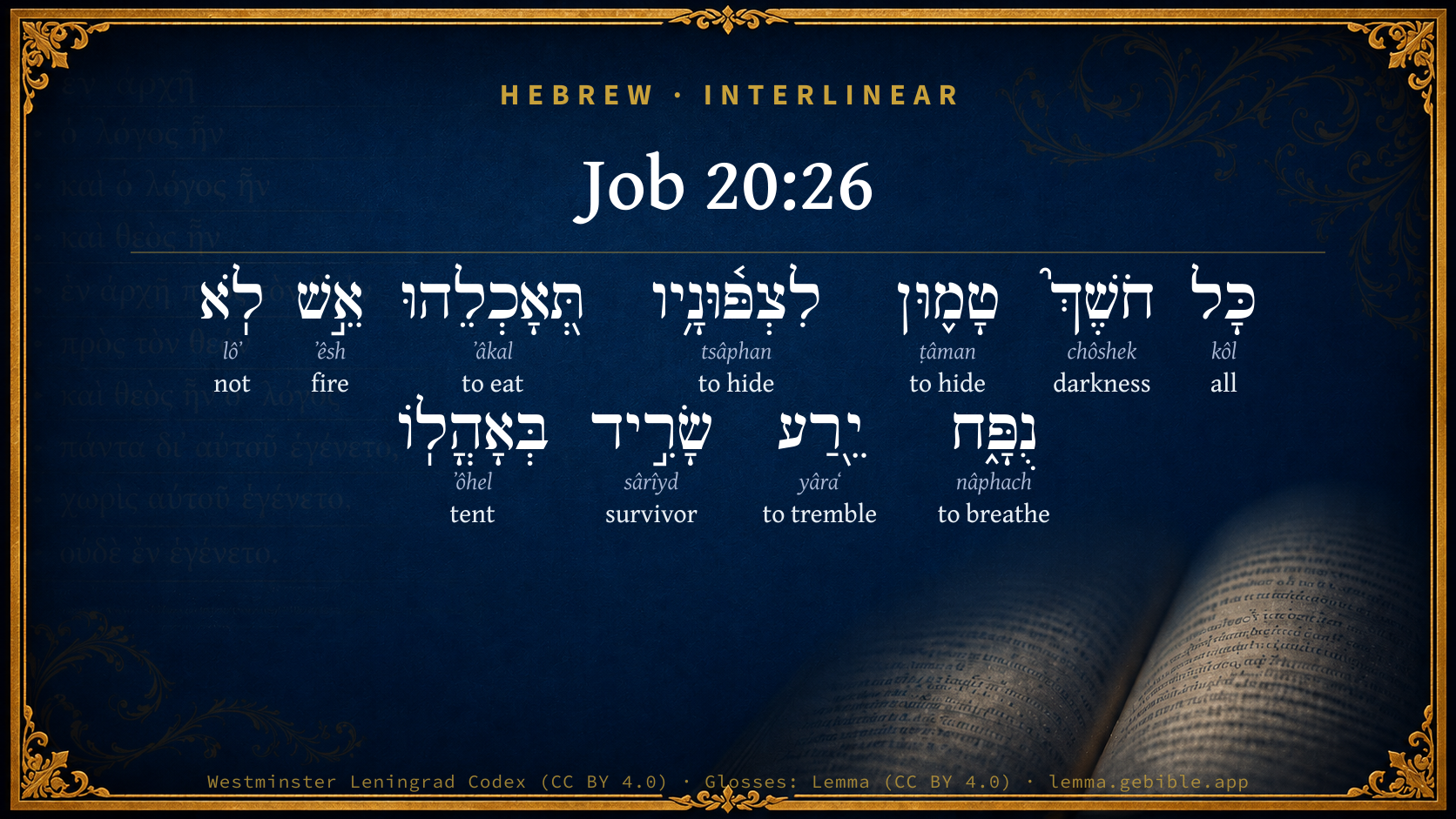
Hebrew (Westminster Leningrad Codex) Job 20:26 appears in the Hebrew Old Testament. The text above is from the Westminster Leningrad Codex. Each word links to its Strong’s number, a concise gloss, and parsing drawn from the Open Scriptures Hebrew Bible morphology. Click any word for its full Brown-Driver-Briggs (BDB) entry.
Download image
Cite this verse

Job 20:26 (World English Bible). Public Domain. Lemma interlinear Bible study tool, https://lemma.gebible.app/v/job/20/26.

Show BibTeX & RIS
BibTeX
RIS
English Translation
All darkness is laid up for his treasures. An unfanned fire shall devour him. It shall consume that which is left in his tent.
World English Bible · Public Domain
Download a study sheet

One document with this verse’s original text, its word-by-word gloss line, the meaning frame, cross-references with their text, attributed commentary, and full source and license credits — printable, and it pastes into notes with its structure intact.

This verse Autodidact and up

Study sheet (.html) Plain text (.txt)

A passage Seminary Student

Up to 50 verses in one chapter. A passage sheet keeps up to 6 commentary sources and 12 cross-references per verse, in the order this page ranks them, and says so on the sheet whenever that leaves anything out. Ask for a single verse and you get the Autodidact verse sheet above.

Everything on this page stays free to read, with no account — the sheet is a download of what is already on screen, not access to it.

Want to remove ads? Support Godless Engineer
Compare translations 3

The same verse in 3 English versions, stacked beneath the original-language interlinear above. Click any original word for its lexicon entry.

Each is an independent rendering of the whole verse — the interlinear is not word-aligned to these translations.

Highlighted words mark where these versions differ — a whole-verse word diff, not a word-by-word alignment.

  • World English Bible Public Domain
    All darkness is laid up for his treasures. An unfanned fire shall devour him. It shall consume that which is left in his tent.
  • King James Version Public Domain
    All darkness shall be hid in his secret places: a fire not blown shall consume him; it shall go ill with him that is left in his tabernacle.
  • unfoldingWord Literal Text CC BY-SA 4.0
    All darkness is hidden for his treasured; a fire not blown will devour him; it will consume the remnant in his tent.

unfoldingWord Literal Text — © unfoldingWord, licensed CC BY-SA 4.0. Word-aligned USFM3 via Door43 (git.door43.org/unfoldingWord/en_ult).

Versions to compare (up to 4)

3 of 4 selected

Show all 18 translations

Every available English version of this verse, each an independent rendering of the whole verse.

  • World English Bible Public Domain
    All darkness is laid up for his treasures. An unfanned fire shall devour him. It shall consume that which is left in his tent.
  • Berean Standard Bible Public Domain
    Total darkness is reserved for his treasures. A fire unfanned will consume him and devour what is left in his tent.
  • Majority Standard Bible Public Domain
    Total darkness is reserved for his treasures. A fire unfanned will consume him and devour what is left in his tent.
  • King James Version Public Domain
    All darkness shall be hid in his secret places: a fire not blown shall consume him; it shall go ill with him that is left in his tabernacle.
  • American Standard Version (1901) Public Domain
    All darkness is laid up for his treasures: A fire not blown `by man' shall devour him; It shall consume that which is left in his tent.
  • Revised Version (1885) Public Domain
    All darkness is laid up for his treasures: a fire not blown by man shall devour him; it shall consume that which is left in his tent.
  • Geneva Bible (1599) Public Domain
    All darkenes shalbe hid in his secret places: the fire that is not blowen, shall deuoure him, and that which remaineth in his tabernacle, shalbe destroyed.
  • Douay-Rheims (1899) Public Domain
    All darkness is hid in his secret places: a fire that is not kindled shall devour him, he shall be afflicted when left in his tabernacle.
  • Young's Literal Translation Public Domain
    All darkness is hid for his treasures, Consume him doth a fire not blown, Broken is the remnant in his tent.
  • Literal Standard Version CC BY-SA 4.0
    All darkness is hid for his treasures, || A fire not blown consumes him, || The remnant is broken in his tent.
  • Unlocked Literal Bible CC BY-SA 4.0
    Complete darkness is reserved for his treasures; a fire not fanned will devour him; it will consume what is left in his tent.
  • unfoldingWord Literal Text CC BY-SA 4.0
    All darkness is hidden for his treasured; a fire not blown will devour him; it will consume the remnant in his tent.
  • Darby Bible Public Domain
    All darkness is laid up for his treasures: a fire not blown shall devour him; it shall feed upon what is left in his tent.
  • World Messianic Bible Public Domain
    All darkness is laid up for his treasures. An unfanned fire will devour him. It will consume that which is left in his tent.
  • Webster's Bible Public Domain
    All darkness shall be hid in his secret places: a fire not blown shall consume him; it shall go ill with him that is left in his tabernacle.
  • Free Bible Version CC BY-SA 4.0
    All they value will disappear into the darkness; divine fire will destroy them; all they have left will go up in smoke.
  • Bible in Basic English Public Domain
    All his wealth is stored up for the dark: a fire not made by man sends destruction on him, and on everything in his tent.
  • JPS Tanakh (1917) Public Domain
    All darkness is laid up for his treasures; a fire not blown by man shall consume him; it shall go ill with him that is left in his tent.

Literal Standard Version (2020), Covenant Press — licensed CC BY-SA 4.0. Text via the HelloAO Bible API (eBible.org). Unlocked Literal Bible (unfoldingWord) — licensed CC BY-SA 4.0. Text via the HelloAO Bible API (eBible.org). unfoldingWord Literal Text — © unfoldingWord, licensed CC BY-SA 4.0. Word-aligned USFM3 via Door43 (git.door43.org/unfoldingWord/en_ult). Free Bible Version, Dr. Jonathan Gallagher — licensed CC BY-SA 4.0. Text via the HelloAO Bible API (eBible.org).

Word by word

More ways to search: Search by grammar → Find every occurrence → Compare this word →

Practice this passage: Drill this verse → Learn its vocabulary →

יֵ֖רַע
yâraʻ
H3415
“to tremble”
Verb, Qal, Imperfect, 3rd Person, Masculine, Singular
Part of Speech
Verb
Stem
Qal
Form
Imperfect
Person
3rd Person
Gender
Masculine
Number
Singular
Full BDB Definition

Origin: a primitive root

TWOT: 917

(Qal) to tremble, quiver
  1. כָּל kôl H3605 “all of” Noun, Common, Masculine, Singular, Construct
  2. חֹשֶׁךְ֮ chôshek H2822 “darkness” Noun, Common, Masculine, Singular, Absolute
  3. טָמ֪וּן ṭâman H2934 “hidden” Verb, Qal, Participle Passive, Masculine, Singular, Absolute
  4. לִצְפּ֫וּנָ֥יו tsâphan H6845 “to/for · hidden · him” Preposition + Verb, Qal, Participle Passive, Masculine, Plural, Construct + Suffix, Personal, 3rd Person, Masculine, Singular
  5. תְּ֭אָכְלֵהוּ ʼâkal H398 “to eat · him” Verb, Qal, Imperfect, 3rd Person, Feminine, Singular + Suffix, Personal, 3rd Person, Masculine, Singular
  6. אֵ֣שׁ ʼêsh H784 “fire” Noun, Common, Both, Singular, Absolute
  7. לֹֽא lôʼ H3808 “not” Particle, Negative
  8. נֻפָּ֑ח nâphach H5301 “to breathe” Verb, Pual, Perfect, 3rd Person, Masculine, Singular
  9. שָׂרִ֣יד sârîyd H8300 “survivor” Noun, Common, Masculine, Singular, Absolute
  10. בְּאָהֳלֽוֹ ʼôhel H168 “in/at · tent · his” Preposition + Noun, Common, Masculine, Singular, Construct + Suffix, Personal, 3rd Person, Masculine, Singular

About this verse

These counts appear in no published source. They are computed here, from the morphology-tagged text and Lemma’s own curated glosses. What Lemma adds →

11
words
11
distinct lemmas
Wisdom
section

Notable vocabulary

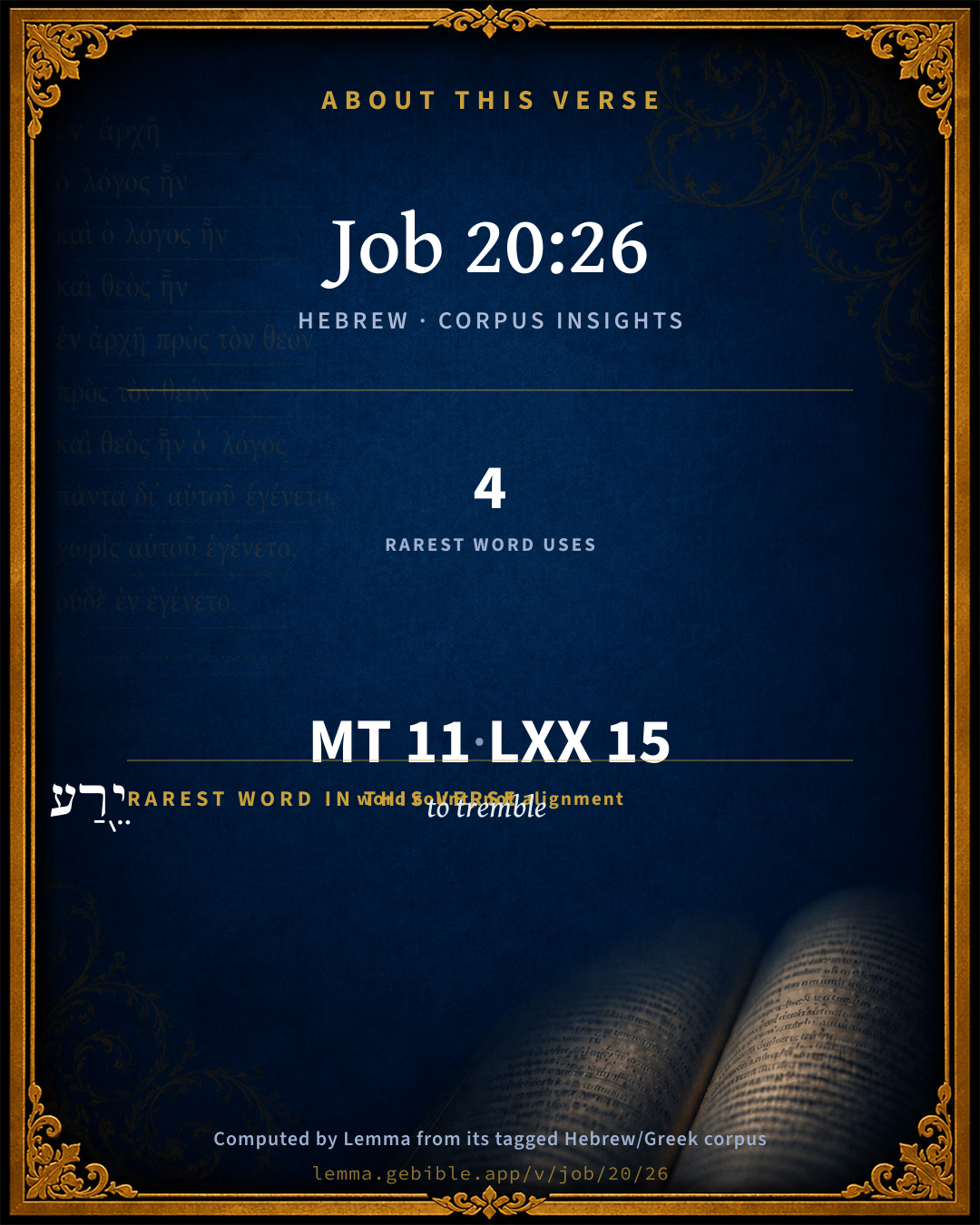
The rarest word here is יֵ֖רַע to tremble H3415 — appearing just 4 times in the whole Hebrew Bible.

Shared distinctive vocabulary

יֵ֖רַע to tremble H3415 occurs in 4 verses of the Hebrew Bible. Also found in:

Grammatical profile

  • 5 verbs
  • 5 nouns
  • 1 particle

Verb forms

  • טָמ֪וּן Qal · Participle Passive
  • לִצְפּ֫וּנָ֥יו Qal · Participle Passive
  • תְּ֭אָכְלֵהוּ Qal · Imperfect
  • נֻפָּ֑ח Pual · Perfect
  • יֵ֖רַע Qal · Imperfect

Hebrew & Septuagint length

In English translation the verse runs 24 words from the Hebrew and 23 from the Septuagint (LXX English) — closely comparable.

A rough comparison of the two English renderings, which tokenize alike — not a word-level alignment.

Word counts can differ between the Hebrew and the Greek without any difference in meaning — e.g. the Hebrew direct-object marker אֵת has no separate Greek word, and Greek often adds the article ὁ.

In the original languages it is 11 Hebrew tokens and 15 Greek tokens — but the two are counted differently (Hebrew bundles its prefixes and suffixes into one token; the Greek is in lemma form), so that isn’t a like-for-like length.

Cross-references

11

Topical passages linked to Job 20:26 in the Treasury of Scripture Knowledge — connected by theme and wording, ordered by reader-vote popularity; previews shown in the World English Bible.

  • Psalms 21:9 You will make them as a fiery furnace in the time of your anger. Yahweh will swallow them up in his wrath. The fire shall devour them.
  • Psalms 120:4 Sharp arrows of the mighty, With coals of juniper.
  • Job 18:5–6 "Yes, the light of the wicked shall be put out, The spark of his fire shall not shine.
  • Job 18:18–19 He shall be driven from light into darkness, And chased out of the world.
  • Psalms 109:9–15 Let his children be fatherless, And his wife a widow.
  • Isaiah 8:22 and they shall look to the earth, and see, distress and darkness, the gloom of anguish; and into thick darkness [they shall be] driven away.
  • Isaiah 14:20–22 You shall not be joined with them in burial, because you have destroyed your land, you have killed your people; the seed of evil-doers shall not be named forever.
  • Isaiah 30:33 For a Topheth is prepared of old; yes, for the king it is made ready; he has made it deep and large; the pile of it is fire and much wood; the breath of Yahweh, like a stream of sulfur, does kindle it.
  • Matthew 3:12 His winnowing fork is in his hand, and he will thoroughly cleanse his threshing floor. He will gather his wheat into the barn, but the chaff he will burn up with unquenchable fire."
  • Matthew 8:12 but the children of the Kingdom will be thrown out into the outer darkness. There will be weeping and the gnashing of teeth."
  • Jude 1:13 wild waves of the sea, foaming out their own shame; wandering stars, for whom the blackness of darkness has been reserved forever.

Cross-references courtesy of OpenBible.info (CC BY 4.0).

Hebrew and Greek witnesses Masoretic Hebrew ↔ Greek Septuagint

The same verse in the two great witnesses to the Old Testament, shown verse-for-verse.

These are two independent witnesses, not word-aligned to each other, and the Septuagint is shown in lemma (dictionary) form.

Hebrew Job 20:26 Masoretic · Westminster Leningrad Codex

כָּל חֹשֶׁךְ֮ טָמ֪וּן לִצְפּ֫וּנָ֥יו תְּ֭אָכְלֵהוּ אֵ֣שׁ לֹֽא נֻפָּ֑ח יֵ֖רַע שָׂרִ֣יד בְּאָהֳלֽוֹ

All darkness is laid up for his treasures. An unfanned fire shall devour him. It shall consume that which is left in his tent.

World English Bible · Public Domain

Greek LXX Job 20:26 Septuagint · lemma form

πᾶς δέ σκότος αὐτός ὑπομένω καταἐσθίω αὐτός πῦρ ἄκαυστος κακόω δέ αὐτός ἐπήλυτος ὁ οἶκος

And let all darkness wait for him: a fire that burns not out shall consume him; and let a stranger plague his house.

LXX2012 (modern English Septuagint) · Public Domain

On this verse, Jamieson, Fausset & Brown discusses the Septuagint’s reading. Read the note in Commentary ↓

Hebrew: Westminster Leningrad Codex (CC BY 4.0). Greek: Septuagint (public domain); English from LXX2012 (modern English Septuagint) (Public Domain). How the Septuagint differs from the Hebrew →

Commentary

Notes on Job 20:26 from classic Christian and Jewish commentators (each source and its license shown beneath its notes). The classic Christian expositions comment on the surrounding passage and are grouped to its opening verse, so a note may address several verses; the Jewish commentaries on the Tanakh (Rashi and others) are per-verse, so they appear only where the commentator wrote on this verse.

Lemma curates 59 commentaries, every one of them public domain or Creative Commons licensed, each selected and text-cleaned for this edition rather than reprinted as found. About our sources →

Trapp's Complete Commentary

John Trapp

Job 20:26 All darkness [shall be] hid in his secret places: a fire not blown shall consume him; it shall go ill with him that is left in his tabernacle.

Ver. 26. All darkness shall be hid in his secret places] That is, saith Diodati, wheresoever he shall think to find a place of safeguard there shall he meet with some horrible mischance. Men that are proscribed, and sought for to death, usually hide themselves, as various Jews did in privies at the last destruction of Jerusalem, and were thence drawn out to the slaughter. The duke of Buckingham, in Richard III’s time, was betrayed by his servant Bannister. Appian telleth of a Roman hid by his wife, and then exposed by his wife to the murderer, to whom she soon after also was married (De Bell. Civ. Rom.). Others render and sense the words thus, The wicked shall come into darkness, propter abscondita, for his secret sins. And others thus, All darkness is laid up for his hid treasures; that is, God or men have taken order that he shall lose his riches as well as his life, though he hide them never so secretly.

A fire not blown shall consume him] i.e. say some, calamities whose causes shall be unknown, and shall proceed immediately from God. See Isa 30:33. Many of the Greeks interpret this text of hell, with its unquenchable fire, Mat 3:12, which being created by God, and kindled by his breath, that is, by his word, it burneth everlastingly. Albeit God many times punisheth wicked men here with fire from heaven, as he did Sodom, Nadab and Abihu, those captains of fifties with their companies, 2Ki 1:9-12 Tremellius rendereth it thus, A fire consumeth him, non accensum flatis, I say him, not kindled by blowing, but burning of his own accord, as stubble fully dried, or hurds, or sear wood, Ut stipulae aut stupae. Ut cremium aut arefactum lignum. See Nah 1:10. {See Trapp on "Nah 1:10"}

It shall go ill with him that is left] His posterity shall never prosper, but be rooted out. Eliphaz and Bildad had said the same thing; and all to pay poor Job, whose family was now ruined. It shall surely go ill with him, or, He shall be wringed, saith Broughton; alluding to the likeness of the sound as well as the sense of the Hebrew word.

John Trapp, A Commentary or Exposition upon All the Books of the Old and New Testament (1647–1656) — public domain. Text from a community e-Sword module.

Joseph Benson's Commentary

Job 20:26. All darkness — All sorts of miseries, of soul, and body, and estate; shall be hid — Or laid up by God for him. They are reserved and treasured up for him, and kept as in a sure place, and shall infallibly overtake him: in his secret places — In those places where he confidently hoped to hide and secure himself from all evils and enemies; yet even there God shall find him out. A fire not blown — By man, but kindled by God himself; shall consume or destroy him — He thinks, by his might and violence, to secure himself from men; but God, by his own immediate hand, or in some unknown and unexpected manner, will find him out. It may be understood of the fire of hell; see Isa 30:33. It shall go ill with him that is left in his tabernacle — With his family, or posterity, who shall inherit his curse, as well as his estate. Heath translates this verse, All manner of calamity is laid up in store for him: an unquenchable fire shall consume him: it shall devour all that remaineth in his stead.

Joseph Benson's Commentary on the Old and New Testaments (1811–1818) — public domain. Text from a community e-Sword module.

Tyndale Open Study Notes

Tyndale Open Resources

20:26 Images such as deepest darkness and wildfire are often associated with God’s presence (Deut 4:11; 5:22-23; Heb 12:18) and especially with his judgment (Exod 9:23-24; 10:21-29).

Tyndale Open Study Notes — © Tyndale Open Resources, licensed CC BY-SA 4.0. Text via the HelloAO Bible API.

Geneva Bible (1599)

Geneva Bible translators

That is, fire from heaven, or the fire of God’s wrath.

All fear and sorrow shall light upon him, when he thinketh to escape.

Geneva Bible (1599) marginal notes — public domain. Text via Bolls.life.

Jamieson, Fausset & Brown

Robert Jamieson, A. R. Fausset & David Brown

All darkness--that is, every calamity that befalls the wicked shall be hid (in store for him) in His (God's) secret places, or treasures (Jde 1:13; Deu 32:34).

not blown--not kindled by man's hands, but by God's (Isa 30:33; the Septuagint in the Alexandrian Manuscript reads "unquenchable fire," Mat 3:12). Tact is shown by the friends in not expressly mentioning, but alluding under color of general cases, to Job's calamities; here (Job 1:16) UMBREIT explains it, wickedness, is a "self-igniting fire"; in it lie the principles of destruction.

ill . . . tabernacle--Every trace of the sinner must be obliterated (Job 18:15).

Jamieson, Fausset & Brown — Commentary Critical and Explanatory on the Whole Bible (1871) — public domain (CC PDM 1.0). Text via the HelloAO Bible API.

Adam Clarke's Commentary

Verse 26. A fire not blown shall consume him] As Zophar is here showing that the wicked cannot escape from the Divine judgments; so he points out the different instruments which God employs for their destruction. The wrath of God - any secret or supernatural curse. The iron weapon - the spear or such like. The bow, and its swift-flying arrow. Darkness - deep horror and perplexity. A fire not blown - a supernatural fire; lightning: such as fell on Korah, and his company, to whose destruction there is probably here an allusion: hence the words, It shall go ill with him who is left in his tabernacle. "And the Lord spake unto Moses and Aaron, Separate yourselves from among this congregation, that I may consume them in a moment. Get ye up from about the tabernacle of Korah, Dathan, and Abiram. Depart from the tents of these wicked men. There came out a fire from the Lord and consumed the two hundred and fifty men that offered incense;" Nu 16:20, &c.

Adam Clarke's Commentary on the Bible (1810–1826) — public domain. Text from a community e-Sword/MySword module.

Ellicott's Commentary for English Readers

(26) All darkness shall be hid in his secret places.—Rather, All darkness, every kind of disaster, is laid up for his secret treasures.

A fire not blown.—By human hands, &c.

A Bible Commentary for English Readers, edited by Charles John Ellicott (1878–1897) — public domain. Text from a community e-Sword module.

The Cambridge Bible for Schools and Colleges

gen. ed. J. J. S. Perowne

26. All darkness is laid up for his treasures;

A fire not blown shall consume him,

It shall devour him that is left in his tent.

“Darkness” is a figure for calamity; cf. ch. Job_15:22-23. “Laid up,” i. e. reserved, destined, for. “Him that is left” may also mean “that which is left,” Job_20:21. A fire “not blown” by mortal breath or man’s mouth, but the fire of God, consumes him; or, it may be a fire which kindles itself,—an allusion to the self-avenging nature of sin; cf. ch. Job_15:34.

The Cambridge Bible for Schools and Colleges (gen. ed. J. J. S. Perowne; Cambridge University Press, 1878–1918) — public domain. Text from a community e-Sword module.

John Gill's Exposition

All darkness shall be hid in his secret places,.... In such places of secrecy, where he may promise himself safety, he shall find more calamities of all sorts; or every kind of judgments shall find him out, and come upon him, sometimes signified by darkness, see Isa 8:22; or utter darkness, the blackness of darkness; everlasting wrath, ruin, and destruction, are laid up and reserved in God's secret places for him, and lie hid among his treasures of vengeance, which he in due time will bring forth from thence, and punish the guilty sinner with, Jde 1:13; or all this shall be because of secret sins, as Ben Gersom interprets it; and so Mr. Broughton renders the words, "for his store"; that is, for the store of his sins, as he explains it, which, however privately and secretly committed, shall be brought into judgment; and there the hidden things of darkness will be brought to light, and sentence pass upon men for them:

a fire not blown shall consume him; not blown by man, but by God himself; which some understand of thunder and lightning, such as fell on Job's sheep and servants, and consumed them, and which may be glanced at; and others of some fiery distemper, a burning fever, hot ulcers, carbuncles, &c. such as were at this time on Job's body; but the Targum, better, of the fire of hell; and so many of the Jewish commentators (g), as well as Christian; the Septuagint version renders it, "unquenchable fire"; and so Mr. Broughton; and such the fire of hell is said to be, Mat 3:12, &c. and which is a fire kindled by the breath of the Lord, like a stream of brimstone, Isa 30:33;

it shall go ill with him that is left in his tabernacle; not only it shall go ill with the wicked man himself, but with those he leaves behind him, that dwell in the house he formerly lived in, with his posterity; God sometimes punishing the iniquities of the fathers upon the children.

(g) Jarchi, Sephorno, and others.

John Gill's Exposition of the Whole Bible (1746–1763) — public domain (CC PDM 1.0). Text via the HelloAO Bible API.

Albert Barnes' Notes on the Bible

All darkness shall be hid in his secret places - The word “darkness” here, as is common, means evidently calamity. The phrase “is hid,” means is treasured up for him. The phrase “in his secret places,” may mean “for his treasures,” or instead of the great treasures which he had laid up for himself. The Apostle Paul has a similar expression, in which, perhaps, he makes an allusion to this place. Rom 2:5, “but, after thy hardness and impenitent heart, treasurest up unto thyself wrath against the day of wrath.” Treasures formerly were laid up in secret places, or places of darkness, that were regarded as inaccessible; see the notes at Isa 45:3.

A fire not blown - A fire unkindled. Probably the meaning is, a fire that man has not kindled, or that is of heavenly origin. The language is such as would convey the idea of being consumed by lightning, and probably Zophar intended to refer to such calamities as had come upon the family of Job, Job 1:16. There is much “tact” in this speech of Zophar, and in the discourses of his friends on this point. They never, I believe, refer expressly to the calamities that had come upon Job and his family. They never in so many words say, that those calamities were proof of the wrath of heaven. But they go on to mention a great many similar “cases” in the abstract; to prove that the wicked would be destroyed in that manner; that when such calamities came upon people, it was proof that they were wicked, and they leave Job himself to make the application. The allusion, as in this case, was too broad to be misunderstood, and Job was not slow in regarding it as intended for himself. Prof Lee (“in loc.”) supposes that there may be an allusion here to the “fire that shall not be quenched,” or to the future punishment of the wicked. But this seems to me to be foreign to the design of the argument, and not to be suggested or demanded by the use of the word. The argument is not conducted on the supposition that people will be punished in the future world. That would at once have given a new phase to the whole controversy, and would have settled it at once. The question was about the dealings of God “in this life,” and whether men are punished according to their deeds here. Had there been a knowledge of the future world of rewards and punishments, the whole difficulty would have vanished at once, and the controversy would have been ended.

It shall go ill with him in his tabernacle - Hebrew שׂריד ירע yâra‛ śârı̂yd - “It shall be ill with whatever survives or remains in his tent.” That is, all that remains in his dwelling shall be destroyed. Prof Lee renders it, “In his tent shall his survivor be broken” - supposing that the word ירע yâra‛ is from רעע râ‛a‛ - “to break.” But it is more probably from רוּע rûa‛ - “to be evil; to suffer evil; to come off ill:” and the sense is, that evil, or calamity, would come upon all that should remain in his dwelling.

Albert Barnes' Notes on the Bible (1834–1885) — public domain. Text from a community e-Sword/MySword module.

Haydock's Catholic Bible Commentary

Darkness, or misery. (Calmet) --- Septuagint, "Terrors upon him, (26) and all darkness may await him." (Haydock) --- He shall find no means of escaping. (Calmet) --- Kindled. Hebrew, "blown." St. Gregory observes that hell-fire is corporeal, but very different from our material fire. Chaldean, &c., explain this passage in the same sense. It may also intimate interior anguish, (Calmet) lightning, (Vatable) pestilence, (Grotius) and every species of calamity. (Calmet) --- Tabernacle, in hell. (Menochius) --- We may also translate, "he who is left," (Haydock) the offspring shall be also miserable. (Menochius)

George Leo Haydock (1774–1849), Haydock's Catholic Family Bible and Commentary, 1859 edition — public domain. Excludes Psalms (Douay-Rheims chapter numbering differs from Protestant) and Deuterocanonical books (Catholic canon only).

Matthew Poole's English Annotations

All darkness, i.e. all sorts of miseries, both of soul, and body, and estate.

Shall be hid, or, is hid, or laid up, to wit, by God for him. This phrase may note, that though it be not actually upon him, yet it is reserved and treasured up for him, and is kept as in a sure place, and shall infallibly overtake him.

In his secret places; either,

1. In his hid treasures, as this very word signifies, Psa 17:14. He treasures up wealth, and with God’s wrath and curse. Or,

2. In those places where he confidently hopes to hide and secure himself from all evils and enemies; yet even there God shall find him out. Or, for, or instead of, (or with, for both ways the prefix lamed is oft used,) his hid treasures.

A fire not blown, to wit, by man, but kindled by God himself, as that was, Job 1:16. He thinks by his might and violence to secure himself from men, but God by his own immediate hand, or in some unknown and unexpected manner, will find him out. Some understand it of hell-fire; of which see Isa 30:33.

With him that is left in his tabernacle, i.e. with his posterity or family, who shall inherit his curse as well as his estate.

Matthew Poole's English Annotations on the Holy Bible (1683–1685) — public domain. Text from a community e-Sword/MySword module.

Whedon's Commentary on the Bible

Daniel D. Whedon

26. His secret places — All darkness shall be hid in his treasures. Darkness is used for dark fate, calamity. He bides (tsaphan) his treasures; God hides (taman) with them his darkness. The fate of each sinner embodies the “divine irony in the Nemesis of history.” Compare Pro_1:24-31; Psa_2:2-4. “Each time the wicked lays his unjust goods by, God lays something by till at last the time of exchange comes, treasure for treasure.” — Hengstenberg.

A fire not blown — The Septuagint has, “fire that burns not out,” πυρ ακαυστον. A fire that God has kindled, and not man, therefore said to be, not blown.

Deu_32:22. “Wickedness is a self-igniting fire,” it carries within itself the elements of destruction. The punishment of sin is in part the letting loose of its own destructive nature.

It shall go ill — It shall destroy that which survives in his tent. Others read as in the text, (A.V.)

Daniel D. Whedon (gen. ed.), Commentary on the Old and New Testaments (1874–1909) — public domain. Text from a community e-Sword module.

The Pulpit Commentary

All darkness shall be hid in his secret places; literally, all darkness is reserved for his treasures, which some understand of his hidden earthly treasures, which no one shall ever find some of the retribution laid up for him by God, which will be such darkness as Job describes in Job_10:21, Job_10:22. A fire not blown shall consume him; i.e. "a fire lighted by no human hands," probably lightning or brimstone from heaven (Job his tent, i.e. in his dwelling. His wife, his children, if he has any, and his domestics, shall be involved in the general ruin.

The Pulpit Commentary (1880–1919), ed. H.D.M. Spence-Jones & Joseph S. Exell — public domain. Text from a community e-Sword module.

John Wesley's Explanatory Notes

Darkness - All sorts of miseries. Hid - Or, laid up; by God for him. It is reserved and treasured up for him, and shall infallibly overtake him. Secret - In those places where he confidently hopes to hide himself from all evil: even there God shall find him out. Not blown - By man, but kindled by God himself. He thinks by his might and violence to secure himself from men, but God will find him out. With him - With his family, who shall inherit his curse as well as his estate.

John Wesley, Explanatory Notes Upon the Whole Bible (1754–1765) — public domain. Text via the GEBible commentary corpus.

Keil & Delitzsch

C. F. Keil & F. Delitzsch

26 All darkness is reserved for his treasured things,

A fire that is not blown upon devoureth him;

It feedeth upon what is left in his tent.

27 The heavens reveal his iniquity,

And the earth riseth up against him.

28 The produce of his house must vanish,

Flowing away in the day of God's wrath.

. . . . . .

29 This is the lot of the wicked man from Elohim,

And the heritage decreed for him from God.

As in Psa 17:14 God's store of earthly goods for the children of men is called צפוּן (צפין), so here the stores laid up by man himself are called צפוּניו. Total darkness, which will finally destroy them, is decreed by God against these stores of the godless, which are brought together not as coming from the hand of God, but covetously, and regardless of Him. Instead of טמוּן it might also have been צפוּן (Job 15:20; Job 21:19; Job 24:1), and instead of לצפוּניו also לטמוּניו (Deu 33:19); but טמוּן is, as Job 40:13 shows, better suited to darkness (on account of the ט, this dull-toned muta, with which the word begins). כּל־חשׁך signifies sheer darkness, as in Psa 39:6, כל־הבל, sheer nothingness; Psa 45:14, כל־כבודה, sheer splendour; and perhaps Isa 4:5, כל־כבוד, sheer glory. And the thought, expressed with somewhat of a play upon words, is, that to the θησαυρίζειν of the godless corresponds a θησαυρίζειν of God, the Judge (Rom 2:5; Jam 5:3): the one gathers up treasures, and the other nothing but darkness, to whom at an appointed season they shall be surrendered. The תּאכלהוּ which follows is regarded by Ges. as Piel instead of תּאכּלהוּ, but such a resolving of the characteristic sharpened syllable of Piel is unsupportable; by Hirz., Olsh. 250, b, and Pual instead of תּאכּלהוּ, but אכּל signifies to be eaten, not (so that it might be connected with an accusative of the obj.) to get to eat; by Ew., Hupf., as Kal for תּאכלהוּ, which is possible both from the letters and the matter (vid., on Psa 94:20); but more correctly it is regarded as Poel, for such Poel forms from strong roots do occur, as שׁפט (vid., on Job 9:15), and that the Cholem of these forms can be shortened into Kametz-chatuph is seen from ודרשׁוּ, Psa 109:10 (vid., Psalter in loc.).

(Note: Such a contraction is also presented in the readings תּרצחוּ, Psa 62:4; מלשׁני, Psa 101:5; and ויּחלקם, Ch1 23:6; Ch1 24:3. All these forms are not resolved forms of Piel (Ges., Berth., Olsh. 248, a), but contracted forms of Poel with Kametz-chatuph instead of Cholem. תּהתלּוּ, Job 13:9, is not a resolved form of Piel, but a non-syncopated Hiphil. It should be observed that the Chateph-Kametz in "wedorschu" above and at p. 328 is used as an unmistakeable sign of the ŏ. - Tr.])

The Poel is in the passage before us the intensive of Kal: a fire which is not blown upon shall eat him up. By this translation נפּח is equivalent to נפּחה, since attention is given to the gender of אשׁ in the verb immediately connected with it, but it is left out of consideration in the verbs נפח and ירע which stand further form it, which Olshausen thinks doubtful; there are, however, not a few examples which may be adduced in favour of it, as Kg1 19:11; Isa 33:9; comp. Ges. 147, rem. 1. Certainly the relative clause לא נפח may also be explained by supplying בּהּ: into which one has not blown, or that one has not blown on (Symm., Theod., ἄνευ φυσήματος): both renderings are possible, according to Eze 22:20, Eze 22:22; but since the masc. ירע follows, having undoubtedly אשׁ as its subject, we can unhesitatingly take the Synallage gen. as beginning even with נפח. A fire which needs no human help for its kindling and its maintenance is intended (comp. on לא ביד, Job 34:20); therefore "fire of God," Job 1:16. This fire feasts upon what has escaped (שׂריד, as Job 20:21; Job 18:19), i.e., whatever has escaped other fates, in his tent. yeera` (Milel) is fut. apoc. Kal; the form of writing ירע (fut. apoc. Niph.) proposed by Olsh. on account of the change of gender, i.e., it is devoured, is to be rejected for the reason assigned in connection with נפח. The correct interpretation has been brought forward by Schultens.

It is not without reference to Job 16:18-19, where Job has called upon earth and heaven as witnesses, that in Job 20:27 Zophar continues: "the heavens reveal his guilt, and the earth rises against him;" heaven and earth bear witness to his being an abhorrence, not worthy of being borne by the earth and shone upon by the light of heaven; they testify this, since their powers from below and above vie with one another to get rid of him. מתקוממה is connected closely with לו (which has Lamed raphatum) by means of Mercha-Zinnorith, and under the influence of the law, according to which before a monosyllabic accented word the tone is drawn back from the last syllable of the preceding word to the penultima (Ew. 73, 3), is accented as Milel on account of the pause.

(Note: This mode of accentuation, which is found in Codd. and is attested by grammarians (vid., Norzi), is grammatically more intelligible than that of our editions, which have the Mercha with the final syllable. For while מתקוממה, as Milel, is the pausal-form of the fem. part. Hithpalel for מתקוממה (מתקוממת) with a pausal instead of , it ought to be as Milra, a passive form; but the Hithpalal has no meaning here, and is in general not firmly supported within the range of biblical Hebrew.)

In Job 20:28, Ges., Olsh., and others translate: the produce of his house, that which is swept together, must vanish away in the day of His wrath; נגּרות corrasae (opes), Niph. from גּרר. But first, the suff. is wanting to נגרות; and secondly, בּיום אפּו has no natural connection in what precedes. The Niph. נגרות in the signification diffluentia, derived from נגר morf devire, to flow away (comp. Arab. jry, to flow), is incomparably better suited to the passage (comp. Sa2 14:14, where Luther transl.: as water which glides away into the earth). The close of the description is similar to Isa 17:11 : "In the day that thou plantedst, thou causedst it to increase, and with the morning thy seed was in flowera harvest-head in the day of deep wounding and deadly sorrow." So here everything that the evil-doer hoards up is spoken of as "vanishing in the day of God's wrath."

The speech now closes by summing up like Bildad's, Job 18:21 : "This is the portion or inheritance of, i.e., the lot that is assigned or falls to, the wicked man (אדם רשׁע, a rare application of אדם, comp. Pro 6:12, instead of which אישׁ is more usual) from Elohim, and this the heritage of his (i.e., concerning him) decree from God." אמר (אמר) with an objective suff., which also occurs elsewhere of the almighty word of command of God (vid., on Hab 3:9), signifies here God's judicial arrangement or order, in this sense just as Arabic as Hebraic, for also in Arab. amr (plur. awâmir) signifies command and order.

The speech of Zophar, Job 20, is his ultimatum, for in the third course of the controversy he takes no part. We have already seen from his first speech, Job 11, that he is the most impassioned of the friends. His vehemence is now the less excusable, since Job in his previous speech has used the truly spiritual language of importunate entreaty and earnest warning in reply to the friends. The friends would now have done well if they had been silent, and still better if they had recognised in the sufferer the tried and buffeted servant of God, and had withdrawn their charges, which his innermost nature repudiates. But Zophar is not disposed to allow the reproach of the correction which they received to rest upon him; in him we have an illustration of the fact that a man is never more eloquent than when he has to defend his injured honour, but that he is also never more in danger of regarding the extravagant images of natural excitement as a higher inspiration, or, however, as striking justifications coming from the fulness of a superior perception. It has been rightly remarked, that in Zophar the poet described to us one of those hot-heads who pretend to fight for religion that is imperilled, while they are zealous for their own wounded vanity. Instead of being warned by Job's threat of judgment, he thrusts back his attempt at producing dismay be a similar attempt. He has nothing new to bring forward in reply to Job; the poet has skilfully understood how to turn the heart of his readers step by step from the friends, and in the same degree to gain its sympathy for Job. For they are completely spent in their one dogma; and while in Job an endless multitude of thoughts and feelings surge up one after another, their heart is as hermetically closed against every new perception and emotion. All that is new in the speech of Zophar, and in those of the friends generally, in this second course of the controversy, is, that they no longer try to lure Job on to penitence by promises, but endeavour to bring him to a right state of mind, or rather to weaken his supposedly-mad assault upon themselves, by presenting to him only the most terrible images. It is not possible to illustrate the principle that the covetous, uncompassionate rich man is torn away from his prosperity by the punishment God decrees for him, more fearfully and more graphically than Zophar does it; and this terrible description is not overdrawn, but true and appropriate-but in opposition to Job it is the extreme of uncharitableness which outdoes itself: applied to him, the fearful truth becomes a fearful lie. For in Zophar's mind Job is the godless man, whose rejoicing does not last long, who indeed raises himself towards heaven, but as his own dung must he perish, and to whom the sin of his unjust gain is become as the poison of the viper in his belly. The arrow of God's wrath sticks fast in him; and though he draw it out, it has already inflicted on him a deservedly mortal wound! The fire of God which has already begun to consume his possessions, does not rest until even the last remnant in his tent is consumed. The heavens, where in his self-delusion he seeks the defender of his innocence, reveal his guilt, and the earth, which he hopes to have as a witness in his favour, rises up as his accuser. Thus mercilessly does Zophar seek to stifle the new trust which Job conceives towards God, to extinguish the faith which bursts upwards from beneath the ashes of the conflict. Zophar's method of treatment is soul-destroying; he seeks to slay that life which germinates from the feeling of death, instead of strengthening it. He does not, however, succeed; for so long as Job does not become doubtful of his innocence, the uncharitableness of the friends must be to him the thread by which he finds his way through the labyrinth of his sufferings to the God who loves him, although He seems to be angry with him.

Keil & Delitzsch — Biblical Commentary on the Old Testament (1861–1891) — public domain (CC PDM 1.0). Text via the HelloAO Bible API. (Old Testament only.)

unfoldingWord translationNotes

Door43 World Missions Community

Complete darkness is reserved for his treasures

"Complete darkness" here is a metaphor for destruction. AT: "Destruction is reserved for his treasures" or "His treasures will be destroyed" (See: Metaphor)

a fire not fanned will devour him

Here "devour" is a metaphor meaning destroy. AT: "a fire that is not fanned will destroy him" (See: Metaphor)

a fire not fanned will devour him

The phrase "not fanned" implies that no human will start the fire. Rather, God will cause the fire. AT: "a fire that is not started by humans will destroy him" or "God will cause a fire to destroy him" (See: Assumed Knowledge and Implicit Information)

it will consume

Here "consume" is a metaphor meaning destroy. AT: "the fire will destroy" (See: Metaphor)

The heavens ... the earth

Possible meanings are: 1) those who live in the heavens and the earth or 2) Zophar is describing the heavens and the earth as if they are humans who will testify in court against the wicked person. (See: Metonymy and Personification)

translationWords

darkness

fire

consume

tent

heaven

reveal

iniquity

raise

testimony

unfoldingWord translationNotes — © Distant Shores Media and the Door43 World Missions Community, licensed CC BY-SA 4.0. Source: git.door43.org/Door43/en_tn.

Rashi

Rabbi Shlomo Yitzchaki (Rashi)

for what awaits him For the hidden things that lie in store for him.

fire that was not blown The fire of Gehinnom.

harm shall befall the survivor in his tent Harm will come upon the survivor who will remain in his tent. The entire portion deals with the people of Sodom. “Harm shall befall the survivor in his tent” means that even Lot who escaped from them—harm befell his tent, i.e., his wife, who became a pillar of salt. I found this in the midrash of Rabbi Tanchuma (Buber, Vayera 8).

Rashi on the Tanakh — English translations: “The Judaica Press complete Tanach with Rashi, translated by A. J. Rosenberg” (CC BY 4.0); “Pentateuch with Rashi's commentary by M. Rosenbaum and A.M. Silbermann, 1929-1934” (public domain); “The Metsudah Tanach series, Lakewood, N.J” (CC BY 4.0); and “The Book of Joshua, Metsudah Publications, 1997” (CC BY 4.0). Text via Sefaria.

Lesson kit

Teaching starters — assembled from the data on this page, not authored interpretation. Every prompt links to the verse data it draws on. Edit before teaching.

Job, in the Wisdom, opens this verse with 11 words (11 distinct Hebrew lemmas). Its most distinctive word is yâraʻ (“to tremble”). A historical commentator’s framing appears above. Read the whole chapter for the surrounding context.

Discussion questions

  1. What does “to tremble” (yâraʻ) contribute to the verse as a whole?
  2. How does 1 Samuel 1:8, which shares the word «to tremble», read alongside this verse?
  3. These translations render this verse differently; the difference is in the English rendering, not the original. What questions does that raise?
  4. «טָמ֪וּן» is a Qal Participle Passive verb. How does that grammatical form shape the action described?
  5. Compare how Trapp's Complete Commentary and Joseph Benson's Commentary read this verse. Where do they agree or differ?

Things to notice

Reading settings

Reading text

Shown beneath each verse's original-language words.

Old Testament
Old Testament edition

Read the OT as the Masoretic Hebrew (MT) or the Greek Septuagint (LXX).

English shown for the Greek Septuagint (in the Hebrew ↔ Greek comparison).

Comparing translations? Open the Compare panel on any verse page to stack up to four side by side.