
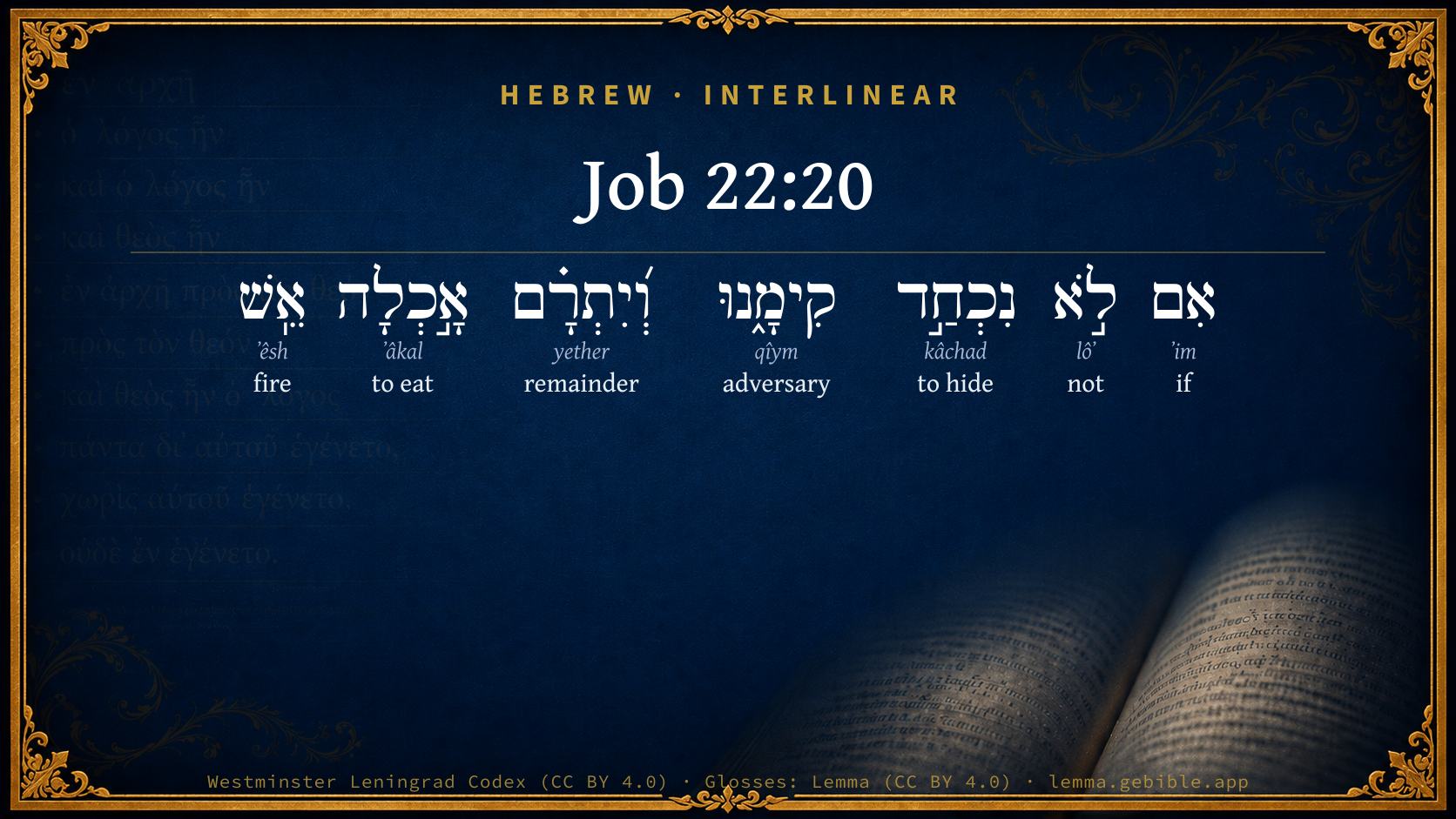
Job 22:20

Hebrew (Westminster Leningrad Codex) Job 22:20 appears in the Hebrew Old Testament. The text above is from the Westminster Leningrad Codex. Each word links to its Strong’s number, a concise gloss, and parsing drawn from the Open Scriptures Hebrew Bible morphology. Click any word for its full Brown-Driver-Briggs (BDB) entry.
Download image
Cite this verse

Job 22:20 (World English Bible). Public Domain. Lemma interlinear Bible study tool, https://lemma.gebible.app/v/job/22/20.

Show BibTeX & RIS
BibTeX
RIS
English Translation
Saying, 'Surely those who rose up against us are cut off, The fire has consumed the remnant of them.'
World English Bible · Public Domain
Highlights
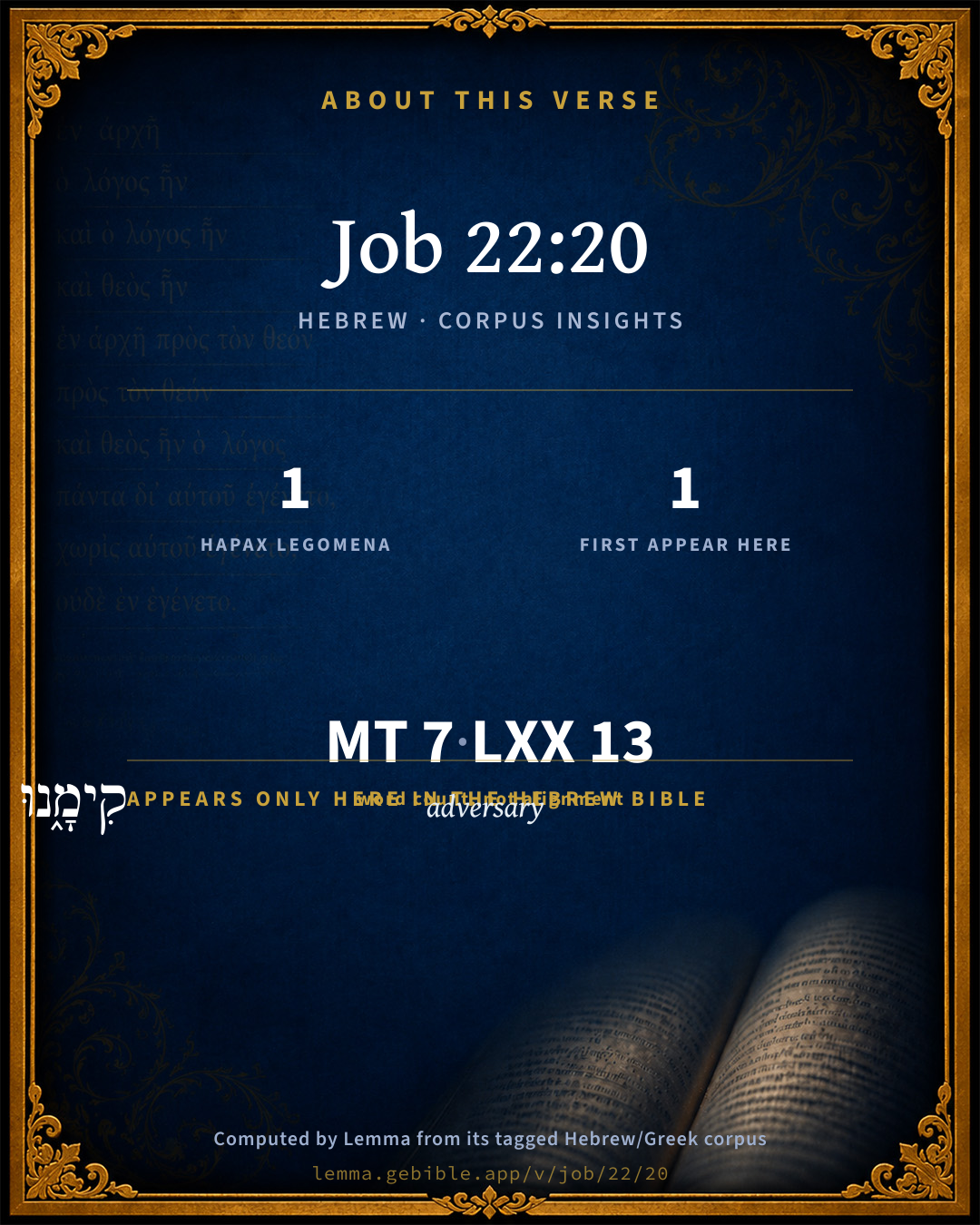
  • 1 hapax legomenon — only here in the Hebrew Bible
  • 1 first appearance in the Hebrew Bible
Full analysis ↓
Download a study sheet

One document with this verse’s original text, its word-by-word gloss line, the meaning frame, cross-references with their text, attributed commentary, and full source and license credits — printable, and it pastes into notes with its structure intact.

This verse Autodidact and up

Study sheet (.html) Plain text (.txt)

A passage Seminary Student

Up to 50 verses in one chapter. A passage sheet keeps up to 6 commentary sources and 12 cross-references per verse, in the order this page ranks them, and says so on the sheet whenever that leaves anything out. Ask for a single verse and you get the Autodidact verse sheet above.

Everything on this page stays free to read, with no account — the sheet is a download of what is already on screen, not access to it.

Want to remove ads? Support Godless Engineer
Compare translations 3

The same verse in 3 English versions, stacked beneath the original-language interlinear above. Click any original word for its lexicon entry.

Each is an independent rendering of the whole verse — the interlinear is not word-aligned to these translations.

Highlighted words mark where these versions differ — a whole-verse word diff, not a word-by-word alignment.

  • World English Bible Public Domain
    Saying, 'Surely those who rose up against us are cut off, The fire has consumed the remnant of them.'
  • King James Version Public Domain
    Whereas our substance is not cut down, but the remnant of them the fire consumeth.
  • unfoldingWord Literal Text CC BY-SA 4.0
    ‘If our enemy is not cut off? And fire has devoured their possessions!’

unfoldingWord Literal Text — © unfoldingWord, licensed CC BY-SA 4.0. Word-aligned USFM3 via Door43 (git.door43.org/unfoldingWord/en_ult).

Versions to compare (up to 4)

3 of 4 selected

Show all 18 translations

Every available English version of this verse, each an independent rendering of the whole verse.

  • World English Bible Public Domain
    Saying, 'Surely those who rose up against us are cut off, The fire has consumed the remnant of them.'
  • Berean Standard Bible Public Domain
    ‘Surely our foes are destroyed, and fire has consumed their excess.’
  • Majority Standard Bible Public Domain
    ‘Surely our foes are destroyed, and fire has consumed their excess.’
  • King James Version Public Domain
    Whereas our substance is not cut down, but the remnant of them the fire consumeth.
  • American Standard Version (1901) Public Domain
    `Saying', Surely they that did rise up against us are cut off, And the remnant of them the fire hath consumed.
  • Revised Version (1885) Public Domain
    Saying, Surely they that did rise up against us are cut off, and the remnant of them the fire hath consumed.
  • Geneva Bible (1599) Public Domain
    Surely our substance is hid: but the fire hath deuoured the remnant of them.
  • Douay-Rheims (1899) Public Domain
    Is not their exaltation cut down, and hath not fire devoured the remnants of them?
  • Young's Literal Translation Public Domain
    `Surely our substance hath not been cut off, And their excellency hath fire consumed.'
  • Literal Standard Version CC BY-SA 4.0
    Surely our substance has not been cut off, || And fire has consumed their excellence.
  • Unlocked Literal Bible CC BY-SA 4.0
    They say, 'Surely those who rose up against us are cut off; fire has consumed their possessions.'
  • unfoldingWord Literal Text CC BY-SA 4.0
    ‘If our enemy is not cut off? And fire has devoured their possessions!’
  • Darby Bible Public Domain
    Is not he who rose against us destroyed, and doth not the fire consume his residue?
  • World Messianic Bible Public Domain
    saying, ‘Surely those who rose up against us are cut off. The fire has consumed their remnant.’
  • Webster's Bible Public Domain
    Whereas our substance is not cut down, but the remnant of them the fire consumeth.
  • Free Bible Version CC BY-SA 4.0
    saying, ‘Our enemies are destroyed, and fire has burned up all that's left of them.’
  • Bible in Basic English Public Domain
    Saying, Truly, their substance is cut off, and their wealth is food for the fire.
  • JPS Tanakh (1917) Public Domain
    'Surely their substance is cut off, and their abundance the fire hath consumed.'

Literal Standard Version (2020), Covenant Press — licensed CC BY-SA 4.0. Text via the HelloAO Bible API (eBible.org). Unlocked Literal Bible (unfoldingWord) — licensed CC BY-SA 4.0. Text via the HelloAO Bible API (eBible.org). unfoldingWord Literal Text — © unfoldingWord, licensed CC BY-SA 4.0. Word-aligned USFM3 via Door43 (git.door43.org/unfoldingWord/en_ult). Free Bible Version, Dr. Jonathan Gallagher — licensed CC BY-SA 4.0. Text via the HelloAO Bible API (eBible.org).

Word by word

More ways to search: Search by grammar → Find every occurrence → Compare this word →

Practice this passage: Drill this verse → Learn its vocabulary →

About this verse

These counts appear in no published source. They are computed here, from the morphology-tagged text and Lemma’s own curated glosses. What Lemma adds →

7
words
7
distinct lemmas
Wisdom
section

Notable vocabulary

1 hapax legomenon — a word that appears only here in the entire Hebrew Bible:

  • קִימָ֑נוּ adversary H7009

First appearance in Scripture

This word makes its first canonical appearance in the Hebrew Bible here:

  • קִימָ֑נוּ adversary H7009

Shared distinctive vocabulary

נִכְחַ֣ד to hide H3582 occurs in 30 verses of the Hebrew Bible. Also found in:

Grammatical profile

  • 2 verbs
  • 3 nouns
  • 1 conjunction
  • 1 particle

Verb forms

  • נִכְחַ֣ד Niphal · Perfect
  • אָ֣כְלָה Qal · Perfect

Hebrew & Septuagint length

In English translation the verse runs 19 words from the Hebrew and 18 from the Septuagint (LXX English) — closely comparable.

A rough comparison of the two English renderings, which tokenize alike — not a word-level alignment.

Word counts can differ between the Hebrew and the Greek without any difference in meaning — e.g. the Hebrew direct-object marker אֵת has no separate Greek word, and Greek often adds the article ὁ.

In the original languages it is 7 Hebrew tokens and 13 Greek tokens — but the two are counted differently (Hebrew bundles its prefixes and suffixes into one token; the Greek is in lemma form), so that isn’t a like-for-like length.

Cross-references

12

Topical passages linked to Job 22:20 in the Treasury of Scripture Knowledge — connected by theme and wording, ordered by reader-vote popularity; previews shown in the World English Bible.

  • Genesis 19:24 Then Yahweh rained on Sodom and on Gomorrah sulfur and fire from Yahweh out of the sky.
  • Job 1:16 While he was still speaking, there also came another, and said, "The fire of God has fallen from the sky, and has burned up the sheep and the servants, and consumed them, and I alone have escaped to tell you."
  • Job 20:26 All darkness is laid up for his treasures. An unfanned fire shall devour him. It shall consume that which is left in his tent.
  • 2 Peter 2:6–7 and turning the cities of Sodom and Gomorrah into ashes, condemned them to destruction, having made them an example to those who would live ungodly;
  • Job 4:7 "Remember, now, whoever perished, being innocent? Or where were the upright cut off?
  • Job 8:3–4 Does God pervert justice? Or does the Almighty pervert righteousness?
  • Job 15:5–6 For your iniquity teaches your mouth, And you choose the language of the crafty.
  • Job 15:30 He shall not depart out of darkness; The flame shall dry up his branches, By the breath of God's mouth shall he go away.
  • Job 20:18–19 That for which he labored he shall restore, and shall not swallow it down; According to the substance that he has gotten, he shall not rejoice.
  • Job 21:27–28 "Behold, I know your thoughts, The devices with which you would wrong me.
  • Luke 13:1–5 Now there were some present at the same time who told him about the Galileans, whose blood Pilate had mixed with their sacrifices.
  • Luke 17:29–30 but in the day that Lot went out from Sodom, it rained fire and sulfur from the sky, and destroyed them all.

Cross-references courtesy of OpenBible.info (CC BY 4.0).

Hebrew and Greek witnesses Masoretic Hebrew ↔ Greek Septuagint

The same verse in the two great witnesses to the Old Testament, shown verse-for-verse.

These are two independent witnesses, not word-aligned to each other, and the Septuagint is shown in lemma (dictionary) form.

Hebrew Job 22:20 Masoretic · Westminster Leningrad Codex

אִם לֹ֣א נִכְחַ֣ד קִימָ֑נוּ וְ֝יִתְרָ֗ם אָ֣כְלָה אֵֽשׁ

Saying, 'Surely those who rose up against us are cut off, The fire has consumed the remnant of them.'

World English Bible · Public Domain

Greek LXX Job 22:20 Septuagint · lemma form

εἰ μή ἀπο ἀναἵζω ὁ ὑπόστασις αὐτός καί ὁ καταλείμμα αὐτός καταἐσθίω πῦρ

Verily their substance has been utterly destroyed, and the fire shall devour what is left of their property.

LXX2012 (modern English Septuagint) · Public Domain

On this verse, Jamieson, Fausset & Brown discusses the Septuagint’s reading. Read the note in Commentary ↓

Hebrew: Westminster Leningrad Codex (CC BY 4.0). Greek: Septuagint (public domain); English from LXX2012 (modern English Septuagint) (Public Domain). How the Septuagint differs from the Hebrew →

Commentary

Notes on Job 22:20 from classic Christian and Jewish commentators (each source and its license shown beneath its notes). The classic Christian expositions comment on the surrounding passage and are grouped to its opening verse, so a note may address several verses; the Jewish commentaries on the Tanakh (Rashi and others) are per-verse, so they appear only where the commentator wrote on this verse.

Lemma curates 59 commentaries, every one of them public domain or Creative Commons licensed, each selected and text-cleaned for this edition rather than reprinted as found. About our sources →

Trapp's Complete Commentary

John Trapp

Job 22:20 Whereas our substance is not cut down, but the remnant of them the fire consumeth.

Ver. 20. Whereas our substance is not cut down] That is, while life lasteth, and while it is called today; before death cometh: and after death, judgment; when the remnant of the wicked fire shall consume. Where we have a forcible motive to repent, because we must either turn or burn, Aut poenitendum, aut pereundum. See Act 17:31 2Co 5:10-11 Heb 12:28-29. Eliphaz seemeth here on purpose to have mentioned that fire wherewith wicked men shall be tormented at the last day (and before, for every man’s death day is his doomsday), and to have changed the person.

The remnant (or excellence) of them the fire consumeth] That it might the more effectually move men to repent, that they might be delivered from the wrath to come. And here I could willingly take up Chrysostom’s wish, Utinam ubique de Gehenna dissereretur! Oh that men would talk more everywhere of hell fire unquenchable, intolerable, and the fuel thereof made of the most tormenting temper, Isa 30:33. It was a speech of Gregory Nyssen, He that does but hear of hell is, without any further labour or study, taken off from sin filled pleasures, and set upon the practice of mortification. But men’s hearts are grown harder today, and he that shall observe their impiety and impenitence may well say to them, as Cato once did to Caesar, Credo quae de inferis dicuntur falsa existimas, I believe thou thinkest all but a fable that is said concerning hell (Juven. Sat. 2.).

Esse aliquos Manes, &c.

Nec pueri credunt nisi qui nondum aere lavantur.

John Trapp, A Commentary or Exposition upon All the Books of the Old and New Testament (1647–1656) — public domain. Text from a community e-Sword module.

Joseph Benson's Commentary

Job 22:20. Whereas — Or rather, seeing that, or, because, when wicked men are destroyed, they are preserved. He should have said their substance; but he changes the person, and saith, our substance; either as including himself in the number of righteous persons, and thereby intimating that he pleaded the common cause of all such, while Job pleaded the cause of the wicked; or because he would hereby thankfully acknowledge some eminent and particular preservation given to him among other righteous men. The remnant of them — All that was left undestroyed in the general calamity. The fire consumeth — He is thought by some to allude to the judgment of God upon Sodom and Gomorrah: as if he had said, Thou mayest find here and there an instance of a wicked man dying in peace. But what is that to the two great instances of the final perdition of ungodly men, the drowning the whole world, and the burning of Sodom and Gomorrah. It seems, however, much more natural, as Dr. Dodd observes, to understand him as referring to the last general conflagration: “for how could the destroying a little city or two be said, with any propriety, to consume the remnant; that is, the whole remainder of wicked men? when, at the very same time, Chaldea, and perhaps the greatest part of the world, was overrun with idolatry. The dissolution of the world by fire is what St. Peter calls expressly, The day of judgment and perdition of ungodly men, 2Pe 3:7. And St. Jude, Job 22:14, seems to say, that this was prophesied of by Enoch before the flood; and if so, must have been known to Noah, and by him, no doubt, transmitted to posterity, and so might be well known to Job and his friends.” Eliphaz, therefore, may be understood as saying, Though the judgment by water, extensive as it was, did not thoroughly purge the world, but wickedness and wicked men again sprung up, spread widely, and abounded; yet know, there shall come a time hereafter when the world shall be consumed by fire, and then the whole race and remainder of wicked men shall be delivered up, once for all, to such an absolute destruction, as that none shall ever spring from their ashes, nor shall the new world and its inhabitants know wickedness, or a defection from God any more. If this view of the passage be admitted, it will appear that the doctrine of the future dissolution of the world by fire, so plainly taught us in the New Testament, and so immediately connected with that of the resurrection, was not unknown in Job’s time, and consequently we shall have a further confirmation of the interpretation we have given of Job 19:25, and some other passages in this book. See Peters, p. 409; and the 24th, 25th, and 26th chapters of Isaiah, where the prophet seems to speak copiously on this subject, using an expression, Job 26:11, very like to this of Eliphaz. The fire of thine enemies, which is prepared for thine enemies, shall consume them.

Joseph Benson's Commentary on the Old and New Testaments (1811–1818) — public domain. Text from a community e-Sword module.

Geneva Bible (1599)

Geneva Bible translators

Meaning, of the wicked.

That is, the state and preservation of the godly, is hid under God’s wings.

Geneva Bible (1599) marginal notes — public domain. Text via Bolls.life.

Jamieson, Fausset & Brown

Robert Jamieson, A. R. Fausset & David Brown

The triumphant speech of the pious. If "substance" be retained, translate, rather as the Septuagint, "Has not their substance been taken away, and . . . ?" But the Hebrew is rather, "Truly our adversary is cut down" [GESENIUS]. The same opposition exists between the godly and ungodly seed as between the unfallen and restored Adam and Satan (adversary); this forms the groundwork of the book (Job 1:1-2:13; Gen 3:15).

remnant--all that "is left" of the sinner; repeated from Job 20:26, which makes UMBREIT'S rendering "glory" (Margin), "excellency," less probable.

fire--alluding to Job (Job 1:16; Job 15:34; Job 18:15). First is mentioned destruction by water (Job 22:16); here, by fire (Pe2 3:5-7).

Jamieson, Fausset & Brown — Commentary Critical and Explanatory on the Whole Bible (1871) — public domain (CC PDM 1.0). Text via the HelloAO Bible API.

Adam Clarke's Commentary

Verse 20. Whereas our substance is not cut down] We, who fear the Lord, still continue in health and peace; whereas they who have departed from him are destroyed even to their very remnant.

Mr. Good thinks that קימנו kimanu, which we translate our substance, is the same as the Arabic [Arabic] our people or tribe; and hence he translates the clause thus: "For our tribe is not cut off; while even the remnant of these a conflagration consumed." The reference here is supposed to be to the destruction of the men of Sodom and Gomorrah. A judgment by a flood took off the world of the ungodly in the days of Noah. Their remnant, those who lived in the same ungodly way, were taken off by a judgment of fire, in the days of Lot. Eliphaz introduces these two examples in order to terrify Job into a compliance with the exhortation which immediately follows.

Adam Clarke's Commentary on the Bible (1810–1826) — public domain. Text from a community e-Sword/MySword module.

Ellicott's Commentary for English Readers

(20) Whereas our substance . . .—These are probably the words of the righteous and the innocent: “Surely they that did rise up against us are cut off, and the remnant of them the fire hath consumed.” The rendering in the Authorised Version is probably less correct, though in that also these words seem to be those of the innocent in Job_22:19.

A Bible Commentary for English Readers, edited by Charles John Ellicott (1878–1897) — public domain. Text from a community e-Sword module.

John Gill's Exposition

Acquaint now thyself with him, and be at peace,.... Not with the righteous and innocent, but with God, as Job 22:22 show: from severe charges and censures, Eliphaz proceeds to advice and exhortations, and seems to be in a better temper, and to talk in a more kind and gentle manner, only he goes upon a false supposition and mistaken notion, that Job was a bad man; had he had a proper object to have directed his discourse to, it would have been excellently said; and, as it is, is not without its use: this first exhortation supposes unacquaintance with God, and an estrangedness from him; which is the case of every man from the womb, and in a state of nature and unregeneracy. Acquaintance with God begins at conversion, when he is made known, not only as the God of nature and providence, but as the God of grace and peace in Christ; and it is carried on by prayer, which is a converse with God, and by attendance on his worship and ordinances, in which men walk before him, and have fellowship with him: this is sometimes interrupted and dropped for a while, through temptation or sin; when there arises on account thereof a shyness and backwardness to draw nigh unto God, until he calls and invites them to take with them words, and return unto him; an acquaintance with God is not kept up when prayer before him is restrained; which Eliphaz charges Job with, Job 15:4; and when saints forsake the assembling of themselves together, or neglect public worship, or grow indifferent to it; and it is renewed again by prayer, and a fresh attendance on the above things; in which frequent visits are made between God and his people, mutual secrets communicated, a holy freedom, familiarity, and boldness contracted, and communion with God enjoyed: men may also acquaint themselves with him yet more and more by the contemplation of his works, by reading and hearing his word, and by conversation with good men, ministers, and others. The Jewish commentators (h) generally interpret it, "use" or "accustom thyself with him", to walk in his ways, and observe his commands: "and be at peace"; not make his peace with God, which a creature cannot do; only Job's living Redeemer could do that, and he has done it; but be easy and still under the afflicting hand of God, quietly submit to it, and patiently endure it, and not murmur at it; or, as Aben Ezra interprets it, as a promise of God, "thou shalt be in peace", or "thou shalt have peace"; all outward prosperity and happiness, which is often signified by this word; or inward peace of mind, which comes from God, and through an acquaintance with him, and from Christ, his blood, righteousness, and sacrifice, by whom the acquaintance with God is opened and maintained; and it is had in a way of duty, in attendance on the ordinances of God, which are paths of peace; and also eternal peace hereafter, when acquaintance with God will be no more dropped, nor interrupted, but continue for ever:

thereby good shall come unto thee: temporal good things, necessary and convenient, the promise of which is annexed to godliness, or an acquaintance with God; spiritual good things, the blessings of grace, all things pertaining to life and godliness, and eternal good things; that far more exceeding and eternal weight of glory, which afflictions, peaceably and patiently borne, work for and bring unto.

(h) Aben Ezra, Ben Gersom, Bar Tzemach.

John Gill's Exposition of the Whole Bible (1746–1763) — public domain (CC PDM 1.0). Text via the HelloAO Bible API.

Albert Barnes' Notes on the Bible

Whereas our substance is not cut down - Margin, or, “Estate” Gesenius supposes that this means our adversary or enemy. The word used here (קים qı̂ym) he regards as derived from קוּם qûm - to rise, to rise up; and, hence, it may have the sense of rising up against, or an enemy. So Noyes understands it, and renders it:

“Truly, our adversary is destroyed;

And fire hath consumed his abundance.”

Rosemmuller accords with this, and it seems to me to be the correct view. According to this, it is the language of the righteous Job 22:19 when exciting over the punishment of the wicked, saying, “Our foe is cut down.” Jerome renders it, Nonne succisa est erectio eorum, etc. The Septuagint, “Has not their substance ὑπόστασις hupostasis disappeared?” The sense is not materially different. If the word “substance,” or “property,” is to be retained it should be read as a question, and regarded as the language of the righteous who exult. “Has not their substance been taken away. and has not the fire consumed their property?” Dr. Good strangely renders it, “For our tribe is not cut off.”

But the remnant of them - Margin, “their excellency.” Hebrew יתרם yı̂thrām. Jerome, “reliquias eorum” - “the remnants of them.” Septuagint, κατάλειμμα kataleimma - “the residue,” or “what is left.” The Hebrew word יתר yether means, “the remainder, the residue, the rest;” then, what is redundant, more than is needed, or that abounds; and then, “wealth,” the superabundant property which a man does not “need” for his own use or family. The word here probably means that which the rich sinner possessed.

The fire consumeth - Or, hath consumed. It has been supposed by many that the allusion here is to the destruction of Sodom and Gomorrah, and it cannot be denied that such an allusion is possible. If it were “certain” that Job lived before that event, there could be little objection to such a supposition. The “only” objection would be, that a reference to such an event was not more prominent. It would be a case just in point in the argument of the three friends of Job, and one to which it might be supposed they would have appealed as decisive of the controversy. They lived in the vicinity. They could not have been strangers to so remarkable an occurrence, and it would have furnished just the argument which they wished, to prove that God punishes the wicked in this life. If they lived after that event, therefore, it is difficult to account for the fact, that they did not make a more distinct and prominent allusion to it in their argument. It is true, that the same remark may be made respecting the allusion to the flood, which was a case equally in point, and in reference to which the allusion, if it exist at all, is almost equally obscure. So far as the language here is concerned, the reference may be either to the destruction of Sodom, or to destruction by lightning, such as happened to the possessions of Job, Job 1:16; and it is difficult, if not impossible, to determine which is correct. The general idea is, that the judgments of heaven, represented by fire, had fallen on the wicked, and that the righteous, therefore, had occasion to rejoice.

Albert Barnes' Notes on the Bible (1834–1885) — public domain. Text from a community e-Sword/MySword module.

Haydock's Catholic Bible Commentary

Their. Hebrew, "our." (Calmet) --- "Whereas our substance is not cut down." (Protestants) (Haydock) --- But the Septuagint and Chaldean agree with the Vulgate, which gives a better sense. --- Fire, which consumed Sodom, &c. (Calmet)

George Leo Haydock (1774–1849), Haydock's Catholic Family Bible and Commentary, 1859 edition — public domain. Excludes Psalms (Douay-Rheims chapter numbering differs from Protestant) and Deuterocanonical books (Catholic canon only).

Matthew Poole's English Annotations

Whereas; or, when; or, seeing that; or, because; for this Hebrew particle im is oft used for chi. And so the following words may contain the reason of the joy and laughter of the innocent, mentioned Job 22:19, because when wicked men are destroyed, they are preserved; because

our substance, i.e. our souls, and bodies, and subsistence,

was now cut down. He should have said their substance, i.e. the substance of the righteous; but he changeth the person, and saith,

our substance; either as including himself in the number of righteous persons, and thereby intimating that he pleaded the common cause of all such, whilst Job pleaded the cause of the wicked, as is elsewhere observed; or because he would hereby thankfully acknowledge some eminent and particular preservation given to him amongst other righteous men; or because he and his brethren were of the same substance with and descended from the loins of them whom God had miraculously preserved, when others round about them were cut off; as God had done for Abraham and his posterity, of which race these are conceived to have been. And a like change both of person and number we find Hos 12:4, He found him (i.e. Jacob) in Beth-el, and there he spake with us, i.e. with him, as representing us, and for all our good.

The remnant; all that was left undestroyed in the general calamity. Or, their excellency; all their desirable and delectable things. Of them, i.e. of those who are opposed to the righteous, and in whose destruction the righteous rejoiced.

The fire, to wit, of God’s wrath: some dreadful judgment, either proper fire, possibly that which destroyed Sodom and Gomorrah, which such knowing and inquisitive persons could not be ignorant of, as a thing done near their times and places; or some other sore calamity; for such oft come under the name of fire. But this whole verse is and may be otherwise rendered, and that interrogatively. Is not (or rather, was not, the Hebrew prefix he being here understood, after the manner of the language, from Job 22:15, where it is expressed) our substance (i.e. almost all our nature and kind) cut off, (almost all destroyed in the flood,) and did not the fire consume a

remnant of them, i.e. of mankind, and of ungodly men, in Sodom and Gomorrah?

Matthew Poole's English Annotations on the Holy Bible (1683–1685) — public domain. Text from a community e-Sword/MySword module.

Whedon's Commentary on the Bible

Daniel D. Whedon

20. Contains THE TRIUMPHANT SONG of the righteous: —

Truly our adversary is cut off,

And their residue fire consumeth.

Whereas — אם לא, truly, the strongest form of affirmation: same as in Job_1:11; Job_17:2. Substance, etc. — קים, He who is set up, adversary, a singular form used collectively. Our translators followed the Septuagint. Our adversary, not in a personal but in a moral sense, for the wicked are the natural enemies of the good.

The remnant of them — That which remains to them, or of them. The destruction is radical and complete, a fact symbolized by the fire.

Daniel D. Whedon (gen. ed.), Commentary on the Old and New Testaments (1874–1909) — public domain. Text from a community e-Sword module.

The Pulpit Commentary

Whereas our substance is not cut down. It is best to take these as the words of the righteous in their triumph over the wicked; but they can scarcely bear the interpretation given them in the Authorized Version. The clause is not really negative but affirmative, and the word does not mean "substance," but "adversary." Translate, Surely they that rose up against us (or, our adversaries) are cut off; and compare the Revised Version. The "adversaries" of the righteous are the "wicked men" who have been "snatched away before their time," and have had their "foundation overflown with a flood" (ver. 16). But the remnant of them the fire consumeth; rather, and the remnant of them hath the fire consumed (see the Revised Version). The "fire" here, like the "flood" in ver. 16, is a metaphor, and therefore not to be pressed. All that is essential is that the wicked are destroyed. Over this the "righteous" and the "innocent" rejoice.

The Pulpit Commentary (1880–1919), ed. H.D.M. Spence-Jones & Joseph S. Exell — public domain. Text from a community e-Sword module.

John Wesley's Explanatory Notes

Because - Because when wicked men are destroyed, they are preserved. He should have said their substance; but he changes the person, and saith, our substance; either as including himself in the member of righteous persons, and thereby intimating that he pleaded the common cause of all such, while Job pleaded the cause of the wicked, or because he would hereby thankfully acknowledge some eminent and particular preservation given to him amongst other righteous men. Remnant - All that was left undestroyed in the general calamity. Fire - Sodom and Gomorrah. As if he had said, thou mayest find here and there an instance, of a wicked man dying in peace. But what is that to the two great instances of the final perdition of ungodly men, the drowning the whole world, and the burning of Sodom and Gomorrah.

John Wesley, Explanatory Notes Upon the Whole Bible (1754–1765) — public domain. Text via the GEBible commentary corpus.

Rashi

Rabbi Shlomo Yitzchaki (Rashi)

Whether their substance was cut off Will you watch and see whether their substance was cut off.

their substance Heb קימנו, like קומתו, his substance; i.e., of that generation, like (Hosea 12:5), “in Bethel he shall fed Him, and there He shall speak with him (עמנו),” like עִמוֹ.

consumed by the fire They were judged with boiling water. Rabbi Tanchuma expounded that they were tall and did not die in the depths. Then boiling water fell upon them from above and this is the meaning of יִתְרָם, their unusually tall height. So I heard.

Rashi on the Tanakh — English translations: “The Judaica Press complete Tanach with Rashi, translated by A. J. Rosenberg” (CC BY 4.0); “Pentateuch with Rashi's commentary by M. Rosenbaum and A.M. Silbermann, 1929-1934” (public domain); “The Metsudah Tanach series, Lakewood, N.J” (CC BY 4.0); and “The Book of Joshua, Metsudah Publications, 1997” (CC BY 4.0). Text via Sefaria.

Lesson kit

Teaching starters — assembled from the data on this page, not authored interpretation. Every prompt links to the verse data it draws on. Edit before teaching.

Job, in the Wisdom, opens this verse with 7 words (7 distinct Hebrew lemmas). Its most distinctive word is qîym (“adversary”). A historical commentator’s framing appears above. Read the whole chapter for the surrounding context.

Discussion questions

  1. The word qîym carries the sense “adversary.” How does it shape the verse?
  2. 1 word here appears nowhere else in the Hebrew Bible. Why might the author reach for such rare wording?
  3. This is the first place “adversary” appears in Scripture (first appears here). What does its debut here establish?
  4. How does Genesis 47:18, which shares the word «to hide», read alongside this verse?
  5. These translations render this verse differently. What is at stake in choosing one wording over another?
  6. «נִכְחַ֣ד» is a Niphal Perfect verb. How does that grammatical form shape the action described?
  7. Compare how Trapp's Complete Commentary and Joseph Benson's Commentary read this verse. Where do they agree or differ?

Things to notice

Reading settings

Reading text

Shown beneath each verse's original-language words.

Old Testament
Old Testament edition

Read the OT as the Masoretic Hebrew (MT) or the Greek Septuagint (LXX).

English shown for the Greek Septuagint (in the Hebrew ↔ Greek comparison).

Comparing translations? Open the Compare panel on any verse page to stack up to four side by side.