
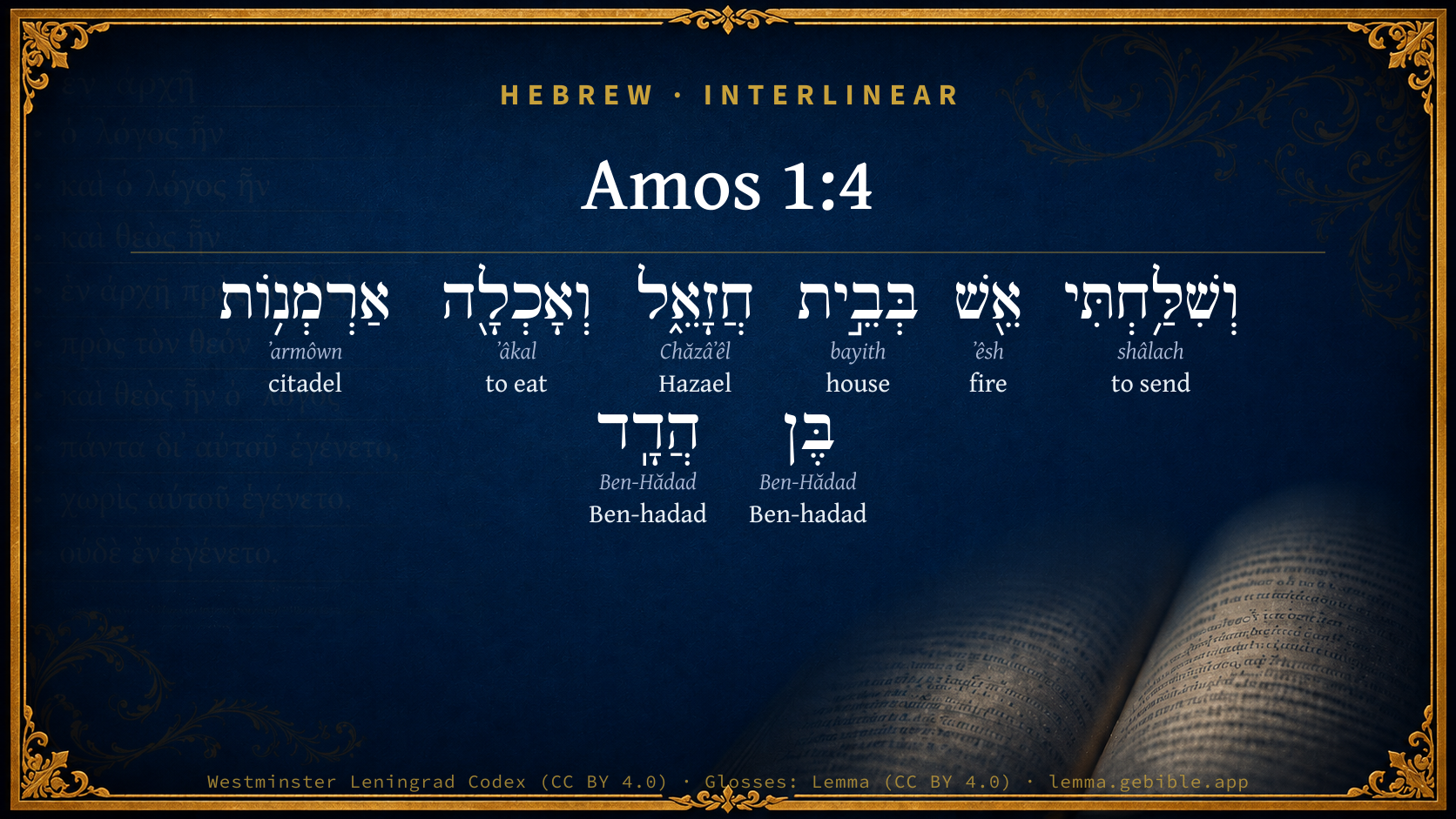
Amos 1:4

Hebrew (Westminster Leningrad Codex) Amos 1:4 appears in the Hebrew Old Testament. The text above is from the Westminster Leningrad Codex. Each word links to its Strong’s number, a concise gloss, and parsing drawn from the Open Scriptures Hebrew Bible morphology. Click any word for its full Brown-Driver-Briggs (BDB) entry.
Download image
Cite this verse

Amos 1:4 (World English Bible). Public Domain. Lemma interlinear Bible study tool, https://lemma.gebible.app/v/amos/1/4.

Show BibTeX & RIS
BibTeX
RIS
English Translation
But I will send a fire into the house of Hazael, And it will devour the palaces of Ben Hadad.
World English Bible · Public Domain
Download a study sheet

One document with this verse’s original text, its word-by-word gloss line, the meaning frame, cross-references with their text, attributed commentary, and full source and license credits — printable, and it pastes into notes with its structure intact.

This verse Autodidact and up

Study sheet (.html) Plain text (.txt)

A passage Seminary Student

Up to 50 verses in one chapter. A passage sheet keeps up to 6 commentary sources and 12 cross-references per verse, in the order this page ranks them, and says so on the sheet whenever that leaves anything out. Ask for a single verse and you get the Autodidact verse sheet above.

Everything on this page stays free to read, with no account — the sheet is a download of what is already on screen, not access to it.

Want to remove ads? Support Godless Engineer
Compare translations 3

The same verse in 3 English versions, stacked beneath the original-language interlinear above. Click any original word for its lexicon entry.

Each is an independent rendering of the whole verse — the interlinear is not word-aligned to these translations.

Highlighted words mark where these versions differ — a whole-verse word diff, not a word-by-word alignment.

  • World English Bible Public Domain
    But I will send a fire into the house of Hazael, And it will devour the palaces of Ben Hadad.
  • King James Version Public Domain
    But I will send a fire into the house of Hazael, which shall devour the palaces of Benhadad.
  • unfoldingWord Literal Text CC BY-SA 4.0
    I will send a fire into the house of Hazael, and it will devour the fortresses of Ben Hadad.

unfoldingWord Literal Text — © unfoldingWord, licensed CC BY-SA 4.0. Word-aligned USFM3 via Door43 (git.door43.org/unfoldingWord/en_ult).

Versions to compare (up to 4)

3 of 4 selected

Show all 18 translations

Every available English version of this verse, each an independent rendering of the whole verse.

  • World English Bible Public Domain
    But I will send a fire into the house of Hazael, And it will devour the palaces of Ben Hadad.
  • Berean Standard Bible Public Domain
    So I will send fire upon the house of Hazael to consume the citadels of Ben-hadad.
  • Majority Standard Bible Public Domain
    So I will send fire upon the house of Hazael to consume the citadels of Ben-hadad.
  • King James Version Public Domain
    But I will send a fire into the house of Hazael, which shall devour the palaces of Benhadad.
  • American Standard Version (1901) Public Domain
    but I will send a fire into the house of Hazael, and it shall devour the palaces of Ben-hadad.
  • Revised Version (1885) Public Domain
    but I will send a fire into the house of Hazael, and it shall devour the palaces of Ben-hadad.
  • Geneva Bible (1599) Public Domain
    Therefore will I sende a fire into the house of Hazael, and it shall deuoure the palaces of Ben-hadad.
  • Douay-Rheims (1899) Public Domain
    And I will send a fire into the house of Azael, and it shall devour the houses of Benadad.
  • Young's Literal Translation Public Domain
    And I have sent a fire against the house of Hazael, And it hath consumed the palaces of Ben-Hadad.
  • Literal Standard Version CC BY-SA 4.0
    And I have sent a fire against the house of Hazael, || And it has consumed the palaces of Ben-Hadad.
  • Unlocked Literal Bible CC BY-SA 4.0
    I will send a fire into the house of Hazael, and it will devour the fortresses of Ben Hadad.
  • unfoldingWord Literal Text CC BY-SA 4.0
    I will send a fire into the house of Hazael, and it will devour the fortresses of Ben Hadad.
  • Darby Bible Public Domain
    And I will send a fire into the house of Hazael, and it shall devour the palaces of Ben-Hadad.
  • World Messianic Bible Public Domain
    but I will send a fire into the house of Hazael, and it will devour the palaces of Ben Hadad.
  • Webster's Bible Public Domain
    But I will send a fire into the house of Hazael, which shall devour the palaces of Ben-hadad.
  • Free Bible Version CC BY-SA 4.0
    So I will send fire down on the house of Hazael and burn up Ben-Hadad's fortresses.
  • Bible in Basic English Public Domain
    And I will send a fire into the house of Hazael, burning up the great houses of Ben-hadad.
  • JPS Tanakh (1917) Public Domain
    So will I send a fire into the house of Hazael, and it shall devour the palaces of Ben-hadad;

Literal Standard Version (2020), Covenant Press — licensed CC BY-SA 4.0. Text via the HelloAO Bible API (eBible.org). Unlocked Literal Bible (unfoldingWord) — licensed CC BY-SA 4.0. Text via the HelloAO Bible API (eBible.org). unfoldingWord Literal Text — © unfoldingWord, licensed CC BY-SA 4.0. Word-aligned USFM3 via Door43 (git.door43.org/unfoldingWord/en_ult). Free Bible Version, Dr. Jonathan Gallagher — licensed CC BY-SA 4.0. Text via the HelloAO Bible API (eBible.org).

Word by word

More ways to search: Search by grammar → Find every occurrence → Compare this word →

Practice this passage: Drill this verse → Learn its vocabulary →

About this verse

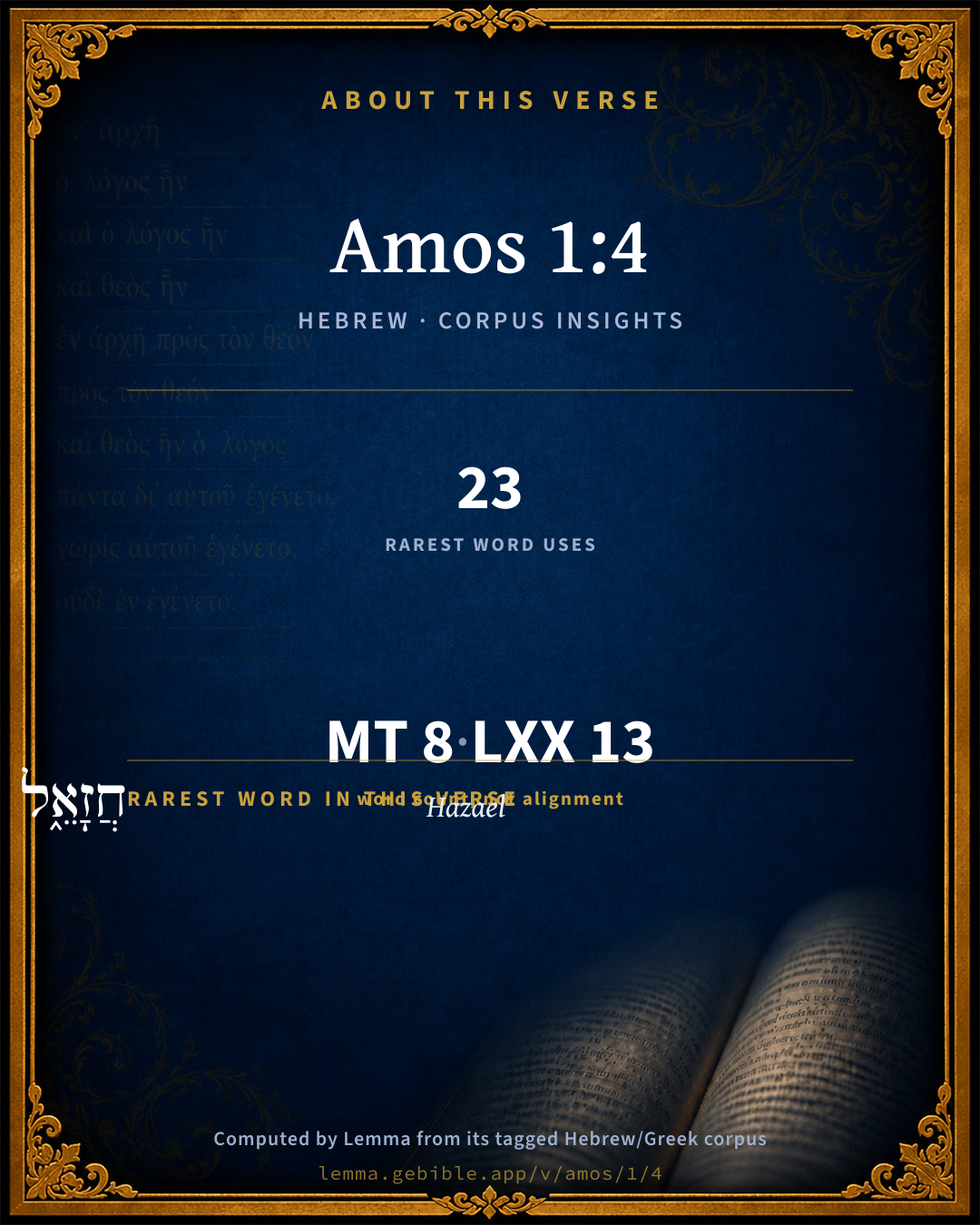
These counts appear in no published source. They are computed here, from the morphology-tagged text and Lemma’s own curated glosses. What Lemma adds →

8
words
7
distinct lemmas
Prophets
section

Notable vocabulary

The rarest word here is חֲזָאֵ֑ל Hazael H2371 — appearing just 23 times in the whole Hebrew Bible.

Shared distinctive vocabulary

חֲזָאֵ֑ל Hazael H2371 occurs in 21 verses of the Hebrew Bible. Also found in:

Grammatical profile

  • 2 verbs
  • 6 nouns

Verb forms

  • וְשִׁלַּ֥חְתִּי Piel · Sequential Perfect
  • וְאָכְלָ֖ה Qal · Sequential Perfect

Repetition

A word recurs within this verse — often emphatic in Hebrew:

  • בֶּן Ben-hadad H1130 ×2

Hebrew & Septuagint length

In English translation the verse runs 20 words from the Hebrew and 22 from the Septuagint (LXX English) — closely comparable.

A rough comparison of the two English renderings, which tokenize alike — not a word-level alignment.

Word counts can differ between the Hebrew and the Greek without any difference in meaning — e.g. the Hebrew direct-object marker אֵת has no separate Greek word, and Greek often adds the article ὁ.

In the original languages it is 8 Hebrew tokens and 13 Greek tokens — but the two are counted differently (Hebrew bundles its prefixes and suffixes into one token; the Greek is in lemma form), so that isn’t a like-for-like length.

Cross-references

20

Topical passages linked to Amos 1:4 in the Treasury of Scripture Knowledge — connected by theme and wording, ordered by reader-vote popularity; previews shown in the World English Bible.

  • Jeremiah 49:27 I will kindle a fire in the wall of Damascus, and it shall devour the palaces of Ben Hadad.
  • 2 Kings 6:24 It happened after this, that Benhadad king of Syria gathered all his host, and went up, and besieged Samaria.
  • 2 Kings 8:7–15 Elisha came to Damascus; and Benhadad the king of Syria was sick; and it was told him, saying, The man of God is come here.
  • 2 Kings 13:3 The anger of Yahweh was kindled against Israel, and he delivered them into the hand of Hazael king of Syria, and into the hand of Benhadad the son of Hazael, continually.
  • 2 Kings 13:25 Jehoash the son of Jehoahaz took again out of the hand of Benhadad the son of Hazael the cities which he had taken out of the hand of Jehoahaz his father by war. Three times did Joash strike him, and recovered the cities of Israel.
  • Jeremiah 17:27 But if you will not listen to me to make the Sabbath day holy, and not to bear a burden and enter in at the gates of Jerusalem on the Sabbath day; then will I kindle a fire in the gates of it, and it shall devour the palaces of Jerusalem, and it shall not be quenched.
  • Judges 9:19–20 if you then have dealt truly and righteously with Jerubbaal and with his house this day, then rejoice you in Abimelech, and let him also rejoice in you:
  • Judges 9:57 and all the wickedness of the men of Shechem did God requite on their heads: and on them came the curse of Jotham the son of Jerubbaal.
  • 1 Kings 19:15 Yahweh said to him, Go, return on your way to the wilderness of Damascus: and when you come, you shall anoint Hazael to be king over Syria;
  • 1 Kings 20:1–22 Ben Hadad the king of Syria gathered all his host together; and there were thirty-two kings with him, and horses and chariots: and he went up and besieged Samaria, and fought against it.
  • 2 Chronicles 16:2 Then Asa brought out silver and gold out of the treasures of the house of Yahweh and of the king's house, and sent to Ben Hadad king of Syria, who lived at Damascus, saying,
  • Ezekiel 30:8 They shall know that I am Yahweh, when I have set a fire in Egypt, and all her helpers are destroyed.
  • Ezekiel 39:6 I will send a fire on Magog, and on those who dwell securely in the isles; and they shall know that I am Yahweh.
  • Hosea 8:14 For Israel has forgotten his Maker and built palaces; And Judah has multiplied fortified cities; But I will send a fire on his cities, And it will devour its fortresses."
  • Amos 1:7 But I will send a fire on the wall of Gaza, And it will devour its palaces.
  • Amos 1:10 But I will send a fire on the wall of Tyre, And it will devour its palaces."
  • Amos 1:12 But I will send a fire on Teman, And it will devour the palaces of Bozrah."
  • Amos 1:14 But I will kindle a fire in the wall of Rabbah, And it will devour its palaces, With shouting in the day of battle, With a tempest in the day of the whirlwind;
  • Amos 2:2 But I will send a fire on Moab, And it will devour the palaces of Kerioth; And Moab will die with tumult, with shouting, and with the sound of the trumpet;
  • Amos 2:5 But I will send a fire on Judah, And it will devour the palaces of Jerusalem."

Cross-references courtesy of OpenBible.info (CC BY 4.0).

Hebrew and Greek witnesses Masoretic Hebrew ↔ Greek Septuagint

The same verse in the two great witnesses to the Old Testament, shown verse-for-verse.

These are two independent witnesses, not word-aligned to each other, and the Septuagint is shown in lemma (dictionary) form.

Hebrew Amos 1:4 Masoretic · Westminster Leningrad Codex

וְשִׁלַּ֥חְתִּי אֵ֖שׁ בְּבֵ֣ית חֲזָאֵ֑ל וְאָכְלָ֖ה אַרְמְנ֥וֹת בֶּן הֲדָֽד

But I will send a fire into the house of Hazael, And it will devour the palaces of Ben Hadad.

World English Bible · Public Domain

Greek LXX Amos 1:4 Septuagint · lemma form

καί ἐκ ἀποστέλλω πῦρ εἰς ὁ οἶκος αζαηλ καί καταἐσθίω θεμέλιον υἱός αδερ

And I will send a fire on the house of Azael, and it shall devour the foundations of the son of Ader.

LXX2012 (modern English Septuagint) · Public Domain

On this verse, Whedon's Commentary on the Bible discusses the Septuagint’s reading. Read the note in Commentary ↓

Hebrew: Westminster Leningrad Codex (CC BY 4.0). Greek: Septuagint (public domain); English from LXX2012 (modern English Septuagint) (Public Domain). How the Septuagint differs from the Hebrew →

Targum (Aramaic paraphrase)

1

The Targum is the ancient Jewish Aramaic paraphrase of the Hebrew Scriptures — an interpretive translation, not the Hebrew text itself. Onkelos (literal) and Pseudo-Jonathan (expansive) render the Torah, and Jonathan the Prophets. Coverage is partial: where no permissively-licensed English translation exists for a verse, only the Aramaic is shown. This is verse-level text, not a word-by-word alignment to the Hebrew.

  1. Targum Jonathan Prophets (Joshua–Malachi)
    וְאַשְׁלַח אֶשְׁתָּא בְבֵית חֲזָאֵל וּתְשֵׁיצֵי בִּרְנְיַת בַּר הֲדָד:

    (no public-domain English translation for this verse)

    Targum Jonathan — Aramaic: “Mikraot Gedolot” (public domain). English: “Sefaria Community Translation” (CC0 1.0 (public-domain dedication)); “London "Chaldee Paraphrase," 1871” (public domain). Text via Sefaria.

Commentary

Notes on Amos 1:4 from classic Christian and Jewish commentators (each source and its license shown beneath its notes). The classic Christian expositions comment on the surrounding passage and are grouped to its opening verse, so a note may address several verses; the Jewish commentaries on the Tanakh (Rashi and others) are per-verse, so they appear only where the commentator wrote on this verse.

Lemma curates 59 commentaries, every one of them public domain or Creative Commons licensed, each selected and text-cleaned for this edition rather than reprinted as found. About our sources →

Trapp's Complete Commentary

John Trapp

Amo 1:4 But I will send a fire into the house of Hazael, which shall devour the palaces of Benhadad.

Ver. 4. But I will send a fire into the house of Hazael] Sin doth as naturally draw judgments to it as the lodestone doth iron or turpentine fire; and heinous sins, heaviest judgments, devouring plagues. Such as are the fire of war, Psa 78:62; pestilence, Lev 26:25; foreign enemies, Num 21:28 Jer 48:45; homebred conspiracies, Jdg 9:15; Jdg 9:20; besides the fire of hell, whereof all miseries here are but typical. Let men kiss the Son therefore, lest God’s anger be kindled; and get the spirit of judgment, and of burning, that they may dwell with everlasting burnings. For even "our God is a consuming fire," Heb 12:29.

John Trapp, A Commentary or Exposition upon All the Books of the Old and New Testament (1647–1656) — public domain. Text from a community e-Sword module.

Albert Barnes' Notes on the Bible

And I will send a fire on the house of Hazael - The fire is probably at once material fire, whereby cities are burned in war, since he adds, “it shall devour the palaces of Benhadad,” and also stands as a symbol of all other severity in war as in the ancient proverb, “a fire is gone out from Heshbon, a flame from the city of Sihon; it hath consumed Ar of Moab, the lords of the high places of Arnon” Num 21:28; and again of the displeasure of Almighty God, as when He says, “a fire is kindled in Mine anger, and it shall burn unto the lowest hell” Deu 32:22. For the fire destroys not the natural buildings only, but “the house of Hazael,” that is, his whole family. In these prophecies, a sevenfold vengeance by fire is denounced against the seven people, an image of the eternal fire into which all iniquity shall be cast.

The palaces of Benhadad - Hazael, having murdered Benhadad his master and ascended his throne, called Iris son after his murdered master, probably in order to connect his own house with the ancient dynasty. Benhadad, that is, son or worshiper of the idol “Hadad,” or “the sun,” had been the name of two of the kings of the old dynasty. Benhadad III was at this time reigning. The prophet foretells the entire destruction of the dynasty founded in blood. The prophecy may have had a fulfillment in the destruction of the house of Hazael, with whose family Rezin, the king of Syria in the time of Ahaz, stands in no known relation. Defeats, such as those of Benhadad III by Jeroboam II who took Damascus itself, are often the close of an usurping dynasty. Having no claim to regard except success, failure vitiates its only title. The name Hazael, “whom God looked upon,” implies a sort of owning of the One God, like Tab-el, “God is good,” El-iada’, “whom God knoweth,” even amid the idolatry in the names, Tab-Rimmon, “good is Rimmon;” Hadad-ezer, “Hadad is help;” and Hadad, or Benhadad. Bad men abuse every creature, or ordinance, or appointment of God. It may be then that, as Sennacherib boasted, “am I now come up without the Lord against this land” to destroy it? the Lord said unto me, Go up against this land and destroy it” Isa 36:10; so Hazael made use of the prophecy of Elisha, to give himself out as the scourge of God, and thought of himself as one “on whom God looked.”

Knowledge of futurity is an awful gift. As “Omniscience alone can wield Omnipotence,” so superhuman knowledge needs superhuman gifts of wisdom and holiness. Hazael seemingly hardened himself in sin by aid of the knowledge which should have been his warning. Probably he came to Elisha, with the intent to murder his master already formed, in case he should not die a natural death; and Elisha read him to himself. But he very probably justified himself to himself in what he had already purposed to do, on the ground that Elisha had foretold to him that he should be king over 2Ki 8:13, and, in his massacres of God’s people, gave himself out as being, what he was, the instrument of God. “Scourges of God” have known themselves to be what they were, although they themselves were not the less sinful, in sinfully accomplishing the Will of God (see the note at Hos 1:4). We have heard of a Christian Emperor, who has often spoken of his “mission,” although his “mission” has already cost the shedding of much Christian blood.

Albert Barnes' Notes on the Bible (1834–1885) — public domain. Text from a community e-Sword/MySword module.

Joseph Benson's Commentary

Amo 1:4-5. But I will send a fire into the house of Hazael — God’s judgments are often compared to fire. But perhaps the expression may here signify, that the fine palaces of Hazael, and his son and successor Ben- hadad, should be burned down, as they probably were in the taking of Damascus by Tiglath-pileser. I will break also the bar of Damascus — The gates and fortifications thereof, in which its strength consists, shall be broken down: and cut off the inhabitant from the plain of Aven — Or, Bikath-aven. The word signifies, the plain of vanity; from whence some conjecture it was a place in Syria remarkable for idolatry, as Beth-el was called Beth-aven for the idolatry practised there. And him that holdeth the sceptre from the house of Eden — That is, the house of pleasure. Probably one of the pleasant palaces of the kings of Syria is intended. But Eden was likewise a country bordering on Syria, mentioned 2Ki 19:12; Eze 27:23. And the people of Syria shall go into captivity — All this was fulfilled when Tiglath-pileser took Damascus, and carried the people captive to Kir, and slew Rezin their king: see the margin.

Joseph Benson's Commentary on the Old and New Testaments (1811–1818) — public domain. Text from a community e-Sword module.

Tyndale Open Study Notes

Tyndale Open Resources

1:4 I will send down fire: In ancient times conquered cities were burned by invading armies (see also 1:7, 10, 12, 14; 2:2, 5). The conquest of Damascus would be God’s judgment on them. • Hazael reigned as king of Damascus (about 843–802 BC) after he seized the throne by assassination. Ben-hadad was Hazael’s son and successor (about 802–792 BC).

Tyndale Open Study Notes — © Tyndale Open Resources, licensed CC BY-SA 4.0. Text via the HelloAO Bible API.

Geneva Bible (1599)

Geneva Bible translators

The antiquity of their buildings shall not avoid my judgments, read Jer. 49:27.

Geneva Bible (1599) marginal notes — public domain. Text via Bolls.life.

Jamieson, Fausset & Brown

Robert Jamieson, A. R. Fausset & David Brown

Hazael . . . Ben-hadad--A black marble obelisk found in the central palace of Nimroud, and now in the British Museum, is inscribed with the names of Hazael and Ben-hadad of Syria, as well as Jehu of Israel, mentioned as tributaries of "Shalmanubar," king of Assyria. The kind of tribute from Jehu is mentioned: gold, pearls, precious oil, &c. [G. V. SMITH]. The Ben-hadad here is the son of Hazael (Kg2 13:3), not the Ben-hadad supplanted and slain by Hazael (Kg2 8:7, Kg2 8:15). The phrase, "I will send a fire," that is, the flame of war (Psa 78:63), occurs also in Amo 1:7, Amo 1:10, Amo 1:12, Amo 1:14, and Amo 2:2, Amo 2:5; Jer 49:27; Hos 8:14.

Jamieson, Fausset & Brown — Commentary Critical and Explanatory on the Whole Bible (1871) — public domain (CC PDM 1.0). Text via the HelloAO Bible API.

Adam Clarke's Commentary

Verse 4. Ben-hadad.] He was son and successor of Hazael. See the cruelties which they exercised upon the Israelites, 2Kg 10:32; 2Kg 13:7, c., and see especially 2Kg 8:12, where these cruelties are predicted.

The fire threatened here is the war so successfully carried on against the Syrians by Jeroboam II., in which he took Damascus and Hamath, and reconquered all the ancient possessions of Israel. See 2Kg 14:25-26; 2Kg 14:28.

Adam Clarke's Commentary on the Bible (1810–1826) — public domain. Text from a community e-Sword/MySword module.

John Calvin's Commentaries

Now the Prophet subjoins, I will send fire unto the house of Hazael, which will devour the palaces of Ben-hadad. The Prophet speaks still of the kingdom of Syria; for we know that both Ben-hadad and Hazael were kings of Syria. But Jerome is much mistaken, who thinks that Ben-hadad was here put in the second place, as if he had been the successor of Hazael, while sacred history relates that Hazael came to Elisha when Ben-hadad was ill in his bed, (2 Kings 8:9;) and he was sent to request an answer. Now the Prophet declared that Hazael would be the king of Syria, and declared this not without tears; for he pitied his own people, of which this Syrian would be the destroyer. After he returned home, he strangled Ben-hadad, and took to himself the royal dignity. But it is common enough in Scripture to speak of a thing present, and then, as in this place, to add what has past, I will send fire into the house of Hazael, and this fire will devour the palaces of Ben-hadad; as though he said, “I will destroy the kingdom of Syria, I will consume it as with burning.” But he first names the house of Hazael, and then the palaces of Ben-hadad; as though he said, “No ancientness shall preserve that kingdom from being destroyed.” For, metaphorically, under the word fire, he designates every kind of consumption; and we know how great is the violence of fire. It is then as though he said, that no wealth, no strength, no fortifications, would stand in the way to prevent the kingdom of Syria from being destroyed.

John Calvin's Commentaries (1540-1563) — public domain. Text from the Calvin Translation Society English edition (1840s-50s) via the Christian Classics Ethereal Library (ccel.org). Calvin's coverage is partial (roughly two-thirds of the Bible); uncommented books and verses are honest gaps, never fabricated. The 19th-century editor's footnotes and remarks are omitted so the notes are faithfully Calvin's own voice.

Ellicott's Commentary for English Readers

(4) I will send a fire . . .—Compare Jer_49:27, where this language is repeated at a time when punishment had fallen for a while on Damascus, and she had become, as Isaiah predicted, “a ruinous heap” (Isa_17:1).

A Bible Commentary for English Readers, edited by Charles John Ellicott (1878–1897) — public domain. Text from a community e-Sword module.

The Cambridge Bible for Schools and Colleges

gen. ed. J. J. S. Perowne

4. But I will send a fire into the house of Hazael, and it shall devour the palaces of Ben-hadad] The same refrain (only the names being varied), Amo_1:7; Amo_1:10; Amo_1:12, Amo_2:2; Amo_2:5, and (with kindle for send) Amo_1:14. Hosea (Hos_8:14) adopts it from Amos (“And I will send a fire into his cities, and it shall devour the palaces thereof”); and it recurs also (with kindle for send, as Amo_1:14) in Jer_17:27; Jer_21:14; Jer_49:27; Jer_50:32. By fire is meant the flame of war, which, partly by literal conflagrations, partly by other destructive operations, works devastation far and near: cf. Num_21:28. The house of Hazael is the family or dynasty founded by him (2Ki_8:15): ‘Ben-hadad’ stands in the parallel clause either as the name of Hazael’s successor, who would still be remembered as the second of Israel’s recent oppressors, or, possibly, as the name of the monarch reigning when Amos wrote.

4–5. The punishment.

The Cambridge Bible for Schools and Colleges (gen. ed. J. J. S. Perowne; Cambridge University Press, 1878–1918) — public domain. Text from a community e-Sword module.

John Gill's Exposition

But I will send a fire into the house of Hazael,.... For so doing; into his family, his sons' sons, one of whom perhaps was Rezin, that Tiglathpileser king of Assyria slew, as Aben Ezra observes. This denotes the judgments of God upon his posterity for his cruel usage of the Israelites; and designs an enemy that should come into his country, and war made in the midst of it, by which it should be depopulated; and this being by the permission and providence of God, and according to his will, is said to be sent by him:

which shall devour the palaces of Benhadad; a name frequently given to the kings of Syria; there was one of this name the immediate predecessor of Hazael, whose servant he was; and he left a son of the same name that succeeded him, Kg2 7:7; these may denote the royal palaces of the kings of Syria, which should not be spared in this time of desolation; though rather by them may be intended the temples, which he and Hazael are said by Josephus (c) to build in the city of Damascus, whereby they greatly adorned it; and for these and other acts of beneficence they were deified by the Syrians, and worshipped as gods; and even to the times of Josephus, he says, their statues were carried in pomp every day in honour of them; and so, the house of Hazael, in the preceding clause, may signify a temple that was either built by him, or for the worship of him, since he was deified as well as Benhadad; and it may be observed, that as Adad was a common name of the kings of Syria; for, according to Nicholas of Damascus (d), ten kings that reigned in Damascus were all called Adad; so this is a name of the god they worshipped. Pliny speaks of a god worshipped by the Syrians, whose name must be Adad; since, according to him; the gem "adadunephros" had its name from him (e); and Macrobius (f) is express for it, that the chief god of the Assyrians was called Adad, which signifies one; See Gill on Isa 66:17.

(c) Antiqu. l. 9. c. 4. sect. 6. (d) Apud Joseph. Antiqu. l. 7. c. 5. sect. 8. (e) Nat. Hist. l. 27. c. 11. (f) Saturnal. l. 1. c. 23.

John Gill's Exposition of the Whole Bible (1746–1763) — public domain (CC PDM 1.0). Text via the HelloAO Bible API.

Matthew Poole's English Annotations

I the Lord, avenger of mine oppressed Israel, Jehovah, as Amo 1:3.

A fire; either literally understood, or figuratively, famine, pestilence, wars foreign or intestine, effects of God’s great but just displeasure, which destroys all like fire.

The house of Hazael; the family, or the material house in which he dwelt, or both; Hazael’s stately dwelling-place should be consumed by fire, and his whole family be cut off.

Devour; eat up, so as to leave nothing remaining of either.

The palaces; the royal palaces, or those that descended from Hazael, and dwelt in them.

Ben-hadad: whether this were some one of the Syrian kings before Hazael, or the Ben-hadad slain by Hazael, or son and successor to Hazael, is uncertain; nor can we know particularly who this was by this name Ben-hadad, which to the Syrian kings was a common name, as Pharaoh to the ancient Egyptian kings, Caesar to the Roman emperors, and Czar to the Muscovite at this day: three Ben-hadads are mentioned in the books of the Kings, as 1Ki 15:18; 2Ki 8:7; 13:3.

Matthew Poole's English Annotations on the Holy Bible (1683–1685) — public domain. Text from a community e-Sword/MySword module.

Whedon's Commentary on the Bible

Daniel D. Whedon

4, 5. Jehovah cannot endure the perpetration of such cruelties. The form which the announcement of judgment takes is practically the same in each case (Amo_1:7; Amo_1:10; Amo_1:12; Amo_1:14; Amo_2:2; Amo_2:5; compare Hos_8:14).

Fire — Symbol of war and its horrors.

House of Hazael — Not “dynasty,” but “palace” or “city” or “land” of Hazael (compare Hos_8:1; Hos_9:15). Hazael usurped the throne of Damascus about 843 B.C. (2Ki_8:7 ff.); he was the contemporary of Kings Joram, Jehu, and Jehoahaz, and inflicted heavy defeats upon all three. Since he was the founder of the then ruling dynasty, Amos calls Syria “the house of Hazael,” just as Israel is called in Assyrian inscriptions “the house of Omri.”

Ben-hadad — Three kings of Damascus by that name are definitely known, two preceding Hazael, the third his son and successor (2Ki_13:3; 2Ki_13:25). The allusion may be to the third, who in time was nearest to Amos, though it is not likely that he was then on the throne. However, it is not impossible that the reigning monarch bore the same name. Some suggest that Hazael and Ben-hadad are mentioned simply as typical, representative names of Syrian kings without reference to any particular monarch; still others think that Ben-hadad (that is, the son of the deity Hadad) was a title of the Syrian kings as Pharaoh was of the Egyptian rulers.

Bar — The bar of iron or bronze used to fasten the gates of ancient cities; here a symbol of defense in general. No human defenses can stand against the wrath of Jehovah.

Inhabitant — R.V. margin, “him that sitteth on the throne” (Isa_10:3) — the ruler; which is preferable, in view of the parallel, “him that holdeth the scepter” — the reigning monarch (Jdg_5:14). The rulers will be smitten; only in the last clause of Amo_1:5 is the fate of the people indicated.

The plain [“valley”] of Aven — R.V. margin, “of Vanity,” or Idolatry. LXX. reads “On” for “Aven,” which presupposes a different vocalization of the same Hebrew consonants. This reading, indecisive though it may be in view of the LXX. rendering of the same word in Hos_4:15; Hos_5:8; Hos_10:5; Hos_10:8, pointed the way to the now almost universally accepted explanation. The word translated “valley” is used even to-day as a proper noun, denoting the valley between the Lebanon and Anti-Lebanon (Jos_11:17), in Arabic el-Buka’a. In this valley, about sixty miles north-northeast of Dan, are located the ruins of Baal-bek, the ancient Heliopolis, formerly, as its name indicates, a center of sun worship. According to two ancient authorities, Macrobius and Lucian, sun worship was introduced in the Syrian Heliopolis from Heliopolis in Egypt. The Egyptian name of Heliopolis in Egypt is Aunu, Hebrews On (Gen_41:45; Gen_41:50; Gen_46:20). This name may have been brought, with the sun worship, from Egypt to Syria, and at one time Heliopolis in Syria may have been known as On. If this is the correct interpretation, instead of “valley of Aven” we should read Buka’a-On, or “valley of On,” the valley around the city On. Intentionally the word was changed by Amos or a later copyist into “vanity” to express contempt for the worship practiced there.

The house of Eden — Margin, “Beth-eden,” making the two words the name of a locality. A village Edhen is located about twenty miles northwest of Baal-bek, which may have served as a summer residence to the Syrian kings. Though the place mentioned by Amos has often been identified with this village, it is more likely that he has in mind a district mentioned frequently in the Assyrian inscriptions and called Bit-adini. This district is about two hundred miles north-northeast of Damascus on both sides of the Euphrates (2Ki_19:12; Eze_27:23), and may have been at one time a vassal state of Damascus. If this is the correct interpretation, the prophet says that the chief ruler in Damascus as well as the vassal princes will be smitten by the divine judgment, while the people will be carried into exile.

Kir — Amo_9:7, makes Kir the original home of the Syrians. According to 2Ki_16:9, the prediction was fulfilled in less than a generation; but it is to be noted that LXX. in the passage in Kings omits “Kir.” Tiglath-pileser III states that he took Damascus (in 732), and that he carried a large proportion of its inhabitants into exile, but the place of exile is omitted. Kir is mentioned again in Isa_22:6. Concerning its location opinions vary. It has been identified most commonly with a district of Armenia, near the river Kur, which flows into the Caspian Sea; but this district does not appear to have been a part of Assyria in the days of Tiglath-pileser. At least ten other identifications have been proposed, not one of which can be considered entirely satisfactory.

Amos does not state by whom he expected the judgment to be executed; nevertheless, it is very probable that he was thinking of the Assyrians, the most powerful nation in his day. As a matter of history, after several unsuccessful attempts the Assyrians, under Tiglath-pileser, finally did overthrow the Syrian power in 732, captured Damascus, put to death King Rezin, and carried thousands of its inhabitants into exile.

Daniel D. Whedon (gen. ed.), Commentary on the Old and New Testaments (1874–1909) — public domain. Text from a community e-Sword module.

The Pulpit Commentary

Fire. Material fire, though elsewhere the term is used metaphorically for war and its evils. (comp. Num_21:28; Jer_48:45) This passage of Amos, combined with ver. 14, is quoted by Jeremiah, (Jer_49:27) where he is pronouncing the doom of Damascus. House of Hazael palaces of Benhadad. The two expressions are parallel, or they may signify the family of Hazael, and Damascus itself with its magnificent royal palaces. There were three kings of Syria named Benhadad. The first of the name made alliance with Asa, and fought successfully against Baasha; (1Ki_15:20) Benhadad II was the contemporary of Ahab, and carded on war for many years with the northern kingdom. (1Ki 20) He was murdered either by Hazael or his servants. (2Ki_8:15) Benhadad III, the son of Hazael, was a monarch of small ability, and Syria under his sway sank into insignificance. (2Ki_13:4, etc.; 2Ki_14:27 2Ki_15:17) All this happened before the time of Amos, who probably refers to all the kings of that name, Benhadad, "Son of the Sun," being the title of the dynasty.

The Pulpit Commentary (1880–1919), ed. H.D.M. Spence-Jones & Joseph S. Exell — public domain. Text from a community e-Sword module.

John Wesley's Explanatory Notes

Ben-hadad - Ben-hadad was to the Syrian kings a common name, as Pharaoh to the Egyptian kings, and Caesar to the Roman emperors.

John Wesley, Explanatory Notes Upon the Whole Bible (1754–1765) — public domain. Text via the GEBible commentary corpus.

Rashi

Rabbi Shlomo Yitzchaki (Rashi)

Hazael etc. Ben Hadad—The kings of Aram, and the head of Aram is Damascus.

Rashi on the Tanakh — English translations: “The Judaica Press complete Tanach with Rashi, translated by A. J. Rosenberg” (CC BY 4.0); “Pentateuch with Rashi's commentary by M. Rosenbaum and A.M. Silbermann, 1929-1934” (public domain); “The Metsudah Tanach series, Lakewood, N.J” (CC BY 4.0); and “The Book of Joshua, Metsudah Publications, 1997” (CC BY 4.0). Text via Sefaria.

Lesson kit

Teaching starters — assembled from the data on this page, not authored interpretation. Every prompt links to the verse data it draws on. Edit before teaching.

Amos, in the Prophets, opens this verse with 8 words (7 distinct Hebrew lemmas). Its most distinctive word is Chăzâʼêl (“Hazael”). A historical commentator’s framing appears above. Read the whole chapter for the surrounding context.

Discussion questions

  1. How does “Hazael” (Chăzâʼêl) shape what this verse is saying?
  2. How does 1 Kings 19:15, which shares the word «Hazael», read alongside this verse?
  3. What does the repetition of “Ben-hadad” (2× in this one verse) do in this verse?
  4. The translations on this page render this verse differently — a whole-verse word diff, not a word-by-word alignment. What might account for the different wordings?
  5. «וְשִׁלַּ֥חְתִּי» is a Piel Sequential Perfect verb. How does that grammatical form shape the action described?
  6. Compare how Trapp's Complete Commentary and Albert Barnes' Notes on the Bible read this verse. Where do they agree or differ?

Things to notice

Reading settings

Reading text

Shown beneath each verse's original-language words.

Old Testament
Old Testament edition

Read the OT as the Masoretic Hebrew (MT) or the Greek Septuagint (LXX).

English shown for the Greek Septuagint (in the Hebrew ↔ Greek comparison).

Comparing translations? Open the Compare panel on any verse page to stack up to four side by side.