
Exodus 14:24

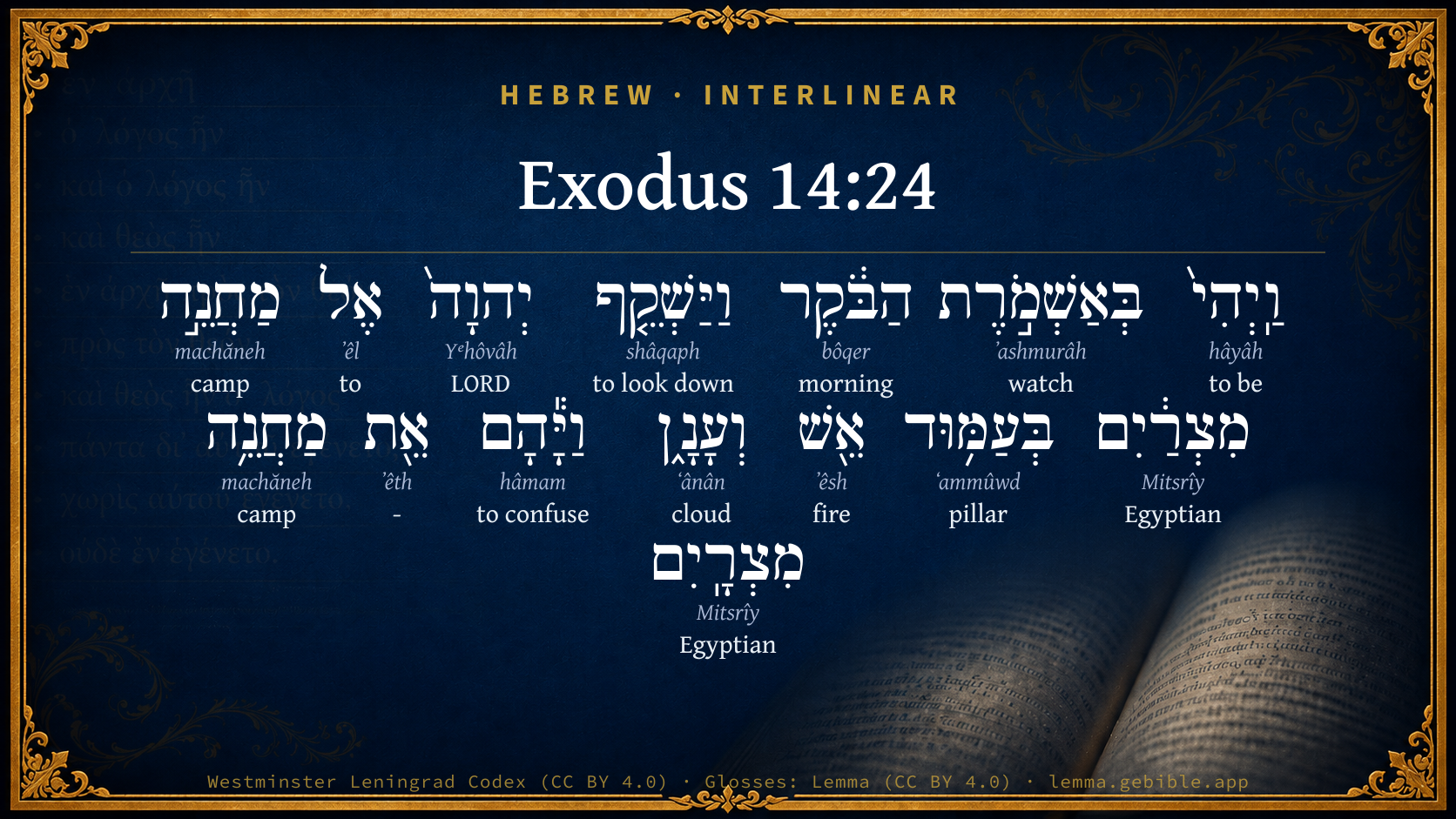
Hebrew (Westminster Leningrad Codex) Exodus 14:24 appears in the Hebrew Old Testament. The text above is from the Westminster Leningrad Codex. Each word links to its Strong’s number, a concise gloss, and parsing drawn from the Open Scriptures Hebrew Bible morphology. Click any word for its full Brown-Driver-Briggs (BDB) entry.
Download image
Cite this verse

Exodus 14:24 (World English Bible). Public Domain. Lemma interlinear Bible study tool, https://lemma.gebible.app/v/exodus/14/24.

Show BibTeX & RIS
BibTeX
RIS
English Translation
It happened in the morning watch, that Yahweh looked out on the host of the Egyptians through the pillar of fire and of cloud, and confused the Egyptian army.
World English Bible · Public Domain
Highlights
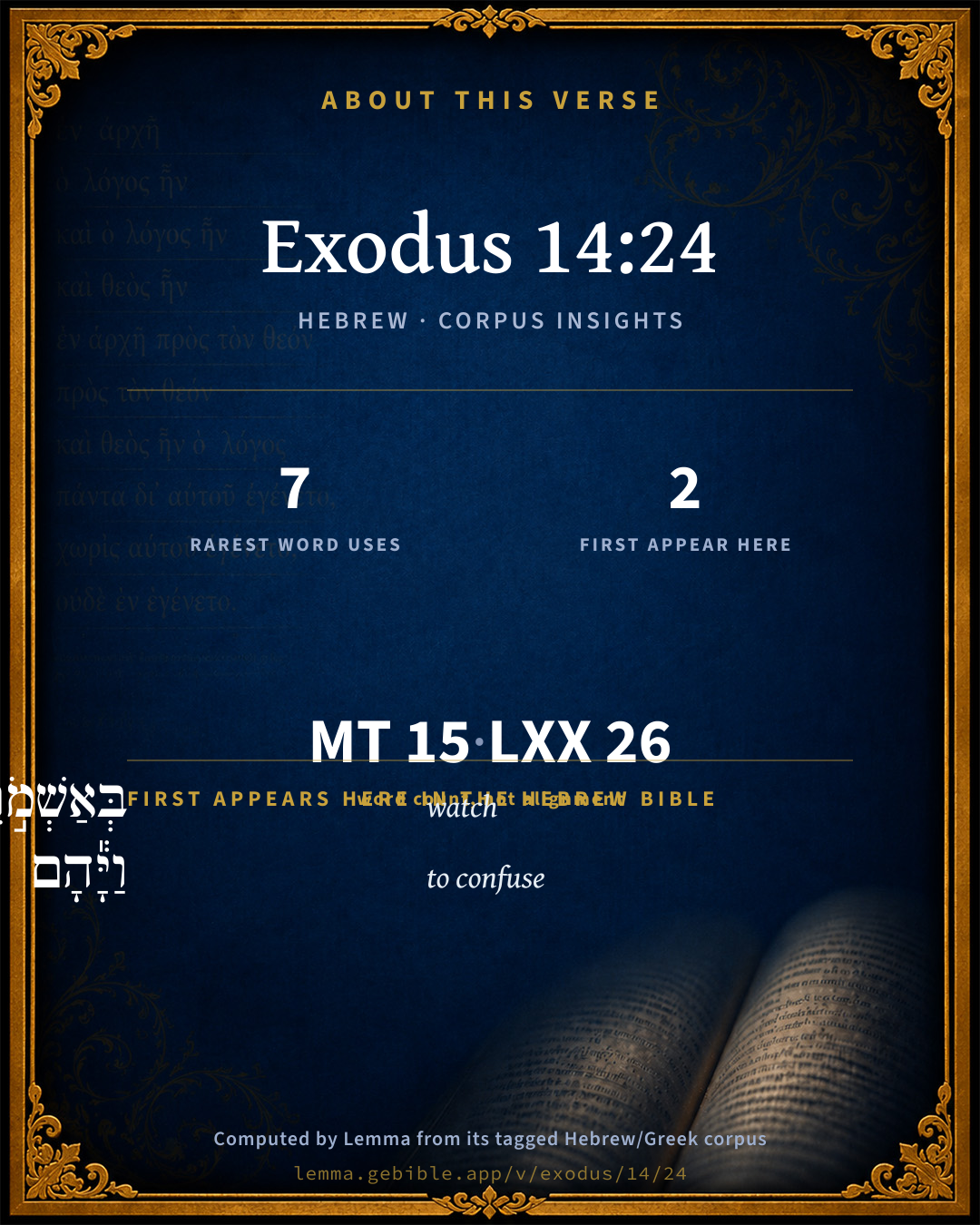
  • 2 first appearances in the Hebrew Bible
Full analysis ↓
Download a study sheet

One document with this verse’s original text, its word-by-word gloss line, the meaning frame, cross-references with their text, attributed commentary, and full source and license credits — printable, and it pastes into notes with its structure intact.

This verse Autodidact and up

Study sheet (.html) Plain text (.txt)

A passage Seminary Student

Up to 50 verses in one chapter. A passage sheet keeps up to 6 commentary sources and 12 cross-references per verse, in the order this page ranks them, and says so on the sheet whenever that leaves anything out. Ask for a single verse and you get the Autodidact verse sheet above.

Everything on this page stays free to read, with no account — the sheet is a download of what is already on screen, not access to it.

Want to remove ads? Support Godless Engineer
Compare translations 3

The same verse in 3 English versions, stacked beneath the original-language interlinear above. Click any original word for its lexicon entry.

Each is an independent rendering of the whole verse — the interlinear is not word-aligned to these translations.

Highlighted words mark where these versions differ — a whole-verse word diff, not a word-by-word alignment.

  • World English Bible Public Domain
    It happened in the morning watch, that Yahweh looked out on the host of the Egyptians through the pillar of fire and of cloud, and confused the Egyptian army.
  • King James Version Public Domain
    And it came to pass, that in the morning watch the LORD looked unto the host of the Egyptians through the pillar of fire and of the cloud, and troubled the host of the Egyptians,
  • unfoldingWord Literal Text CC BY-SA 4.0
    And so it was, in the watch of the morning, Yahweh looked down on the camp of the Egyptians through the pillar of fire and cloud. And he confused the camp of the Egyptians.

unfoldingWord Literal Text — © unfoldingWord, licensed CC BY-SA 4.0. Word-aligned USFM3 via Door43 (git.door43.org/unfoldingWord/en_ult).

Versions to compare (up to 4)

3 of 4 selected

Show all 18 translations

Every available English version of this verse, each an independent rendering of the whole verse.

  • World English Bible Public Domain
    It happened in the morning watch, that Yahweh looked out on the host of the Egyptians through the pillar of fire and of cloud, and confused the Egyptian army.
  • Berean Standard Bible Public Domain
    At morning watch, however, the LORD looked down on the army of the Egyptians from the pillar of fire and cloud, and He threw their camp into confusion.
  • Majority Standard Bible Public Domain
    At morning watch, however, the LORD looked down on the army of the Egyptians from the pillar of fire and cloud, and He threw their camp into confusion.
  • King James Version Public Domain
    And it came to pass, that in the morning watch the LORD looked unto the host of the Egyptians through the pillar of fire and of the cloud, and troubled the host of the Egyptians,
  • American Standard Version (1901) Public Domain
    And it came to pass in the morning watch, that Jehovah looked forth upon the host of the Egyptians through the pillar of fire and of cloud, and discomfited the host of the Egyptians.
  • Revised Version (1885) Public Domain
    And it came to pass in the morning watch, that the LORD looked forth upon the host of the Egyptians through the pillar of fire and of cloud, and discomfited the host of the Egyptians.
  • Geneva Bible (1599) Public Domain
    Nowe in the morning watche, when the Lord looked vnto the hoste of the Egyptians, out of the firie and cloudie pillar, he strooke the host of the Egyptians with feare.
  • Douay-Rheims (1899) Public Domain
    And now the morning watch was come, and behold the Lord looking upon the Egyptian army through the pillar of fire and of the cloud, slew their host.
  • Young's Literal Translation Public Domain
    and it cometh to pass, in the morning watch, that Jehovah looketh unto the camp of the Egyptians through the pillar of fire and of the cloud, and troubleth the camp of the Egyptians,
  • Literal Standard Version CC BY-SA 4.0
    and it comes to pass, in the morning watch, that YHWH looks to the camp of the Egyptians through the pillar of fire and of the cloud, and troubles the camp of the Egyptians,
  • Unlocked Literal Bible CC BY-SA 4.0
    But in the early morning hours, Yahweh looked down on the Egyptian army through the pillar of fire and cloud. He caused panic among the Egyptians.
  • unfoldingWord Literal Text CC BY-SA 4.0
    And so it was, in the watch of the morning, Yahweh looked down on the camp of the Egyptians through the pillar of fire and cloud. And he confused the camp of the Egyptians.
  • Darby Bible Public Domain
    And it came to pass in the morning watch, that Jehovah looked upon the camp of the Egyptians, in the pillar of fire and of the cloud, and embarrassed the camp of the Egyptians.
  • World Messianic Bible Public Domain
    In the morning watch, the LORD looked out on the Egyptian army through the pillar of fire and of cloud, and confused the Egyptian army.
  • Webster's Bible Public Domain
    And it came to pass, that, in the morning-watch, the LORD looked to the host of the Egyptians through the pillar of fire, and of the cloud, and troubled the host of the Egyptians,
  • Free Bible Version CC BY-SA 4.0
    But at the end of the night the Lord looked down on the Egyptian army from the pillar of fire and cloud, and he threw them into a panic.
  • Bible in Basic English Public Domain
    And in the morning watch, the Lord, looking out on the armies of the Egyptians from the pillar of fire and cloud, sent trouble on the army of the Egyptians;
  • JPS Tanakh (1917) Public Domain
    And it came to pass in the morning watch, that the LORD looked forth upon the host of the Egyptians through the pillar of fire and of cloud, and discomfited the host of the Egyptians.

Literal Standard Version (2020), Covenant Press — licensed CC BY-SA 4.0. Text via the HelloAO Bible API (eBible.org). Unlocked Literal Bible (unfoldingWord) — licensed CC BY-SA 4.0. Text via the HelloAO Bible API (eBible.org). unfoldingWord Literal Text — © unfoldingWord, licensed CC BY-SA 4.0. Word-aligned USFM3 via Door43 (git.door43.org/unfoldingWord/en_ult). Free Bible Version, Dr. Jonathan Gallagher — licensed CC BY-SA 4.0. Text via the HelloAO Bible API (eBible.org).

Word by word

More ways to search: Search by grammar → Find every occurrence → Compare this word →

Practice this passage: Drill this verse → Learn its vocabulary →

בְּאַשְׁמֹ֣רֶת
ʼashmurâh
H821
“in/at · watch of”
Preposition + Noun, Common, Feminine, Singular, Construct
Part of Speech
Preposition + Noun
Type
Common
Gender
Feminine
Number
Singular
State
Construct
Full BDB Definition

Origin: from H8104

TWOT: 2414e

watch (a period of time), night-watch
  1. וַֽיְהִי֙ hâyâh H1961 “and · to be” Conjunction + Verb, Qal, Sequential Imperfect, 3rd Person, Masculine, Singular
  2. הַבֹּ֔קֶר bôqer H1242 “the · morning” Particle, Definite Article + Noun, Common, Masculine, Singular, Absolute
  3. וַיַּשְׁקֵ֤ף shâqaph H8259 “and · to look down” Conjunction + Verb, Hiphil, Sequential Imperfect, 3rd Person, Masculine, Singular
  4. יְהוָה֙ Yᵉhôvâh H3068 “LORD” Noun, Proper
  5. אֶל ʼêl H413 “to” Preposition
  6. מַחֲנֵ֣ה machăneh H4264 “camp of” Noun, Common, Both, Singular, Construct
  7. מִצְרַ֔יִם Mitsrîy H4713 “Egyptian” Noun, Proper
  8. בְּעַמּ֥וּד ʻammûwd H5982 “in/at · pillar of” Preposition + Noun, Common, Masculine, Singular, Construct
  9. אֵ֖שׁ ʼêsh H784 “fire” Noun, Common, Both, Singular, Absolute
  10. וְעָנָ֑ן ʻânân H6051 “and · cloud” Conjunction + Noun, Common, Masculine, Singular, Absolute
  11. וַיָּ֕הָם hâmam H2000 “and · to confuse” Conjunction + Verb, Qal, Sequential Imperfect, 3rd Person, Masculine, Singular
  12. אֵ֖ת ʼêth H853 “-” Particle, Direct Object
  13. מַחֲנֵ֥ה machăneh H4264 “camp of” Noun, Common, Both, Singular, Construct
  14. מִצְרָֽיִם Mitsrîy H4713 “Egyptian” Noun, Proper

About this verse

These counts appear in no published source. They are computed here, from the morphology-tagged text and Lemma’s own curated glosses. What Lemma adds →

15
words
13
distinct lemmas
Pentateuch
section

Notable vocabulary

The rarest word here is בְּאַשְׁמֹ֣רֶת watch H821 — appearing just 7 times in the whole Hebrew Bible.

First appearance in Scripture

These words make their first canonical appearance in the Hebrew Bible here:

  • בְּאַשְׁמֹ֣רֶת watch H821
  • וַיָּ֕הָם to confuse H2000

Shared distinctive vocabulary

בְּאַשְׁמֹ֣רֶת watch H821 occurs in 7 verses of the Hebrew Bible. Also found in:

Grammatical profile

  • 3 verbs
  • 10 nouns
  • 1 preposition
  • 1 particle

Verb forms

  • וַֽיְהִי֙ Qal · Sequential Imperfect
  • וַיַּשְׁקֵ֤ף Hiphil · Sequential Imperfect
  • וַיָּ֕הָם Qal · Sequential Imperfect

Repetition

Words recur within this verse — often emphatic in Hebrew:

  • מַחֲנֵ֣ה camp H4264 ×2
  • מִצְרַ֔יִם Egyptian H4713 ×2

Hebrew & Septuagint length

In English translation the verse runs 29 words from the Hebrew and 34 from the Septuagint (LXX English) — closely comparable.

A rough comparison of the two English renderings, which tokenize alike — not a word-level alignment.

Word counts can differ between the Hebrew and the Greek without any difference in meaning — e.g. the Hebrew direct-object marker אֵת has no separate Greek word, and Greek often adds the article ὁ.

In the original languages it is 15 Hebrew tokens and 26 Greek tokens — but the two are counted differently (Hebrew bundles its prefixes and suffixes into one token; the Greek is in lemma form), so that isn’t a like-for-like length.

Cross-references

13

Topical passages linked to Exodus 14:24 in the Treasury of Scripture Knowledge — connected by theme and wording, ordered by reader-vote popularity; previews shown in the World English Bible.

  • Exodus 13:21 Yahweh went before them by day in a pillar of cloud, to lead them on their way, and by night in a pillar of fire, to give them light, that they might go by day and by night:
  • Exodus 14:25 He took off their chariot wheels, and they drove them heavily; so that the Egyptians said, "Let's flee from the face of Israel, for Yahweh fights for them against the Egyptians!"
  • Psalms 77:16–19 The waters saw you, God. The waters saw you, and they writhed. The depths also convulsed.
  • Exodus 14:19–20 The angel of God, who went before the camp of Israel, moved and went behind them; and the pillar of cloud moved from before them, and stood behind them.
  • Job 23:15–16 Therefore I am terrified at his presence. When I consider, I am afraid of him.
  • Job 34:20 In a moment they die, even at midnight; The people are shaken and pass away, The mighty are taken away without hand.
  • Job 34:29 When he gives quietness, who then can condemn? When he hides his face, who then can see him? Alike whether to a nation, or to a man:
  • Job 40:12 Look on everyone who is proud, and humble him. Crush the wicked in their place.
  • Psalms 18:13–14 Yahweh also thundered in the sky, The Most High uttered his voice: Hailstones and coals of fire.
  • Psalms 48:5 They saw it, then they were amazed. They were dismayed, They hurried away.
  • 1 Samuel 11:11 It was so on the next day, that Saul put the people in three companies; and they came into the midst of the camp in the morning watch, and struck the Ammonites until the heat of the day: and it happened, that those who remained were scattered, so that no two of them were left together.
  • Job 22:13 You say, 'What does God know? Can he judge through the thick darkness?
  • Psalms 104:32 He looks at the earth, and it trembles. He touches the mountains, and they smoke.

Cross-references courtesy of OpenBible.info (CC BY 4.0).

Hebrew and Greek witnesses Masoretic Hebrew ↔ Greek Septuagint

The same verse in the two great witnesses to the Old Testament, shown verse-for-verse.

These are two independent witnesses, not word-aligned to each other, and the Septuagint is shown in lemma (dictionary) form.

Hebrew Exodus 14:24 Masoretic · Westminster Leningrad Codex

וַֽיְהִי֙ בְּאַשְׁמֹ֣רֶת הַבֹּ֔קֶר וַיַּשְׁקֵ֤ף יְהוָה֙ אֶל מַחֲנֵ֣ה מִצְרַ֔יִם בְּעַמּ֥וּד אֵ֖שׁ וְעָנָ֑ן וַיָּ֕הָם אֵ֖ת מַחֲנֵ֥ה מִצְרָֽיִם

It happened in the morning watch, that Yahweh looked out on the host of the Egyptians through the pillar of fire and of cloud, and confused the Egyptian army.

World English Bible · Public Domain

Greek LXX Exodus 14:24 Septuagint · lemma form

γίγνομαι δέ ἐν ὁ φυλακή ὁ ἑωθινός καί ἐπιβλέπω κύριος ἐπί ὁ παρεμβολή ὁ αἰγύπτιος ἐν στῦλος πῦρ καί νεφέλη καί συνταράσσω ὁ παρεμβολή ὁ αἰγύπτιος

And it came to pass in the morning watch that the Lord looked forth on the camp of the Egyptians through the pillar of fire and cloud, and troubled the camp of the Egyptians,

LXX2012 (modern English Septuagint) · Public Domain

On this verse, The Pulpit Commentary discusses the Septuagint’s reading. Read the note in Commentary ↓

Hebrew: Westminster Leningrad Codex (CC BY 4.0). Greek: Septuagint (public domain); English from LXX2012 (modern English Septuagint) (Public Domain). How the Septuagint differs from the Hebrew →

Targum (Aramaic paraphrase)

2

The Targum is the ancient Jewish Aramaic paraphrase of the Hebrew Scriptures — an interpretive translation, not the Hebrew text itself. Onkelos (literal) and Pseudo-Jonathan (expansive) render the Torah, and Jonathan the Prophets. Coverage is partial: where no permissively-licensed English translation exists for a verse, only the Aramaic is shown. This is verse-level text, not a word-by-word alignment to the Hebrew.

  1. Targum Onkelos Torah (Genesis–Deuteronomy)
    וַהֲוָה בְּמַטְרַת צַפְרָא וְאִסְתְּכֵי יְיָ לְמַשְׁרִיתָא דְמִצְרָאֵי בְּעַמוּדָא דְאֶשָׁתָא וַעֲנָנָא וְשַׁגִישׁ יָת מַשְׁרִיתָא דְמִצְרָאֵי:

    (no public-domain English translation for this verse)

    Targum Onkelos — Aramaic: “Onkelos Genesis” (public domain); “Onkelos Exodus” (public domain); “Onkelos Leviticus” (public domain); “Onkelos Numbers” (public domain); “Onkelos Deuteronomy” (public domain). English: “Sefaria Community Translation” (CC0 1.0 (public-domain dedication)); “J.W. Etheridge. The Targums of Onkelos and Jonathan Ben Uzziel on the Pentateuch. London: Longmans, Green, 1862” (public domain). Text via Sefaria.

  2. Targum Pseudo-Jonathan Torah (Genesis–Deuteronomy)
    וַהֲוָה בְּמַטְרַת צַפְרָא בְּעִידָנָא דְאַתְיַין חַיְילֵי מְרוֹמָא לְשַׁבָּחָא וְאוֹדִיק יְיָ בִּרְגוֹז עֲלוֹי מַשְׁרִיתְהוֹן דְּמִצְרָאֵי בְּעַמּוּדָא דְאֵישָׁתָא לְמִירְמֵי עֲלֵיהוֹן גּוּמְרִין דְּאֵישָׁא וּבְעַמּוּדָא דַעֲנָנָא לְמִרְמָא עֲלֵיהוֹן בַּרְדִין וְשָׁעֲמָם יַת מַשִּׁרְיַית מִצְרָאֵי

    And it was that in the morning watch, at the time that the powers on high come to offer praise, the Lord looked forth with anger upon the hosts of the Mizraee from the column of fire, to hurl upon them flakes of fire and hail, and from the column of cloud, and confounded the host of the Mizraee

    Targum Pseudo-Jonathan — Aramaic: “Targum Jonathan on Genesis” (public domain); “Targum Jonathan on Exodus” (public domain); “Targum Jonathan on Leviticus” (public domain); “Targum Jonathan on Numbers” (public domain); “Targum Jonathan on Deuteronomy” (public domain). English: “The Targum of Jonathan ben Uzziel, trans. J. W. Etheridge, London, 1862” (public domain). Text via Sefaria.

Commentary

Notes on Exodus 14:24 from classic Christian and Jewish commentators (each source and its license shown beneath its notes). The classic Christian expositions comment on the surrounding passage and are grouped to its opening verse, so a note may address several verses; the Jewish commentaries on the Tanakh (Rashi and others) are per-verse, so they appear only where the commentator wrote on this verse.

Lemma curates 59 commentaries, every one of them public domain or Creative Commons licensed, each selected and text-cleaned for this edition rather than reprinted as found. About our sources →

Trapp's Complete Commentary

John Trapp

Exo 14:24 And it came to pass, that in the morning watch the LORD looked unto the host of the Egyptians through the pillar of fire and of the cloud, and troubled the host of the Egyptians,

Ver. 24. In the morning watch.] God "watcheth upon the evil to bring it" upon his enemies then when he may do them a greatest mischief. {Dan 9:14} He picketh his times for vengeance: "Now will I rise, saith the Lord; now will I be exalted; now will I lift up myself." {Isa 33:10}

The Lord looked unto the host.] He set his eyes upon them; as Paul did upon Elymus the sorcerer; with highest offence, and utmost indignation. After which lightning follows that terrible thunderclap, wherewith he troubled them and took off their wheels. See Psa 77:18-19; Psa 18:15.

John Trapp, A Commentary or Exposition upon All the Books of the Old and New Testament (1647–1656) — public domain. Text from a community e-Sword module.

Joseph Benson's Commentary

Exo 14:24. The Lord — Called the angel before; looked unto the host of the Egyptians — He looked upon them in anger, Psa 104:32. He visited them with marks of his displeasure, and troubled the Egyptians with terrible winds, lightnings, and thunders, Exo 15:10; Psa 77:18-19; also, with terror of mind. Through the pillar of fire and of the cloud — It seems not improbable but that, whereas the cloudy part of the pillar had been toward the Egyptians hitherto, it now turned the other side toward them, and confounded them with showing them their situation.

Joseph Benson's Commentary on the Old and New Testaments (1811–1818) — public domain. Text from a community e-Sword module.

Geneva Bible (1599)

Geneva Bible translators

Which was about the three last hours of the night.

Geneva Bible (1599) marginal notes — public domain. Text via Bolls.life.

Jamieson, Fausset & Brown

Robert Jamieson, A. R. Fausset & David Brown

Lord looked . . . through . . . the cloud, and troubled them--We suppose the fact to have been that the side of the pillar of cloud towards the Egyptians was suddenly, and for a few moments, illuminated with a blaze of light, which, coming as it were in a refulgent flash upon the dense darkness which had preceded, so frightened the horses of the pursuers that they rushed confusedly together and became unmanageable. "Let us flee," was the cry that resounded through the broken and trembling ranks, but it was too late; all attempts at flight were vain [BUSH].

Jamieson, Fausset & Brown — Commentary Critical and Explanatory on the Whole Bible (1871) — public domain (CC PDM 1.0). Text via the HelloAO Bible API.

Adam Clarke's Commentary

Verse 24. The morning watch] A watch was the fourth part of the time from sun-setting to sun-rising; so called from soldiers keeping guard by night, who being changed four times during the night, the periods came to be called watches. - Dodd.

As here and in 1Sa 11:11 is mentioned the morning watch; so in La 2:19, the beginning of the watches; and in Jud 7:19, the middle watch is spoken of; in Lu 12:38, the second and third watch; and in Mt 14:25, the fourth watch of the night; which in Mr 13:35 are named evening, midnight, cock-crowing, and day-dawning. - Ainsworth.

As the Israelites went out of Egypt at the vernal equinox, the morning watch, or, according to the Hebrew, באשמרת הבקר beashmoreth habboker, the watch of day-break, would answer to our four o'clock in the morning. - Calmet.

The Lord looked unto] This probably means that the cloud suddenly assumed a fiery appearance where it had been dark before; or they were appalled by violent thunders and lightning, which we are assured by the psalmist did actually take place, together with great inundations of rain, c.: The clouds POURED OUT WATER the skies sent out a SOUND: thine ARROWS also went abroad. The VOICE of thy THUNDER was in the heaven; the LIGHTNINGS LIGHTENED the world; the earth TREMBLED and SHOOK. Thy way is in the sea, and thy path in the great waters. Thou leddest thy people like a flock, by the hand of Moses and Aaron; Ps 77:17-20. Such tempests as these would necessarily terrify the Egyptian horses, and produce general confusion. By their dashing hither and thither the wheels must be destroyed, and the chariots broken; and foot and horse must be mingled together in one universal ruin; see Ex 14:25. During the time that this state of horror and confusion was at its summit the Israelites had safely passed over; and then Moses, at the command of God, (Ex 14:26), having stretched out his rod over the waters, the sea returned to its strength; (Ex 14:27); i.e., the waters by their natural gravity resumed their level, and the whole Egyptian host were completely overwhelmed, Ex 14:28. But as to the Israelites, the waters had been a wall unto them on the right hand and on the left, Ex 14:29. This the waters could not have been, unless they had been supernaturally supported; as their own gravity would necessarily have occasioned them to have kept their level, or, if raised beyond it, to have regained it if left to their natural law, to which they are ever subject, unless in cases of miraculous interference. Thus the enemies of the Lord perished; and that people who decreed that the male children of the Hebrews should be drowned, were themselves destroyed in the pit which they had destined for others. God's ways are all equal; and he renders to every man according to his works.

Adam Clarke's Commentary on the Bible (1810–1826) — public domain. Text from a community e-Sword/MySword module.

Ellicott's Commentary for English Readers

(24) In the morning watch.—Between 2 a.m. and 6.

A Bible Commentary for English Readers, edited by Charles John Ellicott (1878–1897) — public domain. Text from a community e-Sword module.

The Cambridge Bible for Schools and Colleges

gen. ed. J. J. S. Perowne

24. the morning watch] The Hebrews divided the night into three ‘watches,’ each of about four hours, the ‘morning watch’ (also Exo 1Sa_11:11) would be from about 2 to 6 a.m.; the ‘middle watch’ is mentioned in Jdg_7:19. Cf. Luk_12:38. In the NT., however, the Roman division into four watches is also followed, Mat_14:25 = Mar_6:48; cf. Mar_13:35.

looked forth] Notice the graphic anthropomorphism. Perhaps the idea is, with fiery flashes, startling the Egyptians, and throwing them into a panic. The author of Psa_77:17-19 pictured torrents of rain, with brilliant lightnings and loud thunder (cf. Psa_81:7), as accompanying the passage of the Red Sea: Jos. Ant. ii. 16. 3 describes it similarly.

host (twice)] Heb. camp, as v. 20. Not the word (ḥayil) rendered ‘host’ in vv. 4, 17, 28, and ‘army’ in v. 9.

discomfited] i.e. threw into panic or confusion: Exo_23:27, Deu_2:15; Deu_7:23, Jos_10:10 al.

24, 25. Premonitory warnings of the disaster about to fall upon the Egyptians.

The Cambridge Bible for Schools and Colleges (gen. ed. J. J. S. Perowne; Cambridge University Press, 1878–1918) — public domain. Text from a community e-Sword module.

John Gill's Exposition

And it came to pass, that in the morning watch,.... The Romans divided the night into four watches, so the Hebrews; though some say into three only. The first began at six o'clock, and lasted till nine, the second was from thence to twelve, the third from thence to three in the morning, and the last from three to six, which is here called the morning watch; so that this was some time between three and six o'clock in the morning:

the Lord looked unto the host of the Egyptians, through the pillar of fire and of the cloud; the Angel of the Lord, and who was Jehovah himself, who was in it, he looked to the army of the Egyptians; not to know whereabout they were, he being the omniscient God; nor in a friendly manner, but as an enemy, with indignation and wrath. The Targum of Jonathan is,"he looked through the pillar of fire, to cast upon them coals of fire, and through the pillar of cloud, to cast upon them hailstones.''The Jerusalem Targum is,"pitch, fire, and hailstones;''and Josephus (q) speaks of storms and tempests, of thunder and lightning, and of thunderbolts out of the clouds; and Artapanus (r) of fire or lightning flashing out against them, by which many perished. Perhaps the psalmist may have reference to this in Psa 106:10.

and troubled the host of the Egyptians; the thunder and lightning no doubt frightened the horses, so that they broke their ranks, and horsemen and chariots might run foul on one another, and the hailstones scatter and destroy many; however, the whole must be terrible and distressing to them, especially it being in the night season.

(q) Ut supra. (Antiqu. l. 2. c. 16. sect. 2.) (r) Apud Euseb. ut supra. (Praepar. Evangel. l. 9. c. 27. p. 436.)

John Gill's Exposition of the Whole Bible (1746–1763) — public domain (CC PDM 1.0). Text via the HelloAO Bible API.

Albert Barnes' Notes on the Bible

In the morning watch - At sunrise, a little before 6 a.m.in April.

Troubled - By a sudden panic.

Albert Barnes' Notes on the Bible (1834–1885) — public domain. Text from a community e-Sword/MySword module.

Haydock's Catholic Bible Commentary

Watch. About four o’clock. The Hebrews divided the night into three equal parts, (Calmet) or four, consisting each of three hours, (Menochius) which varied in length as the night was longer. (Haydock) --- Slew many by his thunderbolts, as Artapanus relates, and the Scripture elsewhere insinuates. (Chap. xv. 6, 12; Psalm lxxvi. 16, 18; Josephus, [Antiquities?] ii. 7.

George Leo Haydock (1774–1849), Haydock's Catholic Family Bible and Commentary, 1859 edition — public domain. Excludes Psalms (Douay-Rheims chapter numbering differs from Protestant) and Deuterocanonical books (Catholic canon only).

Matthew Poole's English Annotations

The night was anciently divided, not by hours, as now it is, but by watches, which sometimes were accounted four, and sometimes but three; howsoever the last of them was called the morning watch. Then when they hoped for most advantage in the pursuit, they met with their greatest disaster.

The Lord; called the Angel of God, Exo 14:19. By which promiscuous use of these titles it sufficiently appears that this was no ordinary angel, but the Son of God.

The Lord looked with an eye of indignation and vengeance, (as that phrase is used, Job 40:12 see also Amo 9:4), and troubled them with most terrible and prodigious winds, and rains, and lightnings, and both claps and bolts of thunder, as may be gathered from Exo 15:10; Psa 77:18,19; and, as some ancient historians relate, with terrors also in their minds, &c.

Matthew Poole's English Annotations on the Holy Bible (1683–1685) — public domain. Text from a community e-Sword/MySword module.

Whedon's Commentary on the Bible

Daniel D. Whedon

24. In the morning watch — In New Testament times, the Jews divided the night into four watches, but in the Old Testament history mention is made of three only: the first, or “beginning of the watches,” from sunset to ten P.M., (Lam_2:19;) the “middle watch,” from ten P.M. to two A.M., (Jdg_7:10;) and the morning watch, from two A.M. to sunrise. It was, then, after two o’clock in the morning when the cloud, that had hung like a black curtain over and before the Egyptians, opened, and Jehovah “looked upon them” through his lightnings. Thus the Psalmist describes the scene. To appreciate its awfulness to the Egyptians we must remember that thunder and lightning are extremely rare in Egypt, and that the fearful grandeur of our thunderstorms is there wholly unknown. “The clouds streamed water, the skies lifted up their voice, yea, thine arrows (thunderbolts) flew. The voice of thy crash rolled round, (like a chariot in heaven;) lightnings illumined the world; trembled and shook the earth.” Psa_77:17-18.

Daniel D. Whedon (gen. ed.), Commentary on the Old and New Testaments (1874–1909) — public domain. Text from a community e-Sword module.

The Pulpit Commentary

In the morning watch. The morning watch" of the Hebrews at this period of their history lasted from 2 a.m. to sunrise. Sunrise in Egypt, early in April, would take place about a quarter to six. The Lord looked unto the host of the Egyptians. The description in Psa_77:17, Psa_77:18, is generally regarded as belonging to this point in the narrative of the Exodus, and may be considered as the traditional exposition of it. The clouds poured out water: the skies sent out a sound; thine arrows also went abroad; the voice of thy thunder was in the heavens; the lightning lightened the world; the earth trembled and shook. " As Josephus says Showers of rain came down from the sky, and dreadful thunders and lightning, with flashes of fire; thunderbolts also were darted upon them; nor was there anything, wont to be sent by God upon men as indications of his wrath, which did not happen upon this occasion" (Ant. Jud: 2:16, And troubled the host. Or disturbed the host," i.e., threw it into confusion. (sunetaraxe, LXX).

The Pulpit Commentary (1880–1919), ed. H.D.M. Spence-Jones & Joseph S. Exell — public domain. Text from a community e-Sword module.

John Wesley's Explanatory Notes

The Lord - Called the angel before, looked - With indignation, upon the Egyptians, and troubled the Egyptians - With terrible winds and lightnings and thunders, chap. xv, 10, Psalm lxxvii, 18, 19. Also with terror of mind.

John Wesley, Explanatory Notes Upon the Whole Bible (1754–1765) — public domain. Text via the GEBible commentary corpus.

Rashi

Rabbi Shlomo Yitzchaki (Rashi)

באשמרת הבקר IN THE MORNING WATCH — The three divisions of the night are each called an אשמורה “a watch” (Berakhot 3b), and that which immediately precedes the morning is called “the morning watch”. I am of opinion that because the night is divided for the watches (משמרות) of the song of the ministering angels — company after company — into three divisions, therefore each division of the night is termed, for all purposes, an אשמרת (another form of משמר the angel’s watch), and this is what Onkelos has in mind when he translates אשמרת by מטרת.

‎ וישקף means HE LOOKED, as much as to say, He turned towards them to destroy them (cf. Rashi on Genesis 18:16), and its rendering in the Targum, ואסתכי, is also an expression denoting looking, just as he translates (Numbers 23:14), “the field of the watchers (צפים)” by “the field of,סכותא” which denotes “looking”.

בעמוד אש וענן THROUGH THE PILLAR OF FIRE AND CLOUD — viz., the pillar of cloud descended and made it (the bed of the sea) like clay, and the pillar of fire made it boiling hot so that the horses’ hoofs fell off (Mekhilta).

ויהם has the meaning of confusion. old French estordison. He cast them into confusion; He took away their ensigns. And we read in the Chapters of Rabbi Eliezer, the son of Rabbi José, the Galilean: Wherever it speaks of מהומה (forms from the root המם) it signifies a thundering sound; and the following passage is the father of all of them (i. e. that from which this meaning is quite evident): (I Samuel 7:10) “And the Lord thundered with a great sound … upon the Philistines and discomfited them (ויהמם)”.

Rashi on the Tanakh — English translations: “The Judaica Press complete Tanach with Rashi, translated by A. J. Rosenberg” (CC BY 4.0); “Pentateuch with Rashi's commentary by M. Rosenbaum and A.M. Silbermann, 1929-1934” (public domain); “The Metsudah Tanach series, Lakewood, N.J” (CC BY 4.0); and “The Book of Joshua, Metsudah Publications, 1997” (CC BY 4.0). Text via Sefaria.

Lesson kit

Teaching starters — assembled from the data on this page, not authored interpretation. Every prompt links to the verse data it draws on. Edit before teaching.

Exodus, in the Pentateuch, opens this verse with 15 words (13 distinct Hebrew lemmas). Its most distinctive word is ʼashmurâh (“watch”). A historical commentator’s framing appears above. Read the whole chapter for the surrounding context.

Discussion questions

  1. How does “watch” (ʼashmurâh) shape what this verse is saying?
  2. 2 words make their first appearance in Scripture here. What does this debut establish?
  3. How does Judges 7:19, which shares the word «watch», read alongside this verse?
  4. What does the repetition of “camp” (2× in this one verse) do in this verse?
  5. These translations render this verse differently; the difference is in the English rendering, not the original. What questions does that raise?
  6. «וַֽיְהִי֙» is a Qal Sequential Imperfect verb. How does that grammatical form shape the action described?
  7. Compare how Trapp's Complete Commentary and Joseph Benson's Commentary read this verse. Where do they agree or differ?

Things to notice

Reading settings

Reading text

Shown beneath each verse's original-language words.

Old Testament
Old Testament edition

Read the OT as the Masoretic Hebrew (MT) or the Greek Septuagint (LXX).

English shown for the Greek Septuagint (in the Hebrew ↔ Greek comparison).

Comparing translations? Open the Compare panel on any verse page to stack up to four side by side.