Leviticus 1:8

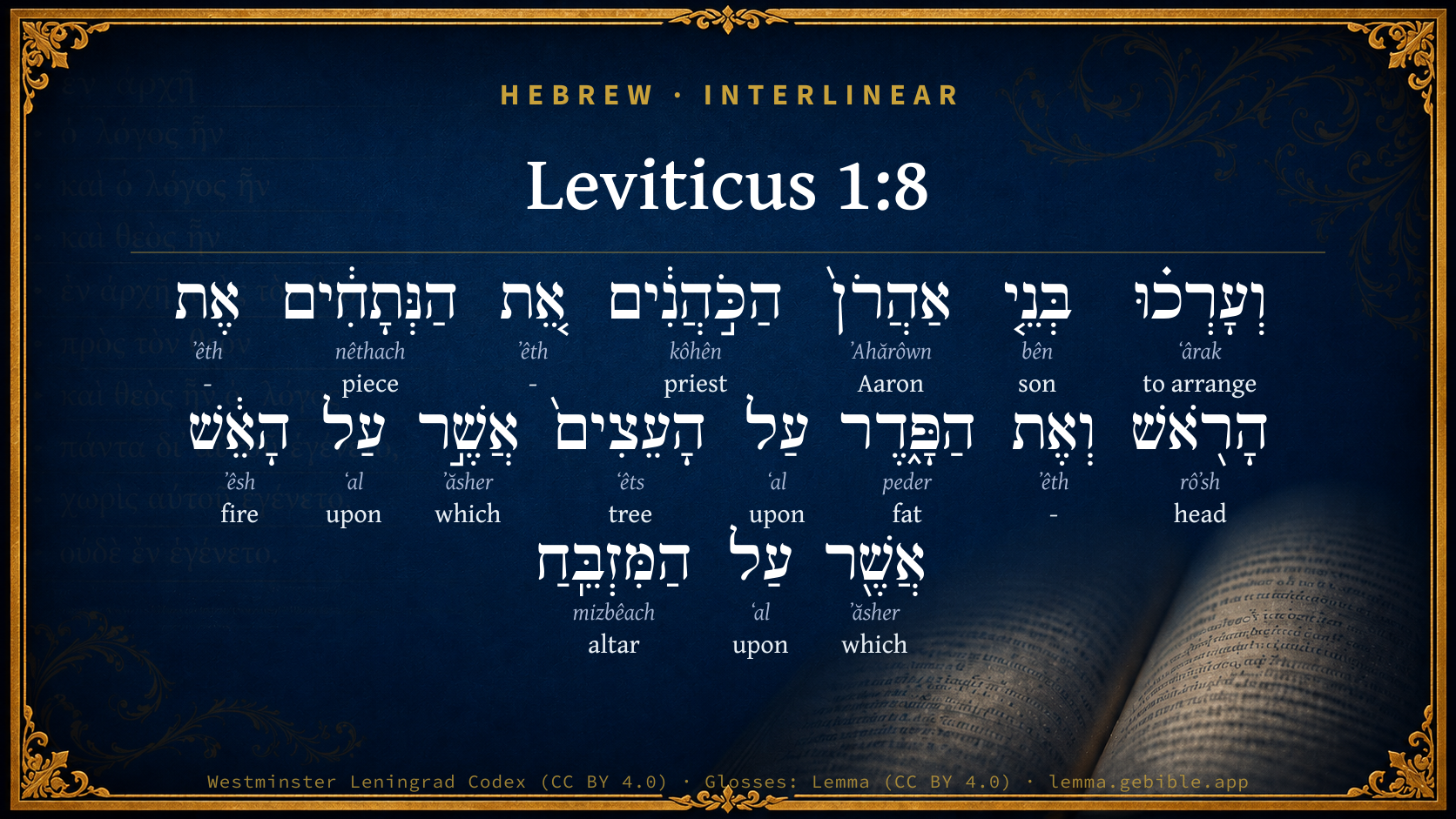
Hebrew (Westminster Leningrad Codex) Leviticus 1:8 appears in the Hebrew Old Testament. The text above is from the Westminster Leningrad Codex. Each word links to its Strong’s number, a concise gloss, and parsing drawn from the Open Scriptures Hebrew Bible morphology. Click any word for its full Brown-Driver-Briggs (BDB) entry.
Download image
Cite this verse

Leviticus 1:8 (World English Bible). Public Domain. Lemma interlinear Bible study tool, https://lemma.gebible.app/v/leviticus/1/8.

Show BibTeX & RIS
BibTeX
RIS
English Translation
and Aaron's sons, the priests, shall lay the pieces, the head, and the fat in order on the wood that is on the fire which is on the altar;
World English Bible · Public Domain
Highlights
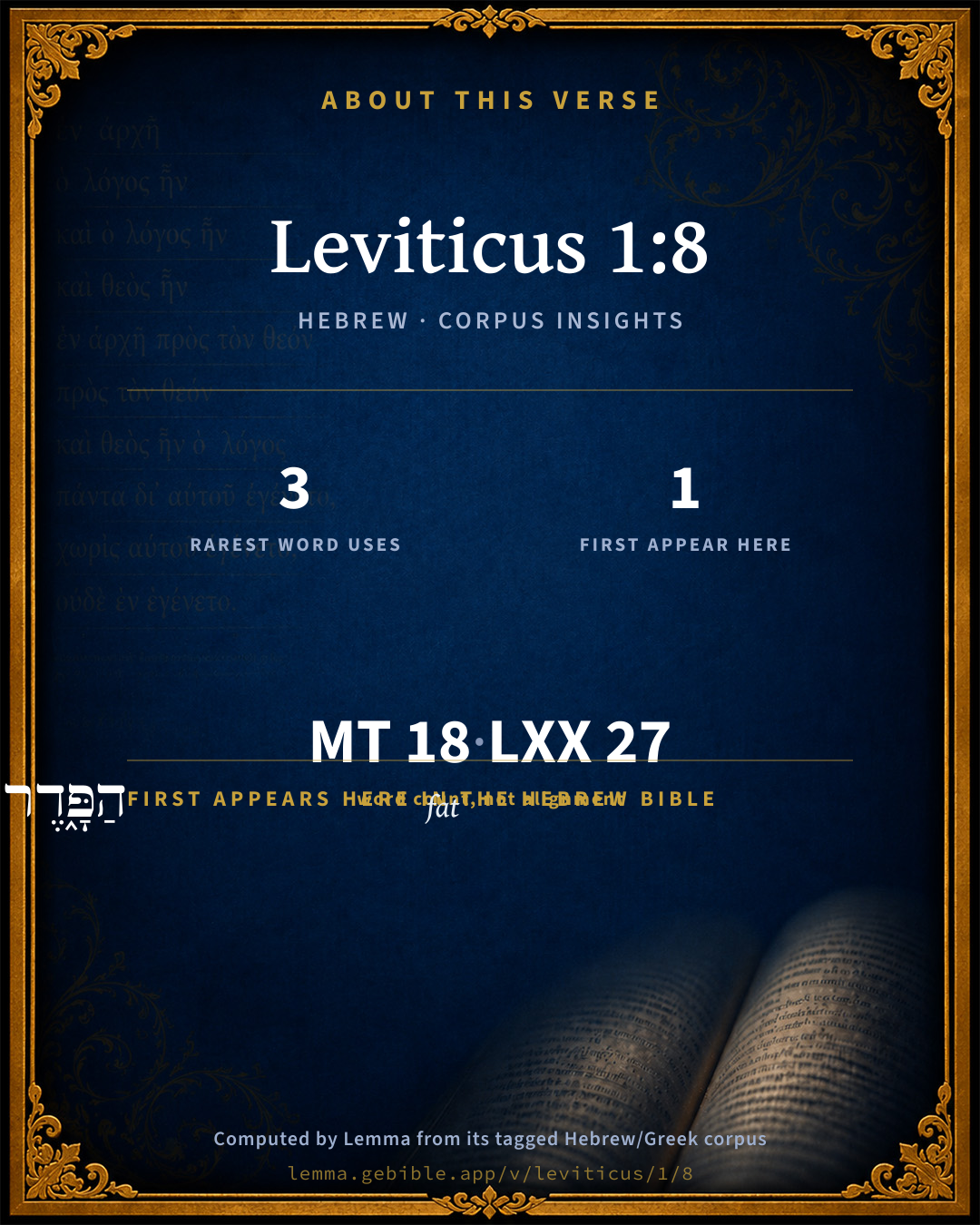
  • 1 first appearance in the Hebrew Bible
Full analysis ↓
Download a study sheet

One document with this verse’s original text, its word-by-word gloss line, the meaning frame, cross-references with their text, attributed commentary, and full source and license credits — printable, and it pastes into notes with its structure intact.

This verse Autodidact and up

Study sheet (.html) Plain text (.txt)

A passage Seminary Student

Up to 50 verses in one chapter. A passage sheet keeps up to 6 commentary sources and 12 cross-references per verse, in the order this page ranks them, and says so on the sheet whenever that leaves anything out. Ask for a single verse and you get the Autodidact verse sheet above.

Everything on this page stays free to read, with no account — the sheet is a download of what is already on screen, not access to it.

Want to remove ads? Support Godless Engineer
Compare translations 3

The same verse in 3 English versions, stacked beneath the original-language interlinear above. Click any original word for its lexicon entry.

Each is an independent rendering of the whole verse — the interlinear is not word-aligned to these translations.

Highlighted words mark where these versions differ — a whole-verse word diff, not a word-by-word alignment.

  • World English Bible Public Domain
    and Aaron's sons, the priests, shall lay the pieces, the head, and the fat in order on the wood that is on the fire which is on the altar;
  • King James Version Public Domain
    And the priests, Aaron's sons, shall lay the parts, the head, and the fat, in order upon the wood that is on the fire which is upon the altar:
  • unfoldingWord Literal Text CC BY-SA 4.0
    And the sons of Aaron, the priests, shall arrange the pieces, the head, and the suet on the wood that on the fire that on the altar.

unfoldingWord Literal Text — © unfoldingWord, licensed CC BY-SA 4.0. Word-aligned USFM3 via Door43 (git.door43.org/unfoldingWord/en_ult).

Versions to compare (up to 4)

3 of 4 selected

Show all 18 translations

Every available English version of this verse, each an independent rendering of the whole verse.

  • World English Bible Public Domain
    and Aaron's sons, the priests, shall lay the pieces, the head, and the fat in order on the wood that is on the fire which is on the altar;
  • Berean Standard Bible Public Domain
    Then Aaron’s sons the priests are to arrange the pieces, including the head and the fat, atop the burning wood on the altar.
  • Majority Standard Bible Public Domain
    Then Aaron’s sons the priests are to arrange the pieces, including the head and the fat, atop the burning wood on the altar.
  • King James Version Public Domain
    And the priests, Aaron's sons, shall lay the parts, the head, and the fat, in order upon the wood that is on the fire which is upon the altar:
  • American Standard Version (1901) Public Domain
    and Aaron's sons, the priests, shall lay the pieces, the head, and the fat, in order upon the wood that is on the fire which is upon the altar:
  • Revised Version (1885) Public Domain
    and Aaron’s sons, the priests, shall lay the pieces, the head, and the fat, in order upon the wood that is on the fire which is upon the altar:
  • Geneva Bible (1599) Public Domain
    Then the Priestes Aarons sonnes shall lay the parts in order, the head and the kall vpon the wood that is in the fire which is vpon the altar.
  • Douay-Rheims (1899) Public Domain
    And they shall lay the parts that are cut out in order thereupon, to wit, the head, and all things that cleave to the liver,
  • Young's Literal Translation Public Domain
    and sons of Aaron, the priests, have arranged the pieces, with the head and the fat, on the wood, which `is' on the fire, which `is' on the altar;
  • Literal Standard Version CC BY-SA 4.0
    and sons of Aaron, the priests, have arranged the pieces, with the head and the fat, on the wood, which [is] on the fire, which [is] on the altar;
  • Unlocked Literal Bible CC BY-SA 4.0
    Aaron's sons, the priests, are to place the pieces, the head and the fat, in order on the wood that is on the fire which is on the altar.
  • unfoldingWord Literal Text CC BY-SA 4.0
    And the sons of Aaron, the priests, shall arrange the pieces, the head, and the suet on the wood that on the fire that on the altar.
  • Darby Bible Public Domain
    and Aaron's sons, the priests, shall lay the pieces, the head, and the fat, in order on the wood that is on the fire which is on the altar;
  • World Messianic Bible Public Domain
    and Aaron’s sons, the priests, shall lay the pieces, the head, and the fat in order on the wood that is on the fire which is on the altar;
  • Webster's Bible Public Domain
    And the priests, Aaron's sons, shall lay the parts, the head, and the fat, in order upon the wood that is on the fire which is upon the altar.
  • Free Bible Version CC BY-SA 4.0
    Then the priests shall carefully place the pieces, including the head and the fat, on the wood burning on the altar.
  • Bible in Basic English Public Domain
    And Aaron's sons, the priests, are to put the parts, the head and the fat, in order on the wood which is on the fire on the altar:
  • JPS Tanakh (1917) Public Domain
    And Aaron's sons, the priests, shall lay the pieces, and the head, and the suet, in order upon the wood that is on the fire which is upon the altar;

Literal Standard Version (2020), Covenant Press — licensed CC BY-SA 4.0. Text via the HelloAO Bible API (eBible.org). Unlocked Literal Bible (unfoldingWord) — licensed CC BY-SA 4.0. Text via the HelloAO Bible API (eBible.org). unfoldingWord Literal Text — © unfoldingWord, licensed CC BY-SA 4.0. Word-aligned USFM3 via Door43 (git.door43.org/unfoldingWord/en_ult). Free Bible Version, Dr. Jonathan Gallagher — licensed CC BY-SA 4.0. Text via the HelloAO Bible API (eBible.org).

Word by word

More ways to search: Search by grammar → Find every occurrence → Compare this word →

Practice this passage: Drill this verse → Learn its vocabulary →

הַפָּ֑דֶר
peder
H6309
“the · fat”
Particle, Definite Article + Noun, Common, Masculine, Singular, Absolute
Part of Speech
Particle + Noun
Type
Common
Gender
Masculine
Number
Singular
State
Absolute
Full BDB Definition

Origin: from an unused root meaning to be greasy

TWOT: 1737

fat, suet
  1. וְעָרְכ֗וּ ʻârak H6186 “and · to arrange” Conjunction + Verb, Qal, Sequential Perfect, 3rd Person, Common, Plural
  2. בְּנֵ֤י bên H1121 “sons of” Noun, Common, Masculine, Plural, Construct
  3. אַהֲרֹן֙ ʼAhărôwn H175 “Aaron” Noun, Proper
  4. הַכֹּ֣הֲנִ֔ים kôhên H3548 “the · priests” Particle, Definite Article + Noun, Common, Masculine, Plural, Absolute
  5. אֵ֚ת ʼêth H853 “-” Particle, Direct Object
  6. הַנְּתָחִ֔ים nêthach H5409 “the · pieces” Particle, Definite Article + Noun, Common, Masculine, Plural, Absolute
  7. אֶת ʼêth H853 “-” Particle, Direct Object
  8. הָרֹ֖אשׁ rôʼsh H7218 “the · head” Particle, Definite Article + Noun, Common, Masculine, Singular, Absolute
  9. וְאֶת ʼêth H853 “and · -” Conjunction + Particle, Direct Object
  10. עַל ʻal H5921 “upon” Preposition
  11. הָעֵצִים֙ ʻêts H6086 “the · trees” Particle, Definite Article + Noun, Common, Masculine, Plural, Absolute
  12. אֲשֶׁ֣ר ʼăsher H834 “which” Particle, Relative
  13. עַל ʻal H5921 “upon” Preposition
  14. הָאֵ֔שׁ ʼêsh H784 “the · fire” Particle, Definite Article + Noun, Common, Both, Singular, Absolute
  15. אֲשֶׁ֖ר ʼăsher H834 “which” Particle, Relative
  16. עַל ʻal H5921 “upon” Preposition
  17. הַמִּזְבֵּֽחַ mizbêach H4196 “the · altar” Particle, Definite Article + Noun, Common, Masculine, Singular, Absolute

About this verse

These counts appear in no published source. They are computed here, from the morphology-tagged text and Lemma’s own curated glosses. What Lemma adds →

18
words
13
distinct lemmas
Pentateuch
section

Notable vocabulary

The rarest word here is הַפָּ֑דֶר fat H6309 — appearing just 3 times in the whole Hebrew Bible.

First appearance in Scripture

This word makes its first canonical appearance in the Hebrew Bible here:

  • הַפָּ֑דֶר fat H6309

Shared distinctive vocabulary

הַפָּ֑דֶר fat H6309 occurs in 3 verses of the Hebrew Bible. Also found in:

Grammatical profile

  • 1 verb
  • 9 nouns
  • 3 prepositions
  • 5 particles

Verb forms

  • וְעָרְכ֗וּ Qal · Sequential Perfect

Repetition

Words recur within this verse — often emphatic in Hebrew:

  • עַל upon H5921 ×3
  • אֲשֶׁ֣ר which H834 ×2

Hebrew & Septuagint length

In English translation the verse runs 29 words from the Hebrew and 32 from the Septuagint (LXX English) — closely comparable.

A rough comparison of the two English renderings, which tokenize alike — not a word-level alignment.

Word counts can differ between the Hebrew and the Greek without any difference in meaning — e.g. the Hebrew direct-object marker אֵת has no separate Greek word, and Greek often adds the article ὁ.

In the original languages it is 18 Hebrew tokens and 27 Greek tokens — but the two are counted differently (Hebrew bundles its prefixes and suffixes into one token; the Greek is in lemma form), so that isn’t a like-for-like length.

Cross-references

6

Topical passages linked to Leviticus 1:8 in the Treasury of Scripture Knowledge — connected by theme and wording, ordered by reader-vote popularity; previews shown in the World English Bible.

  • Leviticus 9:13–14 They delivered the burnt offering to him, piece by piece, and the head: and he burned them upon the altar.
  • Exodus 29:17–18 You shall cut the ram into its pieces, and wash its innards, and its legs, and put them with its pieces, and with its head.
  • Leviticus 1:12 He shall cut it into its pieces, with its head and its fat. The priest shall lay them in order on the wood that is on the fire which is on the altar,
  • Leviticus 8:18–21 He presented the ram of the burnt offering: and Aaron and his sons laid their hands on the head of the ram.
  • 1 Kings 18:23 Let them therefore give us two bulls; and let them choose one bull for themselves, and cut it in pieces, and lay it on the wood, and put no fire under; and I will dress the other bull, and lay it on the wood, and put no fire under.
  • 1 Kings 18:33 He put the wood in order, and cut the bull in pieces, and laid it on the wood. He said, Fill four jars with water, and pour it on the burnt offering, and on the wood.

Cross-references courtesy of OpenBible.info (CC BY 4.0).

Hebrew and Greek witnesses Masoretic Hebrew ↔ Greek Septuagint

The same verse in the two great witnesses to the Old Testament, shown verse-for-verse.

These are two independent witnesses, not word-aligned to each other, and the Septuagint is shown in lemma (dictionary) form.

Hebrew Leviticus 1:8 Masoretic · Westminster Leningrad Codex

וְעָרְכ֗וּ בְּנֵ֤י אַהֲרֹן֙ הַכֹּ֣הֲנִ֔ים אֵ֚ת הַנְּתָחִ֔ים אֶת הָרֹ֖אשׁ וְאֶת הַפָּ֑דֶר עַל הָעֵצִים֙ אֲשֶׁ֣ר עַל הָאֵ֔שׁ אֲשֶׁ֖ר עַל הַמִּזְבֵּֽחַ

and Aaron's sons, the priests, shall lay the pieces, the head, and the fat in order on the wood that is on the fire which is on the altar;

World English Bible · Public Domain

Greek LXX Leviticus 1:8 Septuagint · lemma form

καί ἐπιστοιβάζω ὁ υἱός ἀαρών ὁ ἱερεύς ὁ διχοτόμημα καί ὁ κεφαλή καί ὁ στέαρ ἐπί ὁ ξύλον ὁ ἐπί ὁ πῦρ ὁ εἰμί ἐπί ὁ θυσιαστήριον

And the sons of Aaron the priests shall pile up the divided parts, and the head, and the fat on the wood on the fire, the wood which is on the altar.

LXX2012 (modern English Septuagint) · Public Domain

Hebrew: Westminster Leningrad Codex (CC BY 4.0). Greek: Septuagint (public domain); English from LXX2012 (modern English Septuagint) (Public Domain). How the Septuagint differs from the Hebrew →

Targum (Aramaic paraphrase)

2

The Targum is the ancient Jewish Aramaic paraphrase of the Hebrew Scriptures — an interpretive translation, not the Hebrew text itself. Onkelos (literal) and Pseudo-Jonathan (expansive) render the Torah, and Jonathan the Prophets. Coverage is partial: where no permissively-licensed English translation exists for a verse, only the Aramaic is shown. This is verse-level text, not a word-by-word alignment to the Hebrew. Some Onkelos verses here show an unreviewed machine translation (clearly flagged), not a published edition.

  1. Targum Onkelos Torah (Genesis–Deuteronomy)
    וִיסַדְרוּן בְּנֵי אַהֲרֹן כָּהֲנַיָא יָת אֶבְרַיָא יָת רֵישָׁא וְיָת תַּרְבָּא עַל אָעַיָא דִי עַל אֶשָׁתָא דִי עַל מַדְבְּחָא

    Unreviewed machine translation (Claude Sonnet 5) — not public domain confidence: high

    And the sons of Aaron, the priests, shall arrange the pieces, the head, and the fat, upon the wood that is upon the fire that is upon the altar.

    Generated by an AI translate-then-audit pipeline and checked against an independent public-domain English translation of the underlying Hebrew for drift only. Not a published edition; pending human review.

    Aramaic base: public-domain Targum Onkelos (via Sefaria). The English above is the unreviewed machine translation, not public domain.

  2. Targum Pseudo-Jonathan Torah (Genesis–Deuteronomy)
    וִיסַדְרוּן בְּנֵי אַהֲרן כַּהֲנַיָא יַת פַּסְגַיָא יַת רֵישָׁא וְיַת פְּרִיסוּתָא דְתַרְבָּא עַל קֵיסִין דְעַל אֵישָׁתָא דְעַל מַדְבְּחָא

    and the priests the sons of Aharon shall lay the members in order and the heart and the covering of the fat upon the wood that is on the fire upon the altar.

    Targum Pseudo-Jonathan — Aramaic: “Targum Jonathan on Genesis” (public domain); “Targum Jonathan on Exodus” (public domain); “Targum Jonathan on Leviticus” (public domain); “Targum Jonathan on Numbers” (public domain); “Targum Jonathan on Deuteronomy” (public domain). English: “The Targum of Jonathan ben Uzziel, trans. J. W. Etheridge, London, 1862” (public domain). Text via Sefaria.

Commentary

Notes on Leviticus 1:8 from classic Christian and Jewish commentators (each source and its license shown beneath its notes). The classic Christian expositions comment on the surrounding passage and are grouped to its opening verse, so a note may address several verses; the Jewish commentaries on the Tanakh (Rashi and others) are per-verse, so they appear only where the commentator wrote on this verse.

Lemma curates 59 commentaries, every one of them public domain or Creative Commons licensed, each selected and text-cleaned for this edition rather than reprinted as found. About our sources →

Trapp's Complete Commentary

John Trapp

Lev 1:8 And the priests, Aaron’s sons, shall lay the parts, the head, and the fat, in order upon the wood that [is] on the fire which [is] upon the altar:

Ver. 8. In order upon the wood.] Showing that ministers must rightly divide, and dispose the word of God, {2Ti 2:15} and evidently set forth Christ crucified. {Gal 3:1}

John Trapp, A Commentary or Exposition upon All the Books of the Old and New Testament (1647–1656) — public domain. Text from a community e-Sword module.

Joseph Benson's Commentary

Lev 1:8-9. The fat — All the fat was to be separated from the flesh, and to be put together, to increase the flame, and to consume the other parts of the sacrifice more speedily. But the inwards shall he wash — To signify the universal and perfect purity both of the inwards, or the heart, and of the legs, or ways, or actions, which was in Christ, and which should be in all Christians. And he washed not only the parts now mentioned, but all the rest, the trunk of the body and the shoulders. A sweet savour — Not in itself, but as it represented Christ’s offering up himself to God as a sweet- smelling savour.

Joseph Benson's Commentary on the Old and New Testaments (1811–1818) — public domain. Text from a community e-Sword module.

Tyndale Open Study Notes

Tyndale Open Resources

1:8 The Hebrew word translated fat describes the suet, or hard fat, from around the kidneys and loins. This specific term occurs only here and in 1:12 and 8:20. All fat—not just this special fat—was considered God’s portion (3:14-17; 7:23-25; see 1 Sam 2:15-17). Only the whole burnt offering was entirely consumed on the altar. With other offerings, the fatty portions and certain internal organs were burned; the rest belonged to the officiating priests and sometimes to the worshiper (Lev 7:11-18).

Tyndale Open Study Notes — © Tyndale Open Resources, licensed CC BY-SA 4.0. Text via the HelloAO Bible API.

Geneva Bible (1599)

Geneva Bible translators

Or, the body of the . . ., or the fat.

Geneva Bible (1599) marginal notes — public domain. Text via Bolls.life.

Jamieson, Fausset & Brown

Robert Jamieson, A. R. Fausset & David Brown

the fat--that about the kidneys especially, which is called "suet."

Jamieson, Fausset & Brown — Commentary Critical and Explanatory on the Whole Bible (1871) — public domain (CC PDM 1.0). Text via the HelloAO Bible API.

Adam Clarke's Commentary

Verse 8. The priests - shall lay the parts] The sacrifice was divided according to its larger joints.

1. After its blood was poured out, and the skin removed, the head was cut off.

2. They then opened it and took out the omentum, or caul, that invests the intestines.

3. They took out the intestines with the mesentery, and washed them well, as also the fat.

4. They then placed the four quarters upon the altar, covered them with the fat, laid the remains of the intestines upon them, and then laid the head above all.

5. The sacred fire was then applied, and the whole mass was consumed. This was the holocaust, or complete burnt-offering.

Adam Clarke's Commentary on the Bible (1810–1826) — public domain. Text from a community e-Sword/MySword module.

Ellicott's Commentary for English Readers

(8) Shall lay the parts.—Better, shall lay the pieces in order, as in Lev_1:12. The word here rendered by parts is the same which is more properly translated pieces in Lev_1:6. Here again the priests are not to lay the pieces upon the altar anyhow, but are to arrange them systematically. In consequence of the order expressed in this verse, the rule obtained during the second Temple that the parts of the victim should as much as possible be arranged in the same order which they occupied in the animal when alive.

A Bible Commentary for English Readers, edited by Charles John Ellicott (1878–1897) — public domain. Text from a community e-Sword module.

John Gill's Exposition

And the priests, Aaron's sons, shall lay the parts,.... That were cut in pieces, Lev 1:6 some of which are particularly mentioned:

the head and the fat; the head which was cut off, and the body, the trunk of it; so, Aben Ezra says, the wise men interpret the word "fat", which is only used here and in Lev 1:12 and which he thinks is right; though others take it to be the fat caul, or midriff, which parts the entrails; and the Targum of Jonathan renders it, the covering of fat: these are particularly mentioned, but include in general the rest of the pieces, which were laid:

in order upon the wood that is on the fire which is upon the altar; this disposition of the several parts of the burnt offering upon the altar signifies the laying of Christ upon the cross, and the disposition of his head, his hands, and feet there; according to the usual order of crucifixion: the skin, as before observed, was not burnt, but was the property of the priest, and the sinew that shrunk was taken away, and cast upon the ashes in the middle of the altar (z).

(z) Ib. Maaseh Hakorbanot, c. 6. sect. 4.

John Gill's Exposition of the Whole Bible (1746–1763) — public domain (CC PDM 1.0). Text via the HelloAO Bible API.

Albert Barnes' Notes on the Bible

The parts of the victim were then salted by the priest in conformity with the rule, Lev 2:13; Eze 43:24; Mar 9:49, and placed IN ORDER upon the wood, i. e. in the same relation to each other that they had in the living animal.

Albert Barnes' Notes on the Bible (1834–1885) — public domain. Text from a community e-Sword/MySword module.

Haydock's Catholic Bible Commentary

All things, &c. Hebrew pador, may signify the fat, or the trunk of the animal. (Calmet)

George Leo Haydock (1774–1849), Haydock's Catholic Family Bible and Commentary, 1859 edition — public domain. Excludes Psalms (Douay-Rheims chapter numbering differs from Protestant) and Deuterocanonical books (Catholic canon only).

Matthew Poole's English Annotations

The fat; all the fat, which was to be separated from the flesh, and to be put together, to increase the flame, and to consume the other parts of the sacrifice more quickly. Others translate it,

the trunk of the body, as distinguished from the head, and joints, and inward parts.

Matthew Poole's English Annotations on the Holy Bible (1683–1685) — public domain. Text from a community e-Sword/MySword module.

Whedon's Commentary on the Bible

Daniel D. Whedon

8. Shall lay the parts — The victim was to be cut in pieces to facilitate the burning. Since the whole burnt offering symbolizes complete self-consecration, the pieces may typify that dedication of self in detail, which eminent saints assure us insures the more perfect work of the fire Divine in the person of the Sanctifier. “Yield… your members as instruments of righteousness unto God.” See note on Rom_6:13.

Daniel D. Whedon (gen. ed.), Commentary on the Old and New Testaments (1874–1909) — public domain. Text from a community e-Sword module.

The Pulpit Commentary

And the priests shall lay the parts, the head, and the fat, in order. The head and the fat are designated by name, because, with the "pieces," they complete the whole of the animal with the exception of the hide. The order in which they were laid is said to have been the same approximately as that which the members held in the living creature.

The Pulpit Commentary (1880–1919), ed. H.D.M. Spence-Jones & Joseph S. Exell — public domain. Text from a community e-Sword module.

Scofield Reference Notes

C. I. Scofield

Fire. Essentially as symbol of God’s holiness. As such it expresses God in three ways:

(1) In judgment upon that which His holiness utterly condemns (e.g.) Gen 19:24; Mar 9:43-48; Rev 20:15.

(2) in the manifestation of Himself, and of that which He approves Exo 3:2; 1Pe 1:7; Exo 13:21

and (3) in purification (e.g) 1Co 3:12-14; Mal 3:2; Mal 3:3. So, in Leviticus, the fire which only manifests the sweet savour of the burnt-, meal-, and peace- offerings, wholly consumes the sin-offering.

fat That which burns most quickly -- devotedness, zeal.

The Scofield Reference Bible (1917 edition), notes by C. I. Scofield — public domain. Text from a community e-Sword module.

Rashi

Rabbi Shlomo Yitzchaki (Rashi)

בני אהרן הכהנים THE SONS OF AARON THE PRIESTS — i e. only as priests: when they are ministering in their priestly dignity; but if an ordinary priest officiates in the eight garments of the High Priest his service is invalid (Sifra, Vayikra Dibbura d'Nedavah, Chapter 5 9; Zevachim 18a).

את הראש את הנתחים [AND THE PRIESTS … SHALL SET] THE PIECES, THE HEAD etc. [IN ORDER] — Since the head was not included in the law prescribing flaying (v. 6) as it was already as good as cut off by the act of slaughter, it therefore was necessary to enumerate it separately here since Scripture wishes every part of the animal to be put on the altar (cf. Sifra, Vayikra Dibbura d'Nedavah, Chapter 6 3; Chullin 27a).

ואת הפדר AND THE FAT — Why is this mentioned separately (is it not included in the word הנתחים)? In order to teach you that he must bring it up on the altar together with the head, and that with it he must cover the throat of the animal (בית השחיטה, lit., the place where the act of slaughter was performed). This (covering the cut in the throat) was done in way of regard for God on high (Chullin 27a).

אשר על המזבח WHICH IS UPON THE ALTAR — upon the altar: this implies that the logs of wood must not project beyond the woodpile (מערכה) (Sifra, Vayikra Dibbura d'Nedavah, Chapter 6 5).

Rashi on the Tanakh — English translations: “The Judaica Press complete Tanach with Rashi, translated by A. J. Rosenberg” (CC BY 4.0); “Pentateuch with Rashi's commentary by M. Rosenbaum and A.M. Silbermann, 1929-1934” (public domain); “The Metsudah Tanach series, Lakewood, N.J” (CC BY 4.0); and “The Book of Joshua, Metsudah Publications, 1997” (CC BY 4.0). Text via Sefaria.

Ramban (Nachmanides)

Rabbi Moshe ben Nachman (Ramban / Nachmanides)

V’ETH HAPADER.’ Onkelos translated it: tarba (fat), and this is also the concensus of opinion of all commentators, the word (pader) having no companion in the Hebrew language. In my opinion the word is not a generic term for all kinds of fat, but signifies specifically the thin layer of fat which spreads over and divides between the inwards, and the word pader is one of those terms whose letters are interchangeable, thus: pader — pared (division), [and is so called] since it divides between the upper and the lower inwards. That is why our Rabbis have said that [when the limbs are taken up to the altar] the pader is spread over the throat of the animal at the place where the act of slaughter was performed, for this is considered regard for Him Who is on high, since that fat is fit to be spread and serve as a cover. It is also customary among the nobility of nations to spread it over a roast. If, however, the word pader is indeed a generic term for all kinds of fat, [it is my opinion that] fat is so called because it is the greasy substance which is “separated” from the flesh, and such in fact is the term used as an equivalent for fat by students of nature, as I will mention.

Ramban (Nachmanides) on the Tanakh — English translation: “Commentary on the Torah by Ramban (Nachmanides). Translated and annotated by Charles B. Chavel. New York, Shilo Pub. House, 1971-1976” (CC BY 4.0). Text via Sefaria.

Lesson kit

Teaching starters — assembled from the data on this page, not authored interpretation. Every prompt links to the verse data it draws on. Edit before teaching.

Leviticus, in the Pentateuch, opens this verse with 18 words (13 distinct Hebrew lemmas). Its most distinctive word is peder (“fat”). A historical commentator’s framing appears above. Read the whole chapter for the surrounding context.

Discussion questions

  1. How does “fat” (peder) shape what this verse is saying?
  2. This is the first place “fat” appears in Scripture (first appears here). What does its debut here establish?
  3. How does Leviticus 1:12, which shares the word «fat», read alongside this verse?
  4. What does the repetition of “upon” (3× in this one verse) do in this verse?
  5. These translations render this verse differently. What is at stake in choosing one wording over another?
  6. «וְעָרְכ֗וּ» is a Qal Sequential Perfect verb. How does that grammatical form shape the action described?
  7. Compare how Trapp's Complete Commentary and Joseph Benson's Commentary read this verse. Where do they agree or differ?

Things to notice

Reading settings

Reading text

Shown beneath each verse's original-language words.

Old Testament
Old Testament edition

Read the OT as the Masoretic Hebrew (MT) or the Greek Septuagint (LXX).

English shown for the Greek Septuagint (in the Hebrew ↔ Greek comparison).

Comparing translations? Open the Compare panel on any verse page to stack up to four side by side.