
Psalms 18:13

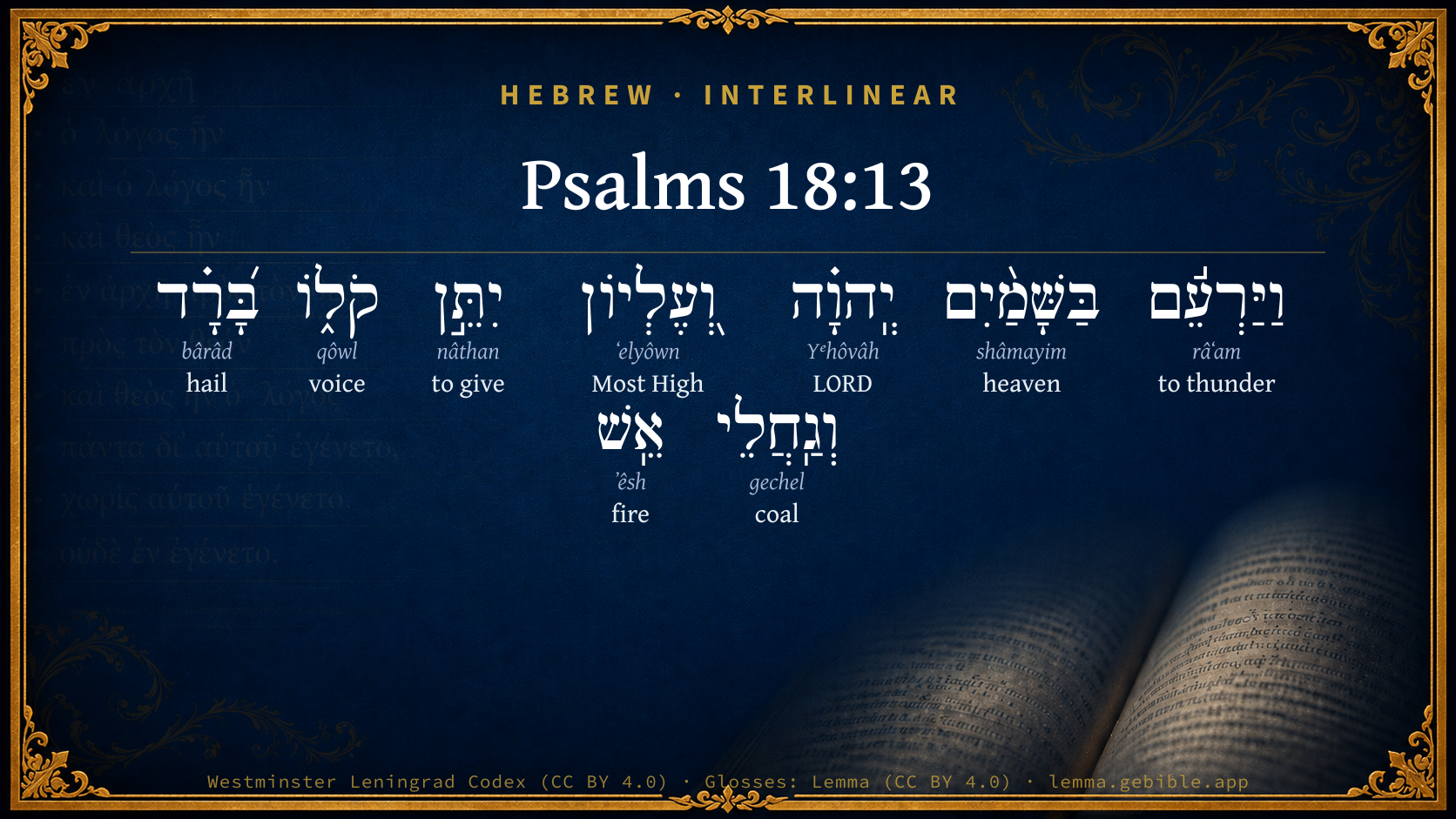
Hebrew (Westminster Leningrad Codex) Psalms 18:13 appears in the Hebrew Old Testament. The text above is from the Westminster Leningrad Codex. Each word links to its Strong’s number, a concise gloss, and parsing drawn from the Open Scriptures Hebrew Bible morphology. Click any word for its full Brown-Driver-Briggs (BDB) entry.
Download image
Cite this verse

Psalms 18:13 (World English Bible). Public Domain. Lemma interlinear Bible study tool, https://lemma.gebible.app/v/psalms/18/13.

Show BibTeX & RIS
BibTeX
RIS
English Translation
Yahweh also thundered in the sky, The Most High uttered his voice: Hailstones and coals of fire.
World English Bible · Public Domain
Download a study sheet

One document with this verse’s original text, its word-by-word gloss line, the meaning frame, cross-references with their text, attributed commentary, and full source and license credits — printable, and it pastes into notes with its structure intact.

This verse Autodidact and up

Study sheet (.html) Plain text (.txt)

A passage Seminary Student

Up to 50 verses in one chapter. A passage sheet keeps up to 6 commentary sources and 12 cross-references per verse, in the order this page ranks them, and says so on the sheet whenever that leaves anything out. Ask for a single verse and you get the Autodidact verse sheet above.

Everything on this page stays free to read, with no account — the sheet is a download of what is already on screen, not access to it.

Want to remove ads? Support Godless Engineer
Compare translations 3

The same verse in 3 English versions, stacked beneath the original-language interlinear above. Click any original word for its lexicon entry.

Each is an independent rendering of the whole verse — the interlinear is not word-aligned to these translations.

Highlighted words mark where these versions differ — a whole-verse word diff, not a word-by-word alignment.

  • World English Bible Public Domain
    Yahweh also thundered in the sky, The Most High uttered his voice: Hailstones and coals of fire.
  • King James Version Public Domain
    The LORD also thundered in the heavens, and the Highest gave his voice; hail stones and coals of fire.
  • unfoldingWord Literal Text CC BY-SA 4.0
    And Yahweh thundered in the heavens and the Most High uttered his voice, hailstones and coals of fire.

unfoldingWord Literal Text — © unfoldingWord, licensed CC BY-SA 4.0. Word-aligned USFM3 via Door43 (git.door43.org/unfoldingWord/en_ult).

Versions to compare (up to 4)

3 of 4 selected

Show all 18 translations

Every available English version of this verse, each an independent rendering of the whole verse.

  • World English Bible Public Domain
    Yahweh also thundered in the sky, The Most High uttered his voice: Hailstones and coals of fire.
  • Berean Standard Bible Public Domain
    The LORD thundered from heaven; the voice of the Most High resounded—hailstones and coals of fire.
  • Majority Standard Bible Public Domain
    The LORD thundered from heaven; the voice of the Most High resounded—hailstones and coals of fire.
  • King James Version Public Domain
    The LORD also thundered in the heavens, and the Highest gave his voice; hail stones and coals of fire.
  • American Standard Version (1901) Public Domain
    Jehovah also thundered in the heavens, And the Most High uttered his voice, Hailstones and coals of fire.
  • Revised Version (1885) Public Domain
    The LORD also thundered in the heavens, and the Most High uttered his voice; hailstones and coals of fire.
  • Geneva Bible (1599) Public Domain
    The Lord also thundred in the heauen, and the Highest gaue his voyce, haylestones and coales of fire.
  • Douay-Rheims (1899) Public Domain
    At the brightness that was before him the clouds passed, hail and coals of fire.
  • Young's Literal Translation Public Domain
    And thunder in the heavens doth Jehovah, And the Most High giveth forth His voice, Hail and coals of fire.
  • Literal Standard Version CC BY-SA 4.0
    And YHWH thunders in the heavens, || And the Most High gives forth His voice, || Hail and coals of fire.
  • Unlocked Literal Bible CC BY-SA 4.0
    Yahweh thundered in the heavens! The voice of the Most High shouted.
  • unfoldingWord Literal Text CC BY-SA 4.0
    And Yahweh thundered in the heavens and the Most High uttered his voice, hailstones and coals of fire.
  • Darby Bible Public Domain
    And Jehovah thundered in the heavens, and the Most High uttered his voice: hail and coals of fire.
  • World Messianic Bible Public Domain
    The LORD also thundered in the sky. The Most High uttered his voice: hailstones and coals of fire.
  • Webster's Bible Public Domain
    \\18:12\\At the brightness that was before him his thick clouds passed, hail stones and coals of fire.
  • Free Bible Version CC BY-SA 4.0
    The Lord thundered from heaven; the voice of the Most High sounded among the hailstones and burning coals.
  • Bible in Basic English Public Domain
    The Lord made thunder in the heavens, and the voice of the Highest was sounding out: a rain of ice and fire.
  • JPS Tanakh (1917) Public Domain
    (18-14) The LORD also thundered in the heavens, and the Most High gave forth His voice; hailstones and coals of fire.

Literal Standard Version (2020), Covenant Press — licensed CC BY-SA 4.0. Text via the HelloAO Bible API (eBible.org). Unlocked Literal Bible (unfoldingWord) — licensed CC BY-SA 4.0. Text via the HelloAO Bible API (eBible.org). unfoldingWord Literal Text — © unfoldingWord, licensed CC BY-SA 4.0. Word-aligned USFM3 via Door43 (git.door43.org/unfoldingWord/en_ult). Free Bible Version, Dr. Jonathan Gallagher — licensed CC BY-SA 4.0. Text via the HelloAO Bible API (eBible.org).

Word by word

More ways to search: Search by grammar → Find every occurrence → Compare this word →

Practice this passage: Drill this verse → Learn its vocabulary →

וַיַּרְעֵ֬ם
râʻam
H7481
“and · to thunder”
Conjunction + Verb, Hiphil, Sequential Imperfect, 3rd Person, Masculine, Singular
Part of Speech
Conjunction + Verb
Stem
Hiphil
Form
Sequential Imperfect
Person
3rd Person
Gender
Masculine
Number
Singular
Full BDB Definition

Origin: a primitive root

TWOT: 2189

to thunder - (Qal) - to make the sound of thunder, thunder - to rage - (Hiphil) - to thunder, cause thunder - to tremble, cause to tremble (by extension)
  1. בַּשָּׁמַ֨יִם shâmayim H8064 “in/at the · heaven(s)” Preposition, Determined + Noun, Common, Masculine, Plural, Absolute
  2. יְֽהוָ֗ה Yᵉhôvâh H3068 “LORD” Noun, Proper
  3. וְ֭עֶלְיוֹן ʻelyôwn H5945 “and · Most High” Conjunction + Adjective, Adjective, Masculine, Singular, Absolute
  4. יִתֵּ֣ן nâthan H5414 “to give” Verb, Qal, Imperfect, 3rd Person, Masculine, Singular
  5. קֹל֑וֹ qôwl H6963 “voice · his” Noun, Common, Masculine, Singular, Construct + Suffix, Personal, 3rd Person, Masculine, Singular
  6. בָּ֝רָ֗ד bârâd H1259 “hail” Noun, Common, Masculine, Singular, Absolute
  7. וְגַֽחֲלֵי gechel H1513 “and · coals of” Conjunction + Noun, Common, Both, Plural, Construct
  8. אֵֽשׁ ʼêsh H784 “fire” Noun, Common, Both, Singular, Absolute

About this verse

These counts appear in no published source. They are computed here, from the morphology-tagged text and Lemma’s own curated glosses. What Lemma adds →

9
words
9
distinct lemmas
Wisdom
section

Notable vocabulary

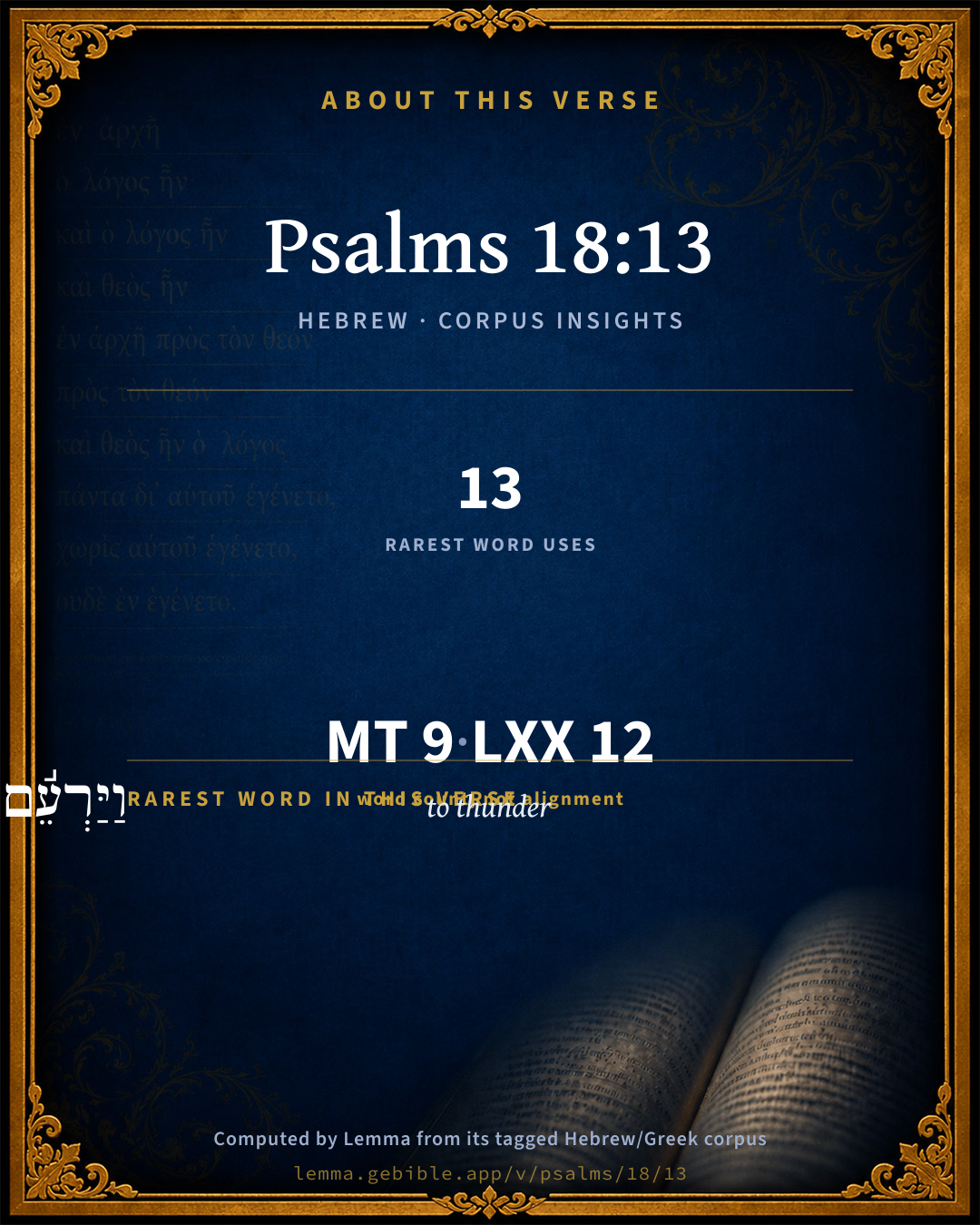
The rarest word here is וַיַּרְעֵ֬ם to thunder H7481 — appearing just 13 times in the whole Hebrew Bible.

Shared distinctive vocabulary

וַיַּרְעֵ֬ם to thunder H7481 occurs in 13 verses of the Hebrew Bible. Also found in:

Grammatical profile

  • 2 verbs
  • 6 nouns
  • 1 adjective

Verb forms

  • וַיַּרְעֵ֬ם Hiphil · Sequential Imperfect
  • יִתֵּ֣ן Qal · Imperfect

Hebrew & Septuagint length

In English translation the verse runs 17 words from the Hebrew and 12 from the Septuagint (LXX English) — closely comparable.

A rough comparison of the two English renderings, which tokenize alike — not a word-level alignment.

Word counts can differ between the Hebrew and the Greek without any difference in meaning — e.g. the Hebrew direct-object marker אֵת has no separate Greek word, and Greek often adds the article ὁ.

In the original languages it is 9 Hebrew tokens and 12 Greek tokens — but the two are counted differently (Hebrew bundles its prefixes and suffixes into one token; the Greek is in lemma form), so that isn’t a like-for-like length.

Cross-references

15

Topical passages linked to Psalms 18:13 in the Treasury of Scripture Knowledge — connected by theme and wording, ordered by reader-vote popularity; previews shown in the World English Bible.

  • Psalms 104:7 At your rebuke they fled. At the voice of your thunder they hurried away.
  • 1 Samuel 7:10 As Samuel was offering up the burnt offering, the Philistines drew near to battle against Israel; but Yahweh thundered with a great thunder on that day on the Philistines, and confused them; and they were struck down before Israel.
  • Psalms 29:3–4 Yahweh's voice is on the waters. The God of glory thunders, even Yahweh on many waters.
  • Psalms 140:10 Let burning coals fall on them. Let them be thrown into the fire, Into miry pits, from where they never rise.
  • Exodus 20:18 All the people perceived the thunderings, the lightnings, the sound of the trumpet, and the mountain smoking. When the people saw it, they trembled, and stayed at a distance.
  • Deuteronomy 32:24 [They shall be] wasted with hunger, and devoured with burning heat Bitter destruction; The teeth of animals will I send on them, With the poison of crawling things of the dust.
  • Job 40:9 Or have you an arm like God? Can you thunder with a voice like him?
  • Psalms 78:48 He gave over their cattle also to the hail, And their flocks to hot thunderbolts.
  • Psalms 120:3–4 What will be given to you, and what will be done more to you, You deceitful tongue?
  • Ezekiel 10:5 The sound of the wings of the cherubim was heard even to the outer court, as the voice of God Almighty when he speaks.
  • Habakkuk 3:5 Plague went before him, And pestilence followed his feet.
  • John 12:29 The multitude therefore, who stood by and heard it, said that it had thundered. Others said, "An angel has spoken to him."
  • Revelation 4:5 Out of the throne proceed lightnings, sounds, and thunders. There were seven lamps of fire burning before his throne, which are the seven Spirits of God.
  • Revelation 8:5 The angel took the censer, and he filled it with the fire of the altar, and threw it on the earth. There followed thunders, sounds, lightnings, and an earthquake.
  • Revelation 19:6 I heard something like the voice of a great multitude, and like the voice of many waters, and like the voice of mighty thunders, saying, "Hallelujah! For the Lord our God, the Almighty, reigns!

Cross-references courtesy of OpenBible.info (CC BY 4.0).

Hebrew and Greek witnesses Masoretic Hebrew ↔ Greek Septuagint

The same verse in the two great witnesses to the Old Testament, shown verse-for-verse.

You’re reading Greek Psalm 17 (Hebrew Psalm 18). The Septuagint counts the superscription, so verse numbers can differ from the Hebrew — chapter-level alignment, not verse-by-verse. Numbering follows Rahlfs.

These are two independent witnesses, not word-aligned to each other, and the Septuagint is shown in lemma (dictionary) form.

Hebrew Psalms 18:13 Masoretic · Westminster Leningrad Codex

וַיַּרְעֵ֬ם בַּשָּׁמַ֨יִם יְֽהוָ֗ה וְ֭עֶלְיוֹן יִתֵּ֣ן קֹל֑וֹ בָּ֝רָ֗ד וְגַֽחֲלֵי אֵֽשׁ

Yahweh also thundered in the sky, The Most High uttered his voice: Hailstones and coals of fire.

World English Bible · Public Domain

Greek LXX Greek Psalm 17:13 Septuagint · lemma form

ἀπό ὁ τηλαύγησις ἐνώπιον αὐτός ὁ νεφέλη διαἔρχομαι χάλαζα καί ἄνθραξ πυρός

The Lord also thundered from heaven, and the Highest uttered his voice.

LXX2012 (modern English Septuagint) · Public Domain

On this verse, Adam Clarke's Commentary discusses the Septuagint’s reading. Read the note in Commentary ↓

Hebrew: Westminster Leningrad Codex (CC BY 4.0). Greek: Septuagint (public domain); English from LXX2012 (modern English Septuagint) (Public Domain). How the Septuagint differs from the Hebrew →

Commentary

Notes on Psalms 18:13 from classic Christian and Jewish commentators (each source and its license shown beneath its notes). The classic Christian expositions comment on the surrounding passage and are grouped to its opening verse, so a note may address several verses; the Jewish commentaries on the Tanakh (Rashi and others) are per-verse, so they appear only where the commentator wrote on this verse.

Lemma curates 59 commentaries, every one of them public domain or Creative Commons licensed, each selected and text-cleaned for this edition rather than reprinted as found. About our sources →

Trapp's Complete Commentary

John Trapp

Psa 18:13 The LORD also thundered in the heavens, and the Highest gave his voice; hail [stones] and coals of fire.

Ver. 13. The Lord also thundered in the heavens] Quasi pro classico, et auspicio proelii ineundi.

John Trapp, A Commentary or Exposition upon All the Books of the Old and New Testament (1647–1656) — public domain. Text from a community e-Sword module.

The Biblical Illustrator

Joseph S. Exell

Psa_18:13

The Lord also thundered in the heavens.

The terrors of an Eastern thunderstorm

There is said to be something peculiarly terrific in an Oriental thunderstorm. Its vivid lightning and intense darkness, succeeding each other with startling rapidity, are appalling. This is indicated in the words, at the brightness that was before Him, His thick clouds passed; that is, passed away. So intense is the light of the lightnings flash that the whole mass of dark clouds seems to pass away, and their place to be occupied for an instant by a mass of solid light, shedding its beams over everything upon the earth like a midday sun. The light, however, is only for an instant--and then a darkness, that may be felt, shuts up the whole from every vision but His, to whom the darkness and the light are both alike. Meanwhile the roar of the thunder, the voice of the Most High in the clouds, is incessant; the lightnings flashing from cloud to cloud, from the clouds to the earth, and from the earth back again to the clouds. Moreover, it seems as if He who measureth the waters in the hollow of His hand had poured them out, for the rain descends in torrents, mingled at times with destructive hail, while coals of fire--balls of meteoric flame--run along the ground (Exo_9:23). (David Caldwell, A. M.)

The Biblical Illustrator, edited by Joseph S. Exell (c. 1880s–1900s) — public domain. Text from a community e-Sword module.

Joseph Benson's Commentary

Psa 18:13-14. The Lord also thundered, &c. — The preceding verse mentioned the lightning with its effects; this gives us the report of the thunder, and the increasing storm of hail and fire that attended it. Yea, he sent out his arrows — Namely, lightnings, as it is expressed in the next clause; and scattered them — Namely, mine enemies, which is sufficiently understood from Psa 18:3; Psa 18:17, and from the whole context. Thus magnificently does the psalmist describe the discharge of the celestial artillery upon God’s enemies. Terrible was the execution of the divine vengeance upon them, “as when lightnings and thunders, hail-stones and balls of fire, making their way through the dark clouds which contain them, strike terror and dismay into the hearts of men. Such is the voice, and such are the arrows of the Lord Almighty, wherewith he discomfiteth all who oppose the execution of his counsels, and obstruct the salvation of his chosen. Every display and description of this sort, and indeed every thunder-storm which we behold, should remind us of that exhibition of power and vengeance which is hereafter to accompany the general resurrection.” — Horne.

Joseph Benson's Commentary on the Old and New Testaments (1811–1818) — public domain. Text from a community e-Sword module.

J. A. Alexander on Psalms

Joseph Addison Alexander

14. (Psa 18:13). Then thundered in the heavens Jehovah, and the Highest gave his voice—hail and coals of fire. The second clause is a poetical repetition of the first. "The Most High gave his voice," means in this connection neither more nor less than that he "thundered in the heavens." Though visibly present upon earth he is described as still in heaven. Comstrued as in Psa 18:13, or made dependent on the verb gave, as in Exo 9:23 : "Jehovah gave thunder and hail." This clause is repeated because the hail and lightning were not merely terrific circumstances, but appointed instruments of vengeance and weapons of destruction.

Joseph Addison Alexander, The Psalms Translated and Explained (1850) — public domain. Text from a community e-Sword module.

Geneva Bible (1599)

Geneva Bible translators

Thundered, lightninged and hailed.

Geneva Bible (1599) marginal notes — public domain. Text via Bolls.life.

Jamieson, Fausset & Brown

Robert Jamieson, A. R. Fausset & David Brown

The storm breaks forth--thunder follows lightning, and hail with repeated lightning, as often seen, like balls or coals of fire, succeed (Exo 9:23).

Jamieson, Fausset & Brown — Commentary Critical and Explanatory on the Whole Bible (1871) — public domain (CC PDM 1.0). Text via the HelloAO Bible API.

Adam Clarke's Commentary

Verse 13. The Lord also thundered in the heavens, and the Highest gave his voice] And then followed the hail and coals of fire. The former verse mentioned the lightning, with its effects; this gives us the report of the thunder, and the increasing storm of hail and fire that attended it. Some think the words hail-stones and coals of fire are entered here by some careless transcribers from the preceding verse; and it is true that they are wanting in the Septuagint and the Arabic, in the parallel place in 2 Samuel, and in five of Kennicott's and De Rossi's MSS. I should rather, with Bishop Horsley, suppose them to be an interpolation in the preceding verse: or in that to have been borrowed from this; for this most certainly is their true place.

Adam Clarke's Commentary on the Bible (1810–1826) — public domain. Text from a community e-Sword/MySword module.

John Calvin's Commentaries

13. Jehovah thundered. David here repeats the same thing in different words, declaring that God thundered from heaven; and he calls the thunder the yoke of God, that we may not suppose it is produced merely by chance or by natural causes, independent of the appointment and will of God. Philosophers, it is true, are well acquainted with the intermediate or secondary causes, from which the thunder proceeds, namely, that when the cold and humid vapours obstruct the dry and hot exhalations in their course upwards, a collision takes place, and by this, together with the noise of the clouds rushing against each other, is produced the rumbling thunder-peal. “De ce combat et aussi du bruit des nuees allans l’une contre l’autre, se fait un son.” — Fr.

“Et tardifs a reconnaistre la vertu de Dieu.” — Fr.

John Calvin's Commentaries (1540-1563) — public domain. Text from the Calvin Translation Society English edition (1840s-50s) via the Christian Classics Ethereal Library (ccel.org). Calvin's coverage is partial (roughly two-thirds of the Bible); uncommented books and verses are honest gaps, never fabricated. The 19th-century editor's footnotes and remarks are omitted so the notes are faithfully Calvin's own voice.

Ellicott's Commentary for English Readers

(13) In the heavens.—The version in Samuel is from the heavens,” which is better. For the thunder as God’s voice see Psa_29:3, and Note.

A Bible Commentary for English Readers, edited by Charles John Ellicott (1878–1897) — public domain. Text from a community e-Sword module.

The Cambridge Bible for Schools and Colleges

gen. ed. J. J. S. Perowne

13. and the Highest &c.] R.V., and the Most High uttered his voice. The Most High is the title of God as the Supreme Ruler of the Universe. See Psa_7:17; and Appendix, Note II. Thunder is the voice of God. See Psa_29:3; Job_37:2-5. The words hailstones and coals of fire have no proper grammatical construction, and are wanting in the LXX and in 2 Sam. They seem to have been added here from Psa_18:12 by an error of transcription.

The Cambridge Bible for Schools and Colleges (gen. ed. J. J. S. Perowne; Cambridge University Press, 1878–1918) — public domain. Text from a community e-Sword module.

John Gill's Exposition

Yea, he sent out his arrows,.... By which thunderbolts, cracks of thunder, and flashes of lightning, seem to be meant; see Psa 77:17; comparable to arrows shot, and sent out of a bow; and may denote, either the doctrines of the Gospel, which were sharp in the hearts of Christ's enemies, and are either the means of subduing them to him, or of destroying them, being the savour of death unto death; or however, like arrows, give great pain and uneasiness where they stick, and grievously distress and torment; as does the fire which comes out of the mouth of the two witnesses, Rev 11:5. The Targum is,

"he sent his word as arrows;''

or else the judgments of God are meant, as famine, pestilence, and the sword, which God sent unto, and spent upon the Jewish nation, Deu 32:23;

and scattered them; among the nations of the world, where they have been dispersed ever since;

and he shot out lightnings; or "many lightnings", so the Targum:

and discomfited them; troubled, terrified, and distressed them.

John Gill's Exposition of the Whole Bible (1746–1763) — public domain (CC PDM 1.0). Text via the HelloAO Bible API.

Albert Barnes' Notes on the Bible

The Lord also thundered in the heavens - Thunder is often in the Scriptures described as the voice of God. See the magnificent description in Psa 29:1-11; compare Job 40:9, “Canst thou thunder with a voice like him?” So 1Sa 7:10; 1Sa 12:18; Psa 77:18; Job 37:4.

And the Highest gave his voice - God, the most exalted Being in the universe, uttered his voice in the thunder; or, the thunder was his voice.

Hail-stones, and coals of fire - Accompanying the thunder. The repetition seems to be because these were such striking and constant accompaniments of the storm.

Albert Barnes' Notes on the Bible (1834–1885) — public domain. Text from a community e-Sword/MySword module.

Matthew Poole's English Annotations

The Lord also thundered, to wit, against my adversaries. Thunder is a sign of God’s anger, 1Sa 2:10; 7:10.

His voice, i.e. thunder, oft so called. The same thing expressed in other words.

Matthew Poole's English Annotations on the Holy Bible (1683–1685) — public domain. Text from a community e-Sword/MySword module.

The Treasury of David

Charles H. Spurgeon

Ver. 13. Over all this splendour of tempest pealed the dread thunder.

The Lord also thundered in the heavens, and the Highest gave his voice. Fit accompaniment for the flames of vengeance. How will men bear to hear it at the last when addressed to them in proclamation of their doom, for even now their hearts are in their mouths if they do but hear it muttering from afar? In all this terror David found a theme for song, and thus every believer finds even in the terrors of God a subject for holy praise.

Hailstones and coals of fire are twice mentioned to show how certainly they are in the divine hand, and are the weapons of Heaven's vengeance. Horne remarks that "every thunderstorm should remind us of that exhibition of power and vengeance, which is hereafter to accompany the general resurrection; "may it not also assure us of the real power of him who is our Father and our friend, and tend to assure us of our safety while he fights our battles for us. The prince of the power of the air is soon dislodged when the cherubic chariot is driven through his dominions; therefore let not the legions of hell cause us dismay. He who is with us is greater than all they that be against us.

Ver. 13. Hailstones and coals of fire. The terrific in its relation to Jehovah.

Psalms 18:14*

Charles H. Spurgeon's The Treasury of David (1869–1885) — public domain. Psalms only. Text from a community e-Sword/MySword module.

Whedon's Commentary on the Bible

Daniel D. Whedon

13. The Lord also thundered… Highest gave his voice—This was the word of command to the elements to discharge their burden of wrath upon his enemies.

Hail… and coals of fire—The allusion is to Exo_9:24; Jos_10:11. Compare “hot thunderbolts,” Psa_78:48; on which see note.

Daniel D. Whedon (gen. ed.), Commentary on the Old and New Testaments (1874–1909) — public domain. Text from a community e-Sword module.

The Pulpit Commentary

The Lord also thundered in the heavens, and the Highest gave his voice. With the lightning came, necessarily, thunder, rolling along the heavens, and seeming like the voice of God.Hail (comp. Job_38:4, Job_38:5) stones and coals of fire. The phrase is repeated for the sake of emphasis. The hail and the lightning are represented as conjointly the ministers of the Divine vengeance.

The Pulpit Commentary (1880–1919), ed. H.D.M. Spence-Jones & Joseph S. Exell — public domain. Text from a community e-Sword module.

Keil & Delitzsch

C. F. Keil & F. Delitzsch

(Heb.: 18:14-16) Amidst thunder, Jahve hurled lightnings as arrows upon David's enemies, and the breath of His anger laid bare the beds of the flood to the very centre of the earth, in order to rescue the sunken one. Thunder is the rumble of God, and as it were the hollow murmur of His mouth, Job 37:2. עליון, the Most High, is the name of God as the inapproachable Judge, who governs all things. The third line of Psa 18:14 is erroneously repeated from the preceding strophe. It cannot be supported on grammatical grounds by Exo 9:23, since קול נתן, edere vocem, has a different meaning from the נתן קלת, dare tonitrua, of that passage. The symmetry of the strophe structure is also against it; and it is wanting both in 2 Sam. and in the lxx. רב, which, as the opposite of מעט Neh 2:12; Isa 10:7, means adverbially "in abundance," is the parallel to ויּשׁלח. It is generally taken, after the analogy of Gen 49:23, in the sense of בּרק, Psa 144:6 : רב in pause = רב (the ō passing over into the broader like עז instead of עז in Gen 49:3) = רבב, cognate with רבה, רמה; but the forms סב, סבּוּ, here, and in every other instance, have but a very questionable existence, as e.g., רב, Isa 54:13, is more probably an adjective than the third person praet. (cf. Bttcher, Neue Aehrenlese No. 635, 1066). The suffixes ēm do not refer to the arrows, i.e., lightnings, but to David's foes. המם means both to put in commotion and to destroy by confounding, Exo 14:24; Exo 23:27. In addition to the thunder, the voice of Jahve, comes the stormwind, which is the snorting of the breath of His nostrils. This makes the channels of the waters visible and lays bare the foundations of the earth. אפיק (collateral form to אפק) is the bed of the river and then the river or brook itself, a continendo aquas (Ges.), and exactly like the Arabic mesı̂k, mesâk, mesek (from Arab. msk, the VI form of which, tamâsaka, corresponds to התאפּק), means a place that does not admit of the water soaking in, but on account of the firmness of the soil preserves it standing or flowing. What are here meant are the water-courses or river beds that hold the water. It is only needful for Jahve to threaten (epitiman Mat 8:26) and the floods, in which he, whose rescue is undertaken here, is sunk, flee (Psa 104:7) and dry up (Psa 106:9, Nah 1:4). But he is already half engulfed in the abyss of Hades, hence not merely the bed of the flood is opened up, but the earth is rent to its very centre. From the language being here so thoroughly allegorical, it is clear that we were quite correct in interpreting the description as ideal. He, who is nearly overpowered by his foes, is represented as one engulfed in deep waters and almost drowning.

Keil & Delitzsch — Biblical Commentary on the Old Testament (1861–1891) — public domain (CC PDM 1.0). Text via the HelloAO Bible API. (Old Testament only.)

unfoldingWord translationNotes

Door43 World Missions Community

Yahweh thundered in the heavens

Yahweh's voice sounded like thunder. (See: Simile)

the Most High

"the Most High" refers to Yahweh.

He shot his arrows and scattered his enemies ... lightning bolts dispersed them

Both of these clauses have similar meanings. (See: Parallelism)

He shot his arrows and scattered his enemies

Here lighting strikes are being spoken of as if they were arrows (See: Metaphor)

dispersed them

"sent them in different directions"

translationWords

Most High

send

bow and arrow

disperse

unfoldingWord translationNotes — © Distant Shores Media and the Door43 World Missions Community, licensed CC BY-SA 4.0. Source: git.door43.org/Door43/en_tn.

Rashi

Rabbi Shlomo Yitzchaki (Rashi)

passed Heb. עברו, trepasant in Old French, passed. The hail split and passes through onto the Egyptians at the Sea of Reeds.

Rashi on the Tanakh — English translations: “The Judaica Press complete Tanach with Rashi, translated by A. J. Rosenberg” (CC BY 4.0); “Pentateuch with Rashi's commentary by M. Rosenbaum and A.M. Silbermann, 1929-1934” (public domain); “The Metsudah Tanach series, Lakewood, N.J” (CC BY 4.0); and “The Book of Joshua, Metsudah Publications, 1997” (CC BY 4.0). Text via Sefaria.

Lesson kit

Teaching starters — assembled from the data on this page, not authored interpretation. Every prompt links to the verse data it draws on. Edit before teaching.

Psalms, in the Wisdom, opens this verse with 9 words (9 distinct Hebrew lemmas). Its most distinctive word is râʻam (“to thunder”). A historical commentator’s framing appears above. Read the whole chapter for the surrounding context.

Discussion questions

  1. What does “to thunder” (râʻam) contribute to the verse as a whole?
  2. How does 1 Samuel 1:6, which shares the word «to thunder», read alongside this verse?
  3. The translations on this page render this verse differently — a whole-verse word diff, not a word-by-word alignment. What might account for the different wordings?
  4. «וַיַּרְעֵ֬ם» is a Hiphil Sequential Imperfect verb. How does that grammatical form shape the action described?
  5. Compare how Trapp's Complete Commentary and The Biblical Illustrator read this verse. Where do they agree or differ?

Things to notice

Reading settings

Reading text

Shown beneath each verse's original-language words.

Old Testament
Old Testament edition

Read the OT as the Masoretic Hebrew (MT) or the Greek Septuagint (LXX).

English shown for the Greek Septuagint (in the Hebrew ↔ Greek comparison).

Comparing translations? Open the Compare panel on any verse page to stack up to four side by side.