
Leviticus 13:52

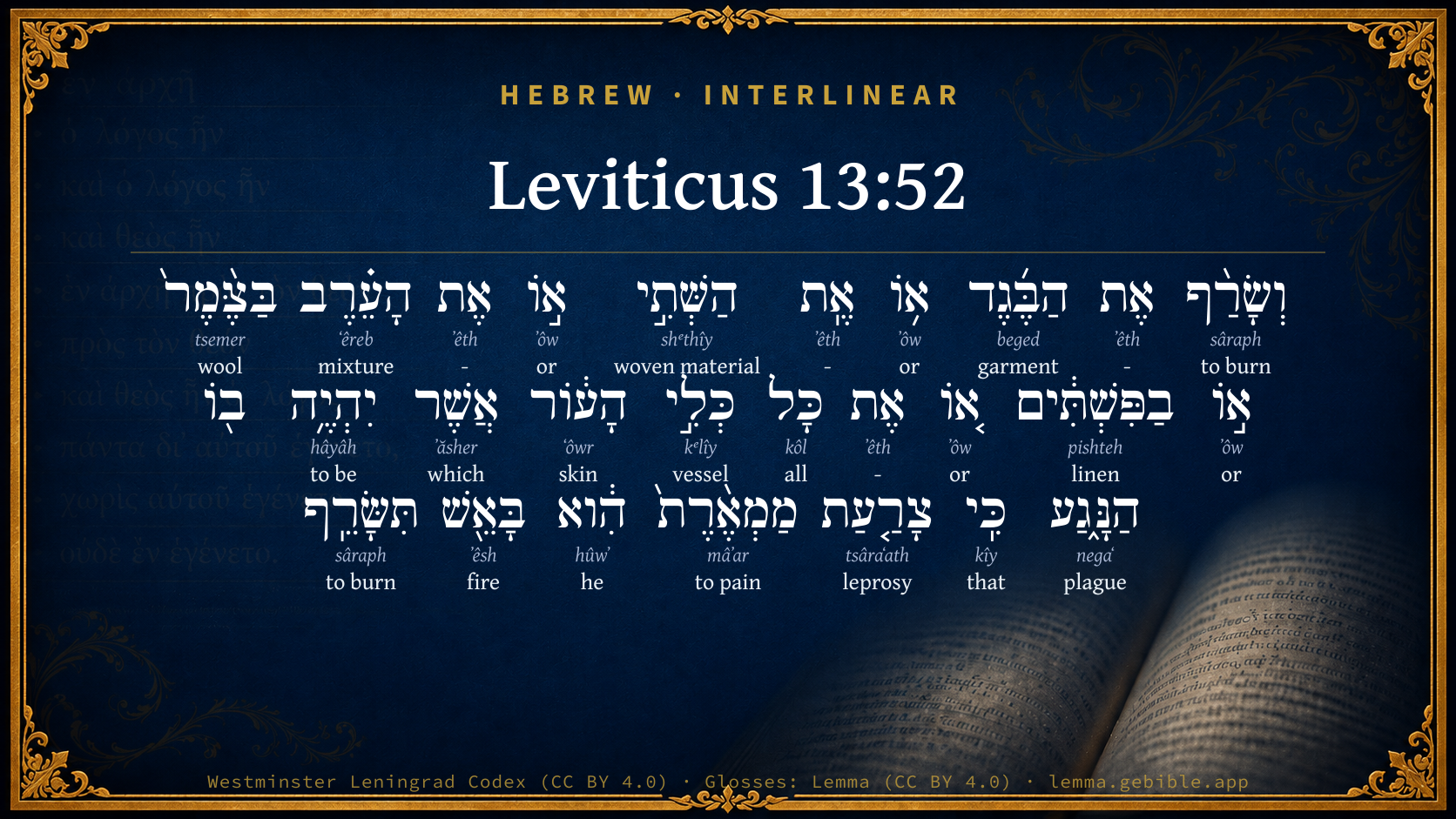
Hebrew (Westminster Leningrad Codex) Leviticus 13:52 appears in the Hebrew Old Testament. The text above is from the Westminster Leningrad Codex. Each word links to its Strong’s number, a concise gloss, and parsing drawn from the Open Scriptures Hebrew Bible morphology. Click any word for its full Brown-Driver-Briggs (BDB) entry.
Download image
Cite this verse

Leviticus 13:52 (World English Bible). Public Domain. Lemma interlinear Bible study tool, https://lemma.gebible.app/v/leviticus/13/52.

Show BibTeX & RIS
BibTeX
RIS
English Translation
He shall burn the garment, whether the warp or the woof, in wool or in linen, or anything of skin, in which the plague is: for it is a destructive mildew. It shall be burned in the fire.
World English Bible · Public Domain
Download a study sheet

One document with this verse’s original text, its word-by-word gloss line, the meaning frame, cross-references with their text, attributed commentary, and full source and license credits — printable, and it pastes into notes with its structure intact.

This verse Autodidact and up

Study sheet (.html) Plain text (.txt)

A passage Seminary Student

Up to 50 verses in one chapter. A passage sheet keeps up to 6 commentary sources and 12 cross-references per verse, in the order this page ranks them, and says so on the sheet whenever that leaves anything out. Ask for a single verse and you get the Autodidact verse sheet above.

Everything on this page stays free to read, with no account — the sheet is a download of what is already on screen, not access to it.

Want to remove ads? Support Godless Engineer
Compare translations 3

The same verse in 3 English versions, stacked beneath the original-language interlinear above. Click any original word for its lexicon entry.

Each is an independent rendering of the whole verse — the interlinear is not word-aligned to these translations.

Highlighted words mark where these versions differ — a whole-verse word diff, not a word-by-word alignment.

  • World English Bible Public Domain
    He shall burn the garment, whether the warp or the woof, in wool or in linen, or anything of skin, in which the plague is: for it is a destructive mildew. It shall be burned in the fire.
  • King James Version Public Domain
    He shall therefore burn that garment, whether warp or woof, in woolen or in linen, or any thing of skin, wherein the plague is: for it is a fretting leprosy; it shall be burnt in the fire.
  • unfoldingWord Literal Text CC BY-SA 4.0
    And he shall burn the clothing or the warp or the woof, on wool or on linen or any equipment of leather, whatever has on it the infection, because it a malignant disease. It shall be burned with fire.

unfoldingWord Literal Text — © unfoldingWord, licensed CC BY-SA 4.0. Word-aligned USFM3 via Door43 (git.door43.org/unfoldingWord/en_ult).

Versions to compare (up to 4)

3 of 4 selected

Show all 18 translations

Every available English version of this verse, each an independent rendering of the whole verse.

  • World English Bible Public Domain
    He shall burn the garment, whether the warp or the woof, in wool or in linen, or anything of skin, in which the plague is: for it is a destructive mildew. It shall be burned in the fire.
  • Berean Standard Bible Public Domain
    He is to burn the fabric, weave, or knit, whether the contaminated item is wool or linen or leather. Since the mildew is harmful, the article must be burned up.
  • Majority Standard Bible Public Domain
    He is to burn the fabric, weave, or knit, whether the contaminated item is wool or linen or leather. Since the mildew is harmful, the article must be burned up.
  • King James Version Public Domain
    He shall therefore burn that garment, whether warp or woof, in woolen or in linen, or any thing of skin, wherein the plague is: for it is a fretting leprosy; it shall be burnt in the fire.
  • American Standard Version (1901) Public Domain
    And he shall burn the garment, whether the warp or the woof, in woollen or in linen, or anything of skin, wherein the plague is: for it is a fretting leprosy; it shall be burnt in the fire.
  • Revised Version (1885) Public Domain
    And he shall burn the garment, whether the warp or the woof, in woollen or in linen, or any thing of skin, wherein the plague is: for it is a fretting leprosy; it shall be burnt in the fire.
  • Geneva Bible (1599) Public Domain
    And hee shall burne the garment, or the warpe, or the woofe, whether it bee wollen or linen, or any thing that is made of skin, wherein the plague is: for it is a freating leprosie, therefore it shalbe burnt in the fire.
  • Douay-Rheims (1899) Public Domain
    And therefore it shall be burnt with fire.
  • Young's Literal Translation Public Domain
    `And he hath burnt the garment, or the warp, or the woof, in wool or in linen, or any vessel of skin in which the plague is; for it `is' a fretting leprosy; with fire it is burnt.
  • Literal Standard Version CC BY-SA 4.0
    And he has burned the garment, or the warp, or the woof, in wool or in linen, or any vessel of skin in which the plague is; for it [is] a fretting leprosy; it is burned with fire.
  • Unlocked Literal Bible CC BY-SA 4.0
    He must burn the garment, or anything woven or knitted from wool or linen material, or leather or anything made with leather, anything in which the harmful mildew is found, for it can lead to disease. The item must be completely burned up.
  • unfoldingWord Literal Text CC BY-SA 4.0
    And he shall burn the clothing or the warp or the woof, on wool or on linen or any equipment of leather, whatever has on it the infection, because it a malignant disease. It shall be burned with fire.
  • Darby Bible Public Domain
    And they shall burn the garment, or the warp or the woof, of wool or of linen, or anything of skin, wherein the sore is; for it is a corroding leprosy: it shall be burned with fire.
  • World Messianic Bible Public Domain
    He shall burn the garment, whether the warp or the woof, in wool or in linen, or anything of leather, in which the plague is, for it is a destructive mildew. It shall be burned in the fire.
  • Webster's Bible Public Domain
    He shall therefore burn that garment, whether warp or woof, in woolen or in linen, or any thing of skin, in which the plague is: for it is a fretting leprosy; it shall be burnt in the fire.
  • Free Bible Version CC BY-SA 4.0
    The priest is to burn it, whether the affected item is wool or linen or leather. Because the mold is harmful, the article must be burned.
  • Bible in Basic English Public Domain
    And the clothing, or the wool or linen material, or anything of leather in which is the disease, is to be burned: for the disease is biting into it; let it be burned in the fire.
  • JPS Tanakh (1917) Public Domain
    And he shall burn the garment, or the warp, or the woof, whether it be of wool or of linen, or any thing of skin, wherein the plague is; for it is a malignant leprosy; it shall be burnt in the fire.

Literal Standard Version (2020), Covenant Press — licensed CC BY-SA 4.0. Text via the HelloAO Bible API (eBible.org). Unlocked Literal Bible (unfoldingWord) — licensed CC BY-SA 4.0. Text via the HelloAO Bible API (eBible.org). unfoldingWord Literal Text — © unfoldingWord, licensed CC BY-SA 4.0. Word-aligned USFM3 via Door43 (git.door43.org/unfoldingWord/en_ult). Free Bible Version, Dr. Jonathan Gallagher — licensed CC BY-SA 4.0. Text via the HelloAO Bible API (eBible.org).

Word by word

More ways to search: Search by grammar → Find every occurrence → Compare this word →

Practice this passage: Drill this verse → Learn its vocabulary →

מַמְאֶ֨רֶת֙
mâʼar
H3992
“paining”
Verb, Hiphil, Participle Active, Feminine, Singular, Absolute
Part of Speech
Verb
Stem
Hiphil
Form
Participle Active
Gender
Feminine
Number
Singular
State
Absolute
Full BDB Definition

Origin: a primitive root

TWOT: 1141

(Hiphil) to pain, prick, irritate, be in pain
  1. וְשָׂרַ֨ף sâraph H8313 “and · to burn” Conjunction + Verb, Qal, Sequential Perfect, 3rd Person, Masculine, Singular
  2. אֶת ʼêth H853 “-” Particle, Direct Object
  3. הַבֶּ֜גֶד beged H899 “the · garment” Particle, Definite Article + Noun, Common, Masculine, Singular, Absolute
  4. א֥וֹ ʼôw H176 “or” Conjunction
  5. אֶֽת ʼêth H853 “-” Particle, Direct Object
  6. הַשְּׁתִ֣י shᵉthîy H8359 “the · woven material” Particle, Definite Article + Noun, Common, Masculine, Singular, Absolute
  7. א֣וֹ ʼôw H176 “or” Conjunction
  8. אֶת ʼêth H853 “-” Particle, Direct Object
  9. הָעֵ֗רֶב ʻêreb H6154 “the · mixture” Particle, Definite Article + Noun, Common, Masculine, Singular, Absolute
  10. בַּצֶּ֨מֶר֙ tsemer H6785 “in/at the · wool” Preposition, Determined + Noun, Common, Masculine, Singular, Absolute
  11. א֣וֹ ʼôw H176 “or” Conjunction
  12. בַפִּשְׁתִּ֔ים pishteh H6593 “in/at the · linen” Preposition, Determined + Noun, Common, Masculine, Plural, Absolute
  13. א֚וֹ ʼôw H176 “or” Conjunction
  14. אֶת ʼêth H853 “-” Particle, Direct Object
  15. כָּל kôl H3605 “all of” Noun, Common, Masculine, Singular, Construct
  16. כְּלִ֣י kᵉlîy H3627 “vessel of” Noun, Common, Masculine, Singular, Construct
  17. הָע֔וֹר ʻôwr H5785 “the · skin” Particle, Definite Article + Noun, Common, Masculine, Singular, Absolute
  18. אֲשֶׁר ʼăsher H834 “which” Particle, Relative
  19. יִהְיֶ֥ה hâyâh H1961 “to be” Verb, Qal, Imperfect, 3rd Person, Masculine, Singular
  20. הַנָּ֑גַע negaʻ H5061 “the · plague” Particle, Definite Article + Noun, Common, Masculine, Singular, Absolute
  21. כִּֽי kîy H3588 “that” Conjunction
  22. צָרַ֤עַת tsâraʻath H6883 “leprosy” Noun, Common, Feminine, Singular, Absolute
  23. הִ֔וא hûwʼ H1931 “he” Pronoun, Personal, 3rd Person, Feminine, Singular
  24. בָּאֵ֖שׁ ʼêsh H784 “in/at the · fire” Preposition, Determined + Noun, Common, Both, Singular, Absolute
  25. תִּשָּׂרֵֽף sâraph H8313 “to burn” Verb, Niphal, Imperfect, 3rd Person, Feminine, Singular

About this verse

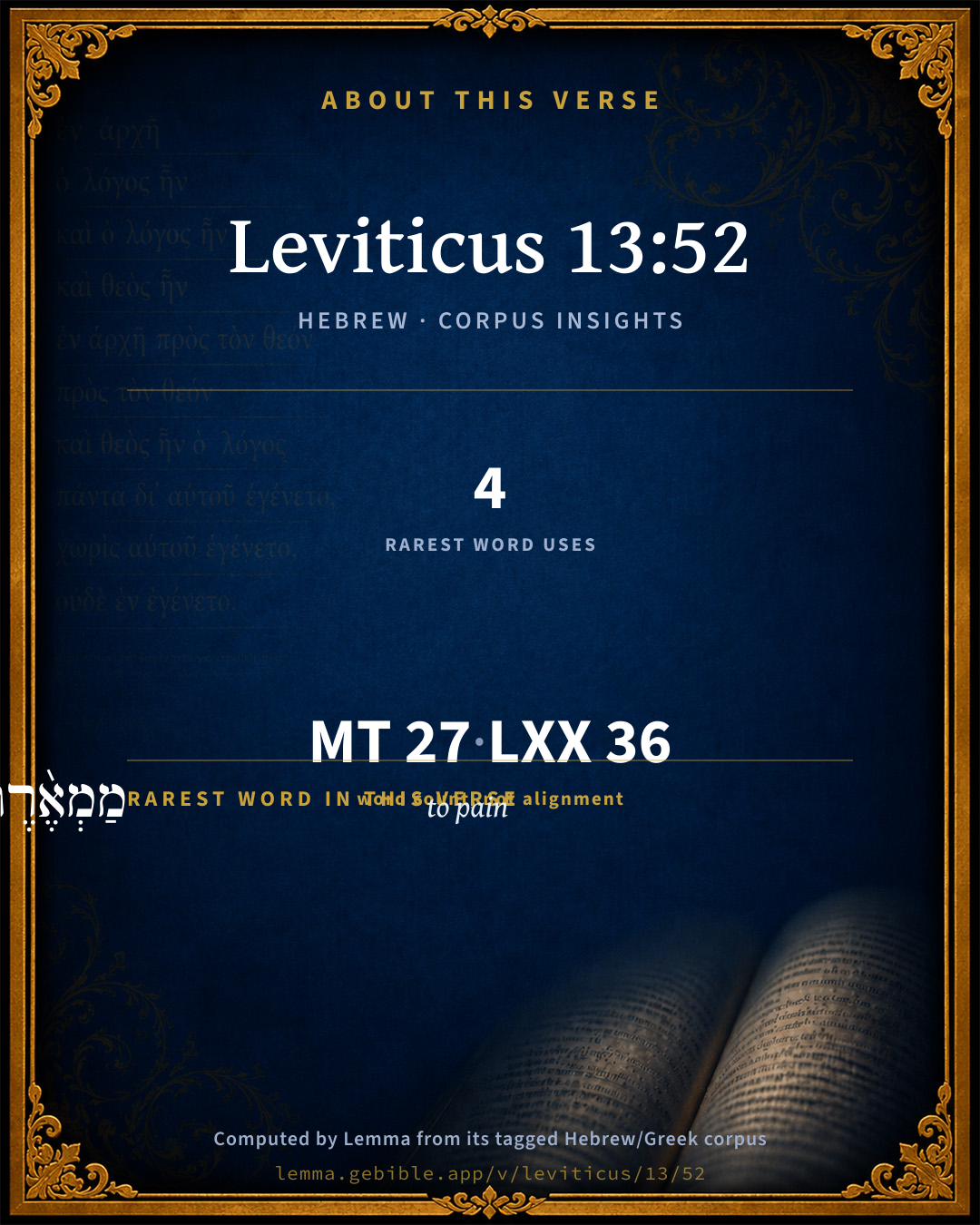
These counts appear in no published source. They are computed here, from the morphology-tagged text and Lemma’s own curated glosses. What Lemma adds →

27
words
19
distinct lemmas
Pentateuch
section

Notable vocabulary

The rarest word here is מַמְאֶ֨רֶת֙ to pain H3992 — appearing just 4 times in the whole Hebrew Bible.

Shared distinctive vocabulary

מַמְאֶ֨רֶת֙ to pain H3992 occurs in 4 verses of the Hebrew Bible. Also found in:

Grammatical profile

  • 4 verbs
  • 11 nouns
  • 1 pronoun
  • 1 preposition
  • 5 conjunctions
  • 5 particles

Verb forms

  • וְשָׂרַ֨ף Qal · Sequential Perfect
  • יִהְיֶ֥ה Qal · Imperfect
  • מַמְאֶ֨רֶת֙ Hiphil · Participle Active
  • תִּשָּׂרֵֽף Niphal · Imperfect

Repetition

Words recur within this verse — often emphatic in Hebrew:

  • וְשָׂרַ֨ף to burn H8313 ×2
  • א֥וֹ or H176 ×4

Hebrew & Septuagint length

In English translation the verse runs 38 words from the Hebrew and 41 from the Septuagint (LXX English) — closely comparable.

A rough comparison of the two English renderings, which tokenize alike — not a word-level alignment.

Word counts can differ between the Hebrew and the Greek without any difference in meaning — e.g. the Hebrew direct-object marker אֵת has no separate Greek word, and Greek often adds the article ὁ.

In the original languages it is 27 Hebrew tokens and 36 Greek tokens — but the two are counted differently (Hebrew bundles its prefixes and suffixes into one token; the Greek is in lemma form), so that isn’t a like-for-like length.

Cross-references

6

Topical passages linked to Leviticus 13:52 in the Treasury of Scripture Knowledge — connected by theme and wording, ordered by reader-vote popularity; previews shown in the World English Bible.

  • Leviticus 11:33 Every earthen vessel, into which any of them falls, all that is in it shall be unclean, and you shall break it.
  • Leviticus 11:35 Everything whereupon part of their carcass falls shall be unclean; whether oven, or range for pots, it shall be broken in pieces: they are unclean, and shall be unclean to you.
  • Leviticus 14:44–45 then the priest shall come in and look; and, behold, if the plague has spread in the house, it is a destructive mildew in the house. It is unclean.
  • Deuteronomy 7:25–26 The engraved images of their gods shall you burn with fire: you shall not covet the silver or the gold that is on them, nor take it to you, lest you be snared therein; for it is an abomination to Yahweh your God.
  • Isaiah 30:22 You shall defile the overlaying of your engraved images of silver, and the plating of your molten images of gold: you shall cast them away as an unclean thing; you shall tell it, Get you hence.
  • Acts 19:19–20 Many of those who practiced magical arts brought their books together and burned them in the sight of all. They counted the price of them, and found it to be fifty thousand pieces of silver.

Cross-references courtesy of OpenBible.info (CC BY 4.0).

Hebrew and Greek witnesses Masoretic Hebrew ↔ Greek Septuagint

The same verse in the two great witnesses to the Old Testament, shown verse-for-verse.

These are two independent witnesses, not word-aligned to each other, and the Septuagint is shown in lemma (dictionary) form.

Hebrew Leviticus 13:52 Masoretic · Westminster Leningrad Codex

וְשָׂרַ֨ף אֶת הַבֶּ֜גֶד א֥וֹ אֶֽת הַשְּׁתִ֣י א֣וֹ אֶת הָעֵ֗רֶב בַּצֶּ֨מֶר֙ א֣וֹ בַפִּשְׁתִּ֔ים א֚וֹ אֶת כָּל כְּלִ֣י הָע֔וֹר אֲשֶׁר יִהְיֶ֥ה ב֖וֹ הַנָּ֑גַע כִּֽי צָרַ֤עַת מַמְאֶ֨רֶת֙ הִ֔וא בָּאֵ֖שׁ תִּשָּׂרֵֽף

He shall burn the garment, whether the warp or the woof, in wool or in linen, or anything of skin, in which the plague is: for it is a destructive mildew. It shall be burned in the fire.

World English Bible · Public Domain

Greek LXX Leviticus 13:52 Septuagint · lemma form

κατακαίω ὁ ἱμάτιον ἤ ὁ στήμων ἤ ὁ κρόκη ἐν ὁ ἐρεοῦς ἤ ἐν ὁ λινοῦς ἤ ἐν πᾶς σκεῦος δερμάτινος ἐν ὅς ἐάν εἰμί ἐν αὐτός ὁ ἁφή ὅτι λέπρα ἔμμονος εἰμί ἐν πῦρ κατακαίω

He shall burn the garment, either the warp or woof in woollen garments or in flaxen, or in any utensil of skin, in which there may be the plague; because it is a confirmed leprosy; it shall be burnt with fire.

LXX2012 (modern English Septuagint) · Public Domain

Hebrew: Westminster Leningrad Codex (CC BY 4.0). Greek: Septuagint (public domain); English from LXX2012 (modern English Septuagint) (Public Domain). How the Septuagint differs from the Hebrew →

Targum (Aramaic paraphrase)

2

The Targum is the ancient Jewish Aramaic paraphrase of the Hebrew Scriptures — an interpretive translation, not the Hebrew text itself. Onkelos (literal) and Pseudo-Jonathan (expansive) render the Torah, and Jonathan the Prophets. Coverage is partial: where no permissively-licensed English translation exists for a verse, only the Aramaic is shown. This is verse-level text, not a word-by-word alignment to the Hebrew.

  1. Targum Onkelos Torah (Genesis–Deuteronomy)
    וְיוֹקִיד יָת לְבוּשָׁא אוֹ יָת שִׁתְיָא אוֹ יָת עַרְבָא בְעַמְרָא אוֹ בְכִתָּנָא אוֹ יָת כָּל מָאן דִמְשַׁךְ דִי יְהֵי בֵהּ מַכְתָּשָׁא אֲרֵי סְגִירוּת מְחַסְרָא הִיא בְּנוּרָא תִּתּוֹקָד

    (no public-domain English translation for this verse)

    Targum Onkelos — Aramaic: “Onkelos Genesis” (public domain); “Onkelos Exodus” (public domain); “Onkelos Leviticus” (public domain); “Onkelos Numbers” (public domain); “Onkelos Deuteronomy” (public domain). English: “Sefaria Community Translation” (CC0 1.0 (public-domain dedication)); “J.W. Etheridge. The Targums of Onkelos and Jonathan Ben Uzziel on the Pentateuch. London: Longmans, Green, 1862” (public domain). Text via Sefaria.

  2. Targum Pseudo-Jonathan Torah (Genesis–Deuteronomy)
    וְיוֹקִד יַת לְבוּשָׁא אוֹ יַת שִׁתְיָא אוֹ יַת עַרְבָא בְּעַמְרָא אוֹ בְּכִיתָּנָא אוֹ יַת כָּל מַאן דִיצְלָא דִיהֵי בֵּיהּ מַכְתְּשָׁא אֲרֵי סְגִירוּת מְחַסְרָא הוּא בְּנוּרָא תִתּוֹקָד

    (no public-domain English translation for this verse)

    Targum Pseudo-Jonathan — Aramaic: “Targum Jonathan on Genesis” (public domain); “Targum Jonathan on Exodus” (public domain); “Targum Jonathan on Leviticus” (public domain); “Targum Jonathan on Numbers” (public domain); “Targum Jonathan on Deuteronomy” (public domain). English: “The Targum of Jonathan ben Uzziel, trans. J. W. Etheridge, London, 1862” (public domain). Text via Sefaria.

Commentary

Notes on Leviticus 13:52 from classic Christian and Jewish commentators (each source and its license shown beneath its notes). The classic Christian expositions comment on the surrounding passage and are grouped to its opening verse, so a note may address several verses; the Jewish commentaries on the Tanakh (Rashi and others) are per-verse, so they appear only where the commentator wrote on this verse.

Lemma curates 59 commentaries, every one of them public domain or Creative Commons licensed, each selected and text-cleaned for this edition rather than reprinted as found. About our sources →

Adam Clarke's Commentary

Verse 52. He shall therefore burn that garment] There being scarcely any means of radically curing the infection. It is well known that the garments infected by the psora, or itch animal, have been known to communicate the disease even six or seven years after the first infection. This has been also experienced by the sorters of rags at some paper mills.

Adam Clarke's Commentary on the Bible (1810–1826) — public domain. Text from a community e-Sword/MySword module.

Ellicott's Commentary for English Readers

(52) He shall therefore burn.—As this distemper could never be eradicated from stuffs, the garments which have once become possessed of leprosy had to be burnt.

A Bible Commentary for English Readers, edited by Charles John Ellicott (1878–1897) — public domain. Text from a community e-Sword module.

John Gill's Exposition

Then the priest shall command that they wash the thing wherein the plague is,.... The priest did not wash it himself, but ordered others to do it; and this was either the part in which the plague was, or the whole garment or skin in which it was; which may be typical of the washing of the garments of men in the blood of Christ, which cleanses from all sin, Rev 7:14,

and he shall shut it up seven days more: the garment or skin in which the leprosy was, or suspected to be, to see what alteration would be made by that time through the washing, whether the colour would be altered, or whether it would spread any more or not.

John Gill's Exposition of the Whole Bible (1746–1763) — public domain (CC PDM 1.0). Text via the HelloAO Bible API.

Rashi

Rabbi Shlomo Yitzchaki (Rashi)

בצמר ובפשתים means OF WOOL OR OF FLAX. This is the plain meaning. And the Midrashic explanation is: One might think that he must bring fleeces of wool or stalks of flax and burn them together with it, (the garment, in order to make a flame in which to burn it; then the verse will mean: he shall burn the garment with wool etc.) Scripture, however, states, in this verse, היא באש תשרף “it (the garment) shall be burnt in fire” — no other thing being required with it. If this be so why does it state בצמר או בפשתים? To exclude from being burnt the אומריות, the hems, that are on it if these are made of a different material than wool or flax respectively. The word אומריות means a hem; it is the same as the better-known word אימרא. (The translation is therefore: he shall burn [apply fire to] the garment etc., on the woolen parts only) (Sifra, Tazria Parashat Nega'im, Chapter 15 1).

Rashi on the Tanakh — English translations: “The Judaica Press complete Tanach with Rashi, translated by A. J. Rosenberg” (CC BY 4.0); “Pentateuch with Rashi's commentary by M. Rosenbaum and A.M. Silbermann, 1929-1934” (public domain); “The Metsudah Tanach series, Lakewood, N.J” (CC BY 4.0); and “The Book of Joshua, Metsudah Publications, 1997” (CC BY 4.0). Text via Sefaria.

Ramban (Nachmanides)

Rabbi Moshe ben Nachman (Ramban / Nachmanides)

FOR IT IS A LEPROSY THAT IS ‘MAM’ERETH’ (FRETTING). “Mam’ereth is an expression of ‘silon mam’ir’ (a pricking brier). The Midrashic interpretation is: attach a me’eirah (curse) to it — so that you will have no benefit from it.” This is Rashi’s language. And Onkelos translated: “a leprosy that is mechasra (pricking).” This interpretation he also derived from ‘silon mam’ir’ (a pricking brier), for in Aramaic any shrub which causes a pricking pain is called chisra. Thus: “k’chizra (as a thorn) in a ball of wool;” “take thy good-natured advice and throw it over achizri (the hedge).” And the truth of the matter is that mam’ereth is indeed an expression of curse, that it is to say, it is G-d’s curse upon the garment and house, as I have mentioned. But the Midrash which states that it is forbidden to derive any benefit from it [a leprous garment] is based [not on the word mam’ereth as Rashi had it, but] on the redundancy of expression. appears in Verses 51 and 52 in the same connection. Since one is redundant, it serves as the basis for the Midrashic interpretation mentioned. The same law applies to a leprous house, and it is derived from the verse, And he shall break down the house. Thus also I have found in the Talmud Yerushalmi of Tractate Orlah: “If stones were removed from a house affected with leprosy and made into plaster, some Rabbis taught that they become free of their impurity, and some taught that they do not become free of their impurity. Those who said that they become free, are also of the opinion that they may now be used [for some benefit], and those who say that they do not become free are also of the opinion that they are still forbidden [to be made use of], for it is written: it is a leprosy that is ‘mam’ereth’, meaning, attach a curse to it and derive no benefit from it. Rabbi Abohu said in the name of Rabbi Yochanan: All things which must be burnt, one may derive benefit from their ashes, except for the ashes of an idol. Rabbi Chiya the son of Yosei asked Rabbi Yochanan: ‘There is the case of the ashes of a house [affected with leprosy], which is not related to idolatry, and yet you say that the ashes thereof are forbidden for any use [like the stones which have been turned into lime or plaster]! Said Rabbi Yochanan to him: ‘This is different,’ since [concerning a house affected with leprosy] it is written that it be ‘broken down.’” (Deuteronomy 12:3), we derive from a similarity of phrases the law that just as it is forbidden to have any benefit from idols, so we are under the same stricture of making any use from the stones of a house which had been affected with leprosy (P’nei Moshe, ibid.).Metzora

Ramban (Nachmanides) on the Tanakh — English translation: “Commentary on the Torah by Ramban (Nachmanides). Translated and annotated by Charles B. Chavel. New York, Shilo Pub. House, 1971-1976” (CC BY 4.0). Text via Sefaria.

Lesson kit

Teaching starters — assembled from the data on this page, not authored interpretation. Every prompt links to the verse data it draws on. Edit before teaching.

Leviticus, in the Pentateuch, opens this verse with 27 words (19 distinct Hebrew lemmas). Its most distinctive word is mâʼar (“to pain”). A historical commentator’s framing appears above. Read the whole chapter for the surrounding context.

Discussion questions

  1. The word mâʼar carries the sense “to pain.” How does it shape the verse?
  2. How does Leviticus 13:51, which shares the word «to pain», read alongside this verse?
  3. What does the repetition of “to burn” (2× in this one verse) do in this verse?
  4. These translations render this verse differently; the difference is in the English rendering, not the original. What questions does that raise?
  5. «וְשָׂרַ֨ף» is a Qal Sequential Perfect verb. How does that grammatical form shape the action described?
  6. Compare how Adam Clarke's Commentary and Ellicott's Commentary for English Readers read this verse. Where do they agree or differ?

Things to notice

Reading settings

Reading text

Shown beneath each verse's original-language words.

Old Testament
Old Testament edition

Read the OT as the Masoretic Hebrew (MT) or the Greek Septuagint (LXX).

English shown for the Greek Septuagint (in the Hebrew ↔ Greek comparison).

Comparing translations? Open the Compare panel on any verse page to stack up to four side by side.