
Deuteronomy 12:31

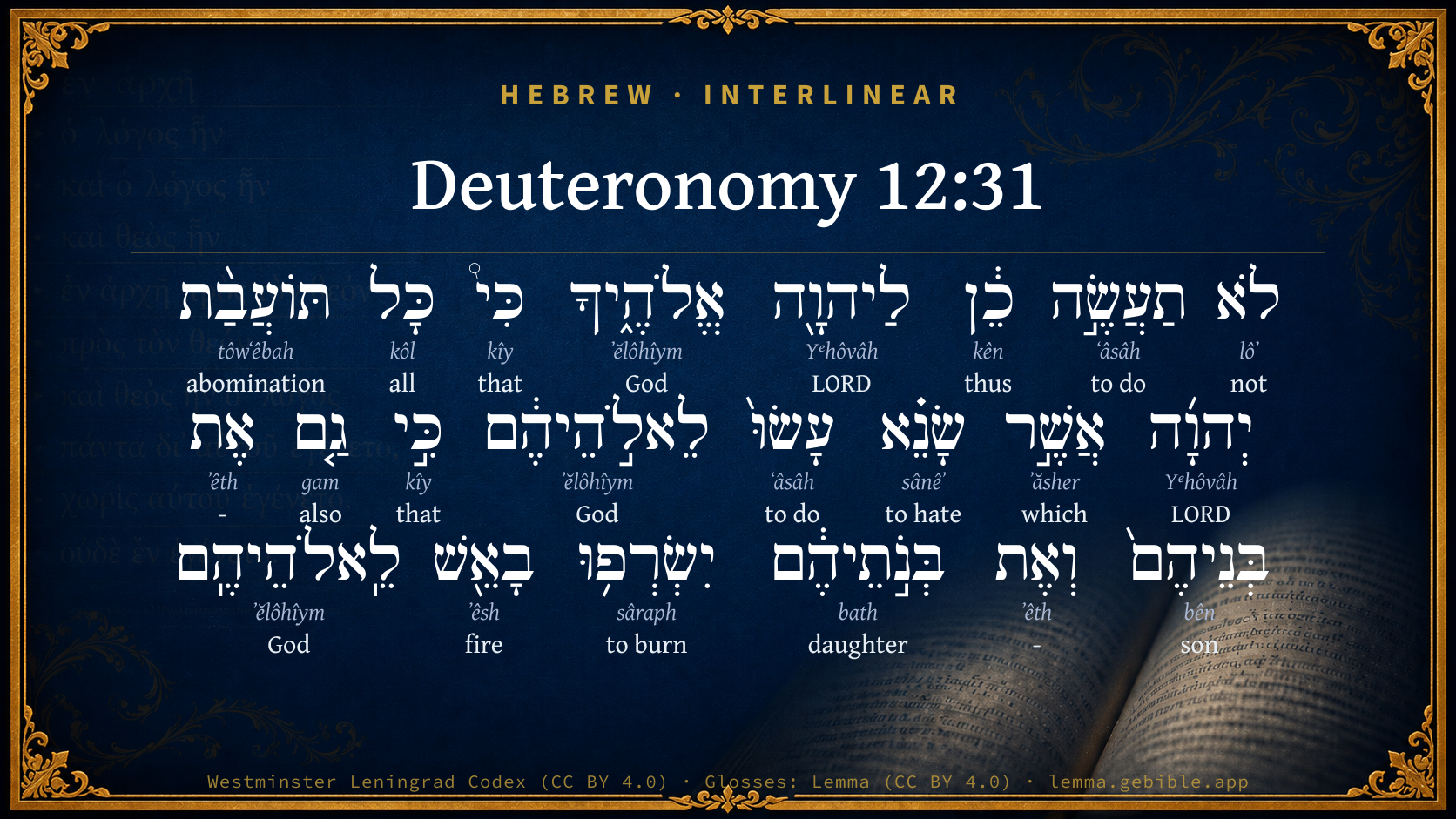
Hebrew (Westminster Leningrad Codex) Deuteronomy 12:31 appears in the Hebrew Old Testament. The text above is from the Westminster Leningrad Codex. Each word links to its Strong’s number, a concise gloss, and parsing drawn from the Open Scriptures Hebrew Bible morphology. Click any word for its full Brown-Driver-Briggs (BDB) entry.
Download image
Cite this verse

Deuteronomy 12:31 (World English Bible). Public Domain. Lemma interlinear Bible study tool, https://lemma.gebible.app/v/deuteronomy/12/31.

Show BibTeX & RIS
BibTeX
RIS
English Translation
You shall not do so to Yahweh your God: for every abomination to Yahweh, which he hates, have they done to their gods; for even their sons and their daughters do they burn in the fire to their gods.
World English Bible · Public Domain
Download a study sheet

One document with this verse’s original text, its word-by-word gloss line, the meaning frame, cross-references with their text, attributed commentary, and full source and license credits — printable, and it pastes into notes with its structure intact.

This verse Autodidact and up

Study sheet (.html) Plain text (.txt)

A passage Seminary Student

Up to 50 verses in one chapter. A passage sheet keeps up to 6 commentary sources and 12 cross-references per verse, in the order this page ranks them, and says so on the sheet whenever that leaves anything out. Ask for a single verse and you get the Autodidact verse sheet above.

Everything on this page stays free to read, with no account — the sheet is a download of what is already on screen, not access to it.

Want to remove ads? Support Godless Engineer
Compare translations 3

The same verse in 3 English versions, stacked beneath the original-language interlinear above. Click any original word for its lexicon entry.

Each is an independent rendering of the whole verse — the interlinear is not word-aligned to these translations.

Highlighted words mark where these versions differ — a whole-verse word diff, not a word-by-word alignment.

  • World English Bible Public Domain
    You shall not do so to Yahweh your God: for every abomination to Yahweh, which he hates, have they done to their gods; for even their sons and their daughters do they burn in the fire to their gods.
  • King James Version Public Domain
    Thou shalt not do so unto the LORD thy God: for every abomination to the LORD, which he hateth, have they done unto their gods; for even their sons and their daughters they have burnt in the fire to their gods.
  • unfoldingWord Literal Text CC BY-SA 4.0
    Do not do thus to Yahweh your God, for every abomination Yahweh, which he hates, they have done for their gods; for they even burn their sons and their daughters in the fire for their gods.

unfoldingWord Literal Text — © unfoldingWord, licensed CC BY-SA 4.0. Word-aligned USFM3 via Door43 (git.door43.org/unfoldingWord/en_ult).

Versions to compare (up to 4)

3 of 4 selected

Show all 18 translations

Every available English version of this verse, each an independent rendering of the whole verse.

  • World English Bible Public Domain
    You shall not do so to Yahweh your God: for every abomination to Yahweh, which he hates, have they done to their gods; for even their sons and their daughters do they burn in the fire to their gods.
  • Berean Standard Bible Public Domain
    You must not worship the LORD your God in this way, because they practice for their gods every abomination which the LORD hates. They even burn their sons and daughters in the fire as sacrifices to their gods.
  • Majority Standard Bible Public Domain
    You must not worship the LORD your God in this way, because they practice for their gods every abomination which the LORD hates. They even burn their sons and daughters in the fire as sacrifices to their gods.
  • King James Version Public Domain
    Thou shalt not do so unto the LORD thy God: for every abomination to the LORD, which he hateth, have they done unto their gods; for even their sons and their daughters they have burnt in the fire to their gods.
  • American Standard Version (1901) Public Domain
    Thou shalt not do so unto Jehovah thy God: for every abomination to Jehovah, which he hateth, have they done unto their gods; for even their sons and their daughters do they burn in the fire to their gods.
  • Revised Version (1885) Public Domain
    Thou shalt not do so unto the LORD thy God: for every abomination to the LORD, which he hateth, have they done unto their gods; for even their sons and their daughters do they burn in the fire to their gods.
  • Geneva Bible (1599) Public Domain
    Thou shalt not doe so vnto the Lord thy God: for al abomination, which the Lord hateth, haue they done vnto their gods: for they haue burned both their sonnes and their daughters with fire to their gods.
  • Douay-Rheims (1899) Public Domain
    Thou shalt not do in like manner to the Lord thy God. For they have done to their gods all the abominations which the Lord abhorreth, offering their sons and daughters, and burning them with fire.
  • Young's Literal Translation Public Domain
    `Thou dost not do so to Jehovah thy God; for every abomination of Jehovah which He is hating they have done to their gods, for even their sons and their daughters they burn with fire to their gods.
  • Literal Standard Version CC BY-SA 4.0
    You do not do so to your God YHWH; for every abomination that YHWH has hated they have done for their gods, for they even burn their sons and their daughters with fire for their gods.
  • Unlocked Literal Bible CC BY-SA 4.0
    You must not worship Yahweh your God in that way, for everything that is an abomination to Yahweh, things that he hates—they have done these with their gods; they even burn their sons and their daughters in fire for their gods.
  • unfoldingWord Literal Text CC BY-SA 4.0
    Do not do thus to Yahweh your God, for every abomination Yahweh, which he hates, they have done for their gods; for they even burn their sons and their daughters in the fire for their gods.
  • Darby Bible Public Domain
    Thou shalt not do so to Jehovah thy God; for every [thing that is] abomination to Jehovah, which he hateth, have they done unto their gods; for even their sons and their daughters have they burned in the fire to their gods.
  • World Messianic Bible Public Domain
    You shall not do so to the LORD your God; for every abomination to the LORD, which he hates, they have done to their gods; for they even burn their sons and their daughters in the fire to their gods.
  • Webster's Bible Public Domain
    Thou shalt not do so to the LORD thy God; for every abomination to the LORD which he hateth have they done to their gods; for even their sons and their daughters they have burnt in the fire to their gods.
  • Free Bible Version CC BY-SA 4.0
    You must not worship the Lord your God like this, because when they worship their gods they do every kind of abominable thing that the Lord hates. They even burn their sons and daughters as sacrifices to their gods!
  • Bible in Basic English Public Domain
    Do not so to the Lord your God: for everything which is disgusting to the Lord and hated by him they have done in honour of their gods: even burning their sons and daughters in the fire to their gods.
  • JPS Tanakh (1917) Public Domain
    Thou shalt not do so unto the LORD thy God; for every abomination to the LORD, which He hateth, have they done unto their gods; for even their sons and their daughters do they burn in the fire to their gods.

Literal Standard Version (2020), Covenant Press — licensed CC BY-SA 4.0. Text via the HelloAO Bible API (eBible.org). Unlocked Literal Bible (unfoldingWord) — licensed CC BY-SA 4.0. Text via the HelloAO Bible API (eBible.org). unfoldingWord Literal Text — © unfoldingWord, licensed CC BY-SA 4.0. Word-aligned USFM3 via Door43 (git.door43.org/unfoldingWord/en_ult). Free Bible Version, Dr. Jonathan Gallagher — licensed CC BY-SA 4.0. Text via the HelloAO Bible API (eBible.org).

Word by word

More ways to search: Search by grammar → Find every occurrence → Compare this word →

Practice this passage: Drill this verse → Learn its vocabulary →

יִשְׂרְפ֥וּ
sâraph
H8313
“to burn”
Verb, Qal, Imperfect, 3rd Person, Masculine, Plural
Part of Speech
Verb
Stem
Qal
Form
Imperfect
Person
3rd Person
Gender
Masculine
Number
Plural
Full BDB Definition

Origin: a primitive root

TWOT: 2292

to burn - (Qal) to burn - (Niphal) to be burned - (Piel) burner, burning (participle) - (Pual) to be burnt up, be burned
  1. לֹא lôʼ H3808 “not” Particle, Negative
  2. תַעֲשֶׂ֣ה ʻâsâh H6213 “to do” Verb, Qal, Imperfect, 2nd Person, Masculine, Singular
  3. כֵ֔ן kên H3651 “thus” Adverb
  4. לַיהוָ֖ה Yᵉhôvâh H3068 “to/for · LORD” Preposition + Noun, Proper
  5. אֱלֹהֶ֑יךָ ʼĕlôhîym H430 “God(s) · your” Noun, Common, Masculine, Plural, Construct + Suffix, Personal, 2nd Person, Masculine, Singular
  6. כִּי֩ kîy H3588 “that” Conjunction
  7. כָּל kôl H3605 “all of” Noun, Common, Masculine, Singular, Construct
  8. תּוֹעֲבַ֨ת tôwʻêbah H8441 “abomination of” Noun, Common, Feminine, Singular, Construct
  9. יְהוָ֜ה Yᵉhôvâh H3068 “LORD” Noun, Proper
  10. אֲשֶׁ֣ר ʼăsher H834 “which” Particle, Relative
  11. שָׂנֵ֗א sânêʼ H8130 “to hate” Verb, Qal, Perfect, 3rd Person, Masculine, Singular
  12. עָשׂוּ֙ ʻâsâh H6213 “to do” Verb, Qal, Perfect, 3rd Person, Common, Plural
  13. לֵאלֹ֣הֵיהֶ֔ם ʼĕlôhîym H430 “to/for · God(s) · their” Preposition + Noun, Common, Masculine, Plural, Construct + Suffix, Personal, 3rd Person, Masculine, Plural
  14. כִּ֣י kîy H3588 “that” Conjunction
  15. גַ֤ם gam H1571 “also” Adverb
  16. אֶת ʼêth H853 “-” Particle, Direct Object
  17. בְּנֵיהֶם֙ bên H1121 “sons · their” Noun, Common, Masculine, Plural, Construct + Suffix, Personal, 3rd Person, Masculine, Plural
  18. וְאֶת ʼêth H853 “and · -” Conjunction + Particle, Direct Object
  19. בְּנֹ֣תֵיהֶ֔ם bath H1323 “daughters · their” Noun, Common, Feminine, Plural, Construct + Suffix, Personal, 3rd Person, Masculine, Plural
  20. בָאֵ֖שׁ ʼêsh H784 “in/at the · fire” Preposition, Determined + Noun, Common, Both, Singular, Absolute
  21. לֵֽאלֹהֵיהֶֽם ʼĕlôhîym H430 “to/for · God(s) · their” Preposition + Noun, Common, Masculine, Plural, Construct + Suffix, Personal, 3rd Person, Masculine, Plural

About this verse

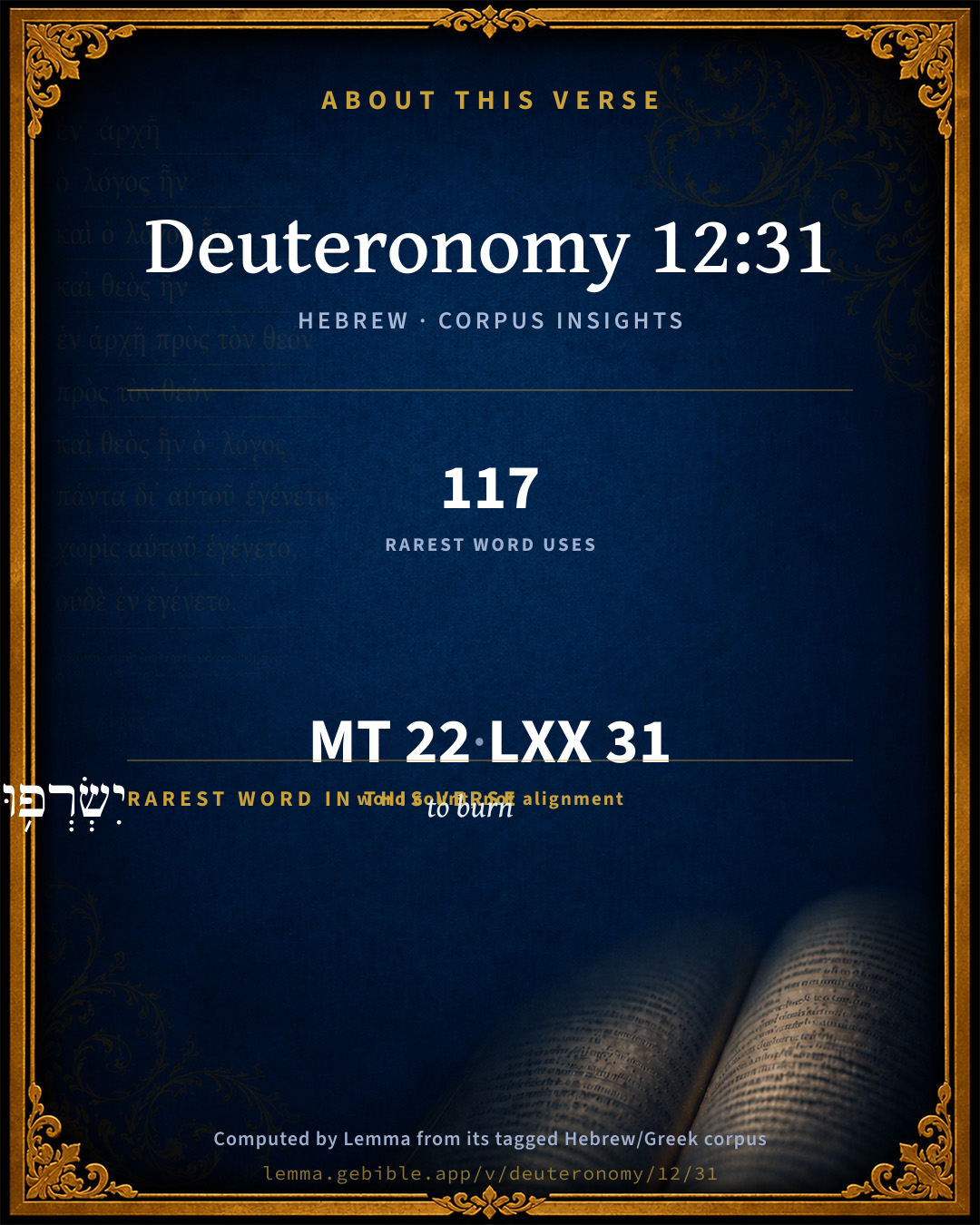
These counts appear in no published source. They are computed here, from the morphology-tagged text and Lemma’s own curated glosses. What Lemma adds →

22
words
16
distinct lemmas
Pentateuch
section

Grammatical profile

  • 4 verbs
  • 10 nouns
  • 2 conjunctions
  • 2 adverbs
  • 4 particles

Verb forms

  • תַעֲשֶׂ֣ה Qal · Imperfect
  • שָׂנֵ֗א Qal · Perfect
  • עָשׂוּ֙ Qal · Perfect
  • יִשְׂרְפ֥וּ Qal · Imperfect

Repetition

Words recur within this verse — often emphatic in Hebrew:

  • אֱלֹהֶ֑יךָ God H430 ×3
  • תַעֲשֶׂ֣ה to do H6213 ×2
  • לַיהוָ֖ה LORD H3068 ×2
  • כִּי֩ that H3588 ×2

Hebrew & Septuagint length

In English translation the verse runs 39 words from the Hebrew and 36 from the Septuagint (LXX English) — closely comparable.

A rough comparison of the two English renderings, which tokenize alike — not a word-level alignment.

Word counts can differ between the Hebrew and the Greek without any difference in meaning — e.g. the Hebrew direct-object marker אֵת has no separate Greek word, and Greek often adds the article ὁ.

In the original languages it is 22 Hebrew tokens and 31 Greek tokens — but the two are counted differently (Hebrew bundles its prefixes and suffixes into one token; the Greek is in lemma form), so that isn’t a like-for-like length.

Cross-references

17

Topical passages linked to Deuteronomy 12:31 in the Treasury of Scripture Knowledge — connected by theme and wording, ordered by reader-vote popularity; previews shown in the World English Bible.

  • Jeremiah 32:35 They built the high places of Baal, which are in the valley of the son of Hinnom, to cause their sons and their daughters to pass through [the fire] to Molech; which I didn't command them, neither did it come into my mind, that they should do this abomination, to cause Judah to sin.
  • Deuteronomy 18:9–10 When you are come into the land which Yahweh your God gives you, you shall not learn to do after the abominations of those nations.
  • 2 Kings 17:15–17 They rejected his statutes, and his covenant that he made with their fathers, and his testimonies which he testified to them; and they followed vanity, and became vain, and [went] after the nations that were round about them, concerning whom Yahweh had charged those who they should not do like them.
  • 2 Kings 21:2 He did that which was evil in the sight of Yahweh, after the abominations of the nations whom Yahweh cast out before the children of Israel.
  • Jeremiah 7:31 They have built the high places of Topheth, which is in the valley of the son of Hinnom, to burn their sons and their daughters in the fire; which I didn't command, neither came it into my mind.
  • Deuteronomy 9:5 Not for your righteousness, or for the uprightness of your heart, do you go in to possess their land; but for the wickedness of these nations Yahweh your God does drive them out from before you, and that he may establish the word which Yahweh swore to your fathers, to Abraham, to Isaac, and to Jacob.
  • Deuteronomy 12:4 You shall not do so to Yahweh your God.
  • Exodus 23:2 You shall not follow a crowd to do evil; neither shall you testify in court to side with a multitude to pervert justice;
  • Leviticus 18:3 You shall not do as they do in the land of Egypt, where you lived: and you shall not do as they do in the land of Canaan, where I am bringing you; neither shall you walk in their statutes.
  • Leviticus 18:21 "'You shall not give any of your children to sacrifice to Molech; neither shall you profane the name of your God: I am Yahweh.
  • Leviticus 18:26–30 You therefore shall keep my statutes and my ordinances, and shall not do any of these abominations; neither the native-born, nor the stranger who lives as a foreigner among you;
  • Leviticus 20:2 "Moreover, you shall tell the children of Israel, 'Anyone of the children of Israel, or of the strangers who live as foreigners in Israel, who gives any of his seed to Molech; he shall surely be put to death. The people of the land shall stone him with stones.
  • 2 Chronicles 33:2 He did that which was evil in the sight of Yahweh, after the abominations of the nations whom Yahweh cast out before the children of Israel.
  • 2 Chronicles 36:14 Moreover all the chiefs of the priests, and the people, trespassed very greatly after all the abominations of the nations; and they polluted the house of Yahweh which he had made holy in Jerusalem.
  • Ezekiel 20:31 and when you offer your gifts, when you make your sons to pass through the fire, do you pollute yourselves with all your idols to this day? and shall I be inquired of by you, house of Israel? As I live, says the Lord Yahweh, I will not be inquired of by you;
  • Ezekiel 23:27 Thus will I make your lewdness to cease from you, and your prostitution [brought] from the land of Egypt; so that you shall not lift up your eyes to them, nor remember Egypt any more.
  • Micah 6:7 Will Yahweh be pleased with thousands of rams? With tens of thousands of rivers of oil? Shall I give my firstborn for my disobedience? The fruit of my body for the sin of my soul?

Cross-references courtesy of OpenBible.info (CC BY 4.0).

Hebrew and Greek witnesses Masoretic Hebrew ↔ Greek Septuagint

The same verse in the two great witnesses to the Old Testament, shown verse-for-verse.

These are two independent witnesses, not word-aligned to each other, and the Septuagint is shown in lemma (dictionary) form.

Hebrew Deuteronomy 12:31 Masoretic · Westminster Leningrad Codex

לֹא תַעֲשֶׂ֣ה כֵ֔ן לַיהוָ֖ה אֱלֹהֶ֑יךָ כִּי֩ כָּל תּוֹעֲבַ֨ת יְהוָ֜ה אֲשֶׁ֣ר שָׂנֵ֗א עָשׂוּ֙ לֵאלֹ֣הֵיהֶ֔ם כִּ֣י גַ֤ם אֶת בְּנֵיהֶם֙ וְאֶת בְּנֹ֣תֵיהֶ֔ם יִשְׂרְפ֥וּ בָאֵ֖שׁ לֵֽאלֹהֵיהֶֽם

You shall not do so to Yahweh your God: for every abomination to Yahweh, which he hates, have they done to their gods; for even their sons and their daughters do they burn in the fire to their gods.

World English Bible · Public Domain

Greek LXX Deuteronomy 12:31 Septuagint · lemma form

οὐ ποιέω οὕτως κύριος ὁ θεός σύ ὁ γάρ βδέλυγμα ὅς κύριος μισέω ποιέω ὁ θεός αὐτός ὅτι ὁ υἱός αὐτός καί ὁ θυγάτηρ αὐτός κατακαίω ἐν πῦρ ὁ θεός αὐτός

You shall not do so to your God; for they have sacrificed to their gods the abominations of the Lord which he hates, for they burn their sons and their daughters in fire to their gods.

LXX2012 (modern English Septuagint) · Public Domain

Hebrew: Westminster Leningrad Codex (CC BY 4.0). Greek: Septuagint (public domain); English from LXX2012 (modern English Septuagint) (Public Domain). How the Septuagint differs from the Hebrew →

Targum (Aramaic paraphrase)

2

The Targum is the ancient Jewish Aramaic paraphrase of the Hebrew Scriptures — an interpretive translation, not the Hebrew text itself. Onkelos (literal) and Pseudo-Jonathan (expansive) render the Torah, and Jonathan the Prophets. Coverage is partial: where no permissively-licensed English translation exists for a verse, only the Aramaic is shown. This is verse-level text, not a word-by-word alignment to the Hebrew.

  1. Targum Onkelos Torah (Genesis–Deuteronomy)
    לָא תַעְבֵּד כֵּן קֳדָם יְיָ אֱלָהָךְ אֲרֵי כָּל דִמְרָחָק קֳדָם יְיָ דִי סָנֵי עֲבָדוּ לְטַעֲוָתְהוֹן אֲרֵי אַף יָת בְּנֵיהוֹן וְיָת בְּנָתֵיהוֹן מוֹקְדִין בְּנוּרָא לְטַּעֲוָתְהוֹן

    (no public-domain English translation for this verse)

    Targum Onkelos — Aramaic: “Onkelos Genesis” (public domain); “Onkelos Exodus” (public domain); “Onkelos Leviticus” (public domain); “Onkelos Numbers” (public domain); “Onkelos Deuteronomy” (public domain). English: “Sefaria Community Translation” (CC0 1.0 (public-domain dedication)); “J.W. Etheridge. The Targums of Onkelos and Jonathan Ben Uzziel on the Pentateuch. London: Longmans, Green, 1862” (public domain). Text via Sefaria.

  2. Targum Pseudo-Jonathan Torah (Genesis–Deuteronomy)
    לָא תַעַבְדוּן פּוּלְחָנָא כְּדֵין לַייָ אֱלָהָכוֹן אֲרוּם כָּל דִּמְרַחֵק יְיָ דְסָנֵי עָבְדִין לְטַעֲוַותְהוֹן אֲרוּם אוּף יַת בְּנֵיהוֹן וְיַת בְּנָתֵיהוֹן כַּפְתִין וּמוֹקְדִין בְּנוּרָא לְטַעֲוַותְהוֹן

    So shall you not do in serving the Lord your God; for whatever is abominable and hateful to Him have they done to their idols; for even their sons and daughters they have bound and burned with fire unto their idols.

    Targum Pseudo-Jonathan — Aramaic: “Targum Jonathan on Genesis” (public domain); “Targum Jonathan on Exodus” (public domain); “Targum Jonathan on Leviticus” (public domain); “Targum Jonathan on Numbers” (public domain); “Targum Jonathan on Deuteronomy” (public domain). English: “The Targum of Jonathan ben Uzziel, trans. J. W. Etheridge, London, 1862” (public domain). Text via Sefaria.

Commentary

Notes on Deuteronomy 12:31 from classic Christian and Jewish commentators (each source and its license shown beneath its notes). The classic Christian expositions comment on the surrounding passage and are grouped to its opening verse, so a note may address several verses; the Jewish commentaries on the Tanakh (Rashi and others) are per-verse, so they appear only where the commentator wrote on this verse.

Lemma curates 59 commentaries, every one of them public domain or Creative Commons licensed, each selected and text-cleaned for this edition rather than reprinted as found. About our sources →

Keil & Delitzsch

C. F. Keil & F. Delitzsch

Deu 12:31, like Deu 12:4, with the reason assigned in Deu 12:31 : "for the Canaanites prepare (עשׂה, as in Deu 12:27) all kinds of abominations for their gods," i.e., present offerings to these, which Jehovah hates and abhors; they even burn their children to their idols-for example, to Moloch (see at Lev 18:21).

Keil & Delitzsch — Biblical Commentary on the Old Testament (1861–1891) — public domain (CC PDM 1.0). Text via the HelloAO Bible API. (Old Testament only.)

Tyndale Open Study Notes

Tyndale Open Resources

12:31 burn their sons and daughters: Human sacrifice was one of the most abhorrent practices of ancient pagan religions. The Ammonites believed that their god Molech required such sacrifice from his worshipers (Lev 18:21; 20:2; 2 Kgs 23:10; Jer 32:35).

Tyndale Open Study Notes — © Tyndale Open Resources, licensed CC BY-SA 4.0. Text via the HelloAO Bible API.

Geneva Bible (1599)

Geneva Bible translators

They thought nothing too dear to offer to their idols.

Geneva Bible (1599) marginal notes — public domain. Text via Bolls.life.

Adam Clarke's Commentary

Verse 31. Their sons and their daughters they have burnt in the fire] Almost all the nations in the world agreed in offering human victims to their gods on extraordinary occasions, by which it is evident that none of those nations had any right notion of the Divine nature. How necessary, then, was the volume of revelation, to teach men what that religion is with which God can be well pleased! The Hindoos to this day offer human victims to their goddess Cali, and at the temple of Jaggernaut; and yet, notwithstanding this, there are found certain persons who, while they profess Christianity, are absolutely unwilling to send the Hindoos the Gospel of Christ, because they think it would not be politically wise! But the wisdom of this world has ever been foolishness with God; and in spite of all this infidel policy, the word of the Lord shall have free course and be glorified.

Adam Clarke's Commentary on the Bible (1810–1826) — public domain. Text from a community e-Sword/MySword module.

John Gill's Exposition

Thou shalt not do so unto the Lord thy God,.... Not serve and worship him after the manner of the Gentiles, nor introduce their rites and customs into his service, used by them in the worship of their gods:

for every abomination which he hateth have they done unto their gods; as murder, adultery, &c. which God has expressed his aversion to, and indignation at; one instance of the former sort is given here:

for even their sons and their daughters they have burnt in the fire to their gods; not only men have they sacrificed to them, but such near relations; and not only caused them to pass through the fire, but burnt them in it; so the Carthaginians are said to do, who learned this inhuman practice from the Phoenicians; they were a colony of the inhabitants of this land of Canaan. Of the Phoenicians Porphyry says (i), that in great calamities, as war or pestilence, they sacrificed to Saturn some one of those that were dearest to them, appointed by suffrage. The Phoenician history, adds he, is full of such sacrifices, which Sanchoniatho wrote in the Phoenician language; and Curtius says (k), this custom of sacrificing a fine boy to Saturn was received by the Carthaginians from their founders (the Tyrians and Phoenicians), and which they continued even to the destruction of their city.

(i) De Abstinentia, l. 2. sect. 56. (k) Hist. l. 4. c. 3.

John Gill's Exposition of the Whole Bible (1746–1763) — public domain (CC PDM 1.0). Text via the HelloAO Bible API.

Haydock's Catholic Bible Commentary

Fire. See Leviticus xviii. 21.

George Leo Haydock (1774–1849), Haydock's Catholic Family Bible and Commentary, 1859 edition — public domain. Excludes Psalms (Douay-Rheims chapter numbering differs from Protestant) and Deuterocanonical books (Catholic canon only).

Matthew Poole's English Annotations

Shalt not do so unto the Lord; either,

1. Not offer him that indignity and injury to worship other gods together with him. Or rather,

2. Not worship him in such manner as they worshipped their gods, to wit, by offering thy children to him, as they did to their gods, as it here follows, or by their own devices or superstitions, as is implied, Deu 12:32.

Matthew Poole's English Annotations on the Holy Bible (1683–1685) — public domain. Text from a community e-Sword/MySword module.

The Pulpit Commentary

For even their sons and their daughters have they burnt in the fire to their gods. Elsewhere the phrase used is "make to pass through the fire", (Deu_18:10) or simply "make to pass through to Molech" (Lev_18:21; Jer_32:35) This has led some to maintain that the ceremony described was merely a februation, a lustration by fire, and not an actual burning alive of these victims; but there can be no doubt that both among the Ammonites and the Phoenicians, and indeed wherever the worship of Baal or Molech was followed, the offering of children in sacrifice by burning prevailed (Munter, "Religion der Karthager," p. 18, 2nd edit.; Selden, "De Diis Syris Syntag," i.e. 6, pp. 93, 257, edit. Beyer, Amst., 1680).

The Pulpit Commentary (1880–1919), ed. H.D.M. Spence-Jones & Joseph S. Exell — public domain. Text from a community e-Sword module.

unfoldingWord translationNotes

Door43 World Missions Community

Do not add to it or take away from it

They are not to create more laws nor are they to ignore laws that God has given them.

translationWords

abomination

false god

fire

command

unfoldingWord translationNotes — © Distant Shores Media and the Door43 World Missions Community, licensed CC BY-SA 4.0. Source: git.door43.org/Door43/en_tn.

Rashi

Rabbi Shlomo Yitzchaki (Rashi)

כי גם את בניהם FOR ALSO THEIR SONS [AND THEIR DAUGHTERS HAVE THEY BURNT IN THE FIRE TO THEIR GOD] — The word גם, “also”, is intended to include amongst those they used to burn, their parents also. R. Akiba related, “I once saw a heathen who bound his father before his dog which thereupon devoured him” (Sifrei Devarim 81:6).

Rashi on the Tanakh — English translations: “The Judaica Press complete Tanach with Rashi, translated by A. J. Rosenberg” (CC BY 4.0); “Pentateuch with Rashi's commentary by M. Rosenbaum and A.M. Silbermann, 1929-1934” (public domain); “The Metsudah Tanach series, Lakewood, N.J” (CC BY 4.0); and “The Book of Joshua, Metsudah Publications, 1997” (CC BY 4.0). Text via Sefaria.

Lesson kit

Teaching starters — assembled from the data on this page, not authored interpretation. Every prompt links to the verse data it draws on. Edit before teaching.

Deuteronomy, in the Pentateuch, opens this verse with 22 words (16 distinct Hebrew lemmas). Its most distinctive word is sâraph (“to burn”). A historical commentator’s framing appears above. Read the whole chapter for the surrounding context.

Discussion questions

  1. What does “to burn” (sâraph) contribute to the verse as a whole?
  2. Jeremiah 32:35 shares this passage’s theme. How do the two illuminate each other?
  3. “God” occurs 3× in this one verse. What is the effect of the repetition?
  4. These translations render this verse differently. What is at stake in choosing one wording over another?
  5. The verb «תַעֲשֶׂ֣ה» is Qal Imperfect. How does its form color the action?
  6. Reading how Keil & Delitzsch and Tyndale Open Study Notes read this verse, where do the two commentators agree and where do they part?

Things to notice

Reading settings

Reading text

Shown beneath each verse's original-language words.

Old Testament
Old Testament edition

Read the OT as the Masoretic Hebrew (MT) or the Greek Septuagint (LXX).

English shown for the Greek Septuagint (in the Hebrew ↔ Greek comparison).

Comparing translations? Open the Compare panel on any verse page to stack up to four side by side.