
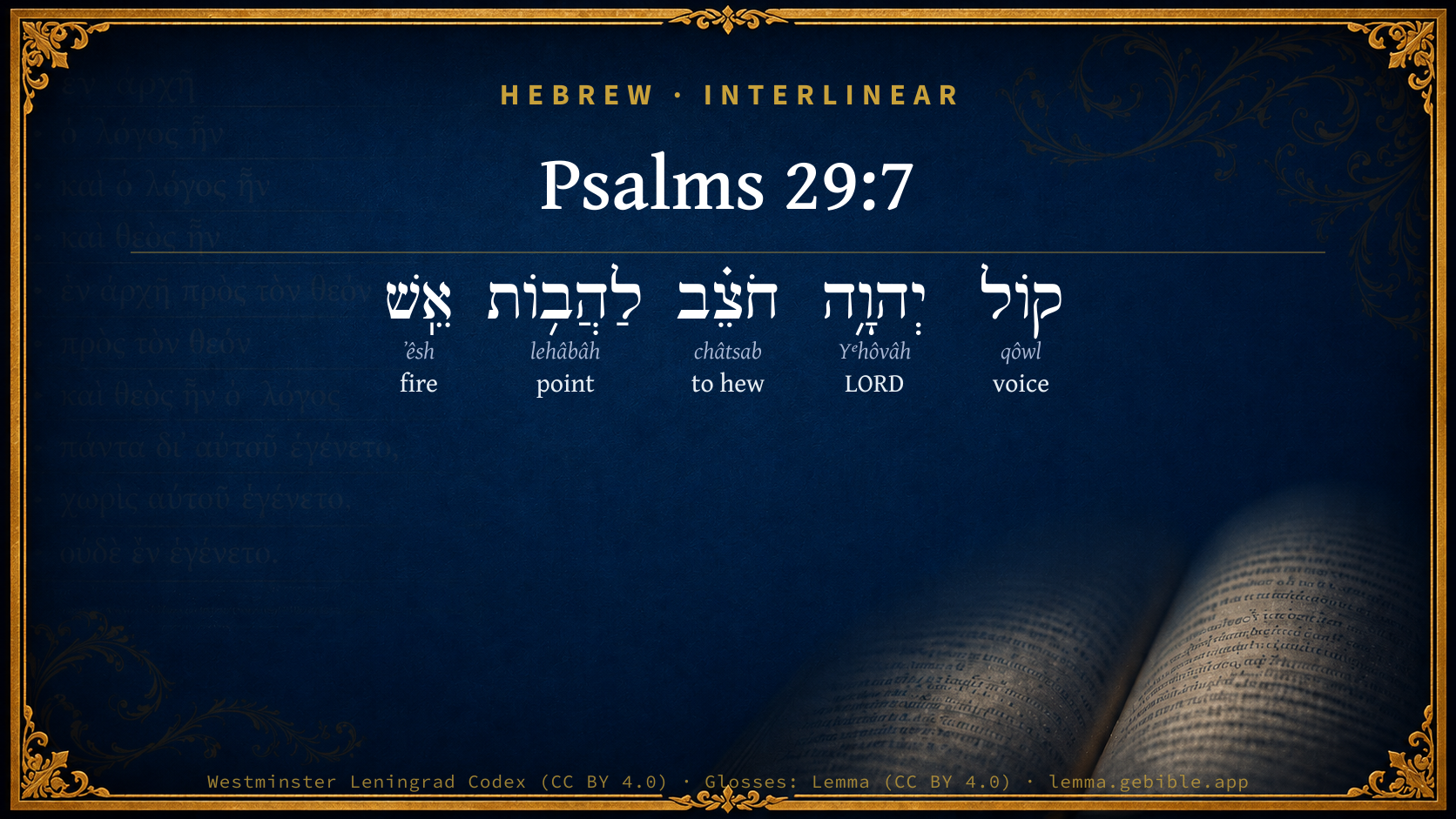
Psalms 29:7

Hebrew (Westminster Leningrad Codex) Psalms 29:7 appears in the Hebrew Old Testament. The text above is from the Westminster Leningrad Codex. Each word links to its Strong’s number, a concise gloss, and parsing drawn from the Open Scriptures Hebrew Bible morphology. Click any word for its full Brown-Driver-Briggs (BDB) entry.
Download image
Cite this verse

Psalms 29:7 (World English Bible). Public Domain. Lemma interlinear Bible study tool, https://lemma.gebible.app/v/psalms/29/7.

Show BibTeX & RIS
BibTeX
RIS
English Translation
Yahweh's voice strikes with flashes of lightning.
World English Bible · Public Domain
Download a study sheet

One document with this verse’s original text, its word-by-word gloss line, the meaning frame, cross-references with their text, attributed commentary, and full source and license credits — printable, and it pastes into notes with its structure intact.

This verse Autodidact and up

Study sheet (.html) Plain text (.txt)

A passage Seminary Student

Up to 50 verses in one chapter. A passage sheet keeps up to 6 commentary sources and 12 cross-references per verse, in the order this page ranks them, and says so on the sheet whenever that leaves anything out. Ask for a single verse and you get the Autodidact verse sheet above.

Everything on this page stays free to read, with no account — the sheet is a download of what is already on screen, not access to it.

Want to remove ads? Support Godless Engineer
Compare translations 3

The same verse in 3 English versions, stacked beneath the original-language interlinear above. Click any original word for its lexicon entry.

Each is an independent rendering of the whole verse — the interlinear is not word-aligned to these translations.

Highlighted words mark where these versions differ — a whole-verse word diff, not a word-by-word alignment.

  • World English Bible Public Domain
    Yahweh's voice strikes with flashes of lightning.
  • King James Version Public Domain
    The voice of the LORD divideth the flames of fire.
  • unfoldingWord Literal Text CC BY-SA 4.0
    The voice of Yahweh is hewing out with flames of fire.

unfoldingWord Literal Text — © unfoldingWord, licensed CC BY-SA 4.0. Word-aligned USFM3 via Door43 (git.door43.org/unfoldingWord/en_ult).

Versions to compare (up to 4)

3 of 4 selected

Show all 18 translations

Every available English version of this verse, each an independent rendering of the whole verse.

  • World English Bible Public Domain
    Yahweh's voice strikes with flashes of lightning.
  • Berean Standard Bible Public Domain
    The voice of the LORD strikes with flames of fire.
  • Majority Standard Bible Public Domain
    The voice of the LORD strikes with flames of fire.
  • King James Version Public Domain
    The voice of the LORD divideth the flames of fire.
  • American Standard Version (1901) Public Domain
    The voice of Jehovah cleaveth the flames of fire.
  • Revised Version (1885) Public Domain
    The voice of the LORD cleaveth the flames of fire.
  • Geneva Bible (1599) Public Domain
    The voice of the Lord deuideth the flames of sire.
  • Douay-Rheims (1899) Public Domain
    The voice of the Lord divideth the flame of fire:
  • Young's Literal Translation Public Domain
    The voice of Jehovah is hewing fiery flames,
  • Literal Standard Version CC BY-SA 4.0
    The voice of YHWH is hewing fiery flames,
  • Unlocked Literal Bible CC BY-SA 4.0
    The voice of Yahweh sends out flames of fire.
  • unfoldingWord Literal Text CC BY-SA 4.0
    The voice of Yahweh is hewing out with flames of fire.
  • Darby Bible Public Domain
    The voice of Jehovah cleaveth out flames of fire.
  • World Messianic Bible Public Domain
    The LORD’s voice strikes with flashes of lightning.
  • Webster's Bible Public Domain
    The voice of the LORD divideth the flames of fire.
  • Free Bible Version CC BY-SA 4.0
    The Lord's voice blazes out like lightning flashes.
  • Bible in Basic English Public Domain
    At the voice of the Lord flames of fire are seen.
  • JPS Tanakh (1917) Public Domain
    The voice of the LORD heweth out flames of fire.

Literal Standard Version (2020), Covenant Press — licensed CC BY-SA 4.0. Text via the HelloAO Bible API (eBible.org). Unlocked Literal Bible (unfoldingWord) — licensed CC BY-SA 4.0. Text via the HelloAO Bible API (eBible.org). unfoldingWord Literal Text — © unfoldingWord, licensed CC BY-SA 4.0. Word-aligned USFM3 via Door43 (git.door43.org/unfoldingWord/en_ult). Free Bible Version, Dr. Jonathan Gallagher — licensed CC BY-SA 4.0. Text via the HelloAO Bible API (eBible.org).

Word by word

More ways to search: Search by grammar → Find every occurrence → Compare this word →

Practice this passage: Drill this verse → Learn its vocabulary →

About this verse

These counts appear in no published source. They are computed here, from the morphology-tagged text and Lemma’s own curated glosses. What Lemma adds →

5
words
5
distinct lemmas
Wisdom
section

Notable vocabulary

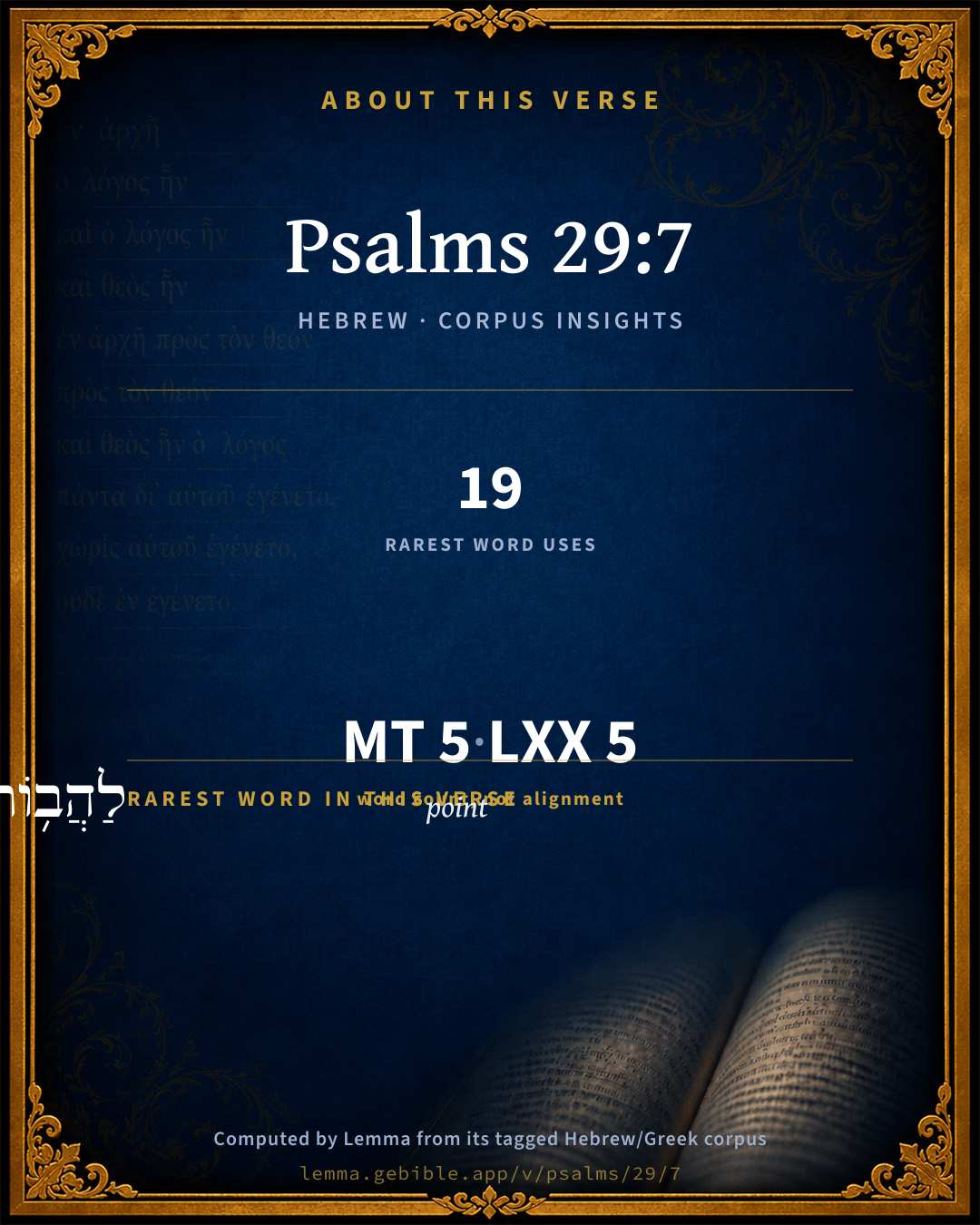
The rarest word here is לַהֲב֥וֹת point H3852 — appearing just 19 times in the whole Hebrew Bible.

Shared distinctive vocabulary

לַהֲב֥וֹת point H3852 occurs in 19 verses of the Hebrew Bible. Also found in:

Grammatical profile

  • 1 verb
  • 4 nouns

Verb forms

  • חֹצֵ֗ב Qal · Participle Active

Hebrew & Septuagint length

In English translation the verse runs 7 words from the Hebrew and 13 from the Septuagint (LXX English) — closely comparable.

A rough comparison of the two English renderings, which tokenize alike — not a word-level alignment.

Word counts can differ between the Hebrew and the Greek without any difference in meaning — e.g. the Hebrew direct-object marker אֵת has no separate Greek word, and Greek often adds the article ὁ.

In the original languages it is 5 Hebrew tokens and 5 Greek tokens — but the two are counted differently (Hebrew bundles its prefixes and suffixes into one token; the Greek is in lemma form), so that isn’t a like-for-like length.

Cross-references

8

Topical passages linked to Psalms 29:7 in the Treasury of Scripture Knowledge — connected by theme and wording, ordered by reader-vote popularity; previews shown in the World English Bible.

  • Psalms 77:18 The voice of your thunder was in the whirlwind. The lightnings lit up the world. The earth trembled and shook.
  • Leviticus 10:2 And fire came forth from before Yahweh, and devoured them, and they died before Yahweh.
  • Psalms 144:5–6 Part your heavens, Yahweh, and come down. Touch the mountains, and they will smoke.
  • Exodus 9:23 Moses stretched forth his rod toward the heavens, and Yahweh sent thunder, hail, and lightning flashed down to the earth. Yahweh rained hail on the land of Egypt.
  • 2 Kings 1:10–12 Elijah answered to the captain of fifty, If I be a man of God, let fire come down from the sky, and consume you and your fifty. Fire came down from the sky, and consumed him and his fifty.
  • Job 37:3 He sends it forth under the whole sky, And his lightning to the ends of the earth.
  • Job 38:35 Can you send forth lightnings, that they may go? Do they report to you, 'Here we are?'
  • Numbers 16:35 Fire came forth from Yahweh, and devoured the two hundred fifty men who offered the incense.

Cross-references courtesy of OpenBible.info (CC BY 4.0).

Hebrew and Greek witnesses Masoretic Hebrew ↔ Greek Septuagint

The same verse in the two great witnesses to the Old Testament, shown verse-for-verse.

You’re reading Greek Psalm 28 (Hebrew Psalm 29). The Septuagint counts the superscription, so verse numbers can differ from the Hebrew — chapter-level alignment, not verse-by-verse. Numbering follows Rahlfs.

These are two independent witnesses, not word-aligned to each other, and the Septuagint is shown in lemma (dictionary) form.

Hebrew Psalms 29:7 Masoretic · Westminster Leningrad Codex

קוֹל יְהוָ֥ה חֹצֵ֗ב לַהֲב֥וֹת אֵֽשׁ

Yahweh's voice strikes with flashes of lightning.

World English Bible · Public Domain

Greek LXX Greek Psalm 28:7 Septuagint · lemma form

φωνή κύριος διακόπτω φλόξ πύρ

There is a voice of the Lord who divides a flame of fire.

LXX2012 (modern English Septuagint) · Public Domain

On this verse, The Treasury of David discusses the Septuagint’s reading. Read the note in Commentary ↓

Hebrew: Westminster Leningrad Codex (CC BY 4.0). Greek: Septuagint (public domain); English from LXX2012 (modern English Septuagint) (Public Domain). How the Septuagint differs from the Hebrew →

Commentary

Notes on Psalms 29:7 from classic Christian and Jewish commentators (each source and its license shown beneath its notes). The classic Christian expositions comment on the surrounding passage and are grouped to its opening verse, so a note may address several verses; the Jewish commentaries on the Tanakh (Rashi and others) are per-verse, so they appear only where the commentator wrote on this verse.

Lemma curates 59 commentaries, every one of them public domain or Creative Commons licensed, each selected and text-cleaned for this edition rather than reprinted as found. About our sources →

Trapp's Complete Commentary

John Trapp

Psa 29:7 The voice of the LORD divideth the flames of fire.

Ver. 7. The voice of the Lord divideth (Heb. cutteth out) the flames of fire] i.e. The lightniugs, which the thunder is said to strike, or cut out, because it causeth them to shoot and glide; it immediately followeth one flash, and goeth before another; dispersing and darting them hither and thither.

John Trapp, A Commentary or Exposition upon All the Books of the Old and New Testament (1647–1656) — public domain. Text from a community e-Sword module.

Joseph Benson's Commentary

Psa 29:7-8. Divideth the flames of fire — That is, casteth out many flashes of lightning. The Hebrew, חצב, chatzeb, signifies hews, or cuts up, divides, or distributes. “So the thunder, or voice of the Lord, is said to send forth the lightning; which is, indeed, the precursor of the thunder; the cause, and not the effect of it. The thunder, however, or voice of the Lord, is here, with great beauty and propriety, considered as that which commands and distributes the lightning.” Shaketh the wilderness — That is, either the trees, or rather, the beasts of the wilderness, by a metonymy, as before. Compare this with the next verse; the wilderness of Kadesh — Which he mentions as an eminent wilderness, vast and terrible, and well known to the Israelites, Num 20:1; Num 20:16, wherein, possibly, they had seen some such effects of thunder as are here mentioned.

Joseph Benson's Commentary on the Old and New Testaments (1811–1818) — public domain. Text from a community e-Sword module.

J. A. Alexander on Psalms

Joseph Addison Alexander

7. (Psa 29:7) The voice of Jehovah (is) hewing flames (or with flames) of fire. The reference to lightning in this verse is universally admitted, some even seeing an allusion to the brief and sudden flash in the single clause of which the sentence is composed. Interpreters are not agreed, however, with respect to the specific image here presented. Some understand the act described to be that of cleaving or dividing, in allusion to the forked appearance of a flash of lightning; others that of hewing out, extracting flames; and others that of hewing with them, i.e. using them as weapons of warfare or instruments of vengeance. This last construction is a common one in Hebrew, and is favoured here by the analogy of Isa 51:9, Hos 6:5, where the same verb is applied to God's penal judgments.—The voice of God must here mean his authority or order, as it could not be said without absurdity, that the thunder either hews the lightning, or hews with it.

Joseph Addison Alexander, The Psalms Translated and Explained (1850) — public domain. Text from a community e-Sword module.

Geneva Bible (1599)

Geneva Bible translators

It causeth the lightnings to shoot and glide.

Geneva Bible (1599) marginal notes — public domain. Text via Bolls.life.

Jamieson, Fausset & Brown

Robert Jamieson, A. R. Fausset & David Brown

divideth--literally, "hews off." The lightning, like flakes and splinters hewed from stone or wood, flies through the air.

Jamieson, Fausset & Brown — Commentary Critical and Explanatory on the Whole Bible (1871) — public domain (CC PDM 1.0). Text via the HelloAO Bible API.

Adam Clarke's Commentary

Verse 7. Divideth the flames of fire.] The forked zigzag lightning is the cause of thunder; and in a thunder-storm these lightnings are variously dispersed, smiting houses, towers, trees, men, and cattle, in different places.

Adam Clarke's Commentary on the Bible (1810–1826) — public domain. Text from a community e-Sword/MySword module.

Ellicott's Commentary for English Readers

(7) The voice . . .—Literally, the voice of Jehovah cleaving flames of fire. The word is used of hewingstone and wood (Isa_10:15). The reference to lightning in this verse is universally admitted, some even seeing an allusion to the brief and sudden flash in the single clause of which the sentence is composed. But the most various explanations are given of the image employed. One of these—that of beating out as from an anvil—may be set aside as clumsy and unworthy of the poet. But the comparison with Isa_51:9, and Hos_6:5, where the same verb is used of God’s “judgments,” makes it possible that the lightnings here are regarded as “thought-executing fires,” and if language would allow, we might translate “hewing with flames of fire,” and illustrate by

“And ever and anon some bright white shaft

Burnt through the pine-tree roof, here burnt and there,

As if God’s messenger through the close wood screen

Plunged and replunged his weapon at a venture,

Feeling for guilty thee and me.”

BROWNING: Pippa Passes.

But this, though the usual ancient translation, is now generally rejected in favour of the allusion to “forked lightning,” as we call it, the ignes trisulci of Ovid, a natural metaphor by which to try to represent the “nimble stroke of quick cross-lightnings.” For the apparent physical mistake in making thunder the agent in producing the lightning, see Note on Psa_29:5.

A Bible Commentary for English Readers, edited by Charles John Ellicott (1878–1897) — public domain. Text from a community e-Sword module.

The Cambridge Bible for Schools and Colleges

gen. ed. J. J. S. Perowne

7. divideth the flames of fire] Better, as in R.V., cleaveth the flames of fire; or, as in R.V. marg., heweth out flames of fire; a poetical description of the forked lightnings darting from the cloud.

The Cambridge Bible for Schools and Colleges (gen. ed. J. J. S. Perowne; Cambridge University Press, 1878–1918) — public domain. Text from a community e-Sword module.

John Gill's Exposition

The voice of the Lord divideth the flames of fire. Or "cutteth with flames of fire" (e); that is, the thunder breaks through the clouds with flames of fire, or lightning, as that is sometimes called, Psa 105:32; and with which it cleaves asunder trees and masts of ships, cuts and hews them down, and divides them into a thousand shivers. Some refer this, in the figurative and mystical sense, to the giving of the law on Mount Sinai (f), on which the Lord descended in fire, and from his right hand went a fiery law; but rather this may be applied to the cloven or divided tongues of fire which sat upon the disciples on the day of Pentecost, as an emblem of the extraordinary gifts of the Spirit bestowed on them; though it seems best of all, as before, to understand this of the voice of Christ in the Gospel, which cuts and hews down all the goodliness of men, and lays them to the ground, Hos 6:5; and is of a dividing nature, and lays open all the secrets of the heart, Heb 4:12; and, through the corruption or human nature, is the occasion of dividing one friend from another, Luk 12:51; and like flames of fire it has both light and heat in it; it is the means of enlightening men's eyes to see their sad estate, and their need of Christ, and salvation by him; and of warming their souls with its refreshing truths and promises, and of inflaming their love to God and Christ, and of setting their affections on things above, and of causing their hearts to burn within them.

(e) "caedit cum flammis ignis", Cocceius, Gejerus. (f) Jarchi in loc.

John Gill's Exposition of the Whole Bible (1746–1763) — public domain (CC PDM 1.0). Text via the HelloAO Bible API.

Albert Barnes' Notes on the Bible

Divideth the flames of fire - Margin, “cutteth out.” The Hebrew word - חצב châtsab - means properly “to cut, to hew, to hew out;” as, for example, stones. The allusion here is undoubtedly to lightning; and the image is either that it seems to be cut out, or cut into tongues and streaks - or, more probably, that the “clouds” seem to be cut or hewed so as to make openings or paths for the lightning. The eye is evidently fixed on the clouds, and on the sudden flash of lightning, as if the clouds had been “cleaved” or “opened” for the passage of it. The idea of the psalmist is that the “voice of the Lord,” or the thunder, seems to cleave or open the clouds for the flames of fire to play amidst the tempest. Of course this language, as well as that which has been already noticed Psa 29:5, must be taken as denoting what “appears” to the eye, and not as a scientific statement of the reality in the case. The rolling thunder not only shakes the cedars, and makes the lofty trees on Lebanon and Sirion skip like a calf or a young unicorn, but it rends asunder or cleaves the clouds, and cuts out paths for the flames of fire.

Albert Barnes' Notes on the Bible (1834–1885) — public domain. Text from a community e-Sword/MySword module.

Matthew Poole's English Annotations

Divideth, Heb. heweth out, i.e. it breaketh out of the clouds, and thereby makes way for the lightnings, which are suddenly dispersed over the face of the earth.

Matthew Poole's English Annotations on the Holy Bible (1683–1685) — public domain. Text from a community e-Sword/MySword module.

The Treasury of David

Charles H. Spurgeon

Ver. 7. The voice of the Lord divideth the flames of fire. As when sparks fly from the anvil by blows of a ponderous hammer, so the lightning attends the thundering strokes of Jehovah.

"At first heard solemn over the verge of heaven,

The tempest growls; but as it nearer comes,

And rolls its awful burden on the wind,

The lightnings flash a larger curve, and more

The noise astounds: till overhead a sheet

Of livid flame discloses wide; then shuts

And opens wider; shuts and opens still

Expansive, wrapping ether in a blaze."

The thunder seems to divide one flash from another, interposing its deepening roar between the flash which precedes it and the next. That the flashes are truly flames of fire is witnessed by their frequently falling upon houses, churches, etc., and wrapping them in a blaze. How easily could the Lord destroy his rebellious creatures with his hot thunderbolts! how gracious is the hand which spares such great offenders, when to crush them would be so easy!

Flames of fire attend the voice of God in the gospel, illuminating and melting the hearts of men: by those he consumes our lusts and kindles in us a holy flame of ever aspiring love and holiness. Pentecost is a suggestive commentary upon this verse.

Ver. 7. The voice of the Lord divideth the flames of fire. By the power of God, the "flames of fire" are "divided" and sent abroad from the clouds upon the earth, in the terrible form of lightning, that sharp and glittering sword of the Almighty, which no substance can withstand. The same power of God goeth forth by his word, "quick and powerful, and sharper than any two edged sword." penetrating, melting, enlightening, and inflaming the hearts of men, Ac 2:3 Heb 4:12. George Horne.

Ver. 7. The voice of the Lord divideth the flames of fire. The voice of the Lord is here said to divide the flames; literally, to hew out flames, (latomein flav). The Septuagint has (diakoptei floga puroz). In the words of Gensenius, "The voice of Jehovah cutteth out flames of fire, "i.e., "sendeth out divided flames of fire." This is (as Theodoret has observed) very descriptive of the divine action at Pentecost, sending forth divided flames, like "tela trisulca, "in the tongues of fire which were divided off from one heavenly source or fountain of flame, and sat upon the heads of the apostles, and which filled them with the fire of holy zeal and love. Christopher Wordsworth.

Ver. 7. Divideth the flames of fire. Margin, cutteth out. The Hebrew word (bux) khatzab means properly to cut, to hew, to hew out; as for example, stones. The allusion here is undoubtedly to lightning; and the image is either that it seems to be cut out, or cut into tongues and streaksor, more probably, that the clouds seem to be cut or hewed, so as to make openings or paths for the lightning. The eye is evidently fixed on the clouds, and on the sudden flash of lightning, as if the clouds has been cleaved or opened for the passage of it. The idea of the psalmist is, that the "voice of the Lord, "or the thunder, seems to cleave or open the clouds for the flames of fire to play amidst the tempest. Albert Barnes.

Ver. 7. The fire which goes with the word. This is a wide subject.

Psalms 29:8*

Charles H. Spurgeon's The Treasury of David (1869–1885) — public domain. Psalms only. Text from a community e-Sword/MySword module.

Whedon's Commentary on the Bible

Daniel D. Whedon

7. Divideth the flames of fire—A poetical description of forked lightning, as if it were cleaved or split. The word frequently means hewing and splitting, as Isa_10:15. The grammatical construction would make “the voice of the Lord” (thunder) the cause of cleaving or cutting out, the lightning; but the poet speaks phenomenally, as it appears. Elsewhere the thunder is put for the effect of lightning. Job_37:3-4. “With every thunder peal comes the terrible forked lightning, so striking in tropical and eastern lands. Its vivid, zig-zag, serpent-like flash, is given in a few words.”—Perowne.

Daniel D. Whedon (gen. ed.), Commentary on the Old and New Testaments (1874–1909) — public domain. Text from a community e-Sword module.

The Pulpit Commentary

The voice of the Lord divideth the flames of fire; rather, the voice of the Lord heweth out flames of fire. The poet describes the appearances of things, not the actual reality. To him it seems as if the thunder, rolling along the sky, hewed out a chasm in the clouds, from which the forked lightning issued.

The Pulpit Commentary (1880–1919), ed. H.D.M. Spence-Jones & Joseph S. Exell — public domain. Text from a community e-Sword module.

John Wesley's Explanatory Notes

The flames - The lightnings.

John Wesley, Explanatory Notes Upon the Whole Bible (1754–1765) — public domain. Text via the GEBible commentary corpus.

Rashi

Rabbi Shlomo Yitzchaki (Rashi)

cleaves with flames of fire taylont in Old French, to cut. Our Sages (Mechilta ibid.) explained that the utterance of the Decalogue emanated from His mouth with a flame of fire and was engraved on the tablets according to their form.

Rashi on the Tanakh — English translations: “The Judaica Press complete Tanach with Rashi, translated by A. J. Rosenberg” (CC BY 4.0); “Pentateuch with Rashi's commentary by M. Rosenbaum and A.M. Silbermann, 1929-1934” (public domain); “The Metsudah Tanach series, Lakewood, N.J” (CC BY 4.0); and “The Book of Joshua, Metsudah Publications, 1997” (CC BY 4.0). Text via Sefaria.

Lesson kit

Teaching starters — assembled from the data on this page, not authored interpretation. Every prompt links to the verse data it draws on. Edit before teaching.

Psalms, in the Wisdom, opens this verse with 5 words (5 distinct Hebrew lemmas). Its most distinctive word is lehâbâh (“point”). A historical commentator’s framing appears above. Read the whole chapter for the surrounding context.

Discussion questions

  1. What does “point” (lehâbâh) contribute to the verse as a whole?
  2. Numbers 21:28 shares the word «point» with this verse. How do the two illuminate each other?
  3. These translations render this verse differently; the difference is in the English rendering, not the original. What questions does that raise?
  4. The verb «חֹצֵ֗ב» is Qal Participle Active. How does its form color the action?
  5. Reading how Trapp's Complete Commentary and Joseph Benson's Commentary read this verse, where do the two commentators agree and where do they part?

Things to notice

Reading settings

Reading text

Shown beneath each verse's original-language words.

Old Testament
Old Testament edition

Read the OT as the Masoretic Hebrew (MT) or the Greek Septuagint (LXX).

English shown for the Greek Septuagint (in the Hebrew ↔ Greek comparison).

Comparing translations? Open the Compare panel on any verse page to stack up to four side by side.