
Jeremiah 48:45

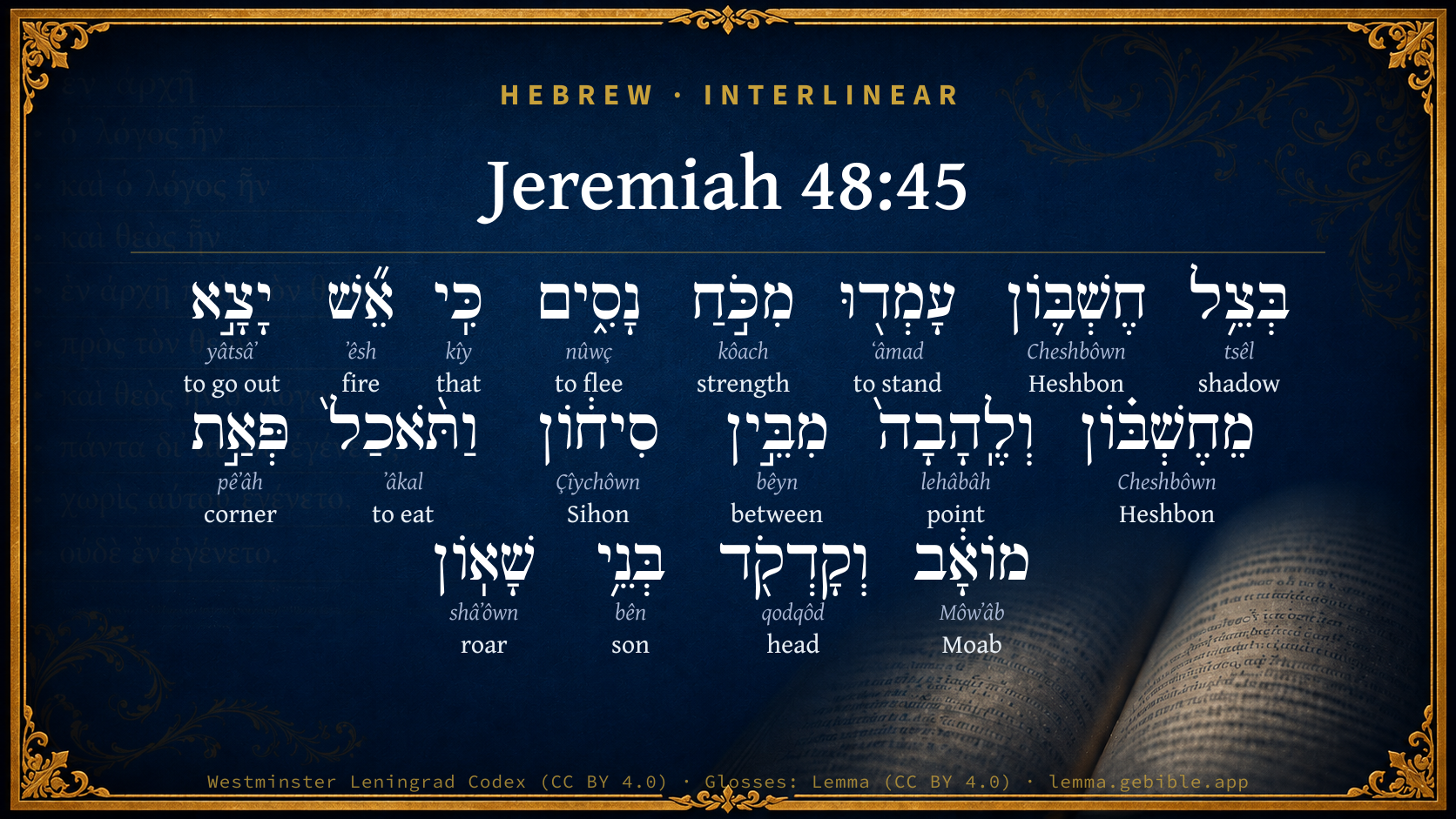
Hebrew (Westminster Leningrad Codex) Jeremiah 48:45 appears in the Hebrew Old Testament. The text above is from the Westminster Leningrad Codex. Each word links to its Strong’s number, a concise gloss, and parsing drawn from the Open Scriptures Hebrew Bible morphology. Click any word for its full Brown-Driver-Briggs (BDB) entry.
Download image
Cite this verse

Jeremiah 48:45 (World English Bible). Public Domain. Lemma interlinear Bible study tool, https://lemma.gebible.app/v/jeremiah/48/45.

Show BibTeX & RIS
BibTeX
RIS
English Translation
Those who fled stand without strength under the shadow of Heshbon; for a fire is gone forth out of Heshbon, and a flame from the midst of Sihon, and has devoured the corner of Moab, and the crown of the head of the tumultuous ones.
World English Bible · Public Domain
Download a study sheet

One document with this verse’s original text, its word-by-word gloss line, the meaning frame, cross-references with their text, attributed commentary, and full source and license credits — printable, and it pastes into notes with its structure intact.

This verse Autodidact and up

Study sheet (.html) Plain text (.txt)

A passage Seminary Student

Up to 50 verses in one chapter. A passage sheet keeps up to 6 commentary sources and 12 cross-references per verse, in the order this page ranks them, and says so on the sheet whenever that leaves anything out. Ask for a single verse and you get the Autodidact verse sheet above.

Everything on this page stays free to read, with no account — the sheet is a download of what is already on screen, not access to it.

Want to remove ads? Support Godless Engineer
Compare translations 3

The same verse in 3 English versions, stacked beneath the original-language interlinear above. Click any original word for its lexicon entry.

Each is an independent rendering of the whole verse — the interlinear is not word-aligned to these translations.

Highlighted words mark where these versions differ — a whole-verse word diff, not a word-by-word alignment.

  • World English Bible Public Domain
    Those who fled stand without strength under the shadow of Heshbon; for a fire is gone forth out of Heshbon, and a flame from the midst of Sihon, and has devoured the corner of Moab, and the crown of the head of the tumultuous ones.
  • King James Version Public Domain
    They that fled stood under the shadow of Heshbon because of the force: but a fire shall come forth out of Heshbon, and a flame from the midst of Sihon, and shall devour the corner of Moab, and the crown of the head of the tumultuous ones.
  • unfoldingWord Literal Text CC BY-SA 4.0
    The ones who flee will stand in the shadow of Heshbon without any strength, for fire will go out from Heshbon, flame from the middle of Sihon. It will devour the forehead of Moab and the top of the heads of the boastful people.

unfoldingWord Literal Text — © unfoldingWord, licensed CC BY-SA 4.0. Word-aligned USFM3 via Door43 (git.door43.org/unfoldingWord/en_ult).

Versions to compare (up to 4)

3 of 4 selected

Show all 18 translations

Every available English version of this verse, each an independent rendering of the whole verse.

  • World English Bible Public Domain
    Those who fled stand without strength under the shadow of Heshbon; for a fire is gone forth out of Heshbon, and a flame from the midst of Sihon, and has devoured the corner of Moab, and the crown of the head of the tumultuous ones.
  • Berean Standard Bible Public Domain
    “Those who flee will stand helpless in Heshbon’s shadow, because fire has gone forth from Heshbon and a flame from within Sihon. It devours the foreheads of Moab and the skulls of the sons of tumult.
  • Majority Standard Bible Public Domain
    “Those who flee will stand helpless in Heshbon’s shadow, because fire has gone forth from Heshbon and a flame from within Sihon. It devours the foreheads of Moab and the skulls of the sons of tumult.
  • King James Version Public Domain
    They that fled stood under the shadow of Heshbon because of the force: but a fire shall come forth out of Heshbon, and a flame from the midst of Sihon, and shall devour the corner of Moab, and the crown of the head of the tumultuous ones.
  • American Standard Version (1901) Public Domain
    They that fled stand without strength under the shadow of Heshbon; for a fire is gone forth out of Heshbon, and a flame from the midst of Sihon, and hath devoured the corner of Moab, and the crown of the head of the tumultuous ones.
  • Revised Version (1885) Public Domain
    They that fled stand without strength under the shadow of Heshbon: for a fire is gone forth out of Heshbon, and a flame from the midst of Sihon, and hath devoured the corner of Moab, and the crown of the head of the tumultuous ones.
  • Geneva Bible (1599) Public Domain
    They that fled, stoode vnder the shadowe of Heshbon, because of the force: for the fire came out of Heshbon, and a flame from Sihon, and deuoured the corner of Moab, and the top of the seditious children.
  • Douay-Rheims (1899) Public Domain
    They that fled from the snare stood in the shadow of Hesebon: but there came a fire out of Kesebon, and a flame out of the midst of Seen, and it shall devour part of Moab. and the crown of the head of the children of tumult.
  • Young's Literal Translation Public Domain
    In the shadow of Heshbon stood powerless have fugitives, For fire hath gone forth from Heshbon, And a flame from within Sihon, And it consumeth the corner of Moab, And the crown of the sons of Shaon.
  • Literal Standard Version CC BY-SA 4.0
    In the shadow of Heshbon fugitives have stood powerless, || For fire has gone forth from Heshbon, || And a flame from within Sihon, || And it consumes the corner of Moab, || And the crown of the sons of Shaon.
  • Unlocked Literal Bible CC BY-SA 4.0
    The ones who flee will stand in the shadow of Heshbon without any strength, for fire will go out from Heshbon, flame from the middle of Sihon. It will devour the forehead of Moab and the top of the heads of the boastful people.
  • unfoldingWord Literal Text CC BY-SA 4.0
    The ones who flee will stand in the shadow of Heshbon without any strength, for fire will go out from Heshbon, flame from the middle of Sihon. It will devour the forehead of Moab and the top of the heads of the boastful people.
  • Darby Bible Public Domain
    They that fled stood under the shadow of Heshbon powerless; for a fire hath come forth from Heshbon, and a flame from the midst of Sihon, and hath consumed the corner of Moab, and the crown of the head of the sons of tumult.
  • World Messianic Bible Public Domain
    “Those who fled stand without strength under the shadow of Heshbon; for a fire has gone out of Heshbon, and a flame from the middle of Sihon, and has devoured the corner of Moab, and the crown of the head of the tumultuous ones.
  • Webster's Bible Public Domain
    They that fled stood under the shade of Heshbon because of the force: but a fire shall come out of Heshbon, and a flame from the midst of Sihon, and shall devour the corner of Moab, and the crown of the head of the tumultuous ones.
  • Free Bible Version CC BY-SA 4.0
    Those who run away will be left defenseless in Heshbon where they went for protection, because fire blazes out from Heshbon, a fire from where Sihon once reigned. It burns up the whole country of Moab and its defiant people.
  • Bible in Basic English Public Domain
    Those who went in flight from the fear are waiting under the shade of Heshbon: for a fire has gone out from Heshbon and a flame from the house of Sihon, burning up the pride of Moab and the crown of the head of the violent ones.
  • JPS Tanakh (1917) Public Domain
    In the shadow of Heshbon the fugitives stand without strength; for a fire is gone forth out of Heshbon, and a flame from the midst of Sihon, and it devoureth the corner of Moab, and the crown of the head of the tumultuous ones.

Literal Standard Version (2020), Covenant Press — licensed CC BY-SA 4.0. Text via the HelloAO Bible API (eBible.org). Unlocked Literal Bible (unfoldingWord) — licensed CC BY-SA 4.0. Text via the HelloAO Bible API (eBible.org). unfoldingWord Literal Text — © unfoldingWord, licensed CC BY-SA 4.0. Word-aligned USFM3 via Door43 (git.door43.org/unfoldingWord/en_ult). Free Bible Version, Dr. Jonathan Gallagher — licensed CC BY-SA 4.0. Text via the HelloAO Bible API (eBible.org).

Word by word

More ways to search: Search by grammar → Find every occurrence → Compare this word →

Practice this passage: Drill this verse → Learn its vocabulary →

וְקָדְקֹ֖ד
qodqôd
H6936
“and · head of”
Conjunction + Noun, Common, Masculine, Singular, Construct
Part of Speech
Conjunction + Noun
Type
Common
Gender
Masculine
Number
Singular
State
Construct
Full BDB Definition

Origin: from H6915

TWOT: 1986a

head, crown of head, top of head, hairy crown, scalp
  1. בְּצֵ֥ל tsêl H6738 “in/at · shadow of” Preposition + Noun, Common, Masculine, Singular, Construct
  2. חֶשְׁבּ֛וֹן Cheshbôwn H2809 “Heshbon” Noun, Proper
  3. עָמְד֖וּ ʻâmad H5975 “to stand” Verb, Qal, Perfect, 3rd Person, Common, Plural
  4. מִכֹּ֣חַ kôach H3581 “from · strength” Preposition + Noun, Common, Masculine, Singular, Absolute
  5. נָסִ֑ים nûwç H5127 “fleeing” Verb, Qal, Participle Active, Masculine, Plural, Absolute
  6. כִּֽי kîy H3588 “that” Conjunction
  7. אֵ֞שׁ ʼêsh H784 “fire” Noun, Common, Both, Singular, Absolute
  8. יָצָ֣א yâtsâʼ H3318 “to go out” Verb, Qal, Perfect, 3rd Person, Masculine, Singular
  9. מֵחֶשְׁבּ֗וֹן Cheshbôwn H2809 “from · Heshbon” Preposition + Noun, Proper
  10. וְלֶֽהָבָה֙ lehâbâh H3852 “and · point” Conjunction + Noun, Common, Feminine, Singular, Absolute
  11. מִבֵּ֣ין bêyn H996 “from · between” Preposition + Preposition
  12. סִיח֔וֹן Çîychôwn H5511 “Sihon” Noun, Proper
  13. וַתֹּ֨אכַל֙ ʼâkal H398 “and · to eat” Conjunction + Verb, Qal, Sequential Imperfect, 3rd Person, Feminine, Singular
  14. פְּאַ֣ת pêʼâh H6285 “corner of” Noun, Common, Feminine, Singular, Construct
  15. מוֹאָ֔ב Môwʼâb H4124 “Moab” Noun, Proper
  16. בְּנֵ֥י bên H1121 “sons of” Noun, Common, Masculine, Plural, Construct
  17. שָׁאֽוֹן shâʼôwn H7588 “roar” Noun, Common, Masculine, Singular, Absolute

About this verse

These counts appear in no published source. They are computed here, from the morphology-tagged text and Lemma’s own curated glosses. What Lemma adds →

18
words
17
distinct lemmas
Prophets
section

Notable vocabulary

The rarest word here is וְקָדְקֹ֖ד head H6936 — appearing just 11 times in the whole Hebrew Bible.

Shared distinctive vocabulary

וְקָדְקֹ֖ד head H6936 occurs in 11 verses of the Hebrew Bible. Also found in:

Grammatical profile

  • 4 verbs
  • 12 nouns
  • 1 preposition
  • 1 conjunction

Verb forms

  • עָמְד֖וּ Qal · Perfect
  • נָסִ֑ים Qal · Participle Active
  • יָצָ֣א Qal · Perfect
  • וַתֹּ֨אכַל֙ Qal · Sequential Imperfect

Repetition

A word recurs within this verse — often emphatic in Hebrew:

  • חֶשְׁבּ֛וֹן Heshbon H2809 ×2

Cross-references

7

Topical passages linked to Jeremiah 48:45 in the Treasury of Scripture Knowledge — connected by theme and wording, ordered by reader-vote popularity; previews shown in the World English Bible.

  • Numbers 24:17 I see him, but not now; I see him, but not near: There shall come forth a star out of Jacob, A scepter shall rise out of Israel, Shall strike through the corners of Moab, Break down all the sons of tumult.
  • Numbers 21:28 For a fire is gone out of Heshbon, A flame from the city of Sihon: It has devoured Ar of Moab, The lords of the high places of the Arnon.
  • Numbers 21:21 Israel sent messengers to Sihon king of the Amorites, saying,
  • Numbers 21:26 For Heshbon was the city of Sihon the king of the Amorites, who had fought against the former king of Moab, and taken all his land out of his hand, even to the Arnon.
  • Amos 2:2 But I will send a fire on Moab, And it will devour the palaces of Kerioth; And Moab will die with tumult, with shouting, and with the sound of the trumpet;
  • Zechariah 10:4 From him will come forth the corner-stone, From him the nail, From him the battle bow, From him every ruler together.
  • Matthew 21:42 Jesus said to them, "Did you never read in the Scriptures, 'The stone which the builders rejected, The same was made the head of the corner. This was from the Lord. It is marvelous in our eyes?'

Cross-references courtesy of OpenBible.info (CC BY 4.0).

Hebrew and Greek witnesses Masoretic Hebrew ↔ Greek Septuagint

The same verse in the two great witnesses to the Old Testament, shown verse-for-verse.

These are two independent witnesses, not word-aligned to each other, and the Septuagint is shown in lemma (dictionary) form.

Hebrew Jeremiah 48:45 Masoretic · Westminster Leningrad Codex

בְּצֵ֥ל חֶשְׁבּ֛וֹן עָמְד֖וּ מִכֹּ֣חַ נָסִ֑ים כִּֽי אֵ֞שׁ יָצָ֣א מֵחֶשְׁבּ֗וֹן וְלֶֽהָבָה֙ מִבֵּ֣ין סִיח֔וֹן וַתֹּ֨אכַל֙ פְּאַ֣ת מוֹאָ֔ב וְקָדְקֹ֖ד בְּנֵ֥י שָׁאֽוֹן

Those who fled stand without strength under the shadow of Heshbon; for a fire is gone forth out of Heshbon, and a flame from the midst of Sihon, and has devoured the corner of Moab, and the crown of the head of the tumultuous ones.

World English Bible · Public Domain

Greek LXX Structure differs

In the Septuagint, Jeremiah is about an eighth shorter than the Hebrew and arranges its material differently — the Oracles Against the Nations (Hebrew chapters 46–51) appear in the middle of the Greek book, after 25:13. Because the chapter and verse boundaries do not line up, a verse-for-verse comparison with the Hebrew is not shown.

A verse-for-verse comparison isn’t shown here because the chapters and verses don’t line up. Switch to the LXX edition with the MT / LXX toggle above to read the Greek directly.

Hebrew: Westminster Leningrad Codex (CC BY 4.0). Greek: Septuagint (public domain); English from a public-domain English Septuagint. How the Septuagint differs from the Hebrew →

Targum (Aramaic paraphrase)

1

The Targum is the ancient Jewish Aramaic paraphrase of the Hebrew Scriptures — an interpretive translation, not the Hebrew text itself. Onkelos (literal) and Pseudo-Jonathan (expansive) render the Torah, and Jonathan the Prophets. Coverage is partial: where no permissively-licensed English translation exists for a verse, only the Aramaic is shown. This is verse-level text, not a word-by-word alignment to the Hebrew.

  1. Targum Jonathan Prophets (Joshua–Malachi)
    עַל דִאֶשְׁתְּמָעוּ לְיַתְבֵי חֶשְׁבּוֹן גְלוֹ אִתְקְצַר חֵילֵיהוֹן עֲרָקוּ אֲרֵי קִידוּם תַּקִיף כְּאֶשְׁתָּא נְפַק מֵחֶשְׁבוֹן וְעָבְדֵי קְרָבָא כְּשַׁלְהוֹבִיתָא מִבֵּית סִיחוֹן וְקַטִילוּ רַבְרְבֵי מוֹאָב וְיַקִירֵי בְּנֵי אִתְרְגוּשָׁא:

    (no public-domain English translation for this verse)

    Targum Jonathan — Aramaic: “Mikraot Gedolot” (public domain). English: “Sefaria Community Translation” (CC0 1.0 (public-domain dedication)); “London "Chaldee Paraphrase," 1871” (public domain). Text via Sefaria.

Commentary

Notes on Jeremiah 48:45 from classic Christian and Jewish commentators (each source and its license shown beneath its notes). The classic Christian expositions comment on the surrounding passage and are grouped to its opening verse, so a note may address several verses; the Jewish commentaries on the Tanakh (Rashi and others) are per-verse, so they appear only where the commentator wrote on this verse.

Lemma curates 59 commentaries, every one of them public domain or Creative Commons licensed, each selected and text-cleaned for this edition rather than reprinted as found. About our sources →

Trapp's Complete Commentary

John Trapp

Jer 48:45 They that fled stood under the shadow of Heshbon because of the force: but a fire shall come forth out of Heshbon, and a flame from the midst of Sihon, and shall devour the corner of Moab, and the crown of the head of the tumultuous ones.

Ver. 45. Stood under the shadow of Heshbon.] As thinking they had had a good bush on their backs.

But a fire shall come forth out of Heshbon.] As once before it did, {Num 21:28-29} and became a proverb.

Of the tumultuous ones.] Of those revelling gallants.

John Trapp, A Commentary or Exposition upon All the Books of the Old and New Testament (1647–1656) — public domain. Text from a community e-Sword module.

Joseph Benson's Commentary

Jer 48:45-46. They that fled stood under the shadow of Heshbon, &c. — They that fled for fear of the enemies’ forces thought to find shelter and safety in Heshbon, a strong fenced city. Or, instead of, because of the force, the Hebrew מכח, may be rendered for want of force, or strength, namely, force of their own to withstand the enemy. But a fire shall come forth out of Heshbon, and a flame from the midst of Sihon — That is, of the city of Sihon, meaning still Heshbon. When the enemies have possessed themselves of Heshbon, they will quickly spread like fire over the rest of the country. Thus the prophet fitly applies to the present case the words of an ancient poem made upon Sihon’s conquests over Moab, and recited by Moses, Num 21:27-28, where see the notes. And shall devour the corner of Moab, and the crown of the head of the tumultuous ones — By the corner may be meant the borders, or extreme parts of the country. So the Hebrew word פאתsignifies, Num 34:3; Neh 9:22. The nobility, who are the stay and support of the government, are expressed by the crown of the head. By the tumultuous are meant those that are proud and haughty in their state and plenty, and insult over their inferiors. Wo be unto thee, O Moab! — This verse is likewise taken out of Num 21:19. The people of Chemosh perisheth — People are sometimes denominated from the God they worship: so the Jews were called the people of the Lord, or Jehovah.

Joseph Benson's Commentary on the Old and New Testaments (1811–1818) — public domain. Text from a community e-Sword module.

Keil & Delitzsch

C. F. Keil & F. Delitzsch

Conclusion. - Jer 48:45. "Under the shadow of Heshbon stand fugitives, powerless; for a fire goes out from Heshbon, and a flame from Sihon, and devours the region of Moab, and the crown of the head of the sons of tumult. Jer 48:46. Woe unto thee, Moab! the people of Chemosh are perished! for thy sons are taken away into captivity, and thy daughters into captivity. Jer 48:47. Yet will I turn the captivity of Moab at the end of the days, saith Jahveh. Thus far is the judgment of Moab."

From Heshbon issued the resolution to annihilate Moab (Jer 48:2); to Heshbon the prophecy finally returns. "In the shadow of Heshbon stand fugitives, powerless' (מכּח, with מן privative), where, no doubt, they were seeking refuge; cf. Isa 30:2-3. The fugitives can only be Moabites. Here it is astonishing that they seek refuge in Heshbon, since the enemy comes from the north, and according to Jer 48:2, it is in Heshbon that the resolution to destroy Moab was formed; and judging from Jer 49:3, that city was then in the hands of the Ammonites. Hence Hitzig and Graf miss the connection. Hitzig thinks that the whole clause was inserted by a glosser, who imagined the town belonged to Moab, perhaps allowing himself to be misled in this by Num 21:27, "Come to Heshbon." Graf, on the other hand, is of opinion that the fugitives are seeking the protection of the Ammonites in Heshbon, but do not find it: hence he would take the כּי which follows in the adversative sense of "however" or "rather;" but this is against the use of the word, and cannot be allowed. The tenor of the words, "Fugitives stand under the shadow of Heshbon," does not require us to assume that people had fled to Heshbon out of the whole of Moab. Let us rather think of fugitives from the environs of Heshbon, who seek refuge in this fortified town, from the enemy advancing from the north, but who find themselves disappointed in their expectation, because from this city there bursts forth the fire of war which destroys Moab. The thought merely serves the purpose of attaching to it the utterances which follow regarding Moab; but from Jer 48:43 and Jer 48:44 alone, it is evident that escape will be impossible. In proof of this he mentions the flight to Heshbon, that he may have an opportunity of introducing a portion of the old triumphal songs of the Mosaic age, with which he wished to conclude his prophecy, Jer 48:45 and Jer 48:46. The fugitives stand powerless, i.e., exhausted and unable to flee any further, while Heshbon affords them no refuge. For there bursts forth from it the fire that is to destroy the whole of Moab. The words from "for a fire," etc., on to the end of Jer 48:46, are a free imitation of some strophes out of an ancient song, in which poets of the Mosaic period celebrated the victory of Israel over Sihon the king of the Amorites, who had conquered the greater portion of Moab; but with this here is interwoven a passage from the utterances of Balaam the seer, regarding the fall of Moab, found in Num 24:17, viz., from ותּאכל to בּני שׁאון. These insertions are made for the purpose of showing that, through this judgment which is now coming upon Moab, not only those ancient sayings, but also the prophecy of Balaam, will find their full accomplishment. Just as in the time of Moses, so now also there again proceeds from Heshbon the fire of war which will consume Moab. The words, "for a fire has gone out from Heshbon," are a verbatim repetition of what we find in Num 21:28, with the single exception that אשׁ is here, as in Psa 104:4, construed as masculine, and thus takes יצא instead of יצאה; but this change, of course, does not affect the meaning of the words. The next clause runs, in Numbers, l.c., להבה מקּרית סיחון, but here ולהבה מבּין; this change into מבּין is difficult to account for, so that J. D. Michaelis and Ewald would alter it into מבּית.

There is no need for refuting the assumption of Raschi and Ngelsbach, that Sihon stands for the city of Sihon; or the fancy of Morus and Hitzig, that an old glosser imagined Sihon was a town instead of a king. When we consider that the burning of Heshbon by the Israelites, celebrated in that ancient song, was brought on by Sihon the Amorite king, since the Israelites were not to make war on Moab, and only fought against Sihon, who had made Heshbon his residence, there can be no doubt that Jeremiah purposely changed מקּרית into מבּין סיחון, in order to show that Sihon was the originator of the fire which consumed Heshbon. By this latter expression Jeremiah seeks to intimate that, in Nebuchadnezzar and the Chaldean army, there will arise against the Moabites another Sihon, from whose legions will burst forth the flame that is to consume Moab. מבּין, "from between," is to be explained on the ground that Sion is not viewed as a single individual, but as the leader of martial hosts. This fire will "devour the region of Moab, and the crown of the head of the sons of tumult." These words have been taken by Jeremiah from Balaam's utterance regarding Moab, Num 24:17, and embodied in his address after some transformation. What Balaam announces regarding the ruler (Star and Sceptre) that is to arise out of Israel, viz., "he shall smite the region of Moab, and dash in pieces the sons of tumult," Jeremiah has transferred to the fire: accordingly, he has changed וּמחץ into ותּאכל, and וקרקר into וקדקד. Several commentators understand פאה as signifying the margin of the beard (Lev 19:27; Lev 21:5); but the mention of the crown of the head in the parallel member does not require this meaning, for פאה does not signify the corner of the beard, except when found in combination with ראשׁ or זקן. The singeing of the margin of the beard seems, in connection with the burning of the crown, too paltry and insignificant. As in the fundamental passage פּאתי signify the sides of Moab, so here פאה is the side of the body, and קדקד the head. בּני שׁאון, homines tumultuosi, are the Moabites with their imperious disposition; cf. Jer 48:29.

Jer 48:46

Jer 48:46 is again derived from the ancient poem in Num 21, but the second half of the verse is altered. The bold figure which represents Chemosh the god of the Moabites as delivering his people up to captivity, is continued in the literal statement of the case; Moab's sons and daughters, i.e., its population, are carried away by the enemy into captivity.

Jer 48:47

This infliction of judgment, however, on the Moabites, is not to prove a complete annihilation of them. At the end of the days, i.e., in the Messianic times (see on Jer 23:20), there is in store for them a turn in their fortunes, or a restoration. For שׁוּב שׁבוּת, see on Jer 29:14. Cf. the similar promise for Egypt, Jer 46:26; Ammon and Elam, Jer 49:6 and Jer 49:39. The last clause, "Thus far," etc., is an addition made by the editor, when this oracle was received into the collection of Jeremiah's prophecies; cf. Jer 51:64. משׁפּט means the prophecy regarding Moab with respect to its contents.

As to the fulfilment of the threatened ruin, Josephus (Antt. x. 9. 7) states that Nebuchadnezzar, in the fifth year after the destruction of Jerusalem, made war on the Moabites and subdued them. This statement is not to be questioned, though the date given should be incorrect. We have no other sources of information regarding this people. After the return of the Israelites from Babylon, the Moabites are no longer mentioned as a people, except in Ezr 9:1; Neh 13:1, Neh 13:23, where it is stated that some Israelites had married Moabitish wives; nor is any mention made of this people in the books of the Maccabees, which, however, relate the wars of Judas Maccabeus with the Ammonites and Edomites (1 Macc. 5:3 and 6, cf. 4:61); neither is there any further notice taken of them in Josephus, who only now and then speaks of Moab, i.e., the country and its towns (Antt. xiii. 14. 2, 15. 4; Bell. Jud. iii. 3. 3, iv. 8. 2). This name seems to have been merged, after the exile, in that of the Arabians. But the disappearance of the name of this people does not exclude the probability that descendants continued to exist, who, when Christianity spread in the country to the east of the Jordan, were received into the communion of the Christian church.

Keil & Delitzsch — Biblical Commentary on the Old Testament (1861–1891) — public domain (CC PDM 1.0). Text via the HelloAO Bible API. (Old Testament only.)

Tyndale Open Study Notes

Tyndale Open Resources

48:45 If the Moabites fled north, they would be met by their enemies at Heshbon. • a fire comes from Heshbon: Cp. Num 21:28.

Tyndale Open Study Notes — © Tyndale Open Resources, licensed CC BY-SA 4.0. Text via the HelloAO Bible API.

Geneva Bible (1599)

Geneva Bible translators

They fled thither, thinking to have succor of the Amorites.

The Amorites had destroyed the Moabites in times past, and now because of their power, the Moabites shall seek to them for help.

Geneva Bible (1599) marginal notes — public domain. Text via Bolls.life.

Jamieson, Fausset & Brown

Robert Jamieson, A. R. Fausset & David Brown

under . . . shadow of Heshbon--They thought that they would be safe in Heshbon.

because of the force--that is, "they that fled because of the force" of the enemy: they that fled from it. GLASSIUS translates, "through want of strength." So the Hebrew particle is translated (Psa 109:24), "faileth of fatness," that is, "faileth through want of fatness"; also Lam 4:9.

but a fire, &c.--copied in part from Sihon's hymn of victory (Num 21:27-28). The old "proverb" shall hold good again. As in ancient times Sihon, king of the Amorites, issued forth from his city, Heshbon, as a devouring "flame" and consumed Moab, so now the Chaldeans, making Heshbon their starting-point, shall advance to the destruction of Moab.

midst of Sihon--that is, the city of Sihon.

corner of Moab--that is, Moab from one corner to the other.

crown of . . . head--the most elevated points of Moab. Making some alterations, he here copies Balaam's prophecy (Num 24:17). Margin there translates "princes" for corners; if so, "crown of . . . head" here refers to the nobles.

tumultuous ones--sons of tumult; those who have tumultuously revolted from Babylon. Heshbon passed from the Amorite to the Israelite sway. Moab had wrested it from Israel and helped the Chaldeans against the Jews; but revolting from Babylon, they brought ruin on themselves in turn.

Jamieson, Fausset & Brown — Commentary Critical and Explanatory on the Whole Bible (1871) — public domain (CC PDM 1.0). Text via the HelloAO Bible API.

Adam Clarke's Commentary

Verse 45. They that fled stood under the shadow of Heshbon] Heshbon being a fortified place, they who were worsted in the fight fled to it, and rallied under its walls; but, instead of safety, they found themselves disappointed, betrayed, and ruined. See Jer 48:2, and the note there. See Clarke on Jer 48:2.

But a fire shall come forth out of Heshbon] Jeremiah has borrowed this part of his discourse from an ancient poet quoted by Moses, Nu 21:28; where see the notes.

The crown of the head] The choicest persons of the whole nation.

Adam Clarke's Commentary on the Bible (1810–1826) — public domain. Text from a community e-Sword/MySword module.

John Calvin's Commentaries

He confirms what is said in the last verse, that the Moabites would in vain resort to their strongest cities, even Heshbon and Sihon; because a flame would thence break forth, which would consume the whole land. We hence see that God took away from the Moabites all their vain confidences, and showed that no defences could stand against his power, when once he rose up for judgment.

The fleers, he says, shall stand under the shadow of Heshbon, thinking that there would be a safe refuge in that city, and in others. But the particle כי, ki, seems not to me to be here causal, but rather an affirmative, or even an adversative; but, or surely a fire has gone forth from Heshbon, and a flame from Sihon The Prophet, I doubt not, borrowed these words from Moses, for he says in Numbers 21:28, that a fire had gone forth from Heshbon; and there the expression is given as an old proverb. There is no doubt but that enemies had triumphed over that city when it was taken; for that whole song spoken by Moses is ironical, and in saying that fire had gone forth, he referred to their counsels, for they thought that city sufficiently strong against enemies. Now the Prophet says, that what had been formerly said of Heshbon would be again fulfilled, that it would be, as it were, the beginning of the fire. The meaning then, as I think, is, that the Moabites indeed thought, that they would have a quiet and agreeable shadow under the protection of the city Heshbon, and of the city Sihon; but what was to be? even that these two cities would become, as it were, the beginnings of the fire. How, or in what way? even because the probability is, that there those counsels were taken which provoked the Chaldeans. We indeed know that riches and power always produce haughtiness and false confidence in men; for in villages and small towns wars are not contrived; but the great cities gather the wood and kindle the fire; and the fire afterwards spreads and pervades the whole land.

This, then, is what our Prophet means, when he says, that fire went forth from Heshbon, even contrary to the expectation of the people, for they thought that were all things to go to ruin, there yet would be safety for them in that city: go forth, he says, shall fire from the city Heshbon, and a flame from the midst of Sihon, and it shall consume the corner of Moab, and all his extremities; for by קרקר, kadkad, he means all parts. Extremity is elsewhere taken for a part; but he does not mean that fire would come to all parts or extreme corners, only as it were to touch them slightly: but he intimates that the whole land would be consumed by this fire; it would thus spread itself to its very extremities.

But as I have already said, the Prophet alludes to that old saying mentioned by Moses, (Numbers 21:27, 28.) Further, there is no doubt but that Heshbon and Sihon were then in the possession of that nation; for they had taken away many cities from the Israelites, and thus the children of Israel had been reduced to narrower limits. At length the tribe of Judah alone remained after the overthrow of the kingdom of Israel. When they were driven into Chaldea, it was an easy thing for the Moabites to make that their own which belonged to no one. Besides, as they had helped the Chaldeans and betrayed that miserable people, and had thus acted perfidiously towards their brethren, a reward was given to them. But when at length they themselves dreaded the power of the Babylonian monarchy, they began to change their minds, and endeavored to obstruct the farther progress of the Chaldeans. Hence then a war was contemplated, and the occasion was given. He then speaks of Heshbon and Sihon as chief cities; and there is no doubt but that Sihon derived its name from a king who ruled there. For we know that there was a king bearing this name; but as he speaks here of a place, it is probable, that the king’s name was given to the city in order to commemorate it.

He at length adds, that this fire and flame would devour the top of the head of the sons of Saon, or tumult. But he calls the Moabites tumultuous, because they before made a great noise, and were dreaded by their neighbors. As then all their neighbors had been frightened, in a manner, by their voice alone, he calls them sons of tumult, or tumultuous men, from the effect produced. It follows —

John Calvin's Commentaries (1540-1563) — public domain. Text from the Calvin Translation Society English edition (1840s-50s) via the Christian Classics Ethereal Library (ccel.org). Calvin's coverage is partial (roughly two-thirds of the Bible); uncommented books and verses are honest gaps, never fabricated. The 19th-century editor's footnotes and remarks are omitted so the notes are faithfully Calvin's own voice.

Ellicott's Commentary for English Readers

(45) Because of the force.—Better, without strength. What is meant is that the fugitives of Moab seek shelter in Heshbon, the capital of the Ammonites (Jer_49:3), and find no protection there.

A fire shall come forth out of Heshbon . . .—The words are interesting as being a quotation from a fragment of an old poem, probably from the “Book of the Wars of the Lord,” which is also to be found in Num_21:28. Heshbon, at the time of the Exodus the capital of the Amorites, is here identified with Sihon as their king. In the prophet’s application of the words, the Moabites are represented as taking refuge under the walls of Heshbon, but, instead of finding shelter, fire bursts out from walls and gates. They have come to look on its conflagration. The flames spread far and near. They devour the “corner” as of the beard, the hair on the crown of the head. The symbolism of destruction is the same as in Isa_7:20. In the “tumultuous ones” (literally, children of tumult) we have the panic-stricken clamorous crowds of the Moabite fugitives. The phrase in the Hebrew is nearly the same as “the children of Seth” in Num_24:17.

A Bible Commentary for English Readers, edited by Charles John Ellicott (1878–1897) — public domain. Text from a community e-Sword module.

The Cambridge Bible for Schools and Colleges

gen. ed. J. J. S. Perowne

45. They that fled … Heshbon] i.e. the fugitives of Moab in vain seek help from Heshbon, as it is among the first to be overthrown (Jer_48:2).

midst] Read house, changing one letter of MT. Heshbon is meant, as the old capital (Num_21:26; Deu_2:26). The Moabites now are to recover it, after it had been held successively by Sihon and the Israelites.

corner] rather, the temples of the head. See on Jer_9:25.

the tumultuous ones] lit. sons of tumult or din of battle, Moabite warriors. See on Jer_25:31.

The Cambridge Bible for Schools and Colleges (gen. ed. J. J. S. Perowne; Cambridge University Press, 1878–1918) — public domain. Text from a community e-Sword module.

John Gill's Exposition

Woe be unto thee, O Moab! the people of Chemosh perisheth,.... The inhabitants of Moab, who worshipped the idol Chemosh; of which see Jer 48:7; and so called his people, as Israel were called the people of the Lord; now these, notwithstanding their idol, whom they worshipped, and in whom they trusted, should perish; and sad and deplorable would be their condition and circumstances:

for thy sons are taken captives, and thy daughters captives; this explains the woe that should come upon them, and in what sense they should perish; since their sons and daughters, who they hoped would have continued their name and nation, were taken, and would be carried captives into Babylon; see Num 21:29.

John Gill's Exposition of the Whole Bible (1746–1763) — public domain (CC PDM 1.0). Text via the HelloAO Bible API.

Albert Barnes' Notes on the Bible

Because of the force - Rather, without force. Translate it: “The fugitives have stood, (i. e., halted) powerless in the shadow of Heshbon.” As Heshbon was the capital of the Ammonites, the sense is that the defeated Moabites looked to Ammon for protection.

But afire ... - Not only will Ammon refuse aid to Moab, but her ruin is to come forth from Heshbon. To show this Jeremiah has recourse to the old triumphal poetry of the Mosaic age (marginal reference).

The corner - i. e., of the beard ...”the crown of the head.” The fire of war consumes both far and near, both hair and beard, i. e., everything that it can singe and destroy.

The tumultuous ones - literally, “sons of the battle-shout,” the brave Moabite warriors.

Albert Barnes' Notes on the Bible (1834–1885) — public domain. Text from a community e-Sword/MySword module.

Haydock's Catholic Bible Commentary

There....saith, &c., to the end of the chapter is supplied by Grabe. His copy subjoins, "What Jeremias prophesied against all nations. Thus," &c., chap. xxv. 15. (Haydock)

Hesebon, expecting shelter. But internal broils ruined them. --- There, &c., to [verse] 47., is borrowed from Numbers xxi. 27.[28, 29.?] Sehon had taken Hesebon from Moab. --- Part. Moses has "Ar, of Moab, and the inhabitants of the heights of Arnon." [Numbers xxi. 28.] (Calmet) --- Tumult. Hebrew shaon, (Haydock) means also pride, in which sense Balaam uses Seth, Numbers xxiv. 17. (Calmet)

George Leo Haydock (1774–1849), Haydock's Catholic Family Bible and Commentary, 1859 edition — public domain. Excludes Psalms (Douay-Rheims chapter numbering differs from Protestant) and Deuterocanonical books (Catholic canon only).

Matthew Poole's English Annotations

Heshbon was a great city, and, as it should seem, a place of some force; the war being in the country, they made Heshbon the place of their sanctuary. But the prophet, applying to the Chaldeans what was said in Moses’s time, Num 21:28, prophesieth that Heshbon also should be destroyed, and the fire should devour the crown of the head, that is, the glory of the brave rebelling gallants, called hi the Hebrew the children of noise.

Matthew Poole's English Annotations on the Holy Bible (1683–1685) — public domain. Text from a community e-Sword/MySword module.

Whedon's Commentary on the Bible

Daniel D. Whedon

45. Under the shadow of Heshbon — Why do we find fugitives in Heshbon, since the enemy comes from the north? They came from the environs and sought refuge in this fortified town, but a fire devoured them.

Daniel D. Whedon (gen. ed.), Commentary on the Old and New Testaments (1874–1909) — public domain. Text from a community e-Sword module.

The Pulpit Commentary

Apparently quoted from memory from Num_21:28 Num_24:17, except the first clause; the application, however, is peculiar to this passage. They that fled, etc.; rather, The fugitives stand without strength in the shadow of Heshbon. There is a difficulty here, for, according to ver. 2, the hostile raid into Moab started from Heshbon. Surely the fugitives would not think of escaping northwards, much less would they be able to elude the vigilance of the foe and reach Heshbon. But it is not surprising that the author of so long a poem should now and then make a slip; the author of the Book of Job is sometimes inconsistent with the Prologue, and ver. 2 is as far away from the passage before us as the Prologue of Job is Job_19:18. Nor can we be absolutely certain that our prophecy is exactly as Jeremiah wrote it. Shall come forth; rather, hath come forth (or, cometh forth). From the midst of Sihon. Sihon being, perhaps, regarded as the leader and representative of his warriors. The corner of Moab; rather, the sides (literally, side, used collectively) of Moab. the tumultuous ones; literally, sons of tumult, a poetical phrase for warriors. The prophet has substituted the more common word shaon for its synonym sheth.

The Pulpit Commentary (1880–1919), ed. H.D.M. Spence-Jones & Joseph S. Exell — public domain. Text from a community e-Sword module.

John Wesley's Explanatory Notes

Heshbon - Heshbon was it seems a place of force. The crown - That is, the glory.

John Wesley, Explanatory Notes Upon the Whole Bible (1754–1765) — public domain. Text via the GEBible commentary corpus.

unfoldingWord translationNotes

Door43 World Missions Community

The ones who flee

This refers to the people who were able to run away during the destruction of Moab.

will stand in the shadow of Heshbon

Here "in the shadow" represents protection or shelter. AT: "will hide in Heshbon for protection" or "will go to Heshbon for shelter" (See: Metonymy)

for fire will go out from Heshbon, flame from the middle of Sihon

These two phrases have similar meanings and emphasize that Moab's destruction will begin and spread out from Heshbon, where King Sihon once lived. AT: because a fire will burn in Heshbon, which is the city where King Sihon lived long ago (See: Parallelism and Assumed Knowledge and Implicit Information)

Heshbon

Translate the name of this city as you did in Jeremiah 48:2. (See: How to Translate Names)

Sihon

This is the name of an Amorite king who once ruled over Heshbon. (See: How to Translate Names)

It will devour the forehead of Moab and the top of the heads of the boastful people

Here "forehead" and "top of the heads" represent the people of Moab as a whole. AT: "It will burn up all the people in Moab who noisily boasted very much" (See: Synecdoche)

forehead

the part of the face that is above the eyes, but below the hairline

translationWords

shadow

fire

devour

unfoldingWord translationNotes — © Distant Shores Media and the Door43 World Missions Community, licensed CC BY-SA 4.0. Source: git.door43.org/Door43/en_tn.

Rashi

Rabbi Shlomo Yitzchaki (Rashi)

In the shadow of Heshbon which is high and has a shadow.

stood Those who were fleeing [stood] to rest in the shadow since they had no more strength to flee.

from the city of Sihon Heb. מבין, from the city of Sihon. Cf. “the city of (בֶּן) Reuben” in Joshua (15:6).

and the crown of the head Heb. וקדקד, (estrit in Provencal or estrif in O.F. [to fight]) and Menahem (Machbereth Menahem p. 158) classified it as an expression of a spring (מָקוֹר) and Jonathan rendered: יַקִּירֵי the esteemed ones, an expression of יְקָר, esteem.

the tumultuous ones Heb. בני שאון, those who would raise their voice with boasting.

Rashi on the Tanakh — English translations: “The Judaica Press complete Tanach with Rashi, translated by A. J. Rosenberg” (CC BY 4.0); “Pentateuch with Rashi's commentary by M. Rosenbaum and A.M. Silbermann, 1929-1934” (public domain); “The Metsudah Tanach series, Lakewood, N.J” (CC BY 4.0); and “The Book of Joshua, Metsudah Publications, 1997” (CC BY 4.0). Text via Sefaria.

Lesson kit

Teaching starters — assembled from the data on this page, not authored interpretation. Every prompt links to the verse data it draws on. Edit before teaching.

Jeremiah, in the Prophets, opens this verse with 18 words (17 distinct Hebrew lemmas). Its most distinctive word is qodqôd (“head”). A historical commentator’s framing appears above. Read the whole chapter for the surrounding context.

Discussion questions

  1. The word qodqôd carries the sense “head.” How does it shape the verse?
  2. Genesis 49:26 shares the word «head» with this verse. How do the two illuminate each other?
  3. “Heshbon” occurs 2× in this one verse. What is the effect of the repetition?
  4. These translations render this verse differently; the difference is in the English rendering, not the original. What questions does that raise?
  5. The verb «עָמְד֖וּ» is Qal Perfect. How does its form color the action?
  6. Reading how Trapp's Complete Commentary and Joseph Benson's Commentary read this verse, where do the two commentators agree and where do they part?

Things to notice

Reading settings

Reading text

Shown beneath each verse's original-language words.

Old Testament
Old Testament edition

Read the OT as the Masoretic Hebrew (MT) or the Greek Septuagint (LXX).

English shown for the Greek Septuagint (in the Hebrew ↔ Greek comparison).

Comparing translations? Open the Compare panel on any verse page to stack up to four side by side.