Ezekiel 15:4

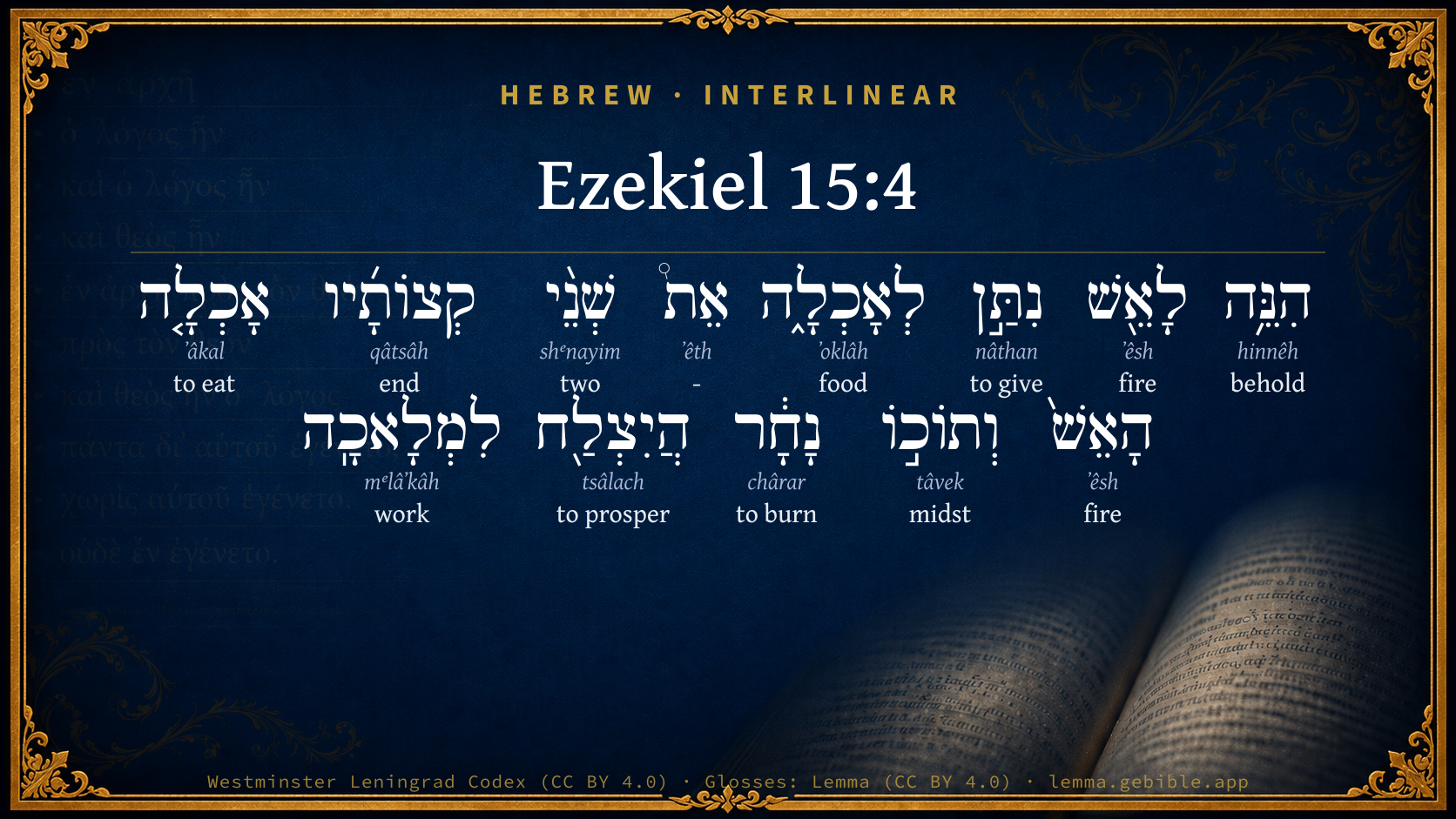
Hebrew (Westminster Leningrad Codex) Ezekiel 15:4 appears in the Hebrew Old Testament. The text above is from the Westminster Leningrad Codex. Each word links to its Strong’s number, a concise gloss, and parsing drawn from the Open Scriptures Hebrew Bible morphology. Click any word for its full Brown-Driver-Briggs (BDB) entry.
Download image
Cite this verse

Ezekiel 15:4 (World English Bible). Public Domain. Lemma interlinear Bible study tool, https://lemma.gebible.app/v/ezekiel/15/4.

Show BibTeX & RIS
BibTeX
RIS
English Translation
Behold, it is cast into the fire for fuel; the fire has devoured both the ends of it, and the midst of it is burned: is it profitable for any work?
World English Bible · Public Domain
Download a study sheet

One document with this verse’s original text, its word-by-word gloss line, the meaning frame, cross-references with their text, attributed commentary, and full source and license credits — printable, and it pastes into notes with its structure intact.

This verse Autodidact and up

Study sheet (.html) Plain text (.txt)

A passage Seminary Student

Up to 50 verses in one chapter. A passage sheet keeps up to 6 commentary sources and 12 cross-references per verse, in the order this page ranks them, and says so on the sheet whenever that leaves anything out. Ask for a single verse and you get the Autodidact verse sheet above.

Everything on this page stays free to read, with no account — the sheet is a download of what is already on screen, not access to it.

Want to remove ads? Support Godless Engineer
Compare translations 3

The same verse in 3 English versions, stacked beneath the original-language interlinear above. Click any original word for its lexicon entry.

Each is an independent rendering of the whole verse — the interlinear is not word-aligned to these translations.

Highlighted words mark where these versions differ — a whole-verse word diff, not a word-by-word alignment.

  • World English Bible Public Domain
    Behold, it is cast into the fire for fuel; the fire has devoured both the ends of it, and the midst of it is burned: is it profitable for any work?
  • King James Version Public Domain
    Behold, it is cast into the fire for fuel; the fire devoureth both the ends of it, and the midst of it is burned. Is it meet for any work?
  • unfoldingWord Literal Text CC BY-SA 4.0
    See! If it is thrown into a fire as fuel, and if the fire has burned both of its ends and also the middle, is it good for anything?

unfoldingWord Literal Text — © unfoldingWord, licensed CC BY-SA 4.0. Word-aligned USFM3 via Door43 (git.door43.org/unfoldingWord/en_ult).

Versions to compare (up to 4)

3 of 4 selected

Show all 18 translations

Every available English version of this verse, each an independent rendering of the whole verse.

  • World English Bible Public Domain
    Behold, it is cast into the fire for fuel; the fire has devoured both the ends of it, and the midst of it is burned: is it profitable for any work?
  • Berean Standard Bible Public Domain
    No, it is cast into the fire for fuel. The fire devours both ends, and the middle is charred. Can it be useful for anything?
  • Majority Standard Bible Public Domain
    No, it is cast into the fire for fuel. The fire devours both ends, and the middle is charred. Can it be useful for anything?
  • King James Version Public Domain
    Behold, it is cast into the fire for fuel; the fire devoureth both the ends of it, and the midst of it is burned. Is it meet for any work?
  • American Standard Version (1901) Public Domain
    Behold, it is cast into the fire for fuel; the fire hath devoured both the ends of it, and the midst of it is burned: is it profitable for any work?
  • Revised Version (1885) Public Domain
    Behold, it is cast into the fire for fuel: the fire hath devoured both the ends of it, and the midst of it is burned; is it profitable for any work?
  • Geneva Bible (1599) Public Domain
    Behold, it is cast in the fire to be consumed: the fire consumeth both the endes of it, and the middes of it is burnt. Is it meete for any worke?
  • Douay-Rheims (1899) Public Domain
    Behold it is cast into the fire for fuel: the fire hath consumed both ends thereof, and the midst thereof is reduced to ashes: shall it be useful for any work?
  • Young's Literal Translation Public Domain
    Lo, to the fire it hath been given for fuel, Its two ends hath the fire eaten, And its midst hath been scorched! Is it profitable for work?
  • Literal Standard Version CC BY-SA 4.0
    Behold, it has been given to the fire for fuel, || The fire has eaten its two ends, || And its midst has been scorched! Is it profitable for work?
  • Unlocked Literal Bible CC BY-SA 4.0
    See! If it is thrown into a fire as fuel, and if the fire has burned both of its ends and also the middle, is it good for anything?
  • unfoldingWord Literal Text CC BY-SA 4.0
    See! If it is thrown into a fire as fuel, and if the fire has burned both of its ends and also the middle, is it good for anything?
  • Darby Bible Public Domain
    Behold, it is given to the fire for fuel: the fire consumeth both the ends of it, and the midst of it is burned; is it fit for [any] work?
  • World Messianic Bible Public Domain
    Behold, it is cast into the fire for fuel; the fire has devoured both its ends, and the middle of it is burned. Is it profitable for any work?
  • Webster's Bible Public Domain
    Behold, it is cast into the fire for fuel; the fire devoureth both the ends of it, and the midst of it is burned. Is it suitable for any work?
  • Free Bible Version CC BY-SA 4.0
    No, you just throw it on the fire to keep the fire burning. Even then the fire burns both ends, but only chars the middle part. Can you use it for anything?
  • Bible in Basic English Public Domain
    See, it is put into the fire for burning: the fire has made a meal of its two ends and the middle part of it is burned; is it good for any work?
  • JPS Tanakh (1917) Public Domain
    Behold, it is cast into the fire for fuel; the fire hath devoured both the ends of it, and the midst of it is singed; is it profitable for any work?

Literal Standard Version (2020), Covenant Press — licensed CC BY-SA 4.0. Text via the HelloAO Bible API (eBible.org). Unlocked Literal Bible (unfoldingWord) — licensed CC BY-SA 4.0. Text via the HelloAO Bible API (eBible.org). unfoldingWord Literal Text — © unfoldingWord, licensed CC BY-SA 4.0. Word-aligned USFM3 via Door43 (git.door43.org/unfoldingWord/en_ult). Free Bible Version, Dr. Jonathan Gallagher — licensed CC BY-SA 4.0. Text via the HelloAO Bible API (eBible.org).

Word by word

More ways to search: Search by grammar → Find every occurrence → Compare this word →

Practice this passage: Drill this verse → Learn its vocabulary →

נָחָ֔ר
chârar
H2787
“to burn”
Verb, Niphal, Perfect, 3rd Person, Masculine, Singular
Part of Speech
Verb
Stem
Niphal
Form
Perfect
Person
3rd Person
Gender
Masculine
Number
Singular
Full BDB Definition

Origin: a primitive root

TWOT: 756

to burn, be hot, be scorched, be charred - (Qal) - to be hot, be scorched - to burn, be burned - (Niphal) - to be scorched, be burned - to burn - to be dry, be angry - (Pilpel) to cause to burn
  1. הִנֵּ֥ה hinnêh H2009 “behold” Particle, Demonstrative
  2. לָאֵ֖שׁ ʼêsh H784 “to/for the · fire” Preposition, Determined + Noun, Common, Both, Singular, Absolute
  3. נִתַּ֣ן nâthan H5414 “to give” Verb, Niphal, Perfect, 3rd Person, Masculine, Singular
  4. לְאָכְלָ֑ה ʼoklâh H402 “to/for · food” Preposition + Noun, Common, Feminine, Singular, Absolute
  5. אֵת֩ ʼêth H853 “-” Particle, Direct Object
  6. שְׁנֵ֨י shᵉnayim H8147 “two” Adjective, Cardinal number, Masculine, Dual, Construct
  7. קְצוֹתָ֜יו qâtsâh H7098 “ends · his” Noun, Common, Both, Plural, Construct + Suffix, Personal, 3rd Person, Masculine, Singular
  8. אָכְלָ֤ה ʼâkal H398 “to eat” Verb, Qal, Perfect, 3rd Person, Feminine, Singular
  9. הָאֵשׁ֙ ʼêsh H784 “the · fire” Particle, Definite Article + Noun, Common, Both, Singular, Absolute
  10. וְתוֹכ֣וֹ tâvek H8432 “and · midst · his” Conjunction + Noun, Common, Masculine, Singular, Construct + Suffix, Personal, 3rd Person, Masculine, Singular
  11. הֲיִצְלַ֖ח tsâlach H6743 “to prosper” Particle, Interrogative + Verb, Qal, Imperfect, 3rd Person, Masculine, Singular
  12. לִמְלָאכָֽה mᵉlâʼkâh H4399 “to/for · work” Preposition + Noun, Common, Feminine, Singular, Absolute

About this verse

These counts appear in no published source. They are computed here, from the morphology-tagged text and Lemma’s own curated glosses. What Lemma adds →

13
words
12
distinct lemmas
Prophets
section

Notable vocabulary

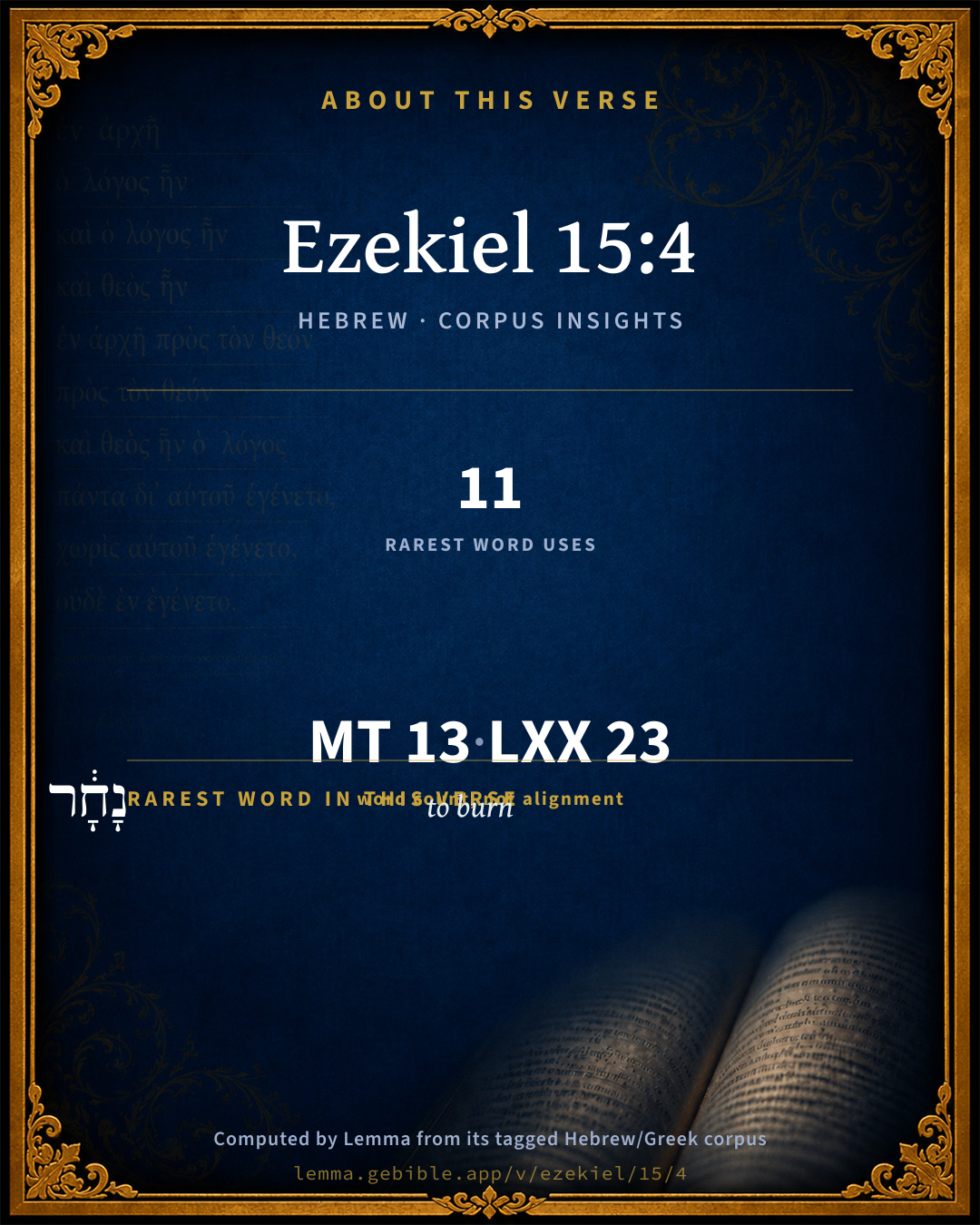
The rarest word here is נָחָ֔ר to burn H2787 — appearing just 11 times in the whole Hebrew Bible.

Shared distinctive vocabulary

נָחָ֔ר to burn H2787 occurs in 11 verses of the Hebrew Bible. Also found in:

Grammatical profile

  • 4 verbs
  • 6 nouns
  • 1 adjective
  • 2 particles

Verb forms

  • נִתַּ֣ן Niphal · Perfect
  • אָכְלָ֤ה Qal · Perfect
  • נָחָ֔ר Niphal · Perfect
  • הֲיִצְלַ֖ח Qal · Imperfect

Repetition

A word recurs within this verse — often emphatic in Hebrew:

  • לָאֵ֖שׁ fire H784 ×2

Hebrew & Septuagint length

In English translation the verse runs 31 words from the Hebrew and 32 from the Septuagint (LXX English) — closely comparable.

A rough comparison of the two English renderings, which tokenize alike — not a word-level alignment.

Word counts can differ between the Hebrew and the Greek without any difference in meaning — e.g. the Hebrew direct-object marker אֵת has no separate Greek word, and Greek often adds the article ὁ.

In the original languages it is 13 Hebrew tokens and 23 Greek tokens — but the two are counted differently (Hebrew bundles its prefixes and suffixes into one token; the Greek is in lemma form), so that isn’t a like-for-like length.

Cross-references

10

Topical passages linked to Ezekiel 15:4 in the Treasury of Scripture Knowledge — connected by theme and wording, ordered by reader-vote popularity; previews shown in the World English Bible.

  • John 15:6 If a man doesn't remain in me, he is thrown out as a branch, and is withered; and they gather them, throw them into the fire, and they are burned.
  • Psalms 80:16 It's burned with fire. It's cut down. They perish at your rebuke.
  • Isaiah 27:11 When the boughs of it are withered, they shall be broken off; the women shall come, and set them on fire; for it is a people of no understanding: therefore he who made them will not have compassion on them, and he who formed them will show them no favor.
  • Isaiah 1:31 The strong will be like tinder, And his work like a spark. They will both burn together, And no one will quench them."
  • Ezekiel 19:14 Fire is gone out of the rods of its branches, it has devoured its fruit, so that there is in it no strong rod to be a scepter to rule. This is a lamentation, and shall be for a lamentation.
  • Amos 4:11 "I have overthrown some of you, As when God overthrew Sodom and Gomorrah, And you were like a burning stick plucked out of the fire; Yet you haven't returned to me," says Yahweh.
  • Malachi 4:1 "For, behold, the day comes, it burns as a furnace; and all the proud, and all who work wickedness, will be stubble; and the day that comes will burn them up," says Yahweh of Hosts, "that it shall leave them neither root nor branch.
  • Matthew 3:12 His winnowing fork is in his hand, and he will thoroughly cleanse his threshing floor. He will gather his wheat into the barn, but the chaff he will burn up with unquenchable fire."
  • Hebrews 6:8 but if it bears thorns and thistles, it is rejected and near being cursed, whose end is to be burned.
  • Hebrews 12:29 for our God is a consuming fire.

Cross-references courtesy of OpenBible.info (CC BY 4.0).

Hebrew and Greek witnesses Masoretic Hebrew ↔ Greek Septuagint

The same verse in the two great witnesses to the Old Testament, shown verse-for-verse.

These are two independent witnesses, not word-aligned to each other, and the Septuagint is shown in lemma (dictionary) form.

Hebrew Ezekiel 15:4 Masoretic · Westminster Leningrad Codex

הִנֵּ֥ה לָאֵ֖שׁ נִתַּ֣ן לְאָכְלָ֑ה אֵת֩ שְׁנֵ֨י קְצוֹתָ֜יו אָכְלָ֤ה הָאֵשׁ֙ וְתוֹכ֣וֹ נָחָ֔ר הֲיִצְלַ֖ח לִמְלָאכָֽה

Behold, it is cast into the fire for fuel; the fire has devoured both the ends of it, and the midst of it is burned: is it profitable for any work?

World English Bible · Public Domain

Greek LXX Ezekiel 15:4 Septuagint · lemma form

πάρεξ πῦρ δίδωμι εἰς ἀνάλωσις ὁ κατά ἐνιαυτός κάθαρσις ἀπό αὐτός ἀναἁλίσκω ὁ πῦρ καί ἐκλείπω εἰς τέλος μή χρήσιμος εἰμί εἰς ἐργασία

It is only given to the fire to be consumed; the fire consumes that which is yearly pruned of it, and it is utterly gone. Will it be useful for any work?

LXX2012 (modern English Septuagint) · Public Domain

Hebrew: Westminster Leningrad Codex (CC BY 4.0). Greek: Septuagint (public domain); English from LXX2012 (modern English Septuagint) (Public Domain). How the Septuagint differs from the Hebrew →

Targum (Aramaic paraphrase)

1

The Targum is the ancient Jewish Aramaic paraphrase of the Hebrew Scriptures — an interpretive translation, not the Hebrew text itself. Onkelos (literal) and Pseudo-Jonathan (expansive) render the Torah, and Jonathan the Prophets. Coverage is partial: where no permissively-licensed English translation exists for a verse, only the Aramaic is shown. This is verse-level text, not a word-by-word alignment to the Hebrew.

  1. Targum Jonathan Prophets (Joshua–Malachi)
    הָא לְאֶשְׁתָּא אִתְמְסַר לְאִשְׁתֵּיצָאָה יַת תְּרֵין סִטְרוֹהִי אָכְלָא אַשִׁתָּא וְגַוֵיהּ חַר הַיִכְשַׁר לַעֲבִידָא:

    (no public-domain English translation for this verse)

    Targum Jonathan — Aramaic: “Mikraot Gedolot” (public domain). English: “Sefaria Community Translation” (CC0 1.0 (public-domain dedication)); “London "Chaldee Paraphrase," 1871” (public domain). Text via Sefaria.

Commentary

Notes on Ezekiel 15:4 from classic Christian and Jewish commentators (each source and its license shown beneath its notes). The classic Christian expositions comment on the surrounding passage and are grouped to its opening verse, so a note may address several verses; the Jewish commentaries on the Tanakh (Rashi and others) are per-verse, so they appear only where the commentator wrote on this verse.

Lemma curates 59 commentaries, every one of them public domain or Creative Commons licensed, each selected and text-cleaned for this edition rather than reprinted as found. About our sources →

Trapp's Complete Commentary

John Trapp

Eze 15:4 Behold, it is cast into the fire for fuel; the fire devoureth both the ends of it, and the midst of it is burned. Is it meet for [any] work?

Ver. 4. Behold, it is cast into the fire for fuel.] But then it must be taken before it be overly dry; and so Cornelius A Lapide testifieth that they burn little else in Italy but fagots made of vine branches. See Joh 15:6. {See Trapp on "Joh 15:6"}

The midst of it is burned.] Ustulatum; scorched and seared, so that it is altogether unuseful, and is therefore cast again into the fire, out of which, for some other purpose, it had been pulled. Woe to apostates; the hottest fire in hell abideth them.

John Trapp, A Commentary or Exposition upon All the Books of the Old and New Testament (1647–1656) — public domain. Text from a community e-Sword module.

Jamieson, Fausset & Brown

Robert Jamieson, A. R. Fausset & David Brown

cast into . . . fire-- (Joh 15:6).

both the ends--the north kingdom having been already overturned by Assyria under Tiglath-pileser; the south being pressed on by Egypt (Kg2 23:29-35).

midst of it is burned--rather, "is on flame"; namely, Jerusalem, which had now caught the flame by the attack of Nebuchadnezzar.

Is it meet for any work--"it," that is, the scorched part still remaining.

Jamieson, Fausset & Brown — Commentary Critical and Explanatory on the Whole Bible (1871) — public domain (CC PDM 1.0). Text via the HelloAO Bible API.

Adam Clarke's Commentary

Verse 4. The fire devoureth both the ends of it, and the midst of it is burned.] Judea is like a vine branch thrown into the fire, which seizes on both the ends, and scorches the middle: so both the extremities of the land is wasted; and the middle, Jerusalem, is now threatened with a siege, and by and by will be totally destroyed.

Adam Clarke's Commentary on the Bible (1810–1826) — public domain. Text from a community e-Sword/MySword module.

The Cambridge Bible for Schools and Colleges

gen. ed. J. J. S. Perowne

4. A hypothetical sentence: Behold, when it hath been cast into the fire for fuel, when the fire hath devoured both the ends of it, and the midst of it is charred, will it be meet for any work? This part of the similitude is borrowed from the actual instance of Israel. As it is Jerusalem, including Judah, that is compared to the vine, the burning of the ends and scorching of the middle probably refers to the calamities sustained by that kingdom, such as the captivity under Jehoiachin and other severe reverses.

The Cambridge Bible for Schools and Colleges (gen. ed. J. J. S. Perowne; Cambridge University Press, 1878–1918) — public domain. Text from a community e-Sword module.

John Gill's Exposition

Behold, when it was whole it was meet for no work,.... Before it was cut into pieces, and east into the fire, it was not fit to make so much as a pin of to hang anything on; so Israel, when all together, before the ten tribes were carried captive, or the Jews before the captivity of Jeconiah, were useless and unfruitful, and to every good work reprobate:

how much less shall it be meet yet for any work when the fire hath devoured it, and it is burned? as its wood is good for nothing before it is burned, its ashes are useless after.

John Gill's Exposition of the Whole Bible (1746–1763) — public domain (CC PDM 1.0). Text via the HelloAO Bible API.

Albert Barnes' Notes on the Bible

Behold, it is cast into the fire - The wood is in itself useless for any purpose; but what if it have been cast into the fire, and half burned, what of it then?

Albert Barnes' Notes on the Bible (1834–1885) — public domain. Text from a community e-Sword/MySword module.

Haydock's Catholic Bible Commentary

Ashes. It is not even solid enough for fuel. (Calmet) --- When a faggot is consumed in the middle, the ends are also put into the fire; so not one shall escape who dies out of the Church. (Worthington) --- The wicked Jews shall surely suffer, ver. 6. (Haydock)

George Leo Haydock (1774–1849), Haydock's Catholic Family Bible and Commentary, 1859 edition — public domain. Excludes Psalms (Douay-Rheims chapter numbering differs from Protestant) and Deuterocanonical books (Catholic canon only).

Matthew Poole's English Annotations

When for its barrenness it is cut down, it is fit only to be burnt. Nor is it a choice fuel neither, a little branch of a tree of the forest is better, and affords more fuel.

Matthew Poole's English Annotations on the Holy Bible (1683–1685) — public domain. Text from a community e-Sword/MySword module.

John Wesley's Explanatory Notes

For fuel - When for its barrenness it is cut down, it is fit only to burn.

John Wesley, Explanatory Notes Upon the Whole Bible (1754–1765) — public domain. Text via the GEBible commentary corpus.

Rashi

Rabbi Shlomo Yitzchaki (Rashi)

Behold, [if] it were given to the fire to be consumed Adevorer in Old French, to be devoured, consumed. Behold I asked you about a whole one, which is not fit for anything. Now I shall add more to the question: Behold if they put a branch of it into the fire, and the fire consumed it at its two ends of its outer surface until its inside became charred...

were charred Heb. נָחָר, blackened from the fire, brouir in French, to blacken, to scorch. נָחָר derives from the same form found in (Job 30:30): “and my bones dried out (חָרָה) from the heat.” Some translate this as e(s)sart in Old French, calcined, burnt to ashes, as [its sense] in Hosea (8:5) and also in (Job 19:11): “He has kindled (וַיַחַר) His wrath against me.” Menachem (p. 93) [however] related it to “my bones dried out.” is it fit [Is it] still fit for work?

Rashi on the Tanakh — English translations: “The Judaica Press complete Tanach with Rashi, translated by A. J. Rosenberg” (CC BY 4.0); “Pentateuch with Rashi's commentary by M. Rosenbaum and A.M. Silbermann, 1929-1934” (public domain); “The Metsudah Tanach series, Lakewood, N.J” (CC BY 4.0); and “The Book of Joshua, Metsudah Publications, 1997” (CC BY 4.0). Text via Sefaria.

Lesson kit

Teaching starters — assembled from the data on this page, not authored interpretation. Every prompt links to the verse data it draws on. Edit before teaching.

Ezekiel, in the Prophets, opens this verse with 13 words (12 distinct Hebrew lemmas). Its most distinctive word is chârar (“to burn”). A historical commentator’s framing appears above. Read the whole chapter for the surrounding context.

Discussion questions

  1. The word chârar carries the sense “to burn.” How does it shape the verse?
  2. How does Job 30:30, which shares the word «to burn», read alongside this verse?
  3. What does the repetition of “fire” (2× in this one verse) do in this verse?
  4. These translations render this verse differently; the difference is in the English rendering, not the original. What questions does that raise?
  5. «נִתַּ֣ן» is a Niphal Perfect verb. How does that grammatical form shape the action described?
  6. Compare how Trapp's Complete Commentary and Jamieson, Fausset & Brown read this verse. Where do they agree or differ?

Things to notice

Reading settings

Reading text

Shown beneath each verse's original-language words.

Old Testament
Old Testament edition

Read the OT as the Masoretic Hebrew (MT) or the Greek Septuagint (LXX).

English shown for the Greek Septuagint (in the Hebrew ↔ Greek comparison).

Comparing translations? Open the Compare panel on any verse page to stack up to four side by side.