Numbers 16:35

Hebrew (Westminster Leningrad Codex) Numbers 16:35 appears in the Hebrew Old Testament. The text above is from the Westminster Leningrad Codex. Each word links to its Strong’s number, a concise gloss, and parsing drawn from the Open Scriptures Hebrew Bible morphology. Click any word for its full Brown-Driver-Briggs (BDB) entry.
Download image
Cite this verse

Numbers 16:35 (World English Bible). Public Domain. Lemma interlinear Bible study tool, https://lemma.gebible.app/v/numbers/16/35.

Show BibTeX & RIS
BibTeX
RIS
English Translation
Fire came forth from Yahweh, and devoured the two hundred fifty men who offered the incense.
World English Bible · Public Domain
Download a study sheet

One document with this verse’s original text, its word-by-word gloss line, the meaning frame, cross-references with their text, attributed commentary, and full source and license credits — printable, and it pastes into notes with its structure intact.

This verse Autodidact and up

Study sheet (.html) Plain text (.txt)

A passage Seminary Student

Up to 50 verses in one chapter. A passage sheet keeps up to 6 commentary sources and 12 cross-references per verse, in the order this page ranks them, and says so on the sheet whenever that leaves anything out. Ask for a single verse and you get the Autodidact verse sheet above.

Everything on this page stays free to read, with no account — the sheet is a download of what is already on screen, not access to it.

Want to remove ads? Support Godless Engineer
Compare translations 3

The same verse in 3 English versions, stacked beneath the original-language interlinear above. Click any original word for its lexicon entry.

Each is an independent rendering of the whole verse — the interlinear is not word-aligned to these translations.

Highlighted words mark where these versions differ — a whole-verse word diff, not a word-by-word alignment.

  • World English Bible Public Domain
    Fire came forth from Yahweh, and devoured the two hundred fifty men who offered the incense.
  • King James Version Public Domain
    And there came out a fire from the LORD, and consumed the two hundred and fifty men that offered incense.
  • unfoldingWord Literal Text CC BY-SA 4.0
    And fire went out from with Yahweh, and it ate the 250 men presenting the incense.

unfoldingWord Literal Text — © unfoldingWord, licensed CC BY-SA 4.0. Word-aligned USFM3 via Door43 (git.door43.org/unfoldingWord/en_ult).

Versions to compare (up to 4)

3 of 4 selected

Show all 18 translations

Every available English version of this verse, each an independent rendering of the whole verse.

  • World English Bible Public Domain
    Fire came forth from Yahweh, and devoured the two hundred fifty men who offered the incense.
  • Berean Standard Bible Public Domain
    And fire came forth from the LORD and consumed the 250 men who were offering the incense.
  • Majority Standard Bible Public Domain
    And fire came forth from the LORD and consumed the 250 men who were offering the incense.
  • King James Version Public Domain
    And there came out a fire from the LORD, and consumed the two hundred and fifty men that offered incense.
  • American Standard Version (1901) Public Domain
    And fire came forth from Jehovah, and devoured the two hundred and fifty men that offered the incense.
  • Revised Version (1885) Public Domain
    And fire came forth from the LORD, and devoured the two hundred and fifty men that offered the incense.
  • Geneva Bible (1599) Public Domain
    But there came out a fire from the Lord, and consumed the two hundreth and fiftie men that offred the incense.
  • Douay-Rheims (1899) Public Domain
    And a fire coming out from the Lord, destroyed the two hundred and fifty men that offered the incense.
  • Young's Literal Translation Public Domain
    and fire hath come out from Jehovah, and consumeth the two hundred and fifty men bringing near the perfume.
  • Literal Standard Version CC BY-SA 4.0
    and fire has come out from YHWH and consumes the two hundred and fifty men bringing the incense near.
  • Unlocked Literal Bible CC BY-SA 4.0
    Then fire flashed out from Yahweh and devoured the 250 men who had offered incense.
  • unfoldingWord Literal Text CC BY-SA 4.0
    And fire went out from with Yahweh, and it ate the 250 men presenting the incense.
  • Darby Bible Public Domain
    And there came out a fire from Jehovah, and consumed the two hundred and fifty men that had presented incense.
  • World Messianic Bible Public Domain
    Fire came out from the LORD, and devoured the two hundred fifty men who offered the incense.
  • Webster's Bible Public Domain
    And there came out a fire from the LORD, and consumed the two hundred and fifty men that offered incense.
  • Free Bible Version CC BY-SA 4.0
    Fire burst out from the Lord and burned up the 250 men who were offering incense.
  • Bible in Basic English Public Domain
    Then fire came out from the Lord, burning up the two hundred and fifty men who were offering the perfume.
  • JPS Tanakh (1917) Public Domain
    And fire came forth from the LORD, and devoured the two hundred and fifty men that offered the incense.

Literal Standard Version (2020), Covenant Press — licensed CC BY-SA 4.0. Text via the HelloAO Bible API (eBible.org). Unlocked Literal Bible (unfoldingWord) — licensed CC BY-SA 4.0. Text via the HelloAO Bible API (eBible.org). unfoldingWord Literal Text — © unfoldingWord, licensed CC BY-SA 4.0. Word-aligned USFM3 via Door43 (git.door43.org/unfoldingWord/en_ult). Free Bible Version, Dr. Jonathan Gallagher — licensed CC BY-SA 4.0. Text via the HelloAO Bible API (eBible.org).

Word by word

More ways to search: Search by grammar → Find every occurrence → Compare this word →

Practice this passage: Drill this verse → Learn its vocabulary →

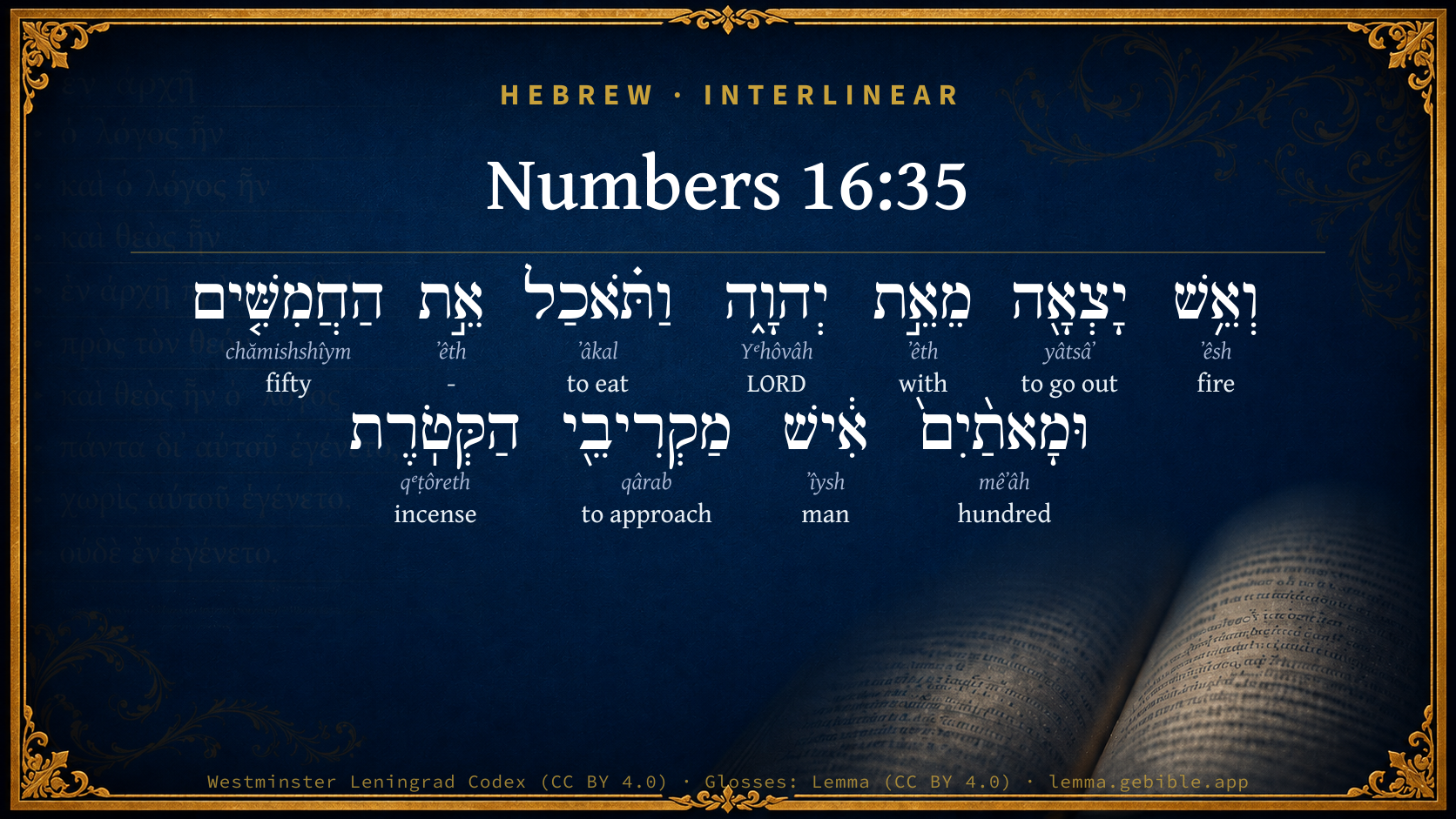
הַקְּטֹֽרֶת
qᵉṭôreth
H7004
“the · incense”
Particle, Definite Article + Noun, Common, Feminine, Singular, Absolute
Part of Speech
Particle + Noun
Type
Common
Gender
Feminine
Number
Singular
State
Absolute
Full BDB Definition

Origin: from H6999

TWOT: 2011a

incense, smoke, odour of (burning) sacrifice - sweet smoke of sacrifice - incense - perfume
  1. וְאֵ֥שׁ ʼêsh H784 “and · fire” Conjunction + Noun, Common, Both, Singular, Absolute
  2. יָצְאָ֖ה yâtsâʼ H3318 “to go out” Verb, Qal, Perfect, 3rd Person, Feminine, Singular
  3. מֵאֵ֣ת ʼêth H854 “from · with” Preposition + Preposition
  4. יְהוָ֑ה Yᵉhôvâh H3068 “LORD” Noun, Proper
  5. וַתֹּ֗אכַל ʼâkal H398 “and · to eat” Conjunction + Verb, Qal, Sequential Imperfect, 3rd Person, Feminine, Singular
  6. אֵ֣ת ʼêth H853 “-” Particle, Direct Object
  7. הַחֲמִשִּׁ֤ים chămishshîym H2572 “the · fifty” Particle, Definite Article + Adjective, Cardinal number, Both, Plural, Absolute
  8. וּמָאתַ֨יִם֙ mêʼâh H3967 “and · hundred” Conjunction + Adjective, Cardinal number, Both, Dual, Absolute
  9. אִ֔ישׁ ʼîysh H376 “man” Noun, Common, Masculine, Singular, Absolute
  10. מַקְרִיבֵ֖י qârab H7126 “approaching” Verb, Hiphil, Participle Active, Masculine, Plural, Construct

About this verse

These counts appear in no published source. They are computed here, from the morphology-tagged text and Lemma’s own curated glosses. What Lemma adds →

11
words
11
distinct lemmas
Pentateuch
section

Shared distinctive vocabulary

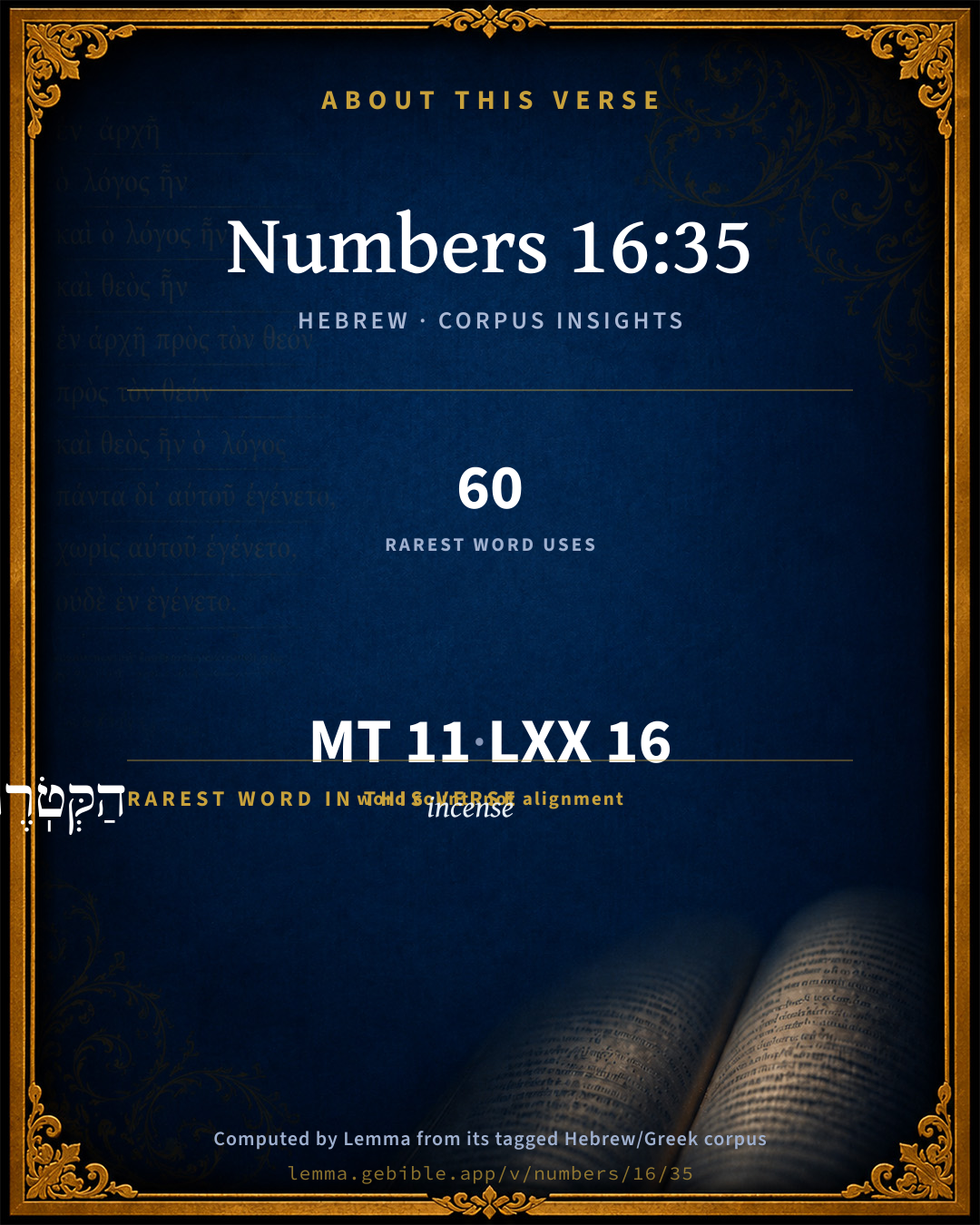
הַקְּטֹֽרֶת incense H7004 occurs in 58 verses of the Hebrew Bible. Also found in:

Grammatical profile

  • 3 verbs
  • 4 nouns
  • 2 adjectives
  • 1 preposition
  • 1 particle

Verb forms

  • יָצְאָ֖ה Qal · Perfect
  • וַתֹּ֗אכַל Qal · Sequential Imperfect
  • מַקְרִיבֵ֖י Hiphil · Participle Active

Hebrew & Septuagint length

In English translation the verse runs 16 words from the Hebrew and 18 from the Septuagint (LXX English) — closely comparable.

A rough comparison of the two English renderings, which tokenize alike — not a word-level alignment.

Word counts can differ between the Hebrew and the Greek without any difference in meaning — e.g. the Hebrew direct-object marker אֵת has no separate Greek word, and Greek often adds the article ὁ.

In the original languages it is 11 Hebrew tokens and 16 Greek tokens — but the two are counted differently (Hebrew bundles its prefixes and suffixes into one token; the Greek is in lemma form), so that isn’t a like-for-like length.

Cross-references

6

Topical passages linked to Numbers 16:35 in the Treasury of Scripture Knowledge — connected by theme and wording, ordered by reader-vote popularity; previews shown in the World English Bible.

  • Leviticus 10:2 And fire came forth from before Yahweh, and devoured them, and they died before Yahweh.
  • Numbers 26:10 and the earth opened its mouth, and swallowed them up together with Korah, when that company died; what time the fire devoured two hundred fifty men, and they became a sign.
  • Psalms 106:18 A fire was kindled in their company. The flame burned up the wicked.
  • Numbers 11:1–3 The people were as murmurers, [speaking] evil in the ears of Yahweh: and when Yahweh heard it, his anger was kindled; and the fire of Yahweh burnt among them, and devoured in the uttermost part of the camp.
  • Numbers 16:2 and they rose up before Moses, with certain of the children of Israel, two hundred fifty princes of the congregation, called to the assembly, men of renown;
  • Numbers 16:17 and take every man his censer, and put incense on them, and bring you before Yahweh every man his censer, two hundred fifty censers; you also, and Aaron, each his censer.

Cross-references courtesy of OpenBible.info (CC BY 4.0).

Hebrew and Greek witnesses Masoretic Hebrew ↔ Greek Septuagint

The same verse in the two great witnesses to the Old Testament, shown verse-for-verse.

These are two independent witnesses, not word-aligned to each other, and the Septuagint is shown in lemma (dictionary) form.

Hebrew Numbers 16:35 Masoretic · Westminster Leningrad Codex

וְאֵ֥שׁ יָצְאָ֖ה מֵאֵ֣ת יְהוָ֑ה וַתֹּ֗אכַל אֵ֣ת הַחֲמִשִּׁ֤ים וּמָאתַ֨יִם֙ אִ֔ישׁ מַקְרִיבֵ֖י הַקְּטֹֽרֶת

Fire came forth from Yahweh, and devoured the two hundred fifty men who offered the incense.

World English Bible · Public Domain

Greek LXX Numbers 16:35 Septuagint · lemma form

καί πῦρ ἐκἔρχομαι παρά κύριος καί καταἐσθίω ὁ πεντήκοντα καί διακόσιοι ἀνήρ ὁ προςφέρω ὁ θυμίαμα

And fire went forth from the Lord, and devoured the two hundred and fifty men that offered incense.

LXX2012 (modern English Septuagint) · Public Domain

Hebrew: Westminster Leningrad Codex (CC BY 4.0). Greek: Septuagint (public domain); English from LXX2012 (modern English Septuagint) (Public Domain). How the Septuagint differs from the Hebrew →

Targum (Aramaic paraphrase)

2

The Targum is the ancient Jewish Aramaic paraphrase of the Hebrew Scriptures — an interpretive translation, not the Hebrew text itself. Onkelos (literal) and Pseudo-Jonathan (expansive) render the Torah, and Jonathan the Prophets. Coverage is partial: where no permissively-licensed English translation exists for a verse, only the Aramaic is shown. This is verse-level text, not a word-by-word alignment to the Hebrew.

  1. Targum Onkelos Torah (Genesis–Deuteronomy)
    וְאֶשָׁתָא נְפָקַת מִן קֳדָם יְיָ וַאֲכָלַת יָת מָאתָן וְחַמְשִׁין גַבְרָא מְקַרְבֵי קְטוֹרֶת בּוּסְמַיָא

    (no public-domain English translation for this verse)

    Targum Onkelos — Aramaic: “Onkelos Genesis” (public domain); “Onkelos Exodus” (public domain); “Onkelos Leviticus” (public domain); “Onkelos Numbers” (public domain); “Onkelos Deuteronomy” (public domain). English: “Sefaria Community Translation” (CC0 1.0 (public-domain dedication)); “J.W. Etheridge. The Targums of Onkelos and Jonathan Ben Uzziel on the Pentateuch. London: Longmans, Green, 1862” (public domain). Text via Sefaria.

  2. Targum Pseudo-Jonathan Torah (Genesis–Deuteronomy)
    וְאֵישָׁתָא נְפָקַת בְּרוּגְזָא מִן קֳדָם יְיָ וַאֲכָלַת יַת מָאתָן וְחַמְשִׁין גוּבְרִין מַסְקֵי קְטוֹרֶת בּוּסְמַיָא

    And a fire came out in wrath from before the Lord, and devoured the two hundred and fifty men who offered the incense.

    Targum Pseudo-Jonathan — Aramaic: “Targum Jonathan on Genesis” (public domain); “Targum Jonathan on Exodus” (public domain); “Targum Jonathan on Leviticus” (public domain); “Targum Jonathan on Numbers” (public domain); “Targum Jonathan on Deuteronomy” (public domain). English: “The Targum of Jonathan ben Uzziel, trans. J. W. Etheridge, London, 1862” (public domain). Text via Sefaria.

Commentary

Notes on Numbers 16:35 from classic Christian and Jewish commentators (each source and its license shown beneath its notes). The classic Christian expositions comment on the surrounding passage and are grouped to its opening verse, so a note may address several verses; the Jewish commentaries on the Tanakh (Rashi and others) are per-verse, so they appear only where the commentator wrote on this verse.

Lemma curates 59 commentaries, every one of them public domain or Creative Commons licensed, each selected and text-cleaned for this edition rather than reprinted as found. About our sources →

Matthew Henry's Commentary

We must now look back to the door of the tabernacle, where we left the pretenders to the priesthood with their censers in their hands ready to offer incense; and here we find,

I. Vengeance taken on them, Num 16:35. It is probable that when the earth opened in the camp to swallow up Dathan and Abiram a fire went out from the Lord and consumed the 250 men that offered incense, while Aaron that stood with them was preserved alive. This punishment was not indeed so new a thing as the former, for Nadab and Abihu thus died; but it was not less strange or dreadful, and in it it appeared, 1. That our God is a consuming fire. Is thunder a sensible indication of the terror of his voice? Lightning is also the power of his hand. We must see in this his fiery indignation which devours the adversaries, and infer from it what a fearful thing it is to fall into the hands of the living God, Heb 10:27-31. 2. That it is at our peril if we meddle with that which does not belong to us. God is jealous of the honour of his own institutions, and will not have them invaded. It is most probable that Korah himself was consumed with those 250 that presumed to offer incense; for the priesthood was the thing he aimed at, and therefore we have reason to think that he would not quit his post at the door of the tabernacle. But, behold, those are made sacrifices to the justice of God who flattered themselves with the hopes of being priests. Had they been content with their office as Levites, which was sacred and honourable, and better than they deserved, they might have lived and died with joy and reputation; but, like the angels that sinned, leaving their first estate, and aiming at the honours that were not appointed them, they were thrust down to Hades, their censers struck out of their hands, and their breath out of their bodies, by a burning which typified the vengeance of eternal fire.

II. Care is taken to perpetuate the remembrance of this vengeance. No mention is made of the taking up of their carcases: the scripture leaves them as dung upon the face of the earth; but orders are given about their censers, 1. That they be secured, because they are hallowed. Eleazar is charged with this, Num 16:37. Those invaders of the priesthood had proceeded so far, by the divine patience and submission, as to kindle their incense with fire from off the altar, which they were suffered to use by way of experiment: but, as soon as they had kindled their fire, God kindled another, which put a fatal final period to their pretensions; now Eleazar is ordered to scatter the fire, with the incense that was kindled with it, in some unclean place without the camp, to signify God's abhorrence of their offering as a polluted thing: The sacrifice of the wicked is an abomination to the Lord. But he is to gather up the censers out of the mingled burning, God's fire and theirs, because they are hallowed. Having been once put to a holy use, and that by God's own order (though only for trial), they must not return to common service; so some understand it: rather, they are devoted, they are an anathema; and therefore, as all devoted things, they must be made some way or other serviceable to the glory of God. 2. That they be used in the service of the sanctuary, not as censers, which would rather have put honour upon the usurpers whose disgrace was intended; nor was there occasion for brazen censers, the golden altar was served with golden ones; but they must be beaten into broad plates for a covering of the brazen altar, Num 16:38-40. These pretenders thought to have ruined the altar, by laying the priesthood in common again; but to show that Aaron's office was so far from being shaken by their impotent malice that it was rather confirmed by it, their censers, which offered to rival his, were used both for the adorning and for the preserving of the altar at which he ministered. Yet this was not all; this covering of the altar must be a memorial to the children of Israel, throughout their generations, of this great event. Though there was so much in it astonishing, and though Moses was to record it in his history, yet there was danger of its being forgotten in process of time; impressions that seem deep are not always durable; therefore it was necessary to appoint this record of the judgment, that the Levites who attended this altar, and had their inferior services appointed them, might learn to keep within their bounds, and be afraid of transgressing them, lest they should be made like Korah and his company, who were Levites, and would have been priests. These censers were preserved in terrorem, that others might hear and fear, and do no more presumptuously. Thus God has provided that his wonderful works, both in mercy and judgment, should be had in everlasting remembrance, that the end of them may be answered, and they may serve for instruction and admonition to those on whom the ends of the world are come.

Matthew Henry's Commentary on the Whole Bible (1708–1710) — public domain (CC PDM 1.0). Text via the HelloAO Bible API.

Trapp's Complete Commentary

John Trapp

Num 16:35 And there came out a fire from the LORD, and consumed the two hundred and fifty men that offered incense.

Ver. 35. And there came out a fire.] By fire they sinned, and by a fire they suffer: -

“ Per quod quis peccat, per idem punitur ipse. ”

John Trapp, A Commentary or Exposition upon All the Books of the Old and New Testament (1647–1656) — public domain. Text from a community e-Sword module.

Joseph Benson's Commentary

Num 16:35. From the Lord — From the cloud, wherein the glory of the Lord appeared.

Joseph Benson's Commentary on the Old and New Testaments (1811–1818) — public domain. Text from a community e-Sword module.

Jamieson, Fausset & Brown

Robert Jamieson, A. R. Fausset & David Brown

there came out a fire from the Lord--that is, from the cloud. This seems to describe the destruction of Korah and those Levites who with him aspired to the functions of the priesthood. (See Num 26:11, Num 26:58; Ch1 6:22, Ch1 6:37).

Jamieson, Fausset & Brown — Commentary Critical and Explanatory on the Whole Bible (1871) — public domain (CC PDM 1.0). Text via the HelloAO Bible API.

Ellicott's Commentary for English Readers

(35) And there came out a fire from the Lord . . . —It was thus, as Bishop Wordsworth has observed, that “Korah and his company were punished by the same element as that by which they had sinned.”

A Bible Commentary for English Readers, edited by Charles John Ellicott (1878–1897) — public domain. Text from a community e-Sword module.

The Cambridge Bible for Schools and Colleges

gen. ed. J. J. S. Perowne

35. The sin of Korah’s company was the same as that of Nadab and Abihu (Lev_10:1-2), and their punishment was the same. ‘The gainsaying of Korah’ is referred to as a typical sin in Judges 11.

36–40 [Heb. 17:1–15]. The fire-pans were made into a covering of the altar, as a memorial of the incident. As Num_16:40 shews, this section is written from the later point of view found in Num_16:8-11; Num_16:16-17. The writer who inserted them took the test of the fire-pans as proving the superiority of priests to Levites, not of Levites to laymen. (In the Heb. Bible Num_16:36 forms the beginning of ch. 17)

The Cambridge Bible for Schools and Colleges (gen. ed. J. J. S. Perowne; Cambridge University Press, 1878–1918) — public domain. Text from a community e-Sword module.

John Gill's Exposition

And there came out a fire from the Lord,.... Flashes of lightning from the cloud in which he was:

and consumed the two hundred and fifty men that offered incense; not that it reduced them to ashes, but took away their lives, struck them dead at once, in like manner as Nadab and Abihu were, who though said to be devoured by the fire, yet their bodies remained, Lev 10:2; and is often the case of persons killed by lightning; though Josephus (a) thinks they were so consumed as that their bodies were no more seen, and who is express for it that Korah perished with them in this manner; which is not improbable, since he took his censer and offered incense with them, and was the ringleader of them, and the person that contended with Aaron for the priesthood, which was to be determined in this way; and though he is not mentioned it may be concluded, as Aben Ezra observes, by an argument from the lesser to the greater, that if the men he drew in perished, much more he himself; and the same writer observes, that in the song of the Red sea, no mention is made of the drowning of Pharaoh in it, only of his chariots and his host, and yet he himself was certainly drowned: now these men burning incense which belonged only to the priests of the Lord, were by just retaliation consumed by fire, and which made it plainly appear they were not the priests of the Lord; and the judgment on them was the more remarkable, that Moses and Aaron, who stood by them, remained unhurt. This was an emblem of the vengeance of eternal fire, of everlasting burnings, Jde 1:11.

(a) Antiq. l. 4. c. 3. sect. 4.

John Gill's Exposition of the Whole Bible (1746–1763) — public domain (CC PDM 1.0). Text via the HelloAO Bible API.

Albert Barnes' Notes on the Bible

Compare the marginal references The fire came out from the sanctuary or the altar.

Albert Barnes' Notes on the Bible (1834–1885) — public domain. Text from a community e-Sword/MySword module.

Haydock's Catholic Bible Commentary

Incense. Core had left them, and was busy in stirring up the people to rebellion, when a fire proceeding from the cloud, or from the altar, or perhaps a thunderbolt, (Calmet) came to arraign them before God’s tribunal, there to meet their chief, and to hear the eternal sentence of separation from all good, which was instantly pronounced upon all who died impenitent. (Haydock) --- Perhaps Core might have been offering incense with his 250 men, when the fire seized him, ver. 40. (Du Hamel)

George Leo Haydock (1774–1849), Haydock's Catholic Family Bible and Commentary, 1859 edition — public domain. Excludes Psalms (Douay-Rheims chapter numbering differs from Protestant) and Deuterocanonical books (Catholic canon only).

Matthew Poole's English Annotations

From the Lord; i.e. from the cloud, wherein the glory of the Lord appeared, Num 16:19, to give sentence in this cause.

Matthew Poole's English Annotations on the Holy Bible (1683–1685) — public domain. Text from a community e-Sword/MySword module.

Whedon's Commentary on the Bible

Daniel D. Whedon

35. A fire — A stroke of lightning from the cloudy pillar.

Consumed the two hundred and fifty — This occurred at the door of the tabernacle. If the earth had not swallowed up these, Aaron and his sons and the tabernacle itself would have been in jeopardy.

Daniel D. Whedon (gen. ed.), Commentary on the Old and New Testaments (1874–1909) — public domain. Text from a community e-Sword module.

The Pulpit Commentary

There came out a fire from the Lord. The fire probably flashed out from the sanctuary with the destructive force of lightning. The two hundred and fifty men. These had remained swinging their censers before the gate of the tabernacle while Moses and (presumably) Korah himself had gone to the camp of Reuben.

The Pulpit Commentary (1880–1919), ed. H.D.M. Spence-Jones & Joseph S. Exell — public domain. Text from a community e-Sword module.

John Wesley's Explanatory Notes

From the Lord - From the cloud, wherein the glory of the Lord appeared.

John Wesley, Explanatory Notes Upon the Whole Bible (1754–1765) — public domain. Text via the GEBible commentary corpus.

Keil & Delitzsch

C. F. Keil & F. Delitzsch

The other 250 rebels, who were probably still in front of the tabernacle, were then destroyed by fire which proceeded from Jehovah, as Nadab and Abihu had been before (Lev 10:2).

Keil & Delitzsch — Biblical Commentary on the Old Testament (1861–1891) — public domain (CC PDM 1.0). Text via the HelloAO Bible API. (Old Testament only.)

Lesson kit

Teaching starters — assembled from the data on this page, not authored interpretation. Every prompt links to the verse data it draws on. Edit before teaching.

Numbers, in the Pentateuch, opens this verse with 11 words (11 distinct Hebrew lemmas). Its most distinctive word is qᵉṭôreth (“incense”). A historical commentator’s framing appears above. Read the whole chapter for the surrounding context.

Discussion questions

  1. The word qᵉṭôreth carries the sense “incense.” How does it shape the verse?
  2. How does Exodus 25:6, which shares the word «incense», read alongside this verse?
  3. These translations render this verse differently. What is at stake in choosing one wording over another?
  4. «יָצְאָ֖ה» is a Qal Perfect verb. How does that grammatical form shape the action described?
  5. Compare how Matthew Henry's Commentary and Trapp's Complete Commentary read this verse. Where do they agree or differ?

Things to notice

Reading settings

Reading text

Shown beneath each verse's original-language words.

Old Testament
Old Testament edition

Read the OT as the Masoretic Hebrew (MT) or the Greek Septuagint (LXX).

English shown for the Greek Septuagint (in the Hebrew ↔ Greek comparison).

Comparing translations? Open the Compare panel on any verse page to stack up to four side by side.