
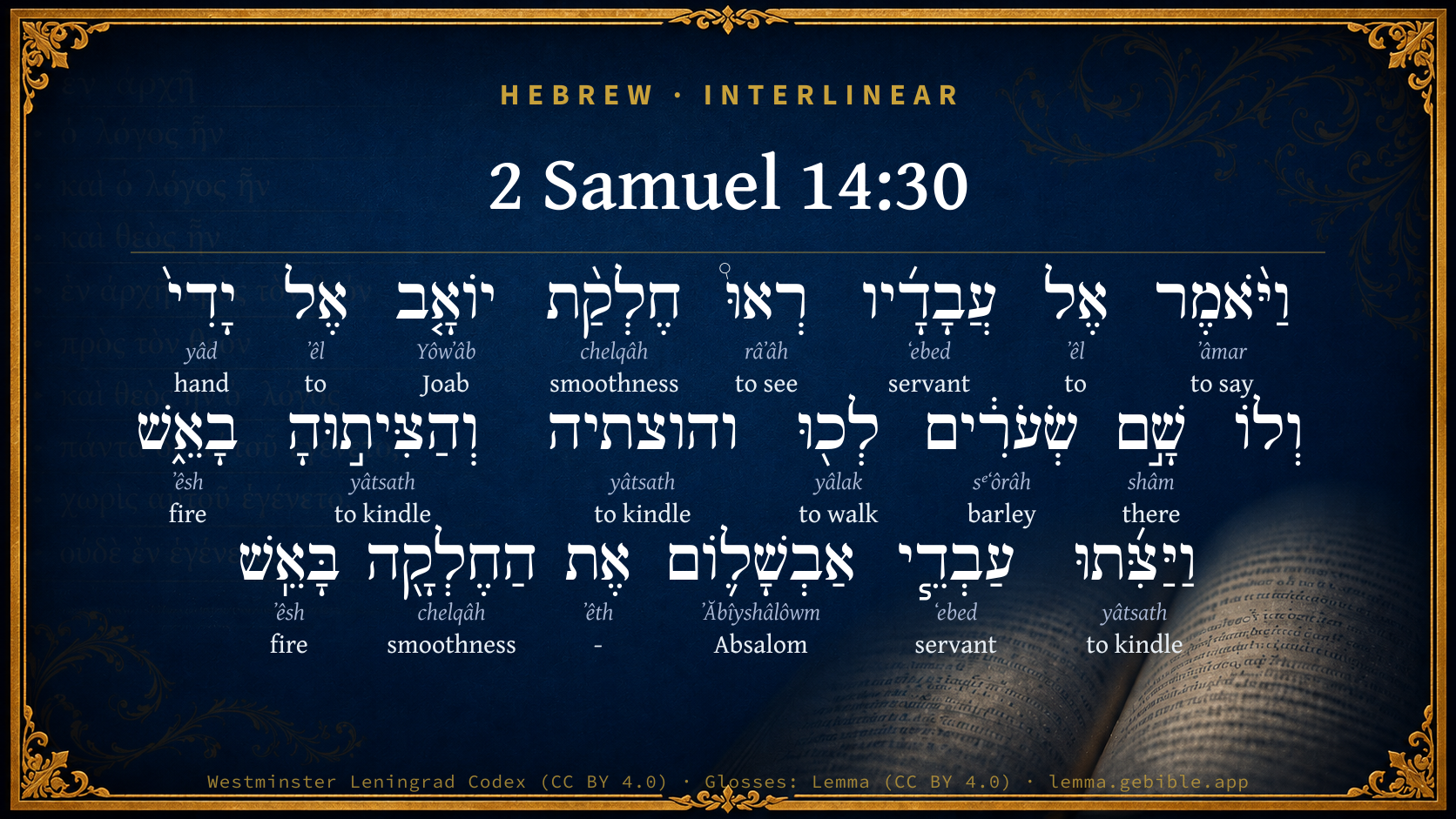
2 Samuel 14:30

Hebrew (Westminster Leningrad Codex) 2 Samuel 14:30 appears in the Hebrew Old Testament. The text above is from the Westminster Leningrad Codex. Each word links to its Strong’s number, a concise gloss, and parsing drawn from the Open Scriptures Hebrew Bible morphology. Click any word for its full Brown-Driver-Briggs (BDB) entry.
Download image
Cite this verse

2 Samuel 14:30 (World English Bible). Public Domain. Lemma interlinear Bible study tool, https://lemma.gebible.app/v/2-samuel/14/30.

Show BibTeX & RIS
BibTeX
RIS
English Translation
Therefore he said to his servants, Behold, Joab's field is near mine, and he has barley there; go and set it on fire. Absalom's servants set the field on fire.
World English Bible · Public Domain
Download a study sheet

One document with this verse’s original text, its word-by-word gloss line, the meaning frame, cross-references with their text, attributed commentary, and full source and license credits — printable, and it pastes into notes with its structure intact.

This verse Autodidact and up

Study sheet (.html) Plain text (.txt)

A passage Seminary Student

Up to 50 verses in one chapter. A passage sheet keeps up to 6 commentary sources and 12 cross-references per verse, in the order this page ranks them, and says so on the sheet whenever that leaves anything out. Ask for a single verse and you get the Autodidact verse sheet above.

Everything on this page stays free to read, with no account — the sheet is a download of what is already on screen, not access to it.

Want to remove ads? Support Godless Engineer
Compare translations 3

The same verse in 3 English versions, stacked beneath the original-language interlinear above. Click any original word for its lexicon entry.

Each is an independent rendering of the whole verse — the interlinear is not word-aligned to these translations.

Highlighted words mark where these versions differ — a whole-verse word diff, not a word-by-word alignment.

  • World English Bible Public Domain
    Therefore he said to his servants, Behold, Joab's field is near mine, and he has barley there; go and set it on fire. Absalom's servants set the field on fire.
  • King James Version Public Domain
    Therefore he said unto his servants, See, Joab's field is near mine, and he hath barley there; go and set it on fire. And Absalom's servants set the field on fire.
  • unfoldingWord Literal Text CC BY-SA 4.0
    So he said to his servants, “See, the property of Joab to my hand, and barley to him there. Go and burn it with fire.” So the servants of Absalom burned the property with fire.

unfoldingWord Literal Text — © unfoldingWord, licensed CC BY-SA 4.0. Word-aligned USFM3 via Door43 (git.door43.org/unfoldingWord/en_ult).

Versions to compare (up to 4)

3 of 4 selected

Show all 18 translations

Every available English version of this verse, each an independent rendering of the whole verse.

  • World English Bible Public Domain
    Therefore he said to his servants, Behold, Joab's field is near mine, and he has barley there; go and set it on fire. Absalom's servants set the field on fire.
  • Berean Standard Bible Public Domain
    Then Absalom said to his servants, “Look, Joab’s field is next to mine, and he has barley there. Go and set it on fire!” And Absalom’s servants set the field on fire.
  • Majority Standard Bible Public Domain
    Then Absalom said to his servants, “Look, Joab’s field is next to mine, and he has barley there. Go and set it on fire!” And Absalom’s servants set the field on fire.
  • King James Version Public Domain
    Therefore he said unto his servants, See, Joab's field is near mine, and he hath barley there; go and set it on fire. And Absalom's servants set the field on fire.
  • American Standard Version (1901) Public Domain
    Therefore he said unto his servants, See, Joab's field is near mine, and he hath barley there; go and set it on fire. And Absalom's servants set the field on fire.
  • Revised Version (1885) Public Domain
    Therefore he said unto his servants, See, Joab’s field is near mine, and he hath barley there; go and set it on fire. And Absalom’s servants set the field on fire.
  • Geneva Bible (1599) Public Domain
    Therefore he sayde vnto his seruants, Beholde, Ioab hath a fielde by my place, and hath barley therein: go, and set it on fire: and Absaloms seruants set the field on fire.
  • Douay-Rheims (1899) Public Domain
    He said to his servants: You know the field of Joab near my field, that hath a crop of barley: go now and set it on fire. So the servants of Absalom set the corn on fire. And Joab's servants coming with their garments rent, said: The servants of Absalom have set part of the field on fire.
  • Young's Literal Translation Public Domain
    And he saith unto his servants, `See, the portion of Joab `is' by the side of mine, and he hath barley there; go, and burn it with fire;' and the servants of Absalom burn the portion with fire.
  • Literal Standard Version CC BY-SA 4.0
    And he says to his servants, “See, the portion of Joab [is] by the side of mine, and he has barley there; go and burn it with fire”; and the servants of Absalom burn the portion with fire.
  • Unlocked Literal Bible CC BY-SA 4.0
    So Absalom said to his servants, “See, Joab's field is near mine, and he has barley there. Go and set it on fire.” So Absalom's servants set the field on fire.
  • unfoldingWord Literal Text CC BY-SA 4.0
    So he said to his servants, “See, the property of Joab to my hand, and barley to him there. Go and burn it with fire.” So the servants of Absalom burned the property with fire.
  • Darby Bible Public Domain
    Then he said to his servants, See, Joab's allotment is near mine and he has barley there: go and set it on fire. And Absalom's servants set the allotment on fire.
  • World Messianic Bible Public Domain
    Therefore he said to his servants, “Behold, Joab’s field is near mine, and he has barley there. Go and set it on fire.” So Absalom’s servants set the field on fire.
  • Webster's Bible Public Domain
    Therefore he said to his servants, See, Joab's field is near mine, and he hath barley there; go and set it on fire. And Absalom's servants set the field on fire.
  • Free Bible Version CC BY-SA 4.0
    So Absalom told his servants, “Look, Joab's field is next to mine, and he has barley growing there. Go and set it on fire!” Absalom's servants went and set the field on fire.
  • Bible in Basic English Public Domain
    So he said to his servants, See, Joab's field is near mine, and he has barley in it; go and put it on fire. And Absalom's servants put the field on fire.
  • JPS Tanakh (1917) Public Domain
    Therefore he said unto his servants: 'See, Joab's field is near mine, and he hath barley there; go and set it on fire.' And Absalom's servants set the field on fire.

Literal Standard Version (2020), Covenant Press — licensed CC BY-SA 4.0. Text via the HelloAO Bible API (eBible.org). Unlocked Literal Bible (unfoldingWord) — licensed CC BY-SA 4.0. Text via the HelloAO Bible API (eBible.org). unfoldingWord Literal Text — © unfoldingWord, licensed CC BY-SA 4.0. Word-aligned USFM3 via Door43 (git.door43.org/unfoldingWord/en_ult). Free Bible Version, Dr. Jonathan Gallagher — licensed CC BY-SA 4.0. Text via the HelloAO Bible API (eBible.org).

Word by word

More ways to search: Search by grammar → Find every occurrence → Compare this word →

Practice this passage: Drill this verse → Learn its vocabulary →

חֶלְקַ֨ת
chelqâh
H2513
“smoothness of”
Noun, Common, Feminine, Singular, Construct
Part of Speech
Noun
Type
Common
Gender
Feminine
Number
Singular
State
Construct
Full BDB Definition

Origin: from H2506

TWOT: 670c

portion, parcel - of ground - smooth part, smoothness, flattery - smoothness, smooth part - slippery places - smoothness, flattery
  1. וַיֹּ֨אמֶר ʼâmar H559 “and · to say” Conjunction + Verb, Qal, Sequential Imperfect, 3rd Person, Masculine, Singular
  2. אֶל ʼêl H413 “to” Preposition
  3. עֲבָדָ֜יו ʻebed H5650 “servants · his” Noun, Common, Masculine, Plural, Construct + Suffix, Personal, 3rd Person, Masculine, Singular
  4. רְאוּ֩ râʼâh H7200 “see” Verb, Qal, Imperative, 2nd Person, Masculine, Plural
  5. יוֹאָ֤ב Yôwʼâb H3097 “Joab” Noun, Proper
  6. אֶל ʼêl H413 “to” Preposition
  7. יָדִי֙ yâd H3027 “hand · my” Noun, Common, Both, Singular, Construct + Suffix, Personal, 1st Person, Common, Singular
  8. שָׁ֣ם shâm H8033 “there” Adverb
  9. שְׂעֹרִ֔ים sᵉʻôrâh H8184 “barley” Noun, Common, Feminine, Plural, Absolute
  10. לְכ֖וּ yâlak H3212 “walk” Verb, Qal, Imperative, 2nd Person, Masculine, Plural
  11. והוצתיה yâtsath H3341 “and · to kindle · her” Conjunction + Verb, Hiphil, Sequential Perfect, 1st Person, Common, Singular + Suffix, Personal, 3rd Person, Feminine, Singular
  12. וְהַצִּית֣וּהָ yâtsath H3341 “and · kindle · her” Conjunction + Verb, Hiphil, Imperative, 2nd Person, Masculine, Plural + Suffix, Personal, 3rd Person, Feminine, Singular
  13. בָאֵ֑שׁ ʼêsh H784 “in/at the · fire” Preposition, Determined + Noun, Common, Both, Singular, Absolute
  14. וַיַּצִּ֜תוּ yâtsath H3341 “and · to kindle” Conjunction + Verb, Hiphil, Sequential Imperfect, 3rd Person, Masculine, Plural
  15. עַבְדֵ֧י ʻebed H5650 “servants of” Noun, Common, Masculine, Plural, Construct
  16. אַבְשָׁל֛וֹם ʼĂbîyshâlôwm H53 “Absalom” Noun, Proper
  17. אֶת ʼêth H853 “-” Particle, Direct Object
  18. הַחֶלְקָ֖ה chelqâh H2513 “the · smoothness” Particle, Definite Article + Noun, Common, Feminine, Singular, Absolute
  19. בָּאֵֽשׁ ʼêsh H784 “in/at the · fire” Preposition, Determined + Noun, Common, Both, Singular, Absolute

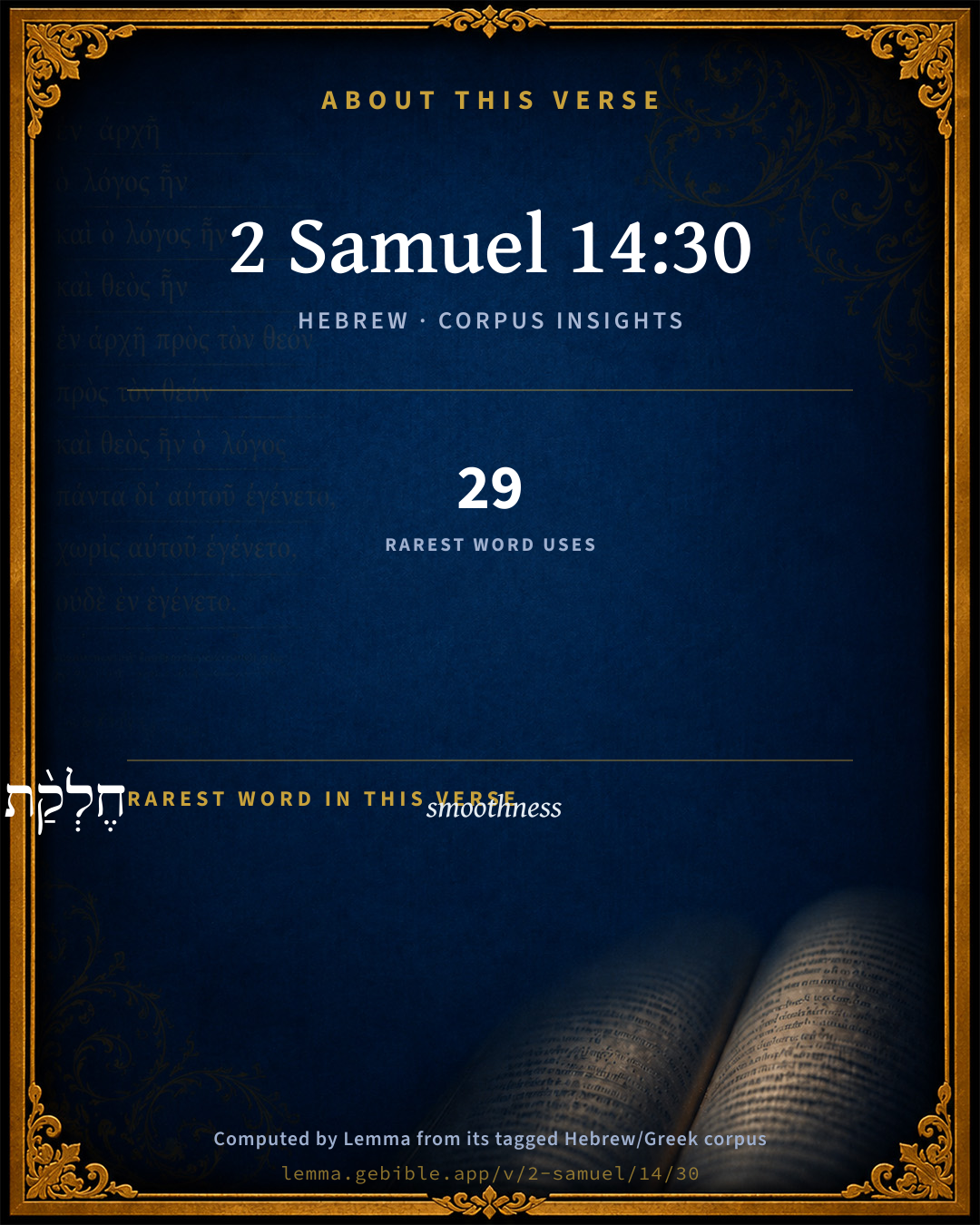
About this verse

These counts appear in no published source. They are computed here, from the morphology-tagged text and Lemma’s own curated glosses. What Lemma adds →

21
words
14
distinct lemmas
Historical
section

Shared distinctive vocabulary

חֶלְקַ֨ת smoothness H2513 occurs in 25 verses of the Hebrew Bible. Also found in:

Grammatical profile

  • 6 verbs
  • 10 nouns
  • 3 prepositions
  • 1 adverb
  • 1 particle

Verb forms

  • וַיֹּ֨אמֶר Qal · Sequential Imperfect
  • רְאוּ֩ Qal · Imperative
  • לְכ֖וּ Qal · Imperative
  • והוצתיה Hiphil · Sequential Perfect
  • וְהַצִּית֣וּהָ Hiphil · Imperative
  • וַיַּצִּ֜תוּ Hiphil · Sequential Imperfect

Repetition

Words recur within this verse — often emphatic in Hebrew:

  • והוצתיה to kindle H3341 ×3
  • עֲבָדָ֜יו servant H5650 ×2
  • חֶלְקַ֨ת smoothness H2513 ×2
  • בָאֵ֑שׁ fire H784 ×2
  • אֶל to H413 ×2

Hebrew & Septuagint length

In English translation the verse runs 30 words from the Hebrew and 65 from the Septuagint (LXX English) — the Septuagint runs noticeably longer here. See the side-by-side →

A rough comparison of the two English renderings, which tokenize alike — not a word-level alignment.

Word counts can differ between the Hebrew and the Greek without any difference in meaning — e.g. the Hebrew direct-object marker אֵת has no separate Greek word, and Greek often adds the article ὁ.

Cross-references

5

Topical passages linked to 2 Samuel 14:30 in the Treasury of Scripture Knowledge — connected by theme and wording, ordered by reader-vote popularity; previews shown in the World English Bible.

  • Judges 15:4–5 Samson went and caught three hundred foxes, and took firebrands, and turned tail to tail, and put a firebrand in the midst between every two tails.
  • 2 Samuel 13:28–29 Absalom commanded his servants, saying, Mark you now, when Amnon's heart is merry with wine; and when I tell you, Smite Amnon, then kill him; don't be afraid; haven't I commanded you? be courageous, and be valiant.
  • 1 Kings 21:9–14 She wrote in the letters, saying, Proclaim a fast, and set Naboth on high among the people:
  • 2 Kings 9:33 He said, Throw her down. So they threw her down; and some of her blood was sprinkled on the wall, and on the horses: and he trod her under foot.
  • 2 Kings 10:6–7 Then he wrote a letter the second time to them, saying, If you be on my side, and if you will listen to my voice, take the heads of the men your master's sons, and come to me to Jezreel by tomorrow this time. Now the king's sons, being seventy persons, were with the great men of the city, who brought them up.

Cross-references courtesy of OpenBible.info (CC BY 4.0).

Hebrew and Greek witnesses Masoretic Hebrew ↔ Greek Septuagint

The same verse in the two great witnesses to the Old Testament, shown verse-for-verse.

Here the Septuagint runs noticeably longer than the Hebrew — LXX2012 (modern English Septuagint) 65 words vs World English Bible 30. A rough length comparison of the two English translations, not a word-level alignment — read both below.

These are two independent witnesses, not word-aligned to each other, and the Septuagint is shown in lemma (dictionary) form.

Hebrew 2 Samuel 14:30 Masoretic · Westminster Leningrad Codex

וַיֹּ֨אמֶר אֶל עֲבָדָ֜יו רְאוּ֩ חֶלְקַ֨ת יוֹאָ֤ב אֶל יָדִי֙ וְלוֹ שָׁ֣ם שְׂעֹרִ֔ים לְכ֖וּ והוצתיה וְהַצִּית֣וּהָ בָאֵ֑שׁ וַיַּצִּ֜תוּ עַבְדֵ֧י אַבְשָׁל֛וֹם אֶת הַחֶלְקָ֖ה בָּאֵֽשׁ

Therefore he said to his servants, Behold, Joab's field is near mine, and he has barley there; go and set it on fire. Absalom's servants set the field on fire.

World English Bible · Public Domain

Greek LXX 2 Samuel 14:30 Septuagint · lemma form

καί εἶπον αβεσσαλωμ πρός ὁ παῖς αὐτός ὁράω ὁ μερίς ἐν ἀγρός ὁ ιωαβ ἔχω ἐγώ καί αὐτός κριθή ἐκεῖ πορεύομαι καί ἐνπίμπρημι αὐτός ἐν πῦρ καί ἐνπίμπρημι αὐτός ὁ παῖς αβεσσαλωμ καί παραγίγνομαι ὁ δοῦλος ιωαβ πρός αὐτός διαῥήγνυμι ὁ ἱμάτιον αὐτός καί εἶπον ἐνπυρίζω ὁ δοῦλος αβεσσαλωμ ὁ μερίς ἐν πῦρ

And Abessalom said to his servants, Behold, Joab's portion in the field is next to mine, and he has in it barley; go and set it on fire. And the servants of Abessalom set the field on fire: and the servants of Joab come to him with their clothes torn, and they said to him, The servants of Abessalom have set the field on fire.

LXX2012 (modern English Septuagint) · Public Domain

Hebrew: Westminster Leningrad Codex (CC BY 4.0). Greek: Septuagint (public domain); English from LXX2012 (modern English Septuagint) (Public Domain). How the Septuagint differs from the Hebrew →

Targum (Aramaic paraphrase)

1

The Targum is the ancient Jewish Aramaic paraphrase of the Hebrew Scriptures — an interpretive translation, not the Hebrew text itself. Onkelos (literal) and Pseudo-Jonathan (expansive) render the Torah, and Jonathan the Prophets. Coverage is partial: where no permissively-licensed English translation exists for a verse, only the Aramaic is shown. This is verse-level text, not a word-by-word alignment to the Hebrew.

  1. Targum Jonathan Prophets (Joshua–Malachi)
    וַאֲמַר לְעַבְדוֹהִי חֲזוֹ אַחְסַנְתֵּיהּ דְיוֹאָב דִסְמִיכָא לְדִילִי וְלֵיהּ תַּמָן סְעוֹרִין אֱזִילוּ וְאַדְלְקוּהָ בְּנוּרָא וְאַדְלִיקוּ עַבְדֵי אַבְשָׁלוֹם יַת אַחְסַנְתֵּיהּ בְּנוּרָא:

    (no public-domain English translation for this verse)

    Targum Jonathan — Aramaic: “Mikraot Gedolot” (public domain). English: “Sefaria Community Translation” (CC0 1.0 (public-domain dedication)); “London "Chaldee Paraphrase," 1871” (public domain). Text via Sefaria.

Commentary

Notes on 2 Samuel 14:30 from classic Christian and Jewish commentators (each source and its license shown beneath its notes). The classic Christian expositions comment on the surrounding passage and are grouped to its opening verse, so a note may address several verses; the Jewish commentaries on the Tanakh (Rashi and others) are per-verse, so they appear only where the commentator wrote on this verse.

Lemma curates 59 commentaries, every one of them public domain or Creative Commons licensed, each selected and text-cleaned for this edition rather than reprinted as found. About our sources →

Trapp's Complete Commentary

John Trapp

2Sa 14:30 Therefore he said unto his servants, See, Joab’s field is near mine, and he hath barley there; go and set it on fire. And Absalom’s servants set the field on fire.

Ver. 30. Go and set it on fire,] viz., That he may have cause to come and speak with me. So - but in a mere just way - God fetcheth his home to himself by afflictions, he fireth them out of their false refuges.

John Trapp, A Commentary or Exposition upon All the Books of the Old and New Testament (1647–1656) — public domain. Text from a community e-Sword module.

Joseph Benson's Commentary

2Sa 14:30. Go and set it on fire — Absalom’s ambition could but ill endure Joab’s coldness and delay, and therefore he ordered this extraordinary step to be taken that he might be set right with his father, a step which showed him determined to go any lengths, rather than fall short of his ambitious aims. For he that could order his friend’s field, and that friend so great a man as Joab, and his near kinsman, to be set on fire, barely that he might be admitted to court, would little scruple to set his country in a flame (if the expression may be allowed) to be raised to a crown. See Delaney. Absalom’s servants set the field on fire — For he had still those about him who were ready to execute any command, though ever so unjust, as his servants did when he bade them kill Amnon.

Joseph Benson's Commentary on the Old and New Testaments (1811–1818) — public domain. Text from a community e-Sword module.

Geneva Bible (1599)

Geneva Bible translators

The wicked are impatient in their affections, and spare no unlawful means to compass them.

Or, possession.

Geneva Bible (1599) marginal notes — public domain. Text via Bolls.life.

Adam Clarke's Commentary

Verse 30. Go and set it on fire] This was strange conduct, but it had the desired effect. He had not used his influence to get Absalom to court; now he uses it, and succeeds.

ADDITIONAL observations on ver. 26: -

"And at every year's end, he (Absalom) polled his head; and he weighed the hair at two hundred shekels."

The very learned Bochart has written a dissertation on this subject (vide Bocharti Opera, vol. iii., col. 883, edit. Lugd. 1692) in a letter to his friend M. Faukell. I shall give the substance in what follows.

There is nothing more likely than that corruptions in the Scripture numerals have taken place. Budaeus de Asse (lib. ii., p. 49 and 51, also lib. iii., p. 67 c.) complains loudly of this.

This might easily have happened, as in former times the numbers in the sacred writings appear to have been expressed by single letters. The letter ר resh stands for two hundred, and might in this place be easily mistaken for ד daleth which signifies four but this may be thought to be too little, as it would not amount to more than a quarter of a pound; yet, if the two hundred shekels be taken in the amount will be utterly incredible; for Josephus says, (Antiq. lib. vii., cap. 8), Σικλους διακοσιους, οὑτοι δε εισι πεντε μναι, i.e., "Two hundred shekels make five minae," and in lib. xiv., cap. 12. he says, Ἡ δε μνα παρ' ἡμιν ισχει λιτρας β' και ημισυ; "And a mina with us (i.e., the Jews) weighs two pounds and a half." This calculation makes Absalom's hair weigh twelve pounds and a half! Credat Judaeus Apella!

Indeed, the same person tells us that the hair of Absalom was so thick, c., ὡς μολις αυτην ἡμεραις αποκειρειν οκτω, "that eight days were scarcely sufficient to cut it off in! "This is rabbinism, with a witness.

Epiphanius, in his treatise De Ponderibus et Mensuris, casts much more light on this place, where he says, Σικλος ὁ λεγεται και κοδραντης τεταρτον μεν εστι της ουγκιας, ἡμισυ δε του στατηρος, δυο δραχμας εχων; "A shekel, (i.e., a common or king's shekel, equal to half a shekel of the sanctuary), which is called also a quarter, is the fourth part of an ounce, or half a stater; which is about two drachms." This computation seems very just, as the half-shekel, (i.e., of the sanctuary,) Ex 30:13, which the Lord commanded the children of Israel to give as an offering for their souls, is expressly called in Mt 17:24, το διδραχμον, "two drachms:" and our Lord wrought a miracle to pay this, which the Romans then exacted by way of tribute: and Peter took out of the fish's mouth a stater, which contained exactly four drachms or one shekel, (of the sanctuary), the tribute money for our Lord and himself.

The king's shekel was about the fourth part of an ounce, according to what Epiphanius says above; and Hesychius says the same: Δυναται δε ὁ σικλος δυο δραχμας Αττικας; "A shekel is equal to, or worth, two Attic drachms." The whole amount, therefore, of the two hundred shekels is about fifty ounces, which make four pounds two ounces, Troy weight, or three pounds two ounces, Avoirdupois. This need not, says my learned author, be accounted incredible, especially as abundance of oil and ointments were used by the ancients in dressing their heads; as is evident, not only from many places in the Greek and Roman writers, but also from several places in the sacred writings. See Ps 23:5; Ec 9:8; Mt 6:17.

Josephus also informs us that the Jews not only used ointments, but that they put gold dust in their hair, that it might flame in the sun; and this they might do in considerable quantities, as gold was so plentiful among them. I must own I have known an instance that makes much for Bochart's argument: an officer, who had upwards of two pounds of powder and ointments put on his head daily, whose hair did not weigh a fourth part of that weight. And Absalom, being exceedingly vain, might be supposed to make a very extensive use of these things. There are some, however, who endeavour to solve the difficulty by understanding שקל shakal to mean rather the value than the weight.

Bochart concludes this elaborate dissertation, in which he appears to have ransacked all the Hebrew, Greek, and Roman authors for proofs of his opinion, by exhorting his friend in these words of Horace: -

_____ Si quid novisti rectius istis,

Candidus imperti; si non, his utere mecum.

To me the above is quite unsatisfactory; and, with due deference to so great a character, I think I have found out something better.

I believe the text is not here in its original form; and that a mistake has crept into the numeral letters. I imagine that ל lamed, THIRTY, was first written; which, in process of time, became changed for ר resh, TWO HUNDRED, which might easily have happened from the similarity of the letters. But if this be supposed to be too little, (which I think it is not), being only seven ounces and a half in the course of a year; let it be observed that the sacred text does not limit it to that quantity of time, for מקץ ימים לימים mikkets yamim laiyamim signifies literally, "From the end of days to days;" which Jonathan properly renders, מזמן עדן לעדן mizzeman iddan leiddan, "at proper or convenient times," viz., when it grew too long or weighty, which it might be several times in the year. Besides, this was not all his hair; for his head was not shaved but polled, i.e., the redundancy cut off.

But how was it probable that these two numerals should be interchanged? Thus; if the upper stroke of the ל lamed were but a little impaired, as it frequently is both in MSS. and printed books, it might be very easily taken for ר resh, and the remains of the upper part of the lamed might be mistaken for the stroke over the ר, which makes it the character of two hundred.

But how could מאתים mathayim, two hundred, in the text, be put in the place of שלשים sheloshim, thirty? Very easily, when the numbers became expressed by words at length instead of numeral letters.

The common reading of the text appears to me irreconcilable with truth; and I humbly hope that what I have offered above solves every difficulty, and fully accounts for all that the sacred historian speaks of this vain-comely lad.

Ver. 27. "Absalom had a daughter, whose name was Tamar."

Adam Clarke's Commentary on the Bible (1810–1826) — public domain. Text from a community e-Sword/MySword module.

Ellicott's Commentary for English Readers

(30) Set it on fire.—Absalom’s stratagem for obtaining an interview with Joab was perfectly successful, but would only have been resorted to by a lawless and unscrupulous character.

A Bible Commentary for English Readers, edited by Charles John Ellicott (1878–1897) — public domain. Text from a community e-Sword module.

The Cambridge Bible for Schools and Colleges

gen. ed. J. J. S. Perowne

30. set it on fire] Partly in revenge for Absalom’s refusal (cp. Jdg_15:3-5), partly in the hope of bringing Joab to make a complaint in person.

The Sept. and some MSS. of the Vulg. add at the end of the verse: “And Joab’s servants came to him with their clothes rent, and said, Absalom’s servants have set thy field on fire.” The words are not absolutely necessary to the sense, but they may have been accidentally omitted from the Heb. text.

The Cambridge Bible for Schools and Colleges (gen. ed. J. J. S. Perowne; Cambridge University Press, 1878–1918) — public domain. Text from a community e-Sword module.

John Gill's Exposition

Therefore he said unto his servants,.... That did his business for him in the field, in keeping his flocks, and tilling his ground:

see Joab's field is near mine: for great personages in those days attended to husbandry:

and he hath barley there, go and set it on fire; it being ripe, and so capable of being fired, and therefore must be some time in March or April, when barley harvest began; he served Joab as Samson did the Philistines, Jdg 15:4; which shows him to be a bold, and revengeful, and ungrateful man, to use his friend, and the general of the king's army, after this manner:

and Absalom's servants set the field on fire; as their master had bid them, and which is no wonder; for as they murdered Ammon at his command, they would not stop at burning Joab's field, when he bid them do it; see Sa2 13:28.

John Gill's Exposition of the Whole Bible (1746–1763) — public domain (CC PDM 1.0). Text via the HelloAO Bible API.

Matthew Poole's English Annotations

Go and set it on fire, that Joab may be forced to come to me to complain of and demand reparations for, this injury.

Matthew Poole's English Annotations on the Holy Bible (1683–1685) — public domain. Text from a community e-Sword/MySword module.

Whedon's Commentary on the Bible

Daniel D. Whedon

30. Set it on fire — This act shows up the bold and daring spirit of this prince. Only one of such spirit could plan and carry out the bold scheme of usurping a father’s throne.

Daniel D. Whedon (gen. ed.), Commentary on the Old and New Testaments (1874–1909) — public domain. Text from a community e-Sword module.

The Pulpit Commentary

Go, and set it on fire. The Hebrew has, Go, and I will set it on.fire. Absalom represents himself as doing in his own person what his servants were to be his instruments in accomplishing. The versions, however, agree with the Massorites in substituting the easy phrase in the text. But few languages are so indifferent to persons and numbers as the Hebrew.

The Pulpit Commentary (1880–1919), ed. H.D.M. Spence-Jones & Joseph S. Exell — public domain. Text from a community e-Sword module.

unfoldingWord translationNotes

Door43 World Missions Community

See

Here this word is used to remind people of something. AT: "As you know"

translationWords

barley

fire

unfoldingWord translationNotes — © Distant Shores Media and the Door43 World Missions Community, licensed CC BY-SA 4.0. Source: git.door43.org/Door43/en_tn.

Rashi

Rabbi Shlomo Yitzchaki (Rashi)

Which is near me. Near my domain in a place where I can inflict damage.

Which is near me. En mains aussi in O.F.

Rashi on the Tanakh — English translations: “The Judaica Press complete Tanach with Rashi, translated by A. J. Rosenberg” (CC BY 4.0); “Pentateuch with Rashi's commentary by M. Rosenbaum and A.M. Silbermann, 1929-1934” (public domain); “The Metsudah Tanach series, Lakewood, N.J” (CC BY 4.0); and “The Book of Joshua, Metsudah Publications, 1997” (CC BY 4.0). Text via Sefaria.

Lesson kit

Teaching starters — assembled from the data on this page, not authored interpretation. Every prompt links to the verse data it draws on. Edit before teaching.

2 Samuel, in the Historical, opens this verse with 21 words (14 distinct Hebrew lemmas). Its most distinctive word is chelqâh (“smoothness”). The Greek Septuagint runs longer here. A historical commentator’s framing appears above. Read the whole chapter for the surrounding context.

Discussion questions

  1. What does “smoothness” (chelqâh) contribute to the verse as a whole?
  2. How does Genesis 27:16, which shares the word «smoothness», read alongside this verse?
  3. What does the repetition of “to kindle” (3× in this one verse) do in this verse?
  4. The Septuagint runs longer here than the Hebrew. What might account for the difference?
  5. These translations render this verse differently; the difference is in the English rendering, not the original. What questions does that raise?
  6. «וַיֹּ֨אמֶר» is a Qal Sequential Imperfect verb. How does that grammatical form shape the action described?
  7. Compare how Trapp's Complete Commentary and Joseph Benson's Commentary read this verse. Where do they agree or differ?

Things to notice

Reading settings

Reading text

Shown beneath each verse's original-language words.

Old Testament
Old Testament edition

Read the OT as the Masoretic Hebrew (MT) or the Greek Septuagint (LXX).

English shown for the Greek Septuagint (in the Hebrew ↔ Greek comparison).

Comparing translations? Open the Compare panel on any verse page to stack up to four side by side.