
Leviticus 13:55

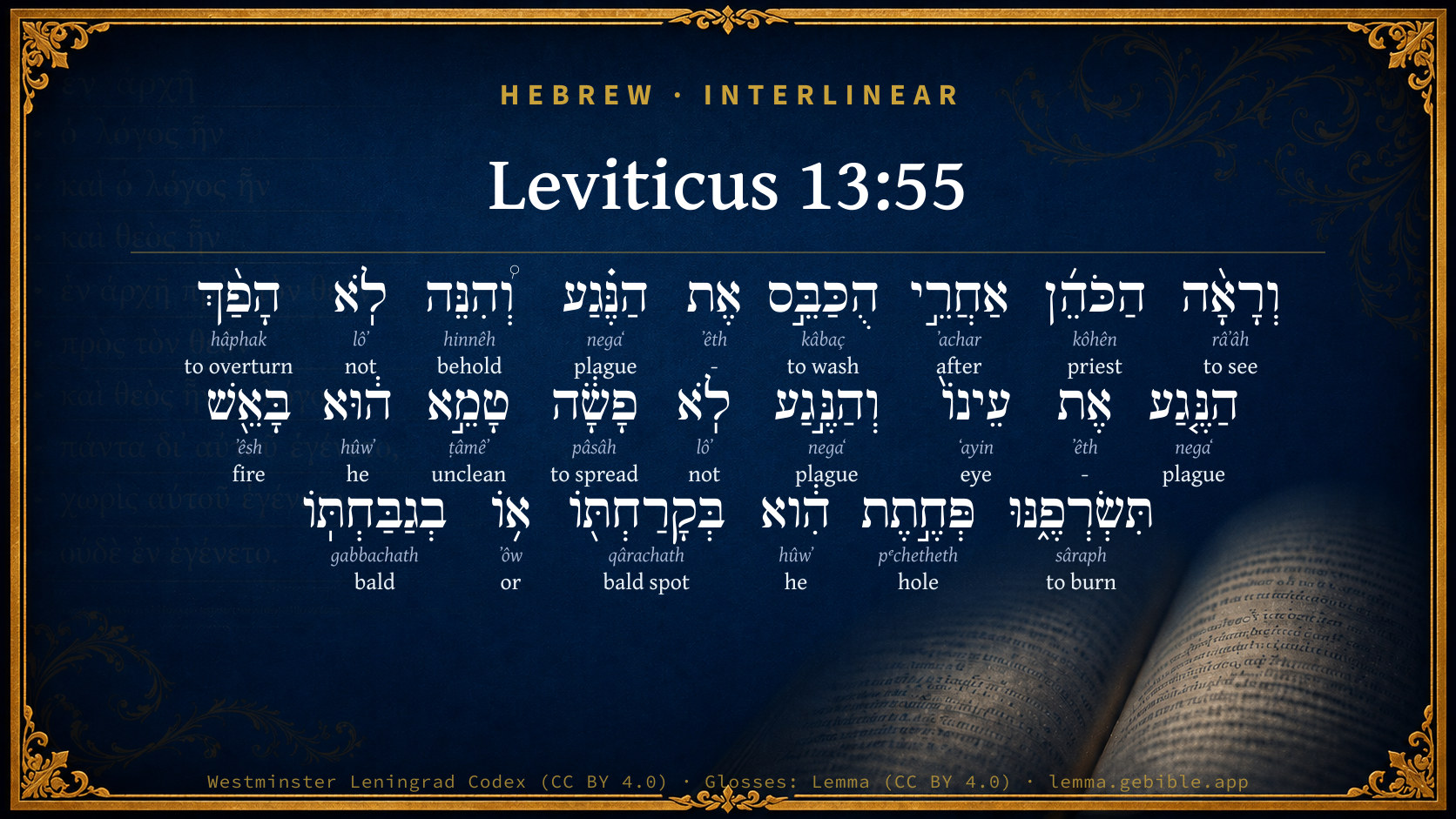
Hebrew (Westminster Leningrad Codex) Leviticus 13:55 appears in the Hebrew Old Testament. The text above is from the Westminster Leningrad Codex. Each word links to its Strong’s number, a concise gloss, and parsing drawn from the Open Scriptures Hebrew Bible morphology. Click any word for its full Brown-Driver-Briggs (BDB) entry.
Download image
Cite this verse

Leviticus 13:55 (World English Bible). Public Domain. Lemma interlinear Bible study tool, https://lemma.gebible.app/v/leviticus/13/55.

Show BibTeX & RIS
BibTeX
RIS
English Translation
Then the priest shall examine it, after the plague is washed; and, behold, if the plague hasn't changed its color, and the plague hasn't spread, it is unclean; you shall burn it in the fire. It is a mildewed spot, whether the bareness is inside or outside.
World English Bible · Public Domain
Highlights
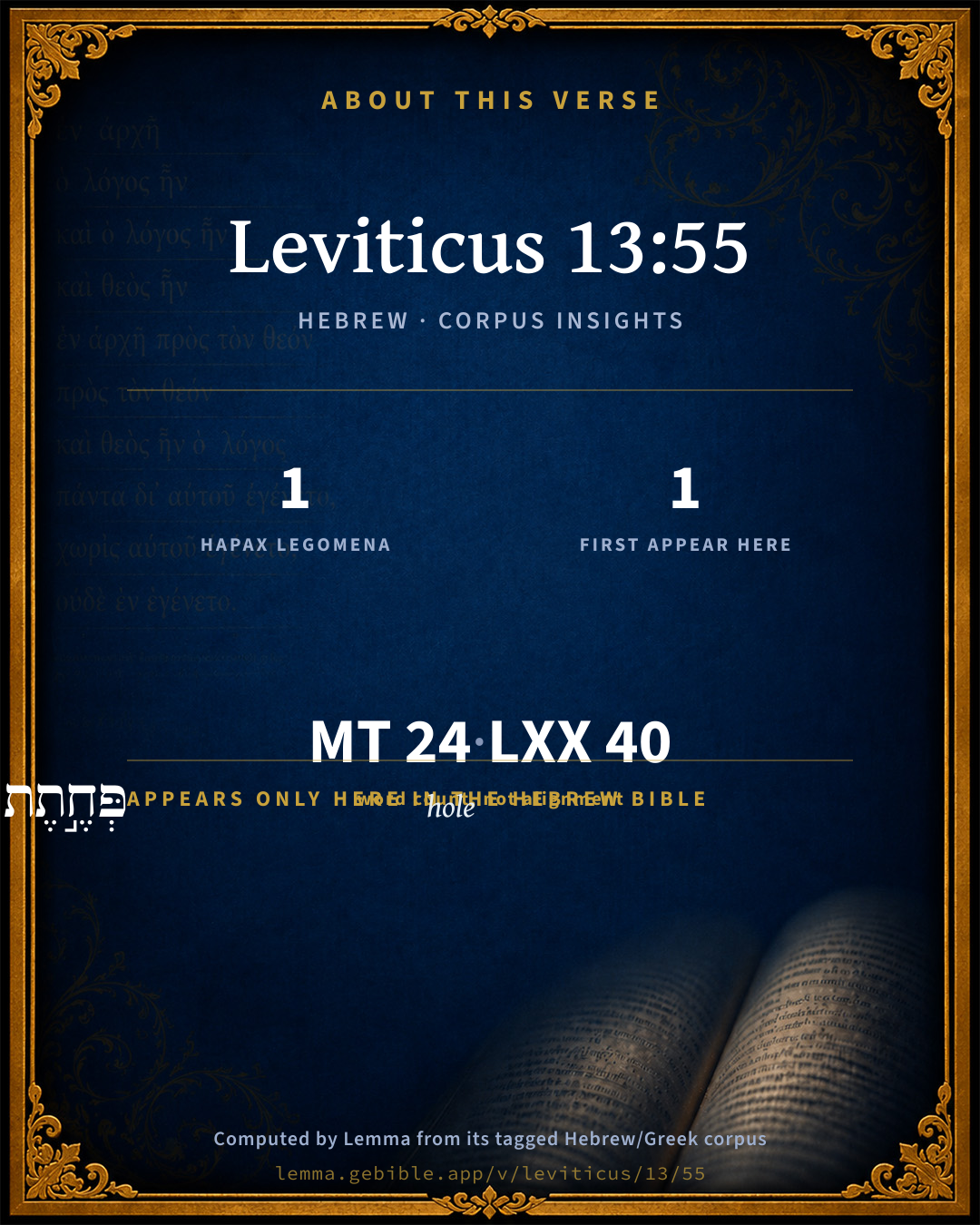
  • 1 hapax legomenon — only here in the Hebrew Bible
  • 1 first appearance in the Hebrew Bible
Full analysis ↓
Download a study sheet

One document with this verse’s original text, its word-by-word gloss line, the meaning frame, cross-references with their text, attributed commentary, and full source and license credits — printable, and it pastes into notes with its structure intact.

This verse Autodidact and up

Study sheet (.html) Plain text (.txt)

A passage Seminary Student

Up to 50 verses in one chapter. A passage sheet keeps up to 6 commentary sources and 12 cross-references per verse, in the order this page ranks them, and says so on the sheet whenever that leaves anything out. Ask for a single verse and you get the Autodidact verse sheet above.

Everything on this page stays free to read, with no account — the sheet is a download of what is already on screen, not access to it.

Want to remove ads? Support Godless Engineer
Compare translations 3

The same verse in 3 English versions, stacked beneath the original-language interlinear above. Click any original word for its lexicon entry.

Each is an independent rendering of the whole verse — the interlinear is not word-aligned to these translations.

Highlighted words mark where these versions differ — a whole-verse word diff, not a word-by-word alignment.

  • World English Bible Public Domain
    Then the priest shall examine it, after the plague is washed; and, behold, if the plague hasn't changed its color, and the plague hasn't spread, it is unclean; you shall burn it in the fire. It is a mildewed spot, whether the bareness is inside or outside.
  • King James Version Public Domain
    And the priest shall look on the plague, after that it is washed: and, behold, if the plague have not changed his color, and the plague be not spread; it is unclean; thou shalt burn it in the fire; it is fret inward, whether it be bare within or without.
  • unfoldingWord Literal Text CC BY-SA 4.0
    And the priest shall see after the infection has been washed, and behold, the infection has not turned its eye and the infection has not spread. It unclean. You shall burn it with fire. It a rot, on its bare back side or on its bare front side.

unfoldingWord Literal Text — © unfoldingWord, licensed CC BY-SA 4.0. Word-aligned USFM3 via Door43 (git.door43.org/unfoldingWord/en_ult).

Versions to compare (up to 4)

3 of 4 selected

Show all 18 translations

Every available English version of this verse, each an independent rendering of the whole verse.

  • World English Bible Public Domain
    Then the priest shall examine it, after the plague is washed; and, behold, if the plague hasn't changed its color, and the plague hasn't spread, it is unclean; you shall burn it in the fire. It is a mildewed spot, whether the bareness is inside or outside.
  • Berean Standard Bible Public Domain
    After it has been washed, the priest is to reexamine it, and if the mildewed article has not changed in appearance, it is unclean. Even though the mildew has not spread, you must burn it, whether the rot is on the front or back.
  • Majority Standard Bible Public Domain
    After it has been washed, the priest is to reexamine it, and if the mildewed article has not changed in appearance, it is unclean. Even though the mildew has not spread, you must burn it, whether the rot is on the front or back.
  • King James Version Public Domain
    And the priest shall look on the plague, after that it is washed: and, behold, if the plague have not changed his color, and the plague be not spread; it is unclean; thou shalt burn it in the fire; it is fret inward, whether it be bare within or without.
  • American Standard Version (1901) Public Domain
    and the priest shall look, after that the plague is washed; and, behold, if the plague have not changed its color, and the plague be not spread, it is unclean; thou shalt burn it in the fire: it is a fret, whether the bareness be within or without.
  • Revised Version (1885) Public Domain
    and the priest shall look, after that the plague is washed: and, behold, if the plague have not changed its colour, and the plague be not spread, it is unclean; thou shalt burn it in the fire: it is a fret, whether the bareness be within or without.
  • Geneva Bible (1599) Public Domain
    Againe ye Priest shall looke on the plague, after it is washed: and if the plague haue not changed his colour, though the plague haue spred no further, it is vncleane: thou shalt burne it in the fire, for it is a fret inwarde, whether the spot bee in the bare place of the whole, or in part thereof.
  • Douay-Rheims (1899) Public Domain
    And when he shall see that the former colour is not returned, nor yet the leprosy spread, he shall judge it unclean, and shall burn it with fire, for the leprosy has taken hold of the outside of the garment, or through the whole.
  • Young's Literal Translation Public Domain
    And the priest hath seen `that which hath' the plague after it hath been washed, and lo, the plague hath not changed its aspect, and the plague hath not spread, -- it `is' unclean; with fire thou dost burn it; it `is' a fretting in its back-part or in its front-part.
  • Literal Standard Version CC BY-SA 4.0
    And the priest has seen [that which has] the plague after it has been washed, and behold, the plague has not changed its aspect, and the plague has not spread—it [is] unclean; you burn it with fire; it [is] a fretting in its back-part or in its front-part.
  • Unlocked Literal Bible CC BY-SA 4.0
    Then the priest will examine the item after the mildewed item was washed. If the mildew has not changed its color, even though it has not spread, it is unclean. You must burn the item, no matter where the mildew has contaminated it.
  • unfoldingWord Literal Text CC BY-SA 4.0
    And the priest shall see after the infection has been washed, and behold, the infection has not turned its eye and the infection has not spread. It unclean. You shall burn it with fire. It a rot, on its bare back side or on its bare front side.
  • Darby Bible Public Domain
    And the priest shall look on the sore after the washing, and behold, if the sore have not changed its appearance, and the sore have not spread, it is unclean: thou shalt burn it with fire: it is a fretting sore on what is threadbare or where the nap is gone.
  • World Messianic Bible Public Domain
    Then the priest shall examine it, after the plague is washed; and behold, if the plague hasn’t changed its color, and the plague hasn’t spread, it is unclean; you shall burn it in the fire. It is a mildewed spot, whether the bareness is inside or outside.
  • Webster's Bible Public Domain
    And the priest shall look on the plague after it is washed: and behold, if the plague hath not changed its color, and the plague hath not spread; it is unclean; thou shalt burn it in the fire; it is fret inward, whether it is bare within or without.
  • Free Bible Version CC BY-SA 4.0
    Once it has been washed, the priest is to inspect it again, and if the item with the mold hasn't changed how it looks, it is unclean. Though the mold hasn't spread, you must burn the item, whether the mold damage is on the inside or the outside.
  • Bible in Basic English Public Domain
    And if, after the mark has been washed, the priest sees that the colour of it is not changed and it is not increased, it is to be burned in the fire: the disease is working in it, though the damage may be inside or outside.
  • JPS Tanakh (1917) Public Domain
    And the priest shall look, after that the plague is washed; and, behold, if the plague have not changed its colour, and the plague be not spread, it is unclean; thou shalt burn it in the fire; it is a fret, whether the bareness be within or without.

Literal Standard Version (2020), Covenant Press — licensed CC BY-SA 4.0. Text via the HelloAO Bible API (eBible.org). Unlocked Literal Bible (unfoldingWord) — licensed CC BY-SA 4.0. Text via the HelloAO Bible API (eBible.org). unfoldingWord Literal Text — © unfoldingWord, licensed CC BY-SA 4.0. Word-aligned USFM3 via Door43 (git.door43.org/unfoldingWord/en_ult). Free Bible Version, Dr. Jonathan Gallagher — licensed CC BY-SA 4.0. Text via the HelloAO Bible API (eBible.org).

Word by word

More ways to search: Search by grammar → Find every occurrence → Compare this word →

Practice this passage: Drill this verse → Learn its vocabulary →

פְּחֶ֣תֶת
pᵉchetheth
H6356
“hole”
Noun, Common, Feminine, Singular, Absolute
Part of Speech
Noun
Type
Common
Gender
Feminine
Number
Singular
State
Absolute
Full BDB Definition

Origin: from the same as H6354

TWOT: 1761b

a boring or eating out, hole, hollow - of leprous decay in garment
  1. וְרָאָ֨ה râʼâh H7200 “and · to see” Conjunction + Verb, Qal, Sequential Perfect, 3rd Person, Masculine, Singular
  2. הַכֹּהֵ֜ן kôhên H3548 “the · priest” Particle, Definite Article + Noun, Common, Masculine, Singular, Absolute
  3. אַחֲרֵ֣י ʼachar H310 “after” Preposition
  4. הֻכַּבֵּ֣ס kâbaç H3526 “to wash” Verb, Hothpaal, Infinitive Construct
  5. אֶת ʼêth H853 “-” Particle, Direct Object
  6. הַנֶּ֗גַע negaʻ H5061 “the · plague” Particle, Definite Article + Noun, Common, Masculine, Singular, Absolute
  7. וְ֠הִנֵּה hinnêh H2009 “and · behold” Conjunction + Particle, Demonstrative
  8. לֹֽא lôʼ H3808 “not” Particle, Negative
  9. הָפַ֨ךְ hâphak H2015 “to overturn” Verb, Qal, Perfect, 3rd Person, Masculine, Singular
  10. הַנֶּ֤גַע negaʻ H5061 “the · plague” Particle, Definite Article + Noun, Common, Masculine, Singular, Absolute
  11. אֶת ʼêth H853 “-” Particle, Direct Object
  12. עֵינוֹ֙ ʻayin H5869 “eye · his” Noun, Common, Both, Singular, Construct + Suffix, Personal, 3rd Person, Masculine, Singular
  13. וְהַנֶּ֣גַע negaʻ H5061 “and · the · plague” Conjunction + Particle, Definite Article + Noun, Common, Masculine, Singular, Absolute
  14. לֹֽא lôʼ H3808 “not” Particle, Negative
  15. פָשָׂ֔ה pâsâh H6581 “to spread” Verb, Qal, Perfect, 3rd Person, Masculine, Singular
  16. טָמֵ֣א ṭâmêʼ H2931 “unclean” Adjective, Adjective, Masculine, Singular, Absolute
  17. ה֔וּא hûwʼ H1931 “he” Pronoun, Personal, 3rd Person, Masculine, Singular
  18. בָּאֵ֖שׁ ʼêsh H784 “in/at the · fire” Preposition, Determined + Noun, Common, Both, Singular, Absolute
  19. תִּשְׂרְפֶ֑נּוּ sâraph H8313 “to burn · him” Verb, Qal, Imperfect, 2nd Person, Masculine, Singular + Suffix, Personal, 3rd Person, Masculine, Singular
  20. הִ֔וא hûwʼ H1931 “he” Pronoun, Personal, 3rd Person, Feminine, Singular
  21. בְּקָרַחְתּ֖וֹ qârachath H7146 “in/at · bald spot · his” Preposition + Noun, Common, Feminine, Singular, Construct + Suffix, Personal, 3rd Person, Masculine, Singular
  22. א֥וֹ ʼôw H176 “or” Conjunction
  23. בְגַבַּחְתּֽוֹ gabbachath H1372 “in/at · bald · his” Preposition + Noun, Common, Feminine, Singular, Construct + Suffix, Personal, 3rd Person, Masculine, Singular

About this verse

These counts appear in no published source. They are computed here, from the morphology-tagged text and Lemma’s own curated glosses. What Lemma adds →

24
words
19
distinct lemmas
Pentateuch
section

Notable vocabulary

1 hapax legomenon — a word that appears only here in the entire Hebrew Bible:

  • פְּחֶ֣תֶת hole H6356

First appearance in Scripture

This word makes its first canonical appearance in the Hebrew Bible here:

  • פְּחֶ֣תֶת hole H6356

Shared distinctive vocabulary

בְּקָרַחְתּ֖וֹ bald spot H7146 occurs in 3 verses of the Hebrew Bible. Also found in:

Grammatical profile

  • 5 verbs
  • 9 nouns
  • 1 adjective
  • 2 pronouns
  • 1 preposition
  • 1 conjunction
  • 5 particles

Verb forms

  • וְרָאָ֨ה Qal · Sequential Perfect
  • הֻכַּבֵּ֣ס Hothpaal · Infinitive Construct
  • הָפַ֨ךְ Qal · Perfect
  • פָשָׂ֔ה Qal · Perfect
  • תִּשְׂרְפֶ֑נּוּ Qal · Imperfect

Repetition

Words recur within this verse — often emphatic in Hebrew:

  • הַנֶּ֗גַע plague H5061 ×3
  • לֹֽא not H3808 ×2
  • ה֔וּא he H1931 ×2

Hebrew & Septuagint length

In English translation the verse runs 47 words from the Hebrew and 52 from the Septuagint (LXX English) — closely comparable.

A rough comparison of the two English renderings, which tokenize alike — not a word-level alignment.

Word counts can differ between the Hebrew and the Greek without any difference in meaning — e.g. the Hebrew direct-object marker אֵת has no separate Greek word, and Greek often adds the article ὁ.

In the original languages it is 24 Hebrew tokens and 40 Greek tokens — but the two are counted differently (Hebrew bundles its prefixes and suffixes into one token; the Greek is in lemma form), so that isn’t a like-for-like length.

Cross-references

4

Topical passages linked to Leviticus 13:55 in the Treasury of Scripture Knowledge — connected by theme and wording, ordered by reader-vote popularity; previews shown in the World English Bible.

  • Ezekiel 24:13 In your filthiness is lewdness: because I have cleansed you and you weren't cleansed, you shall not be cleansed from your filthiness any more, until I have caused my wrath toward you to rest.
  • Hebrews 6:4–8 For concerning those who were once enlightened and tasted of the heavenly gift, and were made partakers of the Holy Spirit,
  • 2 Peter 1:9 For he who lacks these things is blind, seeing only what is near, having forgotten the cleansing from his old sins.
  • 2 Peter 2:20–22 For if, after they have escaped the defilement of the world through the knowledge of the Lord and Savior Jesus Christ, they are again entangled therein and overcome, the last state has become worse with them than the first.

Cross-references courtesy of OpenBible.info (CC BY 4.0).

Hebrew and Greek witnesses Masoretic Hebrew ↔ Greek Septuagint

The same verse in the two great witnesses to the Old Testament, shown verse-for-verse.

These are two independent witnesses, not word-aligned to each other, and the Septuagint is shown in lemma (dictionary) form.

Hebrew Leviticus 13:55 Masoretic · Westminster Leningrad Codex

וְרָאָ֨ה הַכֹּהֵ֜ן אַחֲרֵ֣י הֻכַּבֵּ֣ס אֶת הַנֶּ֗גַע וְ֠הִנֵּה לֹֽא הָפַ֨ךְ הַנֶּ֤גַע אֶת עֵינוֹ֙ וְהַנֶּ֣גַע לֹֽא פָשָׂ֔ה טָמֵ֣א ה֔וּא בָּאֵ֖שׁ תִּשְׂרְפֶ֑נּוּ פְּחֶ֣תֶת הִ֔וא בְּקָרַחְתּ֖וֹ א֥וֹ בְגַבַּחְתּֽוֹ

Then the priest shall examine it, after the plague is washed; and, behold, if the plague hasn't changed its color, and the plague hasn't spread, it is unclean; you shall burn it in the fire. It is a mildewed spot, whether the bareness is inside or outside.

World English Bible · Public Domain

Greek LXX Leviticus 13:55 Septuagint · lemma form

καί ὁράω ὁ ἱερεύς μετά ὁ πλύνω αὐτός ὁ ἁφή καί ὅδε μή μεταβάλλω ὁ ὄψις ὁ ἁφή καί ὁ ἁφή οὐ διαχέω ἀκάθαρτος εἰμί ἐν πῦρ κατακαίω στηρίζω ἐν ὁ ἱμάτιον ἤ ἐν ὁ στήμων ἤ ἐν ὁ κρόκη

And the priest shall look upon it after the plague has been washed; and if this, even the plague, has not changed its appearance, and the plague does not spread, it is unclean; it shall be burnt with fire: it is fixed in the garment, in the warp, or in the woof.

LXX2012 (modern English Septuagint) · Public Domain

Hebrew: Westminster Leningrad Codex (CC BY 4.0). Greek: Septuagint (public domain); English from LXX2012 (modern English Septuagint) (Public Domain). How the Septuagint differs from the Hebrew →

Targum (Aramaic paraphrase)

2

The Targum is the ancient Jewish Aramaic paraphrase of the Hebrew Scriptures — an interpretive translation, not the Hebrew text itself. Onkelos (literal) and Pseudo-Jonathan (expansive) render the Torah, and Jonathan the Prophets. Coverage is partial: where no permissively-licensed English translation exists for a verse, only the Aramaic is shown. This is verse-level text, not a word-by-word alignment to the Hebrew.

  1. Targum Onkelos Torah (Genesis–Deuteronomy)
    וְיֶחֱזֵי כַהֲנָא בָּתַר דְחַוָרוּ יָת מַכְתָּשָׁא וְהָא לָא שְׁנָא מַכְתָּשָׁא מִן כַּד הֲוָה וּמַכְתָּשָׁא לָא אוֹסֵף מְסָאָב הוּא בְּנוּרָא תּוֹקְדִנֵהּ תַּבְרָא הִיא בִּשְׁחִיקוּתֵהּ אוֹ בחַדָתוּתֵהּ

    (no public-domain English translation for this verse)

    Targum Onkelos — Aramaic: “Onkelos Genesis” (public domain); “Onkelos Exodus” (public domain); “Onkelos Leviticus” (public domain); “Onkelos Numbers” (public domain); “Onkelos Deuteronomy” (public domain). English: “Sefaria Community Translation” (CC0 1.0 (public-domain dedication)); “J.W. Etheridge. The Targums of Onkelos and Jonathan Ben Uzziel on the Pentateuch. London: Longmans, Green, 1862” (public domain). Text via Sefaria.

  2. Targum Pseudo-Jonathan Torah (Genesis–Deuteronomy)
    וְיֶחֱמֵי כַּהֲנָא בָּתַר דְחַוָורוּ יַת מַכְתְּשָׁא וְהָא לָא שְׁנָא מַכְתְּשָׁא מִן כַּד הֲוָה וּמַכְתְּשָׁא לָא הֲלִיךְ פִּסְיוֹנֵיהּ מְסָאָב הוּא בְנוּרָא תוֹקְדִינֵיהּ מְטוֹל דְצוֹרָעָא שַׁקִיעָא הִיא בְּרַדַדֵיהּ אוֹ בְּלַבַּדֵיהּ

    And the priest shall look after they have washed the plague, and, behold, the (condition of the) plague hath not altered from what it was, and the plague hath not advanced in its size, it is unclean, thou shalt burn it in the fire, for the leprosy is deep in its bareness (or in its outward side).

    Targum Pseudo-Jonathan — Aramaic: “Targum Jonathan on Genesis” (public domain); “Targum Jonathan on Exodus” (public domain); “Targum Jonathan on Leviticus” (public domain); “Targum Jonathan on Numbers” (public domain); “Targum Jonathan on Deuteronomy” (public domain). English: “The Targum of Jonathan ben Uzziel, trans. J. W. Etheridge, London, 1862” (public domain). Text via Sefaria.

Commentary

Notes on Leviticus 13:55 from classic Christian and Jewish commentators (each source and its license shown beneath its notes). The classic Christian expositions comment on the surrounding passage and are grouped to its opening verse, so a note may address several verses; the Jewish commentaries on the Tanakh (Rashi and others) are per-verse, so they appear only where the commentator wrote on this verse.

Lemma curates 59 commentaries, every one of them public domain or Creative Commons licensed, each selected and text-cleaned for this edition rather than reprinted as found. About our sources →

Joseph Benson's Commentary

Lev 13:55. If it have not changed its colour — If washing doth not take away that vicious colour, and restore it to its own native colour.

Joseph Benson's Commentary on the Old and New Testaments (1811–1818) — public domain. Text from a community e-Sword module.

Geneva Bible (1599)

Geneva Bible translators

But remain as it did before.

Or, whether it be in any bare place before, or behind.

Geneva Bible (1599) marginal notes — public domain. Text via Bolls.life.

Ellicott's Commentary for English Readers

(55) And the plague be not spread.—Better, though the plague hath not spread. If after the washing of the affected spot the priest finds that its appearance has not changed, it must nevertheless be burnt, since the retention of the suspicious colour indicates that it is leprosy.

It is fret inward, whether it be bare within or without.—Better, it is a corroding in the fore baldness thereof or in the back baldness thereof. (See Lev_13:42-43.) That is, though it has not spread in breadth, the distemper has eaten into the fabric, either on the upper side, which is compared to the forehead, or into the under side, which is compared to the hinder part of the head in human head-leprosy.

A Bible Commentary for English Readers, edited by Charles John Ellicott (1878–1897) — public domain. Text from a community e-Sword module.

The Cambridge Bible for Schools and Colleges

gen. ed. J. J. S. Perowne

55. it is a fret, whether the bareness be within or without] The Heb. word for ‘fret’ occurs only here, and probably means a depression in the surface caused by the material being eaten away. The Heb. words which follow are those used for baldness in the back or front of the head in Lev_13:40-41. They are used here to denote the back or front of the garment, the inside or outside. The word ‘fret’ has nothing in common with ‘fretting’ in Lev_13:51.

The Cambridge Bible for Schools and Colleges (gen. ed. J. J. S. Perowne; Cambridge University Press, 1878–1918) — public domain. Text from a community e-Sword module.

John Gill's Exposition

And if it appear still in the garment, either in the warp, or in the woof, or in anything of skin,.... After the piece has been rent out, in another part of the garment, &c. where before it was not seen:

it is a spreading plague; or leprosy; a flourishing one, as the word signifies, a growing and increasing one:

thou shalt burn that wherein the plague is with fire; according to Aben Ezra, only that part in which the plague was; but Jarchi says the whole garment; with whom Ben Gersom seems to agree, who reads the words, thou shall burn it, with that in which the plague is; the whole garment, skin, warp, or woof, along with the part in which the leprosy is.

John Gill's Exposition of the Whole Bible (1746–1763) — public domain (CC PDM 1.0). Text via the HelloAO Bible API.

Haydock's Catholic Bible Commentary

Returned, which it had before it was infected, and, consequently, as the Hebrew reads, "behold the plague has not changed its colour." (Haydock)

George Leo Haydock (1774–1849), Haydock's Catholic Family Bible and Commentary, 1859 edition — public domain. Excludes Psalms (Douay-Rheims chapter numbering differs from Protestant) and Deuterocanonical books (Catholic canon only).

Matthew Poole's English Annotations

If the plague have not changed his colour; if washing doth not take away that vicious colour, and restore it to its own native colour.

Bare within or without; in the outside of the garment, which is here called the forehead or foreside, as being most visible, or in the inside of it. Some of the Jewish doctors understood it thus, whether the garment was made threadbare by the leprosy, or by former wearing of it.

Matthew Poole's English Annotations on the Holy Bible (1683–1685) — public domain. Text from a community e-Sword/MySword module.

John Wesley's Explanatory Notes

If it have not changed its colour - If washing doth not take away that vicious colour, and restore it to its own native colour.

John Wesley, Explanatory Notes Upon the Whole Bible (1754–1765) — public domain. Text via the GEBible commentary corpus.

Rashi

Rabbi Shlomo Yitzchaki (Rashi)

הֻכַּבֵּס‎ ‎ ‎‎‎‏ אחרי AFTER IT IS WASHED — The verbal form is an expression of something done (a passive infinitive).

לא הפך הנגע את עינו THE PLAGUE HATH NOT CHANGED ITS COLOR — i. e. it has not become paler than its former colour.

והנגע לא פשה AND THE PLAGUE HATH NOT SPREAD — We understand from this that if it has not changed its color and has not spread it is unclean, (although the fact that it has not spread might lead us to suppose that it is clean;here, however, the color has not changed, and so it is unclean). It is, of course, not necessary to state that it is unclean if the colour has not changed but the plague has spread (for the spreading is an additional reason for declaring it unclean). If, however, it has changed its colour, but it has not spread, I would not know what one should do with it. Therefore it states, (v. 50) “And he shall shut up the plague” for a period and examine it again — shut it up whatever the circumstances of doubt may be. This is the opinion of Rabbi Jehuda. But other Sages say that in this case it is undoubtedly unclean as is stated in Torath Cohanim (Sifra, Tazria Parashat Nega'im, Chapter 15 7): and I make mention of this here (instead of doing so on v. 50), in order to explain that verse in its connection with this text.

פחתת היא — This is an expression denoting a pit (anything cut out) as in, (II Samuel 17:9) “in one of the pits (פחתים)”. It is as much as to say, it is low-lying — a plague the colour of which is sunk deep (Sifra, Tazria Parashat Nega'im, Chapter 15 8).

בגבחתו ‎‎‎ או‎ בקרחתו — Understand this as the Targum does: in its old state (lit., rubbed condition) or in its new state.

קרחתו is therefore שחקים (clothes rubbed by wear), old (and consequently,שחיקותיה is a proper contrast to חדתותיה in the Targum). These words, קרחת and גבחת, although not properly applicable to garments are used here to afford an opportunity for an Halachic derivation, for which there is required an argument deduced from the similarity of phrases: Whence do we know in regard to a plague spreading over the entire surface in the case of garments that it is c1ean? Because the, terms קרחת and גבחת are used in the case of a human being and the terms קרחת and גבחת are used in the case of garments. How is it in the former case? If it has spread over all his body, he is clean (v.13)! So here, also, if it has spread over all the garment it is clean (Niddah 19a). For this reason Scripture here purposely avails itself of the expressions קרחת and גבחת, to make the גז"ש possible. And in regard to its interpretation and its translation in the Targum the following is what it implies: קרחת is an expression denoting “old”, and גבחת is an expression denoting “new” (Sifra, Tazria Parashat Nega'im, Chapter 15 9); and the meaning is just the same as though it were written באחריתו או בקדמותו. at its end or at its beginning, — for קרחת has the meaning of the back- parts (i. e. the end), since גבחת has the meaning of face (front-side, i. e. beginning), as it is written, (v. 41) “And if from the corner towards his face [the hair of his head be fallen] … he is a גבח” — so that קרחת must be all that part which slopes downwards on the skull towards the back. Thus is it explained in Torath Cohanim (Sifra, Tazria Parashat Nega'im, Chapter 10 7).

Rashi on the Tanakh — English translations: “The Judaica Press complete Tanach with Rashi, translated by A. J. Rosenberg” (CC BY 4.0); “Pentateuch with Rashi's commentary by M. Rosenbaum and A.M. Silbermann, 1929-1934” (public domain); “The Metsudah Tanach series, Lakewood, N.J” (CC BY 4.0); and “The Book of Joshua, Metsudah Publications, 1997” (CC BY 4.0). Text via Sefaria.

Lesson kit

Teaching starters — assembled from the data on this page, not authored interpretation. Every prompt links to the verse data it draws on. Edit before teaching.

Leviticus, in the Pentateuch, opens this verse with 24 words (19 distinct Hebrew lemmas). Its most distinctive word is pᵉchetheth (“hole”). A historical commentator’s framing appears above. Read the whole chapter for the surrounding context.

Discussion questions

  1. The word pᵉchetheth carries the sense “hole.” How does it shape the verse?
  2. This verse holds 1 word here found nowhere else in the Hebrew Bible. What might the rare word draw attention to?
  3. The word “hole” first appears here in Scripture. What is being introduced at this debut?
  4. Leviticus 13:42 shares the word «bald spot» with this verse. How do the two illuminate each other?
  5. “plague” occurs 3× in this one verse. What is the effect of the repetition?
  6. These translations render this verse differently. What is at stake in choosing one wording over another?
  7. The verb «וְרָאָ֨ה» is Qal Sequential Perfect. How does its form color the action?
  8. Reading how Joseph Benson's Commentary and Geneva Bible (1599) read this verse, where do the two commentators agree and where do they part?

Things to notice

  • 1 word in this verse appears nowhere else in the Hebrew Bible.
  • 1 word makes its first canonical appearance in Scripture here.
  • This verse counts 24 Hebrew ↔ 40 Greek words.
  • These translations choose different wording for 29 words in this verse.
  • “plague” occurs 3× in this single verse.

Reading settings

Reading text

Shown beneath each verse's original-language words.

Old Testament
Old Testament edition

Read the OT as the Masoretic Hebrew (MT) or the Greek Septuagint (LXX).

English shown for the Greek Septuagint (in the Hebrew ↔ Greek comparison).

Comparing translations? Open the Compare panel on any verse page to stack up to four side by side.