
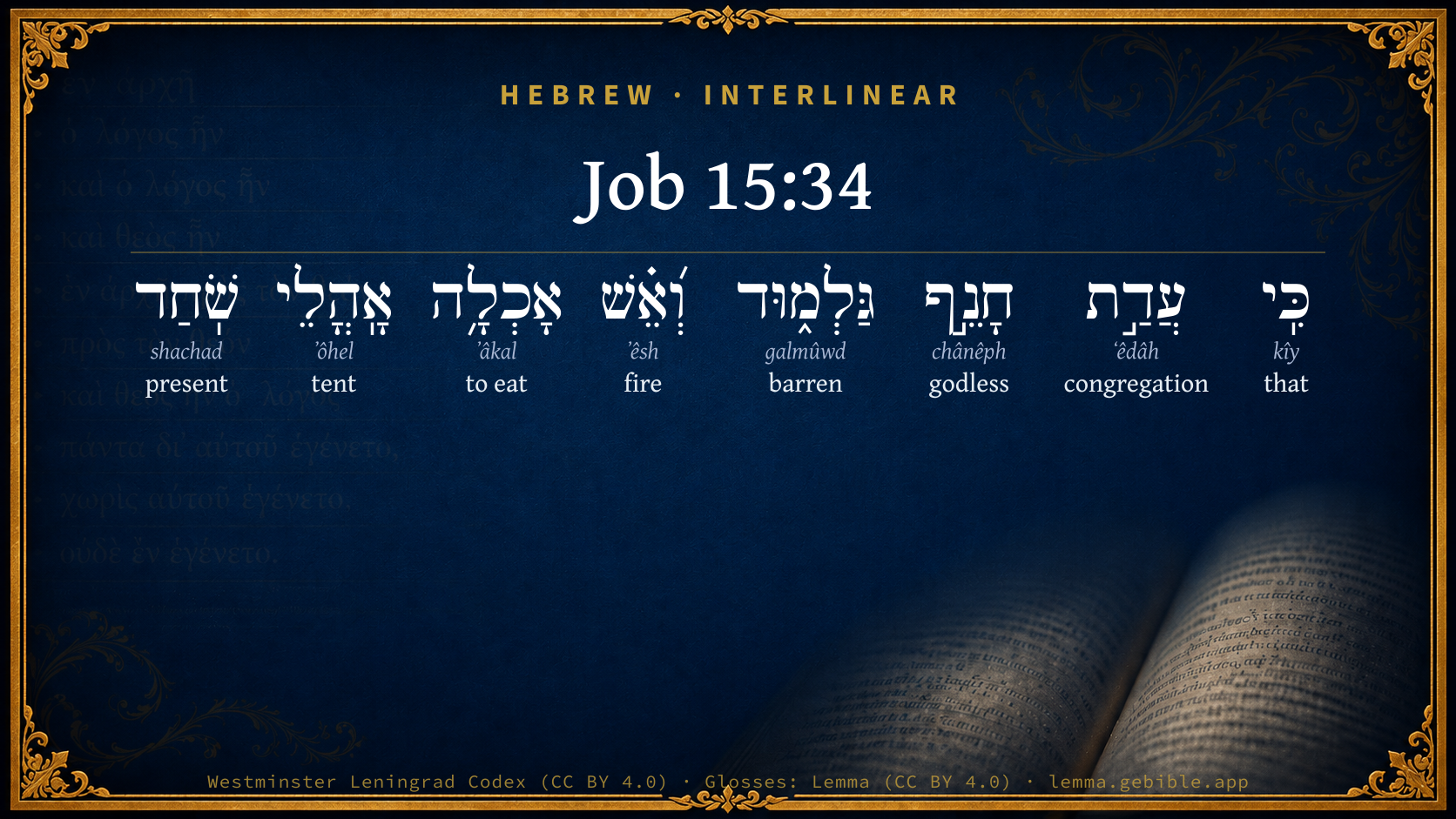
Job 15:34

Hebrew (Westminster Leningrad Codex) Job 15:34 appears in the Hebrew Old Testament. The text above is from the Westminster Leningrad Codex. Each word links to its Strong’s number, a concise gloss, and parsing drawn from the Open Scriptures Hebrew Bible morphology. Click any word for its full Brown-Driver-Briggs (BDB) entry.
Download image
Cite this verse

Job 15:34 (World English Bible). Public Domain. Lemma interlinear Bible study tool, https://lemma.gebible.app/v/job/15/34.

Show BibTeX & RIS
BibTeX
RIS
English Translation
For the company of the godless shall be barren, And fire shall consume the tents of bribery.
World English Bible · Public Domain
Download a study sheet

One document with this verse’s original text, its word-by-word gloss line, the meaning frame, cross-references with their text, attributed commentary, and full source and license credits — printable, and it pastes into notes with its structure intact.

This verse Autodidact and up

Study sheet (.html) Plain text (.txt)

A passage Seminary Student

Up to 50 verses in one chapter. A passage sheet keeps up to 6 commentary sources and 12 cross-references per verse, in the order this page ranks them, and says so on the sheet whenever that leaves anything out. Ask for a single verse and you get the Autodidact verse sheet above.

Everything on this page stays free to read, with no account — the sheet is a download of what is already on screen, not access to it.

Want to remove ads? Support Godless Engineer
Compare translations 3

The same verse in 3 English versions, stacked beneath the original-language interlinear above. Click any original word for its lexicon entry.

Each is an independent rendering of the whole verse — the interlinear is not word-aligned to these translations.

Highlighted words mark where these versions differ — a whole-verse word diff, not a word-by-word alignment.

  • World English Bible Public Domain
    For the company of the godless shall be barren, And fire shall consume the tents of bribery.
  • King James Version Public Domain
    For the congregation of hypocrites shall be desolate, and fire shall consume the tabernacles of bribery.
  • unfoldingWord Literal Text CC BY-SA 4.0
    For the company of the godless barren, and fire devours the tents of bribery.

unfoldingWord Literal Text — © unfoldingWord, licensed CC BY-SA 4.0. Word-aligned USFM3 via Door43 (git.door43.org/unfoldingWord/en_ult).

Versions to compare (up to 4)

3 of 4 selected

Show all 18 translations

Every available English version of this verse, each an independent rendering of the whole verse.

  • World English Bible Public Domain
    For the company of the godless shall be barren, And fire shall consume the tents of bribery.
  • Berean Standard Bible Public Domain
    For the company of the godless will be barren, and fire will consume the tents of bribery.
  • Majority Standard Bible Public Domain
    For the company of the godless will be barren, and fire will consume the tents of bribery.
  • King James Version Public Domain
    For the congregation of hypocrites shall be desolate, and fire shall consume the tabernacles of bribery.
  • American Standard Version (1901) Public Domain
    For the company of the godless shall be barren, And fire shall consume the tents of bribery.
  • Revised Version (1885) Public Domain
    For the company of the godless shall be barren, and fire shall consume the tents of bribery.
  • Geneva Bible (1599) Public Domain
    For the congregation of the hypocrite shalbe desolate, and fire shall deuoure the houses of bribes.
  • Douay-Rheims (1899) Public Domain
    For the congregation of the hypocrite is barren, and fire shall devour their tabernacles, who love to take bribes.
  • Young's Literal Translation Public Domain
    For the company of the profane `is' gloomy, And fire hath consumed tents of bribery.
  • Literal Standard Version CC BY-SA 4.0
    For the company of the profane [is] barren, || And fire has consumed tents of bribery.
  • Unlocked Literal Bible CC BY-SA 4.0
    For the company of godless people will be barren; fire will consume their tents of bribery.
  • unfoldingWord Literal Text CC BY-SA 4.0
    For the company of the godless barren, and fire devours the tents of bribery.
  • Darby Bible Public Domain
    For the family of the ungodly shall be barren, and fire shall consume the tents of bribery.
  • World Messianic Bible Public Domain
    For the company of the godless will be barren, and fire will consume the tents of bribery.
  • Webster's Bible Public Domain
    For the congregation of hypocrites shall be desolate, and fire shall consume the tabernacles of bribery.
  • Free Bible Version CC BY-SA 4.0
    For those who reject God are barren, and fire will burn up the homes of those who love bribes.
  • Bible in Basic English Public Domain
    For the band of the evil-doers gives no fruit, and the tents of those who give wrong decisions for reward are burned with fire.
  • JPS Tanakh (1917) Public Domain
    For the company of the godless shall be desolate, and fire shall consume the tents of bribery.

Literal Standard Version (2020), Covenant Press — licensed CC BY-SA 4.0. Text via the HelloAO Bible API (eBible.org). Unlocked Literal Bible (unfoldingWord) — licensed CC BY-SA 4.0. Text via the HelloAO Bible API (eBible.org). unfoldingWord Literal Text — © unfoldingWord, licensed CC BY-SA 4.0. Word-aligned USFM3 via Door43 (git.door43.org/unfoldingWord/en_ult). Free Bible Version, Dr. Jonathan Gallagher — licensed CC BY-SA 4.0. Text via the HelloAO Bible API (eBible.org).

Word by word

More ways to search: Search by grammar → Find every occurrence → Compare this word →

Practice this passage: Drill this verse → Learn its vocabulary →

About this verse

These counts appear in no published source. They are computed here, from the morphology-tagged text and Lemma’s own curated glosses. What Lemma adds →

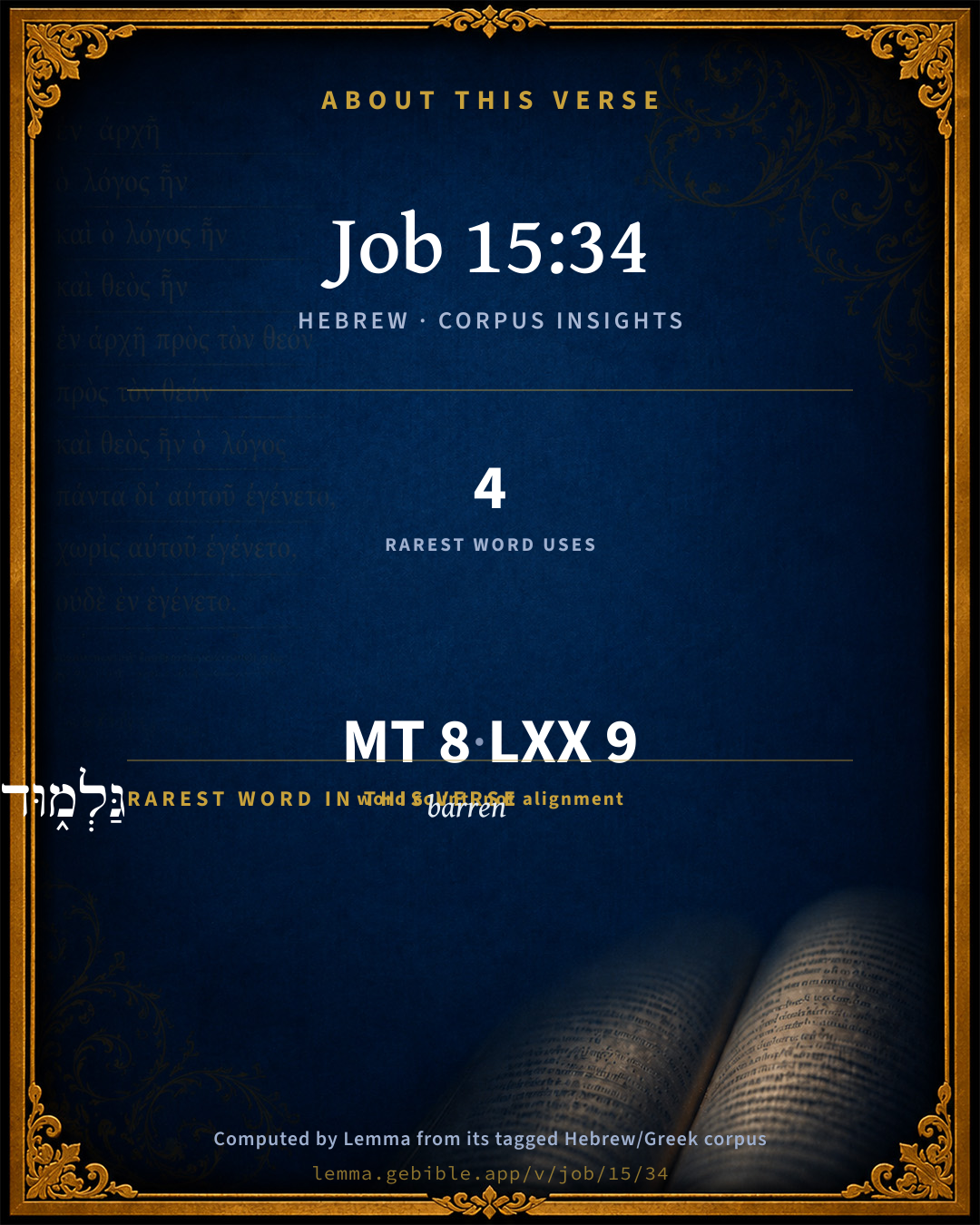
8
words
8
distinct lemmas
Wisdom
section

Notable vocabulary

The rarest word here is גַּלְמ֑וּד barren H1565 — appearing just 4 times in the whole Hebrew Bible.

Shared distinctive vocabulary

גַּלְמ֑וּד barren H1565 occurs in 4 verses of the Hebrew Bible. Also found in:

Grammatical profile

  • 1 verb
  • 4 nouns
  • 2 adjectives
  • 1 conjunction

Verb forms

  • אָכְלָ֥ה Qal · Perfect

Hebrew & Septuagint length

In English translation the verse runs 17 words from the Hebrew and 20 from the Septuagint (LXX English) — closely comparable.

A rough comparison of the two English renderings, which tokenize alike — not a word-level alignment.

Word counts can differ between the Hebrew and the Greek without any difference in meaning — e.g. the Hebrew direct-object marker אֵת has no separate Greek word, and Greek often adds the article ὁ.

In the original languages it is 8 Hebrew tokens and 9 Greek tokens — but the two are counted differently (Hebrew bundles its prefixes and suffixes into one token; the Greek is in lemma form), so that isn’t a like-for-like length.

Cross-references

15

Topical passages linked to Job 15:34 in the Treasury of Scripture Knowledge — connected by theme and wording, ordered by reader-vote popularity; previews shown in the World English Bible.

  • Job 8:13 So are the paths of all who forget God. The hope of the godless man shall perish,
  • Job 27:8 For what is the hope of the godless, when he is cut off, When God takes away his life?
  • Job 8:22 Those who hate you shall be clothed with shame. The tent of the wicked shall be no more."
  • Micah 7:2 The godly man has perished out of the earth, And there is no one upright among men. They all lie in wait for blood; Every man hunts his brother with a net.
  • 1 Samuel 8:3 His sons didn't walk in his ways, but turned aside after lucre, and took bribes, and perverted justice.
  • 1 Samuel 12:3 Here I am: witness against me before Yahweh, and before his anointed: whose ox have I taken? or whose donkey have I taken? or whom have I defrauded? whom have I oppressed? or of whose hand have I taken a ransom to blind my eyes therewith? and I will restore it you.
  • Job 11:14 If iniquity is in your hand, put it far away, Don't let unrighteousness dwell in your tents.
  • Job 12:6 The tents of robbers prosper, Those who provoke God are secure; Who carry their God in their hands.
  • Job 20:1 Then Zophar the Naamathite answered,
  • Job 22:5–9 Isn't your wickedness great? Neither is there any end to your iniquities.
  • Job 29:12–17 Because I delivered the poor who cried, And the fatherless also, who had none to help him.
  • Job 36:13 "But those who are godless in heart lay up anger. They don't cry for help when he binds them.
  • Isaiah 33:14–15 The sinners in Zion are afraid; trembling has seized the godless ones: Who among us can dwell with the devouring fire? who among us can dwell with everlasting burning?
  • Amos 5:11–12 Forasmuch therefore as you trample on the poor, And take taxes from him of wheat: You have built houses of hewn stone, But you will not dwell in them. You have planted pleasant vineyards, But you shall not drink their wine.
  • Matthew 24:51 and will cut him in pieces, and appoint his portion with the hypocrites; there is where the weeping and grinding of teeth will be.

Cross-references courtesy of OpenBible.info (CC BY 4.0).

Hebrew and Greek witnesses Masoretic Hebrew ↔ Greek Septuagint

The same verse in the two great witnesses to the Old Testament, shown verse-for-verse.

These are two independent witnesses, not word-aligned to each other, and the Septuagint is shown in lemma (dictionary) form.

Hebrew Job 15:34 Masoretic · Westminster Leningrad Codex

כִּֽי עֲדַ֣ת חָנֵ֣ף גַּלְמ֑וּד וְ֝אֵ֗שׁ אָכְלָ֥ה אָֽהֳלֵי שֹֽׁחַד

For the company of the godless shall be barren, And fire shall consume the tents of bribery.

World English Bible · Public Domain

Greek LXX Job 15:34 Septuagint · lemma form

μαρτύριον γάρ ἀσεβής θάνατος πῦρ δέ καίω οἶκος δωροδέκτης

For death is the witness of an ungodly man, and fire shall burn the houses of them that receive gifts.

LXX2012 (modern English Septuagint) · Public Domain

On this verse, Trapp's Complete Commentary discusses the Septuagint’s reading. Read the note in Commentary ↓

Hebrew: Westminster Leningrad Codex (CC BY 4.0). Greek: Septuagint (public domain); English from LXX2012 (modern English Septuagint) (Public Domain). How the Septuagint differs from the Hebrew →

Commentary

Notes on Job 15:34 from classic Christian and Jewish commentators (each source and its license shown beneath its notes). The classic Christian expositions comment on the surrounding passage and are grouped to its opening verse, so a note may address several verses; the Jewish commentaries on the Tanakh (Rashi and others) are per-verse, so they appear only where the commentator wrote on this verse.

Lemma curates 59 commentaries, every one of them public domain or Creative Commons licensed, each selected and text-cleaned for this edition rather than reprinted as found. About our sources →

Trapp's Complete Commentary

John Trapp

Job 15:34 For the congregation of hypocrites [shall be] desolate, and fire shall consume the tabernacles of bribery.

Ver. 34. For the congregation of hypocrites shall be desolate] Heb. Of the hypocrite; where he seemeth to point at Job, as by the unripe grapes, and blasted flowers of the olive, he had understood Job’s children and possessions, Job 15:33. Now the whole congregation or train and retinue of the hypocrite God will unnest and ruin, saith Eliphaz; they shall all be as one desolated, so the original hath it.

And fire shall consume the tabernacles of bribery] Heb. The tabernacles of a bribe. Under these two heads, saith one, we may reduce all sorts of sinners; sinners against God under the notion of hypocrites; and sinners against men under the notion of bribe takers; δωροδεκτον, say the Septuagint, that is, receivers of gifts; and the Hebrew word signifieth, a gift in general; it is taken also for a bribe, because very many gifts are bribes, Munera sunt honoraria vel corruptoria (Lavat. in loc.). Now houses built by bribes or very many gifts shall be consumed and come to nothing, Jer 22:13-17 Hab 2:9-12; see the note there. This Eliphaz casteth in Job’s teeth, but herein he dealt with him as injuriously as Bouner did with Philpot, the martyr, when he said to him, Also I lay to thy charge, that thou killedst thy father, and wast accursed of thy mother on her death bed (Acts & Mon. fol. 1650).

John Trapp, A Commentary or Exposition upon All the Books of the Old and New Testament (1647–1656) — public domain. Text from a community e-Sword module.

Joseph Benson's Commentary

Job 15:34-35. For the congregation of hypocrites — Their children, servants, friends, and dependants; shall be desolate — That is, utterly destroyed; and fire — Some eminent and terrible judgment of God, often expressed by fire: see Isa 9:19; Isa 26:11; shall consume the tabernacles of bribery — Which were either built or maintained by extortion and bribery, or such unrighteous practises, of which they thought Job guilty, Job 22:8. They conceive mischief — They devise and contrive pernicious enterprises against others; and bring forth vanity — They execute what they had contrived. They produce iniquity, injury, or trouble, either to others, or rather to themselves: for the mischief they designed for others falls upon their own heads, and they reap what they sowed. And their belly — That is, their inward parts, their hearts and minds; prepareth deceit — For others, whom they design to cheat; and especially for themselves, who, while they seek to deceive others, shall find that they themselves are most deceived, as being deprived of all their desires and hopes wherewith they fed themselves, and cast into all those calamities which they thought to prevent by these artifices. This whole description is evidently pointed at the situation of Job. His prosperity was become vanity; his children were all cut off before their time; his family become solitary; and his hopes, to all appearance, an illusion. All the fine prospect with which the wicked man entertained himself, and for which he endured all the anguish here described, produced only a deceit. He hath imposed on himself.

Joseph Benson's Commentary on the Old and New Testaments (1811–1818) — public domain. Text from a community e-Sword module.

Tyndale Open Study Notes

Tyndale Open Resources

15:34 The flame of judgment (15:30) will burn the unjust gain of the godless.

Tyndale Open Study Notes — © Tyndale Open Resources, licensed CC BY-SA 4.0. Text via the HelloAO Bible API.

Geneva Bible (1599)

Geneva Bible translators

Which were built or maintained by powling and bribery.

Geneva Bible (1599) marginal notes — public domain. Text via Bolls.life.

Jamieson, Fausset & Brown

Robert Jamieson, A. R. Fausset & David Brown

Rather, The binding together of the hypocrites (wicked) shall be fruitless [UMBREIT].

tabernacles of bribery--namely, dwellings of unjust judges, often reprobated in the Old Testament (Isa 1:23). The "fire of God" that consumed Job's possessions (Job 1:16) Eliphaz insinuates may have been on account of Job's bribery as an Arab sheik or emir.

Jamieson, Fausset & Brown — Commentary Critical and Explanatory on the Whole Bible (1871) — public domain (CC PDM 1.0). Text via the HelloAO Bible API.

Adam Clarke's Commentary

Verse 34. The congregation of hypocrites]

11. Job is here classed with hypocrites, or rather the impious of all kinds. The congregation, or adath, society, of such, shall be desolate, or a barren rock, גלמוד galmud. See this Arabic word explained in Clarke's note on "Job 3:7".

Fire shall consume the tabernacles of bribery.]

12. Another insinuation against Job, that he had perverted justice and judgment, and had taken bribes.

Adam Clarke's Commentary on the Bible (1810–1826) — public domain. Text from a community e-Sword/MySword module.

Ellicott's Commentary for English Readers

(34) Desolate.—This was Job’s own word (Job_3:7), and as it is an uncommon word, there may be some intentional reference to his use of it.

A Bible Commentary for English Readers, edited by Charles John Ellicott (1878–1897) — public domain. Text from a community e-Sword module.

The Cambridge Bible for Schools and Colleges

gen. ed. J. J. S. Perowne

34. The same truth as that expressed in Job_15:31-32 now taught without figure, and reduced to a general principle.

congregation of hypocrites] Or, company of the ungodly, ch. Job_8:13; Job_13:16. “Desolate” is barren (ch. Job_3:7), unfruitful. The households of the godless are unfruitful, under God’s curse they come to nought; but it is puerile to make the grapes and flowers of Job_15:33 figures for children.

tabernacles of bribery] Bribery, a common method of perverting justice in the East, is here a general name for wrong and injustice.

The Cambridge Bible for Schools and Colleges (gen. ed. J. J. S. Perowne; Cambridge University Press, 1878–1918) — public domain. Text from a community e-Sword module.

John Gill's Exposition

They conceive mischief,.... That is, such wicked persons as before described; they meditate sin in their minds, and contrive how to commit it, and form schemes within themselves to do mischief to others:

forth vanity; or sin; for lust when it is conceived bringeth forth sin, and that is vanity, an empty thing, and neither yields profit nor pleasure in the issue, but that which is useless and unserviceable, yea, harmful and ruinous; for sin, when it is finished, bringeth forth death, even death eternal, Jam 1:14;

and their belly prepareth deceit; their inward part frames and devises that which is designed to deceive others, and in the end proves deceitful to themselves: the allusion is to a pregnant woman, or rather to one who seems to be so, and whose conception proves abortive, and so deceives and disappoints herself and others; see Psa 7:14.

Next: Job Chapter 16

John Gill's Exposition of the Whole Bible (1746–1763) — public domain (CC PDM 1.0). Text via the HelloAO Bible API.

Albert Barnes' Notes on the Bible

For the congregation of hypocrites - The word rendered “congregation” here (עדה ‛êdâh) means properly an appointed meeting; a meeting convened by appointment or at stated times (from ידה yâdâh), and hence, an assembly of any kind. It is commonly applied to an assembly for public worship; but it may refer to a more private company - a family, or circle of friends, dependents, etc. It refers here, I suppose, to such a community that a man can get around him in his own dwelling - his family, servants, dependents, etc. The word rendered “hypocrites” (חנף chânêph) is in the singular number, and should be so rendered here. It does not mean that a worshipping assembly composed of hypocrites would be desolate - which may be true - but that the community which a man who is a hypocrite can gather around him shall be swept away. His children, his dependents, and his retinue of servants, shall be taken away from him, and he shall be left to solitude. Probably there was an allusion here to Job, who had been stripped in this manner; or at any rate the remark was one, if it were a quotation from the ancient sayings of the Arabians, which Job could not but regard as applied to himself.

And fire shall consume - This has all the appearance of being a proverb. The meaning is, that they who received a bribe would be certainly punished.

The tabernacles of bribery - The tents or dwellings of those who receive bribes, and who therefore are easily corrupted, and have no solid principles. There is probably an allusion here to Job; and no doubt Eliphaz meant to apply this severe remark to him. Job was a Sheik, an Emir, a head of a tribe, and, therefore, a magistrate; see Job 29:7, seq. Yet a part of his possessions and servants had been cut off by fire from heaven Job 1:16; and Eliphaz means probably to imply that it had been because he had been guilty of receiving a bribe. This ancient proverb declared that the dwellings of the man who could be bribed would be consumed by fire; and now he presumes that the fact that Job had been visited by the fire of heaven was full proof that he had been guilty in this manner. It was about on principles such as these that the reasoning of the friends of Job was conducted.

Albert Barnes' Notes on the Bible (1834–1885) — public domain. Text from a community e-Sword/MySword module.

Haydock's Catholic Bible Commentary

Congregation, or family. --- Bribes. Literally, "presents," which (Haydock) frequently were not given freely, but extorted as a real tribute. (Calmet) --- Septuagint, "for the death of the wicked is a martyrdom," or proof of his impiety. "But fire shall consume the houses of the present (or bribe) receivers."

George Leo Haydock (1774–1849), Haydock's Catholic Family Bible and Commentary, 1859 edition — public domain. Excludes Psalms (Douay-Rheims chapter numbering differs from Protestant) and Deuterocanonical books (Catholic canon only).

Matthew Poole's English Annotations

The congregation, i.e. their children, and servants, and friends, and dependents.

Desolate, i.e. utterly destroyed. Fire, i.e. some eminent and terrible judgment of God, which is oft expressed by fire; as Isa 9:19; 26:11.

The tabernacles of bribery, i.e. which were either built or maintained by extortion and bribery, and suchlike unrighteous courses, whereof they thought Job guilty, Job 22:8.

Matthew Poole's English Annotations on the Holy Bible (1683–1685) — public domain. Text from a community e-Sword/MySword module.

Whedon's Commentary on the Bible

Daniel D. Whedon

34. The congregation of hypocrites — The household of the impure.

Desolate — The figure is of a rock, hard and barren. Fire is often employed in the Bible for the wrath of God.

Daniel D. Whedon (gen. ed.), Commentary on the Old and New Testaments (1874–1909) — public domain. Text from a community e-Sword module.

The Pulpit Commentary

For the congregation of hypocrites shall be desolate; or, shall be sterile"or barren"like the vine and olive of the preceding verse. The entire company of the wicked shall suffer this punishment. And fire shall consume the tabernacles of bribery. God"s lightning shall fall from heaven, and burn up the tents (i.e. the habitations) of those who take bribes to pervert justice. It is suggested that Eliphaz intends to accuse Job of the two secret sins of hypocrisy and corruption.

The Pulpit Commentary (1880–1919), ed. H.D.M. Spence-Jones & Joseph S. Exell — public domain. Text from a community e-Sword module.

unfoldingWord translationNotes

Door43 World Missions Community

the company of godless people

"the group of godless people"

fire will consume their tents of bribery

The phrase "tents of bribery" means that the wicked people bought these tents with the money they made by bribery. AT: "the tents they bought with their bribes will be burned by fire" (See: Possession)

They conceive mischief and give birth to iniquity; their womb conceives deceit

The same thought is repeated three times to emphasize how much evil these people produce. This speaks of a person planning to do evil things and doing them as if the person were conceiving and giving birth to these things as a woman conceives and gives birth to a child. AT: "They plan to cause mischief and do evil things; they are always planning to deceive others" (See: Parallelism and Metaphor)

their womb conceives

Here the "womb" is used to refer to the person to emphasize conception, as it is in the womb that conception takes place. AT: "they conceive" (See: Synecdoche)

translationWords

godly

barren

fire

tent

bribe

conceive

iniquity

womb

deceive

unfoldingWord translationNotes — © Distant Shores Media and the Door43 World Missions Community, licensed CC BY-SA 4.0. Source: git.door43.org/Door43/en_tn.

Lesson kit

Teaching starters — assembled from the data on this page, not authored interpretation. Every prompt links to the verse data it draws on. Edit before teaching.

Job, in the Wisdom, opens this verse with 8 words (8 distinct Hebrew lemmas). Its most distinctive word is galmûwd (“barren”). A historical commentator’s framing appears above. Read the whole chapter for the surrounding context.

Discussion questions

  1. What does “barren” (galmûwd) contribute to the verse as a whole?
  2. Job 3:7 shares the word «barren» with this verse. How do the two illuminate each other?
  3. These translations render this verse differently; the difference is in the English rendering, not the original. What questions does that raise?
  4. The verb «אָכְלָ֥ה» is Qal Perfect. How does its form color the action?
  5. Reading how Trapp's Complete Commentary and Joseph Benson's Commentary read this verse, where do the two commentators agree and where do they part?

Things to notice

Reading settings

Reading text

Shown beneath each verse's original-language words.

Old Testament
Old Testament edition

Read the OT as the Masoretic Hebrew (MT) or the Greek Septuagint (LXX).

English shown for the Greek Septuagint (in the Hebrew ↔ Greek comparison).

Comparing translations? Open the Compare panel on any verse page to stack up to four side by side.