Psalms 78:21

Hebrew (Westminster Leningrad Codex) Psalms 78:21 appears in the Hebrew Old Testament. The text above is from the Westminster Leningrad Codex. Each word links to its Strong’s number, a concise gloss, and parsing drawn from the Open Scriptures Hebrew Bible morphology. Click any word for its full Brown-Driver-Briggs (BDB) entry.
Download image
Cite this verse

Psalms 78:21 (World English Bible). Public Domain. Lemma interlinear Bible study tool, https://lemma.gebible.app/v/psalms/78/21.

Show BibTeX & RIS
BibTeX
RIS
English Translation
Therefore Yahweh heard, and was angry. A fire was kindled against Jacob, Anger also went up against Israel,
World English Bible · Public Domain
Highlights
  • 1 first appearance in the Hebrew Bible
Full analysis ↓
Download a study sheet

One document with this verse’s original text, its word-by-word gloss line, the meaning frame, cross-references with their text, attributed commentary, and full source and license credits — printable, and it pastes into notes with its structure intact.

This verse Autodidact and up

Study sheet (.html) Plain text (.txt)

A passage Seminary Student

Up to 50 verses in one chapter. A passage sheet keeps up to 6 commentary sources and 12 cross-references per verse, in the order this page ranks them, and says so on the sheet whenever that leaves anything out. Ask for a single verse and you get the Autodidact verse sheet above.

Everything on this page stays free to read, with no account — the sheet is a download of what is already on screen, not access to it.

Want to remove ads? Support Godless Engineer
Compare translations 3

The same verse in 3 English versions, stacked beneath the original-language interlinear above. Click any original word for its lexicon entry.

Each is an independent rendering of the whole verse — the interlinear is not word-aligned to these translations.

Highlighted words mark where these versions differ — a whole-verse word diff, not a word-by-word alignment.

  • World English Bible Public Domain
    Therefore Yahweh heard, and was angry. A fire was kindled against Jacob, Anger also went up against Israel,
  • King James Version Public Domain
    Therefore the LORD heard this, and was wroth: so a fire was kindled against Jacob, and anger also came up against Israel;
  • unfoldingWord Literal Text CC BY-SA 4.0
    Therefore, Yahweh heard and was furious, and a fire was kindled against Jacob, and also nose went up against Israel,

unfoldingWord Literal Text — © unfoldingWord, licensed CC BY-SA 4.0. Word-aligned USFM3 via Door43 (git.door43.org/unfoldingWord/en_ult).

Versions to compare (up to 4)

3 of 4 selected

Show all 18 translations

Every available English version of this verse, each an independent rendering of the whole verse.

  • World English Bible Public Domain
    Therefore Yahweh heard, and was angry. A fire was kindled against Jacob, Anger also went up against Israel,
  • Berean Standard Bible Public Domain
    Therefore the LORD heard and was filled with wrath; so a fire was kindled against Jacob, and His anger flared against Israel,
  • Majority Standard Bible Public Domain
    Therefore the LORD heard and was filled with wrath; so a fire was kindled against Jacob, and His anger flared against Israel,
  • King James Version Public Domain
    Therefore the LORD heard this, and was wroth: so a fire was kindled against Jacob, and anger also came up against Israel;
  • American Standard Version (1901) Public Domain
    Therefore Jehovah heard, and was wroth; And a fire was kindled against Jacob, And anger also went up against Israel;
  • Revised Version (1885) Public Domain
    Therefore the LORD heard, and was wroth: and a fire was kindled against Jacob, and anger also went up against Israel;
  • Geneva Bible (1599) Public Domain
    Therefore the Lord heard and was angrie, and the fire was kindled in Iaakob, and also wrath came vpon Israel,
  • Douay-Rheims (1899) Public Domain
    Therefore the Lord heard, and was angry: and a fire was kindled against Jacob, and wrath came up against Israel.
  • Young's Literal Translation Public Domain
    Therefore hath Jehovah heard, And He sheweth Himself wroth, And fire hath been kindled against Jacob, And anger also hath gone up against Israel,
  • Literal Standard Version CC BY-SA 4.0
    Therefore YHWH has heard, || And He shows Himself angry, || And fire has been kindled against Jacob, || And anger has also gone up against Israel,
  • Unlocked Literal Bible CC BY-SA 4.0
    When Yahweh heard this, he was angry; so his fire burned against Jacob, and his anger attacked Israel,
  • unfoldingWord Literal Text CC BY-SA 4.0
    Therefore, Yahweh heard and was furious, and a fire was kindled against Jacob, and also nose went up against Israel,
  • Darby Bible Public Domain
    Therefore Jehovah heard, and was wroth; and fire was kindled against Jacob, and anger also went up against Israel:
  • World Messianic Bible Public Domain
    Therefore the LORD heard, and was angry. A fire was kindled against Jacob, anger also went up against Israel,
  • Webster's Bible Public Domain
    Therefore the LORD heard this, and was wroth: so a fire was kindled against Jacob, and anger also came up against Israel;
  • Free Bible Version CC BY-SA 4.0
    When he heard this, the Lord became very angry, burning like fire against the descendants of Jacob, furious with the people of Israel,
  • Bible in Basic English Public Domain
    So these things came to the Lord's ears, and he was angry; and a fire was lighted against Jacob, and wrath came up against Israel;
  • JPS Tanakh (1917) Public Domain
    Therefore the LORD heard, and was wroth; and a fire was kindled against Jacob, and anger also went up against Israel;

Literal Standard Version (2020), Covenant Press — licensed CC BY-SA 4.0. Text via the HelloAO Bible API (eBible.org). Unlocked Literal Bible (unfoldingWord) — licensed CC BY-SA 4.0. Text via the HelloAO Bible API (eBible.org). unfoldingWord Literal Text — © unfoldingWord, licensed CC BY-SA 4.0. Word-aligned USFM3 via Door43 (git.door43.org/unfoldingWord/en_ult). Free Bible Version, Dr. Jonathan Gallagher — licensed CC BY-SA 4.0. Text via the HelloAO Bible API (eBible.org).

Word by word

More ways to search: Search by grammar → Find every occurrence → Compare this word →

Practice this passage: Drill this verse → Learn its vocabulary →

נִשְּׂקָ֣ה
nâsaq
H5400
“to kindle”
Verb, Niphal, Perfect, 3rd Person, Feminine, Singular
Part of Speech
Verb
Stem
Niphal
Form
Perfect
Person
3rd Person
Gender
Feminine
Number
Singular
Full BDB Definition

Origin: a primitive root

TWOT: 2266

to kindle, burn - (Niphal) to be kindled - (Hiphil) to make a fire, burn
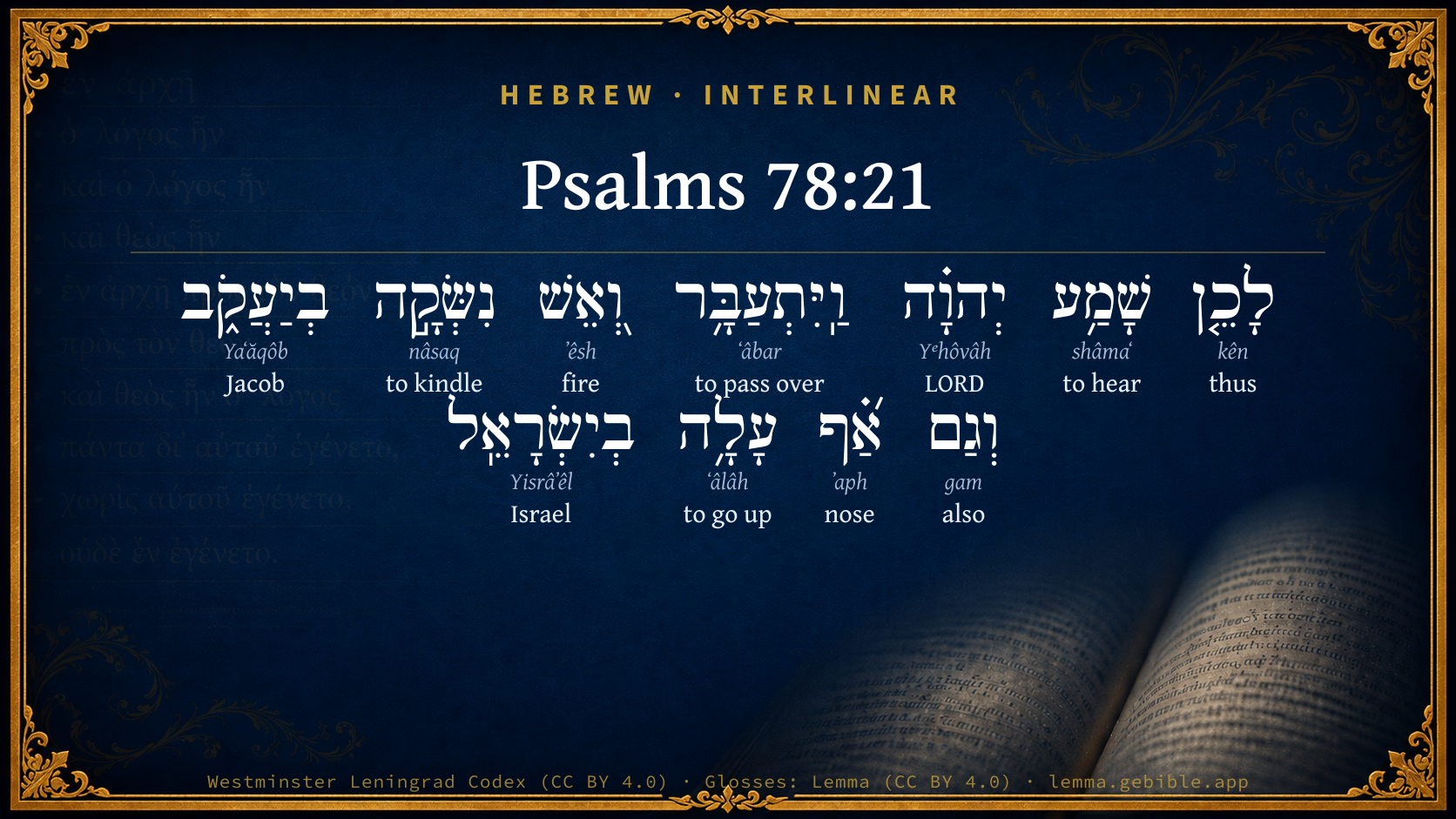
  1. לָכֵ֤ן kên H3651 “to/for · thus” Preposition + Adverb
  2. שָׁמַ֥ע shâmaʻ H8085 “to hear” Verb, Qal, Perfect, 3rd Person, Masculine, Singular
  3. יְהוָ֗ה Yᵉhôvâh H3068 “LORD” Noun, Proper
  4. וַֽיִּתְעַבָּ֥ר ʻâbar H5674 “and · to pass over” Conjunction + Verb, Hithpael, Sequential Imperfect, 3rd Person, Masculine, Singular
  5. וְ֭אֵשׁ ʼêsh H784 “and · fire” Conjunction + Noun, Common, Both, Singular, Absolute
  6. בְיַעֲקֹ֑ב Yaʻăqôb H3290 “in/at · Jacob” Preposition + Noun, Proper
  7. וְגַם gam H1571 “and · also” Conjunction + Particle, Accusative
  8. אַ֝֗ף ʼaph H639 “nose” Particle, Accusative
  9. עָלָ֥ה ʻâlâh H5927 “to go up” Verb, Qal, Perfect, 3rd Person, Masculine, Singular
  10. בְיִשְׂרָאֵֽל Yisrâʼêl H3478 “in/at · Israel” Preposition + Noun, Proper

About this verse

These counts appear in no published source. They are computed here, from the morphology-tagged text and Lemma’s own curated glosses. What Lemma adds →

11
words
11
distinct lemmas
Wisdom
section

Notable vocabulary

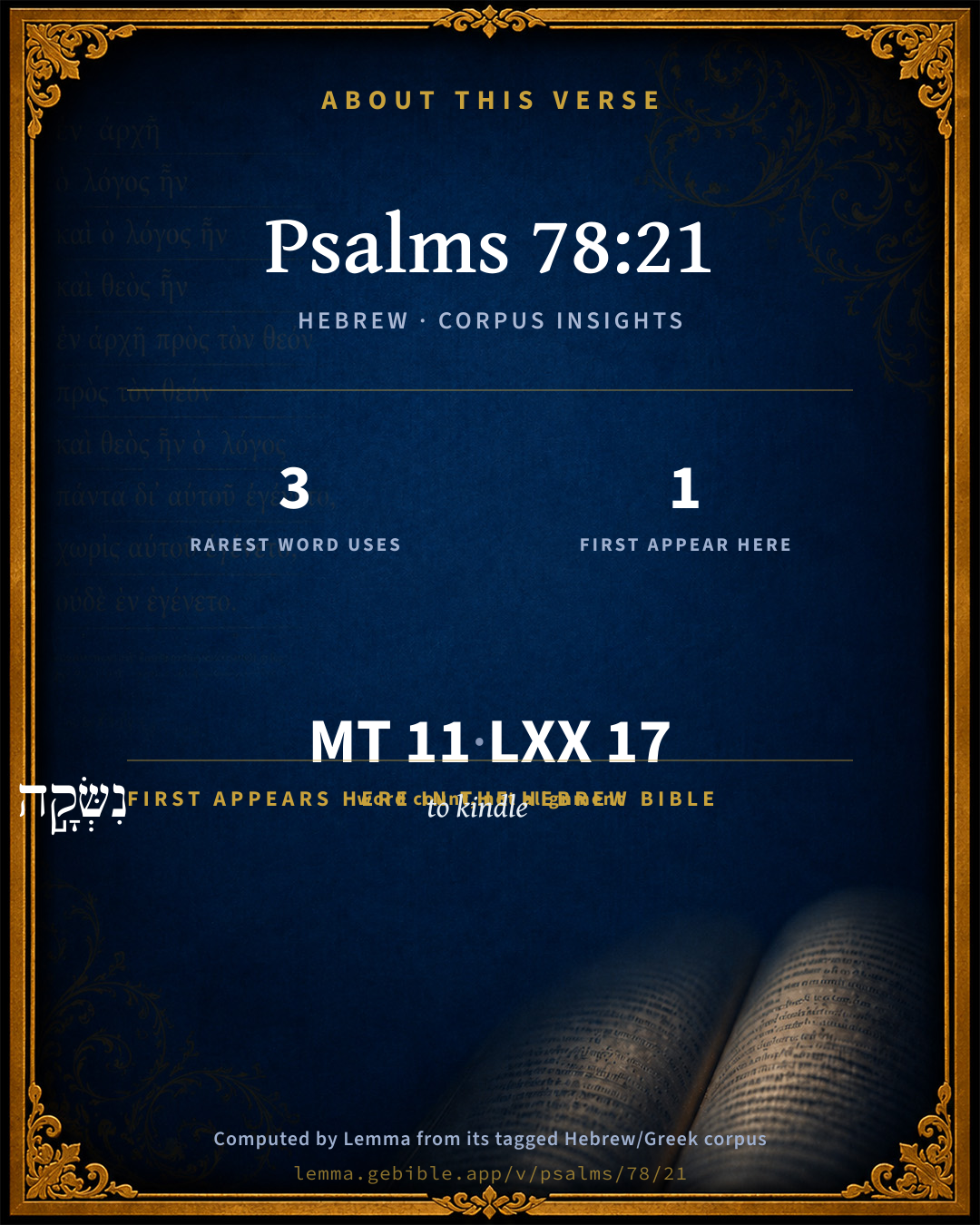
The rarest word here is נִשְּׂקָ֣ה to kindle H5400 — appearing just 3 times in the whole Hebrew Bible.

First appearance in Scripture

This word makes its first canonical appearance in the Hebrew Bible here:

  • נִשְּׂקָ֣ה to kindle H5400

Shared distinctive vocabulary

נִשְּׂקָ֣ה to kindle H5400 occurs in 3 verses of the Hebrew Bible. Also found in:

Grammatical profile

  • 4 verbs
  • 4 nouns
  • 1 adverb
  • 2 particles

Verb forms

  • שָׁמַ֥ע Qal · Perfect
  • וַֽיִּתְעַבָּ֥ר Hithpael · Sequential Imperfect
  • נִשְּׂקָ֣ה Niphal · Perfect
  • עָלָ֥ה Qal · Perfect

Hebrew & Septuagint length

In English translation the verse runs 18 words from the Hebrew and 19 from the Septuagint (LXX English) — closely comparable.

A rough comparison of the two English renderings, which tokenize alike — not a word-level alignment.

Word counts can differ between the Hebrew and the Greek without any difference in meaning — e.g. the Hebrew direct-object marker אֵת has no separate Greek word, and Greek often adds the article ὁ.

In the original languages it is 11 Hebrew tokens and 17 Greek tokens — but the two are counted differently (Hebrew bundles its prefixes and suffixes into one token; the Greek is in lemma form), so that isn’t a like-for-like length.

Cross-references

8

Topical passages linked to Psalms 78:21 in the Treasury of Scripture Knowledge — connected by theme and wording, ordered by reader-vote popularity; previews shown in the World English Bible.

  • Numbers 11:1–3 The people were as murmurers, [speaking] evil in the ears of Yahweh: and when Yahweh heard it, his anger was kindled; and the fire of Yahweh burnt among them, and devoured in the uttermost part of the camp.
  • 1 Corinthians 10:11 Now all these things happened to them by way of example, and they were written for our admonition, on whom the ends of the ages have come.
  • Jude 1:5 Now I desire to remind you, though you already know this, that the Lord, having saved a people out of the land of Egypt, afterward destroyed those who didn't believe.
  • Hebrews 12:29 for our God is a consuming fire.
  • Numbers 11:10 Moses heard the people weeping throughout their families, every man at the door of his tent: and the anger of Yahweh was kindled greatly; and Moses was displeased.
  • Deuteronomy 32:22 For a fire is kindled in my anger, Burns to the lowest Sheol, Devours the earth with its increase, Sets on fire the foundations of the mountains.
  • Psalms 78:31 When the anger of God went up against them, Killed some of the fattest of them, And struck down the young men of Israel.
  • 1 Corinthians 10:5 However with most of them, God was not well pleased, for they were overthrown in the wilderness.

Cross-references courtesy of OpenBible.info (CC BY 4.0).

Hebrew and Greek witnesses Masoretic Hebrew ↔ Greek Septuagint

The same verse in the two great witnesses to the Old Testament, shown verse-for-verse.

You’re reading Greek Psalm 77 (Hebrew Psalm 78). The Septuagint counts the superscription, so verse numbers can differ from the Hebrew — chapter-level alignment, not verse-by-verse. Numbering follows Rahlfs.

These are two independent witnesses, not word-aligned to each other, and the Septuagint is shown in lemma (dictionary) form.

Hebrew Psalms 78:21 Masoretic · Westminster Leningrad Codex

לָכֵ֤ן שָׁמַ֥ע יְהוָ֗ה וַֽיִּתְעַבָּ֥ר וְ֭אֵשׁ נִשְּׂקָ֣ה בְיַעֲקֹ֑ב וְגַם אַ֝֗ף עָלָ֥ה בְיִשְׂרָאֵֽל

Therefore Yahweh heard, and was angry. A fire was kindled against Jacob, Anger also went up against Israel,

World English Bible · Public Domain

Greek LXX Greek Psalm 77:21 Septuagint · lemma form

διά οὗτος ἀκούω κύριος καί ἀναβάλλω καί πῦρ ἀναἅπτω ἐν ἰακώβ καί ὀργή ἀναβαίνω ἐπί ὁ ἰσραήλ

Therefore the Lord heard, and was provoked: and fire was kindled in Jacob, and wrath went up against Israel.

LXX2012 (modern English Septuagint) · Public Domain

Hebrew: Westminster Leningrad Codex (CC BY 4.0). Greek: Septuagint (public domain); English from LXX2012 (modern English Septuagint) (Public Domain). How the Septuagint differs from the Hebrew →

Commentary

Notes on Psalms 78:21 from classic Christian and Jewish commentators (each source and its license shown beneath its notes). The classic Christian expositions comment on the surrounding passage and are grouped to its opening verse, so a note may address several verses; the Jewish commentaries on the Tanakh (Rashi and others) are per-verse, so they appear only where the commentator wrote on this verse.

Lemma curates 59 commentaries, every one of them public domain or Creative Commons licensed, each selected and text-cleaned for this edition rather than reprinted as found. About our sources →

Trapp's Complete Commentary

John Trapp

Psa 78:21 Therefore the LORD heard [this], and was wroth: so a fire was kindled against Jacob, and anger also came up against Israel;

Ver. 21. Therefore the Lord heard this, and was wroth] Efferbuit, excanduit. Anger is a kind of fire, a boiling of the blood about the heart, through desire of revenge. "But fury is not in me," saith God, Isa 27:4. If anger be ascribed unto him, as here, it is an expression fitted to our apprehension, because he doeth that which angry men use to do, viz. chide and smite for sin; but all in a way of justice, and without the least perturbation.

So a fire was kindled] It began to smoke and burn.

And anger also came up] Ascended, i.e. Flamed, for anger beginneth at the heart, and then cometh up into the brain, face, nostrils.

John Trapp, A Commentary or Exposition upon All the Books of the Old and New Testament (1647–1656) — public domain. Text from a community e-Sword module.

The Biblical Illustrator

Joseph S. Exell

Psa_78:21-22

Therefore the Lord heard this, and was wroth . . . Because they believed not in God, and trusted not in His salvation.

Mistrust that destroys

There are morbid growths in the human frame which our doctors divide into two groups--benign and malignant; and the distinction often comes to mean the distinction between life and death. In dealing with the unbelief which crosses our pathway and even creeps into our homes, it is most important that we should observe the same principle of minute and discriminating classification, and beware of confusing things that entirely differ. Some phases of scepticism are chiefly intellectual; morbid, weakening, and hurtful all the same: phases which begin to assume a moral complexion when a man parades them as a beggar parades his sores, and it may be frets and keeps them open when they tend to heal. And on the other hand there are scepticisms which are moral in their beginnings and which tend to destroy the most vital fibres of conscience and character.

1. Unbelief is malignant when it is a product of the flesh and its tyrannous appetites. Of that we have an instructive example in the text. Our fleshly passions always tend to make us distrustful of the spiritual and the unseen, and this drift in the passions sometimes warps the reason and deflects the moral sense, and has done so for generations, so that we inherit a maimed aptitude for faith. It is only by the subjugation of the flesh that we become susceptible of the faith that God seeks from us. Men may be mistrustful malcontents because they do not find themselves in the kind of world upon which they have set their foolish desire. The atheist is occasionally a person who cannot get all the beer he wants. Now and again men gnash their teeth upon religious belief because Divine law puts restraint upon their lusts and upholds the strict sanctities of marriage and the home. The ideal world that would convince them of the Makers benevolence would be a world fluttering with hosts of unclaimed hours.

2. Another sign of malignant unbelief is that it thwarts men in working out the appointed problems of life and salvation. We find the scientific mind smouldering with resentment because unscientific definitions of the supernatural have been current in religious circles, just as if such accidents were of the essence of faith. The mind trained to methods of historical research is exasperated to contempt by the uncritical methods of pietists who do not grasp the human part in revelation, and the Bible is despised because of the narrowness and illiteracy of some good Christians who honour it. The man needs our richest pity over whom, for any of these reasons, the Bible has lost its authority. But the obligations of faith are first of all those which present themselves in the pathway of our common duty, and when those obligations are met, we shall probably find the further claim the Bible makes upon our faith easier of fulfilment

3. That unbelief is malignant which impeaches a God who is in the very act of proving His covenant and friendship with us and leading us forth into freedom, privilege, blessedness. Our vaunted doubt is an affront to a living Benefactor, a stab at the warm love that is ever brooding over us, a gross filial impiety; for the signs that our lives are under covenant guidance are as indisputable as those vouchsafed to Israel of old, however much they may differ in form. If you flatter yourself that it is only the God of an empty tradition you disparage in your modes of unbelief, you eliminate the most noteworthy facts from your experience of life, and judge with disastrous prejudice. God is nearer to us than all others, directing our steps to right ends, moulding our characters by wise chastisement, and clinging tenaciously to the faint promise of better things that may yet be in us; and it is all this which puts the culminating blackness upon our unbelief.

4. Unbelief is malignant when the most memorable experiences of our history furnish sufficient warrant for the faith we are required to exercise. Such was the case with Israel in the wilderness. Such unbelief as they avowed might have been less unseemly before the first plague alighted upon Egypt, and the first wonder had been wrought for their salvation. God never asks from men an arbitrary and impossible faith, and it will always be found that He has prepared us by the lessons of our previous history for the next heroic act of trust that is required. In Gods order for our education in this cardinal virtue, the intricate, the complex, the formidable do not come first, although misguided men do not always respect Gods order. The duties of faith are graded just as carefully as a childs scales in music or his first exercises in reading. The infant who can scarcely climb up-stairs is not set to scale Mount Ararat. Gods providence puts the demands of faith in a rational series, and we must rise in harmony with our personal experience of His grace and power. High destinies are in store for you, and you must needs believe in Gods continuous salvation through every step of your pilgrimage, and let Him shape the plan of it in His own way. Why should your whims and weaknesses and insistences forsooth be sacred in His sight? Be content to have them set aside. When you believe in Gods salvation as it persists through your life and breaks out into floods of ever-growing illumination, you will find it easier to believe in the history of salvation preserved for us in the sacred book; and mounting those ascents of faith, made ready for your steps, you shall find that nothing is impossible to him that believeth. (T. G. Selby.)

Israels sin and danger

I. The sin charged.

1. They believed not in Jehovah as contrasted with idol gods, or as the only living and true God.

2. They believed not in His great salvation to be achieved by the promised seed.

II. The consequences.

1. Because men believe not in God, they are left to become the dupes of delusion and error.

2. Because they trust not God, they remain slaves of sin.

3. Because they believe not in God, they taste not joy, peace, and true felicity.

4. Because they believe not in God, they are subject to fear of death, and despair of eternal happiness.

5. They wilt be subject to the wrath of God, and will be outcasts from Him for ever.

III. The reasons which should induce us to believe in God.

1. The essential immutability of His nature.

2. The infallible certainty of His Word, and the preparation He has made for our salvation.

3. The impossibility of finding salvation in any other way.

IV. The means to be employed.

1. Contemplation of our own weakness and inefficiency.

2. Study of His character and faithfulness, His Word and grace, His gospel, etc.

3. Diligent attendance upon hearing, for faith cometh by hearing.

4. Fervent prayer for His Divine assistance. (The Evangslist.)

The Biblical Illustrator, edited by Joseph S. Exell (c. 1880s–1900s) — public domain. Text from a community e-Sword module.

The Treasury of David

Charles H. Spurgeon

Ver. 21. Therefore the Lord heard this, and was wroth. He was not indifferent to what they said. He dwelt among them in the holy place, and, therefore, they insulted him to his face. He did not hear a report of it, but the language itself came into his ears.

So a fire was kindled against Jacob. The fire of his anger which was also attended with literal burnings.

And anger also came up against Israel. Whether he viewed them in the lower or higher light, as Jacob or as Israel, he was angry with them: even as mere men they ought to have believed him; and as chosen tribes, their wicked unbelief was without excuse. The Lord doeth well to be angry at so ungrateful, gratuitous and dastardly an insult as the questioning of his power.

None.

Ver. 21-22. Evil consequences of unbelief.

I. The sin itself: they doubted the ultimate certainty,

completeness, and reality of God's salvation from

Egypt.

II. The aggravation of it: the object of it was God; they

who entertained it were God's people: The aids to

faith were overlooked: "though."

III. What it led them to; inward sin--Ps 78:18; outward

sin--Ps 78:19, etc.

IV. What it brought upon them; Ps 78:21. Fiery

serpents, etc. C. D.

Psalms 78:22*

Ver. 21-22. Evil consequences of unbelief.

I. The sin itself: they doubted the ultimate certainty,

completeness, and reality of God's salvation from

Egypt.

II. The aggravation of it: the object of it was God; they

who entertained it were God's people: The aids to

faith were overlooked: "though."

III. What it led them to; inward sin--Ps 78:18;

outward sin--Ps 78:19, etc.

IV. What it brought upon them; Ps 78:21. Fiery

serpents, etc. C. D.

Psalms 78:23*

Charles H. Spurgeon's The Treasury of David (1869–1885) — public domain. Psalms only. Text from a community e-Sword/MySword module.

Joseph Benson's Commentary

Psa 78:21-22. The Lord heard, and was wroth — Such rude and insolent language highly incensed the Divine Majesty. So a fire was kindled against Jacob — He sent lightning from heaven to consume those whom he had before cherished, Num 11:1. Or, the expression may be taken figuratively for the fire of God’s anger, as it follows. Observe, reader, God is a witness to all our murmurings and distrusts: he hears them, and is much displeased with them. To unbelievers our God is himself a consuming fire, and those that will not confide in the power of his mercy shall feel the power of his indignation, and be made to confess that it is a fearful thing to fall into his hands. Because they believed not in God — Because, by this their distrust and murmuring, it appeared that they did not give credit to the revelation God had made of himself to them: for they durst not commit themselves to his care, nor venture themselves in his hands; and trusted not in his salvation — That he could and would save them from the famine and destruction which they feared; they trusted not in the salvation he had begun to work for them; for, if they had, they would not thus have questioned its progress. Mark well, reader, those cannot be said to trust in God’s salvation as their felicity at last, who cannot find in their hearts to trust in his providence for food convenient in the way to it.

Joseph Benson's Commentary on the Old and New Testaments (1811–1818) — public domain. Text from a community e-Sword module.

J. A. Alexander on Psalms

Joseph Addison Alexander

21. (Psa 78:21) Therefore Jehovah heard and was wroth, and fire was kindled in Jacob, and also anger came up in (or against) Israel. The first clause exemplifies a common Hebrew idiom, equivalent to saying, therefore when he heard he was angry. Heard, not the rumour or report of their offence, but the offence itself, which consisted externally in speaking against God. The second verb is a reflexive form of one that means to pass out or over, and properly denotes the act of letting one's self out or giving vent to the emotions. Fire seems to be a figure for this same wrath, with or without allusion to material fire as a destroying agent. Compare Num 11:1. Came up, in the mind. See 2Sa 11:20. Or there may be an allusion to the visible ascent of smoke and flame, as in Psa 18:8.

Joseph Addison Alexander, The Psalms Translated and Explained (1850) — public domain. Text from a community e-Sword module.

John Calvin's Commentaries

21. Therefore Jehovah heard, and was wroth. This hearing of God implies full and perfect knowledge; and it is a figure taken from earthly judges, who cannot punish criminals until they have become thoroughly acquainted with the cause. He is said to hear his own people, when he shows his favor and mercy towards them by granting their requests; and, on the other hand, he is said to hear those blasphemies which he does not allow to pass unpunished. To remove all ground for thinking that the divine wrath was unduly severe, the enormity of the guilt of the Israelites is again described as manifested in this, that they believed not God, nor trusted in his salvation. It is here taken as an indisputable point, that promises were made to them to which they ought to have yielded an assent, which, however, they were prevented from yielding by the extreme infatuation with which they were carried away. To trust in the salvation of God, is to lean upon his fatherly providence, and to regard him as sufficient for the supply of all our wants. From this we learn not only how hateful unbelief is in the sight of God, but also, what is the true nature of faith, and what are the fruits which it produces. Whence is it that men quietly submit themselves to Him, but because they are persuaded that their salvation is singularly precious in his sight, and are fully assured that he will give them whatever is needful for them? It is thus that they are led to surrender themselves to him, to be governed according to his good pleasure. Faith, then, is the root of true piety. It teaches us to hope for, and to desire every blessing from God, and it frames us to yield obedience to him; while those who distrust him must necessarily be always murmuring and rebelling against him. The scope of the prophet is this, that the pretences to faith which are made by those who do not hope for salvation from God, rest upon false grounds; for when God is believed in, the hope of salvation is speedily produced in the mind, and this hope renders to him the praise of every blessing.

John Calvin's Commentaries (1540-1563) — public domain. Text from the Calvin Translation Society English edition (1840s-50s) via the Christian Classics Ethereal Library (ccel.org). Calvin's coverage is partial (roughly two-thirds of the Bible); uncommented books and verses are honest gaps, never fabricated. The 19th-century editor's footnotes and remarks are omitted so the notes are faithfully Calvin's own voice.

Ellicott's Commentary for English Readers

(21) See references in margin.

A Bible Commentary for English Readers, edited by Charles John Ellicott (1878–1897) — public domain. Text from a community e-Sword module.

The Cambridge Bible for Schools and Colleges

gen. ed. J. J. S. Perowne

21. Therefore when Jehovah heard, he was wroth:

And a fire was kindled against Jacob,

And anger also went up against Israel.

Cp. Psa_78:59; Psa_78:62. A fire alludes to the punishment of the murmuring Israelites by the burning at Taberah (Num_11:1 ff.), before the second giving of quails.

Went up is a metaphor from smoke. Cp. Psa_18:8; Psa_74:1.

The Cambridge Bible for Schools and Colleges (gen. ed. J. J. S. Perowne; Cambridge University Press, 1878–1918) — public domain. Text from a community e-Sword module.

John Gill's Exposition

Because they believed not in God,.... That he was able to give them bread, and provide flesh for them, or bring them through the wilderness to Canaan's land, as he had promised. God, and he only, is the object of faith, and he is to be believed in at all times, and for all things temporal and spiritual; and nothing is more displeasing to him than unbelief; for as faith gives glory to him, unbelief reflects dishonour upon him; faith sets its seal to him as true, but unbelief makes him a liar; and what is more provoking to man than to have his veracity called in question, and to be counted a liar? in short, as faith has salvation annexed to it, unbelief has damnation, and to whom did the Lord swear that they should not enter into his rest but to them that believed not? so great an evil is unbelief, and is the sin which "easily beset" (c) the Israelites, as appears from the context; see Heb 3:12.

and trusted not in his salvation; which he promised them, and bid them stand still and see, Exo 14:13, and of which they had had some proofs and instances in leading them through the Red sea, and thus far guiding them through the wilderness, and providing for them; and therefore had reason and encouragement to trust in the Lord, that he would yet be with them, and save them, and complete the mercy promised unto them.

(c) which Suidas, in voce interprets a foolish thing; and it is thought by his learned editor Kusterus, in ibid. to allude to foolish persons, who stand round about a mountebank or juggler, gazing at his tricks with pleasure and admiration, being insnared by them.

John Gill's Exposition of the Whole Bible (1746–1763) — public domain (CC PDM 1.0). Text via the HelloAO Bible API.

Albert Barnes' Notes on the Bible

Therefore the Lord heard this, and was wroth - See Num 11:1, Num 11:10.

So a fire was kindled against Jacob ... - Fire may be used here, as in Num 11:1, as an emblem of wrath; a fire may have been literally sent down to consume them.

Albert Barnes' Notes on the Bible (1834–1885) — public domain. Text from a community e-Sword/MySword module.

Matthew Poole's English Annotations

A fire was kindled; either properly, as it was Num 11:1; or figuratively, the fire of God’s anger, as it follows.

Matthew Poole's English Annotations on the Holy Bible (1683–1685) — public domain. Text from a community e-Sword/MySword module.

The Pulpit Commentary

Therefore the Lord heard this. Though these might be unspoken thoughts, yet God would "hear" them, i.e. be aware of them; for "he knoweth the very secrets of the heart." And was wroth. (comp. vers. 59, 62 Deu_3:26) So a fire was kindled against Jacob. Not a material fire, as in Lev_10:2 Num_11:1-3; and Num_16:35; but the fire of God"s displeasure. And anger also came up against Israel. (comp. vers. 30, 31 Num_11:33)

National judgments.

This psalm is emphatically a judgment psalm. It teaches that

I NATIONS ARE JUDGED AS WELL AS INDIVIDUALS. History is almost entirely occupied with the judgments of God upon nations. Hence it is that we say, "Happy is that nation which has no history!" for if it has, we know the nature of the record for the most part.

II THEIR JUDGMENT IS JUST. Study the causes of the decline of empires, nations, and peoples, and it will generally be found that, as with the Canaanitish nations, their vice and wickedness had become so rampant and foul that, for the sake of humanity at large, it was necessary that the besom of God"s destruction should sweep them away. Gibbon"s great work on the "Decline and Fall of the Empire of Rome" is really though Gibbon was far enough from intending it to be so a theodice, a vindication of God and of his righteousness.

III BUT SUCH JUDGMENTS DO NOT COME UNTIL ALL OTHER MEANS HAVE BEEN FIRST TRIED. It was so with Israel. They had witnessed the plagues upon Egypt. They had experienced the unstinted mercy and long suffering of God. They had seen the glorious miracles which God wrought on their behalf. They had been taught his holy Law. So that the question of Isa_5:4 was altogether just. And so in the history of all nations. If God"s vengeance cometh surely, it cometh very slowly; so that, perchance, it may not need to come at all.

IV THEY ARE EXECUTED IN THE PRESENT LIFE. There is no future judgment for nations. When Christ came, as he did at the destruction of Jerusalem in A.D. 70, the judgment he predicted should then take place was fulfilled.

V IN THEM THE INNOCENT SUFFER WITH THE GUILTY. This is inevitable. The sins of the fathers are visited upon the children. Hence

VI THEY PREDICT THE FUTURE FINAL JUDGMENT. God shall then judge every man according to his works, as is not possible in the judgments of the nations now.

VII ARE EFFECTUAL BUT FOR A TIME. They do not put an end to sin, but only stay it for a season (ver. 34).

VIII ARE ACCORDING TO RIGHTEOUSNESS. The leaders in sin shall suffer deepest condemnation. See the doom of Ephraim, Israel"s ringleader in iniquity (vers. 9, 57, 67).

IX THE SINS WHICH PROVOKE THEM DO NOT HINDER THE PURPOSES OF GOD. (Ver. 70.) David was raised up to carry on what should have been Ephraim"s work.

X TRUE PATRIOTISM IS TO HELP FORWARD, BY ALL MEANS IN OUR POWER, THAT RIGHTEOUSNESS WHICH ALONE EXALTETH A NATION. S.C.

God"s call to trustfully.

God is represented as being "grieved" because his people failed to trust him, and depend upon his help. The good man is troubled when those whom he loves fail to trust him. We love to be relied on. We do our noblest and our best for those who will confide in us. And from ourselves we may learn to think of God aright. The best in man is the suggestion of the truest thoughts we can have of God. Our Lord represented the attitude of God towards us when he said to the ruler, "Only believe trust; all things are possible to him that believeth." If God calls us to trust him fully, and is grieved with us when we fail to trust him fully, the question arises, "Has he made such trust possible and reasonable?" We may confidently say he has, in view of what we know he is; what relations he bears to his people; and what things he has been doing in all ages for his people.

I IN VIEW OF WHAT WE KNOW HE IS. Whatever side of his revelation of himself to us we may study, the impression left on us is that he is infinitely trustworthy. Take his Creatorship, involving the reliance of all existence on his upholding. Take his independence, as indicated in the term, "I am," given to Moses as a substitute for a name. Take his holiness, as the indication of absolute perfection in character. We want, in those on whom we can rely, power we must know that they can; independence we must be sure that they are above being biassed; and character we must be sure of their response, in feeling, to our need. On this line it may be shown that none but God can have the right to claim our perfect trust. We may "trust in the Lord forever.

II IN VIEW OF THE RELATIONS HE BEARS TO HIS PEOPLE. These have a special character. Beyond what God is to all his creatures, he bears special relations to his people. These gather up into the terms, Redeemer, Saviour, Father. Redeemer from Egypt, and from sin. Saviour from peril, and from self. Father, as hearing on himself the burden of his children"s well being. If these relations are unfolded in their Christian developments, the call to full trust will be shown as every way reasonable.

III IN VIEW OF THE THINGS HE HAS BEEN DOING IN ALL AGES. This brings us to the psalm. We may select illustrations from this historical retrospect. The two things immediately connected with the text are the failure to trust God to provide needful daily bread. They might have trusted, for he could, he did, provide. With this lesson, the people failed to trust God for needed drink. But they might have trusted fully, for he could, he did, provide. R.T.

The Pulpit Commentary (1880–1919), ed. H.D.M. Spence-Jones & Joseph S. Exell — public domain. Text from a community e-Sword module.

unfoldingWord translationNotes

Door43 World Missions Community

his fire burned against Jacob

The writer speaks of Yahweh's anger as if it were a fire, and of Yahweh acting in anger against Jacob as if that fire burned Jacob. AT: "his anger was like a fire that burned Jacob" (See: Metaphor)

Jacob

This refers to the nation of Israel

his anger attacked Israel

The writer speaks of Yahweh punishing Israel when he was angry as if his anger were a person who attacked Israel. AT: "because he was angry, he attacked Israel" (See: Personification)

did not trust in his salvation

"did not trust him to save them"

translationWords

Yahweh

anger

fire

Jacob

Israel

believe

trust

save

unfoldingWord translationNotes — © Distant Shores Media and the Door43 World Missions Community, licensed CC BY-SA 4.0. Source: git.door43.org/Door43/en_tn.

Rashi

Rabbi Shlomo Yitzchaki (Rashi)

fire was kindled against Jacob Heb. נשקה, as (Ezek. 39:9): “and make fires and heat up (והשיקו),” which is an expression of heating and burning. As it is written (Num. 11:1): “and God’s fire broke out against them.”

Rashi on the Tanakh — English translations: “The Judaica Press complete Tanach with Rashi, translated by A. J. Rosenberg” (CC BY 4.0); “Pentateuch with Rashi's commentary by M. Rosenbaum and A.M. Silbermann, 1929-1934” (public domain); “The Metsudah Tanach series, Lakewood, N.J” (CC BY 4.0); and “The Book of Joshua, Metsudah Publications, 1997” (CC BY 4.0). Text via Sefaria.

Lesson kit

Teaching starters — assembled from the data on this page, not authored interpretation. Every prompt links to the verse data it draws on. Edit before teaching.

Psalms, in the Wisdom, opens this verse with 11 words (11 distinct Hebrew lemmas). Its most distinctive word is nâsaq (“to kindle”). A historical commentator’s framing appears above. Read the whole chapter for the surrounding context.

Discussion questions

  1. What does “to kindle” (nâsaq) contribute to the verse as a whole?
  2. The word “to kindle” first appears here in Scripture. What is being introduced at this debut?
  3. Isaiah 44:15 shares the word «to kindle» with this verse. How do the two illuminate each other?
  4. The translations on this page render this verse differently — a whole-verse word diff, not a word-by-word alignment. What might account for the different wordings?
  5. The verb «שָׁמַ֥ע» is Qal Perfect. How does its form color the action?
  6. Reading how Trapp's Complete Commentary and The Biblical Illustrator read this verse, where do the two commentators agree and where do they part?

Things to notice

Reading settings

Reading text

Shown beneath each verse's original-language words.

Old Testament
Old Testament edition

Read the OT as the Masoretic Hebrew (MT) or the Greek Septuagint (LXX).

English shown for the Greek Septuagint (in the Hebrew ↔ Greek comparison).

Comparing translations? Open the Compare panel on any verse page to stack up to four side by side.