
Ezekiel 28:16

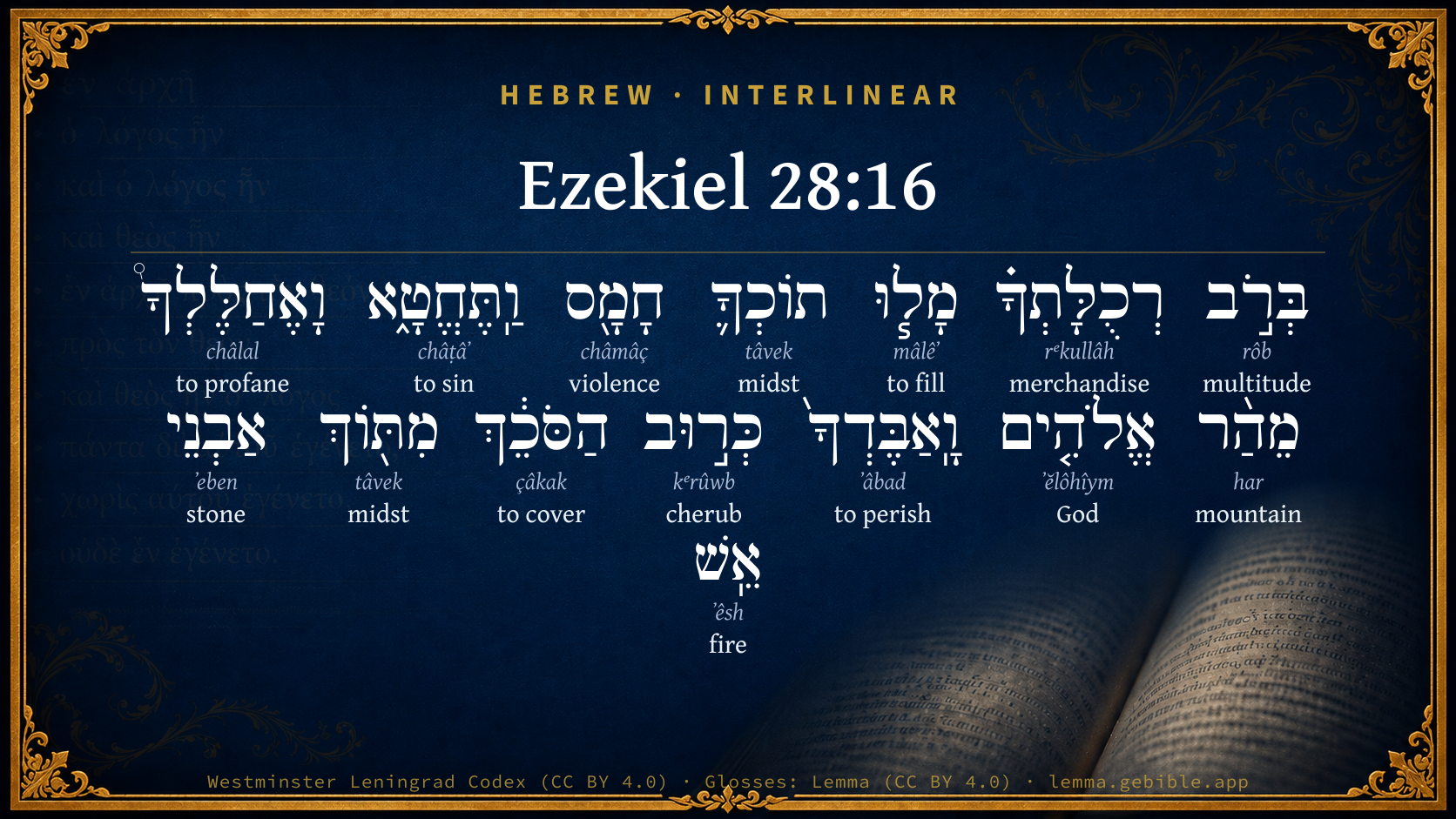
Hebrew (Westminster Leningrad Codex) Ezekiel 28:16 appears in the Hebrew Old Testament. The text above is from the Westminster Leningrad Codex. Each word links to its Strong’s number, a concise gloss, and parsing drawn from the Open Scriptures Hebrew Bible morphology. Click any word for its full Brown-Driver-Briggs (BDB) entry.
Download image
Cite this verse

Ezekiel 28:16 (World English Bible). Public Domain. Lemma interlinear Bible study tool, https://lemma.gebible.app/v/ezekiel/28/16.

Show BibTeX & RIS
BibTeX
RIS
English Translation
By the abundance of your traffic they filled the midst of you with violence, and you have sinned: therefore I have cast you as profane out of the mountain of God; and I have destroyed you, covering cherub, from the midst of the stones of fire.
World English Bible · Public Domain
Download a study sheet

One document with this verse’s original text, its word-by-word gloss line, the meaning frame, cross-references with their text, attributed commentary, and full source and license credits — printable, and it pastes into notes with its structure intact.

This verse Autodidact and up

Study sheet (.html) Plain text (.txt)

A passage Seminary Student

Up to 50 verses in one chapter. A passage sheet keeps up to 6 commentary sources and 12 cross-references per verse, in the order this page ranks them, and says so on the sheet whenever that leaves anything out. Ask for a single verse and you get the Autodidact verse sheet above.

Everything on this page stays free to read, with no account — the sheet is a download of what is already on screen, not access to it.

Want to remove ads? Support Godless Engineer
Compare translations 3

The same verse in 3 English versions, stacked beneath the original-language interlinear above. Click any original word for its lexicon entry.

Each is an independent rendering of the whole verse — the interlinear is not word-aligned to these translations.

Highlighted words mark where these versions differ — a whole-verse word diff, not a word-by-word alignment.

  • World English Bible Public Domain
    By the abundance of your traffic they filled the midst of you with violence, and you have sinned: therefore I have cast you as profane out of the mountain of God; and I have destroyed you, covering cherub, from the midst of the stones of fire.
  • King James Version Public Domain
    By the multitude of thy merchandise they have filled the midst of thee with violence, and thou hast sinned: therefore I will cast thee as profane out of the mountain of God: and I will destroy thee, O covering cherub, from the midst of the stones of fire.
  • unfoldingWord Literal Text CC BY-SA 4.0
    Through your great trade you were filled with violence, and so you sinned. So I threw you out of the mountain of God, as one who was defiled, and I destroyed you, guardian cherub, and drove you from among the fiery stones.

unfoldingWord Literal Text — © unfoldingWord, licensed CC BY-SA 4.0. Word-aligned USFM3 via Door43 (git.door43.org/unfoldingWord/en_ult).

Versions to compare (up to 4)

3 of 4 selected

Show all 18 translations

Every available English version of this verse, each an independent rendering of the whole verse.

  • World English Bible Public Domain
    By the abundance of your traffic they filled the midst of you with violence, and you have sinned: therefore I have cast you as profane out of the mountain of God; and I have destroyed you, covering cherub, from the midst of the stones of fire.
  • Berean Standard Bible Public Domain
    By the vastness of your trade, you were filled with violence, and you sinned. So I drove you in disgrace from the mountain of God, and I banished you, O guardian cherub, from among the fiery stones.
  • Majority Standard Bible Public Domain
    By the vastness of your trade, you were filled with violence, and you sinned. So I drove you in disgrace from the mountain of God, and I banished you, O guardian cherub, from among the fiery stones.
  • King James Version Public Domain
    By the multitude of thy merchandise they have filled the midst of thee with violence, and thou hast sinned: therefore I will cast thee as profane out of the mountain of God: and I will destroy thee, O covering cherub, from the midst of the stones of fire.
  • American Standard Version (1901) Public Domain
    By the abundance of thy traffic they filled the midst of thee with violence, and thou hast sinned: therefore have I cast thee as profane out of the mountain of God; and I have destroyed thee, O covering cherub, from the midst of the stones of fire.
  • Revised Version (1885) Public Domain
    By the multitude of they traffic they filled the midst of thee with violence, and thou hast sinned: therefore, have I cast thee as profane out of the mountain of God; and I have destroyed thee, O covering cherub, from the midst of the stones of fire.
  • Geneva Bible (1599) Public Domain
    By the multitude of thy marchandise, they haue filled the middes of thee with crueltie, and thou hast sinned: therefore I will cast thee as prophane out of the mountaine of God: and I will destroy thee, O couering Cherub from the mids of the stones of fire.
  • Douay-Rheims (1899) Public Domain
    By the multitude of thy merchandise, thy inner parts were filled with iniquity, and thou hast sinned: and I cast thee out from the mountain of God, and destroyed thee, O covering cherub, out of the midst of the stones of fire.
  • Young's Literal Translation Public Domain
    By the abundance of thy merchandise They have filled thy midst with violence, And thou dost sin, And I thrust thee from the mount of God, And I destroy thee, O covering cherub, From the midst of the stones of fire.
  • Literal Standard Version CC BY-SA 4.0
    By [the] abundance of your merchandise || They have filled your midst with violence, || And you sin, || And I thrust you from [the] mountain of God, || And I destroy you, O covering cherub, || From [the] midst of [the] stones of fire.
  • Unlocked Literal Bible CC BY-SA 4.0
    Through your great trade you were filled with violence, and so you sinned. So I threw you out of the mountain of God, as a one who was defiled, and I destroyed you, guardian cherub, and drove you from among the fiery stones.
  • unfoldingWord Literal Text CC BY-SA 4.0
    Through your great trade you were filled with violence, and so you sinned. So I threw you out of the mountain of God, as one who was defiled, and I destroyed you, guardian cherub, and drove you from among the fiery stones.
  • Darby Bible Public Domain
    By the abundance of thy traffic they filled the midst of thee with violence, and thou hast sinned; therefore have I cast thee as profane from the mountain of God, and have destroyed thee, O covering cherub, from the midst of the stones of fire.
  • World Messianic Bible Public Domain
    By the abundance of your commerce, your insides were filled with violence, and you have sinned. Therefore I have cast you as profane out of God’s mountain. I have destroyed you, covering cherub, from the middle of the stones of fire.
  • Webster's Bible Public Domain
    By the multitude of thy merchandise they have filled the midst of thee with violence, and thou hast sinned: therefore I will cast thee as profane out of the mountain of God: and I will destroy thee, O covering cherub, from the midst of the stones of fire.
  • Free Bible Version CC BY-SA 4.0
    You were so busy with all your trading schemes that they destroyed you inside, leading you to sin and filling you with violence. So I sent you away in disgrace from God's mountain, and I removed you from your position as guardian cherub from your place among the stones of fire.
  • Bible in Basic English Public Domain
    Through all your trading you have become full of violent ways, and have done evil: so I sent you out shamed from the mountain of God; the winged one put an end to you from among the stones of fire.
  • JPS Tanakh (1917) Public Domain
    By the multitude of thy traffic they filled the midst of thee with violence, and thou hast sinned; therefore have I cast thee as profane out of the mountain of God; and I have destroyed thee, O covering cherub, from the midst of the stones of fire.

Literal Standard Version (2020), Covenant Press — licensed CC BY-SA 4.0. Text via the HelloAO Bible API (eBible.org). Unlocked Literal Bible (unfoldingWord) — licensed CC BY-SA 4.0. Text via the HelloAO Bible API (eBible.org). unfoldingWord Literal Text — © unfoldingWord, licensed CC BY-SA 4.0. Word-aligned USFM3 via Door43 (git.door43.org/unfoldingWord/en_ult). Free Bible Version, Dr. Jonathan Gallagher — licensed CC BY-SA 4.0. Text via the HelloAO Bible API (eBible.org).

Word by word

More ways to search: Search by grammar → Find every occurrence → Compare this word →

Practice this passage: Drill this verse → Learn its vocabulary →

רְכֻלָּתְךָ֗
rᵉkullâh
H7404
“merchandise · your”
Noun, Common, Feminine, Singular, Construct + Suffix, Personal, 2nd Person, Masculine, Singular
Part of Speech
Noun
Type
Common
Gender
Feminine
Number
Singular
State
Construct
Full BDB Definition

Origin: pass part of H7402

TWOT: 2165a

merchandise, traffic, trade
  1. בְּרֹ֣ב rôb H7230 “in/at · multitude of” Preposition + Noun, Common, Both, Singular, Construct
  2. מָל֧וּ mâlêʼ H4390 “to fill” Verb, Qal, Perfect, 3rd Person, Common, Plural
  3. תוֹכְךָ֛ tâvek H8432 “midst · your” Noun, Common, Masculine, Singular, Construct + Suffix, Personal, 2nd Person, Masculine, Singular
  4. חָמָ֖ס châmâç H2555 “violence” Noun, Common, Masculine, Singular, Absolute
  5. וַֽתֶּחֱטָ֑א châṭâʼ H2398 “and · to sin” Conjunction + Verb, Qal, Sequential Imperfect, 2nd Person, Masculine, Singular
  6. וָאֶחַלֶּלְךָ֩ châlal H2490 “and · to profane · you” Conjunction + Verb, Piel, Sequential Imperfect, 1st Person, Common, Singular + Suffix, Personal, 2nd Person, Masculine, Singular
  7. מֵהַ֨ר har H2022 “from · mountain of” Preposition + Noun, Common, Masculine, Singular, Construct
  8. אֱלֹהִ֤ים ʼĕlôhîym H430 “God(s)” Noun, Common, Masculine, Plural, Absolute
  9. וָֽאַבֶּדְךָ֙ ʼâbad H6 “and · to perish · you” Conjunction + Verb, Piel, Sequential Imperfect, 1st Person, Common, Singular + Suffix, Personal, 2nd Person, Masculine, Singular
  10. כְּר֣וּב kᵉrûwb H3742 “cherub” Noun, Common, Masculine, Singular, Absolute
  11. הַסֹּכֵ֔ךְ çâkak H5526 “the · covering” Particle, Definite Article + Verb, Qal, Participle Active, Masculine, Singular, Absolute
  12. מִתּ֖וֹךְ tâvek H8432 “from · midst of” Preposition + Noun, Common, Masculine, Singular, Construct
  13. אַבְנֵי ʼeben H68 “stones of” Noun, Common, Feminine, Plural, Construct
  14. אֵֽשׁ ʼêsh H784 “fire” Noun, Common, Both, Singular, Absolute

About this verse

These counts appear in no published source. They are computed here, from the morphology-tagged text and Lemma’s own curated glosses. What Lemma adds →

15
words
14
distinct lemmas
Prophets
section

Notable vocabulary

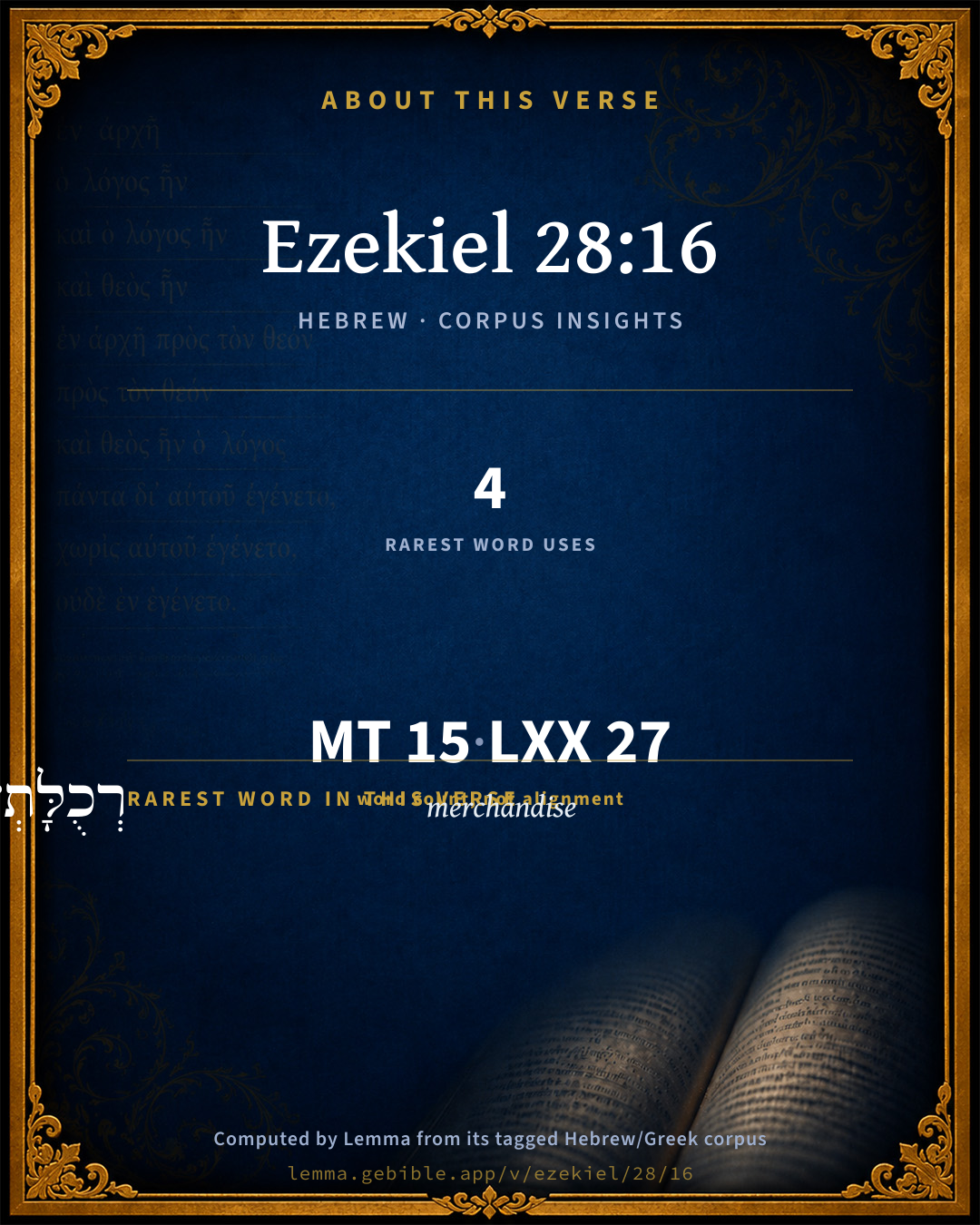
The rarest word here is רְכֻלָּתְךָ֗ merchandise H7404 — appearing just 4 times in the whole Hebrew Bible.

Shared distinctive vocabulary

רְכֻלָּתְךָ֗ merchandise H7404 occurs in 4 verses of the Hebrew Bible. Also found in:

Grammatical profile

  • 5 verbs
  • 10 nouns

Verb forms

  • מָל֧וּ Qal · Perfect
  • וַֽתֶּחֱטָ֑א Qal · Sequential Imperfect
  • וָאֶחַלֶּלְךָ֩ Piel · Sequential Imperfect
  • וָֽאַבֶּדְךָ֙ Piel · Sequential Imperfect
  • הַסֹּכֵ֔ךְ Qal · Participle Active

Repetition

A word recurs within this verse — often emphatic in Hebrew:

  • תוֹכְךָ֛ midst H8432 ×2

Hebrew & Septuagint length

In English translation the verse runs 46 words from the Hebrew and 43 from the Septuagint (LXX English) — closely comparable.

A rough comparison of the two English renderings, which tokenize alike — not a word-level alignment.

Word counts can differ between the Hebrew and the Greek without any difference in meaning — e.g. the Hebrew direct-object marker אֵת has no separate Greek word, and Greek often adds the article ὁ.

In the original languages it is 15 Hebrew tokens and 27 Greek tokens — but the two are counted differently (Hebrew bundles its prefixes and suffixes into one token; the Greek is in lemma form), so that isn’t a like-for-like length.

Cross-references

22

Topical passages linked to Ezekiel 28:16 in the Treasury of Scripture Knowledge — connected by theme and wording, ordered by reader-vote popularity; previews shown in the World English Bible.

  • 1 Timothy 6:9–10 But those who are determined to be rich fall into a temptation and a snare and many foolish and harmful lusts, such as drown men in ruin and destruction.
  • Habakkuk 2:8 Because you have plundered many nations, all the remnant of the peoples will plunder you, because of men's blood, and for the violence done to the land, to the city and to all who dwell in it.
  • Habakkuk 2:17 For the violence done to Lebanon will overwhelm you, and the destruction of the animals, which made them afraid; because of men's blood, and for the violence done to the land, to every city and to those who dwell in them.
  • Genesis 3:24 So he drove out the man; and he placed Cherubs at the east of the garden of Eden, and the flame of a sword which turned every way, to guard the way to the tree of life.
  • John 2:16 To those who sold the doves, he said, "Take these things out of here! Don't make my Father's house a marketplace!"
  • Ezekiel 8:17 Then he said to me, Have you seen [this], son of man? Is it a light thing to the house of Judah that they commit the abominations which they commit here? for they have filled the land with violence, and have turned again to provoke me to anger: and, behold, they put the branch to their nose.
  • Micah 2:2 They covet fields, and seize them; And houses, and take them away: And they oppress a man and his house, Even a man and his heritage.
  • Genesis 6:11 The earth was corrupt before God, and the earth was filled with violence.
  • Leviticus 18:24–28 "'Don't defile yourselves in any of these things: for in all these the nations which I am casting out before you were defiled.
  • Isaiah 22:19 I will thrust you from your office; and from your station shall you be pulled down.
  • Isaiah 23:9 Yahweh of hosts has purposed it, to stain the pride of all glory, to bring into contempt all the honorable of the earth.
  • Isaiah 23:17–18 It shall happen after the end of seventy years, that Yahweh will visit Tyre, and she shall return to her hire, and shall play the prostitute with all the kingdoms of the world on the surface of the earth.
  • Ezekiel 27:12–36 Tarshish was your merchant by reason of the multitude of all kinds of riches; with silver, iron, tin, and lead, they traded for your wares.
  • Ezekiel 28:14 You were the anointed cherub who covers: and I set you, [so that] you were on the holy mountain of God; you have walked up and down in the midst of the stones of fire.
  • Hosea 12:7 A merchant has dishonest scales in his hand. He loves to defraud.
  • Amos 3:9 Proclaim in the palaces at Ashdod, And in the palaces in the land of Egypt, And say, "Assemble yourselves on the mountains of Samaria, And see what unrest is in her, And what oppression is among them."
  • Micah 2:10 Arise, and depart! For this is not your resting place, Because of uncleanness that destroys, Even with a grievous destruction.
  • Micah 6:12 Her rich men are full of violence, Her inhabitants speak lies, And their tongue is deceitful in their speech.
  • Zephaniah 1:9 In that day, I will punish all those who leap over the threshold, who fill their master's house with violence and deceit.
  • Luke 19:45–46 He entered into the temple, and began to drive out those who bought and sold in it,
  • 2 Peter 2:4–6 For if God didn't spare angels when they sinned, but cast them down to Tartarus, and committed them to pits of darkness, to be reserved to judgment;
  • Revelation 12:9 The great dragon was thrown down, the old serpent, he who is called the devil and Satan, the deceiver of the whole world. He was thrown down to the earth, and his angels were thrown down with him.

Cross-references courtesy of OpenBible.info (CC BY 4.0).

Hebrew and Greek witnesses Masoretic Hebrew ↔ Greek Septuagint

The same verse in the two great witnesses to the Old Testament, shown verse-for-verse.

These are two independent witnesses, not word-aligned to each other, and the Septuagint is shown in lemma (dictionary) form.

Hebrew Ezekiel 28:16 Masoretic · Westminster Leningrad Codex

בְּרֹ֣ב רְכֻלָּתְךָ֗ מָל֧וּ תוֹכְךָ֛ חָמָ֖ס וַֽתֶּחֱטָ֑א וָאֶחַלֶּלְךָ֩ מֵהַ֨ר אֱלֹהִ֤ים וָֽאַבֶּדְךָ֙ כְּר֣וּב הַסֹּכֵ֔ךְ מִתּ֖וֹךְ אַבְנֵי אֵֽשׁ

By the abundance of your traffic they filled the midst of you with violence, and you have sinned: therefore I have cast you as profane out of the mountain of God; and I have destroyed you, covering cherub, from the midst of the stones of fire.

World English Bible · Public Domain

Greek LXX Ezekiel 28:16 Septuagint · lemma form

ἀπό πλῆθος ὁ ἐμπορία σύ πίμπλημι ὁ ταμιεῖον σύ ἀνομία καί ἁμαρτάνω καί τραυματίζω ἀπό ὄρος ὁ θεός καί ἄγω σύ ὁ χερουβ ἐκ μέσος λίθος πύρινος

Of the abundance of your merchandise you have filled your storehouses with iniquity, and have sinned: therefore you have been cast down wounded from the mount of God, and the cherub has brought you out of the midst of the stones of fire.

LXX2012 (modern English Septuagint) · Public Domain

On this verse, The Cambridge Bible for Schools and Colleges discusses the Septuagint’s reading. Read the note in Commentary ↓

Hebrew: Westminster Leningrad Codex (CC BY 4.0). Greek: Septuagint (public domain); English from LXX2012 (modern English Septuagint) (Public Domain). How the Septuagint differs from the Hebrew →

Targum (Aramaic paraphrase)

1

The Targum is the ancient Jewish Aramaic paraphrase of the Hebrew Scriptures — an interpretive translation, not the Hebrew text itself. Onkelos (literal) and Pseudo-Jonathan (expansive) render the Torah, and Jonathan the Prophets. Coverage is partial: where no permissively-licensed English translation exists for a verse, only the Aramaic is shown. This is verse-level text, not a word-by-word alignment to the Hebrew.

  1. Targum Jonathan Prophets (Joshua–Malachi)
    בִּסְגִיאוּת סְחוֹרְתָּךְ אִתְמְלִיאוּ אוֹצְרָךְ חֲטוֹף וְחַבְתָּא וַאֲפִסִינָךְ עַל דִבְסַרְתָּ עַל טוּר קוּדְשָׁא דַייָ וְאַבְּדִינָךְ מַלְכָּא דְרַבְּתָנָא עַל דִי סְבַרְתָּא לְמִשְׁלַט בְּעַמָא קַדִישָׁא:

    (no public-domain English translation for this verse)

    Targum Jonathan — Aramaic: “Mikraot Gedolot” (public domain). English: “Sefaria Community Translation” (CC0 1.0 (public-domain dedication)); “London "Chaldee Paraphrase," 1871” (public domain). Text via Sefaria.

Commentary

Notes on Ezekiel 28:16 from classic Christian and Jewish commentators (each source and its license shown beneath its notes). The classic Christian expositions comment on the surrounding passage and are grouped to its opening verse, so a note may address several verses; the Jewish commentaries on the Tanakh (Rashi and others) are per-verse, so they appear only where the commentator wrote on this verse.

Lemma curates 59 commentaries, every one of them public domain or Creative Commons licensed, each selected and text-cleaned for this edition rather than reprinted as found. About our sources →

Trapp's Complete Commentary

John Trapp

Eze 28:16 By the multitude of thy merchandise they have filled the midst of thee with violence, and thou hast sinned: therefore I will cast thee as profane out of the mountain of God: and I will destroy thee, O covering cherub, from the midst of the stones of fire.

Ver. 16. By the multitude of thy merchandise.] Many merchants think they may do anything for their own advantage; cheating and overreaching pass for virtues with them. {a}

And thou hast sinned.] By suffering it so to be; for there is a passive injustice as well as an active.

I will cast thee.] I will bring thee down with a vengeance, and make thee an example of that rule, Great sins have great punishments. {b}

{a} Multae sunt fraudes ubi mercatura fervet. - Oecolamp.

{b} Mεγαλων αδικηματων μεγαλαι εισι αι τιμωριαι παρα του Yεου.

John Trapp, A Commentary or Exposition upon All the Books of the Old and New Testament (1647–1656) — public domain. Text from a community e-Sword module.

Joseph Benson's Commentary

Eze 28:16-17. By the multitude of thy merchandise, &c. — The riches which thy great trade has produced have but increased thy love of gain more and more, and induced thee to commit acts of violence, fraud, and extortion, to make further additions to thy power and riches; therefore I will cast thee out of the mountain of God — I will cast thee down to contempt from that super-eminent degree of power and glory to which I had raised thee, and from the exalted station of governing others, and being able to afford them protection, and from all thy great pomp and magnificence. Thy heart was lifted up because of thy beauty — Thou becamest vain and insolent on account of thy power, riches, and magnificence. Here the root of this prince’s ruin is pointed out to us. His power and riches produced pride and insolence in him, and those every evil way. His grandeur blinded him, so that he did not see his true happiness, nor the right way of pursuing it, but wandered in ways which led to ruin. I will lay thee before kings, that they may behold thee — I will make thee a spectacle to other princes, expose thee as a miserable object before their eyes, that thou mayest be an example to them to deter them from the like pride and practices.

Joseph Benson's Commentary on the Old and New Testaments (1811–1818) — public domain. Text from a community e-Sword module.

Geneva Bible (1599)

Geneva Bible translators

Thou shalt have no part among my people.

Geneva Bible (1599) marginal notes — public domain. Text via Bolls.life.

Jamieson, Fausset & Brown

Robert Jamieson, A. R. Fausset & David Brown

filled the midst of thee--that is, they have filled the midst of the city; he as the head of the state being involved in the guilt of the state, which he did not check, but fostered.

cast thee as profane--no longer treated as sacred, but driven out of the place of sanctity (see Eze 28:14) which thou hast occupied (compare Psa 89:39).

Jamieson, Fausset & Brown — Commentary Critical and Explanatory on the Whole Bible (1871) — public domain (CC PDM 1.0). Text via the HelloAO Bible API.

Adam Clarke's Commentary

Verse 16. I will cast thee as profane] Thou shalt be cast down from thine eminence.

From the midst of the stones of fire.] Some, supposing that stones of fire means the stars, have thought that the whole refers to the fall of Satan.

Adam Clarke's Commentary on the Bible (1810–1826) — public domain. Text from a community e-Sword/MySword module.

Ellicott's Commentary for English Readers

(16) Filled the midst of thee.—The language passes very naturally here from the king himself to the state over which be presided, and with which he was identified, immediately recurring, however, to the king personally. He, as polluted, should be cast out of his imagined mountain of God: he, the cherub covering the mercy-seat, forsooth, shall be destroyed: his fancied God-like walking amid the stones of fire shall for ever cease.

A Bible Commentary for English Readers, edited by Charles John Ellicott (1878–1897) — public domain. Text from a community e-Sword module.

The Cambridge Bible for Schools and Colleges

gen. ed. J. J. S. Perowne

16. By the multitude] Or, in the multitude.

they have filled] Or, thy midst (heart) was filled with wrong, and thou didst sin. LXX., thou didst fill.

therefore I will cast] therefore have I cast. The destruction of the prince is described as completed, lit. therefore have I profaned thee (casting thee) out of the mountain.

and I will destroy thee] More probably: and the (covering) cherub hath destroyed thee (driving thee) from the midst of the stones of fire. The construction as 1st pers. I have destroyed is possible, but quite improbable. The cherub is rather regarded as active in the expulsion from Paradise; in Gen_3:24, he is represented as barring the return of those whom God had expelled.

With the words wanting in LXX. put in square brackets the verses would read: “Thou art the (a) seal of symmetry, [full of wisdom], and the perfection of beauty. 13 Thou wast in Eden the garden of God; every precious stone was thy covering, the sardius, the topaz and the diamond, the beryl, the onyx and the jaspar, the sapphire, the carbuncle and the emerald; and gold was the workmanship of thy sockets and grooves in thee in the day that thou wast created” [they were prepared]. Or, drawing the last words to the beginning of Eze_28:14. 14 “In the day that thou wast created I set thee with the [outspread, the covering] cherub, thou wast in the holy mountain of God, in the midst of the stones of fire [thou didst walk]. 15 Thou wast perfect in thy ways from the day that thou wast created, till iniquity was found in thee. 16 In the multitude of thy traffic thy midst was filled with wrong [LXX. thou didst fill], and thou didst sin: therefore I have profaned thee (and cast thee) from the mountain of God; and the [covering] cherub hath destroyed thee (driving thee) from the midst of the stones of fire.”

The Cambridge Bible for Schools and Colleges (gen. ed. J. J. S. Perowne; Cambridge University Press, 1878–1918) — public domain. Text from a community e-Sword module.

John Gill's Exposition

By the multitude of thy merchandise,.... With the several nations of the earth, who came to the markets and fairs of Tyre, and to whom she sent her goods:

they have filled the midst of thee with violence; or, as the Targum,

"thy treasures are filled with rapine;''

with ill gotten goods, as the pope's coffers are through his merchandise of the souls of men, and the great trade that is driven in pardons and indulgences:

and thou hast sinned; by this unjust and ungodly way of dealing:

therefore I will cast thee as profane out of the mountain of God; Mount Zion, the church of the living God, where he dwells, and is worshipped, and on which the Lamb stands with his hundred and forty and four thousand, having his name and his Father's on their foreheads, Rev 14:1, these will have no communion with the church and pope of Rome; will not receive his mark, nor worship his image; from this mountain, and the inhabitants of it, he stands excluded as a profane person, with whom they will have nothing to do; and hence he persecutes them to the utmost of his power:

and I will destroy thee, O covering cherub, from the midst of the stones of fire; from among the people of God, who have the clear light of the Gospel, and a sincere love for Christ; these withdrew themselves from his jurisdiction and government; and with whom his name, power, and authority perish, especially when they shall have got the victory over him, Rev 15:1. Kimchi paraphrases it,

"from the midst of the saints who are the Israelites, comparable to stones of fire;''

and Jarchi's note is,

"that thou mayest not take a portion with the righteous;''

have no part, lot, or fellowship with them. The Targum is,

"I will destroy thee, O king that art anointed, because thou thoughtest to rule over the holy people.''

John Gill's Exposition of the Whole Bible (1746–1763) — public domain (CC PDM 1.0). Text via the HelloAO Bible API.

Matthew Poole's English Annotations

By the multitude; by, or in, or according to (as the Gallic version) the multitude or greatness of thy trading: in Tyre were merchants that traded in very great adventures, with vast stocks, and in mighty cargoes.

With violence; thy merchants have by craft, where that would, and by violence where craft would not, compassed their unjust designs, as noted, Eze 27:36. This injustice and violence grew as their trade did, and filled the city with guilt as fast as that did with wealth.

Thou hast sinned: either as one trading among them, thou hast violated justice to promote thine own and their gain, or hast connived at thy merchants when they oppressed all they could; or hast, contrary to justice and equity, supported them in their violence, and judged for them against oppressed strangers. Thou who weft a king, and wouldst be thought a god, is this like to God, who hates violence, loves justice, relieveth the stranger, and righteth the oppressed?

I will cast thee out: these abominable things hast thou done, and now, as an abominable thing, I will throw thee out, either of thy throne and kingly dignity, see Eze 28:14, or thy fancied and imagined heaven, where thou wouldst be a god, for such gods of violence and injustice deserve to be cast out with the aspiring angels.

Destroy thee; utterly destroy.

O covering cherub: see Eze 28:14.

Matthew Poole's English Annotations on the Holy Bible (1683–1685) — public domain. Text from a community e-Sword/MySword module.

Whedon's Commentary on the Bible

Daniel D. Whedon

16. Will cast… will destroy — Rather, have cast… have destroyed. So in Eze_28:17-18 the verbs are in the past tense. These words were spoken from the standpoint of prophecy fulfilled. Some scholars amend so as to read, “and the cherub hath destroyed thee.”

Daniel D. Whedon (gen. ed.), Commentary on the Old and New Testaments (1874–1909) — public domain. Text from a community e-Sword module.

The Pulpit Commentary

Sin and destruction.

No doubt the inspired prophet of the Lord saw in the fate of Tyro what was not discernible to worldly and enlightened minds. These would look for political causes and motives and consequences in the rise and fall of states. But Ezekiel saw below the surface. He knew that there was Divine action in and beneath the action of Tyre"s enemies; and that there were reasons only recognizable by a reflecting and religious man for the awful disasters which he was commissioned to foretell.

I THE OCCASIONS OF SIN.

1. We may discover what may be called material occasions of sin, in the wealth and prosperity, the fame and renown, the beauty and splendor, of Tyre. Circumstances of very different kinds may yet agree in suggesting evil thoughts, desires, and habits. Men lay the blame upon circumstances, but this is a very shortsighted method of proceeding.

2. There are moral promptings to sin which may spring out of the former. The heart is lifted up with exultation; a not unnatural confidence in possessions and resources springs up and asserts itself.

II THE MANIFESTATIONS OF SIN. "Thou hast sinned" is the reproach addressed by God to the guilty city; and it is the reproach addressed to every nation and to every man that has yielded to temptations which should have been withstood, repelled, and mastered. The forms which sin assumes are innumerable, and vary with varying times and with varying states of society. The context refers to:

1. Iniquity, or the violation of Divine laws regulating men"s relations among themselves and to God himself.

2. Violence, such as the powerful, willful, and haughty are given to exercise in their treatment of their inferiors.

3. Corruption and defilement, such as are certain to prevail where God is not honored, and where selfish ends inspire men"s conduct.

III THE PUNISHMENT OF SIN. This is:

1. By the decree of God. He is the Speaker throughout this passage. He claims to bestow privileges, and to call men to account for the manner in which those privileges are used. Whatever be the agency or instrumentality of chastisement and correction, it is by the Eternal Wisdom and Righteousness that it is inflicted.

2. In the case of national sin, the penalties are put in force through the instrumentality of neighboring nations. A barbarian horde, or a mighty sovereign and conqueror, has again and again been used as a "scourge of God." It would be wrong to attribute any moral superiority to the victorious people; they may be merely the rod, the sword, in the hand of the Lord of hosts.

3. Where the offence has been heinous, the visitation may be one involving complete destruction, as in the case of Tyre. The terms of threatening here recorded are of the strongest and most unsparing. "I will destroy thee;" "I will cast thee to the ground;" "I will bring forth a fire from the midst of thee; it shall devour thee." Such punishment is sometimes regarded as inconsistent with the attributes of a just and merciful King and Judge. But, whilst it may not be in our power to vindicate all the ways of God, it is certainly not for us to question the acts of him who is omniscient, and whose righteousness is without a flaw. There is nothing in Scripture to support the opinions of those who think that, because God is benevolent, therefore there is no such thing as punishment. There is a moral law which the Sovereign Judge will surely maintain and vindicate.

4. The punishment inflicted upon sinners shall be published far and wide. What is done by God in the exercise of punitive justice is done in the sight of all, and all shall be astonished. This publicity may surely be explained as an arrangement intended for the universal good to impress upon the minds of all mankind the heinousness of iniquity, that they may "stand in awe, and sin not. T.

The Pulpit Commentary (1880–1919), ed. H.D.M. Spence-Jones & Joseph S. Exell — public domain. Text from a community e-Sword module.

John Wesley's Explanatory Notes

I will cast - Out thy kingly dignity.

John Wesley, Explanatory Notes Upon the Whole Bible (1754–1765) — public domain. Text via the GEBible commentary corpus.

unfoldingWord translationNotes

Door43 World Missions Community

Connecting Statement:

Yahweh continues giving Ezekiel his message to the king of Tyre.

General Information:

The words "you" and "your" in these verses refer to the king of Tyre.

great trade

"large volume of trade"

you were filled with violence

Yahweh speaks of the king of Tyre as if he were a container that was filled up with violence. The king is a synecdoche for himself and his people The abstract noun "violence" can be translated using the adjective "violent." AT: "you and your people became completely violent" or "you and your peoplewere completely violent" (See: Metaphor and Synecdoche and Abstract Nouns)

guardian cherub

"guarding cherub"

the fiery stones

"the stones of fire." See how you translated this in Ezekiel 28:14. Possible meanings are 1) a metaphor for the colorful and bright stones mentioned in Ezekiel 28:13 or 2) other fiery stones on the "holy mountain of God." (See: Metaphor)

Your heart was arrogant

Here the "heart" represents the whole person, emphasizing the person's thoughts. AT: "You were arrogant" (See: Synecdoche)

arrogant

falsely believing oneself to be importantbelieving oneself to be important

Your heart was arrogant with your beauty; you ruined your wisdom because of your splendor

The abstract nouns "beauty," wisdom" and "splendor" can be translated using the adjectives "beautiful," "wise" and "splendid." AT: "Your heart was arrogant because you were beautiful; you became unwise because you were so splendid" (See: Abstract Nouns)

before kings

"in front of kings "

so they may see you

"so they may look at you"

translationWords

sin

defile

God

cherub

heart

arrogant

ruin

splendor

unfoldingWord translationNotes — © Distant Shores Media and the Door43 World Missions Community, licensed CC BY-SA 4.0. Source: git.door43.org/Door43/en_tn.

Rashi

Rabbi Shlomo Yitzchaki (Rashi)

they filled [Heb. מָלוּ, like מָלְאוּ,] they filled.

and I shall cast you as profane You caused me to eradicate you, so that you shall no longer be remembered concerning the building of My House.

and I shall destroy you [Heb. וָאַבֶּדְךָ,] like וָאֲאַבֶּדְךָ and I shall destroy you.

from among the stones of fire that you shall not take a share with the righteous. Our Rabbis in the Midrash Aggadah (B. B. 75a) interpreted this section as referring to Adam: So said the prophet to Hiram, “Why should you be proud of your sky? Were you in the Garden of Eden, as Adam was? [13] every precious stone, etc. For I made all these canopies for Adam, and the least of them was gold, which is counted last. the work of your drums, etc. With this, I made you equal to him, but not with anything else, and I pondered over you and created drums and orifices in Adam. [14] Are you a cherub of great measure Are you like that cherub that was great in measure, whose great wingspan covered from one end of heaven completely to the other end of heaven, and did I place you to be on the holy mountains as I placed him?

Rashi on the Tanakh — English translations: “The Judaica Press complete Tanach with Rashi, translated by A. J. Rosenberg” (CC BY 4.0); “Pentateuch with Rashi's commentary by M. Rosenbaum and A.M. Silbermann, 1929-1934” (public domain); “The Metsudah Tanach series, Lakewood, N.J” (CC BY 4.0); and “The Book of Joshua, Metsudah Publications, 1997” (CC BY 4.0). Text via Sefaria.

Lesson kit

Teaching starters — assembled from the data on this page, not authored interpretation. Every prompt links to the verse data it draws on. Edit before teaching.

Ezekiel, in the Prophets, opens this verse with 15 words (14 distinct Hebrew lemmas). Its most distinctive word is rᵉkullâh (“merchandise”). A historical commentator’s framing appears above. Read the whole chapter for the surrounding context.

Discussion questions

  1. The word rᵉkullâh carries the sense “merchandise.” How does it shape the verse?
  2. Ezekiel 26:12 shares the word «merchandise» with this verse. How do the two illuminate each other?
  3. “midst” occurs 2× in this one verse. What is the effect of the repetition?
  4. These translations render this verse differently. What is at stake in choosing one wording over another?
  5. The verb «מָל֧וּ» is Qal Perfect. How does its form color the action?
  6. Reading how Trapp's Complete Commentary and Joseph Benson's Commentary read this verse, where do the two commentators agree and where do they part?

Things to notice

Reading settings

Reading text

Shown beneath each verse's original-language words.

Old Testament
Old Testament edition

Read the OT as the Masoretic Hebrew (MT) or the Greek Septuagint (LXX).

English shown for the Greek Septuagint (in the Hebrew ↔ Greek comparison).

Comparing translations? Open the Compare panel on any verse page to stack up to four side by side.