
Numbers 26:10

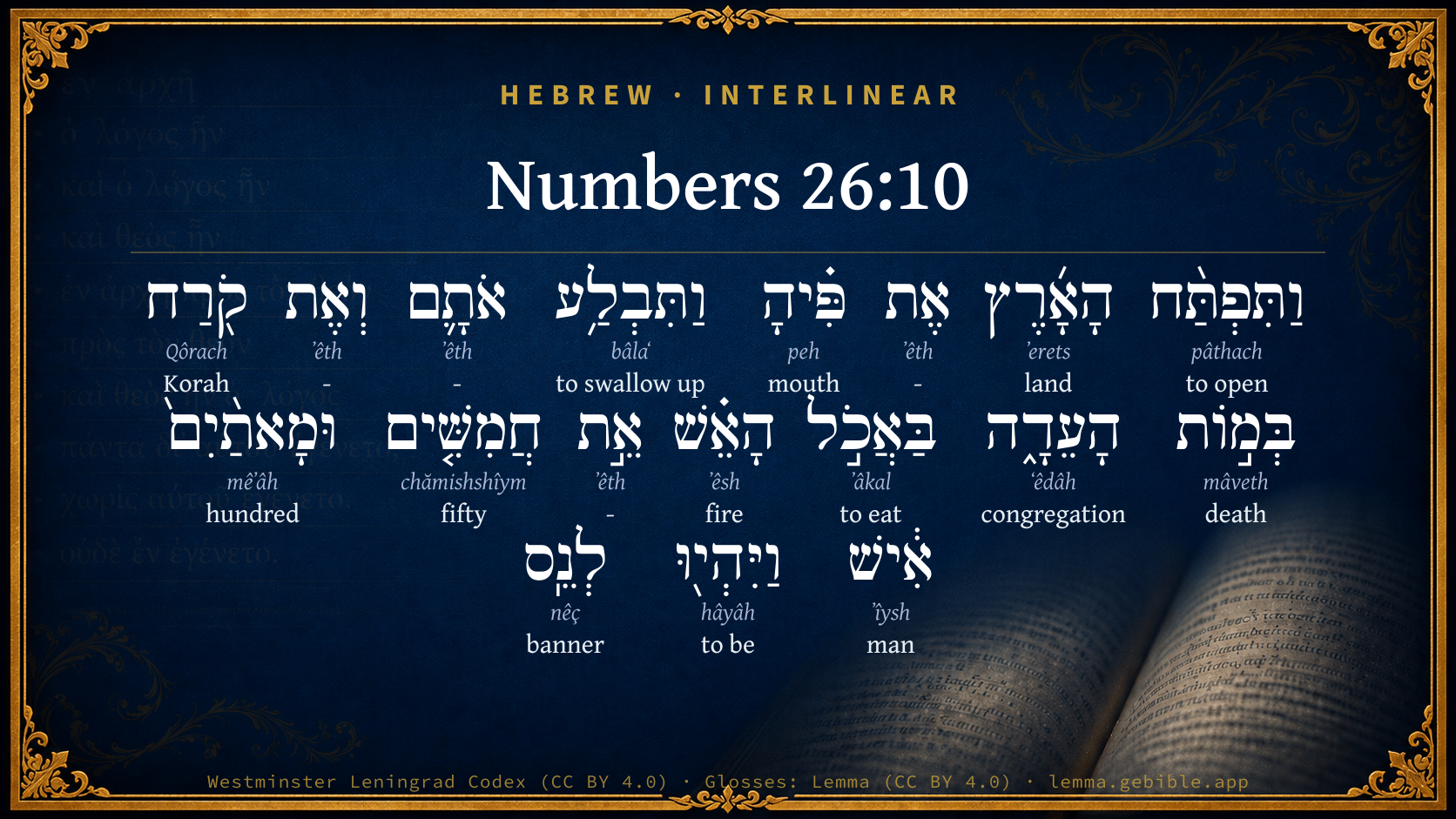
Hebrew (Westminster Leningrad Codex) Numbers 26:10 appears in the Hebrew Old Testament. The text above is from the Westminster Leningrad Codex. Each word links to its Strong’s number, a concise gloss, and parsing drawn from the Open Scriptures Hebrew Bible morphology. Click any word for its full Brown-Driver-Briggs (BDB) entry.
Download image
Cite this verse

Numbers 26:10 (World English Bible). Public Domain. Lemma interlinear Bible study tool, https://lemma.gebible.app/v/numbers/26/10.

Show BibTeX & RIS
BibTeX
RIS
English Translation
and the earth opened its mouth, and swallowed them up together with Korah, when that company died; what time the fire devoured two hundred fifty men, and they became a sign.
World English Bible · Public Domain
Download a study sheet

One document with this verse’s original text, its word-by-word gloss line, the meaning frame, cross-references with their text, attributed commentary, and full source and license credits — printable, and it pastes into notes with its structure intact.

This verse Autodidact and up

Study sheet (.html) Plain text (.txt)

A passage Seminary Student

Up to 50 verses in one chapter. A passage sheet keeps up to 6 commentary sources and 12 cross-references per verse, in the order this page ranks them, and says so on the sheet whenever that leaves anything out. Ask for a single verse and you get the Autodidact verse sheet above.

Everything on this page stays free to read, with no account — the sheet is a download of what is already on screen, not access to it.

Want to remove ads? Support Godless Engineer
Compare translations 3

The same verse in 3 English versions, stacked beneath the original-language interlinear above. Click any original word for its lexicon entry.

Each is an independent rendering of the whole verse — the interlinear is not word-aligned to these translations.

Highlighted words mark where these versions differ — a whole-verse word diff, not a word-by-word alignment.

  • World English Bible Public Domain
    and the earth opened its mouth, and swallowed them up together with Korah, when that company died; what time the fire devoured two hundred fifty men, and they became a sign.
  • King James Version Public Domain
    And the earth opened her mouth, and swallowed them up together with Korah, when that company died, what time the fire devoured two hundred and fifty men: and they became a sign.
  • unfoldingWord Literal Text CC BY-SA 4.0
    And the earth opened its mouth and swallowed them and Korah when the congregation died, when the fire ate 250 men, and they became a sign.

unfoldingWord Literal Text — © unfoldingWord, licensed CC BY-SA 4.0. Word-aligned USFM3 via Door43 (git.door43.org/unfoldingWord/en_ult).

Versions to compare (up to 4)

3 of 4 selected

Show all 18 translations

Every available English version of this verse, each an independent rendering of the whole verse.

  • World English Bible Public Domain
    and the earth opened its mouth, and swallowed them up together with Korah, when that company died; what time the fire devoured two hundred fifty men, and they became a sign.
  • Berean Standard Bible Public Domain
    And the earth opened its mouth and swallowed them along with Korah, whose followers died when the fire consumed 250 men. They serve as a warning sign.
  • Majority Standard Bible Public Domain
    And the earth opened its mouth and swallowed them along with Korah, whose followers died when the fire consumed 250 men. They serve as a warning sign.
  • King James Version Public Domain
    And the earth opened her mouth, and swallowed them up together with Korah, when that company died, what time the fire devoured two hundred and fifty men: and they became a sign.
  • American Standard Version (1901) Public Domain
    and the earth opened its mouth, and swallowed them up together with Korah, when that company died; what time the fire devoured two hundred and fifty men, and they became a sign.
  • Revised Version (1885) Public Domain
    and the earth opened her mouth, and swallowed them up together with Korah, when that company died; what time the fire devoured two hundred and fifty men, and they became a sign.
  • Geneva Bible (1599) Public Domain
    And the earth opened her mouth, and swalowed them vp with Korah, when the Congregation died, what time the fire consumed, two hundreth and fiftie men, who were for a signe.
  • Douay-Rheims (1899) Public Domain
    And the earth opening her mouth swallowed up Core, many others dying, when the fire burned two hundred and fifty men. And there was a great miracle wrought,
  • Young's Literal Translation Public Domain
    and the earth openeth her mouth, and swalloweth them and Korah, in the death of the company, in the fire consuming the two hundred and fifty men, and they become a sign;
  • Literal Standard Version CC BY-SA 4.0
    and the earth opens her mouth, and swallows them and Korah, in the death of the congregation, in the fire consuming the two hundred and fifty men, and they become a sign;
  • Unlocked Literal Bible CC BY-SA 4.0
    The earth opened its mouth and swallowed them up together with Korah when all his followers died. At that time, fire devoured 250 men, who became a warning sign.
  • unfoldingWord Literal Text CC BY-SA 4.0
    And the earth opened its mouth and swallowed them and Korah when the congregation died, when the fire ate 250 men, and they became a sign.
  • Darby Bible Public Domain
    And the earth opened its mouth, and swallowed them up together with Korah, when that band died, when the fire devoured the two hundred and fifty men; and they became a sign.
  • World Messianic Bible Public Domain
    and the earth opened its mouth, and swallowed them up together with Korah when that company died; at the time the fire devoured two hundred fifty men, and they became a sign.
  • Webster's Bible Public Domain
    And the earth opened her mouth, and swallowed them up together with Korah, when that company died, when the fire devoured two hundred and fifty men: and they became a sign.
  • Free Bible Version CC BY-SA 4.0
    The earth opened up and swallowed them down, along with Korah. His followers died when the fire burned up 250 men. What happened to them was a warning to the Israelites.
  • Bible in Basic English Public Domain
    And they went down into the open mouth of the earth, together with Korah, when death overtook him and all his band; at the time when two hundred and fifty men were burned in the fire, and they became a sign.
  • JPS Tanakh (1917) Public Domain
    and the earth opened her mouth, and swallowed them up together with Korah, when that company died; what time the fire devoured two hundred and fifty men, and they became a sign.

Literal Standard Version (2020), Covenant Press — licensed CC BY-SA 4.0. Text via the HelloAO Bible API (eBible.org). Unlocked Literal Bible (unfoldingWord) — licensed CC BY-SA 4.0. Text via the HelloAO Bible API (eBible.org). unfoldingWord Literal Text — © unfoldingWord, licensed CC BY-SA 4.0. Word-aligned USFM3 via Door43 (git.door43.org/unfoldingWord/en_ult). Free Bible Version, Dr. Jonathan Gallagher — licensed CC BY-SA 4.0. Text via the HelloAO Bible API (eBible.org).

Word by word

More ways to search: Search by grammar → Find every occurrence → Compare this word →

Practice this passage: Drill this verse → Learn its vocabulary →

לְנֵֽס
nêç
H5251
“to/for · banner”
Preposition + Noun, Common, Masculine, Singular, Absolute
Part of Speech
Preposition + Noun
Type
Common
Gender
Masculine
Number
Singular
State
Absolute
Full BDB Definition

Origin: from H5264

TWOT: 1379a

something lifted up, standard, signal, signal pole, ensign, banner, sign, sail - standard (as rallying point), signal - standard (pole) - ensign, signal
  1. וַתִּפְתַּ֨ח pâthach H6605 “and · to open” Conjunction + Verb, Qal, Sequential Imperfect, 3rd Person, Feminine, Singular
  2. הָאָ֜רֶץ ʼerets H776 “the · land” Particle, Definite Article + Noun, Common, Both, Singular, Absolute
  3. אֶת ʼêth H853 “-” Particle, Direct Object
  4. פִּ֗יהָ peh H6310 “mouth · her” Noun, Common, Masculine, Singular, Construct + Suffix, Personal, 3rd Person, Feminine, Singular
  5. וַתִּבְלַ֥ע bâlaʻ H1104 “and · to swallow up” Conjunction + Verb, Qal, Sequential Imperfect, 3rd Person, Feminine, Singular
  6. אֹתָ֛ם ʼêth H853 “- · them” Particle, Direct Object + Suffix, Personal, 3rd Person, Masculine, Plural
  7. וְאֶת ʼêth H853 “and · -” Conjunction + Particle, Direct Object
  8. קֹ֖רַח Qôrach H7141 “Korah” Noun, Proper
  9. בְּמ֣וֹת mâveth H4194 “in/at · death of” Preposition + Noun, Common, Masculine, Singular, Construct
  10. הָעֵדָ֑ה ʻêdâh H5712 “the · congregation” Particle, Definite Article + Noun, Common, Feminine, Singular, Absolute
  11. בַּאֲכֹ֣ל ʼâkal H398 “in/at · to eat” Preposition + Verb, Qal, Infinitive Construct
  12. הָאֵ֗שׁ ʼêsh H784 “the · fire” Particle, Definite Article + Noun, Common, Both, Singular, Absolute
  13. אֵ֣ת ʼêth H853 “-” Particle, Direct Object
  14. חֲמִשִּׁ֤ים chămishshîym H2572 “fifty” Adjective, Cardinal number, Both, Plural, Absolute
  15. וּמָאתַ֨יִם֙ mêʼâh H3967 “and · hundred” Conjunction + Adjective, Cardinal number, Both, Dual, Absolute
  16. אִ֔ישׁ ʼîysh H376 “man” Noun, Common, Masculine, Singular, Absolute
  17. וַיִּהְי֖וּ hâyâh H1961 “and · to be” Conjunction + Verb, Qal, Sequential Imperfect, 3rd Person, Masculine, Plural

About this verse

These counts appear in no published source. They are computed here, from the morphology-tagged text and Lemma’s own curated glosses. What Lemma adds →

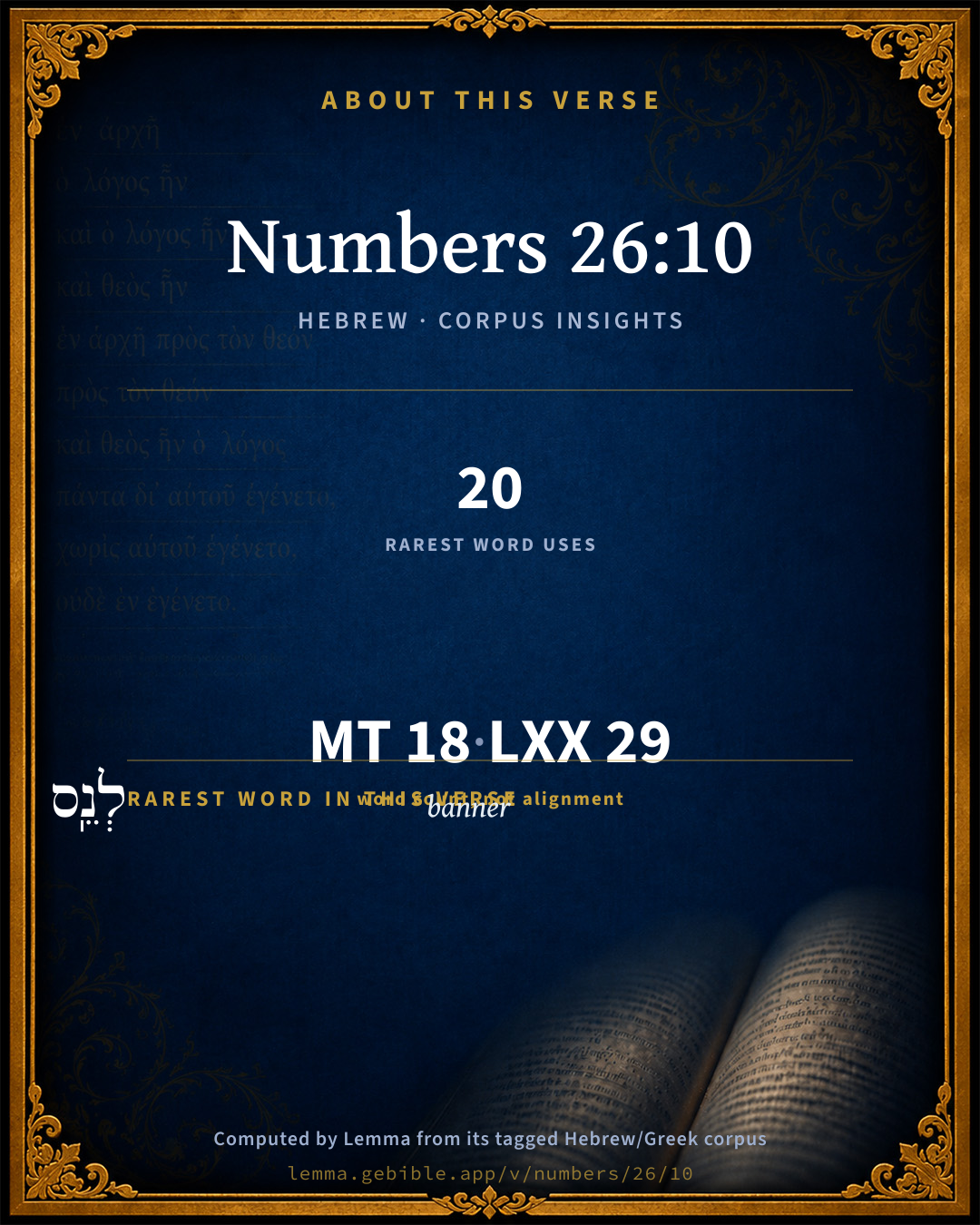
18
words
15
distinct lemmas
Pentateuch
section

Notable vocabulary

The rarest word here is לְנֵֽס banner H5251 — appearing just 20 times in the whole Hebrew Bible.

Shared distinctive vocabulary

לְנֵֽס banner H5251 occurs in 20 verses of the Hebrew Bible. Also found in:

Grammatical profile

  • 4 verbs
  • 8 nouns
  • 2 adjectives
  • 4 particles

Verb forms

  • וַתִּפְתַּ֨ח Qal · Sequential Imperfect
  • וַתִּבְלַ֥ע Qal · Sequential Imperfect
  • בַּאֲכֹ֣ל Qal · Infinitive Construct
  • וַיִּהְי֖וּ Qal · Sequential Imperfect

Hebrew & Septuagint length

In English translation the verse runs 31 words from the Hebrew and 31 from the Septuagint (LXX English) — the same length.

A rough comparison of the two English renderings, which tokenize alike — not a word-level alignment.

Word counts can differ between the Hebrew and the Greek without any difference in meaning — e.g. the Hebrew direct-object marker אֵת has no separate Greek word, and Greek often adds the article ὁ.

In the original languages it is 18 Hebrew tokens and 29 Greek tokens — but the two are counted differently (Hebrew bundles its prefixes and suffixes into one token; the Greek is in lemma form), so that isn’t a like-for-like length.

Cross-references

12

Topical passages linked to Numbers 26:10 in the Treasury of Scripture Knowledge — connected by theme and wording, ordered by reader-vote popularity; previews shown in the World English Bible.

  • Numbers 16:38 even the censers of these sinners against their own lives; and let them be made beaten plates for a covering of the altar: for they offered them before Yahweh; therefore they are holy; and they shall be a sign to the children of Israel.
  • Numbers 16:31–35 It happened, as he made an end of speaking all these words, that the ground split apart that was under them;
  • 2 Peter 2:6 and turning the cities of Sodom and Gomorrah into ashes, condemned them to destruction, having made them an example to those who would live ungodly;
  • Numbers 16:2 and they rose up before Moses, with certain of the children of Israel, two hundred fifty princes of the congregation, called to the assembly, men of renown;
  • 1 Samuel 2:34 This shall be the sign to you, that shall come on your two sons, on Hophni and Phinehas: in one day they shall die both of them.
  • Psalms 106:17–18 The earth opened and swallowed up Dathan, And covered the company of Abiram.
  • Jeremiah 29:22 and of them shall be taken up a curse by all the captives of Judah who are in Babylon, saying, Yahweh make you like Zedekiah and like Ahab, whom the king of Babylon roasted in the fire;
  • Ezekiel 14:8 and I will set my face against that man, and will make him an astonishment, for a sign and a proverb, and I will cut him off from the midst of my people; and you shall know that I am Yahweh.
  • 1 Corinthians 10:6–10 Now these things were our examples, to the intent we should not lust after evil things, as they also lusted.
  • Jude 1:7 Even as Sodom and Gomorrah, and the cities around them, having, in the same way as these, given themselves over to sexual immorality and gone after strange flesh, are set forth as an example, suffering the punishment of eternal fire.
  • Exodus 16:35 The children of Israel ate the manna forty years, until they came to an inhabited land. They ate the manna until they came to the borders of the land of Canaan.
  • Numbers 27:3 Our father died in the wilderness, and he was not among the company of those who gathered themselves together against Yahweh in the company of Korah: but he died in his own sin; and he had no sons.

Cross-references courtesy of OpenBible.info (CC BY 4.0).

Hebrew and Greek witnesses Masoretic Hebrew ↔ Greek Septuagint

The same verse in the two great witnesses to the Old Testament, shown verse-for-verse.

These are two independent witnesses, not word-aligned to each other, and the Septuagint is shown in lemma (dictionary) form.

Hebrew Numbers 26:10 Masoretic · Westminster Leningrad Codex

וַתִּפְתַּ֨ח הָאָ֜רֶץ אֶת פִּ֗יהָ וַתִּבְלַ֥ע אֹתָ֛ם וְאֶת קֹ֖רַח בְּמ֣וֹת הָעֵדָ֑ה בַּאֲכֹ֣ל הָאֵ֗שׁ אֵ֣ת חֲמִשִּׁ֤ים וּמָאתַ֨יִם֙ אִ֔ישׁ וַיִּהְי֖וּ לְנֵֽס

and the earth opened its mouth, and swallowed them up together with Korah, when that company died; what time the fire devoured two hundred fifty men, and they became a sign.

World English Bible · Public Domain

Greek LXX Numbers 26:10 Septuagint · lemma form

καί ἀναοἴγω ὁ γῆ ὁ στόμα αὐτός καταπίνω αὐτός καί κορε ἐν ὁ θάνατος ὁ συναγωγή αὐτός ὅτε καταἐσθίω ὁ πῦρ ὁ πεντήκοντα καί διακόσιοι καί γίγνομαι ἐν σημεῖον

And the earth opened her mouth, and swallowed up them and Core, when their assembly perished, when the fire devoured the two hundred and fifty, and they were made a sign.

LXX2012 (modern English Septuagint) · Public Domain

On this verse, Joseph Benson's Commentary discusses the Septuagint’s reading. Read the note in Commentary ↓

Hebrew: Westminster Leningrad Codex (CC BY 4.0). Greek: Septuagint (public domain); English from LXX2012 (modern English Septuagint) (Public Domain). How the Septuagint differs from the Hebrew →

Targum (Aramaic paraphrase)

2

The Targum is the ancient Jewish Aramaic paraphrase of the Hebrew Scriptures — an interpretive translation, not the Hebrew text itself. Onkelos (literal) and Pseudo-Jonathan (expansive) render the Torah, and Jonathan the Prophets. Coverage is partial: where no permissively-licensed English translation exists for a verse, only the Aramaic is shown. This is verse-level text, not a word-by-word alignment to the Hebrew.

  1. Targum Onkelos Torah (Genesis–Deuteronomy)
    וּפְתָחַת אַרְעָא יַת פּוּמָהּ וּבְלָעַת יָתְהוֹן וְיָת קֹרַח בְּמוֹתָא דִכְנִשְׁתָּא כַּד אֲכָלַת אֵשָׁתָא יַת מָאתָן וְחַמְשִׁין גַבְרָא וַהֲווֹ לְאָת

    (no public-domain English translation for this verse)

    Targum Onkelos — Aramaic: “Onkelos Genesis” (public domain); “Onkelos Exodus” (public domain); “Onkelos Leviticus” (public domain); “Onkelos Numbers” (public domain); “Onkelos Deuteronomy” (public domain). English: “Sefaria Community Translation” (CC0 1.0 (public-domain dedication)); “J.W. Etheridge. The Targums of Onkelos and Jonathan Ben Uzziel on the Pentateuch. London: Longmans, Green, 1862” (public domain). Text via Sefaria.

  2. Targum Pseudo-Jonathan Torah (Genesis–Deuteronomy)
    וּפְתָחַת אַרְעָא יַת פּוּמָהּ וּבְלָעַת יַתְהוֹן וְיַת קרַח כַּד מִיתוּ כְנִישַׁת רַשִׁיעֵי כַּד אָכְלַת אֵישָׁתָא יַת מָאתָן וְחַמְשִׁין גוּבְרִין וַהֲווֹ לְנִיסָיוֹן

    and the earth opened her mouth and swallowed them and Korach, when the congrergation of the wicked died, when the fire devoured the two hundred and fifty men, and they were made an example.

    Targum Pseudo-Jonathan — Aramaic: “Targum Jonathan on Genesis” (public domain); “Targum Jonathan on Exodus” (public domain); “Targum Jonathan on Leviticus” (public domain); “Targum Jonathan on Numbers” (public domain); “Targum Jonathan on Deuteronomy” (public domain). English: “The Targum of Jonathan ben Uzziel, trans. J. W. Etheridge, London, 1862” (public domain). Text via Sefaria.

Commentary

Notes on Numbers 26:10 from classic Christian and Jewish commentators (each source and its license shown beneath its notes). The classic Christian expositions comment on the surrounding passage and are grouped to its opening verse, so a note may address several verses; the Jewish commentaries on the Tanakh (Rashi and others) are per-verse, so they appear only where the commentator wrote on this verse.

Lemma curates 59 commentaries, every one of them public domain or Creative Commons licensed, each selected and text-cleaned for this edition rather than reprinted as found. About our sources →

Trapp's Complete Commentary

John Trapp

Num 26:10 And the earth opened her mouth, and swallowed them up together with Korah, when that company died, what time the fire devoured two hundred and fifty men: and they became a sign.

Ver. 10. And they became a sign.] An example of that rule, that great sins bring great plagues, as Herodotus hath it, speaking of the destruction of Troy. Aliorum perditio, tua sit cautio, Enjoy other men’s madness, &c. Discite iustitiam moniti, &c. Let all that behold me beware; this was written upon the statue of Sennacherib, saith Herodotus.

John Trapp, A Commentary or Exposition upon All the Books of the Old and New Testament (1647–1656) — public domain. Text from a community e-Sword module.

Joseph Benson's Commentary

Num 26:10. Together with Korah — These words seem to import that Korah was swallowed up with Dathan and Abiram. But it being more probable, as was observed on Num 16:32, that Korah was consumed by the fire of God with those who offered incense, the words may be otherwise translated thus: The earth swallowed them up; namely, Dathan and Abiram; and as for Korah, he died with that company, what time the fire devoured, &c. — To the same purpose speak the Samaritan text and Josephus. “Also we have the testimony of the apostolical constitutions, and in effect of Clement of Rome, of Ignatius and Eusebius, that the Septuagint version originally gave the same account.” — Whiston. Junius and Tremellius render the passage, The earth swallowed them up, and what things belonged to Korah; namely, his tent, and goods, and family, his children excepted, as they are here. The psalmist seems to confirm the opinion that Korah was burned with his Levites, mentioning only Dathan and Abiram as being swallowed up, Psa 106:17. They became a sign — A monument of divine vengeance against daring sinners, warning them not to rebel against God, or magistrates, his deputies, nor to usurp the priestly office.

Joseph Benson's Commentary on the Old and New Testaments (1811–1818) — public domain. Text from a community e-Sword module.

Geneva Bible (1599)

Geneva Bible translators

That is, for an example that others should not murmur and rebel against God’s ministers.

Geneva Bible (1599) marginal notes — public domain. Text via Bolls.life.

Jamieson, Fausset & Brown

Robert Jamieson, A. R. Fausset & David Brown

the earth opened her mouth, and swallowed them up together with Korah--rather, "the things of Korah." (See on Num 16:35; compare Psa 106:17).

Jamieson, Fausset & Brown — Commentary Critical and Explanatory on the Whole Bible (1871) — public domain (CC PDM 1.0). Text via the HelloAO Bible API.

Adam Clarke's Commentary

Verse 10. Together with Korah] The Samaritan text does not intimate that Korah was swallowed up, but that he was burnt, as appears in fact to have been the case. And the earth swallowed them up, what time that company died; and the fire devoured Korah with the two hundred and fifty men, who became a sign.

Adam Clarke's Commentary on the Bible (1810–1826) — public domain. Text from a community e-Sword/MySword module.

Ellicott's Commentary for English Readers

(10) And the earth opened her mouth, and swallowed them up together with Korah . . . —Hebrew, and Korah. It would appear from this verse that Korah perished in the earthquake with Dathan and Abiram. The Samaritan Pentateuch, however, has a different reading here. It transposes the words “and Korah,” and combines them with the words”and the two hundred and fifty men”: thus—“when the fire devoured Korah and the two hundred and fifty men.” (See Notes on Num_16:32; Num_16:35.) It is possible that there may have been an omission here of the words which are found in Num_16:32, “all the men that appertained unto,” or of words denoting “all the goods belonging to.”

A Bible Commentary for English Readers, edited by Charles John Ellicott (1878–1897) — public domain. Text from a community e-Sword module.

The Cambridge Bible for Schools and Colleges

gen. ed. J. J. S. Perowne

10. and they became a sign] This is a reference to Num_16:38; but there it is not the offenders but their fire-pans, beaten into plates for the altar, that are a sign.

The Cambridge Bible for Schools and Colleges (gen. ed. J. J. S. Perowne; Cambridge University Press, 1878–1918) — public domain. Text from a community e-Sword module.

John Gill's Exposition

Notwithstanding, the children of Korah died not. Neither of the pestilence, nor by fire, nor by the swallowing up of the earth; they not being in the counsel of their father, but followed the doctrine of Moses the prophet, as the Targum of Jonathan; they either disliked their father's scheme, or, if they engaged with him in it, they repented and departed from him, and were not present when the judgments of God came upon him and his company; there were several of his posterity who were singers in the times of David, and to whom many of the psalms were sent to be sung.

Notwithstanding, the children of Korah died not. Neither of the pestilence, nor by fire, nor by the swallowing up of the earth; they not being in the counsel of their father, but followed the doctrine of Moses the prophet, as the Targum of Jonathan; they either disliked their father's scheme, or, if they engaged with him in it, they repented and departed from him, and were not present when the judgments of God came upon him and his company; there were several of his posterity who were singers in the times of David, and to whom many of the psalms were sent to be sung.

Numbers 26:12

num 26:12

num 26:12

num 26:12The sons of Simeon, after their families,.... This tribe was next numbered, not only because Simeon was next to Reuben by birth, but because his tribe was under the standard of Reuben; two of his sons are a little differently named here than they are in Gen 46:10, there the eldest is called Jemuel, here Nemuel; there the youngest but one is named Zohar, here Zerah; and one of them is here omitted, namely Ohad, perhaps because he died without children, and so no family sprang from him; wherefore the families of Simeon were but five, and the number of them were 22,200; by which it appears there was a very great decrease in this tribe since the last muster, even 37,100 which in some measure is to be accounted for by the great number of this tribe supposed to have died of the plague, on account of fornication and idolatry, made mention of in the preceding chapter; a prince in this tribe having set a bad example, it is probable he was followed in it by many of it, for which great numbers were cut off. Jarchi, from Tanchuma, says, that all the 24,000 that died of the plague was of the tribe of Simeon; and so says the Samaritan Chronicle (o); but that is not likely.

(o) Apud Hottinger. ut supra. (Smegma Oriental, l. 1. c. 8. p. 448.)

John Gill's Exposition of the Whole Bible (1746–1763) — public domain (CC PDM 1.0). Text via the HelloAO Bible API.

Albert Barnes' Notes on the Bible

Together with Korah - i. e., they were engulfed at the same time that Korah perished, for Korah himself appears to bare died among the two hundred and fifty incense offerers at the door of the tabernacle, not with Dathan and Abiram (compare Num 16:32 note).

Albert Barnes' Notes on the Bible (1834–1885) — public domain. Text from a community e-Sword/MySword module.

Haydock's Catholic Bible Commentary

Miracle. Hebrew, "they became a sign," of reproach, and a memorial of God’s just judgments, who caused the earth to swallow up Core and his companions alive, by a most disgraceful kind of death, to which the faithless vestal virgins were condemned at Rome, being buried alive; while those who had offered incense were consumed by fire. Many of the ancients assert that Core was also burnt, meaning perhaps by the fire of hell; to which he descended. (Josephus, [Antiquities?] iv. 3.) --- Others have thought that the children of Core were swallowed up with their father. But this is not true, with respect to some of them at least, (Haydock) who by a miracle of divine grace and goodness, were preserved from joining in his sedition; (Calmet) while Core, his wife and servants, all concurred to shew them such a pernicious example. (Haydock) --- Lyranus and the Rabbins tell us, that the children stopped to intreat their father to repent; and while the earth opened under them, God supported them in the air, and gave them the spirit of prophecy; so that they sung, (Psalm xlv.) God is our refuge, &c., or, according to others, the Psalm xli. which has their name in the title. But these accounts are to be received with caution. The Samaritan text, fuerunt in fugam, (Calmet) may be translated, "out of this world they fled away, (11) and the sons of Core did not perish."

George Leo Haydock (1774–1849), Haydock's Catholic Family Bible and Commentary, 1859 edition — public domain. Excludes Psalms (Douay-Rheims chapter numbering differs from Protestant) and Deuterocanonical books (Catholic canon only).

Matthew Poole's English Annotations

Swallowed them up together with Korah: according to this translation Korah was not consumed by fire with his two hundred and fifty men, Num 16, but swallowed up by the earth. But others rather think he was devoured by the fire, of which see on Num 16:32,35, and render these words, and the things of Korah, or belonging to Korah, to wit, his tent, and goods, and family, children excepted, as here follows; which interpretation receives strength by comparing this place with Num 16:32,

And the earth opened her mouth, and swallowed them (to wit, Dathan and Abiram, as is manifest from Num 26:24,25,27) up, and their houses, and all the men that appertained unto Korah; which variation of the phrase plainly shows that Korah himself was not swallowed up with them, but only his men and his tabernacle, which is mentioned there together with the tabernacles of Dathan and Abiram, Num 26:24,27, but his person is not there mentioned with their persons. Nor is it unusual both in sacred and profane authors, by the name of a man who is the head and master, to understand only his house and family, though himself be not included. But this difficulty may be cleared another way. The Hebrew particle eth may? be here the note of a nominative case, as it is 2Ki 6:5; Neh 9:19; Jer 38:16; Eze 39:14; 43:7, and there may be a defect of a verb, which is most frequent; and so the place may be rendered thus,

and the earth opened her mouth, and swallowed them up, to wit, Dathan and Abiram, Num 26:9, and Korah, or, and as for Korah, he died (which verb is easily understood out of the following noun, of which ellipsis there are many instances in Scripture, some whereof have been given before, and more will follow in their places) in the death of that company, or when that company died, what time the fire devoured the two hundred and fifty men. And so this place, and Num 16:35, explain one another; and whereas there. is mention only of two hundred and fifty men consumed by that fire, Korah is here added to the number.

They became a sign, i.e. God made them a monument or example, to warn others not to rebel against God nor against magistracy, nor to usurp the priestly office.

Matthew Poole's English Annotations on the Holy Bible (1683–1685) — public domain. Text from a community e-Sword/MySword module.

Whedon's Commentary on the Bible

Daniel D. Whedon

10. Together with Korah — The Samaritan text does not intimate that Korah was swallowed up, but that he was burned. See Num_16:25, note; Psa_106:17. This view is sustained by Graves, Boothroyd, Bush, Geddes, Hervey, and Josephus. But Ewald, Keil, Kurtz, and Knobel, think that Korah was engulfed. They argue that he left the two hundred and fifty burning incense at the tabernacle and followed Moses, with the purpose of strengthening Dathan and Abiram in their contumacy; and, standing with them by their tents, was swallowed up. It is clear that he was not in his own tent, which must have been at some little distance, and seems not to have been destroyed.

Became a sign — A warning.

Daniel D. Whedon (gen. ed.), Commentary on the Old and New Testaments (1874–1909) — public domain. Text from a community e-Sword module.

The Pulpit Commentary

Swallowed them up together with Korah. jrqoAtaw lbTiy. Septuagint, katepein autou Kore . This distinct statement, which is not modified in the Targums, seems decisive as to the fate of Korah. If indeed it were quite certain from the detailed narrative in Nu 16 that Korah perished with his own company, and not with the Reubenites, then it might be deemed necessary to force this statement into accordance with that certainty; but it is nowhere stated, or even clearly implied, that he perished by fire, and therefore there is no excuse for doing violence to the obvious meaning of this verse. Korah, Dathan, and Abiram were swallowed up, we are told, at the same time that Korah"s company were consumed by fire; that is a clear statement, and cannot be set aside by any supposed necessity for avenging the sacri1egious ambition of Korah by the element of fire. And they became a sign. The Hebrew properly means a banner or ensign, and is unusual in this sense. It exactly corresponds, however, to the Greek shmeion , and has no doubt the same secondary signification a something made conspicuous in order to attract attention and enforce a warning. (cf. Num_16:30, Num_16:38)

The Pulpit Commentary (1880–1919), ed. H.D.M. Spence-Jones & Joseph S. Exell — public domain. Text from a community e-Sword module.

John Wesley's Explanatory Notes

With Korah - According to this translation Korah was not consumed by fire with his two hundred and fifty men, but swallowed up by the earth. But others rather think he was devoured by the fire, and render these words, and the things of Korah, or belonging to Korah, namely, his tent and goods, and family, children excepted, as here follows. A sign - God made them a monument or example, to warn others not to rebel against God, or magistracy, nor to usurp the priestly office.

John Wesley, Explanatory Notes Upon the Whole Bible (1754–1765) — public domain. Text via the GEBible commentary corpus.

unfoldingWord translationNotes

Door43 World Missions Community

The earth opened its mouth and swallowed them up

Here the earth is spoken of as if it were a person opening its mouth and eating something. AT: "Yahweh caused the earth to split open, and the men fell in the hole" (See: Personification)

fire devoured 250 men

Here the fire is spoken of as if it were a large animal devouring something. AT: "Yahweh caused a fire that killed 250 men" (See: Personification)

250 men

"two hundred and fifty men" (See: Numbers)

Korah's line

"all of Korah's family"

die out

"end"

translationWords

earth

die

fire

devour

sign

unfoldingWord translationNotes — © Distant Shores Media and the Door43 World Missions Community, licensed CC BY-SA 4.0. Source: git.door43.org/Door43/en_tn.

Rashi

Rabbi Shlomo Yitzchaki (Rashi)

ויהיו לנס AND THEY BECAME A נס — a sign and a reminder in order that no stranger should bring himself near to raise further dispute concerning the priesthood (cf. Numbers 17:5).

Rashi on the Tanakh — English translations: “The Judaica Press complete Tanach with Rashi, translated by A. J. Rosenberg” (CC BY 4.0); “Pentateuch with Rashi's commentary by M. Rosenbaum and A.M. Silbermann, 1929-1934” (public domain); “The Metsudah Tanach series, Lakewood, N.J” (CC BY 4.0); and “The Book of Joshua, Metsudah Publications, 1997” (CC BY 4.0). Text via Sefaria.

Lesson kit

Teaching starters — assembled from the data on this page, not authored interpretation. Every prompt links to the verse data it draws on. Edit before teaching.

Numbers, in the Pentateuch, opens this verse with 18 words (15 distinct Hebrew lemmas). Its most distinctive word is nêç (“banner”). A historical commentator’s framing appears above. Read the whole chapter for the surrounding context.

Discussion questions

  1. How does “banner” (nêç) shape what this verse is saying?
  2. How does Numbers 21:8, which shares the word «banner», read alongside this verse?
  3. The translations on this page render this verse differently — a whole-verse word diff, not a word-by-word alignment. What might account for the different wordings?
  4. «וַתִּפְתַּ֨ח» is a Qal Sequential Imperfect verb. How does that grammatical form shape the action described?
  5. Compare how Trapp's Complete Commentary and Joseph Benson's Commentary read this verse. Where do they agree or differ?

Things to notice

Reading settings

Reading text

Shown beneath each verse's original-language words.

Old Testament
Old Testament edition

Read the OT as the Masoretic Hebrew (MT) or the Greek Septuagint (LXX).

English shown for the Greek Septuagint (in the Hebrew ↔ Greek comparison).

Comparing translations? Open the Compare panel on any verse page to stack up to four side by side.