Psalms 66:12

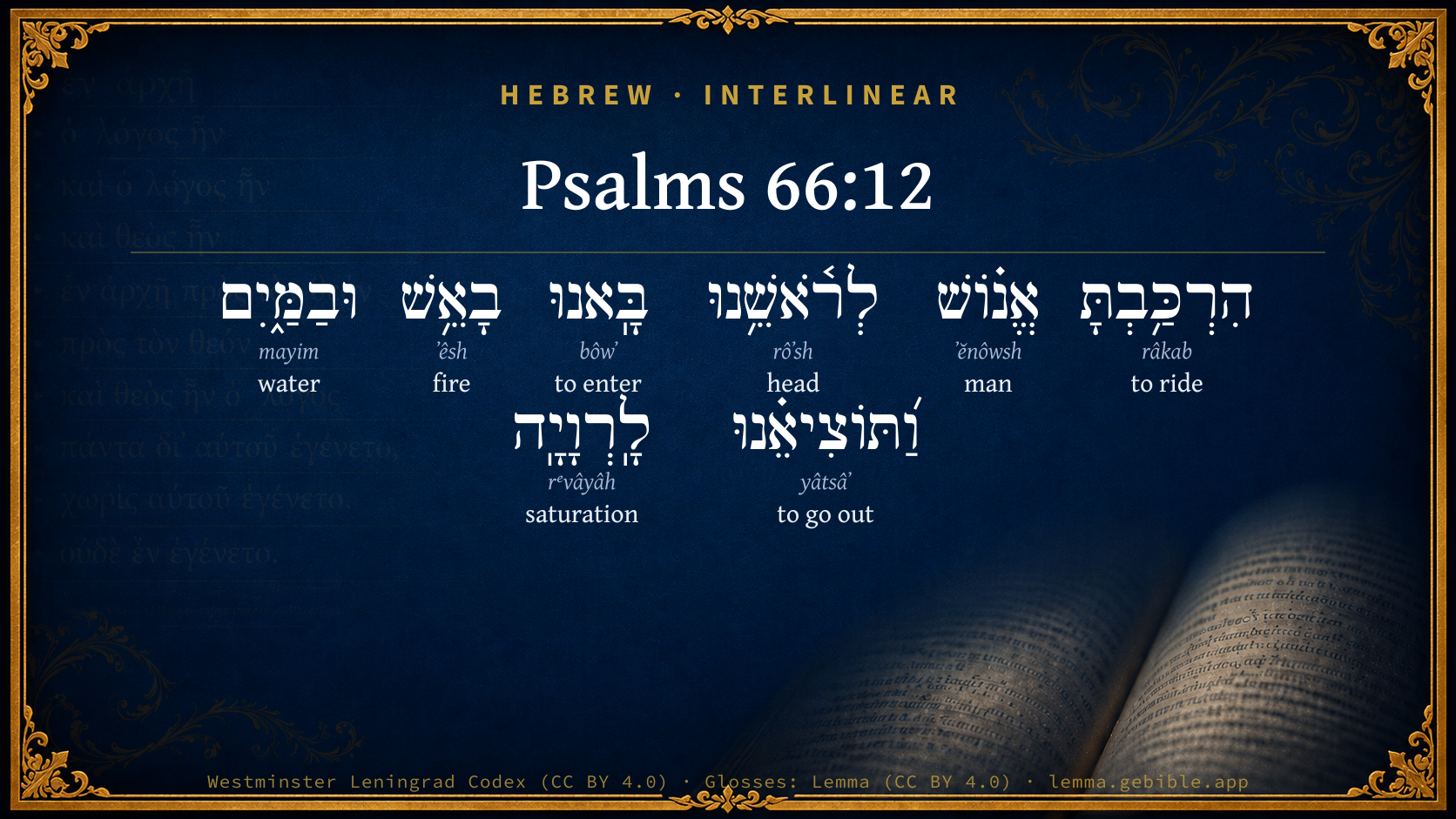
Hebrew (Westminster Leningrad Codex) Psalms 66:12 appears in the Hebrew Old Testament. The text above is from the Westminster Leningrad Codex. Each word links to its Strong’s number, a concise gloss, and parsing drawn from the Open Scriptures Hebrew Bible morphology. Click any word for its full Brown-Driver-Briggs (BDB) entry.
Download image
Cite this verse

Psalms 66:12 (World English Bible). Public Domain. Lemma interlinear Bible study tool, https://lemma.gebible.app/v/psalms/66/12.

Show BibTeX & RIS
BibTeX
RIS
English Translation
You allowed men to ride over our heads. We went through fire and through water, But you brought us to the place of abundance.
World English Bible · Public Domain
Download a study sheet

One document with this verse’s original text, its word-by-word gloss line, the meaning frame, cross-references with their text, attributed commentary, and full source and license credits — printable, and it pastes into notes with its structure intact.

This verse Autodidact and up

Study sheet (.html) Plain text (.txt)

A passage Seminary Student

Up to 50 verses in one chapter. A passage sheet keeps up to 6 commentary sources and 12 cross-references per verse, in the order this page ranks them, and says so on the sheet whenever that leaves anything out. Ask for a single verse and you get the Autodidact verse sheet above.

Everything on this page stays free to read, with no account — the sheet is a download of what is already on screen, not access to it.

Want to remove ads? Support Godless Engineer
Compare translations 3

The same verse in 3 English versions, stacked beneath the original-language interlinear above. Click any original word for its lexicon entry.

Each is an independent rendering of the whole verse — the interlinear is not word-aligned to these translations.

Highlighted words mark where these versions differ — a whole-verse word diff, not a word-by-word alignment.

  • World English Bible Public Domain
    You allowed men to ride over our heads. We went through fire and through water, But you brought us to the place of abundance.
  • King James Version Public Domain
    Thou hast caused men to ride over our heads; we went through fire and through water: but thou broughtest us out into a wealthy place.
  • unfoldingWord Literal Text CC BY-SA 4.0
    You made man ride over our head; we went through fire and through waters, but you brought us out to abundance.

unfoldingWord Literal Text — © unfoldingWord, licensed CC BY-SA 4.0. Word-aligned USFM3 via Door43 (git.door43.org/unfoldingWord/en_ult).

Versions to compare (up to 4)

3 of 4 selected

Show all 18 translations

Every available English version of this verse, each an independent rendering of the whole verse.

  • World English Bible Public Domain
    You allowed men to ride over our heads. We went through fire and through water, But you brought us to the place of abundance.
  • Berean Standard Bible Public Domain
    You let men ride over our heads; we went through fire and water, but You brought us into abundance.
  • Majority Standard Bible Public Domain
    You let men ride over our heads; we went through fire and water, but You brought us into abundance.
  • King James Version Public Domain
    Thou hast caused men to ride over our heads; we went through fire and through water: but thou broughtest us out into a wealthy place.
  • American Standard Version (1901) Public Domain
    Thou didst cause men to ride over our heads; We went through fire and through water; But thou broughtest us out into a wealthy place.
  • Revised Version (1885) Public Domain
    Thou hast caused men to ride over our heads; we went through fire and through water; but thou broughtest us out into a wealthy place.
  • Geneva Bible (1599) Public Domain
    Thou hast caused men to ryde ouer our heads: we went into fire and into water, but thou broughtest vs out into a welthie place.
  • Douay-Rheims (1899) Public Domain
    thou hast set men over our heads. We have passed through tire and water, and thou hast brought us out into a refreshment.
  • Young's Literal Translation Public Domain
    Thou hast caused man to ride at our head. We have entered into fire and into water, And Thou bringest us out to a watered place.
  • Literal Standard Version CC BY-SA 4.0
    You have caused man to ride at our head. We have entered into fire and into water, || And You bring us out to a watered place.
  • Unlocked Literal Bible CC BY-SA 4.0
    You made people ride over our heads; we went through fire and water, but you brought us out into a spacious place.
  • unfoldingWord Literal Text CC BY-SA 4.0
    You made man ride over our head; we went through fire and through waters, but you brought us out to abundance.
  • Darby Bible Public Domain
    Thou didst cause men to ride over our head; we went through fire and through water: but thou hast brought us out into abundance.
  • World Messianic Bible Public Domain
    You allowed men to ride over our heads. We went through fire and through water, but you brought us to the place of abundance.
  • Webster's Bible Public Domain
    Thou hast caused men to ride over our heads; we went through fire and through water: but thou broughtest us out into a wealthy place.
  • Free Bible Version CC BY-SA 4.0
    You let people ride roughshod over us; we suffered through fire and flooding, but you brought us to a safe place.
  • Bible in Basic English Public Domain
    You let men go driving over our heads; we went through fire and through water; but you took us out into a wide place.
  • JPS Tanakh (1917) Public Domain
    Thou hast caused men to ride over our heads; we went through fire and through water; but Thou didst bring us out unto abundance.

Literal Standard Version (2020), Covenant Press — licensed CC BY-SA 4.0. Text via the HelloAO Bible API (eBible.org). Unlocked Literal Bible (unfoldingWord) — licensed CC BY-SA 4.0. Text via the HelloAO Bible API (eBible.org). unfoldingWord Literal Text — © unfoldingWord, licensed CC BY-SA 4.0. Word-aligned USFM3 via Door43 (git.door43.org/unfoldingWord/en_ult). Free Bible Version, Dr. Jonathan Gallagher — licensed CC BY-SA 4.0. Text via the HelloAO Bible API (eBible.org).

Word by word

More ways to search: Search by grammar → Find every occurrence → Compare this word →

Practice this passage: Drill this verse → Learn its vocabulary →

לָֽרְוָיָֽה
rᵉvâyâh
H7310
“to/for the · saturation”
Preposition, Determined + Noun, Common, Feminine, Singular, Absolute
Part of Speech
Preposition + Noun
Type
Common
Gender
Feminine
Number
Singular
State
Absolute
Full BDB Definition

Origin: from H7301

TWOT: 2130c

saturation
  1. הִרְכַּ֥בְתָּ râkab H7392 “to ride” Verb, Hiphil, Perfect, 2nd Person, Masculine, Singular
  2. אֱנ֗וֹשׁ ʼĕnôwsh H582 “man” Noun, Common, Masculine, Singular, Absolute
  3. לְרֹ֫אשֵׁ֥נוּ rôʼsh H7218 “to/for · head · our” Preposition + Noun, Common, Masculine, Singular, Construct + Suffix, Personal, 1st Person, Common, Plural
  4. בָּֽאנוּ bôwʼ H935 “to enter” Verb, Qal, Perfect, 1st Person, Common, Plural
  5. בָאֵ֥שׁ ʼêsh H784 “in/at the · fire” Preposition, Determined + Noun, Common, Both, Singular, Absolute
  6. וּבַמַּ֑יִם mayim H4325 “and · in/at the · water(s)” Conjunction + Preposition, Determined + Noun, Common, Masculine, Plural, Absolute
  7. וַ֝תּוֹצִיאֵ֗נוּ yâtsâʼ H3318 “and · to go out · us” Conjunction + Verb, Hiphil, Sequential Imperfect, 2nd Person, Masculine, Singular + Suffix, Personal, 1st Person, Common, Plural

About this verse

These counts appear in no published source. They are computed here, from the morphology-tagged text and Lemma’s own curated glosses. What Lemma adds →

8
words
8
distinct lemmas
Wisdom
section

Notable vocabulary

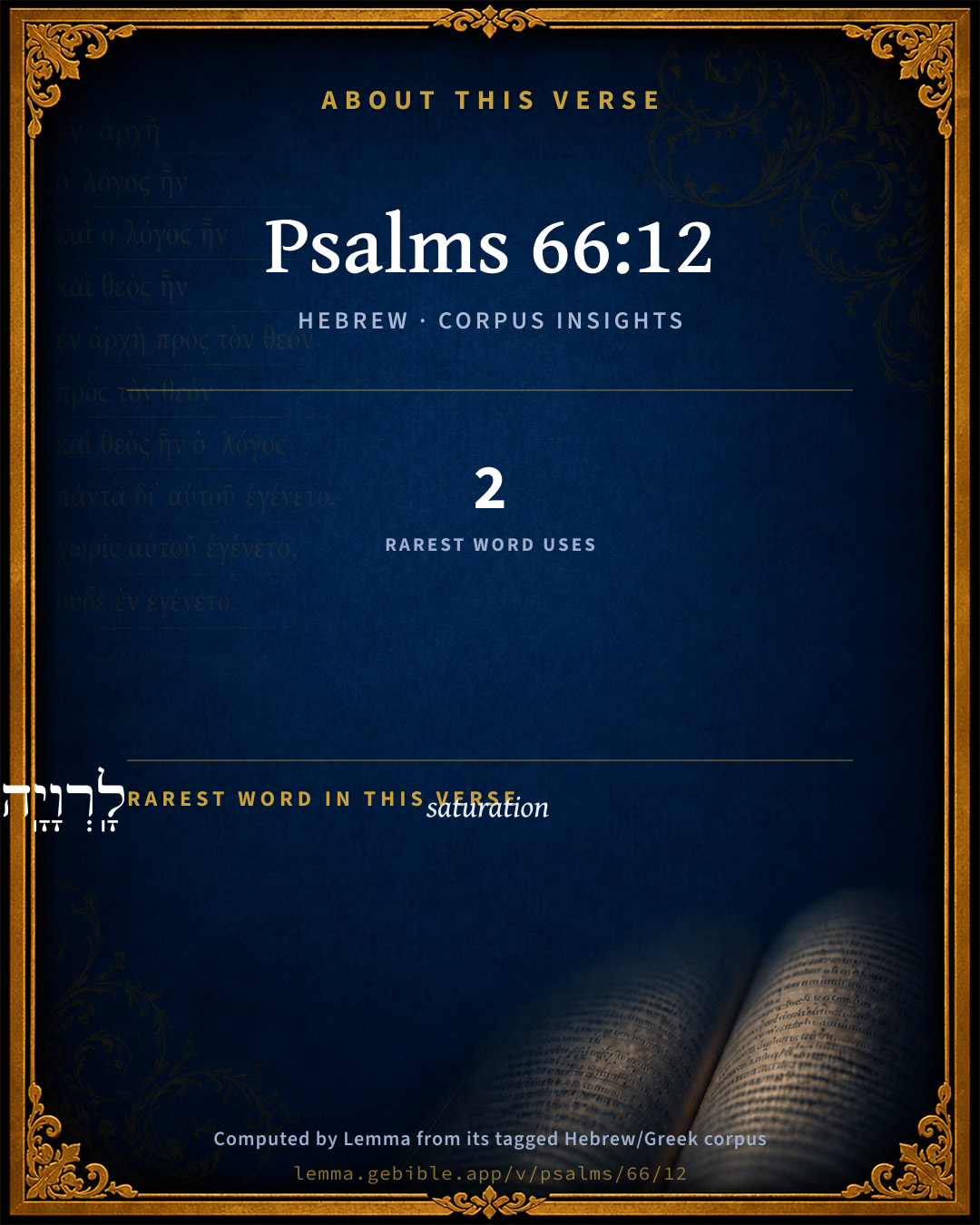
The rarest word here is לָֽרְוָיָֽה saturation H7310 — appearing just 2 times in the whole Hebrew Bible.

Shared distinctive vocabulary

לָֽרְוָיָֽה saturation H7310 occurs in 2 verses of the Hebrew Bible. Also found in:

Grammatical profile

  • 3 verbs
  • 5 nouns

Verb forms

  • הִרְכַּ֥בְתָּ Hiphil · Perfect
  • בָּֽאנוּ Qal · Perfect
  • וַ֝תּוֹצִיאֵ֗נוּ Hiphil · Sequential Imperfect

Hebrew & Septuagint length

In English translation the verse runs 24 words from the Hebrew and 24 from the Septuagint (LXX English) — the same length.

A rough comparison of the two English renderings, which tokenize alike — not a word-level alignment.

Word counts can differ between the Hebrew and the Greek without any difference in meaning — e.g. the Hebrew direct-object marker אֵת has no separate Greek word, and Greek often adds the article ὁ.

Cross-references

13

Topical passages linked to Psalms 66:12 in the Treasury of Scripture Knowledge — connected by theme and wording, ordered by reader-vote popularity; previews shown in the World English Bible.

  • Isaiah 43:1–2 But now thus says Yahweh who created you, Jacob, and he who formed you, Israel: Don't be afraid, for I have redeemed you; I have called you by your name, you are mine.
  • Isaiah 51:23 and I will put it into the hand of those who afflict you, who have said to your soul, Bow down, that we may go over; and you have laid your back as the ground, and as the street, to those who go over.
  • James 5:11 Behold, we call them blessed who endured. You have heard of the patience of Job, and have seen the Lord in the outcome, and how the Lord is full of compassion and mercy.
  • Psalms 40:2–3 He brought me up also out of a horrible pit, Out of the miry clay. He set my feet on a rock, And gave me a firm place to stand.
  • Acts 14:22 confirming the souls of the disciples, exhorting them to continue in the faith, and that through many afflictions we must enter into the Kingdom of God.
  • 1 Thessalonians 3:3–4 that no one be moved by these afflictions. For you know that we are appointed to this task.
  • Revelation 7:14–17 I told him, "My lord, you know." He said to me, "These are those who came out of the great tribulation. They washed their robes, and made them white in the Lamb's blood.
  • Job 36:16 Yes, he would have allured you out of distress, Into a broad place, where there is no restriction. That which is set on your table would be full of fatness.
  • Psalms 107:35–37 He turns a desert into a pool of water, And a dry land into water springs.
  • Psalms 33:19 To deliver their soul from death, To keep them alive in famine.
  • Psalms 129:1–3 Many times they have afflicted me from my youth up. Let Israel now say,
  • Isaiah 35:6–7 Then shall the lame man leap as a hart, and the tongue of the mute shall sing; for in the wilderness shall waters break out, and streams in the desert.
  • Luke 16:25 "But Abraham said, 'Son, remember that you, in your lifetime, received your good things, and Lazarus, in like manner, bad things. But now here he is comforted and you are in anguish.

Cross-references courtesy of OpenBible.info (CC BY 4.0).

Hebrew and Greek witnesses Masoretic Hebrew ↔ Greek Septuagint

The same verse in the two great witnesses to the Old Testament, shown verse-for-verse.

You’re reading Greek Psalm 65 (Hebrew Psalm 66). The Septuagint counts the superscription, so verse numbers can differ from the Hebrew — chapter-level alignment, not verse-by-verse. Numbering follows Rahlfs.

These are two independent witnesses, not word-aligned to each other, and the Septuagint is shown in lemma (dictionary) form.

Hebrew Psalms 66:12 Masoretic · Westminster Leningrad Codex

הִרְכַּ֥בְתָּ אֱנ֗וֹשׁ לְרֹ֫אשֵׁ֥נוּ בָּֽאנוּ בָאֵ֥שׁ וּבַמַּ֑יִם וַ֝תּוֹצִיאֵ֗נוּ לָֽרְוָיָֽה

You allowed men to ride over our heads. We went through fire and through water, But you brought us to the place of abundance.

World English Bible · Public Domain

Greek LXX Greek Psalm 65:12 Septuagint · lemma form

ἐπιβιβάζω ἄνθρωπος ἐπί ὁ κεφαλή ἐγώ διαἔρχομαι διά πυρός καί ὕδωρ καί ἐκἄγω ἐγώ εἰς ἀναψυχή

You did mount men upon our heads; we went through the fire and water; but you brought us out into a place of refreshment.

LXX2012 (modern English Septuagint) · Public Domain

On this verse, Ellicott's Commentary for English Readers discusses the Septuagint’s reading. Read the note in Commentary ↓

Hebrew: Westminster Leningrad Codex (CC BY 4.0). Greek: Septuagint (public domain); English from LXX2012 (modern English Septuagint) (Public Domain). How the Septuagint differs from the Hebrew →

Commentary

Notes on Psalms 66:12 from classic Christian and Jewish commentators (each source and its license shown beneath its notes). The classic Christian expositions comment on the surrounding passage and are grouped to its opening verse, so a note may address several verses; the Jewish commentaries on the Tanakh (Rashi and others) are per-verse, so they appear only where the commentator wrote on this verse.

Lemma curates 59 commentaries, every one of them public domain or Creative Commons licensed, each selected and text-cleaned for this edition rather than reprinted as found. About our sources →

Trapp's Complete Commentary

John Trapp

Psa 66:12 Thou hast caused men to ride over our heads; we went through fire and through water: but thou broughtest us out into a wealthy [place].

Ver. 12. Thou hast caused men to ride over our heads] Subjected us to the villanies and outrages of the basest persons, who have used us more like beasts than men.

We went through fire and through water] That is, through variety of sharpest afflictions, noted out by this proverbial passage; fire and water are merciless elements, Aelius Pertinax fortunae pila pervulgate dicebatur, quod variis casibus exercitus fuit. It is the true Christian’s comfort that nothing befalleth him but by a sweet providence; and that God goeth along with him into both fire and water, Isa 43:2, to see that he take no hurt by either.

But thou broughtest us out into a wealthy place] Heb. moist, that is, into the air, saith Aben Ezra, opposed to fire and water, where we might draw breath, and live comfortably. In locum irriguum, in refrigerium. It is but winking, said that martyr at the stake, and we shall be in heaven immediately. The Arabic hath it, Eduxisti nos ad requiem. Confer Act 3:19.

John Trapp, A Commentary or Exposition upon All the Books of the Old and New Testament (1647–1656) — public domain. Text from a community e-Sword module.

The Biblical Illustrator

Joseph S. Exell

Psa_66:12

Thou hast caused men to ride over our heads.

The rage of oppression

God hath another intent than man hath, even in mans work. The Chaldeans steal Jobs wealth to enrich themselves; the devil afflicts his body in his hatred to mankind; God suffers all this for the trial of his patience. Man for covetousness, the devil for malice, God for probation of the afflicteds constancy, and advancing His own glory. Here are cruel Nimrods riding over innocent heads, as they would over fallow lands; and dangerous passages through fire and water; but the storm is soon ended, or rather the passengers are landed: Thou broughtest us out into a wealthy place. There is desolation and consolation in one verse: a deep dejection, as laid under the feet of beasts; a happy deliverance, brought out into a wealthy place. In both these strains God hath His stroke; He is a principal in this concert. He is brought in for an actor and for an author; an actor in the persecution, an author in the deliverance. Thou causest, etc.; Thou broughtest, etc. In the one He is a causing worker, in the other a soleworking cause. In the one He is joined with company, in the other He works alone. He hath a finger in the former, His whole hand in the latter. Hereupon some wicked libertine may offer to rub his filthiness upon Gods purity, and to plead an authentical derivation of all his villainy against the saints from the Lords warrant: He caused it. We answer, to the justification of truth itself, that God doth ordain and order every persecution that striketh His children, without any allowance to the instrument that gives the blow. God works in the same action with others, not after the same manner. And whom doth the world think to ride over but saints? (Psa_44:22). Who should be appointed to the slaughter but sheep? The wolf will not prey on the fox, he is too crafty; nor on the elephant, he is too mighty; nor on a dog, he is too equal; but on the silly lamb, that can neither run to escape nor fight to conquer. Those whom nature or art, strength or sleight, have made inexposable to easy ruin, may pass unmolested. The wicked will not grapple upon equal terms; they must have either local or ceremonial advantage. But the godly are weak and poor, and it is not hard to prey upon prostrate fortunes. A low hedge is soon trodden down; and over a wretch dejected on the base earth an insulting enemy may easily stride. But what if they ride over our heads, and wound our flesh, let them not wound our patience (Heb_12:1). The agents are men: Thou hast caused men to ride, etc. Man is a sociable-living creature, and should converse with man in love and tranquillity. Man should be a supporter of man; is he become an overthrower? He should help and keep him up; doth he ride over him and tread him under foot? O apostasy, not only from religion, but even from humanity! Lions fight not with lions; serpents spend not their venom on serpents; but man is the main suborner of mischief to his own kind. Our comfort is, that though all these, whether persecutors of our faith or oppressors of our life, ride over our particular heads, yet we have all one Head, whom they cannot touch. Indeed, this Head doth not only take their blows as meant at Him, but He even suffers with us (Act_9:4). Saul strikes on earth; Christ Jesus suffers in heaven. Let but the toe ache, and the head manifests by the countenance a sensible grief. The body of the Church cannot suffer without the sense of our blessed Head. Temptations, persecutions, oppressions, crosses, infamies, bondage, death, are but the way wherein our blessed Saviour went before us; and many saints followed Him. Behold them with the eyes of faith, now mounted above the clouds, trampling all the vanities of this world under their glorified feet; standing on the battlements of heaven, and wafting us to them with the hands of encouragement. They bid us fight, and we shall conquer; suffer, and we shall reign. (T. Adams.)

We went through fire and through water; but Thou broughtest us out into a wealthy place.

The victory of patience

First, We went. They went, so conveniently as they might, and so conscionably as they durst, from the hands of their persecutors, Secondly, the hard exigents they were driven to, when to pass through fire and water was but a less evil compared with that they eschewed.

1. From the former, observe, That it may be lawful in time of persecution to fly. This was granted, yea, in some respects, enjoined by Christ. But must be warily understood; and the rule, in a word, may be this: When our suffering may stand the Church of God in better stead than our flying, we must then lose our lives, to save Gods honour and our own souls. So that suffering for Jesus is a thing to which He promised an ample reward.

2. Prayer. This was the apostles refuge in the time of affliction (Act_2:24). Bernard, in a fiction, doth excellently express this necessity, enforce this duty. Whilst these two opposites, Fear and Hope, stand debating, the Christian soldier resolves to appeal to the direction of sacred Wisdom, who was chief councillor to the captain of the castle, Justice. Hear Wisdom speak: Dost thou know, saith she, that the God whom we serve is able to deliver us? Is he not the Lord of Hosts, even the Lord mighty in battle? We will despatch a messenger to Him with information of our necessity. Fear replies, What messenger? Darkness is on the face of the world; our walls are begirt with an armed troop, which are not only strong as lions, but also watchful as dragons. What messenger can either escape through such a host, or find the way into so remote a country? Wisdom calls for Hope, and chargeth her with all speed to despatch away her old messenger. Hope calls to Prayer, and says, Lo here a messenger speedy, ready, trusty, knowing the way. Ready, you cannot sooner call her than she comes; speedy, she flies faster than eagles, as fast as angels; trusty, what embassage soever you put in her tongue she delivers with faithful secrecy. She knows the way to the court of Mercy, and she will never faint till she come to the chamber of the royal presence. Prayer hath her message, away she flies, borne on the sure and swift wings of faith and zeal; Wisdom having given her a charge, and Hope a blessing. She knocks at the gate, Christ hears her knock, opens the gate, and promiseth her infallible comfort and redress. Back returns Prayer, laden with the news of consolation. She hath a promise, and she delivers it into the hand of Faith: that were our enemies more innumerable than the locusts in Egypt, and more strong than the giants, the sons of Anak, yet Power and Mercy shall fight for us, and we shall be delivered. Pass we, then, through fire and water, through all dangers and difficulties, yet we have a messenger, holy, happy, accessible, acceptable to God, that never comes back without comfort--Prayer. (T. Adams.)

The Biblical Illustrator, edited by Joseph S. Exell (c. 1880s–1900s) — public domain. Text from a community e-Sword module.

J. A. Alexander on Psalms

Joseph Addison Alexander

12. (Psa 66:12) Thou hast caused (or suffered) men to ride at our head, we came into the fire and into the waters, and (now) thou hast caused us to come forth to abundance, overflow, i.e. of enjoyment. Man, frail or mortal man, whose tyranny is therefore the more insupportable. See above, on Psa 8:4. This first clause is ambiguous, in Hebrew as in English. To ride at our head, though an exact translation, suggests only the idea of command or guidance, whereas some kind of suffering is required by the context. The common version, to ride over our heads, presents the image of horsemen trampling on their conquered enemies. Some suppose the idea to be that of riding on us, as a man controls and guides the horse that carries him. The head must then be mentioned only as the noblest part, without implying that the rider actually sits upon it. But this very circumstance makes the interpretation an unnatural and forced one. Fire and water, as the two great destroying elements, are common figures for distress and danger. Compare Isa 23:2. The last Hebrew word in the verse occurs only here and in Psa 23:5.

Joseph Addison Alexander, The Psalms Translated and Explained (1850) — public domain. Text from a community e-Sword module.

Tyndale Open Study Notes

Tyndale Open Resources

66:12 Then you put a leader over us: Or You made people ride over our heads. This expression possibly refers to a foreign ruler who kept the Israelites in submission.

Tyndale Open Study Notes — © Tyndale Open Resources, licensed CC BY-SA 4.0. Text via the HelloAO Bible API.

Jamieson, Fausset & Brown

Robert Jamieson, A. R. Fausset & David Brown

men to ride over our heads--made us to pass.

through fire, &c.--figures describing prostration and critical dangers (compare Isa 43:2; Eze 36:12).

wealthy--literally, "overflowing," or, "irrigated," and hence fertile.

Jamieson, Fausset & Brown — Commentary Critical and Explanatory on the Whole Bible (1871) — public domain (CC PDM 1.0). Text via the HelloAO Bible API.

Adam Clarke's Commentary

Verse 12. Thou hast caused men to ride over our heads] Thou hast permitted us to fall under the dominion of our enemies; who have treated us as broken infantry are when the cavalry dashes among their disordered ranks, treading all under the horses' feet.

We went through fire and through water] Through afflictions of the most torturing and overwhelming nature. To represent such, the metaphors of fire and water are often used in Scripture. The old Psalter considers these trials as a proof of the uprightness of those who were tried - We passid thrugh fire and watir: that is, thurgh wa and wele, as a man that leves noght his waye for hete na for kald, for dry na for wette; and thou out lede us fra tribulacyon intill koling (cooling) that is, in till endles riste, that we hope to hafe after this travell.

Wealthy place.] Well watered place, to wit, the land of Judea.

Adam Clarke's Commentary on the Bible (1810–1826) — public domain. Text from a community e-Sword/MySword module.

Ellicott's Commentary for English Readers

(12) Ride over our heads.—For the figure comp. Isa_51:23.

We went through fire and water.—A figure of extreme danger. (Comp. Isa_43:2.)

A wealthy place.—The LXX. and Vulg., “to refreshment,” which is certainly more in keeping with the figures employed, and may perhaps be got out of the root-idea of the word, “overflow.” But a slight change gives the frequent figure “a broad place.”

A Bible Commentary for English Readers, edited by Charles John Ellicott (1878–1897) — public domain. Text from a community e-Sword module.

The Cambridge Bible for Schools and Colleges

gen. ed. J. J. S. Perowne

12. Better: Thou didst cause … we went … but thou hast brought us out. The figure in the first line is clearly that of the vanquished flung down upon the ground, and trampled remorselessly under the horsehoofs or crushed by the chariot wheels of their conquerors. Cp. Isa_51:23. Representations of a conqueror driving his chariot over prostrate foes may be seen on Egyptian and Assyrian monuments. The sense of outrage is heightened by the word for men, which means mortal men. Cp. Psa_9:19; Psa_10:18; Psa_56:1. Fire and water are symbolical of extreme and varied dangers. Cp. Isa_43:2.

into a wealthy place] Lit., into abundance, the opposite of the privations we endured. But the Ancient Versions point to a different and more suitable reading, a place of liberty. Cp. Psa_18:19; Psa_119:45.

The Cambridge Bible for Schools and Colleges (gen. ed. J. J. S. Perowne; Cambridge University Press, 1878–1918) — public domain. Text from a community e-Sword module.

John Gill's Exposition

Thou hast caused men to ride over our heads,.... Jarchi and Kimchi interpret it of the kings and nations of the world ruling over Israel; and may very well design the Heathen powers and antichristian states tyrannizing over Christian people. The word in the original text is singular, "a man" (c), a frail mortal man; and may be understood of the man of sin and son of perdition; who rides upon the heads of men, exalts himself above all that is called God, and has exercised dominion over the saints in a most lawless and tyrannical manner. Vitringa, on Isa 43:2 interprets it of Antiochus Epiphanes, who was a type of antichrist, and supposes the following clause to refer to the persecution of the church in his time. The Targum renders it, "a lord of rebuke"; that is, either one worthy of rebuke, as antichrist is; or one that gives rebukes, delivers out anathemas and excommunications, as he does: though some translate the words of the Targum, "lords of usury", or "usurers"; a title not unfit for the creatures of antichrist;

we went through fire and through water; through afflictions, compared to fire and water; through fiery trials and overwhelming providences, though not destroyed by them, because the Lord was with them; see Isa 43:2; therefore they are said to go through them, not to abide in them; nor to sink under them, and perish by them: they went cheerfully through them for Christ's sake, even the greatest hardships and difficulties, which this phrase may be expressive of. It may have a particular reference to the sufferings of the saints in Gospel times; to the burning of the martyrs with fire and faggot, who, like Elijah, went up to heaven in a fiery chariot; and to the flood of waters cast out after the woman, the church, by the dragon; see Rev 1:15;

but thou broughtest us out into a wealthy place; the Targum is, into largeness; or into a large place; see Psa 18:19. This may intend either the state of the church upon the Reformation, or rather as it will be in the latter day glory; when there will be a large spread of the Gospel, and of the interest of Christ, everywhere; when the church will be enlarged with converts, and the members of it with the gifts and graces of the Spirit; and which will be a state of great liberty and freedom in the worship of God, both inward and outward. The Septuagint version renders it, "into refreshment": so the Tigurine version, and Piscator; as those times will be times of refreshing from the presence of the Lord, which will be everywhere among his people, in his word and ordinances, and to a great degree; see Act 3:19. The Arabic version, "unto rest"; from adversity, from persecution; for, after this state takes place, there will be no more persecution; no more fines, imprisonment, racks, and torturing deaths, for the sake of Christ and his Gospel. The word used signifies a well watered place (d) or land; such as was the land of Canaan, Deu 8:7; and such will be the state of the church in the latter day: the Spirit will be poured down like floods of water upon the dry ground; the doctrines of the Gospel will drop as the rain, and as showers upon the grass: the ordinances of it will be as green pastures beside the still waters; and every believer will be as a watered garden, whose springs fail not; it will be a time of great plenty and prosperity in spiritual things. Ainsworth renders it, "to an abundant place"; so Gejerus: a place abounding with all good things: a "wealthy" one, as we translate it. And even in a literal sense this will be the wealthy time of the church; when kings shall come into it, and bring their riches and honour there, and use them for the good of it, Isa 49:23; and then also will the saints be enriched with every gift, and be rich in grace and in all good works.

(c) "hominem", Pagninus, Montanus. (d) "ad irrignam", Pagninus, Montanus.

John Gill's Exposition of the Whole Bible (1746–1763) — public domain (CC PDM 1.0). Text via the HelloAO Bible API.

Albert Barnes' Notes on the Bible

Thou hast caused men to ride over our heads - This refers evidently to some national subjection or conquest - most probably to their having been subdued by the Babylonians. Professor Alexander renders this, “Thou hast caused men to ride at our head,” as if leading them forth as captives in war. The most probable meaning, however, is that they had been subdued, as if on a field of battle, and as if their conquerors had ridden over them when prostrate on the ground. Compare the notes at Psa 44:5, and the notes at Isa 51:23.

We went through fire and through water - This is designed to represent the nature of their trials. It was as if they had been made to pass through burning flames and raging floods. Compare the notes at Isa 43:2. Instead of passing through the seas and rivers when the waters had been turned back, and when a dry and safe path was made for them, as was the ease with their fathers Psa 66:6, they had been compelled to breast the flood itself; and yet, notwithstanding this, God had brought them into a place of safety. In either way, by parting the floods, or by conducting his people through them, as shall seem best pleasing to him, God can conduct his people safely, and deliver them from danger. The power, the protecting care, the love, and the faithfulness of God are shown with equal clearness whether he divides the flood and causes his people to march through as on dry land, or whether he suffers the flood to rage and heave around them while he conducts his chosen people safely through.

But there broughtest us out into a wealthy place - Margin, moist. Professor Alexander, overfIow, abundance. Vulgate, info a place of refreshment - refrigerium. The Septuagint, εἰς ἀναψυχήν eis anapsuchēn. Luther, Thou hast led us forth and quickened us. DeWette, zum Ueberflusse - “to overflowing, or abundance.” The Hebrew word - רויה revâyâh - means properly “abundant drink,” “abundance.” It occurs only here and in Psa 23:5, where it is rendered “runneth over.” See the notes at that place. The proper idea here is, that he had brought them into a land where there was plenty of water - as emblematic of abundance in general. He had led them to a place where there were ample rivers, springs, and streams, producing fertility and abundance. This would be the language of the people after their return from exile, and when they were permitted again to re-visit their native land - a land always characterized as a land of plenty. See Deu 8:7; compare Exo 3:8; Lev 20:24; Num 13:27.

Albert Barnes' Notes on the Bible (1834–1885) — public domain. Text from a community e-Sword/MySword module.

Matthew Poole's English Annotations

Men; weak, and mortal, and miserable men, as the word signifies, no better nor stronger than we, if thou hadst not given them power over us.

To ride over our heads; to ride upon our shoulders. By thy permission they have used us like slaves, yea, like beasts, to carry their persons or burdens. Compare Isa 51:23.

Through fire and through water, i.e. through various and dangerous trials and calamities. See Psa 32:6; 69:2; Eze 15:7; 30:8.

Into a wealthy place, Heb. into a moist or well-watered place; such as Canaan was, both in a proper sense and figuratively, as being replenished with Divine graces and blessings.

Matthew Poole's English Annotations on the Holy Bible (1683–1685) — public domain. Text from a community e-Sword/MySword module.

The Treasury of David

Charles H. Spurgeon

Ver. 12. Thou hast caused men to ride over our heads. They stormed, and hectored, and treated us like the mire of the street. Riding the high horse, in their arrogance, they, who were in themselves mean men, treated the Lord's people as if they were the meanest of mankind. They even turned their captives into beasts of burden, and rode upon their heads, as some read the Hebrew. Nothing is too bad for the servants of God when they fall into the hands of proud persecutors.

We went through fire and through water. Trials many and varied were endured by Israel in Egypt, and are still the portion of the saints. The fires of the brick kiln and the waters of the Nile did their worst to destroy the chosen race; hard labour and child murder were both tried by the tyrant, but Israel went through both ordeals unharmed, and even thus the church of God has outlived, and will outlive, all the artifices and cruelties of man. Fire and water are pitiless and devouring, but a divine fiat stays their fury, and forbids these or any other agents from utterly destroying the chosen seed. Many an heir of heaven has had a dire experience of tribulation; the fire through which he has passed has been more terrible than that which chars the bones, for it has fed upon the marrow of his spirit, and burned into the core of his heart; while the waterfloods of affliction have been even more to be feared than the remorseless sea, for they have gone in even unto the soul, and carried the inner nature down into deeps horrible, and not to be imagined without trembling. Yet each saint has been more than conqueror hitherto, and, as it has been, so it shall be. The fire is not kindled which can burn the woman's seed, neither does the dragon know how to vomit a flood which shall suffice to drown it.

But thou broughtest us out into a wealthy place. A blessed issue to a mournful story. Canaan was indeed a broad and royal domain for the once enslaved tribes: God, who took them into Egypt, also brought them into the land which flowed with milk and honey, and Egypt was in his purposes en route to Canaan. The way to heaven is via tribulation.

"The path of sorrow and that path alone,

Leads to the land where sorrow is unknown."

How wealthy is the place of every believer, and how doubly does he feel it to be so in contrast with his former slavery: what songs shall suffice to set forth our joy and gratitude for such a glorious deliverance and such a bountiful heritage. More awaits us. The depth of our griefs bears no proportion to the height of our bliss. For our shame we have double, and more than double. Like Joseph we shall rise from the prison to the palace, like Mordecai we shall escape the gallows prepared by malignity, and ride the white horse and wear the royal robe appointed by benignity. Instead of the net, liberty; instead of a burden on the loins, a crown on our heads; instead of men riding over us, we shall rule over the nations: fire shall no more try us, for we shall stand in glory on the sea of glass mingled with fire; and water shall not harm us, for there shall be no more sea. O the splendour of this brilliant conclusion to a gloomy history. Glory be unto him who saw in the apparent evil the true way to the real good. With patience we will endure the present gloom, for the morning cometh. Over the hills faith sees the daybreak, in whose light we shall enter into the wealthy place.

Ver. 12. Thou hast caused men to ride over our heads. The agents are men. Man is a sociable living creature, and should converse with man in love and tranquillity. Man should be a supporter of man; is he become an overthrower? He should help and keep him up; doth he ride over him and tread him under foot? O apostasy, not only from religion, but even from humanity! Quid homini inimicissimum? Homo. (Seneca.) The greatest danger that befalls man comes whence it should least come, from man himself. Caetera animantia, says Pliny, in suo genere, probe degunt, &c. Lions fight not with lions; serpents spend not their venom on serpents; but man is the main suborner of mischief to his own kind...

1. They ride. What need they mount themselves upon beasts, that have feet malicious enough to trample on us? They have a "foot of pride, "Ps 36:11, from which David prayed to be delivered; a presumptuous heel, which they dare lift up against God; and, therefore, a tyrannous toe, to spurn dejected men. They need not horses and mules, that can kick with the foot of a revengeful malice, Ps 32:9.

2. Over us. The way is broad enough wherein they travel, for it is the devil's road. They might well miss the poor, there is room enough besides; they need not ride over us. It were more brave for them to justle with champions that will not give them the way. We never contend for their path; they have it without our envy, not without our pity. Why should they ride over us?

3. Over our heads. Is it not contentment enough to their pride to ride, to their malice to ride over us, but must they delight in bloodiness to ride over our heads? Will not the breaking of our arms and legs, and such inferior limbs, satisfy their indignation? Is it not enough to rack our strength, to mock our innocence, to prey on our estates, but must they thirst after our bloods and lives? Quo tendit saeva libido? Whither will their madness run? But we must not tie ourselves to the letter. Here is a mystical or metamorphical gradation of their cruelty. Their riding is proud; their riding over us is malicious; and their riding over our heads is bloody oppression. Thomas Adams.

Ver. 12. (first clause). The time was when the Bonners and butchers rode over the faces of God's saints, and madefied (Madefy, to moisten, to make wet) the earth with their bloods, every drop whereof begot a new believer. Thomas Adams.

Ver. 12. Thou hast caused men to ride over our heads. This verse is like that sea (Mt 8:24) so tempestuous at first, that the vessel was covered with waves; but Christ's rebuke quieted all, and there followed a great calm. Here are cruel Nimrods riding over innocent heads, as they would over fallow lands; and dangerous passages through fire and water; but the storm is soon ended, or rather the passengers are landed. Thou broughtest us out into a wealthy place. So that this strain of David's music, or psalmody, consists of two notes--one mournful, the other mirthful; the one a touch of distress, the other of redress: which directs our course to an observation of misery and of mercy; of grievous misery, of gracious mercy. There is desolation and consolation in one verse: a deep dejection, as laid under the feet of beasts; a happy deliverance, broughtest us out into a wealthy place. In both these strains God hath his stroke; he is a principal in this concert. He is brought in for an actor, and for an author; and actor in the persecution, and author in the deliverance. Thou causest, etc; Thou broughtest, etc. In the one he is a causing worker; in the other a sole working cause. In the one he is joined with company: in the other he works alone. He hath a finger in the former; his whole hand is in the latter. We must begin with misery before we come to mercy. If there were no trouble, we should not know the worth of a deliverance. The passion of the saints is given, by the hearty and ponderous description, for very grievous; yet it is written in the forehead of the text, "The Lord caused it." Thou causest men to ride, etc. Hereupon, some wicked libertine may offer to rub his filthiness upon God's purity, and to plead an authentic derivation of all his villainy against the saints from the Lord's warrant: He caused it. We answer, to the justification of truth itself, that God doth ordain and order every persecution that striketh his children, without any allowance to the instrument that gives the blow. God works in the same action with others, not after the same manner. In the affliction of Job were three agents--God, Satan, and the Sabeans. The devil works on his body, the Sabeans on his goods; yet Job confessed a third party: "The Lord gives, and the Lord takes away." Here oppressors trample on the godly, and God is said to cause it. He causeth affliction for trial (so Ps 66:10-11: Thou hast tried us, etc.); they work it for malice; neither can God be accused nor they excused. Thomas Adams.

Ver. 12. Thou hast placed men over our heads. Thus Jerome renders, although the Hebrew noun vwga, is in the singular, the word itself denotes an obscure, mean man, who is mentioned with indignity, but ought to be buried in oblivion. The singular noun is taken collectively, and so also is wgvar, with the affix. Such were the Egyptian and Babylonish idolaters, whom the Hebrew served. To place any one over the head of another, or, as the Hebrew word tbkrh means, to ride, to be superior to, to subdue to oneself and subject, and to sit upon and insult, just as the horseman rules with the rein, and spur, and whip the beast which he rides. Lorinus.

Ver. 12. To ride over our heads. This is an allusion to beasts of burden, and particularly to camels, whose heads the rider almost sits over, and so domineers over them as he pleases. Thomas Fenton, in "Annotations on the Book of Job, and the Psalms." 1732.

Ver. 12. We went through fire and through water. The children of Israel when they had escaped the Red Sea, and seen their enemies the Egyptians dead, they thought all was cocksure, and therefore sang Epicinia, songs of rejoicing for the victory. But what followed within a while? The Lord stirred up another enemy against them from out their bowels, as it were, which was hunger, and this pinched them sorer, they thought, than the Egyptian. But was this the last? No; after the hunger came thirst, and this made them to murmur as much as the former; and after the thirst came fiery serpents, and fire and pestilence, and Amalekites, and Midianites, and what not? Thus hath it been with the church not only under the law, but also under Christ, as it might be easily declared unto you. Neither hath it been better with the several members thereof; they likewise have been made conformable to the body and to the Head. What a sight of temptations did Abraham endure? So Jacob, so Joseph, so the patriarchs, so the prophets? Yea, and all they that would live godly in Christ Jesus, though their sorrow in the end were turned to joy, yet they wept and lamented first. Though they were brought at the length to a wealthy place, yet they passed through fire and water first. Miles Smith, 1624.

Ver. 12. We went through fire and through water. There was a great variety of such perils; and not only of several, but of contrary sorts: We went through fire and through water, either of which singly and alone denotes an extremity of evils. Thus, through water (Ps 69:1-2): "Save me, O God; for the waters are come in unto my soul. I sink in deep mire, where there is no standing: I am come into deep waters, where the floods overflow me." Or, through fire (Eze 15:7): "And I will set my face against them; they shall go out from one fire, and another fire shall devour them; and ye shall know that I am the Lord, when I set my face against them." But when through both successively, one after the other, this denotes an accumulation of miseries, or trials, indeed: as we read Isa 43:2, with God's promise to his people in such conditions: "When thou passest through the waters I will be with thee; and through the rivers, they shall not overflow thee: when thou walkest through the fire, thou shalt not be burned; neither shall the flame kindle upon thee." Which promise is here, you see, acknowledged by the psalmist to have been performed: God was with the three children when they walked through the fire, in the very letter of Isaiah's speech; and with the children of Israel when they went through the water of the Red Sea. Thomas Goodwin.

Ver. 12. We went through fire and through water. In allusion, probably, to the ordeal by fire and water, which is of great antiquity. On the question who had interred the body of Polynices:

"All denied:

Offering, in proof of innocence, to grasp

The burning steel, to walk through fire, and take

Their solemn oath they knew not of the deed." Sophocles. From T. S. Millington's "Testimony of the Heathen to the Truths of Holy Writ." 1863.

Ver. 12. Fire and water. The Jewish law required both these for purification of spoil in war, where they could be borne. Nu 31:23: "Everything that may abide the fire, ye shall make it go through the fire, and it shall be clean: nevertheless it shall be purified through the water of separation." God's saints are, therefore, subject to both ordeals. C. H. S.

Ver. 12. But thou broughtest us out into a wealthy place. Every word is sweetly significant, and amplifies God's mercy to us. Four especially are remarkable: --

1. The deliverer;

2. The deliverance;

3. The delivered; and,

4. Their felicity or blessed advancement.

So there is the deliverer, aliquid celsitudinis, Thou; in the delivery, certitudinis, broughtest out, in the delivered, solitudinis, us; in the happiness, plenitudinis, into a wealthy place. There is highness and lowness, sureness and fulness. The deliverer is great, the deliverance is certain, the distress grievous, the exaltation glorious. There is yet a first word, that like a key unlocks this golden gate of mercy, a veruntamen: --BUT. This is vox respirationis, a gasp that fetcheth back again the very life of comfort. But thou broughtest, etc. We were fearfully endangered into the hands of our enemies; they rode and trod upon us, and drove us through hard perplexities. But thou, etc. If there had been a full point or period at our misery, if those gulfs of persecution had quite swallowed us, and all our light of comfort had been thus smothered and extinguished we might have cried, Periit spes nostra, yea, periit salus nostra. --Our hope, our help is quite gone. He had mocked us that would have spoken, Be of good cheer. This same but is like a happy oar, that turns our vessel from the rocks of despair, and lands it at the haven of comfort. Thomas Adams.

Ver. 12. (second and third clause).

1. The outlet of the trouble is happy. They are in fire and water, yet they get through them; we went through fire and water, and did not perish in the flames or floods. Whatever the troubles of the saints are, blessed be God there is a way through them.

2. The inlet to a better state is much more happy. Thou broughtest us out into a wealthy place, into a well watered place; for the word is, like the gardens of the Lord, and therefore fruitful. Matthew Henry.

Ver. 12. (last clause). Thou, O God, with the temptation hast given the issue. Thou broughtest us out into a wealthy place.

1. Thou hast proved, and thou hast brought.

2. Thou laidest the trouble, and thou tookest it off; yea, and hast made us an ample recompense, for thou hast brought us to a moist, pleasant, lovely, fertile, rich place, a happy condition, a flourishing condition of things, so that thou hast made us to forget all our trouble. William Nicholson, in "David's Harp strung and tuned." 1662.

Ver. 12. A wealthy place. The hand of God led them in that fire and water of affliction through which they went; but who led them out? The psalmist tells us in the next words: Thou broughtest us out into a wealthy place; the margin saith, into a moist place. They were in fire and water before. Fire is the extremity of heat and dryness; water is the extremity of moistness and coldness. A moist place notes a due temperament of heat and cold, of dryness and moistness, and therefore elegantly shadows that comfortable and contented condition into which the good hand of God had brought them, which is significantly expressed in our translation by a wealthy place; those places flourishing most in fruitfulness, and so in wealth, which are neither over hot nor over cold, neither over dry not over moist. Joseph Caryl.

Ver. 12. Fire and water. Varied trials.

1. Discover different evils.

2. Test all parts of manhood.

3. Educate varied graces.

4. Endear many promises.

5. Illustrate divine attributes.

6. Afford extensive knowledge.

7. Create capacity for the varied joys of heaven.

Ver. 12. (first clause). The rage of oppression. Thomas Adam's Sermon.

Ver. 12. (last clause). A plentiful place, free from penury; a pleasant place, void of sorrow; a safe place, free from dangers and distresses. Daniel Wilcocks.

Ver. 12. (last clause). The victory of patience, with the expiration of malice. Thomas Adams' Sermon.

Ver. 12. (last clause). The wealth of a soul whom God has tried and delivered. Among other riches he has the wealth of experience, of strengthened graces, of confirmed faith, and of sympathy for others.

Psalms 66:13*

Charles H. Spurgeon's The Treasury of David (1869–1885) — public domain. Psalms only. Text from a community e-Sword/MySword module.

Whedon's Commentary on the Bible

Daniel D. Whedon

12. Thou hast caused men to ride over our heads—Rabbi Schwarz, of Jerusalem, thinks (Palest., p. 422) this an allusion to the method of transporting travellers over the wadies in the rainy seasons, when the streams overflow their banks. “When they begin to grow a little shallow, and the travellers are tired of waiting, a set of tall and strongly built Bedouins make their appearance, and, as it is their business to transport men and baggage across the stream, they undress themselves completely, take the traveller—who embraces their head quite firmly—on their shoulders, and wade through, whilst the water often stands up to their breast, and place their burden safely on the other shore.” The service is alluded to as quite servile and humiliating.

Daniel D. Whedon (gen. ed.), Commentary on the Old and New Testaments (1874–1909) — public domain. Text from a community e-Sword module.

The Pulpit Commentary

Thou hast caused men to ride over our heads. See the Egyptian and Assyrian sculptures passim, where the king in his chariot gallops over the bodies of his dead and wounded enemies. We went through fire and through water; i.e. through dangers of every kind a proverbial expression. (comp. Isa_43:2) But thou broughtest us out into a wealthy place; or, "a place of refreshment" (eiv anaquchn , LXX). Dr. Kay renders, "a place of rich comfort;" Professor Cheyne, "a place of liberty". (comp. Psa_23:4 and Jer_31:25)

The Pulpit Commentary (1880–1919), ed. H.D.M. Spence-Jones & Joseph S. Exell — public domain. Text from a community e-Sword module.

John Wesley's Explanatory Notes

To ride - To use us like slaves.

John Wesley, Explanatory Notes Upon the Whole Bible (1754–1765) — public domain. Text via the GEBible commentary corpus.

Rashi

Rabbi Shlomo Yitzchaki (Rashi)

You caused man to ride at our head The kings of all the heathen nations.

Rashi on the Tanakh — English translations: “The Judaica Press complete Tanach with Rashi, translated by A. J. Rosenberg” (CC BY 4.0); “Pentateuch with Rashi's commentary by M. Rosenbaum and A.M. Silbermann, 1929-1934” (public domain); “The Metsudah Tanach series, Lakewood, N.J” (CC BY 4.0); and “The Book of Joshua, Metsudah Publications, 1997” (CC BY 4.0). Text via Sefaria.

Lesson kit

Teaching starters — assembled from the data on this page, not authored interpretation. Every prompt links to the verse data it draws on. Edit before teaching.

Psalms, in the Wisdom, opens this verse with 8 words (8 distinct Hebrew lemmas). Its most distinctive word is rᵉvâyâh (“saturation”). A historical commentator’s framing appears above. Read the whole chapter for the surrounding context.

Discussion questions

  1. How does “saturation” (rᵉvâyâh) shape what this verse is saying?
  2. How does Psalms 23:5, which shares the word «saturation», read alongside this verse?
  3. The translations on this page render this verse differently — a whole-verse word diff, not a word-by-word alignment. What might account for the different wordings?
  4. «הִרְכַּ֥בְתָּ» is a Hiphil Perfect verb. How does that grammatical form shape the action described?
  5. Compare how Trapp's Complete Commentary and The Biblical Illustrator read this verse. Where do they agree or differ?

Things to notice

Reading settings

Reading text

Shown beneath each verse's original-language words.

Old Testament
Old Testament edition

Read the OT as the Masoretic Hebrew (MT) or the Greek Septuagint (LXX).

English shown for the Greek Septuagint (in the Hebrew ↔ Greek comparison).

Comparing translations? Open the Compare panel on any verse page to stack up to four side by side.