
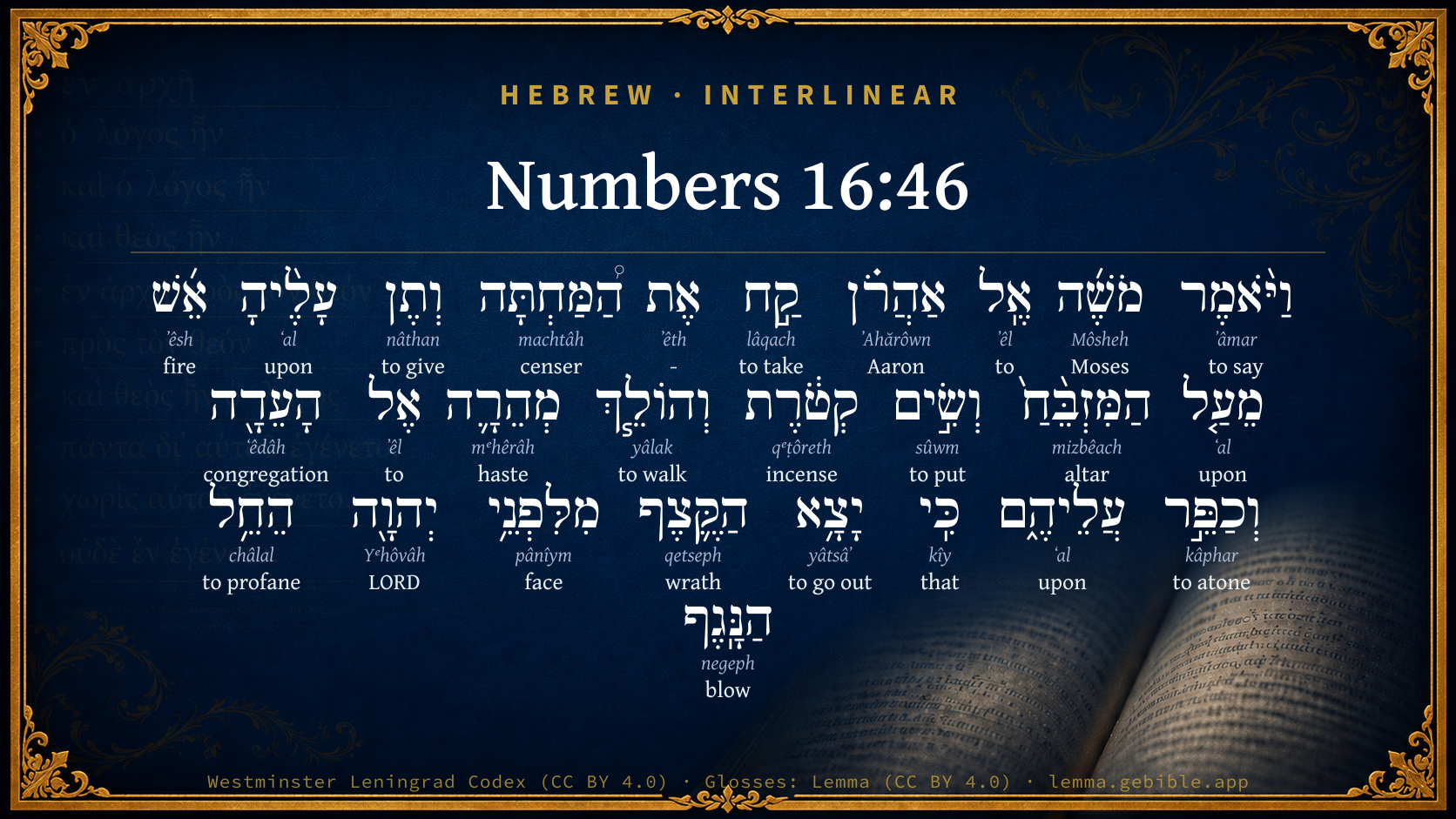
Numbers 16:46

Hebrew (Westminster Leningrad Codex) Numbers 16:46 appears in the Hebrew Old Testament. The text above is from the Westminster Leningrad Codex. Each word links to its Strong’s number, a concise gloss, and parsing drawn from the Open Scriptures Hebrew Bible morphology. Click any word for its full Brown-Driver-Briggs (BDB) entry.
Download image
Cite this verse

Numbers 16:46 (World English Bible). Public Domain. Lemma interlinear Bible study tool, https://lemma.gebible.app/v/numbers/16/46.

Show BibTeX & RIS
BibTeX
RIS
English Translation
Moses said to Aaron, Take your censer, and put fire therein from off the altar, and lay incense thereon, and carry it quickly to the congregation, and make atonement for them: for there is wrath gone out from Yahweh; the plague is begun.
World English Bible · Public Domain
Highlights
  • 1 first appearance in the Hebrew Bible
Full analysis ↓
Download a study sheet

One document with this verse’s original text, its word-by-word gloss line, the meaning frame, cross-references with their text, attributed commentary, and full source and license credits — printable, and it pastes into notes with its structure intact.

This verse Autodidact and up

Study sheet (.html) Plain text (.txt)

A passage Seminary Student

Up to 50 verses in one chapter. A passage sheet keeps up to 6 commentary sources and 12 cross-references per verse, in the order this page ranks them, and says so on the sheet whenever that leaves anything out. Ask for a single verse and you get the Autodidact verse sheet above.

Everything on this page stays free to read, with no account — the sheet is a download of what is already on screen, not access to it.

Want to remove ads? Support Godless Engineer
Compare translations 3

The same verse in 3 English versions, stacked beneath the original-language interlinear above. Click any original word for its lexicon entry.

Each is an independent rendering of the whole verse — the interlinear is not word-aligned to these translations.

Highlighted words mark where these versions differ — a whole-verse word diff, not a word-by-word alignment.

  • World English Bible Public Domain
    Moses said to Aaron, Take your censer, and put fire therein from off the altar, and lay incense thereon, and carry it quickly to the congregation, and make atonement for them: for there is wrath gone out from Yahweh; the plague is begun.
  • King James Version Public Domain
    And Moses said unto Aaron, Take a censer, and put fire therein from off the altar, and put on incense, and go quickly unto the congregation, and make an atonement for them: for there is wrath gone out from the LORD; the plague is begun.
  • unfoldingWord Literal Text CC BY-SA 4.0
    And Moses said to Aaron, “Take the censer, and put fire on it from upon the altar, and set incense, and bring quickly to the congregation, and make atonement for them, for the wrath has gone out from to the face of Yahweh. The plague has begun.”

unfoldingWord Literal Text — © unfoldingWord, licensed CC BY-SA 4.0. Word-aligned USFM3 via Door43 (git.door43.org/unfoldingWord/en_ult).

Versions to compare (up to 4)

3 of 4 selected

Show all 18 translations

Every available English version of this verse, each an independent rendering of the whole verse.

  • World English Bible Public Domain
    Moses said to Aaron, Take your censer, and put fire therein from off the altar, and lay incense thereon, and carry it quickly to the congregation, and make atonement for them: for there is wrath gone out from Yahweh; the plague is begun.
  • Berean Standard Bible Public Domain
    Moses said to Aaron, “Take your censer, place fire from the altar in it, and add incense. Go quickly to the congregation and make atonement for them, because wrath has come out from the LORD; the plague has begun.”
  • Majority Standard Bible Public Domain
    Moses said to Aaron, “Take your censer, place fire from the altar in it, and add incense. Go quickly to the congregation and make atonement for them, because wrath has come out from the LORD; the plague has begun.”
  • King James Version Public Domain
    And Moses said unto Aaron, Take a censer, and put fire therein from off the altar, and put on incense, and go quickly unto the congregation, and make an atonement for them: for there is wrath gone out from the LORD; the plague is begun.
  • American Standard Version (1901) Public Domain
    And Moses said unto Aaron, Take they censer, and put fire therein from off the altar, and lay incense thereon, and carry it quickly unto the congregation, and make atonement for them: for there is wrath gone out from Jehovah; the plague is begun.
  • Revised Version (1885) Public Domain
    And Moses said unto Aaron, Take thy censer, and put fire therein from off the altar, and lay incense thereon, and carry it quickly unto the congregation, and make atonement for them: for there is wrath gone out from the LORD; the plague is begun.
  • Geneva Bible (1599) Public Domain
    And Moses said vnto Aaron, Take the censer and put fire therein of the Altar, and put therein incense, and goe quickly vnto the Congregation, and make an atonement for them: for there is wrath gone out from the Lord: the plague is begunne.
  • Douay-Rheims (1899) Public Domain
    Moses said to Aaron: Take the censer, and putting fire in it from the altar, put incense upon it, and go quickly to the people to pray for them: for already wrath is gone out from the Lord, and the plague rageth.
  • Young's Literal Translation Public Domain
    and Moses saith unto Aaron, `Take the censer, and put on it fire from off the altar, and place perfume, and go, hasten unto the company, and make atonement for them, for the wrath hath gone out from the presence of Jehovah -- the plague hath begun.'
  • Literal Standard Version CC BY-SA 4.0
    and Moses says to Aaron, “Take the censer and put fire on it from off the altar, and place incense, and go quickly to the congregation and make atonement for them, for the wrath has gone out from the presence of YHWH—the plague has begun.”
  • Unlocked Literal Bible CC BY-SA 4.0
    Moses said to Aaron, “Take the censer, put fire in it from off the altar, put incense in it, carry it quickly to the community, and make atonement for them, because anger is coming from Yahweh. The plague has begun.”
  • unfoldingWord Literal Text CC BY-SA 4.0
    And Moses said to Aaron, “Take the censer, and put fire on it from upon the altar, and set incense, and bring quickly to the congregation, and make atonement for them, for the wrath has gone out from to the face of Yahweh. The plague has begun.”
  • Darby Bible Public Domain
    And Moses said to Aaron, Take the censer, and put fire thereon from off the altar, and lay on incense, and carry it quickly to the assembly, and make atonement for them; for there is wrath gone out from Jehovah: the plague is begun.
  • World Messianic Bible Public Domain
    Moses said to Aaron, “Take your censer, put fire from the altar in it, lay incense on it, carry it quickly to the congregation, and make atonement for them; for wrath has gone out from the LORD! The plague has begun.”
  • Webster's Bible Public Domain
    And Moses said to Aaron, Take a censer, and put fire in it from off the altar, and put on incense, and go quickly to the congregation, and make an atonement for them: for there is wrath gone out from the LORD; the plague is begun.
  • Free Bible Version CC BY-SA 4.0
    Moses told Aaron, “Put some coals from the altar and some incense in your incense burner. Then run to the people and make them right before the Lord, for the Lord is angry with them and a plague has started.”
  • Bible in Basic English Public Domain
    And Moses said to Aaron, Take your vessel and put in it fire from the altar, and sweet spices, and take it quickly into the meeting of the people, and make them free from sin: for wrath has gone out from the Lord, and the disease is starting.
  • JPS Tanakh (1917) Public Domain
    (17-11) And Moses said unto Aaron: 'Take thy fire-pan, and put fire therein from off the altar, and lay incense thereon, and carry it quickly unto the congregation, and make atonement for them; for there is wrath gone out from the LORD: the plague is begun.'

Literal Standard Version (2020), Covenant Press — licensed CC BY-SA 4.0. Text via the HelloAO Bible API (eBible.org). Unlocked Literal Bible (unfoldingWord) — licensed CC BY-SA 4.0. Text via the HelloAO Bible API (eBible.org). unfoldingWord Literal Text — © unfoldingWord, licensed CC BY-SA 4.0. Word-aligned USFM3 via Door43 (git.door43.org/unfoldingWord/en_ult). Free Bible Version, Dr. Jonathan Gallagher — licensed CC BY-SA 4.0. Text via the HelloAO Bible API (eBible.org).

Word by word

More ways to search: Search by grammar → Find every occurrence → Compare this word →

Practice this passage: Drill this verse → Learn its vocabulary →

הַנָּֽגֶף
negeph
H5063
“the · blow”
Particle, Definite Article + Noun, Common, Masculine, Singular, Absolute
Part of Speech
Particle + Noun
Type
Common
Gender
Masculine
Number
Singular
State
Absolute
Full BDB Definition

Origin: from H5062

TWOT: 1294a

blow, striking, plague - blow, plague (fatal) - striking
  1. וַיֹּ֨אמֶר ʼâmar H559 “and · to say” Conjunction + Verb, Qal, Sequential Imperfect, 3rd Person, Masculine, Singular
  2. מֹשֶׁ֜ה Môsheh H4872 “Moses” Noun, Proper
  3. אֶֽל ʼêl H413 “to” Preposition
  4. אַהֲרֹ֗ן ʼAhărôwn H175 “Aaron” Noun, Proper
  5. קַ֣ח lâqach H3947 “take” Verb, Qal, Imperative, 2nd Person, Masculine, Singular
  6. אֶת ʼêth H853 “-” Particle, Direct Object
  7. הַ֠מַּחְתָּה machtâh H4289 “the · censer” Particle, Definite Article + Noun, Common, Feminine, Singular, Absolute
  8. וְתֶן nâthan H5414 “and · give” Conjunction + Verb, Qal, Imperative, 2nd Person, Masculine, Singular
  9. עָלֶ֨יהָ ʻal H5921 “upon · her” Preposition + Suffix, Personal, 3rd Person, Feminine, Singular
  10. אֵ֜שׁ ʼêsh H784 “fire” Noun, Common, Both, Singular, Absolute
  11. מֵעַ֤ל ʻal H5921 “from · upon” Preposition + Preposition
  12. הַמִּזְבֵּ֨חַ֙ mizbêach H4196 “the · altar” Particle, Definite Article + Noun, Common, Masculine, Singular, Absolute
  13. וְשִׂ֣ים sûwm H7760 “and · put” Conjunction + Verb, Qal, Imperative, 2nd Person, Masculine, Singular
  14. קְטֹ֔רֶת qᵉṭôreth H7004 “incense” Noun, Common, Feminine, Singular, Absolute
  15. וְהוֹלֵ֧ךְ yâlak H3212 “and · walk” Conjunction + Verb, Hiphil, Imperative, 2nd Person, Masculine, Singular
  16. מְהֵרָ֛ה mᵉhêrâh H4120 “haste” Noun, Common, Feminine, Singular, Absolute
  17. אֶל ʼêl H413 “to” Preposition
  18. הָעֵדָ֖ה ʻêdâh H5712 “the · congregation” Particle, Definite Article + Noun, Common, Feminine, Singular, Absolute
  19. וְכַפֵּ֣ר kâphar H3722 “and · atone” Conjunction + Verb, Piel, Imperative, 2nd Person, Masculine, Singular
  20. עֲלֵיהֶ֑ם ʻal H5921 “upon · them” Preposition + Suffix, Personal, 3rd Person, Masculine, Plural
  21. כִּֽי kîy H3588 “that” Conjunction
  22. יָצָ֥א yâtsâʼ H3318 “to go out” Verb, Qal, Perfect, 3rd Person, Masculine, Singular
  23. הַקֶּ֛צֶף qetseph H7110 “the · wrath” Particle, Definite Article + Noun, Common, Masculine, Singular, Absolute
  24. מִלִּפְנֵ֥י pânîym H6440 “from · to/for · face(s) of” Preposition + Preposition + Noun, Common, Both, Plural, Construct
  25. יְהוָ֖ה Yᵉhôvâh H3068 “LORD” Noun, Proper
  26. הֵחֵ֥ל châlal H2490 “to profane” Verb, Hiphil, Perfect, 3rd Person, Masculine, Singular

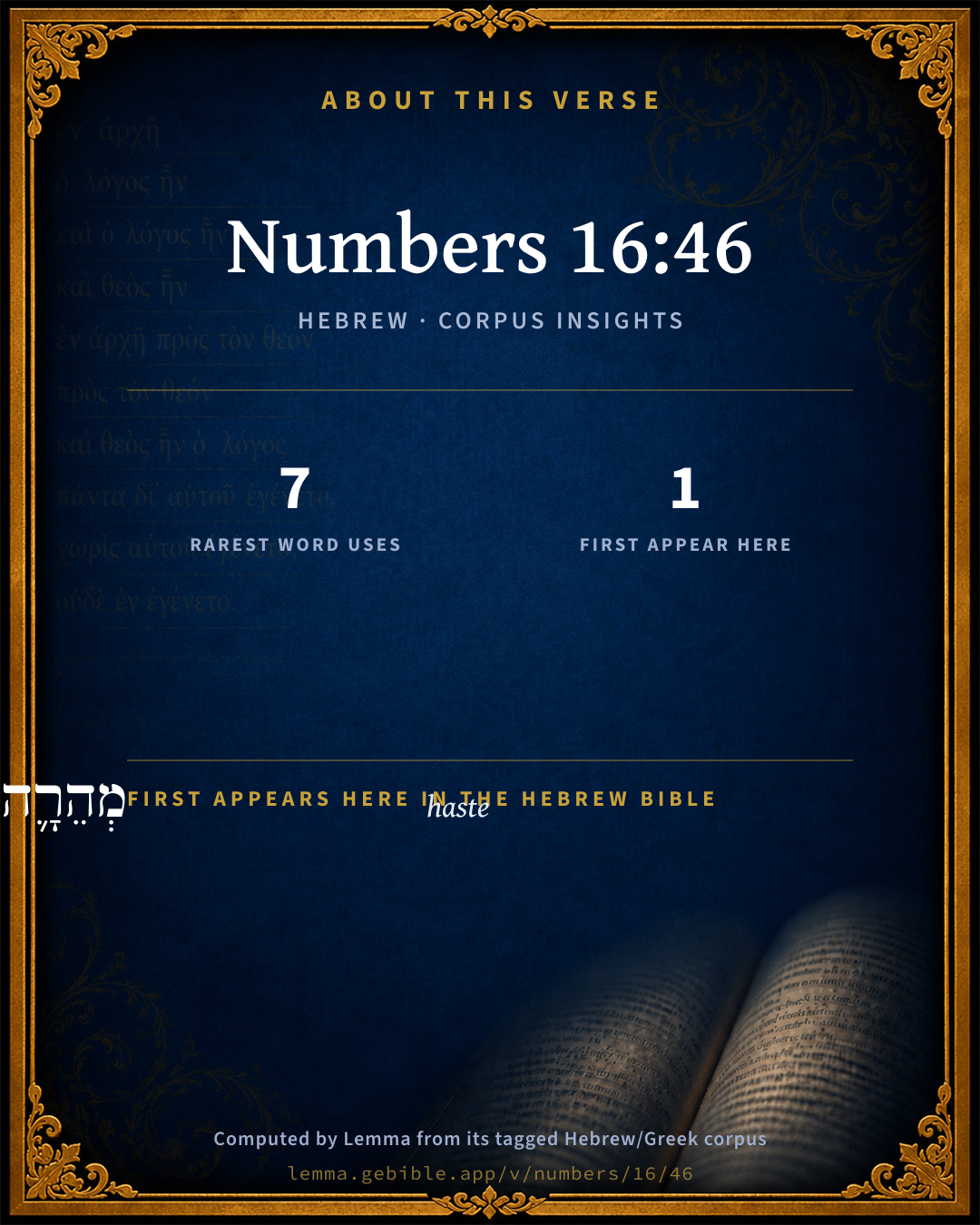
About this verse

These counts appear in no published source. They are computed here, from the morphology-tagged text and Lemma’s own curated glosses. What Lemma adds →

27
words
24
distinct lemmas
Pentateuch
section

Notable vocabulary

The rarest word here is הַנָּֽגֶף blow H5063 — appearing just 7 times in the whole Hebrew Bible.

First appearance in Scripture

This word makes its first canonical appearance in the Hebrew Bible here:

  • מְהֵרָ֛ה haste H4120

Shared distinctive vocabulary

הַנָּֽגֶף blow H5063 occurs in 7 verses of the Hebrew Bible. Also found in:

Grammatical profile

  • 8 verbs
  • 12 nouns
  • 5 prepositions
  • 1 conjunction
  • 1 particle

Verb forms

  • וַיֹּ֨אמֶר Qal · Sequential Imperfect
  • קַ֣ח Qal · Imperative
  • וְתֶן Qal · Imperative
  • וְשִׂ֣ים Qal · Imperative
  • וְהוֹלֵ֧ךְ Hiphil · Imperative
  • וְכַפֵּ֣ר Piel · Imperative
  • יָצָ֥א Qal · Perfect
  • הֵחֵ֥ל Hiphil · Perfect

Repetition

Words recur within this verse — often emphatic in Hebrew:

  • עָלֶ֨יהָ upon H5921 ×3
  • אֶֽל to H413 ×2

Hebrew & Septuagint length

In English translation the verse runs 43 words from the Hebrew and 52 from the Septuagint (LXX English) — closely comparable.

A rough comparison of the two English renderings, which tokenize alike — not a word-level alignment.

Word counts can differ between the Hebrew and the Greek without any difference in meaning — e.g. the Hebrew direct-object marker אֵת has no separate Greek word, and Greek often adds the article ὁ.

Cross-references

20

Topical passages linked to Numbers 16:46 in the Treasury of Scripture Knowledge — connected by theme and wording, ordered by reader-vote popularity; previews shown in the World English Bible.

  • Numbers 8:19 I have given the Levites as a gift to Aaron and to his sons from among the children of Israel, to do the service of the children of Israel in the Tent of Meeting, and to make atonement for the children of Israel; that there be no plague among the children of Israel, when the children of Israel come near to the sanctuary."
  • Leviticus 10:6 Moses said to Aaron, and to Eleazar and to Ithamar, his sons, "Don't let the hair of your heads go loose, neither tear your clothes; that you don't die, and that he not be angry with all the congregation: but let your brothers, the whole house of Israel, bewail the burning which Yahweh has kindled.
  • 1 Chronicles 27:24 Joab the son of Zeruiah began to number, but didn't finish; and there came wrath for this on Israel; neither was the number put into the account in the chronicles of king David.
  • Numbers 11:33 While the flesh was yet between their teeth, before it was chewed, the anger of Yahweh was kindled against the people, and Yahweh struck the people with a very great plague.
  • Numbers 18:5 You shall keep the charge of the sanctuary, and the charge of the altar; that there be wrath no more on the children of Israel.
  • Psalms 106:29 Thus they provoked him to anger with their deeds. The plague broke in on them.
  • Isaiah 6:6–7 Then one of the seraphim flew to me, having a live coal in his hand, which he had taken with the tongs from off the altar.
  • Revelation 8:3–5 Another angel came and stood over the altar, having a golden censer. Much incense was given to him, that he should add it to the prayers of all the saints on the golden altar which was before the throne.
  • Leviticus 9:24–10:1 There came forth fire from before Yahweh, and consumed the burnt offering and the fat upon the altar: and when all the people saw it, they shouted, and fell on their faces.
  • Psalms 141:2 Let my prayer be set before you like incense; The lifting up of my hands like the evening sacrifice.
  • Hebrews 9:25–26 nor yet that he should offer himself often, as the high priest enters into the holy place year by year with blood not his own,
  • Exodus 30:7–10 Aaron shall burn incense of sweet spices on it every morning. When he tends the lamps, he shall burn it.
  • Leviticus 16:11–16 "Aaron shall present the bull of the sin offering, which is for himself, and shall make atonement for himself and for his house, and shall kill the bull of the sin offering which is for himself.
  • Numbers 1:53 But the Levites shall encamp around the Tabernacle of the Testimony, that there may be no wrath on the congregation of the children of Israel: and the Levites shall be responsible for the Tabernacle of the Testimony."
  • Numbers 25:13 and it shall be to him, and to his seed after him, the covenant of an everlasting priesthood; because he was jealous for his God, and made atonement for the children of Israel.
  • Deuteronomy 9:22 At Taberah, and at Massah, and at Kibroth-hattaavah, you provoked Yahweh to wrath.
  • Malachi 1:11 For from the rising of the sun even to the going down of the same, my name is great among the nations, and in every place incense will be offered to my name, and a pure offering: for my name is great among the nations," says Yahweh of Hosts.
  • Romans 5:9–10 Much more then, being now justified by his blood, we will be saved from God's wrath through him.
  • Hebrews 7:25–27 Therefore he is also able to save to the uttermost those who draw near to God through him, seeing he ever lives to make intercession for them.
  • 1 John 2:1–2 My little children, I write these things to you so that you may not sin. If anyone sins, we have a Counselor with the Father, Jesus Christ, the righteous.

Cross-references courtesy of OpenBible.info (CC BY 4.0).

Hebrew and Greek witnesses Masoretic Hebrew ↔ Greek Septuagint

The same verse in the two great witnesses to the Old Testament, shown verse-for-verse.

These are two independent witnesses, not word-aligned to each other, and the Septuagint is shown in lemma (dictionary) form.

Hebrew Numbers 16:46 Masoretic · Westminster Leningrad Codex

וַיֹּ֨אמֶר מֹשֶׁ֜ה אֶֽל אַהֲרֹ֗ן קַ֣ח אֶת הַ֠מַּחְתָּה וְתֶן עָלֶ֨יהָ אֵ֜שׁ מֵעַ֤ל הַמִּזְבֵּ֨חַ֙ וְשִׂ֣ים קְטֹ֔רֶת וְהוֹלֵ֧ךְ מְהֵרָ֛ה אֶל הָעֵדָ֖ה וְכַפֵּ֣ר עֲלֵיהֶ֑ם כִּֽי יָצָ֥א הַקֶּ֛צֶף מִלִּפְנֵ֥י יְהוָ֖ה הֵחֵ֥ל הַנָּֽגֶף

Moses said to Aaron, Take your censer, and put fire therein from off the altar, and lay incense thereon, and carry it quickly to the congregation, and make atonement for them: for there is wrath gone out from Yahweh; the plague is begun.

World English Bible · Public Domain

Greek LXX Numbers 16:46 Septuagint · lemma form
And Moses said to Aaron, Take a censer, and put on it fire from the altar, and put incense on it, and carry it away quickly into the camp, and make atonement for them; for wrath is gone forth from the presence of the Lord, it has begun to destroy the people.

LXX2012 (modern English Septuagint) · Public Domain

Hebrew: Westminster Leningrad Codex (CC BY 4.0). Greek: Septuagint (public domain); English from LXX2012 (modern English Septuagint) (Public Domain). How the Septuagint differs from the Hebrew →

Commentary

Notes on Numbers 16:46 from classic Christian and Jewish commentators (each source and its license shown beneath its notes). The classic Christian expositions comment on the surrounding passage and are grouped to its opening verse, so a note may address several verses; the Jewish commentaries on the Tanakh (Rashi and others) are per-verse, so they appear only where the commentator wrote on this verse.

Lemma curates 59 commentaries, every one of them public domain or Creative Commons licensed, each selected and text-cleaned for this edition rather than reprinted as found. About our sources →

Trapp's Complete Commentary

John Trapp

Num 16:46 And Moses said unto Aaron, Take a censer, and put fire therein from off the altar, and put on incense, and go quickly unto the congregation, and make an atonement for them: for there is wrath gone out from the LORD; the plague is begun.

Ver. 46. For there is wrath.] Moses is quick sighted, and spies it at first setting out. By how much more faithful and familiar men are with God, so much earlier do they discern his wrath.

John Trapp, A Commentary or Exposition upon All the Books of the Old and New Testament (1647–1656) — public domain. Text from a community e-Sword module.

Tyndale Open Study Notes

Tyndale Open Resources

16:46-50 Moses and Aaron acted quickly to rescue the Israelites from God’s wrath. In an unusual procedure, Aaron carried an incense burner with burning coals among the people and thus stopped the plague.

Tyndale Open Study Notes — © Tyndale Open Resources, licensed CC BY-SA 4.0. Text via the HelloAO Bible API.

Geneva Bible (1599)

Geneva Bible translators

For it was not lawful to take any other fire, but of the altar of burnt offering, Lev. 10:1.

Geneva Bible (1599) marginal notes — public domain. Text via Bolls.life.

Adam Clarke's Commentary

Verse 46. The plague is begun.] God now punished them by a secret blast, so as to put the matter beyond all dispute; his hand, and his alone, was seen, not only in the plague, but in the manner in which the mortality was arrested. It was necessary that this should be done in this way, that the whole congregation might see that those men who had perished were not the people of the Lord; and that GOD, not Moses and Aaron, had destroyed them.

Adam Clarke's Commentary on the Bible (1810–1826) — public domain. Text from a community e-Sword/MySword module.

Ellicott's Commentary for English Readers

(46) Take a censer.—Better, the censer. The reference appears to be to the golden censer of the high priest. Incense was an emblem of prayer, and a figure of the intercession and mediation of Christ. (See Psa_141:2; Rev_8:3-4.)

And go quickly.—Or, and carry it quickly.

A Bible Commentary for English Readers, edited by Charles John Ellicott (1878–1897) — public domain. Text from a community e-Sword module.

The Cambridge Bible for Schools and Colleges

gen. ed. J. J. S. Perowne

46. make atonement for them] The offering of incense was an unusual way of making atonement; the shedding of blood was generally required. But since the sin had been the burning of incense, the means for its atonement was similar. Cf. the bronze serpent (Num_21:6-9). A converse application of the same principle is seen in the laws of retaliation—‘an eye for an eye, and a tooth for a tooth.’

there is wrath gone out] lit. the wrath has gone out. The divine wrath is thought of almost as an emanation; it has, so to speak, an existence independent of Jehovah, as soon as it proceeds from Him. Cf. 2Ch_19:2, where, however, ‘wrath’ is without the article.

The Cambridge Bible for Schools and Colleges (gen. ed. J. J. S. Perowne; Cambridge University Press, 1878–1918) — public domain. Text from a community e-Sword module.

John Gill's Exposition

And Aaron took as Moses commanded,.... A censer with fire in it from the altar, and also incense:

and ran into the midst of the congregation: though a man in years and in so high an office, and had been so ill used by the people; yet was not only so ready to obey the divine command, but so eager to serve this ungrateful people, and save them from utter destruction, that he ran from the tabernacle into the midst of them:

and, behold, the plague was begun among the people; he saw them fall down dead instantly in great numbers:

and he put on incense; upon the fire in the censer, which though it was not in common lawful to burn but in the holy place on the altar of incense, yet, upon this extraordinary occasion, it was dispensed with by the Lord, as it had been the day before when he offered it at the door of the tabernacle with the two hundred fifty men of Korah's company; and perhaps the reason of it now was, that the people might see Aaron perform this kind office for them, and give them a fresh convincing proof of his being invested with the office of priesthood from the Lord, or otherwise he could have done this in its proper place, the sanctuary:

and made an atonement for the people; by offering incense, which God smelt a sweet savour in, and accepted of, and his wrath was appeased and the plague stayed: in this Aaron was a type of our Lord Jesus Christ, and of his mediation, atonement, and intercession; wrath is gone forth from God for the sins of men, which is revealed in the law; and death, the effect of it, has taken place on many in every sense of it, corporeal, spiritual, and eternal: Christ, as Mediator, in pursuance of his suretyship engagements, has made atonement for the sins of his people by the sacrifice of himself; and now ever lives to make intercession for them, which is founded upon his sacrifice and satisfaction, his sufferings and death, signified by the fire in which the incense was put.

John Gill's Exposition of the Whole Bible (1746–1763) — public domain (CC PDM 1.0). Text via the HelloAO Bible API.

Albert Barnes' Notes on the Bible

A censer - Rather, the censer. i. e. that of the high priest which was used by him on the great Day of Atonement: compare Lev 16:12; Heb 9:4.

Albert Barnes' Notes on the Bible (1834–1885) — public domain. Text from a community e-Sword/MySword module.

Haydock's Catholic Bible Commentary

Take. Moses was inspired by God, on this extraordinary occasion, to pass over the common rules, which forbade the high priest to offer incense any where but in the tabernacle, and never to appear among the dead. (Calmet)

George Leo Haydock (1774–1849), Haydock's Catholic Family Bible and Commentary, 1859 edition — public domain. Excludes Psalms (Douay-Rheims chapter numbering differs from Protestant) and Deuterocanonical books (Catholic canon only).

Matthew Poole's English Annotations

Put on incense; which was a sign of intercession, Psa 141:2, and was to be accompanied with it, Luk 1:9,10.

Go quickly unto the congregation, with the incense, to stir up the people to repentance and prayer to prevent their utter ruin. This he might do upon this extraordinary occasion, having God’s command for his warrant, though ordinarily incense was to be offered only in the tabernacle.

The plague is begun, in cutting off the people by a sudden and miraculous stroke.

Matthew Poole's English Annotations on the Holy Bible (1683–1685) — public domain. Text from a community e-Sword/MySword module.

Whedon's Commentary on the Bible

Daniel D. Whedon

46. Fire… off the altar — See Lev_6:13, note.

Put on incense — The symbolism of incense is thus explained by Baehr: “Prayer among all Oriental nations signifies calling upon the name of God. The oldest prayers consisted in the mere enumeration of the several titles of God. The Scriptures place incense in close relationship to prayer, so that offering incense is synonymous with worship. Hence incense itself is a symbol of the name of God.” But to us it rather seems to be an emblem of that which makes prayer acceptable, the intercession of Christ. Rev_8:3.

Atonement — This is the only place where atonement is made without blood. But here the incense-offering, embodying the high priestly prayer, does not secure pardon, but only a reprieve; it shields the sinner from instant destruction and prolongs the forfeited lives of many adult Israelites. Thus the people were furnished with a practical proof of the power and operation of the true and divinely-appointed priesthood.

There is wrath gone out — Since Moses and Aaron have been accused of killing the people, an invisible destroyer is sent forth into the camp whose work cannot be ascribed to any human origin. Now the hand of Jehovah only will be seen in sending and in staying the plague. Thus Moses and Aaron are vindicated.

Daniel D. Whedon (gen. ed.), Commentary on the Old and New Testaments (1874–1909) — public domain. Text from a community e-Sword module.

The Pulpit Commentary

Take a censer. Rather, "the censer," i.e., the proper censer of the high priest, which he used upon the great day of atonement, (Lev_16:12) and which is said in Heb_9:4 to have been of gold, and to have been kept in the most holy place. It is not, however, mentioned amongst the sacred furniture in the Levitical books. And go quickly. Rather, "take it quickly." And make an atonement for them. There was no precedent for making an incense offering alter this fashion, but it was on the analogy of the rite performed within the tabernacle on the day of atonement (Leviticus 16). Whether Moses received any intimation that the wroth might be thus averted, or whether it was the daring thought of a devoted heart when all else failed, it is impossible to say. As it had no precedent, so it never serous to have been repeated; nor is the name or idea of atonement anywhere else connected with the offering of incense apart kern the shedding of blood.

The Pulpit Commentary (1880–1919), ed. H.D.M. Spence-Jones & Joseph S. Exell — public domain. Text from a community e-Sword module.

John Wesley's Explanatory Notes

Incense - Which was a sign of intercession, and was to be accompanied with it. Go unto the congregation - He went with the incense, to stir up the people to repentance and prayer, to prevent their utter ruin. This he might do upon this extraordinary occasion, having God's command for his warrant, though ordinarily incense was to be offered only in the tabernacle.

John Wesley, Explanatory Notes Upon the Whole Bible (1754–1765) — public domain. Text via the GEBible commentary corpus.

Lesson kit

Teaching starters — assembled from the data on this page, not authored interpretation. Every prompt links to the verse data it draws on. Edit before teaching.

Numbers, in the Pentateuch, opens this verse with 27 words (24 distinct Hebrew lemmas). Its most distinctive word is negeph (“blow”). A historical commentator’s framing appears above. Read the whole chapter for the surrounding context.

Discussion questions

  1. The word negeph carries the sense “blow.” How does it shape the verse?
  2. This is the first place “haste” appears in Scripture (first appears here). What does its debut here establish?
  3. How does Exodus 12:13, which shares the word «blow», read alongside this verse?
  4. What does the repetition of “upon” (3× in this one verse) do in this verse?
  5. The translations on this page render this verse differently — a whole-verse word diff, not a word-by-word alignment. What might account for the different wordings?
  6. «וַיֹּ֨אמֶר» is a Qal Sequential Imperfect verb. How does that grammatical form shape the action described?
  7. Compare how Trapp's Complete Commentary and Tyndale Open Study Notes read this verse. Where do they agree or differ?

Things to notice

  • 1 word makes its first canonical appearance in Scripture here.
  • These translations choose different wording for 14 words in this verse.
  • “upon” occurs 3× in this single verse.
  • 24 distinct Hebrew lemmas span 27 words in this verse.

Reading settings

Reading text

Shown beneath each verse's original-language words.

Old Testament
Old Testament edition

Read the OT as the Masoretic Hebrew (MT) or the Greek Septuagint (LXX).

English shown for the Greek Septuagint (in the Hebrew ↔ Greek comparison).

Comparing translations? Open the Compare panel on any verse page to stack up to four side by side.